Exercise as Metabolic Medicine: Latest Research on Glucose & Heart Health
Discover how exercise acts as metabolic medicine. Explore the latest research showing how movement improves glucose control, heart health, and long-term metabolic resilience.
EXERCISE
Dr. T.S. Didwal, M.D.
7/9/202612 min read
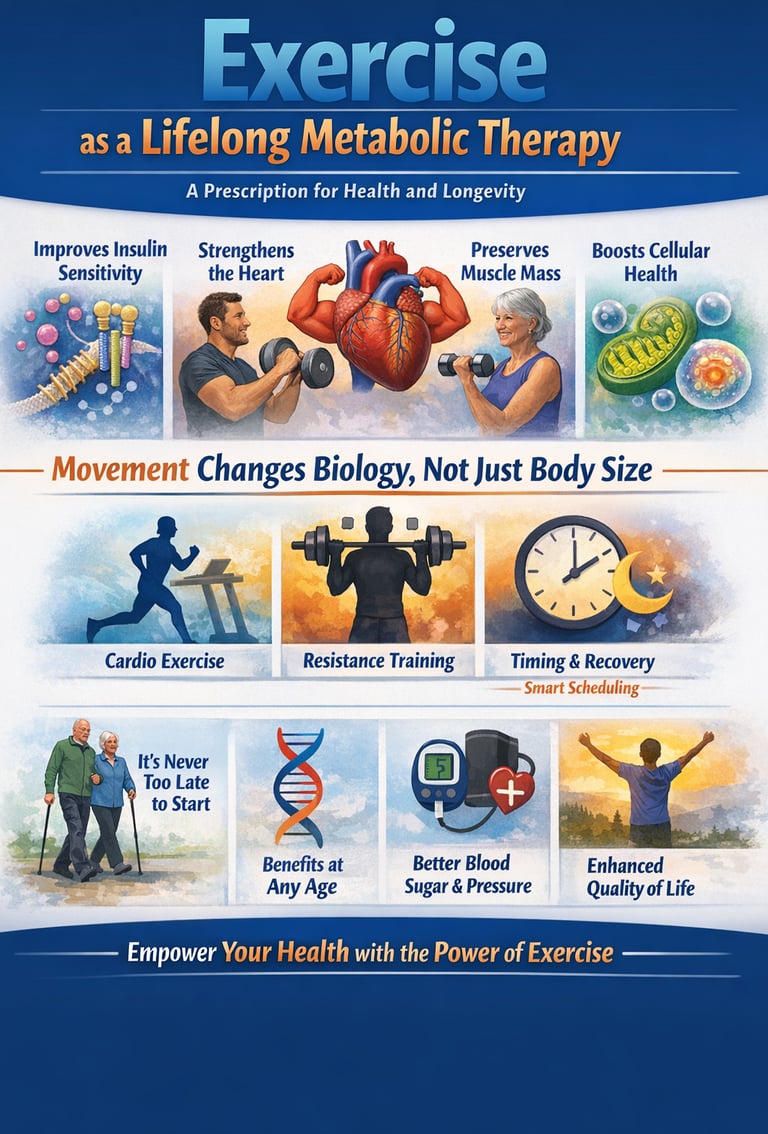
Most people believe exercise works because it “burns calories.” While that idea is not wrong, it barely scratches the surface of what movement actually does inside the human body. Modern medical science now shows that exercise behaves less like a lifestyle choice and more like a powerful biological therapy—one that directly reprograms how your cells handle sugar, fat, and energy.
When you move your body, you are not just strengthening muscles or improving stamina. You are activating molecular pathways that improve insulin sensitivity, reduce chronic inflammation, repair damaged mitochondria, and even remodel the heart itself. These changes occur whether or not significant weight loss happens—and that is why exercise benefits people with diabetes, metabolic syndrome, heart disease, and aging-related decline even when the scale refuses to budge.
Over the past decade, and especially between 2023 and 2025, high-quality research has fundamentally changed how clinicians view physical activity. Exercise is now recognized as a first-line intervention capable of improving blood sugar control, lowering cardiovascular risk, preserving muscle mass, and extending “healthspan”—the years of life lived with strength, independence, and clarity.
This article translates that science into practical understanding. It explains how exercise works at a cellular level, why the type and timing of movement matter, and how even modest, consistent activity can produce profound metabolic benefits. Most importantly, it shows why it is never too late for your body to respond—and why movement remains one of the most powerful medicines you already possess.
Clinical pearls
1. Muscle is Your "Metabolic Sink"
Think of your muscles as a storage tank for blood sugar. Research confirms that resistance training increases the number of glucose transporters (GLUT4) on your cell surfaces. This means that even while you are resting, a body with more lean muscle is more efficient at "vacuuming" sugar out of your bloodstream, reducing the workload on your pancreas.
Clinical Tip: You don't need to bulk up; even a 5% increase in muscle quality significantly improves insulin sensitivity.
2. The "After-Dinner Walk" is a Glucose Buffer
Timing matters. When you move immediately after a meal, your muscles use the incoming glucose for energy before your body has to spike insulin to deal with it. This blunts the "glucose spike" that causes inflammation and damages blood vessels.
Clinical Tip: A simple 10-to-15-minute brisk walk within 30 minutes of your largest meal can be as effective as some first-line glucose-lowering medications.
3. Cardiac Remodeling is Cumulative
Aerobic exercise is not just about burning fat; it’s about "remodeling" the pump. Long-term consistency leads to an increase in left ventricular volume and better heart rate variability (HRV). This makes your heart more resilient to stress and more efficient at delivering oxygen, which directly lowers your resting heart rate.
Clinical Tip: Focus on "Zone 2" training—exercise where you can still hold a conversation. It builds the aerobic base required for these structural heart changes without overstressing the system.
4. Metabolic Flexibility: The Ability to Switch Fuels
Healthy metabolism is like a hybrid engine that can switch between burning carbohydrates and fats seamlessly. Chronic inactivity often locks the body into "sugar-burning mode." Regular exercise, especially when combined with strategic energy restriction, retrains your mitochondria to burn fat efficiently during low-intensity activities and sleep.
Clinical Tip: Vary your intensity. Low-intensity walks teach your body to burn fat, while high-intensity bursts improve your body's ability to handle carbohydrates.
5. "Healthspan" vs. "Lifespan"
Modern medicine is excellent at keeping people alive (lifespan), but exercise is the primary tool for keeping people functional (healthspan). The synergy between movement and cellular "cleanup" processes like autophagy (as noted in 2025 research) means that exercise acts as an anti-aging therapy at the DNA level, preserving cognitive function and mobility.
Clinical Tip: Think of exercise as "pension for your body." The strength you build today is the independence you enjoy at age 80.
The Complete Guide to Exercise and Metabolic Health: What Science Says
Understanding Exercise Metabolism:
Hawley and Hoffman's recent review in Nature Reviews Endocrinology provides a remarkable perspective on human exercise metabolism research over the past two decades. Their work highlights how our understanding of metabolic adaptation and exercise physiology has evolved tremendously (Hawley & Hoffman, 2025).
The authors emphasize that 20 years of progress in human exercise metabolism research has fundamentally changed how we approach fitness and health. Rather than viewing exercise as a simple "calories in, calories out" equation, modern research reveals that exercise creates complex metabolic changes that extend far beyond immediate energy expenditure. These changes include improved insulin sensitivity, enhanced mitochondrial function, and better metabolic flexibility—the ability to switch between burning fat and carbohydrates efficiently. This foundational understanding sets the stage for understanding why the timing and type of exercise matter so much for long-term health outcomes.
Does Timing Matter? The Case for Strategic Exercise
One of the most practical questions people ask is: "Does it matter when I exercise?" Bennett and Sato (2023) tackle this question head-on in their research published in Frontiers in Endocrinology.
Their study reveals that exercise timing does indeed influence metabolic benefits ). The timing of your workout in relation to meals, sleep cycles, and daily circadian rhythms can significantly impact how effectively your body utilizes exercise for metabolic improvement.
What this means for you: If you're trying to optimize metabolic health through exercise, the timing isn't arbitrary. Exercising during your natural energy peaks, avoiding intense workouts immediately before sleep, and considering your meal timing relative to training sessions can all enhance the metabolic adaptations your body experiences. This research supports the increasingly popular idea that exercise optimisation isn't just about frequency and intensity—it's also about when you move your body.
Energy Restriction, Exercise, and Living Longer: The Healthspan Connection
While exercise is powerful, combining it with strategic dietary energy restriction may unlock even greater benefits. Cagigas et al. (2025) explore this intersection in their groundbreaking review published in Trends in Endocrinology and Metabolism.
This comprehensive review examines how dietary energy restriction, pharmacological interventions, and exercise work synergistically for healthspan extension . Healthspan—the number of years you live in good health—may be more important than simple lifespan. The research suggests that caloric restriction combined with regular exercise activates cellular mechanisms like autophagy and mitochondrial renewal that promote longevity.
What this means for you: If your goal is not just to live longer but to live better, this research indicates that combining exercise programs with periods of caloric restriction could be more effective than either intervention alone. This doesn't mean extreme dieting; rather, it suggests that strategic periods of energy deficit paired with consistent physical activity may optimize your health trajectory.
Physical Exercise and Metabolic Syndrome: The Meta-Analysis Evidence
One of the most exciting recent studies comes from Galván and colleagues (2025), who conducted a comprehensive systematic review with meta-analysis examining the effectiveness of physical exercise on metabolic syndrome indicators.
Key Takeaway from Galván et al. (2025)
Published in the Journal of Functional Morphology and Kinesiology, this meta-analysis synthesizes data from numerous clinical trials to demonstrate that physical exercise significantly improves metabolic syndrome markers in adults (Galván et al., 2025). Metabolic syndrome—a cluster of conditions including high blood pressure, elevated blood sugar, excess body fat, and abnormal cholesterol levels—affects millions globally. The evidence overwhelmingly shows that exercise interventions reduce the prevalence and severity of these interconnected conditions.
What this means for you: If you've been told you have metabolic syndrome or pre-diabetic risk factors, understand this: the science is clear that consistent physical activity can reverse these trends. You don't need surgery, extreme diets, or medications as a first line of defense. Regular structured exercise has been proven in multiple high-quality trials to improve blood pressure, glucose control, lipid profiles, and body composition.
The Heart of the Matter: How Exercise Reshapes Your Cardiovascular System
Beyond metabolism lies another crucial system: your heart. Van Ochten et al. (2025) provide fascinating insights into what happens to your cardiovascular system when you exercise regularly.
Their research on "The Structural and Functional Aspects of Exercise-Induced Cardiac Remodeling" reveals that exercise doesn't just improve your fitness—it actually changes your heart's structure Published in Annals of Medicine, this work demonstrates that aerobic exercise triggers beneficial cardiac remodeling, where your heart becomes more efficient, stronger, and more resilient.
What this means for you: When you commit to a consistent exercise program, you're literally building a better heart. Your cardiac output increases, your heart rate variability improves, and your heart becomes more efficient at pumping blood. This translates to better cardiovascular outcomes, reduced risk of heart disease, and improved overall longevity. The changes aren't just functional—they're structural, meaning your heart is being remodeled at the cellular level to function optimally.
Resistance Training for Older Adults with Diabetes: A Powerful Combination
Finally, let's focus on a population that often feels left behind in fitness discussions: older adults managing type 2 diabetes. Feng et al. (2025)
provide compelling evidence about resistance exercise training efficacy.in these patients
Their systematic review and meta-analysis, published in Diabetes Research and Clinical Practice, examines "The Efficacy of Resistance Exercise Training on Metabolic Health, Body Composition, and Muscle Strength in Older Adults with Type 2 Diabetes" The findings are remarkable: resistance training simultaneously improves metabolic health, enhances body composition, and increases muscle strength in this vulnerable population.
What this means for you: If you're over 50 and managing diabetes, resistance training deserves your serious attention. Unlike some fitness trends that come and go, strength training has robust evidence supporting its benefits for blood sugar control, lean muscle maintenance, and metabolic rate. The combination of resistance exercise with aerobic activity creates a comprehensive metabolic intervention that can significantly improve your quality of life and health outcomes.
Synthesizing the Research: A Practical Framework
Now that we've explored each study individually, let's synthesize what they're collectively telling us about optimizing exercise for metabolic health.
The Metabolic Exercise Hierarchy
Consistency matters more than perfection. Across all these studies, the most consistent finding is that regular physical activity creates metabolic benefits. This doesn't require elite athleticism.
Multi-modal exercise is optimal. Combining aerobic exercise with resistance training addresses the full spectrum of metabolic benefits, from cardiovascular health to muscle metabolism.
Timing and context enhance results. As Bennett and Sato (2023) found, the when and how of exercise amplifies benefits.
Exercise works across the lifespan. Whether you're 25 or 75, dealing with metabolic syndrome or optimizing health, exercise interventions are evidence-based and effective.
Synergistic approaches work best. Combining physical activity with strategic dietary patterns (as Cagigas et al. suggest) appears to maximize healthspan extension.
Frequently Asked Questions About Exercise and Metabolic Health
Q: How much exercise do I need to see metabolic benefits?
Based on the research, most studies show significant benefits with 150 minutes of moderate-intensity aerobic exercise per week, combined with 2-3 sessions of resistance training. However, some benefits appear at lower volumes, so consistency matters more than perfection.
Q: Is it too late to start exercising if I'm older?
Absolutely not. Feng et al. (2025) specifically studied older adults with type 2 diabetes and found substantial benefits from resistance training. Your body responds to exercise at any age, though recovery may require more attention.
Q: Should I exercise before or after eating?
According to Bennett and Sato (2023), the timing relative to meals does matter for optimizing metabolic adaptation. Generally, exercising in a fasted state or 2-3 hours after eating can enhance certain fat metabolism benefits, but consistency with your preferred timing matters more than finding the "perfect" window.
Q: Can exercise alone treat metabolic syndrome?
The research shows that physical activity is highly effective for metabolic syndrome management, but combining it with dietary approaches (as Cagigas et al. describe) appears to offer superior results. Talk to your healthcare provider about whether medication is needed alongside your exercise program.
Q: What type of exercise is best for metabolic health?
The research strongly supports a combination approach: aerobic training for cardiovascular health and metabolic flexibility, plus resistance training for muscle metabolism and body composition. Neither type is superior alone—they're complementary.
Q: How long does it take to see metabolic improvements?
Some metabolic adaptations begin within weeks, but substantial body composition changes and cardiovascular remodeling typically require 12+ weeks of consistent effort. Patience and consistency are your greatest assets.
Key Takeaways: What 2025 Research Tells Us
Exercise metabolism is far more complex and powerful than simple calorie burning—it involves cellular, hormonal, and structural adaptations across your entire body
Exercise timing matters for optimizing metabolic benefits, making strategic scheduling part of an effective exercise program
Combined interventions—exercise plus dietary approaches—appear to offer superior healthspan benefits compared to exercise alone
Physical activity effectively reduces metabolic syndrome markers across diverse populations
Exercise causes beneficial structural changes in your heart, making cardiovascular remodeling one of the most important (and underappreciated) benefits
Resistance training is particularly valuable for older adults managing chronic conditions like type 2 diabetes
Making It Real: Your Action Plan
Understanding the science is one thing; implementing it is another. Here's how to put this research into practice:
Start where you are. You don't need a fancy gym or elaborate plan. Begin with 20-30 minutes of walking three times weekly, adding simple bodyweight resistance exercises. Progress from there.
Embrace consistency over intensity. The research across all these studies shows that regular exercise matters far more than occasional intense sessions. A sustainable exercise routine beats a sporadic heroic effort.
Consider your timing. Pay attention to when you exercise relative to meals, sleep, and your daily energy patterns. Small optimization here can amplify results.
Combine modalities. Don't choose between cardiovascular exercise and strength training—do both. Your body benefits from multiple forms of stimulus.
Track your progress. Whether it's energy levels, how your clothes fit, or formal metabolic markers, monitoring helps you see the benefits and stay motivated.
Conclusion: Exercise as a Lifelong Metabolic Therapy
The science is now clear: exercise is far more than a lifestyle choice—it is one of the most powerful therapies available for protecting metabolic and cardiovascular health. Research from recent years shows that regular physical activity improves insulin sensitivity, lowers cardiometabolic risk, strengthens the heart, preserves muscle mass, and activates cellular pathways linked to healthy aging. These benefits occur not only in young, healthy individuals but also in people living with diabetes, metabolic syndrome, and age-related metabolic decline.
Importantly, exercise works through mechanisms that go beyond weight loss. It improves how muscles use glucose, enhances mitochondrial function, reduces chronic inflammation, and remodels the heart in ways that improve efficiency and resilience. This helps explain why people who exercise regularly often experience better health outcomes even when the scale does not change dramatically. Movement changes biology, not just body size.
The evidence also shows that no single “perfect” exercise exists. The greatest benefits come from consistency and variety—combining aerobic activity to support cardiovascular and metabolic health with resistance training to maintain muscle strength, metabolic rate, and functional independence. Thoughtful timing, adequate recovery, and alignment with daily routines can further enhance these adaptations.
Perhaps most reassuring is this: it is never too late to begin. The body retains a remarkable ability to adapt at any age. Even modest, regular physical activity can lead to meaningful improvements in blood sugar control, blood pressure, energy levels, and quality of life.
In a world of complex medical treatments, exercise remains a simple, evidence-based intervention—one that empowers individuals to actively shape their long-term health, mobility, and independence.
Medical Disclaimer
The information in this article, including the research findings is for educational purposes only and does not constitute medical advice, diagnosis, or treatment. Before starting any new exercise program, you must consult with a qualified healthcare professional, especially if you have existing health conditions (such as cardiovascular disease, uncontrolled hypertension, or advanced metabolic disease). Exercise carries inherent risks, and you assume full responsibility for your actions. This article does not establish a doctor-patient relationship.
Related Articles
Post-Meal Exercise: The Simple Habit That Can Flatten Blood Sugar Spikes Naturally
One Diet Lowers Triglycerides. Another May Lower LDL. Here's What New Research Reveals.
Reversing Type 2 Diabetes: Skeletal Muscle as a Master Regulator of Metabolic Health | DR T S DIDWAL
How to Build a Disease-Proof Body: Master Calories, Exercise & Longevity | DR T S DIDWAL
Lower Blood Pressure Naturally: Evidence-Based Exercise Guide for Metabolic Syndrome | DR T S DIDWAL
Exercise vs. Diet Alone: Which is Best for Body Composition? | DR T S DIDWAL
Cardiorespiratory Fitness: The Most Important Predictor of Health and Longevity You Can Improve
Movement Snacks: How VILPA Delivers Max Health Benefits in Minutes | DR T S DIDWAL
Metabolic Health: Why Your Sleep Schedule Is Key to Fat Loss | DR T S DIDWAL
The Metabolic Triad: Why Diabetes, Obesity & CVD Are One Epidemic | DR T S DIDWAL
Breakthrough Research: Leptin Reduction is Required for Sustained Weight Loss | DR T S DIDWAL
HIIT Benefits: Evidence for Weight Loss, Heart Health, & Mental Well-Being | DR T S DIDWAL
References
Bennett, S., & Sato, S. (2023). Enhancing the metabolic benefits of exercise: Is timing the key? Frontiers in Endocrinology, 14, 987208. https://doi.org/10.3389/fendo.2023.987208
Cagigas, M. L., De Ciutiis, I., Masedunskas, A., & Fontana, L. (2025). Dietary and pharmacological energy restriction and exercise for healthspan extension. Trends in Endocrinology and Metabolism: TEM, 36(6), 521–545. https://doi.org/10.1016/j.tem.2025.04.001
Feng, M., Gu, L., Zeng, Y., Gao, W., Cai, C., Chen, Y., & Guo, X. (2025). The efficacy of resistance exercise training on metabolic health, body composition, and muscle strength in older adults with type 2 diabetes: A systematic review and meta-analysis. Diabetes Research and Clinical Practice, 222, 112079. https://doi.org/10.1016/j.diabres.2025.112079
Galván, B., Enriquez del Castillo, L. A., Flores, L. A., Quintana-Mendias, E., Torres-Rojo, F. I., Villegas-Balderrama, C. V., & Cervantes-Hernández, N. (2025). Effectiveness of physical exercise on indicators of metabolic syndrome in adults: A systematic review with meta-analysis of clinical trials. Journal of Functional Morphology and Kinesiology, 10(3), 244. https://doi.org/10.3390/jfmk10030244
Hawley, J. A., & Hoffman, N. J. (2025). Twenty years of progress in human exercise metabolism research. Nature Reviews Endocrinology, 21, 658–659. https://doi.org/10.1038/s41574-025-01181-1
Van Ochten, N. A., Suckow, E., Forbes, L., & Cornwell, W. K. (2025). The structural and functional aspects of exercise-induced cardiac remodeling and the impact of exercise on cardiovascular outcomes. Annals of Medicine, 57(1). https://doi.org/10.1080/07853890.2025.2499959