Lower Blood Pressure Naturally: Evidence-Based Exercise Guide for Metabolic Syndrome
Uncover the science: Learn how resistance, aerobic, and even isometric training lowers blood pressure in metabolic syndrome. A guide to enhanced endothelial function and heart health.
HEARTEXERCISE
Dr. T.S. Didwal, M.D.
5/12/202611 min read
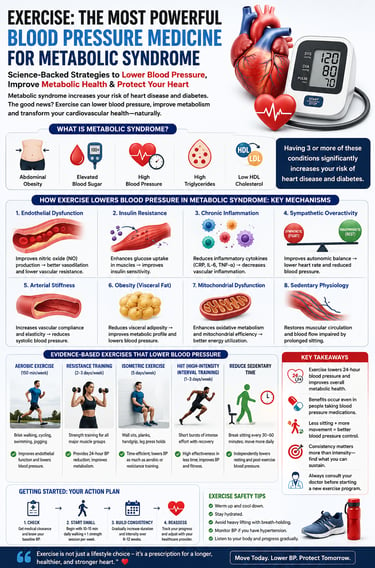
Metabolic syndrome has emerged as one of the defining cardiovascular threats of modern medicine. Characterized by central obesity, insulin resistance, elevated blood pressure, dyslipidemia, and chronic low-grade inflammation, this cardiometabolic disorder dramatically increases the risk of coronary artery disease, stroke, heart failure, chronic kidney disease, and Type 2 diabetes. Yet despite the widespread use of antihypertensive medications, statins, and glucose-lowering therapies, cardiovascular risk often remains stubbornly elevated.
Increasingly, evidence suggests that one intervention directly targets the root physiology driving metabolic syndrome: exercise.
Exercise is no longer viewed merely as a lifestyle recommendation or adjunctive wellness strategy. It is now recognized as a biologically potent therapy capable of remodeling vascular function, restoring endothelial health, improving insulin sensitivity, reducing sympathetic overactivity, and lowering blood pressure at a magnitude comparable to first-line antihypertensive medications.
For patients with metabolic syndrome, the relationship between exercise and blood pressure reduction is especially compelling. Modern studies demonstrate that aerobic training, resistance exercise, isometric contractions, sedentary-behavior interruption, and even mind-body movement therapies can significantly reduce both office and ambulatory blood pressure while improving broader cardiometabolic health.
The science is now clear: movement is medicine—and for hypertension in metabolic syndrome, it may be among the most effective medicines available.
Understanding Metabolic Syndrome and Hypertension
Metabolic syndrome is not a single disease but a cluster of interrelated metabolic abnormalities. Clinical diagnosis generally requires at least three of the following:
Abdominal obesity
Elevated fasting glucose
Elevated triglycerides
Low HDL cholesterol
Hypertension
At the center of this syndrome lies insulin resistance, chronic inflammation, oxidative stress, endothelial dysfunction, and autonomic nervous system imbalance.
Hypertension within metabolic syndrome is particularly dangerous because it develops in a biologically hostile environment. Elevated insulin levels stimulate sympathetic nervous system activity, sodium retention, and vascular smooth muscle proliferation. Simultaneously, inflammation and oxidative stress impair nitric oxide production, stiffen arteries, and reduce vascular compliance.
The result is persistent elevation of systemic vascular resistance and progressive cardiovascular damage. Importantly, these pathophysiologic mechanisms are highly responsive to physical activity.
The Endothelium: Where Exercise Begins to Heal Blood Vessels
One of the most important discoveries in preventive cardiology is the role of the vascular endothelium in blood pressure regulation.
The endothelium is the thin cellular lining inside arteries that controls vascular tone, blood flow, thrombosis, inflammation, and nitric oxide synthesis. In metabolic syndrome, endothelial function becomes severely impaired.
Reduced nitric oxide bioavailability leads to:
Vasoconstriction
Increased arterial stiffness
Elevated peripheral resistance
Impaired blood flow
Increased blood pressure variability
Exercise directly counteracts this process.
Repeated bouts of physical activity increase “shear stress” against arterial walls, stimulating endothelial nitric oxide synthase (eNOS) activity and nitric oxide production. Nitric oxide is a powerful vasodilator that relaxes blood vessels and lowers blood pressure.
Gkaliagkousi and colleagues demonstrated that exercise-induced benefits in metabolic syndrome are mechanistically tied to restoration of endothelial function, reduced oxidative stress, and improved vascular reactivity (Gkaliagkousi et al., 2018).
This is one reason exercise affects cardiovascular risk far beyond calorie expenditure.
Aerobic Exercise: The Foundation of Blood Pressure Reduction
Aerobic exercise remains the cornerstone of exercise prescription for hypertension and metabolic syndrome.
Walking, cycling, swimming, jogging, rowing, and other endurance-based activities consistently reduce systolic and diastolic blood pressure across multiple patient populations.
A major 2026 review in the Journal of Hypertension concluded that moderate-intensity aerobic exercise performed 3–5 times weekly reduced office and ambulatory blood pressure by approximately 5–12 mmHg in resistant hypertension patients (Lopes et al., 2026).
That degree of reduction is clinically meaningful.
Epidemiologic data suggest that every 10 mmHg reduction in systolic blood pressure substantially lowers the risk of stroke, myocardial infarction, heart failure, and cardiovascular mortality.
Aerobic exercise lowers blood pressure through several integrated mechanisms:
Improved endothelial nitric oxide release
Reduced sympathetic nervous system activation
Enhanced insulin sensitivity
Reduced visceral adiposity
Lower systemic inflammation
Improved mitochondrial efficiency
Reduced arterial stiffness
Importantly, these physiologic adaptations occur even without dramatic weight loss.
This challenges the outdated notion that exercise only matters if substantial body fat reduction occurs. In reality, vascular and metabolic improvements often begin long before visible body composition changes.
Resistance Training: A Powerful Antihypertensive Therapy
For decades, resistance training was viewed cautiously in hypertensive individuals because blood pressure transiently rises during heavy lifting. However, modern research has fundamentally changed this perspective.
Resistance training is now considered a primary antihypertensive modality.
In a landmark study, Tibana and colleagues demonstrated that resistance training significantly reduced 24-hour ambulatory blood pressure in women with metabolic syndrome (Tibana et al., 2013).
This finding was especially important because ambulatory blood pressure monitoring captures real-world cardiovascular physiology more accurately than isolated office readings.
The blood pressure reductions persisted throughout the day and night, suggesting durable vascular and autonomic adaptations rather than temporary post-exercise effects.
Resistance training improves hypertension through multiple pathways:
Increased skeletal muscle mass improves glucose disposal
Enhanced insulin sensitivity reduces hyperinsulinemia
Improved endothelial function enhances vasodilation
Reduced visceral adiposity lowers the inflammatory burden
Increased muscular fitness improves autonomic balance
Strength training also counteracts sarcopenia and metabolic slowing associated with aging and menopause.
Cardoso et al. (2014) specifically examined menopausal women with metabolic syndrome and found significant reductions in blood pressure following resistance training interventions. This is clinically important because postmenopausal women often experience accelerated cardiometabolic deterioration due to declining estrogen levels.
Current evidence supports resistance training 2–3 times weekly using moderate loads, controlled breathing, and multi-joint movements targeting major muscle groups.
Sedentary Behavior: The Hidden Driver of Hypertension
One of the most important modern insights in cardiometabolic medicine is that prolonged sitting is itself an independent cardiovascular risk factor.
A person can technically meet exercise guidelines yet still experience harmful physiologic effects from excessive sedentary time.
Norha and colleagues explored this concept in a 2024 randomized controlled trial involving inactive adults with metabolic syndrome (Norha et al., 2024).
The researchers found that simply reducing sedentary behavior improved:
Resting blood pressure
Exercise blood pressure responses
Post-exercise blood pressure recovery
Even without formal structured exercise programs, interrupting prolonged sitting produced measurable cardiovascular benefits.
This finding highlights the importance of non-exercise activity thermogenesis (NEAT)—the energy expenditure associated with daily movement outside structured workouts.
From a physiologic standpoint, prolonged sitting reduces skeletal muscle contraction, impairs glucose uptake, decreases lipoprotein lipase activity, worsens endothelial function, and promotes vascular dysfunction.
Small movement interruptions restore circulation, improve glucose handling, and reduce vascular stress.
Practical applications include:
Standing every 30–60 minutes
Short walking breaks
Stair climbing
Light mobility drills
Desk-based movement sessions
For metabolically compromised individuals, reducing sitting time may represent one of the simplest and most accessible cardiovascular interventions available.
Isometric Exercise: The Emerging Frontier in Hypertension Therapy
One of the most intriguing developments in exercise science is the rise of isometric training for blood pressure control.
Isometric exercise involves sustained muscular contractions without joint movement. Examples include:
Wall sits
Handgrip contractions
Planks
Static lunges
Historically overlooked, isometric training is now supported by increasingly robust evidence.
Edwards et al. (2024) concluded that isometric exercise training produces blood pressure reductions comparable to aerobic and resistance exercise interventions.
Remarkably, these effects often occur with relatively short training sessions.
Lin et al. (2024) further demonstrated that exercise intensity, contraction duration, and muscle mass involvement all influence hemodynamic and blood pressure responses.
Several mechanisms likely explain these effects:
Improved endothelial nitric oxide signaling
Enhanced local vascular responsiveness
Reduced sympathetic activity
Improved autonomic regulation
Increased vascular compliance
Because isometric exercise requires minimal equipment and little time, it may be particularly valuable for:
Older adults
Busy professionals
Individuals with orthopedic limitations
Patients with severe obesity
Deconditioned individuals
This represents an important evolution in precision exercise prescription.
High-Intensity Interval Training and Metabolic Syndrome
High-intensity interval training (HIIT) has gained enormous popularity because of its efficiency and powerful metabolic effects.
HIIT alternates short periods of vigorous activity with recovery intervals. Despite shorter workout durations, HIIT often produces physiologic adaptations comparable to much longer endurance sessions.
In metabolic syndrome, HIIT improves:
VO₂ max
Insulin sensitivity
Mitochondrial function
Endothelial function
Blood pressure regulation
Ramirez-Jimenez et al. (2018) demonstrated that intense aerobic exercise significantly lowered blood pressure in metabolic syndrome patients already taking antihypertensive medications.
Importantly, exercise effects were additive to pharmacologic therapy.
This finding has major clinical implications. Exercise should not be viewed as an alternative to medication but rather as a synergistic therapy that enhances cardiovascular control beyond pharmacologic treatment alone.
Nonetheless, HIIT should be introduced carefully in high-risk individuals and ideally under medical supervision when significant cardiovascular disease is present.
Personalized Exercise Prescriptions: The Future of Hypertension Care
Not all patients respond identically to exercise.
Genetics, baseline fitness, metabolic flexibility, autonomic function, age, inflammation, mitochondrial health, and body composition all influence training responsiveness.
A 2025 randomized controlled trial by Liu et al. found that individualized cardiopulmonary endurance training produced greater improvements in blood pressure and metabolic parameters compared with standardized exercise prescriptions (Liu et al., 2025).
This supports a growing movement toward precision lifestyle medicine.
Future hypertension management will likely involve increasingly personalized exercise protocols tailored to:
Fitness capacity
Insulin resistance severity
Blood pressure variability
Autonomic status
Body composition
Cardiovascular risk profile
Exercise medicine is evolving beyond generic recommendations into highly individualized cardiometabolic therapeutics.
Mind-Body Exercise and Blood Pressure Regulation
Traditional mind-body movement systems are also gaining scientific credibility.
The 2026 BLESS trial published in the Journal of the American College of Cardiology examined Baduanjin, a traditional Chinese exercise combining controlled movement, breathing, and meditation.
Participants practicing Baduanjin approximately five days weekly experienced significant reductions in 24-hour ambulatory systolic blood pressure compared with self-directed exercise controls (Pu et al., 2026).
Importantly, benefits persisted for an entire year.
Mind-body practices may lower blood pressure through combined effects on:
Autonomic nervous system balance
Stress hormone regulation
Vascular function
Respiratory efficiency
Parasympathetic activation
This highlights an important clinical reality: exercise intensity is not the sole determinant of cardiovascular benefit.
Consistency, adherence, nervous system regulation, and stress reduction also matter profoundly.
Resistant Hypertension: Can Exercise Work When Medications Fail?
Resistant hypertension remains one of the greatest challenges in cardiovascular medicine.
These patients often remain hypertensive despite multiple medications and carry extremely high cardiovascular risk.
Emerging evidence suggests exercise remains highly effective even in this difficult population.
Lopes et al. (2026) concluded that combined aerobic and resistance exercise improves:
Endothelial function
Arterial stiffness
Sympathetic overactivity
Cardiorespiratory fitness
Ambulatory blood pressure
Notably, benefits were observed even in older adults and individuals with multiple comorbidities.
This reinforces the concept that exercise directly targets the biologic mechanisms driving resistant hypertension.
The Clinical Reality: Exercise Works Like a Multisystem Drug
Modern cardiovascular medicine increasingly recognises exercise as a true pharmacologic intervention.
Unlike single-target medications, exercise simultaneously influences nearly every pathophysiologic driver of metabolic syndrome:
How Exercise Targets the Root Causes of Metabolic Syndrome and Hypertension
Improves Endothelial Dysfunction:
Exercise enhances nitric oxide production, helping blood vessels relax and improving vascular function.Reduces Insulin Resistance:
Physical activity increases glucose uptake into muscles, improving insulin sensitivity and metabolic control.Lowers Chronic Inflammation:
Regular exercise decreases inflammatory cytokines and systemic inflammatory burden associated with cardiometabolic disease.Balances Sympathetic Nervous System Activity:
Exercise reduces chronic “fight-or-flight” overactivity while improving parasympathetic (“rest-and-digest”) tone.Decreases Arterial Stiffness:
Physical training improves vascular elasticity and increases arterial compliance, lowering blood pressure load.Reduces Visceral and Abdominal Obesity:
Exercise helps decrease metabolically harmful visceral fat linked to hypertension and insulin resistance.Enhances Mitochondrial Function:
Training improves oxidative metabolism and mitochondrial efficiency, supporting better energy utilization.Counteracts Sedentary Physiology:
Frequent movement restores muscular blood flow and circulation impaired by prolonged sitting.
Few interventions in medicine possess such broad therapeutic reach.
Practical Exercise Prescription for Metabolic Syndrome
For most patients, a sustainable, evidence-based exercise strategy includes:
Aerobic Training
150 minutes/week moderate-intensity activity
Brisk walking, cycling, swimming, rowing
Ideally spread across most days
Resistance Training
2–3 sessions weekly
Multi-joint exercises
Moderate loads with controlled breathing
Sedentary Interruption
Move every 30–60 minutes
Walking or light mobility breaks
Isometric Training
Handgrip contractions
Wall sits
Planks
3–5 sessions weekly
Flexibility and Recovery
Stretching
Yoga
Tai Chi
Sleep optimization
Consistency matters more than perfection.
Long-term adherence—not short-term intensity—drives lasting vascular adaptation.
Key Clinical Takeaways
Exercise lowers blood pressure through endothelial restoration, nitric oxide signaling, autonomic regulation, and improved insulin sensitivity.
Aerobic exercise consistently reduces systolic and diastolic blood pressure in metabolic syndrome and resistant hypertension.
Resistance training produces sustained 24-hour ambulatory blood pressure reductions.
Reducing sedentary behavior independently improves vascular health and blood pressure regulation.
Isometric exercise offers a highly time-efficient antihypertensive strategy.
Exercise benefits are additive to antihypertensive medications.
Personalized exercise prescriptions may optimize cardiometabolic outcomes.
Mind-body exercise therapies such as Baduanjin can significantly improve ambulatory blood pressure.
Exercise directly targets the root biology driving hypertension in metabolic syndrome.
Conclusion
The evidence is overwhelming: exercise is one of the most powerful interventions available for hypertension in metabolic syndrome.
Far beyond simple calorie burning, physical activity acts as a systems-level therapy that restores endothelial function, improves nitric oxide bioavailability, reduces inflammation, enhances insulin sensitivity, lowers sympathetic nervous system activation, and reverses vascular dysfunction.
Aerobic exercise, resistance training, sedentary-behavior interruption, isometric exercise, HIIT, and mind-body movement therapies all demonstrate clinically meaningful reductions in blood pressure. Importantly, these benefits occur even in individuals already receiving antihypertensive medications and even among patients with resistant hypertension.
The future of cardiovascular medicine increasingly points toward integrated lifestyle therapeutics in which exercise serves not merely as prevention, but as foundational treatment.
For patients with metabolic syndrome, movement is not optional adjunctive advice—it is a central therapeutic strategy capable of transforming vascular biology and dramatically reducing long-term cardiovascular risk.
Frequently Asked Questions
Q: How quickly will my blood pressure improve with exercise? A: Initial improvements in blood pressure regulation can occur within 2-4 weeks, with more substantial reductions typically appearing after 8-12 weeks of consistent physical activity. However, individual responses vary based on baseline fitness, severity of hypertension, genetics, and adherence.
Q: Can exercise replace my blood pressure medications? A: Never discontinue medications without medical supervision. However, many individuals achieve sufficient blood pressure reduction through exercise training that medication doses can be reduced or, occasionally, eliminated under careful medical monitoring. Always work with your physician on medication adjustments.
Q: Which exercise type is best for blood pressure? A: Research supports all types—aerobic exercise, resistance training, and isometric exercise all produce blood pressure reductions. The "best" exercise is the one you'll do consistently. Combining multiple modalities maximizes benefits.
Q: I have severe joint problems. Can I still benefit from exercise? A: Absolutely. Isometric exercise and aquatic aerobic exercise (which reduces joint stress) are excellent options. Even brief, light activity scattered throughout the day improves blood pressure according to Norha et al. (2024).
Q: How much exercise do I need? A: Guidelines recommend 150 minutes of moderate-intensity aerobic activity or 75 minutes of vigorous-intensity exercise weekly, plus strength training 2-3 times per week. However, Norha et al. (2024) demonstrated that even reducing sedentary time without meeting these targets produces benefits.
Q: Will my blood pressure increase during exercise? A: Yes—this is normal and healthy. Blood pressure rises during physical activity to increase oxygen delivery to working muscles. However, the magnitude of increase and rate of return to baseline improves with training. Discuss appropriate target heart rates and blood pressure responses with your healthcare provider.
Q: Can exercise help if I'm already on maximum medication doses? A: Yes. Ramirez-Jimenez et al. (2018) found that even individuals on antihypertensive medications experienced further blood pressure reductions with aerobic exercise, demonstrating additive benefits.
Disclaimer: This article is for informational purposes only and does not constitute medical advice. Individual circumstances vary, and treatment decisions should always be made in consultation with qualified healthcare professionals.
Related Articles
The BMI Paradox: Why "Normal Weight" People Still Get High Blood Pressure | DR T S DIDWAL
How Insulin Resistance Accelerates Cardiovascular Aging | DR T S DIDWAL
Omega-3 (EPA/DHA): Complete Guide to Heart Health & Disease Prevention | DR T S DIDWAL
Sleep & Hypertension: Duration, Quality, and Blood Pressure | DR T S DIDWAL
References
Pu, B., Zhang, L., Sun, Y., Yu, Y., Yan, L., Li, Y., Liu, J., Zheng, X., Zhang, H., Peng, Y., Wang, Y., Zhao, Y., Ma, X., Guo, L., Wang, Z., Li, G., Wang, Z., Liu, P., Yang, Y., . . . Li, J. (2026). Effect of Baduanjin on blood pressure among individuals with high-normal blood pressure. Journal of the American College of Cardiology (JACC), 87(12), 1436. https://doi.org/10.1016/j.jacc.2026.01.014
Caminiti, G., & Perrone, M. A. (2026). Editorial: Exploring the role of exercise in hypertension and blood pressure variability. Frontiers in Cardiovascular Medicine, 13, Article 1836245. https://doi.org/10.3389/fcvm.2026.1836245
Lopes, J., Dalton-Alves, F., Lopes, S., Costa, E. C., & Ribeiro, F. (2026). The impact of exercise on resistant hypertension: What do we know in 2025? Journal of Hypertension, 44(4), 533–541. https://doi.org/10.1097/HJH.0000000000004242
Cardoso, G. A., Silva, A. S., de Souza, A. A., Dos Santos, M. A., da Silva, R. S., de Lacerda, L. M., & Mota, M. P. (2014). Influence of resistance training on blood pressure in patients with metabolic syndrome and menopause. Journal of Human Kinetics, 43, 87–95. https://doi.org/10.2478/hukin-2014-0093
Edwards, J. J., Coleman, D. A., Ritti-Dias, R. M., & et al. (2024). Isometric exercise training and arterial hypertension: An updated review. Sports Medicine, 54, 1459–1497. https://doi.org/10.1007/s40279-024-02036-x
Gkaliagkousi, E., Gavriilaki, E., & Douma, S. (2018). Exercise-induced benefits in metabolic syndrome. Journal of Clinical Hypertension, 20(1), 19–21. https://doi.org/10.1111/jch.13124
Lin, S., Sun, P., Huang, L., Hernandez, M., Yu, H., & Jan, Y. (2024). Effects of the intensity, duration and muscle mass factors of isometric exercise on acute local muscle hemodynamic responses and systematic blood pressure regulation. Frontiers in Bioengineering and Biotechnology, 12, Article 1444598. https://doi.org/10.3389/fbioe.2024.1444598
Norha, J., Sjöros, T., Garthwaite, T., & et al. (2024). Effects of reduced sedentary time on resting, exercise and post-exercise blood pressure in inactive adults with metabolic syndrome – a six-month exploratory RCT. Journal of Human Hypertension, 38, 314–321. https://doi.org/10.1038/s41371-024-00894-6
Ramirez-Jimenez, M., Fernandez-Elias, V., Morales-Palomo, F., Ortega, J. F., & Mora-Rodriguez, R. (2018). Intense aerobic exercise lowers blood pressure in individuals with metabolic syndrome taking antihypertensive medicine. Blood Pressure Monitoring, 23(5), 230–236. https://doi.org/10.1097/MBP.0000000000000328
Liu, R., Qin, J., Zhang, X., Wang, F., & Xue, W. (2025). Cardiopulmonary endurance-training responsiveness of metabolic syndrome patients to individualized and standardized exercise prescriptions: A randomized controlled trial. Frontiers in Physiology, 16, Article 1427629. https://doi.org/10.3389/fphys.2025.1427629
Tibana, R. A., Pereira, G. B., de Souza, J. C., Tajra, V., Vieira, D. C., Campbell, C. S., Cavaglieri, C. R., & Prestes, J. (2013). Resistance training decreases 24-hour blood pressure in women with metabolic syndrome. Diabetology & Metabolic Syndrome, 5, Article 27. https://doi.org/10.1186/1758-5996-5-27