Why Your Nighttime BP Matters: Essential Guide to Nocturnal Hypertension & Home Monitoring
Elevated blood pressure during sleep is a major, independent risk factor for stroke and heart failure. Learn to use home monitoring, identify the high-risk 'non-dipping' pattern, and how medication timing can dramatically improve your cardiovascular health.
HEART
Dr. T.S. Didwal, M.D.
12/11/202512 min read
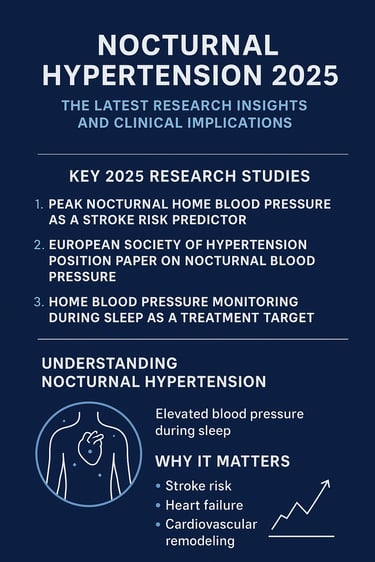
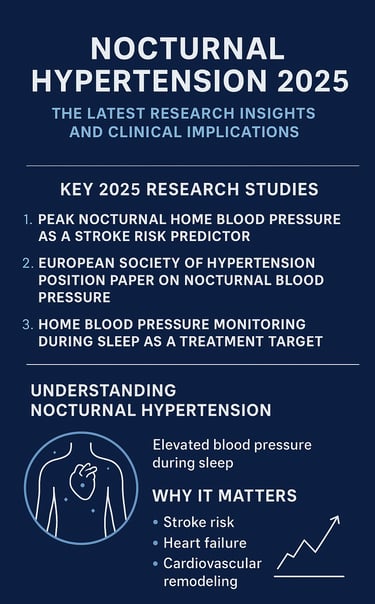
Nocturnal hypertension—elevated blood pressure during sleep—has emerged as one of the most important yet often overlooked aspects of cardiovascular risk management. While clinicians have traditionally focused on daytime blood pressure control, recent 2025 research reveals that what happens during your sleep may be equally or even more critical for predicting serious health complications like stroke and heart failure.
This comprehensive guide explores the cutting-edge 2025 research on nocturnal blood pressure, its measurement, pathophysiology, and practical implications for patient care. Whether you're a healthcare professional seeking the latest evidence or a patient interested in understanding your cardiovascular health, this article covers everything you need to know.
Clinical Pearls
1. Peak Nocturnal BP Predicts Stroke Risk Independently
Pearl: Focus on the maximum nighttime reading. The 2025 J-HOP study demonstrated that the peak nocturnal home blood pressure (specifically readings 149 mmHg averaged over 14 days) is a robust and independent predictor of stroke risk, often fourfold higher in high-risk groups, even if daytime BP is controlled.
Actionable Tip: Don't rely solely on daytime or office BP. Routinely assess peak nocturnal readings using Home Blood Pressure Monitoring (HBPM) during sleep or 24-hour Ambulatory Blood Pressure Monitoring (ABPM).
2. Timing of Medication is a Primary Intervention
Pearl: Bathing is key for many patients. Simply shifting the administration of antihypertensive medication (especially ACE inhibitors/ARBs, Calcium Channel Blockers) from morning to bedtime significantly improves nocturnal BP control and the dipping status.
Actionable Tip: For patients with confirmed nocturnal hypertension or non-dipping patterns, try a bedtime dosing strategy as a first-line adjustment before increasing the total drug dosage, especially in older adults (as shown by the 2025 meta-analysis).
3. Screen for and Treat Sleep Apnea
Pearl: Sleep apnea is a major, treatable driver of nocturnal hypertension. The repetitive drops in oxygen and arousals caused by Obstructive Sleep Apnea (OSA) trigger sympathetic nervous system spikes, preventing the normal nocturnal BP decline.
Actionable Tip: Nocturnal hypertension, non-dipping, and reverse dipping should trigger a high index of suspicion for OSA. Initiating CPAP therapy for OSA patients is often a potent and non-pharmacological treatment for nocturnal hypertension.
4. Non-Dipping Status is a High-Risk Marker
Pearl: A failure to achieve a normal 10-20% drop in BP from day to night (non-dipping, or worse, reverse dipping) is an independent cardiovascular risk factor for stroke and heart failure, even if the absolute daytime readings are within target.
Actionable Tip: Use ABPM or consistent nocturnal HBPM to calculate the dipping percentage. If a patient is a non-dipper ($<10\%$ reduction), intervention is warranted to reduce the sustained pressure load on the heart and vasculature.
5. Methodology and Positioning Matter for Diagnosis
Pearl: Accurate diagnosis requires standardized protocols. Subtle factors like the patient's body position during measurement (supine vs. lateral) and calculation methods can lead to misclassification of nocturnal hypertension.
Actionable Tip: When assessing nocturnal BP, counsel patients on standardized HBPM technique (e.g., measuring at a consistent time after lying down) and ensure reliable readings over 7-14 days (not just a few nights) for a statistically robust assessment.
Nocturnal Hypertension The Latest Research Insights and Clinical Implications
1. Peak Nocturnal Home Blood Pressure as a Stroke Risk Predictor
Study Overview: Wang et al. conducted the J-HOP Nocturnal BP study, demonstrating that peak nocturnal home blood pressure serves as a robust and early indicator of stroke risk, independent of traditional daytime measurements.
Key Findings:
Participants with the highest peak nocturnal readings (≥149 mmHg averaged over 14 days) showed over fourfold higher risk of subsequent stroke compared to those in the lowest category¹
The predictive power strengthened when analyses incorporated more nighttime readings, suggesting that multiple measurements capture crucial variability
Peak nocturnal BP proved independent of daytime BP control, meaning patients with well-controlled daytime pressures could still face significant stroke risk if nighttime levels were elevated
This finding challenges the conventional wisdom that good daytime BP control alone guarantees cardiovascular safety
Clinical Significance: This research establishes nocturnal BP monitoring as a critical tool for identifying high-risk patients who might otherwise appear controlled on standard office or daytime ambulatory measurements.
2. European Society of Hypertension Position Paper on Nocturnal Blood Pressure
Study Overview: The ESH Working Group on Blood Pressure Monitoring by Parati et al (2025) published a comprehensive position paper addressing nocturnal blood pressure pathophysiology, measurement techniques, and clinical implications, representing expert consensus across Europe.
Key Highlights:
Establishes standardized definitions for nocturnal hypertension and non-dipping blood pressure patterns
Reviews the pathophysiological mechanisms underlying elevated nighttime BP, including autonomic dysfunction, hormonal changes, and sleep disorders
Provides evidence-based recommendations for home blood pressure monitoring during sleep hours²
Addresses ambulatory blood pressure monitoring (ABPM) as the gold standard for nocturnal BP assessment
Discusses the relationship between nocturnal dipping (normal 10-20% reduction in BP during sleep) and cardiovascular outcomes
Emphasizes the clinical importance of identifying non-dippers and reverse dippers (patients whose BP actually rises at night)
Clinical Application: This position paper serves as a reference guide for standardizing how clinicians measure, interpret, and act upon nocturnal blood pressure data in routine practice.
3. Home Blood Pressure Monitoring During Sleep as a Treatment Target
Study Overview: Lee et al.(2025) conducted a proof-of-concept randomized controlled trial examining whether home blood pressure monitoring during night-time sleep could serve as a feasible and effective treatment target for hypertension management.
Key Findings:
Demonstrated the feasibility of home-based nocturnal BP monitoring in real-world settings
Showed that patients can successfully self-monitor and track blood pressure during sleep using accessible home devices
Home-monitored nocturnal BP correlates meaningfully with cardiovascular outcomes
Provides evidence supporting the use of nighttime BP targets as a management strategy in hypertension treatment
Suggests that individualizing therapy based on nocturnal BP readings may improve patient outcomes
What This Means for Patients: Rather than relying solely on office visits or daytime readings, this research validates using home-based monitoring to track and manage nocturnal hypertension, making treatment more personalized and outcome-focused.
4. Methodological Considerations in Nocturnal BP Dipping Research
Study Overview: Ferreira and Parisotto (2025) published insights into rethinking methodologies used in nocturnal blood pressure dipping research, highlighting methodological issues that may have led to inconsistent findings.
Key Points:
Discusses the importance of standardized methods for calculating dipping status (the percentage reduction in BP from day to night)
Addresses technical challenges in distinguishing true non-dipping patterns from measurement artifacts
Emphasizes the need for consistent protocols when assessing nocturnal BP variability
Suggests that previous research may have misclassified patients due to methodological variations
Advocates for improved standardization in nocturnal blood pressure research to enable better comparison across studies
Research Implication: Proper methodology in assessing nocturnal dipping is crucial for correctly identifying at-risk patients and ensuring future research findings are reliable and reproducible.
5. Practical Considerations for Assessing Peak Nocturnal Blood Pressure
Study Overview: Hoshide and Kario (2025) provided a detailed response to the Wang et al. study, offering practical guidance on how to best assess and interpret peak nocturnal home blood pressure in clinical settings.
Key Considerations:
Addresses the optimal strategy for measuring peak nocturnal BP in routine clinical practice
Discusses the balance between obtaining enough measurements for statistical reliability and practical feasibility for patients
Highlights the importance of consistent measurement protocols and timing of readings
Emphasizes training patients on proper home BP measurement technique during nighttime hours
Provides guidance on interpreting results and determining which patients warrant intervention based on nocturnal BP peaks
Practical Value: This commentary offers clinicians actionable recommendations for implementing peak nocturnal BP assessment in their practices effectively and reliably.
6. Bedtime Antihypertensive Administration in Older Adults
Study Overview: Saren et al. conducted a systematic review and meta-analysis examining the effectiveness of bedtime antihypertensive medication administration for improving nocturnal blood pressure control specifically in older adults aged 65 and above.
Key Findings:
Demonstrated significant improvement in nocturnal blood pressure when antihypertensive medications are taken at bedtime rather than morning⁴
Showed particular benefit in older adults, a population at higher risk for nocturnal hypertension complications
Identified specific medication classes that are most effective when dosed at bedtime
Provided evidence that timing of antihypertensive drug administration substantially impacts nocturnal BP control
Highlighted the importance of personalized medication timing strategies in older populations
Clinical Relevance: For older patients with nocturnal hypertension, simply adjusting medication timing from morning to bedtime can be an effective, non-invasive intervention strategy.
7. Body Position Effects on Nocturnal Blood Pressure Measurement
Study Overview: Research examining the impact of hydrostatic pressure and body position during sleep revealed significant measurement considerations affecting nocturnal BP assessment.
Key Findings:
Identified that body position during sleep (supine vs. lateral) affects measured blood pressure readings
Demonstrated that when correcting for body position effects, approximately 27.5% of subjects were reclassified regarding their nocturnal hypertension status
Revealed previously missed cases of clinically significant nocturnal hypertension when measurement position wasn't properly controlled
Highlights the importance of standardized measurement positions when assessing nighttime BP
What This Means: Proper patient positioning during nocturnal blood pressure measurement is critical to accurate diagnosis and risk assessment—a detail easily overlooked in routine practice.
Understanding Nocturnal Hypertension: Pathophysiology and Risk
Why Does Blood Pressure Behave Differently at Night?
Your body experiences dramatic physiological changes during sleep that affect blood pressure regulation. During normal sleep, the sympathetic nervous system activity decreases, hormone levels shift, and blood vessels relax. This typically results in a 10-20% decrease in blood pressure from daytime to nighttime—a pattern called dipping.
However, in patients with nocturnal hypertension, this normal decline doesn't occur adequately, or in some cases, blood pressure actually rises during sleep (reverse dipping). This abnormality reflects underlying autonomic dysfunction, hormonal imbalances, or structural cardiovascular changes.
Connected Conditions and Risks
Nocturnal hypertension frequently coexists with:
Sleep apnea (a major driver of elevated nighttime BP)
Chronic kidney disease
Diabetes mellitus
Obesity and metabolic syndrome
Autonomic nervous system disorders
Primary aldosteronism
Sympathomimetic medication use
Each of these conditions can independently impair the body's ability to lower blood pressure during sleep, creating a compounding risk effect.
Why Nocturnal Blood Pressure Matters More Than You Think
The Stroke Connection
The 2025 research on peak nocturnal home blood pressure demonstrates a striking finding: the highest nighttime readings matter more for stroke prediction than previously recognized. With over four times higher stroke risk in those with the most elevated nocturnal peaks, this metric deserves equal attention to daytime control.
Heart Failure and Cardiovascular Remodeling
Research shows nocturnal blood pressure is actually a stronger predictor of heart failure risk than daytime pressure in many patients. When the heart is subjected to sustained elevated pressure 24/7, rather than having a physiological "rest period" at night, the muscle undergoes harmful structural changes leading to heart failure development.
The Non-Dipper Phenomenon
Patients who fail to experience normal nocturnal blood pressure dipping face substantially higher cardiovascular risk. This "non-dipping" status is now recognized as an independent risk factor requiring intervention, even when daytime BP control appears adequate.
Measuring Nocturnal Blood Pressure: Methods and Best Practices
Gold Standard: Ambulatory Blood Pressure Monitoring (ABPM)
24-hour ABPM remains the reference standard for assessing nocturnal blood pressure patterns. This portable device takes readings throughout the day and night, capturing your natural BP behavior in real-world conditions.
Home Blood Pressure Monitoring (HBPM)
Recent research validates home blood pressure monitoring during sleep as a practical, feasible alternative for patients to track nocturnal BP. This approach offers advantages including:
Lower cost than clinical ABPM
Ability to obtain multiple readings over extended periods
Greater patient empowerment and engagement
Real-world measurement conditions
Reduced white-coat effect
Key Measurement Considerations
Based on 2025 research, proper nocturnal BP assessment requires:
Standardized measurement protocols and patient training
Consistent timing of readings during sleep
Multiple readings over at least 7-14 days for reliable assessment
Proper device validation and calibration
Attention to body position (supine vs. lateral) during measurement
Documentation of sleep quality and sleep apnea screening
Interpreting Your Nocturnal Blood Pressure Results
Normal Nocturnal Blood Pressure Patterns
Dippers: Normal 10-20% reduction in BP from daytime to nighttime (generally most favorable)
Daytime systolic BP: <130 mmHg
Nocturnal systolic BP: <115 mmHg (typically)
Abnormal Patterns Requiring Intervention
Non-dippers: <10% reduction in nighttime BP (elevated cardiovascular risk)
Reverse dippers: Increased BP at night compared to daytime (highest risk category)
Extreme dippers: >20% reduction (may indicate other health concerns)
Peak nocturnal readings consistently ≥149 mmHg (associated with stroke risk)
Treatment Strategies for Nocturnal Hypertension
Medication Timing
The 2025 meta-analysis on older adults demonstrated remarkable results: simply shifting antihypertensive medications from morning to bedtime dosing significantly improves nocturnal blood pressure control. This simple intervention is often effective before considering medication intensification.
Medications particularly beneficial at bedtime include:
ACE inhibitors
Angiotensin receptor blockers (ARBs)
Calcium channel blockers
Certain beta-blockers
Thiazide-like diuretics
Lifestyle Modifications
Effective strategies for reducing nocturnal hypertension include:
Sleep optimization: Maintain consistent sleep schedules, ensure 7-9 hours nightly, optimize sleep environment
CPAP therapy: Critical for patients with obstructive sleep apnea, as this directly addresses a major cause of nocturnal hypertension
Sodium reduction: Lower dietary salt intake (critical at night)
Alcohol avoidance: Especially in evening hours
Exercise: Regular daytime physical activity (not evening exercise, which may elevate nighttime BP)
Stress management: Meditation, relaxation techniques
Weight management: Particularly important in metabolic syndrome
Addressing Underlying Causes
Successful nocturnal hypertension management often requires treating underlying conditions:
Sleep apnea diagnosis and treatment
Endocrine evaluation for secondary causes
Kidney disease assessment and management
Metabolic syndrome intervention
Frequently Asked Questions (FAQs)
Q: How do I know if I have nocturnal hypertension? A: You may not have obvious symptoms. Diagnosis requires either 24-hour ambulatory blood pressure monitoring or consistent home blood pressure measurements during sleep. Ask your doctor about testing, especially if you have risk factors like sleep apnea, diabetes, or kidney disease.
Q: Is nocturnal hypertension more dangerous than daytime hypertension? A: For many patients, nocturnal hypertension is equally or more dangerous because it prevents the heart's normal nighttime recovery period. The 2025 research shows peak nocturnal readings predict stroke risk independent of daytime control.
Q: Can I measure my blood pressure at home at night? A: Yes. Home blood pressure monitors work at night, though proper technique is important. The 2025 research by Lee et al. demonstrates the feasibility and value of home-based nocturnal monitoring.
Q: Will taking my blood pressure medication at bedtime help? A: For many patients, yes. The 2025 meta-analysis shows bedtime dosing significantly improves nocturnal BP control, particularly in older adults. Discuss medication timing adjustments with your doctor.
Q: What if my blood pressure drops too much at night? A: Some patients are "extreme dippers" with excessive nighttime BP reduction. This can sometimes indicate other health concerns and warrants discussion with your physician about whether medication adjustments are needed.
Q: How often should nocturnal blood pressure be monitored? A: Initial assessment typically involves 7-14 days of monitoring. After diagnosis and treatment initiation, periodic monitoring (several days every 3-6 months) helps guide medication adjustments.
Q: Is nocturnal hypertension treatable? A: Absolutely. Lifestyle modifications, medication timing adjustments, treating underlying sleep apnea, and optimized medication selection all effectively reduce nocturnal hypertension in most patients.
Q: Can sleep apnea cause nocturnal hypertension? A: Yes. Sleep apnea is one of the most common treatable causes of nocturnal hypertension. Treating sleep apnea with CPAP often significantly improves nocturnal BP.
Key Takeaways: What You Should Remember
✓ Nocturnal blood pressure is a critical cardiovascular risk factor that deserves equal attention to daytime BP in clinical management decisions
✓ Peak nocturnal home blood pressure is a strong, independent predictor of stroke risk, as demonstrated in the 2025 J-HOP study with over fourfold higher risk in high-reading groups
✓ Home blood pressure monitoring during sleep is now validated as a feasible, practical approach for assessing and managing nocturnal hypertension in real-world settings
✓ Bedtime medication dosing significantly improves nocturnal BP control, particularly in older adults—an effective, simple intervention before intensifying therapy
✓ Proper measurement methodology matters: Body position, standardized timing, and multiple readings over 7-14 days ensure accurate diagnosis and prevent misclassification
✓ Non-dipping and reverse-dipping patterns indicate elevated cardiovascular risk requiring intervention, even when daytime BP appears controlled
✓ Sleep apnea is a major, treatable cause of nocturnal hypertension—screening and CPAP therapy should be priority interventions
✓ The European Society of Hypertension position paper provides expert-consensus guidance on standardized definitions, measurement, and management of nocturnal BP
✓ Individual patient characteristics matter: Older age, diabetes, kidney disease, and obesity all contribute to nocturnal hypertension risk and may require tailored approaches
✓ Treatment success requires a comprehensive approach combining lifestyle modification, appropriate medication timing, underlying condition management, and regular monitoring
Call to Action: Taking Control of Your Nocturnal Blood Pressure
If you experience any of these situations, discuss nocturnal blood pressure assessment with your healthcare provider:
Recent stroke or TIA (transient ischemic attack)
Family history of early cardiovascular disease
Diagnosed sleep apnea
Diabetes or chronic kidney disease
Hypertension not responding adequately to standard therapy
Age over 65 with multiple cardiovascular risk factors
Morning headaches, excessive daytime sleepiness
Obesity or metabolic syndrome
Don't assume your blood pressure is controlled just because office or daytime readings look good. The groundbreaking 2025 research demonstrates that nocturnal patterns tell a separate, crucial story about your cardiovascular health.
Request 24-hour ABPM or home nocturnal BP monitoring from your doctor. If abnormalities are found, work with your healthcare team to optimize medication timing, address underlying sleep issues, and implement lifestyle changes. In many cases, simple adjustments—like taking medications at bedtime or treating sleep apnea—can dramatically reduce nocturnal hypertension and your stroke and heart failure risk.
Your nighttime blood pressure matters. Make sure your doctor is paying attention to it.
Disclaimer: This article is for informational purposes only and does not constitute medical advice. Individual circumstances vary, and treatment decisions should always be made in consultation with qualified healthcare professionals.
Related Articles
The BMI Paradox: Why "Normal Weight" People Still Get High Blood Pressure | DR T S DIDWAL
How Insulin Resistance Accelerates Cardiovascular Aging | DR T S DIDWAL
Physical Activity, Adiposity, and Metabolic Health: What Science Reveals | DR T S DIDWAL
Sleep & Hypertension: Duration, Quality, and Blood Pressure | DR T S DIDWAL
References
Hoshide, S., Kario, K. (2025). Practical considerations for assessing nocturnal blood pressure peak: a response to Wang et al. Hypertension Research, 48, 1296-1318. https://doi.org/10.1038/s41440-025-02479-3
Parati G., Pengo, M. F., Avolio, A., et al. (2025). Nocturnal blood pressure: pathophysiology, measurement and clinical implications. Position paper of the European Society of Hypertension. Journal of Hypertension, 43(8), 1296–1318. https://doi.org/10.1097/HJH.0000000000004053
Lee, E. K. P., Wang, S., Yip, B. H. K., et al. (2025). Home blood pressure during night-time sleep – a feasible treatment target for patients with hypertension: a proof-of-concept randomised controlled trial. Journal of Pharmaceutical Policy and Practice, 18(1). https://doi.org/10.1080/20523211.2025.2463435
Ferreira, A. S., & Parisotto, G. (2025). Rethinking methodologies in nocturnal blood pressure dipping research: insights from Lopez et al. Acta Cardiologica, 80(5), 529–530. https://doi.org/10.1080/00015385.2025.2453799
Saren, J., Lieten, S., Petrovic, M., et al. (2025). Improvement in nocturnal blood pressure with bedtime antihypertensive administration in older adults aged 65 and above: a systematic review and meta-analysis. Clinical Autonomic Research, 35, 711–725. https://doi.org/10.1007/s10286-025-01159-z
Wang, J., Wu, L., Wang, Q., et al. (2025). Comment on "Peak nocturnal home blood pressure as an early and strong novel risk factor for stroke: the practitioner-based nationwide J-HOP Nocturnal BP study." Hypertension Research, 48, 1319-1321. https://doi.org/10.1038/s41440-025-02480-3