How to Build a Disease-Proof Body: Master Calories, Exercise & Longevity
Stop the low-calorie trap. New 2025 research reveals how adequate fuel and exercise synergize for longevity. Debunking myths on the U-shaped curve and heart health
EXERCISE
Dr. T.S. Didwal, M.D.
12/20/202511 min read
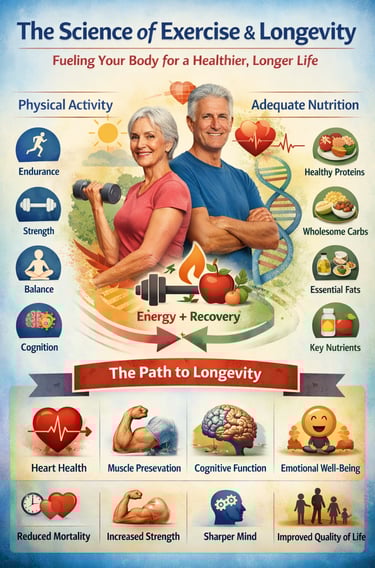
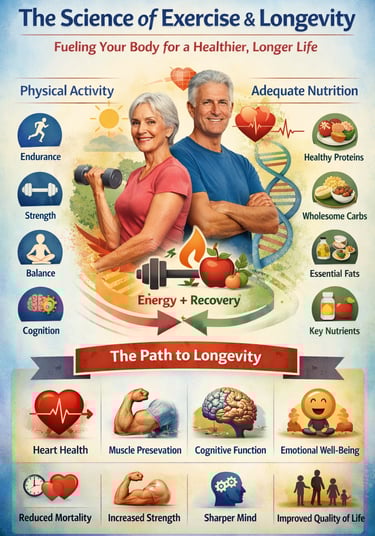
For decades, the dominant prescription for longevity was deceptively simple: exercise regularly, eat less, and avoid excess. Moderate movement was considered protective, while high exercise volumes and adequate calorie intake were often viewed with suspicion. But a growing body of contemporary research now suggests that this framework is incomplete—and in some cases, fundamentally flawed.
Large-scale population studies and mechanistic research are challenging two of the most deeply entrenched beliefs in preventive medicine: that “too much” exercise shortens life, and that calorie restriction universally enhances longevity. Instead, the emerging evidence points toward a more nuanced reality—one in which consistent physical activity, including higher training volumes, paired with sufficient metabolic fuel produces the most robust improvements in survival, cardiovascular health, muscle preservation, cognitive function, and psychological well-being.
Exercise, it turns out, is not merely a calorie-burning tool or a means of weight control. It is a powerful biological signal that remodels the heart, vasculature, skeletal muscle, brain, and endocrine system. Yet like any potent intervention, its benefits are amplified—or undermined—by nutritional context. When movement is chronically under-fueled, adaptation suffers; when properly supported, exercise becomes one of the most effective strategies for extending not just lifespan, but healthspan.
This shift in understanding reframes the goal of fitness and aging. Longevity is no longer defined simply by adding years to life, but by preserving strength, independence, cognitive clarity, and joy across those years. The latest science makes one thing increasingly clear: the path to long-term health is not built on restriction and fear, but on adequate fueling, intelligent training, and lifelong consistency.
Clinical Pearls
1. The "Fueling Paradox": Calories are Recovery, Not Just Energy
Traditional "eat-less, move-more" models often fail because severe caloric restriction triggers a survival response that stalls metabolic benefits.
The Science: High-volume exercise paired with adequate calories is linked to lower mortality than exercise with restriction (Gan et al., 2025).
Patient Strategy: Don't eat as little as possible. Calculate your Total Daily Energy Expenditure (TDEE) and ensure you are fueling at or slightly above your baseline to allow for cellular repair. Exercise is the "work"; food is the "contractor" that fixes the damage
.
2. Debunking the "U-Shape": There is No Ceiling on Health
Previously, doctors feared that too much exercise could harm the heart. New evidence from the American College of Cardiology (2025) suggests the benefit curve doesn't drop off; it simply plateaus.
The Science: Cardiovascular improvements continue linearly even at high volumes. You are far more likely to suffer from "under-exercising" than "over-exercising."
Patient Strategy: As long as you are recovering well (sleeping and eating enough), you don't need to fear the 10,000+ step mark or long-duration workouts.
3. Resistance Training: Your "Metabolic Insurance Policy"
Aerobic work (cardio) saves your heart, but resistance training saves your metabolism.
The Science: Lifting weights increases mitochondrial efficiency and lean muscle mass, which acts as a "glucose sink," soaking up excess blood sugar and protecting you from Type 2 Diabetes.
Patient Strategy: Aim for at least two days of strength work. Muscle is more than just "strength"—it is a metabolically active organ that keeps you young.
4. Exercise as a "Brain Fertilizer"
Movement does for the brain what fertilizer does for a garden.
The Science: Aerobic exercise triggers the release of BDNF (Brain-Derived Neurotrophic Factor), which stimulates the growth of new neurons in the hippocampus (Cabo et al.2025).
Patient Strategy: Think of your morning walk as "mental hygiene." It isn't just about weight; it’s about preserving your memory and emotional resilience as you age.
5. Consistency Over Intensity (The Adherence Factor)
The biological "signals" sent by exercise are temporary; they must be sent frequently to create permanent change.
The Science: Long-term adherence is the single strongest predictor of a 20-30% reduction in all-cause mortality.
Patient Strategy: A 15-minute walk you do every day is scientifically superior to a 2-hour workout you only do once a month. Build a "minimum viable habit" that you never skip.
Breaking the Myths: The U-Shaped Hypothesis
For years, research suggested a U-shaped relationship between exercise and mortality—that excessive exercise might actually increase mortality risk. Recent comprehensive research challenges this assumption.
According to the American College of Cardiology (2025), cardiovascular fitness improvements continue to correlate with mortality reduction even at higher exercise volumes, suggesting a more linear or plateau relationship rather than the previously observed U-shaped pattern. This means you don't need to fear "over-exercising." Focus instead on consistency and activities you enjoy.
The Calorie-Exercise Connection: A Game-Changing Discovery
The conventional wisdom that low-calorie diets combined with exercise represent the optimal approach is wrong. According to an analysis of National Health and Nutrition Examination Survey data (Gan et al., 2025), higher calorie intake with adequate exercise is associated with reduced mortality compared with low-calorie diets paired with equivalent physical activity.
This large-scale observational study across diverse populations found that the protective effect of adequate calorie consumption persisted across multiple demographic groups, and the combination of proper nutrition and physical exercise creates a synergistic effect greater than either intervention alone.
Rather than eating as little as possible while exercising, focus on consuming adequate calories aligned with your activity level while maintaining consistent physical activity. This approach is more sustainable and more effective for longevity.
Does Everyone Benefit Equally from Exercise?
While physical activity provides health benefits across diverse populations, the magnitude of benefit can vary (Börjesson & Arvidsson, 2025). Baseline fitness level influences the rate of improvement from exercise programs, but consistency and adherence to physical activity matter more than individual variation in response.
Your particular health gains from exercise may look different from someone else's, but that doesn't diminish the universal principle: everyone benefits from increased physical activity. Focus on finding a program tailored to your circumstances, preferences, and goals.
Exercise and Aging: Transforming Quality of Life
One of the most compelling applications of exercise science involves older adults. Research shows that regular physical activity significantly enhances quality of life in aging populations (Cabo et al., 2025), with exercise improving both objective health markers and subjective well-being, joy, and functional capacity.
Beyond disease prevention, the research quantified increases in joy and life satisfaction, with older adults engaging in regular physical exercise reporting greater happiness, purpose, and engagement with life. If you're concerned about aging, the research is encouraging: physical activity isn't just about preventing disease—it's about actively enhancing the experience of living.
The Science of Exercise: How Movement Transforms Your Body
Cardiovascular Benefits
Aerobic exercise produces measurable improvements in arterial elasticity and endothelial function, while physical activity reduces systemic inflammation, a key driver of cardiovascular disease (Mi et al., 2025). Population studies consistently show a 20-30% mortality reduction in physically active versus sedentary individuals.
When you engage in regular physical activity, you trigger fundamental cardiovascular improvements at the cellular level. Your blood vessels become more flexible, your heart pumps more efficiently, and your cardiovascular system becomes increasingly resistant to disease.
The Critical Role of Adequate Nutrition
Your body cannot operate optimally on inadequate fuel. When you exercise, you create microscopic stress in your muscles and cardiovascular system. Recovery—where actual fitness improvements occur—requires adequate nutrients and calories.
Severe calorie restriction can disrupt hormonal balance, affecting thyroid function, cortisol levels, and reproductive hormones. These changes can actually undermine exercise benefits. People who exercise while eating adequate calories report better energy levels, faster recovery, improved mood, and greater ability to maintain their habits long-term.
Metabolic Benefits
Regular exercise increases your resting metabolic rate. Key metabolic benefits include improved insulin sensitivity, enhanced fat oxidation capacity, better appetite hormone regulation, increased lean muscle mass, and improved mitochondrial function.
Extreme calorie restriction is counterproductive—your body becomes more efficient at conserving energy, potentially slowing metabolism. Combining adequate nutrition with physical activity optimizes metabolic health.
Mental Health and Cognitive Function
Regular physical activity reduces depression and anxiety, improves sleep quality, and enhances cognitive function. Exercise stimulates endorphins and other mood-regulating neurotransmitters, while aerobic exercise promotes the growth of new neurons in the hippocampus—crucial for memory and learning.
People who maintain regular exercise habits have better mental clarity, improved focus, and enhanced emotional resilience.
Bone Health and Disease Prevention
Weight-bearing exercise is crucial for maintaining bone density, especially for women approaching menopause and older adults at risk of osteoporosis. Regular physical activity also helps prevent type 2 diabetes, certain cancers, and neurodegenerative diseases.
How Much Exercise Do You Actually Need?
Major health institutions recommend:
At least 150 minutes of moderate-intensity aerobic activity per week, or
75 minutes of vigorous-intensity aerobic activity per week
Resistance training at least 2 days per week
The research suggests that beyond meeting these thresholds, additional exercise continues providing benefits without previously feared risks—provided you're properly fueled.
Think of exercise like medicine: there's an effective dose, but unlike some medications, more isn't necessarily harmful when properly fueled. Progressive overload—gradually increasing demands on your body—remains one of the most effective principles for improving fitness levels.
Different Types of Exercise Benefits
Aerobic Exercise: Running, cycling, swimming, or dancing strengthens your aerobic capacity and provides well-documented cardiovascular benefits including improved heart function and significant mortality reduction.
Resistance Training: Strength training builds and maintains muscle mass, which naturally declines with age. Maintaining muscle helps preserve metabolic function, supports bone health, and reduces injury risk. People incorporating strength training have better health outcomes than those relying solely on aerobic activity.
Flexibility and Balance Work: Yoga, stretching, and balance training improve functional fitness, reduce fall risk in older adults, and complement aerobic and resistance benefits.
Special Populations
Aging Adults: The exercise benefits don't diminish with age—they become more pronounced. Older adults often see the most dramatic improvements in quality of life when increasing physical activity. Maintaining muscle mass through resistance training becomes increasingly important, as does adequate nutrition to support aging well.
People with Chronic Conditions: For those with heart disease or diabetes, supervised exercise can be part of treatment and recovery. The cardiovascular benefits are particularly pronounced in those with existing disease.
High-Volume Training: Athletes and highly active individuals can engage in substantial training with minimal risks—provided they consume sufficient calories to support recovery and adaptation.
The Longevity Advantage
Research consistently shows that people meeting physical activity guidelines have 20-30% lower mortality risk compared to sedentary individuals. This translates to years of additional life through multiple mechanisms: reduced cardiovascular disease risk, better immune function, improved metabolic health, enhanced mental health, reduced cancer incidence, and preserved cognitive function.
The longevity benefits are maximized when physical activity is paired with adequate calorie intake, as simply exercising while severely restricting calories undermines the potential for maximal benefit.
Perhaps most importantly, exercise combined with appropriate nutrition doesn't just help us live longer—it helps us live better, with improved quality of life, independence, cognitive sharpness, and emotional fulfillment.
Overcoming Barriers
"I Don't Have Time": Exercise benefits accumulate throughout the day. A 10-minute walk, quick bodyweight workout, or taking the stairs all contribute to your daily total.
"I'm Intimidated by the Gym": Walking, home workouts, dancing, gardening, and sports all count. The best program is the one you'll actually do consistently.
"I Have an Injury or Health Condition": Almost everyone can benefit from some form of physical activity. Consult a healthcare provider or physical therapist to develop a safe plan.
"I'm Too Tired": Physical activity actually increases energy levels, especially when paired with adequate nutrition. Severe restriction causes fatigue, but consuming appropriate calories while exercising improves energy.
"I'm Worried About Overeating": Research indicates that eating adequate calories aligned with your activity level is associated with better health outcomes, not worse.
Building a Sustainable Exercise Habit
Start Small and Build Gradually: If currently sedentary, start with 10-15 minutes of moderate-intensity exercise most days, then progress.
Fuel Appropriately: Eat enough to support your exercise efforts. The research demonstrates that adequate calorie intake enhances benefits.
Find Activities You Enjoy: Choosing activities you genuinely enjoy dramatically increases adherence and ensures consistency.
Build Community: Exercise with others to enhance motivation and amplify psychological benefits.
Track Progress: Monitor improvements in endurance, strength, mood, sleep, and energy levels to maintain motivation.
Be Consistent: Adherence is the strongest predictor of positive health outcomes.
FAQ: Building Your Disease-Proof Body
Q: I’ve heard that "too much" exercise can actually damage the heart. Should I be worried?
The Science: For a long time, we believed in a "U-shaped" curve where extreme exercise was harmful. New 2025 data from the American College of Cardiology shows that the benefits to your heart continue to grow or plateau even at high levels of activity.
The Bottom Line: You are at much higher risk from under-exercising than over-exercising. As long as you feel energized and are sleeping well, keep moving!
Q: I'm trying to lose weight, so shouldn't I eat as few calories as possible while I exercise?
The Science: This is the most common mistake. Severe calorie restriction while exercising tells your body to go into "survival mode," which can mess with your hormones and thyroid. Research shows that people who eat adequate calories to fuel their movement actually live longer and recover faster.
The Bottom Line: Think of food as the "contractor" that comes in to repair the "building" (your body) after a workout. Without the contractor, the building eventually falls apart.
Q: I do plenty of walking and cardio. Do I really need to lift weights?
The Science: Yes. While cardio is great for your heart, Resistance Training is your metabolic insurance policy. Muscle acts like a "sponge" for blood sugar. Having more lean muscle mass significantly lowers your risk of Type 2 Diabetes and keeps your metabolism from slowing down as you age.
The Bottom Line: Aim for at least two sessions a week where you challenge your muscles. It’s not about "bulking up"; it’s about staying metabolically young.
Q: Why does my doctor care more about "consistency" than how hard I sweat?
The Science: Exercise sends a chemical signal to your cells to stay healthy and repair themselves. However, that signal is temporary. To keep your "immune thermostat" and metabolism in the healthy zone, you need to send that signal frequently.
The Bottom Line: A 15-minute daily walk is scientifically better for your lifespan than a 3-hour "weekend warrior" session once a week.
Q: I feel too tired to exercise. What am I doing wrong?
The Science: Often, "exercise fatigue" is actually under-fueling. If you aren't eating enough quality fats and carbohydrates to support your activity, your body will protect itself by making you feel exhausted.
The Bottom Line: Try increasing your "fuel" (healthy calories) on the days you move. You’ll likely find your energy levels—and your results—improve immediately.
Quick-Start Prescription
Cardio: 150 mins/week (Brisk walking, cycling, or swimming).
Strength: 2 days/week (Weights, bands, or bodyweight).
Fuel: Eat to support your movement. Never starve a workout.
Conclusion: A Smarter, Sustainable Path to Health and Longevity
The science of exercise and longevity has evolved well beyond simple rules about “moving more” or “eating less.” What emerges from contemporary research is a clearer, more encouraging message: regular physical activity, when paired with adequate nutrition, is one of the most powerful and reliable ways to protect health, preserve function, and enhance quality of life across the lifespan.
Exercise works not through a single pathway, but by improving cardiovascular efficiency, metabolic health, muscle and bone integrity, cognitive function, and emotional well-being. These benefits are not limited to athletes or the young; they extend to older adults, individuals with chronic disease, and those starting later in life. Importantly, the feared risks of higher exercise volumes appear far smaller than once believed—provided the body is properly fueled and recovery is respected.
At the same time, the evidence challenges the idea that chronic calorie restriction enhances health when combined with exercise. On the contrary, insufficient energy intake can blunt adaptation, impair hormonal balance, increase fatigue, and undermine the very benefits physical activity is meant to deliver. Exercise is a biological investment, and like any investment, it requires adequate resources to yield returns.
Perhaps most reassuring is that perfection is not required. Consistency matters more than intensity, and enjoyment matters more than rigid plans. Walking, resistance training, balance work, and aerobic activity all contribute meaningfully when practiced regularly and supported by sufficient nutrition. In the end, the goal is not simply to live longer, but to live better—stronger, more independent, mentally sharper, and more engaged with life. The science is clear: a well-fueled, active body is one of the most resilient foundations for long-term health and vitality.
Medical Disclaimer
The information in this article, including the research findings, is for educational purposes only and does not constitute medical advice, diagnosis, or treatment. Before starting any new exercise program, you must consult with a qualified healthcare professional, especially if you have existing health conditions (such as cardiovascular disease, uncontrolled hypertension, or advanced metabolic disease). Exercise carries inherent risks, and you assume full responsibility for your actions. This article does not establish a doctor-patient relationship.
Related Articles
Lower Blood Pressure Naturally: Evidence-Based Exercise Guide for Metabolic Syndrome | DR T S DIDWAL
Exercise vs. Diet Alone: Which is Best for Body Composition? | DR T S DIDWAL
Movement Snacks: How VILPA Delivers Max Health Benefits in Minutes | DR T S DIDWAL
HIIT Benefits: Evidence for Weight Loss, Heart Health, & Mental Well-Being | DR T S DIDWAL
References
American College of Cardiology. (2025, July 2). The relationship between exercise and longevity: Challenging the U-shaped hypothesis. American College of Cardiology.
Börjesson, M., & Arvidsson, D. (2025). Does everyone benefit equally from physical activity? The Lancet Public Health, 10(2), e74–e75. https://doi.org/10.1016/S2468-2667(25)00001-5
Cabo, C. A., Tomas-Carus, P., Fernandes, O., et al. (2025). The role of physical exercise in enhancing health, quality of life, and joy among older adults. Scientific Reports, 15, 42495. https://doi.org/10.1038/s41598-025-26683-w
Gan, H., Yan, Y., Jia, S., Guo, Y., & Lu, G. (2025). Higher calorie intake with adequate exercise is associated with reduced mortality compared with low-calorie diet with equivalent exercise. Experimental Gerontology, 208, 112805. https://doi.org/10.1016/j.exger.2025.112805
Mi, M. Y., Perry, A. S., Krishnan, V., & Nayor, M. (2025). Epidemiology and cardiovascular benefits of physical activity and exercise. Circulation Research, 137(2), 120–138. https://doi.org/10.1161/CIRCRESAHA.125.325526