Can Weight Loss Slow Biological Aging? The Science Linking Weight and Longevity
Discover how excess weight accelerates biological aging and explore evidence-based strategies to slow aging, improve health, and enhance longevity.
AGINGOBESITY
Dr. T.S. Didwal, M.D.(Internal Medicine)
1/29/202613 min read
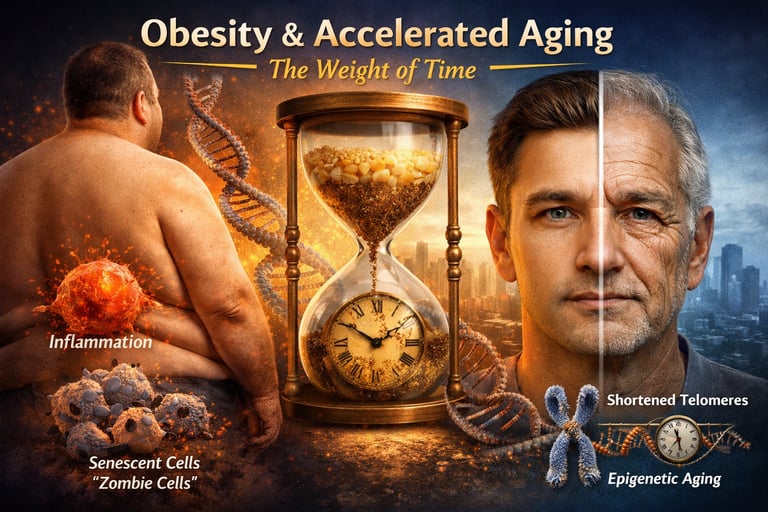
If aging were simply a matter of counting birthdays, medicine would be far simpler than it is. Yet growing evidence suggests that the speed at which we age biologically is shaped not just by time, but by the metabolic environment in which our cells exist. Among the most powerful—and modifiable—drivers of accelerated biological aging is obesity. Far from being a cosmetic concern, excess adiposity acts as a chronic biological stressor that quietly reshapes inflammation, hormone signaling, cellular repair, and even gene expression across the lifespan (Malandrino et al., 2023).
What makes this relationship particularly troubling is that obesity does not merely increase the risk of age-related diseases—it appears to push the aging process itself into fast-forward. Studies now demonstrate that individuals with long-standing obesity exhibit hallmarks of advanced biological aging, including shortened telomeres, accelerated epigenetic clocks, increased cellular senescence, and persistent low-grade inflammation, often decades before clinical disease becomes apparent (Correa-Burrows et al., 2025). In effect, young bodies can house prematurely old cells.
Traditional metrics such as body mass index (BMI) fail to capture this complexity, particularly in older adults, where age-related muscle loss and fat redistribution distort risk assessment. Recognizing this limitation, recent expert consensus has called for redefining obesity in the context of aging, emphasizing body composition, visceral adiposity, and functional capacity over weight alone (The Lancet Healthy Longevity, 2025). This shift reflects a deeper truth: the biological consequences of obesity depend not only on how much weight is carried, but how long it has been carried—a concept increasingly described as the “weight of time” (Ragusa et al., 2025).
Understanding obesity as a driver of accelerated aging reframes prevention and treatment as more than disease avoidance—it positions metabolic health as a cornerstone of longevity itself.
Clinical Pearls
1. Muscle is Your "Metabolic Currency"
Sarcopenic obesity—the simultaneous loss of skeletal muscle and increase in adipose tissue—is a primary driver of frailty and metabolic collapse in older adults. Muscle tissue is the largest site for glucose disposal and a key regulator of basal metabolic rate.
As you age, your goal shifts from "losing weight" to "changing your body's composition." If you lose weight by dieting alone without exercise, you may lose muscle, which actually makes you weaker and slows your metabolism.
Action: Prioritize protein intake and resistance training (like lifting weights or using bands) to protect your "metabolic engine."
2. Focus on "Inflammaging" Rather Than the Scale
Visceral fat (fat stored around internal organs) acts as an active endocrine organ, secreting pro-inflammatory cytokines like IL-6 and TNF-$\alpha$. This creates "inflammaging," a state of chronic low-grade inflammation that accelerates cellular senescence.
That stubborn weight around your middle is more than just an extra layer; it acts like a small "inflammation factory" that can make your cells age faster than your birthday suggests.
Action: Focus on anti-inflammatory habits—like eating leafy greens and improving sleep—which can "cool down" this internal heat even before the scale moves significantly.
3. The "Weight of Time" Principle
Recent data suggest that the duration of obesity (often measured in "obesity-years") is a stronger predictor of biological aging and cardiovascular risk than current BMI alone. This is due to the cumulative "metabolic memory" of cellular damage.
How long you’ve carried extra weight matters as much as how much you carry. Think of it like sun exposure; a single sunburn is one thing, but years of tanning add up.
Action: It is never too late to start, but "earlier is better." Taking action in your 30s, 40s, or 50s provides "compound interest" for your health in your 70s and 80s.
4. Redefining Success: Functional vs. Numerical
In geriatric populations, the "Obesity Paradox" suggests that a slightly higher BMI (25–29.9) may actually be protective against mortality compared to being underweight. Therefore, clinical success should be measured by Functional Capacity (e.g., gait speed, grip strength).
Your doctor isn't looking for you to look like a fitness model. Success means being able to carry your own groceries, get up from a chair easily, and play with your grandkids without pain.
Action: Track your progress by how you move and feel (e.g., "I can walk two blocks without getting winded") rather than just the number on the bathroom scale.
5 .Quality Protein over Caloric Restriction
Older adults often develop "anabolic resistance," meaning the body becomes less efficient at using protein to build muscle. Strict caloric restriction without targeted protein supplementation can lead to a dangerous drop in bone mineral density and lean mass.
Cutting calories too drastically can backfire as you get older. Your body needs "high-quality fuel" to keep your bones and muscles strong while you lose fat.
Action: Instead of just "eating less," focus on "eating better." Aim for high-quality protein (like Greek yogurt, lean meats, or beans) at every meal to signal your body to keep its muscle while burning its fat.
Understanding the Obesity-Ageing Connection: More Than Meets the Eye
When we talk about obesity and biological aging, we're not just discussing the number on your bathroom scale or the candles on your birthday cake. We're exploring how excess body weight fundamentally alters the aging process at a cellular level, potentially adding years to your biological age even while you're chronologically young.
Think of your body as a finely tuned machine. When you carry excess weight, particularly over long periods, it's like running that machine constantly in overdrive—parts wear out faster, systems break down sooner, and the whole operation becomes less efficient.
The Evolving Definition: Why BMI Isn't Telling the Whole Story
Here's something that might surprise you: the way we define obesity in older adults is undergoing a major transformation. For decades, healthcare providers have relied primarily on Body Mass Index (BMI) to determine who's obese and who isn't. But researchers are now recognizing that this one-size-fits-all approach, particularly for aging populations, misses crucial nuances.
Recent editorial commentary has made a compelling case that we need to rethink our entire approach to defining obesity in the context of healthy aging (The Lancet Healthy Longevity, 2025). Traditional BMI cutoffs don't account for age-related changes in body composition, muscle mass loss (sarcopenia), or the redistribution of fat tissue that naturally occurs as we grow older. What's considered a healthy weight at 25 might not be the same target at 65, and vice versa.
This isn't just academic hairsplitting—it has real-world implications for how we diagnose, treat, and prevent obesity-related complications in our aging population.
The Biological Mechanisms: How Obesity Accelerates Aging
A Comprehensive Review of Metabolic Mayhem
A comprehensive examination of the endocrinology literature provides an extensive roadmap of how obesity impacts aging biology (Malandrino et al., 2023). This isn't a simple cause-and-effect relationship; it's a complex web of interconnected biological processes, including
Chronic inflammation: Excess adipose tissue, particularly visceral fat around your organs, acts like a metabolic furnace that constantly pumps out inflammatory molecules. This state of chronic low-grade inflammation—sometimes called "inflammaging"—damages tissues throughout your body and accelerates the aging process. Think of it as your body being in a perpetual state of fighting an infection that never quite resolves.
Oxidative stress: Fat cells produce reactive oxygen species that damage cellular components, including DNA, proteins, and lipids. Over time, this oxidative damage accumulates, contributing to cellular senescence and functional decline.
Hormonal dysregulation: Obesity disrupts the delicate balance of hormones that regulate metabolism, appetite, stress response, and even mood. Insulin resistance, elevated cortisol, reduced growth hormone, and altered sex hormone levels all contribute to accelerated aging.
Cellular senescence: Perhaps most fascinating is how obesity promotes the accumulation of senescent cells—damaged cells that refuse to die but also can't function properly. These "zombie cells" secrete harmful substances that spread inflammation and dysfunction to neighboring healthy cells, creating a domino effect of aging throughout the body.
These mechanisms don't operate in isolation. They interact and amplify each other, creating a vicious cycle where obesity accelerates aging, and ageing-related changes make it harder to lose weight and maintain metabolic health.
The Weight of Time: Unpacking Long-Term Consequences
Recent analysis has explored the temporal dimension of the obesity-aging relationship—essentially asking: does it matter when you gain weight and how long you carry it (Ragusa et al., 2025)?
The answer is a resounding yes. The study reveals that the duration of obesity exposure significantly influences aging trajectories. Someone who becomes obese at 30 and remains so until 60 experiences different biological consequences than someone who gains weight at 50, even if they end up at the same BMI.
Critical findings from this research:
The concept of "obesity years" (similar to "pack-years" in smoking research) helps quantify cumulative exposure to excess weight. A person with obesity for 20 years faces different health risks than someone with the same degree of obesity for 5 years.
Metabolic memory is real—even after weight loss, some of the cellular and metabolic changes induced by long-term obesity can persist, though intervention is still highly beneficial.
Different life stages show varying vulnerability to obesity's aging effects. Mid-life obesity appears particularly detrimental for long-term healthy aging, potentially because it coincides with other age-related metabolic shifts.
The research underscores an important message: it's never too late to intervene, but earlier is definitely better when it comes to preventing obesity-related accelerated aging.
Young Bodies, Old Cells: The Alarming Reality of Obesity in Young Adults
Perhaps no study drives home the urgency of addressing obesity quite like recent research into long-term obesity and biological aging in young adults (Correa-Burrows et al., 2025). This investigation reveals something deeply concerning: carrying excess weight during your 20s and 30s can make you biologically older than your chronological age.
What the Study Found
The researchers followed young adults and measured various biomarkers of biological aging, including:
Epigenetic age (DNA methylation patterns that reflect biological rather than chronological age)
Telomere length (protective caps on chromosomes that shorten with age)
Inflammatory markers (indicators of chronic systemic inflammation)
Metabolic health indicators (glucose regulation, lipid profiles, liver function)
The results were striking. Young adults with sustained obesity showed biological aging acceleration across multiple measures. In some cases, their cells and organs appeared 10-15 years older than their actual age. Imagine being 28 years old chronologically but having the cardiovascular system of someone in their early 40s—this is the reality for many young people struggling with obesity.
Early-life obesity doesn't just predict future health problems—it's already causing measurable biological aging in real-time. The damage isn't waiting until middle age to manifest; it's happening now.
Multiple biological aging systems are affected simultaneously, suggesting systemic rather than localized effects. This means obesity isn't just hard on your heart or your joints—it's aging your entire body.
The good news embedded in the concerning findings: young bodies are also highly resilient and responsive to intervention. Early identification and treatment of obesity in young adults could potentially reverse or slow some of these aging processes.
Addressing Obesity to Promote Healthy Aging: A Clinical Perspective
Practical, clinically-oriented guidance bridges the gap between understanding mechanisms and implementing real-world solutions (Roderka et al., 2020). This research addresses the unique considerations for treating obesity in aging populations.
Treating obesity in older populations requires a delicate balancing act. Several unique considerations include:
Sarcopenic obesity: Many older adults with obesity also have significant muscle loss—a particularly dangerous combination that increases frailty, falls, disability, and mortality. Traditional weight loss approaches might worsen muscle loss if not carefully managed.
Medication considerations: Older adults typically take multiple medications, and obesity treatments must be carefully integrated with existing drug regimens to avoid interactions or complications.
Comorbidity management: Most older adults with obesity have multiple chronic conditions (diabetes, hypertension, arthritis, cardiovascular disease), requiring coordinated, multidisciplinary care.
Functional goals: For older adults, the primary goal isn't necessarily achieving an "ideal" BMI but rather optimizing functional capacity, independence, and quality of life.
Evidence-Based Intervention Strategies
Research outlines several evidence-based approaches to addressing obesity in aging populations:
Comprehensive lifestyle interventions combining diet modification, physical activity (especially resistance training to preserve muscle), and behavioral support show the most promise for sustainable weight management.
Personalized nutrition strategies that maintain adequate protein intake (often higher than standard recommendations) while creating modest caloric deficits help preserve muscle mass during weight loss.
Functional exercise programs emphasizing strength, balance, and mobility rather than just cardiovascular exercise or weight loss maximize health benefits for older adults.
Medical management, including appropriate use of weight loss medications, metabolic surgery when indicated, and aggressive treatment of obesity-related complications.
The emphasis remains clear: modest weight loss of 5-10% of body weight can produce significant health benefits in older adults, improving mobility, reducing pain, enhancing metabolic health, and potentially slowing biological aging—without requiring dramatic transformations.
What This All Means for You: Practical Implications
So we've covered a lot of ground—from cellular senescence to epigenetic aging, from young adults to older populations. But what does all this research actually mean for your daily life?
If You're Currently Dealing with Obesity
First, understand that obesity is not a character flaw or simply a matter of willpower—it's a complex medical condition influenced by genetics, environment, biology, and behavior. The research consistently shows that sustained, modest interventions are far more effective than extreme, short-term approaches.
The biological aging associated with obesity can be slowed and potentially partially reversed through evidence-based interventions. Your body is remarkably resilient, even if you've carried excess weight for years.
If You're Concerned About Aging
Maintaining a healthy weight throughout your lifespan appears to be one of the most powerful levers you have for promoting healthy aging. While genetics certainly play a role in how we age, the research suggests that obesity-related factors are largely within our control.
Early intervention matters. The studies consistently show that the duration of obesity exposure influences outcomes—meaning that addressing weight concerns sooner rather than later provides compounding benefits over time.
Key Takeaways: The Essential Points to Remember
Let's distill this complex science into actionable insights:
Obesity accelerates biological aging through multiple mechanisms including chronic inflammation, oxidative stress, hormonal dysregulation, and cellular senescence—effects that occur across the lifespan but may be particularly impactful during mid-life.
Duration matters: Long-term obesity creates cumulative biological damage that exceeds what would be predicted from current weight alone, making early intervention particularly valuable.
Young adults with obesity show measurable biological aging acceleration across multiple systems, challenging the notion that obesity only becomes dangerous in middle age or later.
Traditional definitions of obesity based primarily on BMI need refinement, especially for older adults, to account for age-related changes in body composition and to better predict health outcomes.
Modest, sustained interventions produce meaningful health benefits—you don't need to achieve "perfect" weight to substantially reduce obesity-related aging acceleration and improve your health span.
Muscle preservation is critical during weight loss, especially for older adults, making resistance training and adequate protein intake essential components of any intervention.
It's never too late to intervene—while earlier is generally better, older adults still benefit substantially from addressing obesity, with improvements in function, mobility, and metabolic health.
Frequently Asked Questions
Q: Does obesity really make you age faster, or does it just increase disease risk?
A: Both. The research shows obesity accelerates biological aging at the cellular level (through mechanisms like increased cellular senescence and shortened telomeres) while also increasing risk for age-related diseases. These effects are interconnected—accelerated cellular aging contributes to earlier onset of age-related conditions.
Q: I've been overweight for 20 years. Is it too late to reverse the damage?
A: While some effects of long-term obesity can persist (the research describes "metabolic memory"), substantial benefits still occur with weight loss and improved metabolic health, regardless of how long you've carried excess weight. Your body retains significant capacity for repair and recovery.
Q: How much weight do I need to lose to see benefits?
A: Research consistently shows that even modest weight loss of 5-10% of your body weight produces meaningful improvements in metabolic health, inflammation, and function. You don't need to reach an "ideal" weight to experience substantial health benefits.
Q: Is obesity in older adults as dangerous as in younger people?
A: The relationship is complex. While obesity at any age carries health risks, some research suggests a mild weight buffer may even be protective for some older adults (the "obesity paradox"). However, sarcopenic obesity—having both excess fat and low muscle mass—is particularly dangerous in older populations.
Q: Can you be metabolically healthy and obese?
A: Some individuals with obesity don't show typical metabolic complications like diabetes or high blood pressure—sometimes called "metabolically healthy obesity." However, research suggests this may be a temporary state, and the biological aging processes described in these studies still occur to some degree even in the absence of overt metabolic disease.
Q: What's the single most important thing I can do about obesity and aging?
A: There's no single silver bullet, but maintaining or building muscle mass while achieving a healthy weight through sustainable lifestyle changes appears to offer the most comprehensive protection against obesity-related aging acceleration.
Taking Action: Your Next Steps Toward Healthy Aging
Knowledge is powerful, but action creates change. Based on the comprehensive research we've explored, here's how you can apply these insights to your life:
You don't need to overhaul your entire life tomorrow. Small, sustainable changes compound over time. Consider beginning with:
Adding resistance training twice weekly to preserve and build muscle mass
Increasing protein intake to support muscle maintenance, especially if you're over 50
Working with a healthcare provider to assess your body composition, not just your BMI
Addressing underlying factors like poor sleep, chronic stress, or emotional eating that contribute to weight management challenges
Think Long-Term
The research emphasizes that sustained, modest interventions outperform dramatic, short-term approaches. Focus on building habits you can maintain for years, not days. What can you see yourself doing consistently six months from now? A year from now? That's where to start.
Seek Support
Obesity treatment is complex and multifactorial—don't go it alone. Consider building a support team that might include:
A primary care physician who understands obesity as a medical condition
A registered dietitian for personalized nutrition guidance
A physical therapist or exercise specialist for safe, effective movement programs
Mental health support for addressing emotional and behavioral components
Community or support groups for sustained motivation and accountability
Monitor What Matters
Rather than obsessing over the scale, track markers that better reflect healthy aging:
Functional capacity (can you climb stairs easily, carry groceries, play with grandchildren?)
Energy levels and sleep quality
Metabolic markers (blood sugar, blood pressure, lipid profiles)
Strength and mobility
Overall quality of life and well-being
Author’s Note
This article was written to bridge the gap between rapidly evolving scientific evidence and real-world clinical understanding of obesity and aging. While obesity has long been recognized as a risk factor for chronic disease, emerging research now makes it clear that excess adiposity also alters the biology of aging itself, influencing inflammation, cellular senescence, epigenetic regulation, and functional decline across the lifespan. The goal here is not to promote weight loss as a cosmetic ideal, but to frame metabolic health as a central determinant of longevity, resilience, and quality of life.
The discussion intentionally moves beyond body mass index to emphasize body composition, duration of obesity exposure, and functional outcomes—factors increasingly recognized as more clinically meaningful, particularly in older adults. Where possible, mechanisms are paired with practical implications to support evidence-based decision-making for clinicians, researchers, and informed readers alike.
This article is intended for educational purposes and reflects the current state of scientific knowledge at the time of writing. As with all areas of medicine, understanding continues to evolve. Readers are encouraged to interpret these findings within the context of individual health status and in consultation with qualified healthcare professionals.
Disclaimer: This article is for informational purposes only and does not constitute medical advice. Individual circumstances vary, and treatment decisions should always be made in consultation with qualified healthcare professionals.
Related Articles
Living to 100: Is it Genetics or Lifestyle? What the New Science Says | DR T S DIDWAL
Time-Restricted Eating: Metabolic Advantage or Just Fewer Calories? | DR T S DIDWAL
Can You Revitalize Your Immune System? 7 Science-Backed Longevity Strategies | DR T S DIDWAL
Exercise and Longevity: The Science of Protecting Brain and Heart Health as You Age | DR T S DIDWAL
Light and Longevity: Can Sunlight Slow Cellular Aging? | DR T S DIDWAL
Obesity as a Cardiometabolic Disease: New Science & Treatments | DR T S DIDWAL
Activate Your Brown Fat: A New Pathway to Longevity and Metabolic Health | DR T S DIDWAL
Leptin vs. Adiponectin: How Your Fat Hormones Control Weight and Metabolic Health | DR T S DIDWAL
References
Correa-Burrows, P., Burrows, R., Albala, C., Sepúlveda, C., Salech, F., Troncoso, R., Bunout, D., & Gonzalez-Billault, C. (2025). Long-term obesity and biological aging in young adults. JAMA Network Open, 8(7), e2520011. https://doi.org/10.1001/jamanetworkopen.2025.20011
Malandrino, N., Bhat, S. Z., Alfaraidhy, M., Grewal, R. S., & Kalyani, R. R. (2023). Obesity and aging. Endocrinology and Metabolism Clinics of North America, 52(2), 317–339. https://doi.org/10.1016/j.ecl.2022.10.001
Ragusa, F. S., Tanaka, T., Veronese, N., et al. (2025). Weight of time: exploring the link between obesity and aging. Aging Clinical and Experimental Research, 37, 236. https://doi.org/10.1007/s40520-025-03106-4
Roderka, M. N., Puri, S., & Batsis, J. A. (2020). Addressing obesity to promote healthy aging. Clinics in Geriatric Medicine, 36(4), 631–643. https://doi.org/10.1016/j.cger.2020.06.006
The Lancet Healthy Longevity. (2025). Defining obesity to improve ageing. The Lancet Healthy Longevity, 6(2), 100696. https://doi.org/10.1016/j.lanhl.2025.100696