Exercise and Longevity: The Science of Protecting Brain and Heart Health as You Age
Wondering how much exercise seniors really need? This complete guide explains how to stay strong, healthy, and independent with age-appropriate exercise.
EXERCISE
Dr. T.S. Didwal, M.D.(Internal Medicine)
1/3/202613 min read
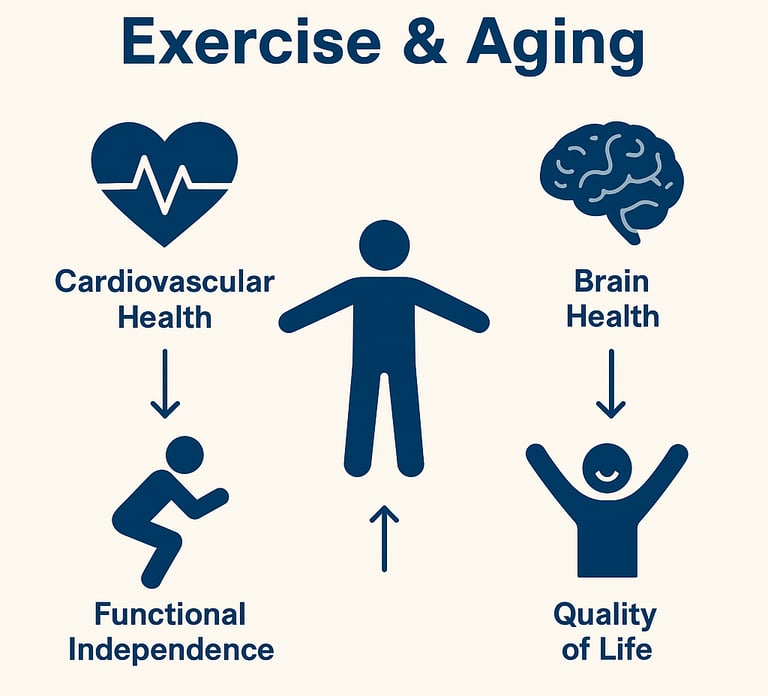
Regular exercise is one of the most powerful, evidence-based tools to support healthy aging, preserve independence, and improve quality of life. Research consistently shows that physical activity benefits nearly every organ system—muscles, bones, heart, and brain—well into advanced age. Importantly, these benefits occur even when exercise is started later in life.
With aging, adults typically lose 3–5% of muscle mass per decade, a process known as sarcopenia, increasing the risk of frailty and falls. Progressive resistance training is the most effective intervention to counter this decline, helping maintain strength, mobility, and functional capacity (Izquierdo et al., 2025). At the same time, aerobic exercise such as walking or cycling improves cardiovascular health and arterial flexibility, with overall physical activity volume showing a stronger association with vascular health than exercise type alone (Hill et al., 2023).
Exercise also plays a critical role in brain health. Regular movement enhances cerebral blood flow, stimulates brain-derived neurotrophic factor (BDNF), and supports neurogenesis, contributing to better memory and reduced cognitive decline risk (Vecchio et al., 2018). Beyond physical benefits, studies show exercise improves mood, reduces depression, and enhances life satisfaction in older adults (Cabo et al., 2025).
In summary, combining strength training, aerobic activity, and balance exercises offers a comprehensive strategy for active aging. Simply put, movement is medicine—and it’s never too late to start.
Clinical Pearls
1. The "Anti-Gravity" Muscle Rule
The Science: To combat sarcopenia (age-related muscle wasting), your body requires "progressive overload." This means muscles only grow when they are forced to handle more than they are used to.
The Pearl: Your muscles don't care if you're 25 or 85; they respond to the same biological signals. To stay independent, prioritize Resistance Training over light cardio. If you can do more than 15 repetitions of an exercise easily, it’s time to slightly increase the weight or resistance. Strength is the "armor" that protects your joints and metabolism.
2. The "BDNF" Brain Fertilizer
The Science: Aerobic exercise triggers the release of Brain-Derived Neurotrophic Factor (BDNF), a protein that supports the survival of existing neurons and encourages the growth of new ones (neurogenesis).
The Pearl: Think of a brisk walk as a "growth serum" for your brain. While crosswords are great, physical movement is actually more effective at preventing cognitive decline because it physically remodels the brain’s architecture, specifically in the hippocampus—the center for memory.
3. Volume Beats Intensity for Your Arteries
The Science: Arterial stiffness is a major predictor of stroke and heart disease. Research shows that total daily movement volume is more closely linked to flexible arteries than short, high-intensity workouts.
The Plot: You cannot "out-train" a sedentary day with one 30-minute gym session. To keep your cardiovascular system "young" and elastic, prioritize low-level activity throughout the day—gardening, walking the dog, or taking the stairs. Consistency in movement is the best "lube" for your circulatory pipes.
4. Specificity in "Functional" Movement
The Science: The nervous system operates on the principle of specificity. If you want to be better at getting out of a car, a bicep curl won't help as much as a squat.
The Pearl: Train for the life you want to lead. Exercises like the "Farmer’s Carry" (walking while holding weights) directly translate to carrying groceries, while single-leg stands translate to fall prevention. If an exercise doesn't look like a real-world movement, it’s a "luxury" workout; if it does, it’s a "necessity."
5. The Anabolic Window is Always Open
The Science: Older adults often experience "Anabolic Resistance," where the body becomes less efficient at turning protein and exercise into muscle.
The Pearl: You are never "too old" for the body to respond to a workout. While the response might be slower than it was at age 20, the biological pathways for repair and growth remain active throughout the human lifespan. The most dangerous myth of aging is that "the damage is done." In reality, your body is in a constant state of turnover, waiting for the right stimulus to rebuild.
Why Exercise Matters More as We Age
The Science of Aging: How Exercise Changes Everything
Before diving into specific benefits, it's important to understand what happens to our bodies as we age. After age 30, most adults lose 3-5% of muscle mass per decade, with the rate accelerating after 60. Bone density decreases, cardiovascular efficiency declines, and neural plasticity—the brain's ability to form new connections—slows. For many, these changes feel inevitable.
But here's the remarkable truth: physical activity for older adults interrupts nearly every one of these aging processes. Research increasingly demonstrates that exercise isn't just beneficial—it's transformative.
Study 1: Arterial Stiffness and the Power of Physical Activity
Key Research Finding
One of the most striking discoveries in recent research examines what matters most for cardiovascular health in aging populations. The investigation assessed whether strength training, balance work, body composition, or general physical activity had the strongest relationship with arterial stiffness—a major risk factor for heart disease and stroke.
The results were striking: physical activity had a significantly stronger correlation with arterial stiffness than strength training, balance work, or BMI (Hill et al., 2023). This finding surprised many in the fitness world who assumed that strength training would dominate. Instead, the volume and consistency of general physical activity emerged as the most important factor for maintaining healthy, flexible arteries as we age.
What This Means for You
This research suggests that simply moving more throughout your day—walking, gardening, climbing stairs, recreational activities—may provide cardiovascular benefits that specialized training cannot match. While strength and balance work remain important, the total volume of physical activity is paramount for heart health. Older adults should prioritize consistency and variety in movement rather than obsessing exclusively over structured workouts.
Key Takeaway
Physical activity duration matters more than training type for arterial health. Aim for consistent, varied movement throughout your day for optimal cardiovascular benefits.
Study 2: Neuroprotection and Brain Health Through Exercise
Key Research Finding
As we age, the brain naturally undergoes changes. Cognitive decline, memory loss, and increased risk of neurodegenerative diseases concern many older adults. Recent neurobiological research demonstrates that exercise provides neuroprotective effects—essentially serving as a shield for brain health throughout the aging process (Vecchio et al., 2018).
The mechanisms are fascinating: physical activity increases blood flow to the brain, promotes neurogenesis (the creation of new brain cells), reduces neuroinflammation, and stimulates the production of protective proteins like brain-derived neurotrophic factor (BDNF). These aren't theoretical benefits—they're observable, measurable changes in brain tissue and function. Exercise enhances brain plasticity, the brain's remarkable ability to reorganize itself and form new neural connections. This has profound implications: it means that through regular physical activity, older adults can literally rewire their brains, building resilience against cognitive decline and potentially offsetting age-related neural changes.
What This Means for You
If you've noticed memory lapses or worried about maintaining mental sharpness, here's the evidence-based reassurance: regular exercise is among the most effective interventions for brain health and cognitive function in aging. The brain responds to physical activity with tangible improvements in structure and function. You're not fighting an inevitable decline—you're actively building neurological resilience.
Key Takeaway
Exercise is a powerful brain protector. Regular physical activity promotes neurogenesis, reduces inflammation, and maintains cognitive function through multiple protective mechanisms.
Study 3: Global Consensus on Optimal Exercise for Healthy Longevity
Key Research Finding
When leading gerontologists, exercise scientists, and public health experts from around the world convened to establish evidence-based guidelines, their consensus was detailed and nuanced. This landmark international agreement identified specific exercise recommendations for healthy aging and longevity (Izquierdo et al., 2025).
The consensus emphasizes that optimal aging requires a multifaceted approach combining different types of physical activity. The recommendations prioritize not just doing any exercise, but strategically combining approaches:
Aerobic activity for cardiovascular health and endurance
Resistance training for muscle preservation and functional capacity
Balance and flexibility work for fall prevention and mobility
Consistency and sustainability as paramount factors
The research makes clear that there is no one-size-fits-all approach. Rather, successful aging through exercise combines multiple modalities tailored to individual capacity, preferences, and health status.
What This Means for You
This consensus gives you permission to stop looking for the "perfect" exercise. Instead, the evidence supports variety and consistency. Whether you prefer swimming, strength training, yoga, tai chi, or walking—the important thing is regular participation in activities that include aerobic challenge, resistance, and balance components.
Key Takeaway
Comprehensive exercise combining aerobic activity, resistance training, and balance work provides optimal benefits for healthy aging. Consistency matters more than intensity.
Study 4: Functional Training for Independence and Quality of Life
Key Research Finding
Independence represents one of the most precious aspects of later life. The ability to get out of a chair unassisted, carry groceries, play with grandchildren, or travel independently differentiates between thriving and merely surviving. Functional training—exercise designed to improve real-world movement patterns—directly addresses this concern.
Recent research demonstrates that functional training supports independence by maintaining the specific muscle groups and movement patterns required for daily living (Brogno, 2025). Unlike abstract strength metrics, functional training improves what actually matters: picking up objects from the floor, maintaining balance while reaching overhead, walking on uneven surfaces, and managing stairs. Older adults who maintain functional strength experience better quality of life, reduced depression, enhanced social engagement, and greater autonomy.
What This Means for You
When choosing exercises, consider whether they translate to daily activities. Squats aren't just about lower body strength—they're about maintaining the ability to use the toilet, get in and out of cars, and rise from chairs. Carries and farmer's walks aren't just forearm exercises—they're about maintaining the ability to handle groceries and carry grandchildren. This practical orientation to exercise for functional ability in aging ensures your workouts translate directly to the activities you love.
Key Takeaway
Functional training preserves independence by maintaining the movement patterns you need for daily life. Choose exercises that mirror real-world activities.
Study 5: Exercise, Health, Quality of Life, and Joy in Aging
Key Research Finding
Exercise is often discussed in clinical terms: blood pressure reduction, muscle gain, bone density improvement. These metrics matter, but they don't capture the complete picture of why movement matters so profoundly in later life.
Recent research explicitly examined how physical exercise enhances quality of life and emotional wellbeing in older adults (Cabo et al., 2025). The findings are powerful: participants engaging in regular physical activity reported significantly improved overall health perception, reduced depression and anxiety, enhanced social connection, and greater life satisfaction. Remarkably, many described their exercise engagement as a source of joy—not obligation.
The research suggests that the benefits of exercise for older adults extend far beyond physical metrics. When older adults commit to regular physical activity, they often experience a ripple effect: improved mood leads to greater social engagement, which reduces isolation, which further improves mental health. Physical capability translates to independence, which restores confidence and purpose.
What This Means for You
If you've been reluctant to start exercising because it seems like another chore, consider this: exercise for aging adults can and should be enjoyable. The research specifically documents that joy and pleasure are legitimate outcomes of regular physical activity. Choose activities you genuinely like, and you're more likely to sustain them—which means more likely to experience the full cascade of physical and emotional benefits.
Key Takeaway
Exercise improves not just physical health but mental wellbeing, emotional resilience, and life satisfaction. Find activities that bring genuine enjoyment.
Study 6: Active Aging Through HIIT vs. Continuous Aerobic Training
Key Research Finding
A common question among older adults considering exercise is: what type of aerobic activity provides the best benefits? Should you pursue steady-state walking, or is high-intensity interval training (HIIT) appropriate and beneficial?
Recent comparative research examined benefits of high-intensity interval training versus continuous aerobic training in older adults (Zoila et al., 2025). The research provides nuanced findings: both approaches provide cardiovascular benefits and improve aerobic capacity. However, they appear to offer somewhat different profiles of benefits.
High-intensity interval training in appropriately prepared older adults can deliver cardiovascular improvements in less total exercise time. Continuous aerobic training, conversely, provides sustained aerobic challenge with lower injury risk. The optimal choice depends on individual fitness level, health status, and preferences. Importantly, the research confirms that active aging through exercise isn't limited to gentle, low-intensity approaches. Properly prepared older adults can benefit from challenging workouts. Simultaneously, those preferring steady-state activity achieve meaningful benefits as well.
What This Means for You
Don't assume your age automatically eliminates certain training approaches. With proper progression and attention to individual capacity, many older adults can incorporate interval training. Simultaneously, if you prefer consistent, moderate-intensity activity, that approach is equally valid. The research supports both—the key is finding an approach you'll maintain consistently.
Key Takeaway
Both HIIT and continuous aerobic training benefit older adults; choice depends on fitness level, health status, and preference. Proper progression ensures safety regardless of approach.
Comprehensive Benefits of Exercise for Aging Adults: What the Research Demonstrates
The collective body of research reveals that exercise for aging provides a comprehensive cascade of benefits:
Cardiovascular Benefits: Physical activity improves arterial flexibility, reduces blood pressure, enhances heart function, and decreases cardiovascular disease risk.
Cognitive Benefits: Exercise promotes neurogenesis, reduces neuroinflammation, improves cognitive function, and may reduce dementia risk.
Musculoskeletal Benefits: Resistance training preserves muscle mass, maintains bone density, improves functional capacity, and enhances balance.
Metabolic Benefits: Regular activity improves glucose metabolism, reduces diabetes risk, and helps maintain healthy body composition
.
Mental Health Benefits: Exercise reduces depression and anxiety, improves sleep quality, and enhances overall life satisfaction.
Functional Benefits: Physical activity preserves independence, maintains mobility, and enables continued participation in valued activities.
Social Benefits: Group exercise provides connection, reduces isolation, and supports psychological wellbeing.
Practical Implementation: How to Start and Sustain an Exercise Program
Understanding research benefits matters little without practical implementation. Here's how to translate the science into sustainable practice:
Start Where You Are: Regardless of current fitness level, the benefits begin immediately. You don't need to become an athlete—modest increases in activity provide measurable benefits.
Combine Multiple Modalities: Include aerobic activity (walking, swimming, cycling), resistance training (weights, bands, bodyweight), and balance work (yoga, tai chi, standing exercises).
Prioritize Consistency Over Intensity: Research consistently demonstrates that showing up regularly matters more than dramatic intensity. Three weekly sessions of moderate activity beats one intense session weekly.
Choose Activities You Enjoy: Sustainability depends on enjoyment. If you hate running, walk. If weights feel boring, try functional circuits or dance. If gyms intimidate you, exercise at home. The best exercise is the one you'll actually do.
Progress Gradually: Small, consistent increases in challenge—adding weight, duration, or intensity—provide continued benefits and prevent adaptation plateaus.
Include Recovery: Quality sleep, adequate nutrition, and rest days support adaptation and injury prevention.
Make It Social: Exercising with others provides accountability, enjoyment, and social connection.
Consult Your Healthcare Provider: Before starting a new exercise program, especially if you have health conditions, discuss your plans with your doctor.
Common Questions: FAQs About Aging and Exercise
Q: Is it ever too late to start exercising?
A: No. Research demonstrates benefits begin immediately at any age. Sedentary 80-year-olds who start exercising show measurable improvements within weeks.
Q: How much exercise do I need?
A: Current recommendations suggest at least 150 minutes weekly of moderate aerobic activity, plus resistance training twice weekly and balance work. However, any increase in activity provides benefits—perfect is the enemy of good.
Q: Is strength training safe for older adults?
A: Yes. Properly supervised resistance training is safe and highly beneficial for older adults. Start with appropriate loads and progress gradually.
Q: Can I do HIIT if I'm older?
A: Possibly, but it depends on fitness level and health status. Consult your healthcare provider and start conservatively, building gradually.
Q: What if I have arthritis or chronic pain?
A: Many exercises can be modified for joint issues. Water-based exercise, gentle yoga, and resistance training with modifications often work well. Consult a physical therapist for personalization.
Q: How long before I notice benefits?
A: Cardiovascular benefits begin within weeks. Strength gains appear within 2-3 weeks. Mental health improvements often emerge quickly. Maintain consistency for optimal results.
Q: Can exercise really prevent cognitive decline?
A: Research demonstrates that exercise supports brain health and reduces decline risk. While not guaranteed prevention, it's among the most effective interventions available.
Q: What's the best time of day to exercise?
A: Consistency matters more than timing. Exercise when you're most likely to do it and maintain it.
Q: Do I need a gym membership?
A: No. Walking, home bodyweight exercises, and online fitness classes provide excellent benefits without gym access.
The Bottom Line: Your Body's Potential Never Expires
Aging is inevitable. Decline is not. The remarkable truth emerging from modern aging and exercise research is that the human body—at any age—retains tremendous plasticity and responsiveness to physical activity. Your muscles can grow, your cardiovascular system can strengthen, your brain can build new neural connections, and your functional capacity can improve.
The research is unequivocal: exercise for older adults isn't optional—it's one of the most powerful interventions available for maintaining health, independence, cognitive function, and quality of life. Whether you're 55 or 95, sedentary or already active, the next chapter of your aging story hasn't been written yet.
Author’s Note
This article is written to bridge the gap between scientific evidence and everyday practice for older adults and their families. Aging is often portrayed as an unavoidable decline, but modern research in exercise physiology, gerontology, and neuroscience tells a far more hopeful story. The human body retains a remarkable capacity to adapt to physical activity well into later life—at the level of muscle, blood vessels, and even the brain.
The recommendations presented here are grounded in peer-reviewed research and international consensus guidelines, yet they are intentionally framed in a practical, patient-friendly manner. Exercise is not presented as a one-size-fits-all prescription, nor as an athletic pursuit, but as a powerful, accessible form of preventive medicine that can be tailored to individual abilities, preferences, and health conditions.
Importantly, this article emphasizes consistency, functional movement, and enjoyment over intensity or perfection. Small, regular increases in physical activity can lead to meaningful improvements in strength, balance, cardiovascular health, cognitive function, and overall quality of life.
Readers are encouraged to view exercise not as an obligation, but as an investment in independence, dignity, and well-being. When health conditions are present, guidance from a healthcare professional is advised to ensure safety and personalization.
Medical Disclaimer
The information in this article, including the research findings, is for educational purposes only and does not constitute medical advice, diagnosis, or treatment. Before starting any new strength training exercise program, you must consult with a qualified healthcare professional, especially if you have existing health conditions (such as cardiovascular disease, uncontrolled hypertension, or advanced metabolic disease). Exercise carries inherent risks, and you assume full responsibility for your actions. This article does not establish a doctor-patient relationship.
Related Articles
Fasted vs. Fed Exercise: Does Training on an Empty Stomach Really Burn More Fat? | DR T S DIDWAL
Inspiratory Muscle Training: Benefits for Lungs, Heart & Performance | DR T S DIDWAL
How to Build a Disease-Proof Body: Master Calories, Exercise & Longevity | DR T S DIDWAL
Exercise vs. Diet Alone: Which is Best for Body Composition? | DR T S DIDWAL
Movement Snacks: How VILPA Delivers Max Health Benefits in Minutes | DR T S DIDWAL
Anabolic Resistance: Why Muscles Age—and How to Restore Their Growth Response | DR T S DIDWAL
References
Brogno, B. (2025). Aging with strength: Functional training to support independence and quality of life. INQUIRY: The Journal of Health Care Organization, Provision, and Financing, 62. https://doi.org/10.1177/00469580251348133
Cabo, C. A., Tomas-Carus, P., Fernandes, O., et al. (2025). The role of physical exercise in enhancing health, quality of life and joy among older adults. Scientific Reports, 15, 42495. https://doi.org/10.1038/s41598-025-26683-w
Hill, H., Elliot, C. A., Lizamore, C. A., & Hamlin, M. J. (2023). Physical activity has a stronger correlation with arterial stiffness than strength, balance, or BMI in an older population. Frontiers in Aging, 4, 1279479. https://doi.org/10.3389/fragi.2023.1279479
Izquierdo, M., de Souto Barreto, P., Arai, H., Bischoff-Ferrari, H. A., Cadore, E. L., Cesari, M., Chen, L. K., Coen, P. M., Courneya, K. S., Duque, G., Ferrucci, L., Fielding, R. A., García-Hermoso, A., Gutiérrez-Robledo, L. M., Harridge, S. D. R., Kirk, B., Kritchevsky, S., Landi, F., Lazarus, N., Liu-Ambrose, T., & Fiatarone Singh, M. A. (2025). Global consensus on optimal exercise recommendations for enhancing healthy longevity in older adults (ICFSR). The Journal of Nutrition, Health & Aging, 29(1), 100401. https://doi.org/10.1016/j.jnha.2024.100401
Vecchio, L. M., Meng, Y., Xhima, K., Lipsman, N., Hamani, C., & Aubert, I. (2018). The neuroprotective effects of exercise: Maintaining a healthy brain throughout aging. Brain Plasticity, 4(1), 17–52. https://doi.org/10.3233/BPL-180069
Zoila, F., Filannino, F. M., Panaro, M. A., Sannicandro, I., Cianciulli, A., & Porro, C. (2025). Enhancing active aging through exercise: A comparative study of high-intensity interval training and continuous aerobic training benefits. Frontiers in Aging, 6, 1493827. https://doi.org/10.3389/fragi.2025.1493827