Anabolic Resistance: Why Muscles Age—and How to Restore Their Growth Response
Discover why ageing muscles stop responding to protein and exercise — and the science-backed strategies that restore strength, muscle growth, and metabolic health.
AGING
Dr. T.S. Didwal, M.D.(Internal Medicine)
5/17/202618 min read
Many adults believe muscle loss is simply an unavoidable part of ageing — a slow and irreversible decline that begins sometime after 40. The weights that once felt manageable suddenly feel heavier. Recovery takes longer. Muscle mass shrinks despite eating “healthy” and staying active. But modern muscle biology tells a far more hopeful story. In many cases, the problem is not that ageing muscles cannot grow — it is that they no longer hear the growth signal as clearly as they once did.
Scientists now recognise this phenomenon as age-related anabolic resistance — a condition in which skeletal muscle becomes less responsive to dietary protein and resistance exercise, the two primary drivers of muscle protein synthesis and muscle hypertrophy (Aragon et al., 2023). This process contributes directly to sarcopenia, the age-related loss of muscle mass, strength, and metabolic health that increases the risk of frailty, falls, insulin resistance, Type 2 diabetes, and loss of independence later in life.
At the cellular level, ageing muscle undergoes profound biological changes. The mTORC1 signalling pathway becomes less responsive, mitochondrial function declines, and chronic low-grade inflammation — often called inflammaging — interferes with muscle repair and recovery (Deane et al., 2024). A landmark 2026 systematic review by Kristiansen and colleagues confirmed that older adults experience significantly blunted muscle protein synthesis compared with younger individuals, even when consuming similar amounts of protein.
Yet the most important discovery is this: anabolic resistance is highly modifiable. Research now shows that optimised protein intake, leucine-rich nutrition, progressive resistance training, and recovery-focused lifestyle strategies can reactivate muscle-building pathways well into older age (Perez-Castillo et al., 2025). In other words, your muscles may be ageing — but they are far from finished.
The 4 Pillars of Beating Anabolic Resistance
Higher protein
Leucine threshold
Progressive resistance training
Recovery and inflammation control
What Is Anabolic Resistance? The Science Explained Simply
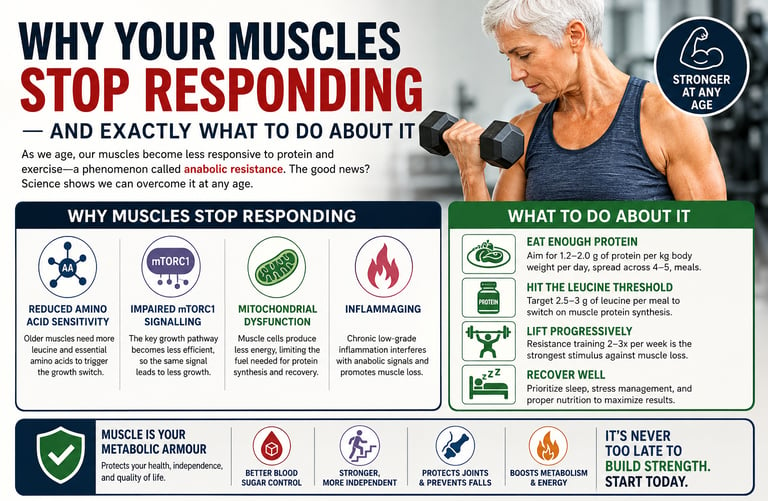
Anabolic resistance refers to the blunted or diminished muscle protein synthesis (MPS) response that occurs when older adults consume protein or engage in resistance training. Think of your muscle's growth receptors as a radio volume dial. In your twenties, the dial is exquisitely sensitive — a moderate dose of protein or a solid workout sends a clear, loud signal for muscle repair and growth. As decades pass, that dial gradually turns down. The same signal becomes muffled. To trigger meaningful muscle building, you must turn the volume up — not with a different radio, but with a stronger, smarter stimulus.
This analogy, while simple, accurately reflects what is happening at the molecular level. Aragon et al. (2023) posed the defining question in their landmark review: Is age-related muscle anabolic resistance inevitable or preventable? Their comprehensive analysis of the available evidence concluded that while age-related cellular changes are real and measurable, their severity and clinical impact are not predetermined. Multiple therapeutic strategies and lifestyle behaviours can substantially shift outcomes — and that conclusion has only grown stronger with subsequent research.
The Four Cellular Mechanisms Behind Anabolic Resistance
Understanding what changes inside an ageing muscle helps clarify why standard approaches often fall short — and what targeted solutions must address.
1. Reduced Amino Acid Sensitivity
Ageing muscles exhibit markedly diminished responsiveness to essential amino acids, particularly leucine — the branched-chain amino acid that acts as the biological 'on switch' for the mTORC1 growth pathway. Where a younger muscle may respond to 1.5 g of leucine per meal, an older muscle may require 3 to 4 g to achieve the same activation threshold (Deane et al., 2024). This explains why simply eating 'enough protein' by general dietary guidelines is frequently insufficient for older adults.
2. Impaired mTORC1 Signalling
The mTORC1 pathway is the molecular master switch that coordinates muscle protein synthesis in response to nutrition and exercise. In ageing muscle, this pathway functions with measurably reduced efficiency. Even when amino acids are present in circulation, the downstream signalling cascade that converts their arrival into actual tissue building is slower, weaker, and shorter-lived (Deane et al., 2024; Kristiansen et al., 2026).
3. Mitochondrial Dysfunction
Muscle protein synthesis is energetically expensive. Ageing muscles suffer from compromised mitochondrial health — the cellular powerhouses produce less energy, more inefficiently. This energy deficit limits the capacity to sustain protein synthesis even when all other signals are present. Poor mitochondrial function also contributes to fatigue, reduced exercise capacity, and slower recovery.
4. Inflammaging: Chronic Low-Grade Inflammation
Persistent, low-grade systemic inflammation — a hallmark of biological ageing — actively suppresses anabolic signals. Pro-inflammatory cytokines interfere with mTORC1 activation and promote muscle protein breakdown. This creates a vicious cycle: sarcopenia and poor metabolic health drive inflammation, which in turn worsens anabolic resistance. Addressing inflammation through nutrition, exercise, sleep, and stress management is therefore not optional — it is central to any anti-sarcopenia strategy.
The Systems-Level View
A 2025 systems modelling study (bioRxiv) demonstrated that anabolic resistance is not the product of any single broken mechanism. Rather, it emerges from multiple factors — nutritional inadequacies, declining testosterone and growth hormone, reduced physical activity, and impaired metabolic flexibility — all interacting and compounding over time. This is precisely why interventions targeting multiple pathways simultaneously prove most effective. Single-lever solutions underperform; integrated strategies win.
The Nutrition Strategy: What the Latest Research Actually Recommends
How Much Protein Do Older Adults Really Need?
The standard dietary recommendation of 0.8 g of protein per kilogram of body weight per day was designed for general population adequacy, not for overcoming anabolic resistance in ageing muscle. Current evidence strongly supports a substantially higher target. Perez-Castillo et al. (2025) conducted a comprehensive review of nutritional and exercise strategies for older adults and identified 1.2 to 2.0 g of protein per kilogram of body weight per day as the appropriate range for those engaging in resistance training. For a 70 kg individual, this translates to approximately 84 to 140 g of total daily protein.
Chen's 2025 analysis of three decades of nutritional intervention research (1992-2025) confirms this trajectory: the research landscape has progressively shifted toward higher protein prescriptions and personalised amino acid profiling as the scientific community has come to better understand the mechanisms of anabolic resistance. The consensus is clear and growing stronger — older muscles require more protein, not less.
Distribution Matters as Much as Total Amount
Many people consume the majority of their daily protein at dinner — a pattern that leaves muscles in a net catabolic state for most of the day. Unlike fat or glycogen, your body has no dedicated protein storage tank. When amino acids are unavailable between meals, muscle tissue is broken down to meet metabolic demands. Distributing protein intake across four to five meals, with each meal providing 25 to 40 g of high-quality protein, ensures the anabolic switch remains activated throughout the day.
The Leucine Threshold: Your Muscle's Biological On-Switch
Not all protein is equal when it comes to waking up ageing muscles. Leucine acts as the primary trigger for mTORC1 activation, and older muscles have a higher activation threshold. Research now suggests that 2.5 to 3 g of leucine per meal represents the minimum effective dose for older adults. Failing to reach this threshold, regardless of total protein consumed, produces a suboptimal anabolic response.
Leucine-Rich Food Sources at a Glance
High-Leucine Animal Protein Sources
Chicken or turkey breast (170 g / 6 oz): 3.5–4.0 g leucine
Lean beef or sirloin (170 g / 6 oz): 3.5–4.5 g leucine
Salmon or tuna fillet (170 g / 6 oz): 3.0–4.0 g leucine
Cottage cheese (1 cup): 2.8–3.0 g leucine
Whey protein isolate (25 g scoop): 2.5–3.0 g leucine
High-Leucine Plant Protein Sources
Firm tofu (1 cup / 250 g): 3.0–3.5 g leucine
Pumpkin seeds (100 g): 2.4 g leucine
Pea protein isolate (25 g scoop): 2.0–2.2 g leucine
Cooked lentils (2 cups): approximately 2.5 g leucine
Practical Tip
If a meal is naturally low in protein, increase its anabolic potential by adding a leucine-rich food source such as:
a boiled egg,
whey protein,
Greek yogurt,
tofu,
or even a tablespoon of pumpkin seeds.
Small additions can help older muscles reach the leucine threshold needed to stimulate muscle protein synthesis and support healthy ageing.
Does Protein Source Matter?
Korzepa et al. (2025) provided a definitive and practically important answer to this question in their randomised controlled trial. Myofibrillar protein synthesis — the type that builds the contractile machinery of muscle — increased significantly following resistance training in middle-aged and older adults regardless of whether they consumed animal-based proteins, plant-based proteins, or mixed sources. Protein source, the research concluded, mattered far less than total intake and the presence of adequate resistance training. This finding is liberating for vegetarians, vegans, and those with dietary restrictions: the pathway to stronger muscle is accessible on any diet that meets quantity and leucine targets.
Exercise: The Most Powerful Stimulus Against Anabolic Resistance
While nutrition provides the building blocks, resistance training remains the single most powerful stimulus for overcoming anabolic resistance. It is the catalyst that transforms dietary protein from inert material into living, contractile muscle. Without it, no nutritional strategy alone can restore the anabolic capacity of ageing muscle.
Why Resistance Training Works: Four Simultaneous Signals
Behringer, Heinrich, and Franz (2025) provided a detailed review of anabolic signals and muscle hypertrophy in the context of sports medicine, identifying four concurrent growth mechanisms that resistance training activates simultaneously:
Mechanical tension: Heavy loads create mechanical stress on muscle fibres, directly activating mTORC1 and satellite cell recruitment
Muscle damage: Controlled micro-damage from resistance exercise triggers an adaptive repair response, laying down new protein strands
Metabolic stress: The metabolic environment during intense exercise (the 'pump') creates additional anabolic signalling through multiple hormonal and cellular pathways
Hormonal responses: Resistance training elevates testosterone, growth hormone, and insulin-like growth factor-1 (IGF-1), all of which augment muscle protein synthesis
Critically, resistance training also dramatically improves insulin sensitivity. A single session of resistance exercise can increase glucose and amino acid uptake in muscle tissue for up to 48 hours afterwards — effectively holding the cellular gate open for the protein consumed during recovery meals. This explains the synergistic relationship between nutrition and exercise: working out today makes your lunch tomorrow more effective at building muscle.
Evidence-Based Training Principles for Older Adults
The research consensus, synthesised across Behringer et al. (2025), Perez-Castillo et al. (2025), and Kristiansen et al. (2026), supports the following practical training framework:
Progressive overload is non-negotiable: Gradually increasing weight, repetitions, or volume is the fundamental driver of continued adaptation. Without progressive challenge, muscles plateau and anabolic signals fade.
Adequate volume: Three to four sets per exercise targeting each major muscle group appear necessary to achieve hypertrophy responses in older adults, contrasting with some research in younger individuals showing single-set effectiveness. Ageing muscles require a stronger stimulus, not a gentler one.
Frequency: Training each muscle group two to three times weekly distributes the anabolic stimulus throughout the week. Full-body sessions performed three times weekly or an upper-lower split performed twice weekly both achieve this.
Recovery investment: Seven to nine hours of quality sleep per night, effective stress management, and structured nutrition during recovery windows are not luxuries — they are the conditions under which muscle is actually built. The training stimulus is meaningless without adequate recovery.
The Lifelong Exerciser Advantage
Perez-Castillo et al. (2025) found that older adults who had maintained consistent exercise habits throughout their lives showed meaningfully better anabolic responsiveness to protein compared to sedentary age-matched peers. This suggests that chronic exercise training actively preserves or even partially restores the sensitivity of ageing muscle to anabolic stimuli. The earlier you invest in consistent training, the better your biological starting point in later decades — though even those beginning later in life show significant and measurable gains.
The Synergy Equation: Why Nutrition + Exercise Equals Far More Than the Sum of Parts
Perhaps the most important practical message across all of the research reviewed here is that nutrition and exercise are not independent variables — they are multiplicative factors. Protein intake stimulates muscle protein synthesis most powerfully when combined with resistance training. Exercise sensitises muscle to the amino acids that follow. The two must be optimised together.
Consider a practical illustration: an older adult consuming 1.6 g of protein per kilogram of body weight daily, distributed across five meals. Without resistance training, this level of protein intake produces modest muscle protein synthesis — adequate to slow loss, but insufficient to drive meaningful gain. Combined with consistent progressive resistance training, the same protein intake produces substantially greater hypertrophy and strength gains. Conversely, someone performing excellent strength training without adequate protein limits their results in the opposite direction. Both variables must be addressed. Neither is optional.
The scientometric analysis by Chen (2025), encompassing 33 years of nutritional intervention research, confirms that the combination of personalised protein strategies with structured resistance training represents the dominant evidence-based approach in the contemporary literature — and that this conclusion has become progressively stronger with each passing decade of research.
Frequently Asked Questions
1. Is it too late to start building muscle in my 60s or 70s?
Absolutely not. Research consistently shows that older adults — even those beginning resistance training later in life — respond with meaningful muscle hypertrophy and strength gains when nutrition and training are appropriately optimised. The magnitude of response may be somewhat smaller than in younger individuals, but the improvement trajectory can be substantial, clinically significant, and life-changing in terms of functional independence and metabolic health. The question is never whether to start. It is simply when — and the answer is always now.
2. How much protein do I actually need per day?
Current evidence from Perez-Castillo et al. (2025) and Kristiansen et al. (2026) supports a target of 1.2 to 2.0 g of protein per kilogram of body weight daily for older adults engaged in resistance training. A 70 kg (154 lb) person should aim for 84 to 140 g per day, distributed across four to five meals. This means roughly 20 to 35 g of protein per meal — an achievable target with practical meal planning.
3. Does the source of protein matter — can I build muscle on a plant-based diet?
Yes. Korzepa et al. (2025) demonstrated in a randomised controlled trial that myofibrillar protein synthesis rates were equivalent across animal, plant, and mixed protein sources in older adults, provided total intake and resistance training were adequate. The key for plant-based eaters is ensuring that leucine thresholds are met — this may require slightly larger portions of plant proteins or the use of leucine-enriched protein supplements, as plant proteins are generally less leucine-dense than animal sources gram-for-gram.
4. How often should older adults train?
Training each major muscle group two to three times per week appears optimal based on current evidence. This can take the form of three full-body resistance sessions weekly, or an upper-lower split performed on four days. The critical variables are consistency and progressive challenge over time — not extreme frequency or excessive session length. A well-designed 45-minute session, performed consistently, outperforms sporadic two-hour efforts.
5. Can I just use nutritional supplements to overcome anabolic resistance without exercising?
Unfortunately, no. While optimised nutrition is essential, it cannot replace the mechanical stimulus that resistance training provides. Exercise is the trigger that initiates the anabolic cascade — protein and amino acids are the raw material that follows. Removing either element significantly degrades the outcome. Supplements such as creatine, leucine, and vitamin D may provide additional support within a comprehensive programme, but they are adjuncts, not substitutes, for structured training.
6. How long will it take to see results?
Measurable improvements in muscle strength typically become apparent within two to three weeks of consistent resistance training, even before visible changes in muscle size. Meaningful hypertrophy — visible increases in muscle fullness and functional improvements — generally becomes apparent between six and twelve weeks for most older adults. Metabolic improvements, including better blood sugar control and reduced fatigue, often arrive even sooner. Setting a twelve-week commitment as an initial target is both scientifically reasonable and psychologically motivating.
7. What if I have joint pain, arthritis, or mobility limitations?
Modified resistance training — using machines rather than free weights, reducing range of motion, adjusting angles, or incorporating isometric contractions — can effectively stimulate muscle protein synthesis even in the presence of physical limitations. The anabolic stimulus does not require pain-free full-range movement; it requires mechanical load applied to the muscle. A qualified physiotherapist or certified personal trainer with experience in older adult populations can design a programme that works safely around your specific limitations. The goal is not perfect form — it is consistent, progressive, safe load.
Practical Applications: Your 12-Week Action Plan
Weeks 1 to 2: Assess, Plan, and Establish Your Baseline
1. Calculate your current daily protein intake using a food diary or tracking app. Identify gaps against the 1.2 to 2.0 g per kg target.
2. Evaluate your current meal distribution. Are you front-loading protein at dinner? Plan to redistribute across four to five eating occasions.
3. Establish baseline strength in three to four major movements — squat, press, row, and hinge — so you can measure progressive overload objectively.
4. Obtain medical clearance from your GP or physician if you have cardiovascular, metabolic, or musculoskeletal conditions before beginning a new training programme.
Weeks 3 to 4: Begin Implementation
5. Restructure meals to include 25 to 35 g of high-quality protein at each eating occasion, with particular attention to the leucine content of each meal.
6. Begin resistance training three times per week, focusing on compound movements (squats, deadlifts, rows, presses) that engage the largest muscle groups.
7. Prioritise sleep: establish a consistent seven-to-nine-hour schedule and treat it as part of your training programme, not a separate lifestyle factor.
8. Start tracking both training volume (sets, reps, weight) and daily protein intake to create accountability and enable progressive adjustment.
Month 2 and Beyond: Progressively Optimise
9. Add weight, repetitions, or an additional set to your training programme every one to two weeks, maintaining the principle of progressive overload.
10. Reassess body composition and strength benchmarks at weeks six and twelve. Adjust protein intake and meal distribution based on your individual response.
11. Consider consulting a registered sports dietitian for personalised protein periodisation around your training sessions.
12. Explore anti-inflammatory nutritional additions — omega-3 fatty acids, colourful vegetables rich in polyphenols, and vitamin D — to address the inflammaging component of anabolic resistance.
The Metabolic Armour Mindset
Reframe your relationship with resistance training. Muscle is not simply an aesthetic concern. It is your body's largest sink for blood glucose, making it the most powerful tool available for preventing and managing Type 2 diabetes. It is the primary determinant of your resting metabolic rate. It is the structural armour that protects joints, prevents falls, and preserves independence in later decades. Every session of resistance training is an investment in metabolic health — not vanity. Treat it accordingly.
Clinical pearls
1. The "Volume Dial" Shift: It’s Not a Loss of Potential, It’s a Need for a Louder Signal
The Science: Age-related anabolic resistance is characterized by a blunted muscle protein synthesis (MPS) response to normal physiological stimuli. The intracellular signaling cascade—specifically the mTORC1 pathway—becomes desensitized to standard amounts of circulating amino acids and mechanical tension.
Think of your muscle growth receptors as a radio volume dial. In your 20s, the dial is highly sensitive; a small protein snack or a light workout sends a loud, clear signal to maintain or build muscle. As we age, that dial naturally gets turned down. The radio isn't broken, but the signal is muffled. To get the same "volume" of muscle repair, you don't need a new radio—you just need to turn up the volume by providing a stronger, more targeted protein and exercise stimulus.
2. The Leucine "On-Switch": Reaching the Threshold vs. Amassing Total Volume
The Science: Leucine is the primary branched-chain amino acid responsible for triggering the molecular "on-switch" for muscle hypertrophy. While younger muscle requires only about 1.5g of leucine to maximize MPS, aging muscle exhibits reduced amino acid sensitivity, requiring 2.5g to 4.0g of leucine per feeding to clear the "leucine trigger" threshold.
When it comes to protecting aging muscle, eating "enough" total daily protein isn't enough if it's spread out too thin. Your muscles need a specific concentration of a key amino acid called leucine in a single sitting to spark growth. Missing this meal-specific threshold is like flicking a light switch halfway up—the light won't turn on. Prioritizing leucine-rich foods (like chicken, lean beef, salmon, cottage cheese, or tofu) ensures you actually trigger the muscle-building process at every meal.
3. Protein Distribution over Compounding: Moving Beyond the "Big Dinner" Habit
The Science: Unlike carbohydrates or fats, the human body has no dedicated storage reservoir for protein. Skeletal muscle undergoes continuous turnover between muscle protein breakdown (MPB) and MPS. Because older adults require higher per-meal protein boluses (25g to 40g) to stimulate MPS, back-loading daily protein intake into one large evening meal leaves the body in a net catabolic (breakdown) state for the majority of the day.
Many people eat a light breakfast, a modest lunch, and a massive dinner. However, your body can't store extra protein from dinner to use the next morning. To prevent your body from breaking down your existing muscle for fuel, you need to space out your protein evenly. Aiming for 4 to 5 smaller, protein-rich meals or snacks throughout the day keeps the muscle-building machinery running continuously, rather than letting it sit idle until dinner.
4. The 48-Hour "Open Gate": Resistance Exercise as a Nutritional Sensitizer
The Science: Progressive resistance training activates four concurrent growth mechanisms: mechanical tension, controlled micro-damage, metabolic stress, and systemic hormonal responses. Crucially, a single session of resistance exercise enhances muscle insulin sensitivity and amino acid transport, effectively "sensitizing" aging tissue to subsequent protein feedings for up to 48 hours.
Think of resistance training as the ultimate key that unlocks your muscle cells. Without exercise, consuming protein provides the raw building blocks, but the doors to the muscle are mostly shut. Lifting weights or doing resistance exercises effectively holds the cellular gates wide open for up to two days. This means the exercise you do today acts as a metabolic amplifier, making the protein you eat tomorrow significantly more effective at building and preserving strength.
5. Overcoming "Inflammaging": Muscle as a Metabolic Shield
The Science: Biological aging is often accompanied by inflammaging—a state of chronic, low-grade systemic inflammation characterized by elevated pro-inflammatory cytokines. These cytokines actively interfere with downstream anabolic signaling and accelerate muscle wasting. Conversely, skeletal muscle acts as the body's primary sink for blood glucose and a major driver of resting metabolic rate, directly counteracting metabolic dysfunction.
Patient Perspective: Chronic, low-grade inflammation acts like a quiet, internal rust that actively degrades muscle tissue and blocks growth signals. Building muscle is about much more than vanity or looking fit; it is your body's structural armor. Muscle acts as a massive sponge that soaks up excess blood sugar, fighting off inflammation and metabolic diseases like Type 2 diabetes. When you lift weights, you are directly polishing away that internal "rust" and protecting your functional independence.
6. Sourcing Versatility: Quantity and Stimulus Trumps Protein Origin
The Science: Landmark randomized controlled trials (such as Korzepa et al., 2025) demonstrate that post-exercise myofibrillar protein synthesis rates are statistically equivalent regardless of whether the protein source is animal-based, plant-based, or a mixed dietary blend—provided that total protein volume is achieved and the leucine threshold is met.
There is a common myth that you must eat meat to build or retain quality muscle as you age. The latest clinical data offers incredibly liberating news: your muscles don't care where the protein comes from, as long as you get enough of it and pair it with strength training. Whether you prefer a plant-based, vegetarian, or omnivorous lifestyle, you can successfully beat anabolic resistance. If you rely primarily on plant proteins, you may just need slightly larger portions or a clean supplement to hit those vital growth-trigger benchmarks.
Key Takeaways
Age-related anabolic resistance is real and measurable — confirmed by Kristiansen et al. (2026) in the most comprehensive systematic review and meta-analysis published to date — but it is modifiable, not inevitable (Aragon et al., 2023).
Multiple cellular mechanisms underlie anabolic resistance, requiring multifaceted solutions that address nutrition, exercise, recovery, and inflammation simultaneously (Deane et al., 2024).
Older adults require significantly higher protein intake (1.2 to 2.0 g per kg body weight) distributed across four to five meals throughout the day, with attention to leucine content at each meal (Perez-Castillo et al., 2025).
Protein source is less important than total intake and training stimulus — muscle can be built effectively on animal, plant, or mixed dietary patterns (Korzepa et al., 2025).
Resistance training is the most powerful anabolic stimulus available, triggering four simultaneous growth pathways and sensitising muscle to dietary protein for 24 to 48 hours post-exercise (Behringer et al., 2025).
The combination of optimised nutrition and progressive resistance training produces synergistic effects far exceeding either intervention alone, a conclusion supported by 33 years of accumulated nutritional research (Chen, 2025).
Lifelong exercisers maintain superior anabolic responsiveness — the earlier and more consistently you train, the stronger your biological resilience in later decades (Perez-Castillo et al., 2025).
Take Action — Your Engagement Checklist
Share this article with someone over 50 who could benefit from understanding the science of muscle loss and healthy ageing. Awareness is the first step toward prevention.
Calculate your daily protein target today by multiplying your body weight in kilograms by 1.5. This provides a practical, evidence-based starting point for supporting muscle protein synthesis and metabolic health.
Commit to three resistance training sessions this week — even short sessions count. Consistency matters far more than perfection or duration.
Follow for more evidence-based longevity and metabolic health content, including upcoming articles on sarcopenia, mitochondrial function, healthy ageing, insulin resistance, and strength training science.
Leave a comment or question below. Our medical team reviews reader feedback carefully, and your questions help shape future evidence-based content.
A Clinician’s Perspective
In clinical practice, one of the most common frustrations I hear from patients over 50 is this: “I’m exercising and eating reasonably well — so why am I still losing muscle and strength?” For years, many people blamed themselves, assuming declining muscle mass was simply an unavoidable consequence of ageing or a lack of discipline. Modern physiology tells a very different story.
Age-related anabolic resistance is real, measurable, and biologically complex. Ageing muscle becomes less responsive to dietary protein and resistance exercise due to impaired mTORC1 signalling, mitochondrial dysfunction, hormonal changes, reduced physical activity, and chronic low-grade inflammation. Importantly, this process affects far more than appearance or athletic performance. Loss of skeletal muscle is strongly linked to insulin resistance, Type 2 diabetes, frailty, falls, osteoporosis, reduced metabolic rate, hospitalisation risk, and loss of independence later in life.
The encouraging reality is that muscle ageing is remarkably modifiable. Across both research and real-world clinical settings, I have seen older adults significantly improve strength, mobility, glucose control, balance, and quality of life through evidence-based interventions centred on progressive resistance training, adequate protein intake, sleep optimisation, and long-term consistency. Even patients beginning in their 60s or 70s can achieve clinically meaningful improvements in muscle function and metabolic health.
One of the most important shifts patients can make is reframing resistance training as preventive medicine rather than optional fitness. Skeletal muscle is a metabolic organ central to healthy ageing. Preserving it is not vanity — it is one of the most powerful investments you can make in longevity, resilience, and functional independence.
Disclaimer: This article is for informational purposes only and should not replace professional medical advice. Always consult with qualified healthcare providers before starting any new treatment program, especially if you have existing health conditions or take medications.
Related Articles
Vitamin D Deficiency and Sarcopenia: The Critical Connection | DR T S DIDWAL
How to Prevent Sarcopenia: Fight Age-Related Muscle Loss and Stay Strong | DR T S DIDWAL
Who Gets Sarcopenia? Key Risk Factors & High-Risk Groups Explained | DR T S DIDWAL
Sarcopenia: The Complete Guide to Age-Related Muscle Loss and How to Fight It | DR T S DIDWAL
References
Aragon, A. A., Tipton, K. D., & Schoenfeld, B. J. (2023). Age-related muscle anabolic resistance: Inevitable or preventable? Nutrition Reviews, 81(4), 441–454. https://doi.org/10.1093/nutrit/nuac062
Behringer, M., Heinrich, C., & Franz, A. (2025). Anabolic signals and muscle hypertrophy - Significance for strength training in sports medicine. Sports Orthopaedics and Traumatology, 41(1), 9–18. https://doi.org/10.1016/j.orthtr.2025.01.002
Chen, W. (2025). Nutritional interventions in muscle hypertrophy research: A scientometric analysis within the context of resistance training (1992–2025). Journal of Health, Population and Nutrition, 44, Article 272. https://doi.org/10.1186/s41043-025-01031-w
Deane, C. S., Cox, J., & Atherton, P. J. (2024). Critical variables regulating age-related anabolic responses to protein nutrition in skeletal muscle. Frontiers in Nutrition, 11, Article 1419229. https://doi.org/10.3389/fnut.2024.1419229
Exploring the multifactorial causes and therapeutic strategies for anabolic resistance in sarcopenia: A systems modelling study. (2025). bioRxiv. https://doi.org/10.1101/2025.09.12.675977v1
Korzepa, M., Quinlan, J. I., Marshall, R. N., Rogers, L. M., Belfield, A. E., Elhassan, Y. S., Lawson, A., Ayre, C., Senden, J. M., Goessens, J. P. B., Glover, E. I., Wallis, G. A., van Loon, L. J. C., & Breen, L. (2025). Resistance training increases myofibrillar protein synthesis in middle-to-older aged adults consuming a typical diet with no influence of protein source: A randomized controlled trial. The American Journal of Clinical Nutrition. Advance online publication. https://doi.org/10.1016/j.ajcnut.2025.04.019
Kristiansen, K. K., Vissing, K., & Nielsen, J. L. (2026). Age-related anabolic resistance and post-absorptive muscle protein synthesis: Integrative evidence from a systematic review and meta-analysis. Frontiers in Physiology, 17, Article 1740284. https://doi.org/10.3389/fphys.2026.1740284
Perez-Castillo, I. M., Rueda, R., Pereira, S. L., Bouzamondo, H., Lopez-Chicharro, J., Segura-Ortiz, F., & Atherton, P. J. (2025). Age-related anabolic resistance: Nutritional and exercise strategies, and potential relevance to life-long exercisers. Nutrients, 17(22), Article 3503. https://doi.org/10.3390/nu17223503