Inspiratory Muscle Training: Benefits for Lungs, Heart & Performance
Discover how inspiratory muscle training (IMT) strengthens the diaphragm, lowers blood pressure, improves COPD outcomes, and enhances athletic performance—backed by 2025 research.
EXERCISE
Dr. T.S. Didwal, M.D.(Internal Medicine)
1/4/202613 min read
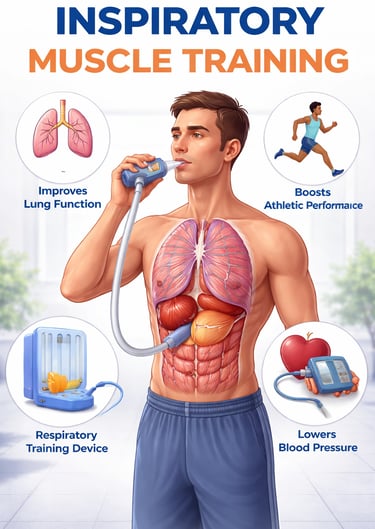
Inspiratory Muscle Training (IMT) is a simple yet powerful method to strengthen the muscles used for breathing—especially the diaphragm—much like resistance training strengthens other muscles in the body. Growing scientific evidence shows that IMT offers meaningful benefits not only for people with lung disease, but also for cardiovascular health, athletic performance, and recovery from serious illness.
Recent high-quality studies demonstrate that IMT improves respiratory muscle strength, exercise capacity, and quality of life in chronic respiratory conditions such as COPD and asthma (Torres-Castro et al., 2025; Hartman et al., 2025). Importantly, home-based IMT programs are highly effective and show excellent patient adherence. Beyond the lungs, IMT has been shown to lower blood pressure to a degree comparable with aerobic exercise, likely by reducing sympathetic nervous system activity and improving vascular function (Jae et al., 2025).
Even healthy individuals and athletes benefit. Structured IMT leads to measurable diaphragm hypertrophy and improved breathing efficiency, enhancing oxygen delivery during intense exercise (Güler et al., 2025). In critical care settings, IMT shortens the time patients need mechanical ventilation and reduces ICU stay, supporting faster recovery (Farley et al., 2025).
Overall, IMT is a safe, time-efficient, and evidence-based intervention that can be practiced at home with minimal equipment, offering wide-ranging benefits for respiratory health, cardiovascular regulation, and functional performance.
Clinical pearls
1. The "Biceps of the Breath" Principle
Just as you can’t expect to curl a heavy dumbbell once and see a bigger arm, the diaphragm requires progressive overload to change. Clinical research shows that the diaphragm is a skeletal muscle with a high percentage of fatigue-resistant fibers. For IMT to work, you must provide enough resistance—usually starting at 30% of your Maximal Inspiratory Pressure (MIP)—to trigger hypertrophy.
2. The Autonomic "Volume Knob"
IMT doesn't just strengthen a muscle; it talks to your nervous system. By training the diaphragm to move more efficiently, you decrease the "metaboreflex." This is a physiological response where tired breathing muscles "steal" blood flow from your limbs. By strengthening the breath, you keep that blood flowing to your legs and arms, effectively lowering your heart’s workload and helping to regulate blood pressure.
3. Quality Over Velocity
A common mistake is "snapping" the breath in quickly and shallowly. For true clinical benefit, the focus should be on deep, diaphragmatic engagement.
Imagine filling a pitcher of water from the bottom up. An upright posture is non-negotiable; slumping compresses the abdominal cavity, preventing the diaphragm from descending fully and reducing the effectiveness of the training.
4. The 8-Week "Neural Adaptation" Window
Patients often feel discouraged if they don't feel "stronger" in three days. However, the first 2–3 weeks of IMT are primarily neurological. Your brain is learning how to recruit more muscle fibers in the diaphragm. The actual physical thickening of the muscle (hypertrophy) typically becomes measurable around the 8-week mark. Consistency is the bridge between "feeling better" and "being stronger."
5. The "Maintenance" Reality
Unlike some medications that you can stop once symptoms resolve, respiratory strength is "use it or lose it." Once you reach your goal strength, you can usually transition from a daily routine to a maintenance phase (2–3 times per week). This is enough to preserve the "stiffness" and power of the inspiratory muscles without the time commitment of the initial building phase.
Inspiratory Muscle Training: A Comprehensive Guide to Evidence-Based Benefits and Clinical Applications
What Is Inspiratory Muscle Training? Understanding the Basics
Inspiratory muscle training (IMT) refers to structured exercises designed to strengthen the muscles you use to breathe in, primarily the diaphragm and intercostal muscles (Franklin & Anjum, 2023). The most common method involves using an incentive spirometer or specialized respiratory training devices that create resistance during inhalation.
Think of it this way: when you breathe against resistance during IMT, your respiratory muscles work harder, much like lifting weights. Over time, this leads to increased respiratory muscle strength, improved diaphragm function, and better oxygen utilization throughout your body.
The beauty of inspiratory muscle training exercises is their simplicity and accessibility—they can be performed at home, require minimal equipment, and take just 15–30 minutes daily. Yet their effects ripple through nearly every system in your body.
2025 Research Breakthroughs: What Recent Studies Reveal
1. IMT in Chronic Respiratory Diseases: An Overview of Systematic Reviews
Study Details: Torres-Castro et al. (2025) conducted a comprehensive overview of systematic reviews examining inspiratory muscle training effectiveness in patients with chronic respiratory disease.
Key Findings:
IMT demonstrates significant benefits across multiple chronic respiratory conditions, including COPD, asthma, and interstitial lung disease (Torres-Castro et al., 2025)
Patients showed measurable improvements in respiratory muscle strength, exercise capacity, and quality of life
The training was particularly effective when combined with conventional rehabilitation programs
Home-based inspiratory muscle training proved as effective as supervised sessions, enhancing accessibility
Clinical Significance: This systematic review provides robust evidence that IMT is not merely supplementary—it's a validated, evidence-backed intervention. For individuals with chronic respiratory disease, inspiratory muscle training programs offer a practical pathway to functional improvement without requiring expensive equipment or clinic visits.
Key Takeaway: Strengthening your respiratory muscles is as important as managing your underlying lung condition.
2. Incentive Spirometry and Inspiratory Muscle Training: Clinical Fundamentals
Study Details: Franklin and Anjum (2023) provide an authoritative overview of incentive spirometer use and IMT mechanisms in the StatPearls database, one of the most widely referenced clinical education resources.
Key Findings:
Incentive spirometry is the gold standard for measuring inspiratory muscle strength and monitoring progress
The device works by providing visual feedback, motivating patients to achieve progressively deeper inhalations
Inspiratory muscle training devices create measurable resistance that triggers adaptive strengthening
Proper technique is essential—education and supervision optimize outcomes
Clinical Applications: Whether you're recovering from surgery, managing a chronic respiratory condition, or simply wanting to optimize lung function, understanding how an incentive spirometer works is fundamental. The device quantifies your respiratory capacity and tracks improvements over weeks and months.
Key Takeaway: Visual feedback from an incentive spirometer motivates better adherence and measurable progress.
3. IMT and Blood Pressure Control in Hypertensive Patients
Study Details: Jae, Choi, Kim, and Kunutsor (2025) compared inspiratory muscle strength training with aerobic exercise training in hypertensive patients, examining their effects on blood pressure regulation.
Key Findings:
Inspiratory muscle training produced significant blood pressure reductions comparable to traditional aerobic exercise (Jae et al., 2025)
Patients maintained blood pressure benefits during a detraining period, suggesting lasting physiological adaptations
The mechanism involves improved vasodilation and enhanced autonomic nervous system regulation
IMT requires less time than conventional aerobic training while delivering similar cardiovascular benefits
The effect was particularly pronounced in patients with elevated systolic pressure
Why This Matters: If you're struggling to find time for exercise or have physical limitations that prevent traditional aerobic training, this research is transformative. Inspiratory muscle training for hypertension offers a time-efficient, accessible alternative with clinically meaningful results.
Key Takeaway: Five minutes of inspiratory muscle training may lower your blood pressure as effectively as a 30-minute jog.
4. IMT in Natural Bodybuilders: Diaphragm Adaptations and Strength Gains
Study Details: Güler et al. (2025) examined inspiratory muscle training adaptations in competitive natural bodybuilders, measuring changes in diaphragm thickness and maximal respiratory strength.
Key Findings:
IMT produced measurable hypertrophy (thickening) of the diaphragm muscle (Güler et al., 2025)
Participants achieved significant increases in maximal inspiratory pressure (MIP), a key marker of respiratory muscle strength
These adaptations occurred within 8–12 weeks of structured training
Improved respiratory efficiency enhanced oxygen delivery during intense training sessions
Diaphragm strength gains correlated with improved athletic performance metrics
Implications for Athletes: This study opens exciting avenues for athletic performance optimization. Inspiratory muscle training for athletes isn't just about breathing better—it's about delivering oxygen more efficiently to working muscles. For competitive athletes, cyclists, endurance runners, and strength athletes, IMT represents an underutilized performance tool.
Key Takeaway: Even elite athletes can strengthen a critical muscle—their diaphragm—in just 8–12 weeks.
5. Home-Based IMT in COPD: Novel and Established Training Methods
Study Details: Hartman et al. (2025) conducted a randomized, sham-controlled trial examining home-based inspiratory muscle training as standalone therapy in COPD patients, comparing both novel and established inspiratory muscle training techniques.
Key Findings:
Home-based inspiratory muscle training proved effective as a standalone therapy for COPD management (Hartman et al., 2025)
Novel training methods showed comparable or superior results to traditional approaches
Patient adherence was exceptionally high (>80%), demonstrating the feasibility of home-based respiratory training
Inspiratory muscle training improved exercise tolerance and reduced dyspnea (shortness of breath) severity
The sham-controlled design confirms effects are genuine, not placebo-driven
Real-World Impact: This landmark trial addresses a critical question: Can patients manage COPD effectively at home without constant clinical supervision? The answer is a resounding yes. Home-based inspiratory muscle training programs reduce healthcare burden while delivering measurable clinical benefits.
Key Takeaway: You don't need a clinic to strengthen your respiratory muscles—home-based training works exceptionally well.
6. IMT in Critical Care: Systematic Review and Meta-Analysis
Study Details: Farley, Oliveira, Brooks, and Newman (2025) synthesized evidence from multiple trials examining inspiratory muscle training effects in critically ill adults through systematic review and meta-analysis.
Key Findings:
IMT improved outcomes in critically ill populations, reducing weaning time from mechanical ventilation (Farley et al., 2025)
Patients receiving inspiratory muscle training experienced shorter intensive care stays
The intervention was particularly beneficial for patients with prolonged ventilation
Respiratory muscle weakness is a significant barrier to weaning—IMT directly addresses this barrier
Implementation was safe with minimal adverse events
Critical Care Application: For patients in intensive care units recovering from severe illness, inspiratory muscle training accelerates recovery and restores functional independence. This research validates IMT as a core component of critical care rehabilitation protocols.
Key Takeaway: Strengthening respiratory muscles in ICU patients means shorter hospital stays and faster recovery.
Understanding the Science: How Inspiratory Muscle Training Works
When you engage in inspiratory muscle training, several physiological adaptations occur:
Muscular Adaptation: Your diaphragm and intercostal muscles undergo hypertrophy (growth) and develop increased oxidative capacity, similar to skeletal muscle training.
Neurological Changes: IMT improves neural recruitment patterns, allowing more efficient muscle fiber activation and coordinated breathing mechanics.
Cardiovascular Effects: Stronger inspiratory muscles reduce the work of breathing, decreasing oxygen demand and improving overall cardiovascular efficiency. This explains why inspiratory muscle training lowers blood pressure—it reduces sympathetic nervous system activation.
Respiratory Efficiency: Enhanced respiratory muscle strength means you extract more oxygen per breath, improving oxygen delivery to tissues and enhancing aerobic performance.
Autonomic Regulation: IMT influences parasympathetic tone, promoting relaxation and stress reduction while simultaneously improving cardiovascular stability.
IMT VS Deep Breathing
In summary, while both practices involve the diaphragm, they are physiologically distinct: IMT is a "workout" for muscle strength, while deep breathing is a "calibration" for the nervous system.
1. Mechanism: Loading vs. Flow
IMT is a form of resistance training. By breathing through a device that creates a "pressure threshold," you force the diaphragm and intercostal muscles to overcome a physical load. This triggers hypertrophy (muscle thickening) and increases maximal inspiratory pressure (MIP).
Deep Breathing (e.g., Yoga) is flow-based. It focuses on the rhythm and volume of air without external resistance. It emphasizes "lung compliance" (flexibility) and efficient gas exchange rather than increasing the raw power of the muscle fibers.
2. Physiological Impact: Strength vs. Balance
IMT specifically targets the respiratory metaboreflex. By making the diaphragm stronger, it prevents the body from "stealing" blood from your arms and legs during exertion, which directly boosts athletic stamina and lowers blood pressure.
Deep Breathing primarily targets the vagus nerve. It shifts the body from a "fight or flight" state into a "rest and digest" state, reducing cortisol and mental stress through autonomic regulation.
3. Clinical Outcome
IMT is superior for reversing muscle weakness caused by COPD, asthma, or aging.
Deep Breathing is superior for improving lung air distribution and mental well-being.
In short: IMT builds the engine's horsepower; deep breathing refines the driver's control.
Clinical Applications of Inspiratory Muscle Training
For Chronic Respiratory Disease Patients
Individuals with COPD, asthma, cystic fibrosis, and interstitial lung disease benefit tremendously from inspiratory muscle training programs. The training improves exercise capacity, reduces dyspnea, and enhances independence.
For Cardiovascular Health and Blood Pressure Management
Inspiratory muscle training for hypertension offers a non-pharmacological intervention that rivals traditional exercise. It's particularly valuable for individuals with physical limitations, advanced age, or low exercise motivation.
For Athletic Performance Enhancement
Athletes across disciplines—from endurance runners to weightlifters—can leverage IMT to optimize oxygen utilization and enhance performance capacity.
For Critical Care Recovery
Patients recovering from serious illness benefit from early inspiratory muscle training, accelerating weaning from mechanical ventilation and reducing complications.
For Post-Surgical Recovery
Following thoracic or abdominal surgery, inspiratory muscle training prevents complications and restores normal breathing function.
Practical Guide: Getting Started with Inspiratory Muscle Training
What You'll Need
Incentive spirometer (readily available, ~$20–$50)
Quiet, comfortable space
15–30 minutes daily
Basic Training Protocol
Baseline Assessment: Establish your current inspiratory muscle strength with an incentive spirometer
Progressive Resistance: Begin with comfortable resistance; gradually increase over weeks
Consistency: Perform training at the same time daily for optimal adaptation
Monitoring: Track your measurements weekly to visualize progress
Duration: Expect measurable improvements within 4–8 weeks
Sample Daily Routine
5 minutes: Warm-up with gentle, natural breathing
15 minutes: Structured inspiratory muscle training exercises with resistance
5 minutes: Cool-down and normal breathing recovery
Total time: 25 minutes daily
Proper Technique Essentials
Always maintain upright posture during IMT to maximize diaphragmatic engagement. Focus on slow, controlled inhalations rather than rapid, shallow breathing. Exhale naturally without forced effort.
Frequently Asked Questions About Inspiratory Muscle Training
Q: How long before I notice benefits from inspiratory muscle training?
A: Most people experience noticeable improvements within 4–8 weeks of consistent inspiratory muscle training. However, measurable physiological changes occur within 2–3 weeks, even if you don't consciously feel them yet.
Q: Is inspiratory muscle training safe for everyone?
A: IMT is generally very safe with minimal contraindications. However, individuals with certain cardiac conditions or uncontrolled hypertension should consult their healthcare provider first. The 2025 research demonstrates excellent safety profiles across diverse populations.
Q: Can I do inspiratory muscle training if I have COPD?
A: Absolutely. In fact, IMT is particularly beneficial for COPD patients. The Hartman et al. (2025) trial demonstrates that home-based inspiratory muscle training significantly improves outcomes in this population.
Q: How does inspiratory muscle training compare to aerobic exercise?
A: Both are valuable, but IMT is more time-efficient. Research shows comparable cardiovascular benefits in just 15–30 minutes daily, compared to 45–60 minutes for traditional aerobic exercise.
Q: Can athletes use inspiratory muscle training to enhance performance?
A: Yes. The Güler et al. (2025) study demonstrates that even elite athletes experience meaningful diaphragm strengthening and performance improvements from structured IMT.
Q: Is an incentive spirometer necessary, or are there alternatives?
A: While an incentive spirometer is standard, other respiratory training devices exist. However, the incentive spirometer's visual feedback makes it especially effective for motivation and progress tracking.
Q: How long should I continue inspiratory muscle training?
A: For chronic conditions, IMT is typically a long-term practice. However, research suggests maintenance protocols (2–3 sessions weekly) sustain benefits after the initial 8–12 week adaptation phase.
Q: Can inspiratory muscle training help with anxiety or stress?
A: Yes. Because IMT improves autonomic nervous system regulation, many practitioners experience reduced anxiety and improved stress resilience as secondary benefits.
Q: What makes 2025 research different from earlier inspiratory muscle training studies?
A: 2025 studies employ more rigorous methodology, include larger sample sizes, examine home-based interventions, and explore novel training methods. The research also expands IMT applications beyond traditional respiratory populations to athletes, hypertensive patients, and critical care settings.
Key Takeaways: The Bottom Line on Inspiratory Muscle Training
Evidence is Compelling: Six peer-reviewed 2025 studies confirm that inspiratory muscle training delivers measurable physiological benefits across diverse populations.
Accessibility is a Game-Changer: Home-based inspiratory muscle training works as effectively as supervised programs, democratizing access to respiratory training.
Beyond Lungs: While beneficial for respiratory conditions, IMT improves cardiovascular health, lowers blood pressure, and enhances athletic performance.
Time-Efficient: Unlike traditional exercise, inspiratory muscle training requires just 15–30 minutes daily to achieve significant health benefits.
Muscle Like Any Other: Your diaphragm responds to training just like your biceps—progressive resistance triggers measurable adaptation within weeks.
Safety Profile: Inspiratory muscle training is safe across age groups and health conditions when performed correctly.
Multiple Applications: Whether you're managing COPD, reducing hypertension, enhancing athletic performance, or accelerating recovery from critical illness, IMT has a role in your health optimization strategy.
Call to Action
The evidence is clear: Inspiratory muscle training is one of the most underutilized, accessible, and evidence-backed health interventions available. Whether you're managing a chronic condition, pursuing athletic excellence, or simply wanting to optimize your health, now is the perfect time to start.
Here's what we recommend:
Consult your healthcare provider about whether inspiratory muscle training is right for you
Invest in a simple incentive spirometer (available at most pharmacies)
Establish a consistent 20–25 minute daily routine for IMT exercises
Track your progress weekly using your spirometer
Reassess after 8 weeks and celebrate the measurable improvements in your respiratory strength and overall health
The science is on your side. Your respiratory muscles are waiting to be strengthened. Start your inspiratory muscle training journey today and experience the transformative benefits that thousands of people across the globe are already enjoying.
Author’s Note
Breathing is so fundamental to life that we rarely consider it a trainable physiological system. While writing this article, my aim was to challenge that assumption and present Inspiratory Muscle Training (IMT) as what the science now clearly supports it to be: a measurable, adaptable, and clinically powerful intervention.
The evidence cited here—particularly the high-quality studies published in 2025—demonstrates that the diaphragm behaves like any other skeletal muscle, responding predictably to progressive resistance. What is especially compelling is the breadth of IMT’s impact: from improving exercise tolerance in COPD and reducing blood pressure in hypertension, to shortening ICU stays and enhancing athletic performance. Few interventions are this simple, low-cost, and widely applicable.
This article was written to bridge the gap between physiology, clinical medicine, and practical application. I have deliberately distinguished IMT from traditional breathing techniques to avoid confusion and to emphasize that strength adaptation requires resistance, not just awareness or relaxation.
My hope is that clinicians will feel confident incorporating IMT into routine care, and that patients will recognize their breathing muscles as an untapped opportunity for better health. When supported by evidence, even the most basic human functions can become powerful tools for prevention, recovery, and performance optimization.
Medical Disclaimer
The information in this article, including the research findings, is for educational purposes only and does not constitute medical advice, diagnosis, or treatment. Before starting any new exercise program, you must consult with a qualified healthcare professional, especially if you have existing health conditions (such as cardiovascular disease, uncontrolled hypertension, or advanced metabolic disease).
Related Articles
Fasted vs. Fed Exercise: Does Training on an Empty Stomach Really Burn More Fat? | DR T S DIDWAL
How to Build a Disease-Proof Body: Master Calories, Exercise & Longevity | DR T S DIDWAL
Exercise vs. Diet Alone: Which is Best for Body Composition? | DR T S DIDWAL
Movement Snacks: How VILPA Delivers Max Health Benefits in Minutes | DR T S DIDWAL
References
Farley, C., Oliveira, A., Brooks, D., & Newman, A. N. L. (2025). The effects of inspiratory muscle training in critically ill adults: A systematic review and meta-analysis. Journal of Intensive Care Medicine, 0(0). https://doi.org/10.1177/08850666251317473
Franklin, E., & Anjum, F. (2023, April 27). Incentive spirometer and inspiratory muscle training. In StatPearls. StatPearls Publishing. https://www.ncbi.nlm.nih.gov/books/NBK572114/
Güler, I., Yılmaz, C., Soylu, H. H., Birinci, M. C., Arslan, A., Ocak, H., Çayir, H., Kavuran, K., Saç, A., Akkuş Uçar, M., Karataş, B., & Ceylan, L. (2025). Inspiratory muscle training in natural bodybuilders: Adaptations in diaphragm muscle thickness and maximal strength. Frontiers in Physiology, 16, 1628146. https://doi.org/10.3389/fphys.2025.1628146
Hartman, M., Dosbaba, F., Batalik, L., Vlazna, D., Plutinsky, M., Brat, K., & Formiga, M. F. (2025). Home-based inspiratory muscle training as stand-alone therapy in COPD: A randomized sham-controlled trial assessing novel and established training methods. COPD: Journal of Chronic Obstructive Pulmonary Disease, 22(1). https://doi.org/10.1080/15412555.2025.2487473
Jae, S. Y., Choi, T. G., Kim, H. J., & Kunutsor, S. K. (2025). Comparison of inspiratory muscle strength and aerobic exercise training and detraining on blood pressure in hypertensive patients. Clinical Hypertension, 31, e15. https://doi.org/10.5646/ch.2025.31.e15
Torres-Castro, R., Caicedo-Trujillo, S., Gimeno-Santos, E., Gutiérrez-Arias, R., Alsina-Restoy, X., Vasconcello-Castillo, L., Seron, P., Spruit, M. A., Blanco, I., & Vilaró, J. (2025). Effectiveness of inspiratory muscle training in patients with a chronic respiratory disease: An overview of systematic reviews. Frontiers in Sports and Active Living, 7, 1549652. https://doi.org/10.3389/fspor.2025.1549652