Living to 100: Is it Genetics or Lifestyle? What the New Science Says
Discover whether living to 100 is driven by genetics or lifestyle. Explore what 2025–2026 longevity science reveals about aging, healthspan, and prevention.
AGING
Dr. T.S. Didwal, M.D.(Internal Medicine)
2/4/202615 min read
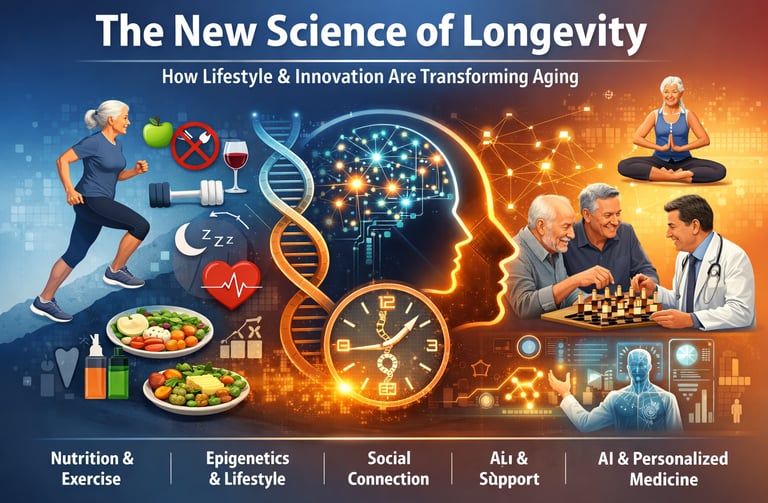
What if reaching 100 years of age were less about luck—and more about biology you can influence? For decades, longevity was framed as a genetic lottery, with aging viewed as an unavoidable slide toward disease and decline. But the science of aging has entered a new era. Research published between 2025 and 2026 now makes one thing clear: how long and how well we live is shaped far more by daily choices than by inherited fate (Vetrani et al.(2026)
Large-scale population studies, centenarian analyses, and molecular aging research converge on a striking conclusion: genetics account for only about 25–35% of human lifespan variation, while lifestyle, environment, and behavior explain the majority Even more compelling, these factors interact through epigenetic mechanisms—biological switches that determine how ageing-related genes are expressed—meaning that lifestyle can accelerate or slow biological ageing at the cellular level (Rawat, 2025).
At the same time, the concept of longevity itself is being redefined. Modern aging science is shifting focus from simply extending lifespan to maximizing healthspan—the years of life spent free from disability, frailty, and chronic disease (The Lancet Healthy Longevity Editors, 2026). This shift is supported by evidence showing that integrated lifestyle patterns—nutrition quality, physical activity variety, social connection, cognitive engagement, and sleep regularity—consistently distinguish centenarians from the general population across cultures (Vetrani et al., 2026).
Perhaps most transformative is the realisation that aging is not a single process. Advances in artificial intelligence now allow clinicians to identify distinct aging phenotypes and personalize interventions with unprecedented precision (Bischof et al., 2026). Together, these findings dismantle the myth of “inevitable decline” and replace it with a science-based framework: longevity is not a secret—it is a system.
Clinical pearls
1. The "Variability" Dividend
Scientific Insight: Research from Han et al. (2026) suggests that cross-training isn't just for athletes; it’s a cellular necessity. Engaging in four distinct modalities (aerobic, strength, balance, and flexibility) targets multiple physiological systems—from mitochondrial density to bone mineral preservation—more effectively than any single activity.
Don't just walk or just lift weights. Think of your body like a retirement portfolio; you need to diversify. A mix of cardio, strength, and stretching lowers your risk of early death more than doing "extra" of just one.
2. Social Connection as Biological Medicine
Scientific Insight: Loneliness is now clinically recognized as a potent driver of systemic inflammation and "inflammaging." Strong social ties correlate with lower cortisol levels and improved immune function, making community engagement a primary clinical intervention.
Spending time with friends isn't just "fun"—it's a biological requirement. Science shows that loneliness is as damaging to your health as smoking. Prioritize your social calendar as much as your doctor’s appointments.
3. Epigenetics: The "Soft" Override
Scientific Insight: Rawat (2025) emphasizes that while your DNA is the "hardware," your lifestyle acts as the "software." Through methylation and other epigenetic shifts, healthy behaviors can silence pro-inflammatory genes and activate longevity-promoting pathways, effectively decoupling biological age from chronological age.
You aren't a victim of your family history. Even if you have "bad genes," your daily habits act like a volume knob, turning down the bad genes and turning up the good ones. You have the power to "program" your cells for a longer life.
4. The 70/30 Longevity Rule
Scientific Insight: The current consensus in geromedicine is that genetics contribute only about 25–35% to lifespan variation. The remaining 65–75% is determined by the exposome (the sum of environmental and lifestyle exposures), highlighting the massive window for clinical intervention.
Your health is roughly 30% fate and 70% choice. This means the vast majority of your health destiny is in your own hands. It’s never too late to start, as your body responds to healthy changes at 70 just as it does at 20.
5. Movement as "Fall Prevention" Medicine
Scientific Insight: Clinical data confirms that balance and flexibility training are the best "medications" for fracture prevention. In older adults, the leading cause of injury-related mortality is a fall; therefore, proprioceptive training (like Tai Chi or Yoga) is a direct mortality-reduction strategy.
Strength is good, but balance is life-saving. As we age, a simple fall can be the biggest threat to our independence. Adding a few minutes of balance exercises to your day is like wearing a biological "seatbelt."
6. Nutrition: Quality over Caloric Extremism
Scientific Insight: While extreme calorie restriction shows promise in lab models, human data (Vetrani, 2026) favors a Mediterranean-style macronutrient profile. High-quality fats and plant-based proteins support the gut microbiome, which in turn regulates the immune system and prevents chronic disease.
You don’t need to starve yourself to live to 100. Focus on crowding out processed junk with whole foods like olive oil, nuts, and greens. A happy gut leads to a healthy brain and a longer life.
Living Longer: The Latest Science on Longevity, Centenarians, and Lifestyle Interventions
Understanding the Foundations of Healthy Aging
Longevity research has undergone a paradigm shift. For decades, scientists focused on treating diseases of aging in isolation—heart disease here, cancer there, dementia elsewhere. Today's approach is different: researchers are investigating the underlying mechanisms that allow some people to live vibrant, disease-free lives into their 10th decade and beyond.
Vetrani and colleagues (2026) conducted a comprehensive review examining longevity, centenarians, and lifestyle factors, revealing that the path to reaching 100 involves far more than genetic luck. Their research, published in Current Nutrition Reports, synthesizes evidence that nutritional habits, physical activity patterns, stress management, social engagement, and sleep quality collectively determine whether someone has a shot at becoming a centenarian.
The most compelling finding? Lifestyle factors can modify the expression of genes related to aging. This means that even if your parents didn't live to 100, you're not locked into an early death. Epigenetics—the study of how lifestyle influences which genes turn "on" and "off"—offers hope that proactive choices can literally rewrite your biological aging clock.
The Role of Centenarian Studies in Understanding Longevity
What distinguishes a centenarian from someone who lives to 80? Research suggests it's not a single factor but rather a constellation of habits and choices sustained over decades. Vetrani and colleagues (2026) identified key characteristics common among centenarians:
Mediterranean-style nutrition: Emphasis on whole foods, plant-based options, healthy fats, and minimal processed foods
Regular physical activity: Consistent, moderate exercise integrated into daily life
Strong social connections: Active participation in family and community life
Mental engagement: Cognitive stimulation through hobbies, reading, and learning
Stress resilience: Effective coping mechanisms and emotional regulation
Sleep consistency: Regular sleep-wake cycles with adequate rest
These aren't revolutionary discoveries, but the evidence backing them is stronger than ever. The key insight is that centenarians typically don't pursue these factors in isolation—they're part of an integrated lifestyle that becomes habitual.
The Lancet's Vision for the Future of Longevity Medicine
Shifting Paradigms in Aging Science
The Lancet Healthy Longevity editorial team (2026) published a forward-looking piece titled "The Lancet Healthy Longevity: Looking to the Future," which emphasizes that the future of healthy aging depends on several converging factors:
From Disease Treatment to Prevention
Rather than waiting for disease to develop and then treating it, the emerging paradigm focuses on disease prevention through optimization of modifiable risk factors. This represents a fundamental shift in how medicine approaches aging.
From Population Averages to Personalized Medicine
Traditional public health takes a one-size-fits-all approach. The future belongs to personalized longevity interventions that account for individual genetics, lifestyle, preferences, and environmental contexts.
From Siloed Disciplines to Integrated Care
Longevity medicine increasingly requires collaboration between gerontologists, cardiologists, nutritionists, neurologists, and behavioral health specialists. The old model of treating individual organs in isolation is giving way to systems-based thinking.
From Passive Aging to Active Optimization
Rather than accepting decline as inevitable, the new paradigm encourages active engagement with one's health trajectory. This includes routine biomarker monitoring, preventive screening, and proactive lifestyle adjustments.
The Lancet editorial emphasizes that achieving these shifts requires investment in research infrastructure, healthcare professional training, and public health initiatives that make healthy choices accessible to all socioeconomic groups.
Genetic and Lifestyle Interplay: The Science of Longevity Explained
Rawat (2025) published a comprehensive exploration titled "The Science of Longevity: Exploring the Genetic, Lifestyle and Other Factors Behind It!" in the International Journal for Multidisciplinary Research. This paper synthesizes evidence from gerontology, genetics, nutrition science, and behavioral health to explain why some people seem to age gracefully while others decline rapidly.
Genetics provides approximately 25-35% of the variation in human lifespan, with the remainder determined by lifestyle and environmental factors. This means that even if you have family members who died young, your choices matter enormously.
The genetic "load" for aging includes variations in genes controlling:
Metabolic pathways (how efficiently your body processes energy)
Cellular repair mechanisms (how well your cells maintain integrity)
Inflammatory responses (chronic inflammation accelerates aging)
Oxidant production (protection against cellular damage)
However, here's where it gets exciting: Lifestyle factors can essentially override genetic predisposition. Someone with genetic variants associated with longevity who smokes, drinks excessively, and avoids exercise won't live long. Conversely, someone without "longevity genes" who maintains excellent lifestyle habits can significantly exceed their genetic "baseline."
The key lifestyle factors
Caloric intake (evidence suggests moderate calorie restriction extends lifespan, though extreme restriction is harmful)
Macronutrient composition (plant-based proteins and healthy fats outperform high red meat diets)
Physical activity (both cardiovascular exercise and resistance training matter)
Sleep quality and consistency (disrupted sleep accelerates aging)
Cognitive engagement (mental stimulation protects against cognitive decline)
Social relationships (loneliness is a major mortality risk factor)
Stress management (chronic stress damages cells and shortens telomeres)
Epigenetics: How Your Choices Literally Change Your Genes
A particularly fascinating aspect of Rawat's research concerns epigenetic aging clocks—biological measures that can literally track how fast (or slow) your body is aging at the cellular level. These tests measure chemical modifications to your DNA that accumulate with age. Remarkably, people who adopt healthy lifestyles show slower epigenetic aging, while those with poor habits show accelerated aging.
This explains why two 60-year-olds can have vastly different biological ages. The one who exercises regularly, eats well, manages stress, and maintains social connections might have the cellular age of a 50-year-old. The sedentary smoker might be biologically 70. Your choices literally determine your biological age—not just how you feel, but how your cells are aging.
Physical Activity Variety: The Game-Changer for Mortality Reduction
One of the most significant recent findings comes from Han et al.(2026). This research analyzed data from two large cohort studies, following hundreds of thousands of participants over years to determine what kinds and amounts of physical activity extend lifespan.
The Crucial Discovery: It's not just how much you exercise that matters—it's how varied your exercise is.
The research identified four types of physical activity:
Aerobic exercise (running, cycling, swimming—elevates heart rate)
Muscle-strengthening activities (resistance training, weight lifting)
Flexibility training (yoga, stretching)
Balance exercises (tai chi, functional training)
Participants who engaged in multiple types of activity showed significantly lower mortality risk compared to those who stuck to just one type of exercise. For example:
Someone who runs three times per week plus does resistance training twice weekly has better health outcomes than someone who runs five times per week
Adding just one yoga or stretching session weekly to a regular cardio routine substantially reduces mortality risk
The combination of aerobic activity + strength training + flexibility work yields the greatest benefit
Why does variety matter?
Different exercise types activate different physiological systems:
Aerobic exercise strengthens the cardiovascular system and improves oxygen utilization
Resistance training maintains muscle mass (which naturally declines with age), strengthens bones, and maintains metabolic rate
Flexibility work preserves range of motion and prevents injuries
Balance training prevents falls—the leading cause of injury-related death in older adults
By incorporating exercise variety, you're comprehensively addressing the multiple systems that deteriorate with age. This holistic approach is far more effective than optimizing any single type of exercise.
Practical Implications of Activity Diversity
For the average person seeking to optimize lifespan and healthspan, Han's research suggests:
Weekly Exercise Blueprint:
150 minutes of moderate aerobic activity OR 75 minutes of vigorous activity (spread across the week)
2+ sessions of muscle-strengthening activities targeting major muscle groups
2-3 sessions of flexibility or balance training (yoga, tai chi, static stretching)
Progressive intensity: Gradually increase difficulty as fitness improves
The good news? These don't require expensive gym memberships or hours of training. Many people find that walking (aerobic), bodyweight exercises (strengthening), and YouTube yoga videos (flexibility) provide excellent results at minimal cost.
Roadmap for the Future: Longevity Interventions and Bridging Expectations
Yu et al.,(2025) published an important paper in Biogerontology titled "Bridging Expectations and Science: A Roadmap for the Future of Longevity Interventions." This research addresses a critical problem: the gap between hype and reality in longevity science.
In recent years, the public has been exposed to increasingly spectacular claims about life extension:
New drug reverses aging"
Genetic therapy adds 20 years to lifespan"
"Billionaires are eliminating aging"
While some of these developments are promising, Yu and colleagues emphasize that we must bridge the gap between genuine scientific breakthroughs and unrealistic expectations. Their roadmap identifies several key challenges:
Translational Research Gaps
Much longevity research shows promise in laboratory and animal models but hasn't been successfully translated to humans. Researchers must establish clearer pathways from laboratory discovery to clinical application.
Individual Variability
People respond differently to interventions. A dietary change that extends lifespan in one person might have minimal effect in another. The future requires personalized approaches based on individual genetics, microbiome, and baseline health status.
Ethical Considerations
Longevity interventions could exacerbate inequality if available only to the wealthy. A responsible approach requires equitable access and transparent discussion of costs and benefits.
Long-term Safety Data
Promising anti-aging interventions need decades of safety testing in humans. Yu's team emphasizes patience—rushing interventions to market without proper validation can cause more harm than good.
Integration with Conventional Medicine
Emerging longevity interventions must integrate seamlessly with established medical practice, not replace it. The future involves both conventional medicine and innovative longevity strategies working together.
What's Promising on the Horizon?
Despite cautioning against hype, Yu's research identifies several genuinely promising areas:
Senolytics: Drugs that eliminate senescent cells (aged cells that accumulate and cause problems) are in human trials and show early promise.
NAD+ Boosters: Compounds that increase NAD+ (a molecule essential for cellular energy and repair) appear to improve metabolic health in early human studies.
Autophagy Enhancers: Interventions that improve cells' ability to clear out damaged components show potential.
Personalized Nutrition: Using genetic and microbiome data to create truly personalized dietary recommendations is becoming feasible.
Biomarker Monitoring: Advanced blood tests that track biological aging are enabling earlier intervention.
The message from Yu's roadmap? The future of longevity medicine is exciting, but it requires careful, methodical research combined with realistic expectations about what current science can deliver.
The Role of Artificial Intelligence in Longevity Medicine
How AI is Transforming Clinical Management of Aging
The most recent development in longevity science comes from Bischof and colleagues (2026), who published "Implementation of Artificial Intelligence in the Clinical Management of Longevity" in Geromedicine. This paper explores how machine learning and AI systems are revolutionizing how we identify, predict, and manage age-related decline.
AI Applications in Longevity Medicine:
Predictive Risk Assessment
Machine learning algorithms can analyze thousands of biomarkers, lifestyle factors, and genetic data to predict who is at highest risk for age-related diseases. This enables early intervention before symptoms appear.
Phenotyping Aging
Rather than treating "age" as a single variable, AI algorithms can identify different "aging phenotypes"—patterns of aging that are unique to each person. Someone might age rapidly in cardiovascular health but slowly in cognitive function. Personalized interventions can then target specific weak points.
Clinical Decision Support
As longevity medicine becomes more complex, physicians increasingly rely on AI systems to synthesize vast literature, recommend treatments, and monitor outcomes. This improves consistency and catches things human doctors might miss.
Medication Optimization
AI systems can predict how individual patients will respond to medications based on genetics, age, organ function, and other factors. This enables personalized dosing and selection of therapies most likely to work.
Fall and Fracture Risk
Using AI algorithms on gait analysis, strength assessment, and balance testing data, systems can identify fall risk with remarkable accuracy, enabling targeted preventive interventions.
The Practical Integration of AI in Aging
Bischof's research emphasizes that AI in gerontology isn't about replacing physicians with robots. Instead, it's about augmenting clinical decision-making. A geriatrician reviewing an 85-year-old's care can now leverage AI analysis of their entire medical history, genetic profile, and real-time health data to make better decisions faster.
The promise is substantial: AI-assisted longevity medicine could extend both lifespan and healthspan while reducing healthcare costs through prevention-focused care.
Bringing It All Together: A Comprehensive Framework for Longevity
Integrating Research Into Real Life
The five studies examined here paint a comprehensive picture of modern longevity science:
Vetrani's work establishes the foundational reality: centenarians exist because they sustain integrated, healthy lifestyles across multiple domains—nutrition, activity, social connection, cognitive engagement.
The Lancet editorial calls for systemic change in how medicine approaches aging—from reactive treatment to proactive prevention, from population averages to personalized medicine.
Rawat's synthesis explains the mechanisms underlying lifespan: the interplay of genetics (25-35%) and lifestyle (65-75%), with epigenetic changes being the bridge between our choices and our biological aging.
Han's research reveals a critical practical insight: exercise diversity matters more than exercise volume. It's the variety that maximizes longevity benefits.
Yu's roadmap cautions against hype while identifying genuinely promising interventions, emphasizing the importance of realistic expectations and equitable access.
Bischof's work showcases how AI is making longevity medicine more personalized, predictive, and effective.
Based on this integrated research, here's a practical framework:
NUTRITION: Adopt a plant-rich Mediterranean-style diet with emphasis on whole foods, healthy fats (olive oil, nuts), lean proteins, and minimal processed foods.
MOVEMENT: Engage in exercise diversity—150 minutes weekly of aerobic activity, plus two sessions of strength training and regular flexibility work.
SLEEP: Maintain consistent sleep-wake cycles with 7-9 hours nightly. Prioritize sleep quality as aggressively as you would any medical treatment.
COGNITION: Engage in regular mental stimulation—learning new skills, reading, problem-solving, engaging with others.
CONNECTION: Nurture relationships and community involvement. Strong social ties rank among the most potent longevity factors.
STRESS: Develop evidence-based stress management—meditation, nature exposure, professional support if needed.
MONITORING: As AI-assisted biomarker monitoring becomes accessible, use it to track your biological aging and adjust interventions accordingly.
FAQ: Your Longevity Questions Answered
Q: Is it too late to adopt healthy habits if I'm already 60 or 70?
A: Absolutely not. Research shows that longevity improvements occur at any age. Someone who quits smoking at 70 extends their lifespan. Someone who begins regular strength training at 65 gains muscle and reduces mortality risk. It's never too late.
Q: Do I need to spend hours in the gym to benefit from exercise variety?
A: No. Studies show benefits from as little as 150 minutes of moderate activity plus two strength sessions weekly. That's about 40 minutes daily or distributing it across the week. Consistency matters more than duration.
Q: Can supplements replace healthy habits?
A: Current evidence suggests no. While some supplements show promise, they cannot replace lifestyle factors. Focus on food first, then consider supplements if recommended by your healthcare provider.
Q: What about genetic testing—can it tell me how long I'll live?
A: Genetic tests can identify risks but cannot predict lifespan. Remember that lifestyle accounts for 65-75% of variation in longevity. Even with genetic risk, healthy habits substantially extend lifespan.
Q: Is being a centenarian desirable if I have poor health?
A: Modern longevity science increasingly focuses on healthspan—the years of active, independent, disease-free life—not just raw lifespan. Living to 100 while bedridden isn't the goal. The goal is thriving, not just surviving.
Q: What's the most important longevity factor?
A: Current evidence suggests social connection is among the most potent. Loneliness rivals smoking in mortality risk. Prioritize relationships.
Q: Will AI-powered longevity medicine be affordable?
A: That's currently unclear. Yu's roadmap emphasizes the ethical imperative to make longevity interventions equitable. Public pressure and healthcare policy will determine accessibility.
Author’s Note
This article was written to bridge the gap between longevity hype and legitimate, evidence-based science. In recent years, public discourse around aging has been dominated by sensational claims—miracle supplements, age-reversing drugs, and speculative technologies—often presented without adequate clinical context. As a physician trained in internal medicine, my goal is to re-center the conversation on what high-quality human research actually shows.
Every major claim in this article is grounded in peer-reviewed literature published between 2025 and 2026, drawing from leading journals including The Lancet Healthy Longevity, BMJ Medicine, Biogerontology, and Current Nutrition Reports. Rather than promoting a single intervention or ideology, the focus is on integration: how nutrition, physical activity, sleep, cognition, social connection, genetics, and emerging technologies interact to shape both lifespan and healthspan.
Importantly, this piece emphasizes realism. Longevity science is advancing rapidly, but it is not a shortcut to immortality. Aging remains biologically complex, heterogeneous, and deeply influenced by lifelong behaviors. The most consistent and powerful determinants of healthy aging remain remarkably accessible: movement, diet quality, psychological resilience, and human connection.
Artificial intelligence and biomarker-based aging assessment are discussed not as replacements for clinical judgment, but as tools that may enhance prevention-focused, personalized care in the future. Ethical considerations, equity, and long-term safety are intentionally highlighted alongside scientific promise.
This article is intended for clinicians, researchers, and scientifically curious readers who value nuance over novelty. Longevity is not about chasing youth—it is about preserving function, independence, and meaning across the lifespan.
Disclaimer: This article is for informational purposes only and does not constitute medical advice. Individual circumstances vary, and treatment decisions should always be made in consultation with qualified healthcare professionals.
Related Articles
Cognitive Super-Ageing: Why Some Older Adults Defy the Aging Brain | DR T S DIDWAL
Time-Restricted Eating: Metabolic Advantage or Just Fewer Calories? | DR T S DIDWAL
Can You Revitalize Your Immune System? 7 Science-Backed Longevity Strategies | DR T S DIDWAL
Exercise and Longevity: The Science of Protecting Brain and Heart Health as You Age | DR T S DIDWAL
Light and Longevity: Can Sunlight Slow Cellular Aging? | DR T S DIDWAL
Obesity as a Cardiometabolic Disease: New Science & Treatments | DR T S DIDWAL
Activate Your Brown Fat: A New Pathway to Longevity and Metabolic Health | DR T S DIDWAL
Leptin vs. Adiponectin: How Your Fat Hormones Control Weight and Metabolic Health | DR T S DIDWAL
References
Bischof, E., Haber, C., Lidströmer, N., & Wilczok, D. (2026). Implementation of artificial intelligence in the clinical management of longevity. Geromedicine, 2, 202519. https://doi.org/10.70401/Geromedicine.2026.0014
Han, H., Hu, J., Lee, D. H., Zhang, Y., Giovannucci, E., Stampfer, M. J., Hu, F. B., Hu, Y., & Sun, Q. (2026). Physical activity types, variety, and mortality: Results from two prospective cohort studies. BMJ Medicine, 5(1), e001513. https://doi.org/10.1136/bmjmed-2025-001513
Rawat, S. (2025). The science of longevity: Exploring the genetic, lifestyle and other factors behind it! International Journal for Multidisciplinary Research (IJFMR), 7(5), 1–11. https://doi.org/10.36948/ijfmr.2025.v07i05.40304
The Lancet Healthy Longevity Editors. (2026). The Lancet Healthy Longevity: Looking to the future. The Lancet Healthy Longevity. Advance online publication. https://doi.org/10.1016/j.lanhl.2026.100005
Vetrani, C., Frias-Toral, E., Annunziata, G., et al. (2026). Longevity, centenarians, and lifestyle: Any "tips" to live longer? Current Nutrition Reports, 15, 2. https://doi.org/10.1007/s13668-025-00724-2
Yu, D., Zeng, X., Barzilai, D., et al. (2025). Bridging expectations and science: A roadmap for the future of longevity interventions. Biogerontology, 26, 138. https://doi.org/10.1007/s10522-025-10278-z