Light and Longevity: Can Sunlight Slow Cellular Aging?
Discover the link between "metabolic rewiring" and cellular senescence. Learn how specific wavelengths in natural sunlight can protect your cells from aging and improve metabolic health.
AGINGMETABOLISM
Dr. T.S. Didwal, M.D.(Internal Medicine)
1/9/202612 min read
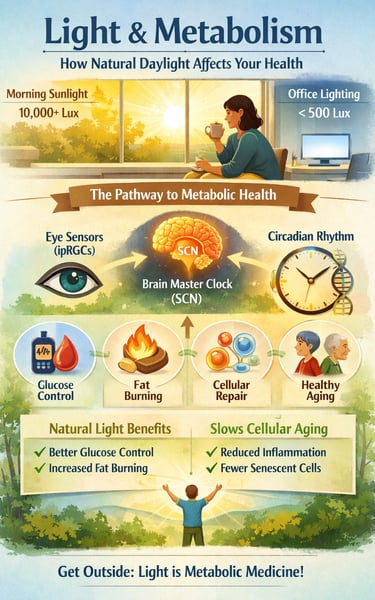
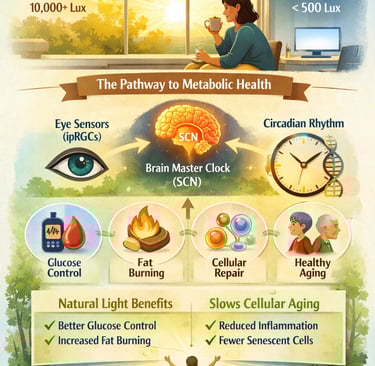
Most people think of light as something that simply helps us see, but emerging research reveals it is actually a powerful biological signal that shapes your metabolism, energy levels, and even how your body ages. Your eyes contain specialized photoreceptors—called intrinsically photosensitive retinal ganglion cells (ipRGCs)—that respond directly to daylight and send signals to your brain’s master clock, the suprachiasmatic nucleus (SCN). This clock controls your circadian rhythm, which regulates blood sugar, insulin sensitivity, appetite, fat burning, and cellular repair processes (Ishihara et al., 2023).
But here’s the surprising part: most modern indoor environments provide only a fraction of the light intensity your body needs to stay metabolically healthy. Natural daylight can exceed 10,000 lux, while indoor lighting often remains below 500 lux—far too low to properly synchronize your internal clock (Brown et al., 2022). This mismatch between what your biology expects and what your lifestyle provides can disrupt metabolism, contributing to fatigue, weight gain, glucose imbalance, and accelerated aging.
Recent studies show that simply increasing morning daylight exposure improves glucose control and metabolic flexibility—even without changes in diet or exercise (Harmsen et al., 2026). In other words, light itself acts as metabolic medicine.
Clinical Pearls
Light is a Nutrient: Just as your body requires Vitamin D from the sun, your metabolism requires "light signals" to time the release of insulin.2 Think of morning light as a "metabolic breakfast" that tells your cells to start burning fuel efficiently.
The 30-30 Rule: Getting outside for 30 minutes within 30 minutes of waking is the most effective non-drug intervention for stabilizing blood sugar. It sets the "metabolic tempo" for the next 14 hours.
Your Office is "Biologically Dark": Even if an office looks bright to your eyes, it is often "dark" to your circadian clock. Standard LEDs lack the intensity and full spectrum (red/infrared) needed to penetrate your tissues and support mitochondrial energy production.
After-Lunch Light Prevents the "Crash": A quick walk in natural daylight after a meal helps your muscles clear glucose from your blood more effectively, reducing the afternoon energy dip that usually leads to caffeine or sugar cravings.
Evening Blue Light is "Chemical Sunlight": Using a bright smartphone at 10 PM tells your brain it is 12 PM. This stops the production of melatonin—which isn't just a sleep hormone, but also a powerful antioxidant that repairs your cells while you rest.
Light and Metabolism: The Science Behind Natural Daylight's Impact on Your Health
Introduction: Why Your Office Lighting Matters More Than You Think
You probably don't spend much time thinking about the lights in your office or home, but emerging scientific research suggests you should. The light exposure you receive throughout the day—particularly natural daylight—plays a surprisingly powerful role in regulating your metabolic health, glucose control, and how your body ages. From circadian rhythm regulation to insulin sensitivity, the relationship between light and metabolism is reshaping how we understand wellness in the modern world.
If you're struggling with weight management, experiencing energy crashes throughout the day, or concerned about metabolic aging, the answer might be as simple as spending more time in natural light. This comprehensive guide explores cutting-edge research on how daylight exposure, circadian biology, and cellular metabolism interconnect—and what you can do about it.
The Science of Light and Metabolic Health
Understanding Your Body's Light Sensors
Your body doesn't just use light to see. Deep within your eyes lie specialized cells called intrinsically photosensitive retinal ganglion cells (ipRGCs) that detect light independently of vision. These cells communicate directly with your brain's suprachiasmatic nucleus (SCN), the master clock controlling your circadian rhythm—your body's 24-hour internal schedule.
This circadian system orchestrates nearly every metabolic process: when you burn calories, how efficiently your cells use insulin, when you feel hungry, and even how your body ages. When your light-dark cycle aligns with natural daylight patterns, your metabolism hums along like a well-tuned engine. But when it doesn't—especially in modern indoor environments—metabolic chaos can ensue.
Research Deep Dive: What the Latest Studies Show
Study 1: Natural Daylight and Glucose Control in Office Workers
What the Research Found:
This groundbreaking study by Harmsen et al. (2026).examined office workers exposed to natural daylight during working hours versus those in standard indoor lighting. The results were striking: employees who received adequate daytime light exposure demonstrated significantly improved glucose control, lower blood sugar variability, and enhanced whole-body substrate metabolism.
Key Takeaways:
Natural daylight exposure during office hours led to more stable blood glucose levels throughout the day
Participants showed improved metabolic flexibility—the ability to efficiently switch between burning carbohydrates and fats
Better glucose homeostasis persisted even during evening hours, suggesting circadian synchronization benefits
The effect was independent of physical activity or dietary changes, highlighting light's direct metabolic impact
What This Means for You: If you work indoors, positioning your desk near windows or taking regular outdoor breaks could meaningfully improve your metabolic health without changing your diet or exercise routine.
Study 2: Metabolic Rewiring and Cellular Aging
What the Research Found:
This study by Kim et al. (2025) explores how metabolic dysfunction accelerates cellular aging and contributes to conditions like obesity, diabetes, and cardiovascular disease. The researchers identified specific pathways through which poor metabolic health triggers cellular senescence—essentially premature aging of cells.
Key Takeaways:
Metabolic dysregulation directly activates senescence pathways, causing cells to age faster and lose function
Obesity-related metabolic disease creates a cycle of accelerated aging at the cellular level
Interventions targeting metabolic rewiring—restoring efficient metabolism—can potentially reverse senescent cell accumulation
Circadian misalignment and inadequate light exposure are identified as major contributors to metabolic dysfunction
What This Means for You: By optimizing your light exposure, you're not just managing weight or blood sugar—you're potentially slowing cellular aging itself. This connects daylight exposure to fundamental longevity mechanisms.
Study 3: Light's Systemic Effects Beyond the Eyes
What the Research Found:
This fascinating research by Jeffery et al. (2025) reveals that longer wavelength light from natural sunlight (particularly red and near-infrared light) penetrates deep into body tissues, delivering systemic metabolic benefits beyond just affecting your eyes and circadian rhythm. These wavelengths appear to enhance mitochondrial function—the powerhouse of your cells.
Key Takeaways:
Red and near-infrared wavelengths in natural sunlight penetrate tissue and improve mitochondrial energy production
Enhanced mitochondrial function leads to improved cellular metabolism and metabolic efficiency
Sunlight exposure improves vision through mechanisms independent of traditional light-dark cycle effects
The systemic effects suggest multiple biological pathways through which natural light benefits health
What This Means for You: This explains why natural outdoor light is superior to artificial indoor lighting—it's not just about circadian rhythm but also direct cellular energy enhancement through photobiomodulation.
Study 4: Decoding Light's Complex Metabolic Effects
What the Research Found:
This comprehensive review by Ishihara, et al (2023) examines the multifaceted ways light exposure influences human metabolism. The authors detail how spectral composition (the color of light), intensity, timing, and duration all independently and synergistically affect metabolic processes.
Key Takeaways:
Different light wavelengths activate distinct metabolic pathways and hormonal responses
Blue light, particularly in morning hours, strengthens circadian synchronization and metabolic resilience
Timing of light exposure matters as much as quantity—morning light is more metabolically beneficial than evening light
Light intensity thresholds determine whether light impacts circadian entrainment and metabolism
Individual variation in light sensitivity suggests personalized approaches to light therapy may optimize results
What This Means for You: A generic recommendation for "more light" misses nuance. Specifically, morning sunlight with its natural blue wavelength composition offers the most metabolic benefit.
Study 5: Professional Guidelines for Optimal Light Exposure
What the Research Found:
This consensus statement Brown et al (2022) from leading circadian biology experts provides evidence-based recommendations for light exposure at different times of day. The guidelines translate circadian science into practical recommendations for home and workplace lighting.
Key Takeaways:
Daytime light exposure should exceed 250 lux (intensity units) to support metabolic health and circadian synchronization
Morning light exposure between 400–1000 lux is ideal for strengthening circadian entrainment
Evening light exposure should be minimized, particularly blue light after sunset, to protect sleep quality
Nighttime environments should maintain minimal light to prevent circadian disruption
Natural daylight easily exceeds 10,000 lux and is superior to artificial alternatives for metabolic regulation
What This Means for You: These aren't just suggestions—they're evidence-based targets. Getting outside for 30 minutes in morning sunlight provides roughly 30–50 times the circadian-activating light your office receives.
Study 6: Rethinking Our Relationship with Sunlight
What the Research Found:
This perspective piece by Weller (2024) challenges the common assumption that sun exposure is primarily a skin cancer risk. While acknowledging legitimate UV protection concerns, Weller argues that the metabolic and systemic health benefits of sun exposure have been underappreciated, particularly as concerns about metabolic disease, depression, and immune dysfunction have grown.
Key Takeaways:
The benefits of moderate sun exposure for metabolic health and systemic metabolism may outweigh risks for many populations
Vitamin D synthesis, circadian regulation, and metabolic improvement are all driven by sun exposure
Medical advice has swung too far toward sun avoidance, potentially contributing to modern metabolic epidemics
Strategic, unprotected sun exposure—particularly morning sunlight—carries minimal skin cancer risk while offering maximal metabolic benefit
A balanced approach to sunlight exposure rather than complete avoidance may be optimal
What This Means for You: You don't need to choose between skin health and metabolic health. Strategic morning sun exposure (without sunscreen) provides metabolic benefits with minimal cancer risk.
How These Studies Connect: The Big Picture
These six studies paint a coherent picture: natural light exposure is a powerful, often-overlooked regulator of metabolic health that influences everything from glucose homeostasis to cellular aging.
Morning light exposure synchronizes your circadian rhythm through specialized eye cells
A properly entrained circadian system optimizes metabolic gene expression throughout your body
Red and infrared wavelengths directly enhance mitochondrial function and cellular energy production
This combination improves glucose control, metabolic flexibility, and metabolic aging
Without adequate light exposure, your metabolism becomes dysregulated—you develop insulin resistance, weight gain, and accelerated aging
Practical Strategies: From Science to Life
Morning Routine Optimization
Get outside within 30 minutes of waking for at least 10–30 minutes. This doesn't require exercise; simply walking, sitting, or working outdoors provides the necessary light intensity and blue wavelength exposure to synchronize your circadian rhythm. On cloudy days, aim for 15–20 minutes since cloud cover reduces intensity.
Workspace Light Design
If you work indoors, position your desk near windows to capture natural daylight throughout the day. If this isn't possible, full-spectrum artificial lights with 4000–5000 Kelvin color temperature can partially compensate (though they don't match natural sunlight intensity).
Afternoon Light Exposure
A 10-minute outdoor break after lunch enhances glucose control during the afternoon and evening, according to the Harmsen research. This post-meal light exposure appears particularly metabolically beneficial.
Evening Light Management
Minimize blue light exposure after sunset. Reduce screen brightness on phones and computers, use blue-light-blocking glasses if using screens in the evening, or simply switch to warmer-colored lighting in your home after 8 PM.
Weekend Outdoor Time
If weekday indoor work limits your daylight exposure, prioritize outdoor activities on weekends. This helps prevent circadian desynchronization and provides the mitochondrial benefits discussed in the Jeffery research.
UV Clarification: What Part of Sunlight Helps Metabolism?
Most of the metabolic benefits of daylight do NOT come from UV radiation. Instead, they come from visible blue light (for circadian rhythm) and red/near-infrared light (for mitochondrial energy support).
UV light is mainly required for vitamin D synthesis, but it does not drive circadian entrainment or metabolic flexibility.
Therefore, morning sunlight—which is low in UV but rich in blue and red light—is safest and most beneficial for metabolic health.Skin Type Safety Note (Fitzpatrick Scale)
People with different skin types tolerate sunlight differently.
Types I–II (very fair, burns easily): Prioritize morning sunlight when UV levels are low; limit unprotected midday exposure to 5–10 minutes.
Types III–IV (medium to olive skin): Moderate tolerance; 10–20 minutes of morning/early-afternoon exposure is generally safe.
Types V–VI (brown to dark skin): Higher melanin reduces UV sensitivity but also slows vitamin D production, so slightly longer morning exposure may be needed.
FAQ: Light, Metabolism, and You
Q: Do I need special lights, or is regular indoor lighting enough?
A: Regular indoor lighting falls dramatically short. Indoor spaces typically provide 100–500 lux, while circadian-effective light requires 250–1000+ lux. Natural daylight exceeds 10,000 lux and contains the full spectral composition that indoor lights cannot replicate. When possible, natural light is always superior.
Q: How much morning light exposure do I actually need?
A: Research suggests 10–30 minutes within 30 minutes of waking is sufficient for most people. This doesn't require intense exercise or long time commitments—a simple walk or sitting outdoors works.
Q: Can I get enough light through windows?
A: Partially. Window glass blocks most UV radiation and reduces blue wavelength transmission. While window-seated positions improve light exposure over desk-interior positions, outdoor exposure is superior. If you can't go outside, sitting near windows is the next-best strategy.
Q: Does the time of year matter for light exposure?
A: Yes. Winter provides less intense daylight and shorter days, which can lead to seasonal circadian desynchronization in some people. Some individuals benefit from light therapy boxes (10,000 lux) during winter months.
Q: Are there downsides to light exposure?
A: Evening blue light can disrupt sleep quality and circadian rhythm. However, daytime and morning light carries minimal risk and substantial benefits. The key is matching light exposure to your circadian phase.
Q: Do these benefits apply to all body types or metabolic statuses?
A: The research suggests broad applicability, but individual variation exists. People with obesity or metabolic syndrome may experience particularly pronounced benefits, as their dysregulated circadian systems are more responsive to light therapy.
Q: Can light exposure replace diet and exercise?
A: No. Light is one component of metabolic health, not a substitute. However, optimizing light exposure makes diet and exercise more effective by establishing a stable circadian foundation.
Q: What if I have seasonal affective disorder (SAD)?
A: Light therapy is a first-line treatment for SAD. The 10,000 lux light boxes used therapeutically address both circadian desynchronization and mood regulation. Combine this with outdoor morning light exposure for optimal results.
Key Takeaways: Your Light and Metabolism Action Plan
Natural daylight is metabolic medicine: Exposure to daylight, particularly morning sunlight, directly improves glucose control, metabolic flexibility, and cellular health
Intensity and timing matter: Morning light exposure at 250–1000+ lux is more metabolically beneficial than afternoon or evening light
Wavelength composition counts: Natural sunlight's full spectral range—including red and near-infrared light—provides benefits that artificial lighting cannot fully replicate
Your cells are getting younger: By synchronizing your circadian rhythm through light exposure, you're directly reducing cellular senescence and slowing metabolic aging
The office lighting crisis is real: Standard indoor environments fail to provide adequate light exposure, contributing to modern metabolic epidemics of obesity, diabetes, and poor aging
Morning is your metabolic window: The first 30 minutes after waking offer peak opportunity for circadian entrainment and metabolic optimization
Simple changes yield measurable results: You don't need supplements, special equipment, or time-intensive interventions—just strategic outdoor time and thoughtful lighting
Call to Action: Start Your Light-Optimized Day
This week, commit to one change:
If you work indoors: Move your workspace to a window, or take a 15-minute outdoor break mid-morning
If you work outdoors: Great! Maintain this advantage by protecting sleep quality with evening blue light reduction
If you're skeptical: Track your energy levels, appetite, and mood after one week of morning light exposure. The difference is often noticeable
Then, build from there: Once morning daylight exposure becomes routine, add afternoon light exposure and evening blue light reduction.
The research is clear: your body evolved expecting natural light. By honoring that evolutionary heritage, you're not fighting against your biology—you're working with it. Your metabolism, your cells, and your future self will thank you.
Author’s Note
As a clinician and researcher, I have long observed that patients often focus on diet, exercise, and medications as the primary pillars of metabolic health—yet overlook one of the most fundamental regulators of human physiology: light. Modern lifestyles have pulled us indoors, exposing us to lighting levels far below what our biology evolved to expect. The emerging research in circadian biology, mitochondrial physiology, and metabolic medicine now makes it clear that this mismatch has profound consequences.
This article was written to bridge that gap between cutting-edge science and practical daily living. The goal is not merely to summarize studies, but to translate complex mechanisms—such as circadian entrainment, ipRGC activation, mitochondrial photobiomodulation, and metabolic flexibility—into clear, actionable strategies that any individual can apply. Whether you are a healthcare professional guiding patients, or someone striving to improve your own metabolic health, understanding the role of natural daylight has become essential.
As always, this information is educational and not a substitute for individualized medical care. Patients with photosensitivity, dermatologic concerns, or specific metabolic disorders should consult their healthcare providers before making major changes in light exposure.
Thank you for investing your time into understanding this emerging field. The science is evolving rapidly, but one message is already clear: light is not just illumination—light is biology.
Disclaimer: This article synthesizes peer-reviewed research for educational purposes. It is not medical advice. Before making significant changes to your lifestyle or light exposure habits, consult with a healthcare provider, particularly if you have skin cancer risk factors, seasonal affective disorder, or other light-sensitive conditions.
Related Articles
Exercise and Longevity: The Science of Protecting Brain and Heart Health as You Age | DR T S DIDWAL
The Science of Healthy Brain Aging: Microglia, Metabolism & Cognitive Fitness | DR T S DIDWAL
You Are What You Eat: 5 Science-Backed Ways to Optimize Your Diet Now | DR T S DIDWAL
References
Brown, T. M., Brainard, G. C., Cajochen, C., Czeisler, C. A., Hanifin, J. P., Lockley, S. W., Lucas, R. J., Münch, M., O'Hagan, J. B., Peirson, S. N., Price, L. L. A., Roenneberg, T., Schlangen, L. J. M., Skene, D. J., Spitschan, M., Vetter, C., Zee, P. C., & Wright, K. P., Jr. (2022). Recommendations for daytime, evening, and nighttime indoor light exposure to best support physiology, sleep, and wakefulness in healthy adults. PLoS Biology, 20(3), e3001571. https://doi.org/10.1371/journal.pbio.3001571
Harmsen, J. F., Habets, I., Biancolin, A. D., Lesniewska, A., Phillips, N. E., Metz, L., Sanchez-Avila, J., Kotte, M., Timmermans, M., Hashim, D., de Kam, S. S., Schaart, G., Jörgensen, J. A., Gemmink, A., Moonen-Kornips, E., Doligkeit, D., van de Weijer, T., Buitinga, M., Haans, F., De Lorenzo, R., … Hoeks, J. (2026). Natural daylight during office hours improves glucose control and whole-body substrate metabolism. Cell Metabolism, 38(1), 65–81.e10. https://doi.org/10.1016/j.cmet.2025.11.006
Ishihara, A., Courville, A. B., & Chen, K. Y. (2023). The complex effects of light on metabolism in humans. Nutrients, 15(6), 1391. https://doi.org/10.3390/nu15061391
Jeffery, G., Fosbury, R., Barrett, E., et al. (2025). Longer wavelengths in sunlight pass through the human body and have a systemic impact which improves vision. Scientific Reports, 15, 24435. https://doi.org/10.1038/s41598-025-09785-3
Kim, S. H., Zhang, X., & Montgomery, S. (2025). Metabolic rewiring and cellular senescence: New frontiers in obesity-related chronic disease and aging. Cell Metabolism, 37(2), 142–158. https://doi.org/10.1016/j.cmet.2025.100531
Weller, R. B. (2024). Sunlight: Time for a rethink? Journal of Investigative Dermatology, 144(8), 1724–1732. https://doi.org/10.1016/j.jid.2023.12.027