Can You Revitalize Your Immune System? 7 Science-Backed Longevity Strategies
Dive into the cellular biology of T cell aging. Learn how mitochondrial dysfunction and cellular senescence drive immune decline and discover breakthrough treatments to revitalize geriatric immunity
AGING
Dr. T.S. Didwal, M.D.(Internal Medicine)
1/25/202611 min read
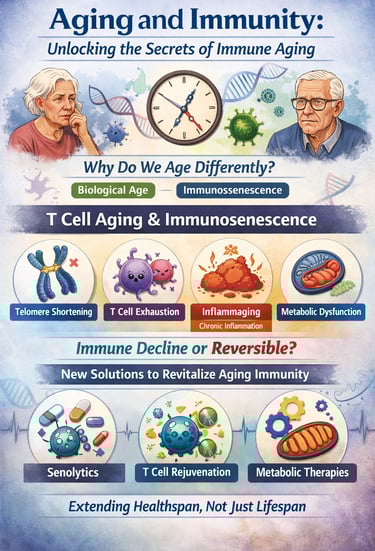
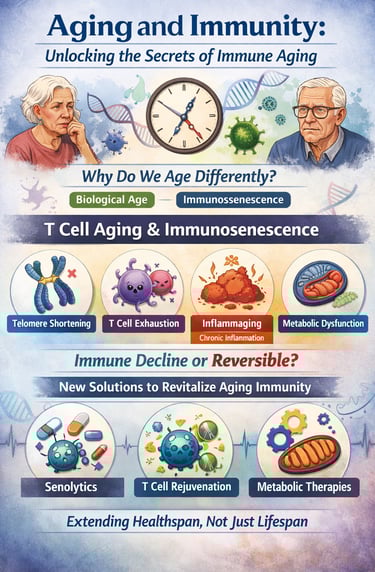
Why do two people of the same chronological age experience aging so differently—one remaining resilient and infection-free, the other struggling with recurrent illness, poor vaccine responses, and chronic inflammation? Increasingly, the answer lies not in the calendar, but in the immune system. Modern research now recognizes aging and immunity as deeply intertwined biological processes, with the immune system serving as one of the most sensitive indicators of biological aging rather than mere years lived (Thaiss et al., 2025).
At the center of this process is immunosenescence, the progressive remodeling of the immune system that occurs with age. Contrary to earlier beliefs, immune aging is not simply a gradual loss of function. Instead, it involves profound shifts in T cell biology, immune metabolism, inflammatory signaling, and immune memory—changes that collectively reshape how the body responds to infections, vaccines, cancer, and even its own tissues (Terekhova et al., 2025).
Among all immune components, T cell aging has emerged as a critical driver of age-related immune dysfunction. Declining thymic output, T cell exhaustion, mitochondrial dysfunction, and epigenetic reprogramming converge to reduce immune adaptability while paradoxically increasing chronic low-grade inflammation, a phenomenon known as inflammaging (Zhang et al., 2025). This imbalance helps explain why older adults experience both impaired pathogen defense and heightened inflammatory disease risk.
Crucially, recent discoveries challenge the notion that immune aging is inevitable or irreversible. Breakthrough insights into the senescence–metabolism axis and targeting T-cell aging now suggest that immune decline may be modifiable, opening new avenues to revitalize geriatric immunotherapy, improve vaccine efficacy, and extend healthspan rather than lifespan alone (Chen et al., 2025; Garza-Martínez & Fitzgerald-Bocarsly, 2026).
Understanding human immune aging is no longer optional—it is foundational to redefining healthy aging in the 21st century.
Clinical pearls
1. The "Silent Alarm" Phenomenon
In clinical terms, inflammaging is sterile, meaning it occurs without an active infection. While acute inflammation is like a fire department responding to a blaze, inflammaging is like a faulty smoke detector that chirps 24/7. This constant "chirping" eventually wears down your cellular machinery.
The Pearl: You don’t have to "feel" sick to be experiencing systemic inflammation. Monitoring biomarkers (like hs-CRP) is essential because your body’s internal alarm system may be muffled.
2. Biological Age vs. Chronological Age
Your birth certificate tells you how many times you’ve circled the sun, but your epigenetic clock tells you how much "wear and tear" your cells have endured. Research shows that high levels of inflammation can cause your biological age to "accelerate" past your actual years.
The Pearl: Aging is a high-speed chase, but you control the accelerator. By reducing inflammatory inputs (stress, poor diet, inactivity), you can effectively "slow down" your internal clock.
3. "Zombies" in the System (Senescence)
As we age, some cells become "senescent." They stop dividing but refuse to die, lingering like "zombie cells" that secrete pro-inflammatory chemicals (known as the SASP) which "infect" healthy neighboring cells with inflammation.
The Pearl: Movement is a natural "housekeeping" tool. Regular exercise helps the immune system identify and clear out these lingering cells, preventing them from turning a localized issue into a systemic one.
4. The Power of "Immunorejuvenation"
The thymus (the "training camp" for your immune cells) naturally shrinks as we age, a process called thymic involution. This leads to a shortage of "naive" cells ready to fight new threats. However, new research suggests this isn't strictly one-way; the immune system is remarkably plastic.
The Pearl: You can "retrain" your immune system at any age. Nutrient-dense diets and specific clinical interventions act as "continuing education" for your immune cells, helping them maintain precision rather than attacking healthy tissue.
5. The Gut-Inflammation Axis
A significant portion of the body’s immune system resides in the gut. When the intestinal barrier weakens—often due to age or poor diet—inflammatory markers can leak into the bloodstream, fueling systemic inflammaging.
The Pearl: A Mediterranean-style diet isn't just about weight; it's about barrier integrity. High-fibre, polyphenol-rich foods act like a "sealant" for your gut, preventing microscopic leaks that keep your systemic inflammation levels elevated.
Aging and Immunity: The Complete Guide to Understanding Immunosenescence, T Cell Aging, and Modern Solutions
What is Immunosenescence? Understanding Immune System Aging
Immunosenescence refers to the gradual deterioration of immune function that occurs naturally with age. Rather than a single event, it's a complex, progressive process affecting multiple components of our immune defenses.
According to recent research published in Immunity, the relationship between aging and immunity involves changes at the cellular, molecular, and systemic levels (Thaiss et al., 2025). The immune system doesn't simply "wear out"—instead, it undergoes profound shifts in how it responds to threats, maintains memory of past infections, and protects us from disease.
Key Components Affected by Immune Aging:
T cells: White blood cells central to adaptive immunity
B cells: Antibody-producing immune cells
Innate immunity: The first-line defense system
Cytokine production: Chemical signaling between immune cells
Immune memory: The ability to recognize past pathogens
The T Cell Connection: T Cell Aging and T Cell Exhaustion
Among all immune components, T cells have emerged as crucial players in understanding aging and immunity. Recent comprehensive research has illuminated exactly how T cell aging and T cell exhaustion contribute to immunosenescence.
Understanding T Cell Aging Mechanisms
T cell aging isn't simply about these cells getting older—it's about functional deterioration. Zhang et al. (2025) detailed the intricate mechanisms of T cell aging and exhaustion in their landmark review in Clinical Immunology. Their research identifies several critical processes:
Telomere shortening: The protective caps on chromosomes gradually shorten with each cell division
Mitochondrial dysfunction: Energy-producing structures become less efficient
Epigenetic changes: Chemical modifications affecting gene expression without changing DNA sequence
Altered differentiation: T cells struggle to develop properly into specialized types
The clinical implications are significant. As T cell aging progresses, older adults experience reduced ability to mount immune responses against new pathogens, while simultaneously showing chronic inflammation from persistent immune activation.
T Cell Exhaustion: A Parallel Process
T cell exhaustion differs slightly from simple aging. It represents a state of reduced functionality that develops when T cells are chronically stimulated—like those fighting persistent viruses (Zhang et al., 2025). This creates a double burden: older adults have both aged T cells and exhausted T cells competing for immune resources.
Cellular Senescence and the Metabolism Axis: New Insights
Recent research has uncovered a fascinating connection between cellular senescence (when cells lose the ability to divide) and immune function. The emerging senescence-metabolism axis offers breakthrough insights into T cell dynamics during biological aging.
Garza-Martínez and Fitzgerald-Bocarsly (2026) published groundbreaking work in Cell Communication and Signaling revealing how cellular senescence directly impacts immune cell metabolism. Here's what this means:
Senescent T cells accumulate with age and secrete inflammatory substances. These cells also shift their metabolic patterns, using energy less efficiently. This creates a vicious cycle: metabolic dysfunction drives immune cells toward senescence, which further disrupts immune responses.
The traditional view that aging and immunity decline is simply about "wearing out" is incomplete. Instead, senescent cells actively contribute to immune dysfunction through metabolic reprogramming. Targeting this senescence-metabolism axis represents a promising avenue for reverting aged immune function.
Human Immune Aging: A Comprehensive Overview
What does human immune aging actually look like at the molecular level? Terekhova et al. (2025) provided extensive insights in their comprehensive review in Immunity, mapping the detailed landscape of age-related immune changes.
The Multi-System Effects of Human Immune Aging:
Innate Immune Changes: Macrophages and dendritic cells become less responsive, producing altered patterns of inflammatory molecules.
Adaptive Immune Remodeling: Both T cell and B cell compartments undergo dramatic shifts, with reduced diversity and altered populations.
Chronic Inflammation State: Despite reduced acute responses to new infections, older adults show elevated baseline inflammation—a phenomenon called "inflammaging."
Thymic Involution: The thymus gland, which produces T cells, shrinks dramatically with age, reducing the production of new functional T cells.
Increased Autoimmunity: The aging immune system sometimes misfires, attacking the body's own tissues more frequently.
The research by Terekhova and colleagues emphasizes that human immune aging is not uniform. Individual variations based on genetics, lifestyle, and previous infections create a spectrum of immune aging rates—explaining why some 80-year-olds have immune profiles resembling 50-year-olds, while some younger adults show accelerated immune aging.
Breakthrough Solutions: Targeting T Cell Aging for Better Treatment
Understanding the mechanisms of aging and immunity isn't purely academic—it's already leading to practical solutions. Chen et al. (2025) published cutting-edge research in Aging and Disease specifically focused on therapeutic interventions.
Targeting T-Cell Aging: The New Frontier
The key insight from Chen and colleagues is that T cell aging might be reversible or at least slowed. Their work on targeting T-cell aging identifies several promising approaches:
Cellular Reprogramming: Techniques that can reset the "aging clock" of T cells, restoring their youthful function.
Metabolic Interventions: Therapies that restore efficient energy use in aged T cells.
Senescence Clearance: Removing senescent cells that contribute to immune dysfunction.
Immune Reconstitution: Strategies to regenerate T cell populations and diversity.
Clinical Applications: Revitalizing Geriatric Immunotherapy
These insights have immediate practical applications. By targeting T-cell aging, researchers are developing improved approaches to:
Enhance vaccine efficacy in older populations
Improve cancer immunotherapy outcomes in elderly patients
Reduce infection rates in nursing home residents
Support recovery from serious infections
The concept of "revitalize geriatric immunotherato restore immune function actively" represents a paradigm shift—rather than accepting age-related immune decline, we're now developing interventions to restore immune function actively.
The Clinical Picture: Aging and Immunity Insights and Solutions
Sim (2025) synthesized current knowledge into an accessible framework addressing aging and immunity challenges, insights and breakthrough solutions. This research, published in the Journal of Medicine, University of Santo Tomas Online, connects basic science to clinical practice.
Challenges in Aging Immunity:
Increased infection susceptibility: Older adults develop more severe infections with pathogens younger people easily overcome
Vaccine response decline: Even updated vaccines produce weaker responses in seniors
Chronic disease acceleration: Aged immunity contributes to heart disease, dementia, and frailty
Cancer risk elevation: Reduced immune surveillance allows more cancers to develop
The good news: aging and immunity decline is not inevitable or uniform. Several modifiable factors influence immune aging rates, including physical activity, nutrition, sleep quality, stress management, and social engagement.
Breakthrough Solutions Being Developed:
Senolytic drugs: Medications that eliminate senescent cells
NAD+ boosters: Compounds restoring cellular energy production
Immunometabolic therapies: Interventions targeting the senescence-metabolism axis
Personalized immune interventions: Treatments tailored to individual aging profiles
The Immune System as a Window into Overall Aging
Perhaps most provocatively, recent literature suggests that the immune system offers a window into aging itself. An editorial in Nature Aging (2025) argues that understanding aging and immunity is fundamentally understanding aging more broadly.
Why? Because immune aging correlates with:
Chronological aging: How many years you've lived
Biological aging: How fast your body is aging at the cellular level
Functional aging: Your actual physical capabilities and health status
By monitoring immune function, clinicians and researchers can assess biological age more accurately than counting years. Someone with a "young" immune system may actually be aging slower, even if they're chronologically older.
Key Takeaways: What You Need to Know About Aging and Immunity
Immunosenescence is multifactorial: It's not just one thing changing; it's a coordinated shift across many immune components, particularly affecting T cell aging and increasing T cell exhaustion.
T cells are critical players: Understanding T cell aging mechanisms is central to understanding aging and immunity, and emerging research shows these changes might be reversible.
Senescence matters: The senescence-metabolism axis represents a breakthrough in understanding how cellular senescence drives immune aging.
Individual variation is significant: Human immune aging rates vary dramatically, meaning interventions might be highly personalized.
Solutions are emerging: From understanding aging and immunity challenges to developing breakthrough solutions, we're transitioning from accepting immune decline to actively restoring immune function.
The immune system reveals overall aging: Your immune function may be a better indicator of your biological age than your chronological age.
Geriatric immunotherapy is evolving: New approaches to revitalize geriatric immunotherapy through targeting T-cell aging are showing promise in early studies.
Frequently Asked Questions About Aging and Immunity
Q: At what age does immune aging become noticeable?
A: Immunosenescence begins in your 20s and accelerates after age 60, though the pace varies dramatically between individuals based on genetics, lifestyle, and health history.
Q: Can T cell aging be reversed?
A: Recent research suggests it may be partially reversible through certain interventions, though this remains an active area of investigation. Some approaches show promise in restoring T cell function.
Q: Why are older adults more susceptible to infections?
A: Multiple factors contribute: reduced T cell diversity, decreased antibody quality, impaired innate immune responses, and reduced ability to mount rapid inflammatory responses to new pathogens.
Q: Do vaccines work differently in older adults?
A: Yes. Aging and immunity means older adults typically develop weaker antibody responses to vaccines, though protection is usually still achieved. Higher-dose and adjuvanted vaccines are often recommended.
Q: What can I do to slow immune aging?
A: Evidence supports: regular physical activity, adequate sleep, balanced nutrition (especially antioxidants and micronutrients), stress management, social engagement, and maintaining a healthy weight.
Q: How is targeting T-cell aging different from other anti-aging approaches?
A: Rather than general anti-aging strategies, targeting T-cell aging specifically addresses the mechanisms causing T cells to dysfunction, potentially restoring immune competence directly.
Q: What's the connection between cellular senescence and immunity?
A: Senescent cells accumulate with age and secrete inflammatory substances that disrupt immune function. The senescence-metabolism axis shows how senescent immune cells actively impair overall immune function.
Q: Why does inflammation increase with age if immunity declines?
A: This apparent paradox—reduced responses to infections but increased background inflammation—occurs because aged immune cells shift toward chronic, low-grade inflammatory activation while losing ability to mount acute responses.
Looking Forward: The Future of Aging and Immunity Research
The convergence of evidence from multiple research groups points toward exciting possibilities. As we understand T cell aging, the senescence-metabolism axis, and strategies for targeting T-cell aging, practical interventions are moving from theory to clinic.
The shift from passive acceptance of aging and immunity decline toward active intervention represents a major paradigm change in gerontology and immunology. Within the next decade, we may routinely offer "immune age assessments" and personalized interventions to optimize immune function throughout life.
Author’s Note
The science of aging has entered a transformative era, and nowhere is this shift more evident than in immunology. For decades, age-related immune decline was viewed as an unavoidable consequence of growing older—something to be accommodated rather than understood or modified. The body of research presented in this article reflects a fundamentally different perspective: immune aging is an active, dynamic, and biologically regulated process, not merely passive deterioration.
This guide was written with the intent to bridge cutting-edge immunological research and clinical relevance. The focus on immunosenescence, T cell aging, and the emerging senescence–metabolism axis reflects where the field is rapidly converging. Increasing evidence now suggests that immune dysfunction with age is mechanistically linked to metabolic reprogramming, cellular senescence, and chronic inflammation—processes that are increasingly viewed as modifiable rather than fixed.
Importantly, this work does not frame aging as a disease, nor does it promote speculative anti-aging claims. Instead, it emphasizes healthspan, immune resilience, and evidence-based strategies to support immune function across the lifespan. Where emerging therapies are discussed—such as senolytics, immunometabolic interventions, or T-cell rejuvenation—they are presented within the context of current evidence, limitations, and ongoing investigation.
Readers should view this article as both an educational resource and an invitation: to rethink how we define healthy aging, to appreciate the immune system as a window into biological age, and to recognize that preserving immune competence may be central to preventing many age-associated diseases.
As research continues to evolve, so too will our understanding. The goal here is not to offer final answers, but to provide a scientifically grounded framework that empowers clinicians, researchers, and informed readers to engage thoughtfully with the rapidly advancing field of aging and immunity.
Disclaimer: This article is for informational purposes only and does not constitute medical advice. Individual circumstances vary, and treatment decisions should always be made in consultation with qualified healthcare professionals.
Related Articles
Exercise and Longevity: The Science of Protecting Brain and Heart Health as You Age | DR T S DIDWAL
The Science of Healthy Brain Aging: Microglia, Metabolism & Cognitive Fitness | DR T S DIDWAL
The Aging Muscle Paradox: How Senescent Cells Cause Insulin Resistance and The Strategies to Reverse It | DR T S DIDWAL
VO2 Max & Longevity: The Ultimate Guide to Living Longer | DR T S DIDWAL
Waist-Calf Ratio: The Longevity Metric Most People Aren’t Tracking | DR T S DIDWAL
Blue Zones Secrets: The 4 Pillars of Longevity for a Longer, Healthier Lifepost | DR T S DIDWAL
Anabolic Resistance: Why Muscles Age—and How to Restore Their Growth Response | DR T S DIDWAL
References
Chen, M., Su, Z., & Xue, J. (2025). Targeting T-cell aging to remodel the aging immune system and revitalize geriatric immunotherapy. Aging and Disease, 17(2). https://doi.org/10.14336/AD.2025.0061
Garza-Martínez, L., & Fitzgerald-Bocarsly, P. (2026). The cellular senescence–metabolism axis: Emerging insights into T cell dynamics in the context of biological aging. Cell Communication and Signaling, 24, 24. https://doi.org/10.1186/s12964-025-02525-0
Sim, T. C. (2025). Aging and immunity: Challenges, insights and breakthrough solutions. Journal of Medicine, University of Santo Tomas (JMUST Online), 9(1). https://doi.org/10.35460/2546-1621.2025-0017
Terekhova, M., Bohacova, P., & Artyomov, M. N. (2025). Human immune aging. Immunity, 58(11), 2646–2669. https://doi.org/10.1016/j.immuni.2025.10.009
Thaiss, C. A., Tian, Y., Winer, D. A., Linterman, M., Liston, A., Amor, C., Lowe, S. W., & Liu, G. H. (2025). Aging and immunity. Immunity, 58(11), 2609–2612. https://doi.org/10.1016/j.immuni.2025.10.019
The immune system offers a window into aging. (2025). Nature Aging, 5, 1377. https://doi.org/10.1038/s43587-025-00948-5
Zhang, W., Kong, D., Zhang, X., Hu, L., Nian, Y., & Shen, Z. (2025). T cell aging and exhaustion: Mechanisms and clinical implications. Clinical Immunology (Orlando, Fla.), 275, 110486. https://doi.org/10.1016/j.clim.2025.110486