Body Roundness Index Explained: The #1 Indicator of Visceral Fat and Cardiovascular Risk
Forget BMI. New 2025 research reveals the Body Roundness Index (BRI) is significantly better at predicting CVD, diabetes, and mortality risk by focusing on dangerous central obesity. Learn what your BRI means.
OBESITY
Dr. T.S. Didwal, M.D.(Internal Medicine)
1/14/202610 min read
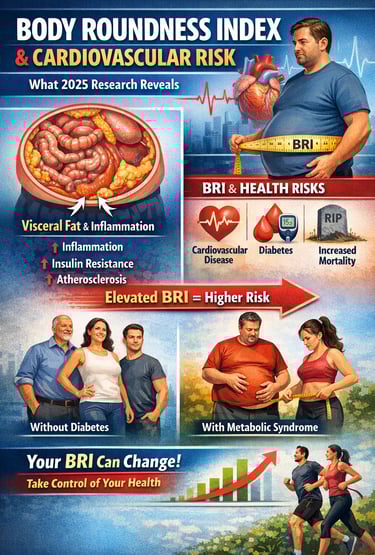
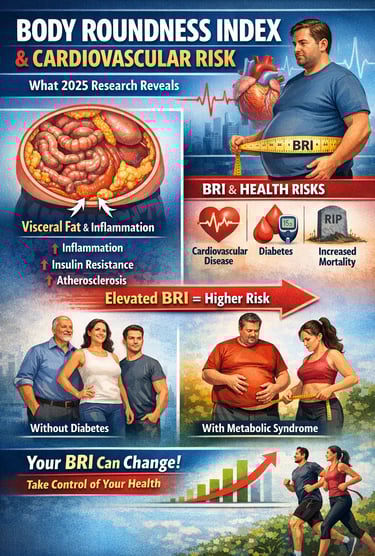
What if one number could reveal more about your cardiovascular risk than the traditional BMI you’ve relied on for years? In 2025, researchers are sounding the alarm: the Body Roundness Index (BRI)—a measurement many people have never heard of—may be one of the most powerful tools yet for predicting heart disease. Unlike BMI, which treats all weight the same, BRI zeroes in on where your fat is stored, especially around your abdomen, where visceral fat fuels inflammation, insulin resistance, and metabolic dysfunction (Wang et al., 2025).
This matters because visceral fat isn’t just inert padding—it behaves like an endocrine organ, secreting inflammatory cytokines that accelerate atherosclerosis and disrupt vascular health (Chen et al., 2025). Emerging evidence now shows that elevated BRI is strongly associated with cardiovascular disease, diabetes, and increased mortality across multiple populations and age groups (Liu et al., 2025). Even individuals without baseline diabetes face significantly higher risk when their BRI rises, underscoring its importance as a universal risk marker (Kong et al., 2025).
In other words, BRI may offer the missing insight you’ve been searching for—a clearer, more precise window into your cardiovascular future. And the best part? Your BRI trajectory is modifiable, giving you actionable control over your long-term health.
Clinical Pearls
BRI is Superior for Central Obesity Risk Assessment:
BRI (Body Roundness Index) appears to be a superior predictor of cardiovascular disease (CVD) and mortality compared to traditional BMI. This is because BRI specifically incorporates waist circumference, which effectively captures visceral adiposity (central obesity)—the metabolically toxic fat surrounding organs—that drives cardiovascular risk through inflammation and insulin resistance.
Trajectory Matters More Than Snapshot:
The longitudinal trajectory of an individual's BRI is a more powerful predictor of future CVD risk than a single, static measurement. Clinicians and individuals should focus on achieving and maintaining a declining BRI trajectory as evidence of successful risk reduction, regardless of the absolute starting value.
Critical in High-Risk Populations:
BRI provides crucial, independent risk stratification for individuals who already have a high-risk profile, particularly those with metabolic syndrome. Monitoring BRI in these patients helps identify who requires the most intensive, targeted interventions beyond standard risk factor management.
Applicable Across Metabolic Profiles:
The predictive power of BRI is independent of an individual's diabetes status. It is associated with new-onset CVD even in middle-aged and older adults without baseline diabetes, underscoring its utility as a universal cardiovascular risk marker that captures underlying risk missed by traditional metrics.
Actionable Intervention Target:
Interventions should be specifically focused on reducing waist circumference to improve BRI. These studies suggest that achieving a healthier BRI trajectory and reducing central fat can yield significant cardiovascular benefits, even if the patient does not achieve conventional "ideal" BMI targets. This makes targeted reduction of visceral fat an empowering and measurable health goal.
Body Roundness Index and Cardiovascular Disease: What 2025 Research Reveals About Your Health Risk
Understanding the Body Roundness Index: Beyond Traditional Metrics
Before diving into the research, let's clarify what we're talking about. The body roundness index is a newer anthropometric measure designed to capture abdominal adiposity and overall body shape more effectively than traditional metrics. Unlike BMI, which relies solely on height and weight, BRI incorporates waist circumference data, offering a more nuanced picture of how fat is distributed throughout your body.
This distinction matters enormously because not all body fat is created equal. Central obesity—excess fat stored around your midsection—poses significantly greater health risks than fat distributed elsewhere. The body roundness index excels at identifying this problematic fat distribution pattern.
Study 1: Longitudinal Trajectory of Body Roundness Index and CVD Risk
Wang et al. (2025) conducted an ambitious multicohort study examining how the body roundness index changes over time and whether these trajectory patterns predict cardiovascular disease risk. Rather than taking a single measurement snapshot, this research tracked how BRI evolves in individuals across multiple years, revealing something crucial: the pattern of change matters as much as the absolute value.
The study found that individuals with increasing body roundness trajectories faced substantially elevated CVD risk, even when accounting for baseline measurements. Conversely, those who successfully reduced their BRI over time showed protective cardiovascular benefits.
Key Takeaways
Longitudinal tracking of BRI provides superior CVD risk stratification compared to single-point assessments
The trajectory pattern of body roundness changes is independently predictive of cardiovascular outcomes
Multicohort analysis strengthens evidence generalizability across diverse populations
Individuals demonstrating declining BRI trajectories experienced meaningful cardiovascular risk reduction
This research underscores an empowering message: your current body roundness index isn't destiny. The direction you're heading matters profoundly for your cardiovascular health.
Study 2: Body Roundness Index in Metabolic Syndrome Patients
Chen et al (2025) shifted focus to a particularly vulnerable population: individuals with metabolic syndrome. This condition—characterised by a cluster of cardiovascular risk factors including hypertension, dyslipidemia, impaired glucose metabolism, and central obesity—affects millions worldwide.
The research revealed that body roundness index emerged as a robust predictor of cardiovascular disease and all-cause mortality specifically within the metabolic syndrome population (Chen et al., 2025). The relationship remained significant even after adjusting for traditional risk factors, suggesting BRI captures unique risk information.
Key Takeaways
Body roundness index demonstrates superior predictive capacity for cardiovascular outcomes in metabolic syndrome patients
BRI-based risk stratification enables clinicians to identify high-risk individuals within this already-vulnerable population
Mortality prediction using BRI outperforms conventional anthropometric measures
Targeted interventions focused on reducing body roundness may yield disproportionate benefits for metabolic syndrome patients
For individuals already grappling with metabolic syndrome, monitoring body roundness index transforms it from an abstract metric into a potentially life-saving clinical tool.
Study 3: Systematic Review and Combined Analysis
Liu et al. (2025), in a systematic review and combined analysis, synthesised evidence across multiple studies, offering a bird's-eye view of body roundness index associations with cardiovascular disease, diabetes, and mortality. By pooling data from numerous investigations, this meta-analytical approach provides robust statistical power and generalizability.
The comprehensive analysis confirmed consistent associations between elevated BRI and increased risk across all three major health outcomes (Liu et al., 2025). Importantly, these relationships persisted across different populations, geographic regions, and study designs—hallmarks of reliable scientific evidence.
Key Takeaways
Body roundness index demonstrates consistent associations with cardiovascular disease across diverse populations and study designs
Diabetes risk increases significantly with elevated BRI, independent of traditional metabolic risk factors
Mortality risk stratification using body roundness index provides clinically meaningful risk discrimination
Systematic evidence synthesis confirms BRI as a robust and generalizable health risk indicator
A systematic review carries particular weight in evidence hierarchies precisely because it synthesizes disparate findings into coherent conclusions. This study essentially confirms that body roundness index isn't a one-off finding but rather a reproducible, reliable marker of serious health risks.
Study 4: Body Roundness Index in Middle-Aged and Older Adults
Kong et al. (2025) leveraged data from the China Health and Retirement Longitudinal Study, a nationally representative cohort following middle-aged and older Chinese adults. This study distinguished between individuals with and without diabetes, examining whether body roundness index predicted new-onset cardiovascular disease differently in these groups.
The research confirmed that BRI independently associated with incident cardiovascular disease in both populations (Kong et al., 2025). Particularly striking was the finding that BRI remained predictive even among individuals without baseline diabetes, suggesting its utility as a universal cardiovascular risk marker across different metabolic profiles.
Key Takeaways
Body roundness index predicts new-onset cardiovascular disease in middle-aged and older populations
BRI associations with CVD incidence persist regardless of diabetes status
Geographic and cultural diversity in study populations strengthens evidence applicability
Age-specific insights confirm body roundness index relevance throughout adulthood
This research particularly matters if you're middle-aged or older, as it confirms that body roundness index remains a valuable health monitoring tool regardless of your diabetes status.
Synthesizing the Evidence: What These Four Studies Tell Us
Collectively, these 2025 investigations paint a compelling picture. The body roundness index emerges not as a niche metric but as a potentially superior cardiovascular risk predictor that captures dimensions of health risk that traditional measures miss.
Here's why this matters: cardiovascular disease remains the leading cause of death globally. If body roundness index genuinely provides superior risk stratification, it could guide more targeted, effective interventions for millions of people.
The Mechanism Behind Body Roundness Index and Cardiovascular Risk
While these studies document strong associations, understanding the why enhances appreciation for the findings. Central obesity—the excessive abdominal fat that BRI specifically measures—is metabolically toxic in ways that peripheral fat is not.
Visceral fat surrounding your organs actively secretes inflammatory cytokines and promotes insulin resistance. This visceral adiposity directly damages your cardiovascular system through multiple pathways: promoting atherosclerosis, elevating blood pressure, increasing thrombotic risk, and compromising endothelial function.
By measuring body shape through waist circumference alongside height, body roundness index captures this toxic central obesity more effectively than BMI alone. This explains why these four studies consistently demonstrate that BRI predicts cardiovascular risk, diabetes, and mortality with remarkable consistency.
Practical Implications: What You Should Know
For Healthcare Providers
The evidence suggests incorporating body roundness index into routine clinical assessment could improve cardiovascular risk stratification. Rather than relying solely on BMI, clinicians could:
Calculate BRI using readily available anthropometric data (height and waist circumference)
Use BRI trajectories to monitor intervention effectiveness
Identify high-risk individuals within ostensibly lower-risk groups (like those without diabetes)
Tailor prevention strategies based on body roundness patterns
For Individuals
If you're concerned about cardiovascular health, these studies suggest practical steps:
Monitor your waist circumference in addition to overall weight
Recognize that body shape matters as much as body size
Understand that improving your BRI can meaningfully reduce cardiovascular risk—and you don't necessarily need to reach an "ideal" BMI to benefit
Consider body roundness trajectories as motivational markers: are you trending in the right direction?
FAQs: Body Roundness Index and Cardiovascular Health
Q: How do I calculate my body roundness index?
A: Body roundness index is calculated using the formula incorporating your height and waist circumference. While the exact formula varies slightly between research groups, most use a calculation based on waist-to-height ratio that yields a more nuanced measure than BMI. Many online calculators now offer BRI calculations—searching "body roundness index calculator" will direct you to reliable tools.
Q: Is body roundness index better than BMI for cardiovascular risk assessment?
A: According to these 2025 studies, body roundness index appears superior to BMI specifically for cardiovascular risk stratification because it better captures central obesity. However, they're complementary rather than mutually exclusive tools. Using both provides a more complete picture of your health risk.
Q: Can I reduce my body roundness index without major weight loss?
A: These studies suggest that even modest reductions in waist circumference—which directly impacts your BRI—may yield cardiovascular benefits. You don't necessarily need dramatic weight loss; targeted reduction of abdominal fat through appropriate nutrition and exercise can improve your BRI substantially.
Q: If I have metabolic syndrome, why does body roundness index matter more?
A: As Chen's research demonstrates, individuals with metabolic syndrome already face elevated cardiovascular risk. Body roundness index provides additional risk discrimination within this high-risk population, helping identify those requiring most intensive intervention.
Q: Does body roundness index matter if I don't have diabetes?
A: Absolutely. Kong's research specifically demonstrated that BRI predicts cardiovascular disease independently of diabetes status. You don't need diabetes for central obesity to threaten your cardiovascular health.
Q: How often should I check my body roundness index?
A: There's no universally established interval, but these studies examining longitudinal trajectories suggest that periodic monitoring—perhaps annually or semi-annually—can reveal important trends in your cardiovascular risk profile. More frequent monitoring may be warranted if you're implementing lifestyle changes.
Q: Are these findings applicable to all populations?
A: These four studies collectively examined diverse populations across different countries and age groups. The consistency of findings across this diversity suggests strong generalizability, though individual factors always influence personal health risk.
Your Next Steps: Taking Action on Body Roundness Index
Understanding body roundness index is one thing; using it to improve your health is another. Consider these actionable steps:
Immediate Actions:
Calculate your current body roundness index using an online calculator
Measure your waist circumference at the level of your navel
Establish a baseline understanding of where you stand
Short-Term (Next 3 Months):
Incorporate waist circumference monitoring into your routine health tracking
Focus dietary changes on reducing visceral fat accumulation—prioritize whole grains, lean proteins, and reduced processed foods
Implement cardiovascular exercise, which research suggests preferentially reduces central obesity
Medium-Term (3-6 Months):
Recheck your body roundness index to assess your trajectory
If improving, reinforce successful strategies; if plateauing, adjust your approach
Consider working with a healthcare provider to interpret your BRI trajectory in context of other health markers
Ongoing:
View body roundness index as one tool among many for health monitoring
Recognize that cardiovascular disease prevention requires multifactorial approach—diet, exercise, stress management, sleep quality all matter
Remember that these studies document associations; they motivate behavior change, not fatalism
Author’s Note
As a physician and researcher deeply involved in metabolic and cardiovascular health, I have spent years examining how subtle physiological changes can dramatically influence long-term disease risk. The emergence of the Body Roundness Index (BRI) as a strong predictor of cardiovascular disease marks an important shift in how we understand obesity, body composition, and metabolic dysfunction.
Traditional measures like BMI often fail to capture the silent yet dangerous accumulation of visceral fat—fat that behaves like an active endocrine organ, driving inflammation, insulin resistance, and vascular injury. The 2025 research highlighted in this article provides compelling evidence that BRI offers a clearer lens through which we can evaluate real cardiometabolic risk, irrespective of age, metabolic status, or baseline weight.
My goal in presenting this body of evidence is not to alarm, but to empower. BRI is not a static number—your trajectory can improve with intentional lifestyle changes. Understanding this metric gives both clinicians and individuals a more actionable, precise way to identify risks early and intervene effectively.
I hope this article inspires you to look beyond traditional measurements and embrace more accurate, evidence-based tools to guide your health decisions
Disclaimer: This article is for informational purposes only and does not constitute medical advice. Individual circumstances vary, and treatment decisions should always be made in consultation with qualified healthcare professionals.
Related Articles
The BMI Paradox: Why "Normal Weight" People Still Get High Blood Pressure | DR T S DIDWAL
Breakthrough Research: Leptin Reduction is Required for Sustained Weight Loss | DR T S DIDWAL
The Metabolic Triad: Why Diabetes, Obesity & CVD Are One Epidemic | DR T S DIDWAL
Obesity 2025: Revolutionary Research Advances in Treatment and Management | DR T S DIDWAL
References
Chen, Z., Cheang, I., Zhu, X., Qu, Q., Chen, S., Xing, Y., Zhou, Y., Zhang, H., & Li, X. (2025). Associations of body roundness index with cardiovascular disease and mortality among patients with metabolic syndrome. Diabetes, Obesity & Metabolism, 27(6), 3285–3298. https://doi.org/10.1111/dom.16346
Kong, Y., Luo, Q., Zhang, Q., et al. (2025). Association of the body roundness index with new-onset cardiovascular disease in middle-aged and older adults with and without diabetes: Evidence from the China Health and Retirement Longitudinal Study. Diabetology & Metabolic Syndrome, 17, 142. https://doi.org/10.1186/s13098-025-01705-9
Liu, J., Shen, Q., & Wang, X. (2025). Novel body roundness index related to cardiovascular disease, diabetes and mortality: A systematic review and combined analysis. Nutrition, Metabolism, and Cardiovascular Diseases: NMCD, 104285. Advance online publication. https://doi.org/10.1016/j.numecd.2025.104285
Wang, X., Gu, J., Wu, S., Fu, P., & Li, J. (2025). Association of longitudinal trajectory of body roundness index with CVD risk: Evidence from a multicohort study. Obesity (Silver Spring, Md.), 33(12), 2387–2397. https://doi.org/10.1002/oby.70038