The Physiology of HIIT: How Mitochondria, Oxygen & Energy Systems Drive Performance
Understand how HIIT trains all three energy systems to boost mitochondria, improve oxygen use, and enhance metabolic health.
EXERCISE
Dr. T.S. Didwal, M.D.(Internal Medicine)
4/13/202616 min read
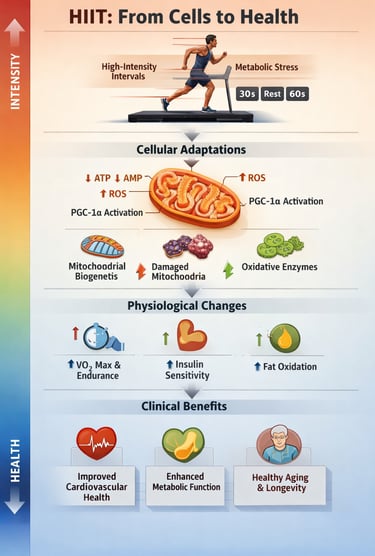
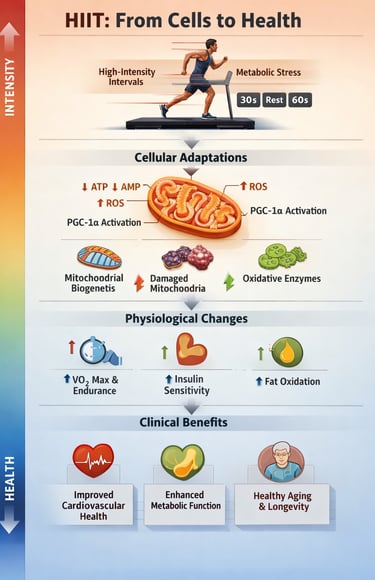
HIIT drives powerful cellular adaptations by stimulating mitochondrial biogenesis and improving oxygen utilization.
Short bursts of intense effort activate key molecular pathways that enhance metabolic efficiency and energy production.
Beyond calorie burn, HIIT reshapes how cells generate and use energy over time.
The “burn” during intervals reflects metabolic stress that signals mitochondria to adapt and grow stronger.
Each session can activate genes linked to improved metabolic function and resilience.
Consistent high-intensity training promotes mitochondrial remodeling and cardiovascular efficiency.
Ultimately, HIIT converts brief stress into long-term cellular strength and performance gains.
Clinician’s Perspective: HIIT Through a Medical Lens
HIIT as a mitochondrial therapeutic exercise
From a clinical standpoint, HIIT should be viewed not merely as exercise, but as a targeted intervention for improving mitochondrial health—central to conditions like Type 2 Diabetes, Cardiovascular Disease, and age-related sarcopenia. The repeated metabolic stress robustly activates pathways such as PGC-1α, driving both mitochondrial biogenesis and functional efficiency.
Superior stimulus for cardiorespiratory fitness
Compared to moderate continuous training, HIIT produces larger improvements in VO2 max per unit time—one of the strongest predictors of all-cause and cardiovascular mortality. This makes it particularly valuable in time-constrained patients.Metabolic remodeling beyond glucose control
HIIT improves insulin sensitivity, skeletal muscle glucose uptake, and lipid oxidation. These adaptations extend beyond glycemic control to broader metabolic resilience, particularly in patients with insulin resistance and metabolic syndrome.Cardiac resilience and ischemic protection
Emerging data suggest HIIT enhances mitochondrial efficiency within cardiomyocytes and may improve tolerance to ischemia–reperfusion injury. While promising, clinicians should interpret this cautiously pending large-scale human trials.Dose and patient selection are critical
HIIT is not universally appropriate. Patients with unstable coronary syndromes, uncontrolled hypertension, or arrhythmias require careful screening and often supervised programs before initiation.Adherence and behavioral sustainability
Despite its efficiency, long-term adherence varies. Clinicians should individualize prescriptions—blending HIIT with moderate-intensity training to optimize both physiological benefit and patient compliance.Position in modern preventive cardiology
HIIT represents a shift toward precision exercise medicine—where intensity, not just duration, is leveraged to drive meaningful biological change.
High-intensity interval training (HIIT) is often promoted as a time-efficient way to improve fitness—but its true power lies far deeper than calorie burn or convenience. Each intense burst of effort triggers a coordinated molecular response inside skeletal muscle, activating pathways that regulate energy production, mitochondrial remodeling, and long-term metabolic health. At the center of this adaptation is the mitochondrion—not just a passive “powerhouse,” but a dynamic organelle that senses cellular stress and responds by becoming more numerous, more efficient, and more resilient.
During a HIIT session, rapid fluctuations in energy demand disrupt cellular homeostasis: ATP levels fall, AMP rises, and reactive oxygen species accumulate. These signals converge on key regulators such as peroxisome proliferator-activated receptor gamma coactivator-1 alpha (PGC-1α), widely recognized as the master driver of mitochondrial biogenesis (Bishop et al., 2019). Repeated exposure to this metabolic stress leads to measurable increases in mitochondrial density, oxidative enzyme activity, and aerobic capacity—even with relatively low training volume (Ruegsegger et al., 2023).
Emerging evidence further suggests that HIIT not only increases mitochondrial quantity but also improves mitochondrial quality by enhancing fusion–fission dynamics and promoting the removal of dysfunctional components (Li et al., 2025). These cellular adaptations translate into clinically meaningful outcomes, including improved insulin sensitivity, cardiovascular function, and resistance to metabolic disease.
In essence, HIIT is not merely exercise—it is a targeted stimulus for cellular renewal. The intensity you experience at the surface reflects a deeper biological process: one that reshapes how your body produces energy, responds to stress, and sustains long-term health.
What is HIIT? A Quick Orientation
High-intensity interval training is an exercise strategy alternating short bursts of near-maximal effort (typically 80–100% of your maximum heart rate) with periods of active recovery or complete rest. A classic session might look like 30 seconds of all-out cycling, 90 seconds of slow pedalling, repeated 8–10 times. The total exercise time is often under 25 minutes, yet the physiological stimulus it delivers can rival — and in some domains exceed — 45–60 minutes of moderate-intensity continuous training (MICT).
That efficiency is not magic. It is the direct result of how intensely the intervals stress your energy systems, your oxygen-delivery machinery, and above all, your mitochondria. To understand why HIIT works, you need to understand those systems first.
20–30% Greater mitochondrial density after HIIT vs MICT in 8 weeks
<25 min Typical HIIT session length vs 45–60 min for MICT
3×Rise in PGC-1α expression driving mitochondrial biogenesis post-HIIT
Your Three Energy Systems — Why HIIT Trains Them All
Your body does not rely on a single energy source during exercise. Instead, it uses three interconnected energy systems that activate based on exercise intensity and duration. High-intensity interval training (HIIT) is uniquely effective because it stresses all three systems within a single workout—driving powerful metabolic and mitochondrial adaptations.
The Three Energy Systems Explained
Phosphagen System (ATP-PCr)
Uses stored ATP and creatine phosphate to deliver immediate energy for explosive efforts lasting 0–10 seconds. This system powers the initial burst of a sprint or high-intensity movement.Glycolytic System (Anaerobic)
Breaks down muscle glycogen into lactate to sustain activity for 10–120 seconds. This pathway dominates during intense HIIT intervals and is responsible for the familiar muscle “burn.”Oxidative System (Aerobic)
Utilizes oxygen to convert carbohydrates, fats, and ketones into sustained energy over longer durations. It plays a key role during recovery periods between intervals and improves with training.
Why the “Burn” Matters
The burning sensation during intense exercise is not just fatigue—it is a biological signal. The accumulation of lactate and hydrogen ions activates molecular pathways that enhance your body’s ability to clear lactate, improve fat oxidation, and increase aerobic efficiency. Over time, these signals drive mitochondrial adaptation, making your muscles more metabolically resilient.
The discomfort you feel during HIIT is not a limitation—it is the trigger for cellular adaptation.
Mitochondria: The Engine of Adaptation
Mitochondria are often described as the “powerhouses of the cell,” but this definition is incomplete. Beyond producing nearly 90% of resting cellular energy, mitochondria are highly dynamic organelles that continuously undergo fusion and fission, communicate with other cellular systems, and regulate metabolic health.
This dynamic behavior is central to how exercise—especially HIIT—reshapes human physiology. By repeatedly stressing cellular energy systems, HIIT stimulates mitochondrial remodeling, improving both their quantity and functional efficiency
Fusion and Fission: The Mitochondrial Social Life
When mitochondria fuse (join together), they form elongated, interconnected networks that are more efficient at energy production and better at buffering stress. When they undergo fission (splitting), damaged segments can be isolated and cleared away through a process called mitophagy — essentially cellular housekeeping. Healthy mitochondrial turnover requires a balance of both processes.
A landmark 2025 review by Li et al. published in Frontiers in Physiology directly compared the effects of HIIT versus moderate-intensity continuous training on these dynamics in human skeletal muscle. Their findings were striking: HIIT promoted significantly greater upregulation of fusion proteins (particularly MFN1, MFN2, and OPA1) and improved the overall quality of mitochondrial networks compared to MICT (Li et al., 2025). In plain terms, HIIT does not just grow more mitochondria — it builds better, more interconnected, more resilient ones.
Why this matters for you
Healthier mitochondrial networks mean your muscles are more efficient at burning calories at rest, recover faster between exercise bouts, and are better protected against the type of mitochondrial dysfunction linked to type 2 diabetes, cardiovascular disease, and age-related muscle loss (sarcopenia).
Mitochondrial Biogenesis: Building New Power Plants
Beyond remodelling existing mitochondria, intense exercise actually triggers the creation of brand-new ones — a process called mitochondrial biogenesis. The master switch for this process is a protein called PGC-1α (peroxisome proliferator-activated receptor gamma coactivator 1-alpha). When you push hard during a HIIT interval, falling oxygen availability, rising AMP-to-ATP ratios, and accumulating reactive oxygen species all converge to activate PGC-1α. It then switches on downstream genes that build new mitochondrial components.
Ruegsegger et al. (2023) conducted a carefully controlled trial comparing high-intensity aerobic training, resistance training, and combined protocols on both cardiometabolic health and skeletal muscle mitochondrial dynamics. Their results, published in the Journal of Applied Physiology, showed that high-intensity aerobic exercise — the core modality in HIIT — was uniquely effective at improving both cardiometabolic markers and mitochondrial dynamics simultaneously. Resistance training and combined protocols produced improvements, but not to the same degree in the mitochondrial domain (Ruegsegger et al., 2023). This underlines that the aerobic, oxygen-demanding component of HIIT is particularly potent as a mitochondrial stimulus.
Complementing these human data, Jahangiri et al. (2025) used a high-fat diet rat model to examine how HIIT alters gene expression linked to mitochondrial biogenesis and dynamics. Even in the context of diet-induced metabolic stress — a model of what happens in overweight individuals — HIIT robustly upregulated PGC-1α, TFAM, and NRF-1 gene expression, all central to building new mitochondria (Jahangiri et al., 2025). The message is encouraging: even a diet-impaired metabolic environment does not blunt the mitochondrial response to intense training.
The debate around "high-intensity" biogenesis
Bishop et al. (2019) published an important caution in Physiology: not all high-intensity exercise protocols produce equal biogenesis effects, and early studies overstated some claims. The magnitude of the PGC-1α response depends heavily on session design, training status, and nutrition. This means generic "HIIT" labels are not all equivalent — the details of interval duration, intensity, and recovery shape the molecular outcome (Bishop et al., 2019).
Oxygen: The Ultimate Currency of Endurance
Oxygen is the essential ingredient for aerobic energy production. Your capacity to consume oxygen — measured as VO₂max — is arguably the single strongest predictor of all-cause mortality in adults. People with high VO₂max live longer, have lower rates of cancer, cardiovascular disease, and dementia, and maintain independence further into old age. HIIT is one of the most powerful known interventions for raising VO₂max, and understanding why reveals a lot about how oxygen and mitochondria interact.
The Oxygen Cascade During a HIIT Sprint
When you begin a sprint, your muscles' oxygen demand spikes almost instantly. Your heart rate surges, your arteries dilate, and your red blood cells rush more oxygen to working tissues. But in the first seconds, supply cannot keep pace with demand — hence the anaerobic contribution. As the interval continues and then as you recover, a complex process of oxygen repayment begins: this is the well-known "excess post-exercise oxygen consumption" (EPOC) effect, colloquially called "afterburn." Your body continues consuming elevated amounts of oxygen for minutes to hours after exercise, as it restores phosphocreatine, clears lactate, lowers body temperature, and handles the hormonal aftermath of intense effort.
Over weeks, the repeated demand for oxygen during HIIT drives structural changes: your heart's left ventricle becomes more powerful, your muscles develop denser capillary networks, and — crucially — your mitochondria proliferate and become more efficient at extracting oxygen from blood and converting it into ATP. These adaptations collectively raise your VO₂max and mean that activities that once left you breathless become manageable.
Cardiac Protection: HIIT and the Heart Muscle
One of the most clinically significant 2025 studies examined HIIT's role in protecting cardiac cells. Wei et al. (2025) demonstrated that HIIT improved mitochondrial function and significantly attenuated damage to cardiomyocytes (heart muscle cells) in an ischemia-reperfusion injury model — the type of cellular damage that occurs during and after a heart attack. The proposed mechanism involves HIIT reducing mitochondrial membrane permeability, decreasing oxidative stress, and improving the efficiency of the electron transport chain within cardiac mitochondria (Wei et al., 2025). These findings carry profound implications: HIIT-trained hearts may be structurally and biochemically more resilient to acute cardiac events, not merely better at endurance exercise.
Practical Applications: Turning Science into Smart Training
Understanding the physiology is empowering, but the goal is to translate it into something you can actually do. Here are evidence-aligned, patient-friendly applications drawn from the research above.
Choose the right interval length
Intervals of 20–40 seconds at near-maximal effort optimally stress the phosphagen and glycolytic systems while creating sufficient lactate to powerfully activate PGC-1α. Longer intervals (2–4 min) stress the aerobic system more — both have valid mitochondrial benefits depending on your goal
Respect the recovery period
Recovery is not "wasted time" — it is when your aerobic system pays back the oxygen debt and your mitochondria clear accumulated metabolites. A 1:2 or 1:3 work-to-rest ratio for true HIIT lets you maintain quality effort in subsequent intervals, maximising the total mitochondrial stimulus.
Two to three sessions per week
The research supports 2–3 HIIT sessions per week for most non-athletes. More frequent sessions without adequate recovery can suppress mitochondrial fusion signalling and increase injury risk. More is not automatically better — the biogenesis adaptation peaks in the 48 hours after each session.
Fuel and fast strategically
Training in a carbohydrate-restricted state (e.g., fasted morning HIIT) may amplify the PGC-1α response, but it also limits performance capacity. For most people, a small pre-session carbohydrate source and adequate protein post-session optimises both the stimulus and the adaptation.
Cardiac patients: proceed carefully
The cardiac protection data from Wei et al. (2025) are promising, but if you have existing heart disease, HIIT should only be undertaken under supervised cardiac rehabilitation. The same intensity that builds resilience in healthy hearts can be unsafe without medical clearance and monitoring.
Track progress beyond weight
Since HIIT drives mitochondrial and cardiovascular adaptation, monitor metrics that reflect those changes: resting heart rate (a falling resting HR is a great sign), time to recover between intervals, and perceived effort at a given speed or resistance — all of which improve as your mitochondria and oxygen systems adapt.
Beginners: start here before you sprint
Begin with interval walking: 30 seconds brisk, 60 seconds slow, for 15 minutes. Your mitochondria respond to any increase in relative intensity.
Progress to jogging intervals only after 3–4 weeks of consistent activity. Tendons and joints adapt more slowly than mitochondria — protect them.
Use the "talk test": you should not be able to complete a full sentence during a work interval. If you can, intensity is too low for a HIIT stimulus.
Low-impact options (cycling, swimming, rowing, elliptical) produce identical mitochondrial and oxygen adaptations with far lower joint stress — an important point for anyone managing arthritis or obesity.
HIIT vs. Moderate-Intensity Training: What the Research Actually Tells Us
A common question is whether HIIT is simply "better" than traditional steady-state cardio. The evidence suggests a more nuanced answer. For mitochondrial dynamics specifically, Li et al. (2025) found HIIT superior to MICT in promoting beneficial fusion proteins and mitochondrial network quality. For VO₂max improvement, multiple meta-analyses confirm HIIT's advantage per unit of training time. For cardiometabolic markers (blood pressure, insulin sensitivity, cholesterol), the gap is smaller, and for certain populations — such as those with very low fitness, joint conditions, or high cardiovascular risk — MICT may be safer and more sustainable as a foundation.
Ruegsegger et al. (2023) specifically showed that aerobic high-intensity exercise was superior to both resistance training and combined protocols for mitochondrial dynamics. This does not mean resistance training is useless — it is essential for preserving muscle mass and bone health — but it clarifies the specific pathway through which intensity drives mitochondrial adaptation. For optimal overall health, the evidence favours a combined approach: HIIT for mitochondrial and cardiovascular adaptations, complemented by resistance training for muscle and bone.
The most important factor, however, is adherence. The world's most mitochondrially optimal training protocol is worthless if you cannot sustain it. Research consistently shows that HIIT has strong short-term adherence — many people enjoy the variety and brevity of sessions — but longer studies reveal dropout rates comparable to MICT. The best programme is one that is scientifically sound and genuinely fits your life.
The Future of HIIT Research: What We Still Do Not Know
Science is always a work in progress. Bishop et al. (2019) identified several important controversies in the field that remain partially unresolved: the ideal relationship between interval intensity, duration, and biogenesis magnitude; the degree to which initial fitness level modifies mitochondrial response; and the long-term (multi-year) trajectory of HIIT-driven mitochondrial adaptations. Some early animal studies suggested that very high volumes of intense training could, paradoxically, impair mitochondrial health — a cautionary note for those inclined toward extremes.
The 2025 study by Jahangiri et al. opens an exciting frontier: using HIIT as a therapeutic tool in metabolic disease states, where dietary and lifestyle factors have already compromised mitochondrial function. If HIIT can override dietary-induced mitochondrial dysfunction at the genetic level, the clinical implications for obesity, pre-diabetes, and metabolic syndrome could be significant. Larger human trials in these populations are urgently needed.
Similarly, Wei et al.'s (2025) cardiac findings prompt further investigation: can HIIT-trained individuals actually recover better from cardiac events? And can brief HIIT protocols be safely incorporated into cardiac rehabilitation much earlier than currently standard? These are the questions that will define the next decade of exercise medicine.
Every HIIT session you complete is, at the molecular level, an investment in your mitochondria — your cells' most fundamental machinery for energy, resilience, and longevity. The science makes this beautifully clear: the discomfort is not punishment. It is the signal your body uses to build something better.
Frequently Asked Questions
How quickly will I see mitochondrial changes after starting HIIT?
Measurable increases in mitochondrial enzyme activity can appear within as little as 1–2 weeks of consistent HIIT sessions. However, meaningful changes in mitochondrial density, network quality, and fusion protein levels — the kind documented by Li et al. (2025) — typically develop over 6–12 weeks of regular training. You will likely feel the improvements in your recovery speed and perceived effort before any lab test would confirm them.
Is HIIT safe for people who are overweight or have metabolic syndrome?
Yes — with appropriate modifications. Jahangiri et al.'s (2025) animal data show that even metabolically stressed subjects respond positively to HIIT at the gene-expression level. For humans with metabolic syndrome, low-impact HIIT modalities (cycling, swimming, elliptical) are recommended to protect joints. Starting conservatively and progressively increasing intensity under the guidance of a healthcare provider or exercise physiologist is the safest and most effective approach.
Can HIIT actually protect my heart from a heart attack?
The evidence from Wei et al. (2025) is promising — HIIT trained hearts showed significantly reduced cardiomyocyte damage in an ischemia-reperfusion model, linked to improved mitochondrial function and reduced oxidative stress. However, this does not mean HIIT makes you immune to cardiac events. It suggests trained hearts may be more resilient. If you have pre-existing cardiovascular disease, HIIT should only be undertaken under medical supervision. For healthy individuals, regular HIIT is one of the strongest evidence-based strategies for cardiovascular protection.
What does "mitochondrial dynamics" actually mean in everyday language?
Think of your mitochondria as a community of workers. "Dynamics" refers to how those workers collaborate and maintain themselves: merging together (fusion) to share resources and work more efficiently, splitting apart (fission) to isolate and remove damaged workers, and clearing out broken-down members entirely (mitophagy). HIIT improves all of these processes, keeping the mitochondrial community healthier, more organised, and more productive over time.
Is HIIT better than steady-state cardio for mitochondria?
For mitochondrial dynamics specifically, HIIT appears superior to moderate-intensity continuous training (MICT), as shown by Li et al. (2025). However, MICT also produces meaningful mitochondrial benefits and may be more sustainable for beginners or those with joint issues. Ruegsegger et al. (2023) found high-intensity aerobic training uniquely effective. The ideal approach for most people combines both — HIIT for intensity-driven mitochondrial signalling, and MICT for building aerobic base and improving adherence to a long-term programme.
How many HIIT sessions per week should I do?
The research generally supports 2–3 HIIT sessions per week for non-athletes. Each session generates a 24–48-hour window of elevated mitochondrial biogenesis signalling. Attempting daily HIIT without adequate recovery can blunt this signal and increase the risk of overuse injury and burnout. A practical weekly structure might be: 2 HIIT sessions, 1–2 resistance training sessions, and 1–2 lower-intensity active recovery walks or swims.
Do I need gym equipment to get the mitochondrial benefits of HIIT?
Absolutely not. The mitochondrial stimulus comes from achieving a high relative intensity — not from any specific piece of equipment. Bodyweight HIIT protocols (burpees, jump squats, high knees, mountain climbers) that elevate your heart rate to 80%+ of maximum produce the same PGC-1α activation and mitochondrial biogenesis response as treadmill or cycling intervals. Stair climbing, hill sprints, and even vigorous swimming work equally well. The key variable is effort, not equipment.
Key Takeaways
1. The Clinical/Scientific Perspective: "The Metabolic Re-set"
From a clinical standpoint, HIIT is a tool for metabolic flexibility. This is the body's ability to switch efficiently between burning carbohydrates and fats.
Glucose Regulation: Clinical data (like Ruegsegger et al., 2023) shows that HIIT increases the translocation of GLUT4, a protein that acts as a "doorway" for sugar to enter muscle cells. This happens even in insulin-resistant patients, effectively lowering blood glucose without relying solely on insulin.
Vascular Remodelling: Beyond the heart, HIIT stimulates shear stress on artery walls. This triggers the release of nitric oxide, which improves endothelial function (the ability of blood vessels to dilate). Scientifically, this is a primary defense against atherosclerosis (hardening of the arteries).
The "Mitophagy" Effect: Clinicians are increasingly interested in how HIIT triggers the clearance of "zombie" mitochondria (fission and mitophagy). By stressing the cell, HIIT forces it to "recycle" damaged components, which is a key anti-aging mechanism at the cellular level.
2. The Patient Perspective: "The Efficiency & Energy Shift"
For the patient, the "science" matters less than how they feel on Tuesday morning. The primary clinical outcomes from a patient’s point of view are time-wealth and functional capacity.
The "Afterburn" (EPOC): Patients often report feeling "revved up" for hours after a session. Clinically, we explain this as the body working hard to return to homeostasis—re-oxygenating blood and balancing hormones—which helps with weight management and mental alertness.
Practical Stamina: Patients notice that "the hills get flatter." As VO₂max improves, the percentage of effort required to perform daily tasks (like carrying groceries or climbing stairs) drops. This is the transition from frailty to resilience.
Mental Clarity: There is a strong neurological component. The high-intensity effort triggers a surge of BDNF (Brain-Derived Neurotrophic Factor), which patients experience as improved mood and "brain fog" lifting.
Clinical Safety Note
From both perspectives, the "Minimum Effective Dose" is the most important concept. You do not need to vomit or collapse to achieve mitochondrial biogenesis.
Clinician’s Rule: "Train, don't strain."
Patient’s Rule: "If you can't talk, you're in the zone. If you can't breathe, back off."
Author’s Note
High-intensity interval training (HIIT) is often discussed in terms of efficiency—short workouts, rapid results, measurable gains. But the real story is far more compelling. What drew me to this topic is not just its performance benefits, but its profound implications for human physiology at the cellular level. The emerging science around mitochondrial dynamics, metabolic signaling, and cardiovascular adaptation reframes exercise not as a lifestyle choice alone, but as a form of targeted biological therapy.
In writing this article, I aimed to bridge three worlds that are too often separated: molecular science, clinical medicine, and everyday practice. The goal was not simply to explain how HIIT works, but to make that knowledge usable—whether you are a clinician advising patients, or an individual trying to understand what is happening inside your body during those demanding intervals.
It is equally important to acknowledge what we still do not fully understand. While the evidence supporting HIIT is robust and rapidly evolving, many mechanistic pathways—especially in diverse clinical populations—require further long-term human data. As with any powerful intervention, context matters: the right intensity, the right patient, and the right supervision.
Ultimately, this article is part of a broader effort to present exercise as medicine in its truest sense—precise, evidence-based, and deeply rooted in human biology.
Medical Disclaimer: This article is intended for educational and informational purposes only. It does not constitute medical advice and should not be used as a substitute for consultation with a qualified healthcare professional. Always discuss exercise programmes and cardiac risk assessment with your doctor, particularly if you have existing cardiovascular disease or significant risk factors.
Share this article: Send it to a friend or family member who has been told they're "healthy" based solely on blood tests. VO₂ max is the missing piece of their picture.
Related Articles
The Psychology of HIIT at 90% HRmax: Building Mental Resilience and Brain Performance
HIIT for Athletes: Boost VO₂ Max, Lactate Threshold, and Peak Performance – Science-Based Guide
HIIT vs Moderate Cardio: Which Improves Cardiovascular Fitness Faster?
HIIT Benefits: Evidence for Weight Loss, Heart Health, and Mental Well-Being
HIIT vs Aerobic Exercise: Which Burns More Fat, Reverses Insulin Resistance, and Extends Lifespan?
15-Minute HIIT: The Science-Backed Metabolic Reset for Fat Loss and Insulin Sensitivity
Why HIIT Preferentially Reduces Visceral Fat: Mechanisms, Evidence, and Clinical Implications
High-Intensity Interval Training in Type 2 Diabetes: Clinical Evidence for Metabolic Improvement
References
Bishop, D. J., Botella, J., Genders, A. J., Lee, M. J. C., Saner, N. J., Kuang, J., & Granata, C. (2019). High-intensity exercise and mitochondrial biogenesis: Current controversies and future research directions. Physiology, 34(1), 56–70. https://doi.org/10.1152/physiol.00038.2018
Jahangiri, M., Shahrbanian, S., & Gharakhanlou, R. (2025). High intensity interval training alters gene expression linked to mitochondrial biogenesis and dynamics in high fat diet fed rats. Scientific Reports, 15, 5442. https://doi.org/10.1038/s41598-025-86767-5
Li, Y., Zhao, W., & Yang, Q. (2025). Effects of high-intensity interval training and moderate-intensity continuous training on mitochondrial dynamics in human skeletal muscle. Frontiers in Physiology, 16, 1554222. https://doi.org/10.3389/fphys.2025.1554222
Ruegsegger, G. N., et al. (2023). High-intensity aerobic, but not resistance or combined, exercise training improves both cardiometabolic health and skeletal muscle mitochondrial dynamics. Journal of Applied Physiology, 135(4). https://doi.org/10.1152/japplphysiol.00405.2023
Wei, Z., Ahmad, M., Chen, R., Fatima, S., & Shah, S. (2025). High-intensity interval training improves mitochondrial function and attenuates cardiomyocytes damage in ischemia–reperfusion. IJC Heart & Vasculature, 60, 101756. https://doi.org/10.1016/j.ijcha.2025.101756