The Psychology of HIIT at 90% HRmax: Building Mental Resilience and Brain Performance
HIIT at 90% HRmax boosts mental resilience, cognitive function, and neuroplasticity. Discover the science behind BDNF, lactate, and brain adaptation.
EXERCISE
Dr. T.S. Didwal, M.D.(Internal Medicine)
4/15/202619 min read
What does HIIT at 90% HRmax do to your brain?
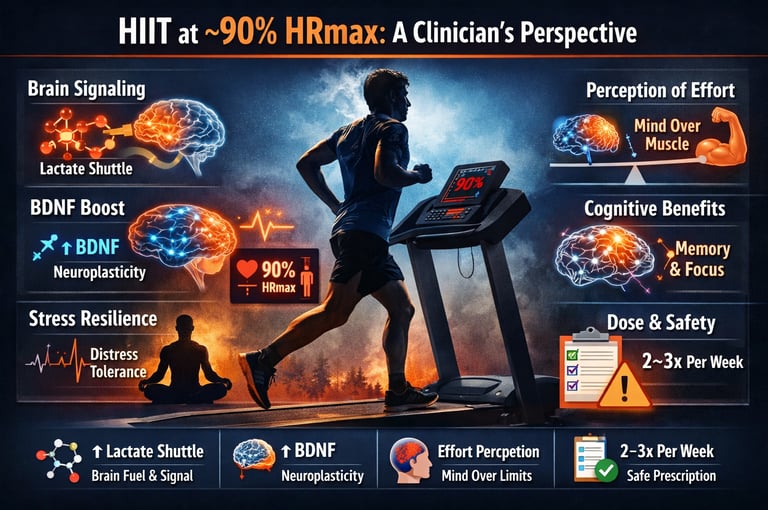
HIIT at ~90% HRmax is a form of high-intensity exercise that pushes the body into the severe intensity domain, improving cardiovascular fitness, brain function, and psychological resilience through mechanisms like BDNF release and lactate signaling
Key Takeaways
HIIT at ~90% HRmax trains brain resilience, not just fitness
Increases BDNF → neuroplasticity
Lactate acts as a brain fuel and signaling molecule
Optimal dose: 2–3 sessions/week
Clinician’s Perspective: HIIT at ~90% HRmax and Psychological Resilience
HIIT as a Neurocardiometabolic Intervention
Training at ~90% HRmax should be viewed not only as a cardiovascular stimulus but as a central nervous system challenge. It engages integrated responses involving autonomic activation, cortical processing, and interoceptive signaling, making it highly relevant in both preventive and therapeutic medicine.Effort Limitation Is Brain-Mediated
Clinical and experimental evidence supports the concept that exercise intolerance is often driven by perception of effort rather than true physiological limitation, aligning with frameworks proposed by Samuele Marcora. This has direct implications for patients with fatigue syndromes, cardiometabolic disease, and deconditioning.Role of Lactate as a Signaling Molecule
At high intensities, elevated lactate levels contribute to brain metabolism via the Astrocyte–Neuron Lactate Shuttle and may enhance neuroplasticity. Clinically, this reframes lactate from a “fatigue toxin” to a metabolic and cognitive facilitator.BDNF and Cognitive Health
HIIT induces robust increases in Brain-Derived Neurotrophic Factor (BDNF), supporting hippocampal function, executive processing, and mood regulation. This positions HIIT as a non-pharmacological adjunct in managing depression, cognitive decline, and stress-related disorders.Psychological Resilience as a Trainable Outcome
Repeated exposure to high-intensity effort acts as graded stress inoculation, improving distress tolerance, emotional regulation, and self-efficacy—key determinants of long-term health behavior adherence.Dose and Safety Considerations
Two to three HIIT sessions per week appear optimal for most individuals. Overprescription increases the risk of overreaching, autonomic imbalance, and psychological burnout, particularly in high-stress or clinical populations.Translational Application in Practice
Incorporating structured HIIT with cognitive strategies (e.g., reframing, controlled breathing, RPE monitoring) allows clinicians to target both physiological capacity and psychological adaptability, bridging the gap between exercise prescription and behavioral medicine.
Why Your Brain — Not Just Your Body — Determines How Hard You Can Push
Three intervals into a high-intensity session, your breathing is ragged, your legs are burning, and an unmistakable thought cuts through the noise: stop now. Yet, from a strictly physiological standpoint, you are not at your limit. Your muscles still contain usable energy substrates, oxygen delivery remains adequate, and catastrophic failure is nowhere near. So why does the urge to quit feel so overwhelming?
The answer lies not in your muscles—but in your brain.
Exercise at ~90% of maximum heart rate (HRmax) represents more than a metabolic challenge; it is a neuropsychological stress test that forces the brain to continuously evaluate effort, discomfort, and risk. Competing models attempt to explain this limit. The central governor hypothesis proposes that the brain subconsciously downregulates performance to protect homeostasis (Noakes), whereas the psychobiological model argues that fatigue reflects a conscious decision, driven by perceived effort and motivation rather than true physiological failure (Marcora). Increasingly, evidence supports the latter: performance can be significantly altered by changing perception, incentives, or mental fatigue without altering physiological capacity (Marcora, 2008).
At the same time, the biochemical environment of the brain is rapidly shifting. Lactate—once dismissed as a waste product—crosses the blood–brain barrier and fuels neurons via the astrocyte–neuron lactate shuttle, while also acting as a signaling molecule that promotes neuroplasticity. Concurrently, high-intensity exercise stimulates the release of brain-derived neurotrophic factor (BDNF), enhancing synaptic plasticity, learning, and memory (Liu et al., 2024).
Taken together, these findings reshape how we understand effort. The point at which you feel like stopping is not a fixed physiological boundary—it is a dynamic, trainable construct, governed by perception, neurochemistry, and experience
What Exactly Is 90% HRmax — and Why Does It Matter Psychologically?
Before diving into the neuroscience, it helps to understand what training at ~90% HRmax actually means physiologically. At this intensity, you are operating deep within the "severe exercise domain" — well beyond your lactate threshold and approaching your VO₂max ceiling. Lactate accumulates rapidly, CO₂ rises sharply, your sympathetic nervous system is in full activation, and your brain begins receiving a torrent of alarming afferent signals from your muscles, lungs, and cardiovascular system (Hung et al., 2025).
These signals — breathlessness, muscle burn, cardiovascular strain — are processed not as neutral information but as potential threats. Your amygdala (the brain's threat-detection hub) responds. Your anterior cingulate cortex (ACC) begins weighing the cost of continuing versus the benefit of pushing on. Your insula, responsible for interoception (reading your body's internal state), amplifies the sensations of discomfort.
This is precisely why ~90% HRmax represents a psychological inflection point. Below it, effort feels manageable. Above it, the brain begins seriously evaluating whether to disengage. Learning to stay the course at this threshold — repeatedly, over weeks and months — is what builds genuine psychological resilience.
The Neurobiology of Pushing Through: What Happens Inside Your Brain
The Central Governor at Work
The concept of the "central governor," first proposed by exercise physiologist Tim Noakes, suggests that your brain — not peripheral fatigue — ultimately regulates how hard you can exercise. It does this by integrating afferent feedback from Group III and IV muscle afferents (the nerves that sense fatigue, pain, and metabolic stress) and adjusting your effort output accordingly. At ~90% HRmax, this system is operating near its regulatory limit.
The Chemistry of Effort
Three key neurotransmitters shape your psychological experience during intense exercise:
Dopamine drives your motivation and reward prediction. Research consistently shows that dopamine surges during and after high-intensity exercise, which explains the post-HIIT euphoria many people report. Over time, repeated HIIT exposure recalibrates the dopamine system, making effortful activity feel more rewarding (Liu et al., 2024).
Serotonin rises during prolonged or intense effort and contributes to fatigue signalling. When serotonin accumulates excessively, it reduces the drive to continue. Managing mental fatigue — through pacing, cognitive strategies, and adequate recovery — helps prevent premature serotonergic fatigue.
Noradrenaline (norepinephrine) sharpens arousal and focus. The noradrenergic surge at high intensity can enhance performance when optimally dosed, but contribute to anxiety and cognitive overload when excessive.
Understanding this chemistry is not just academic. It directly informs why certain mental strategies — like rhythmic self-talk, controlled breathing, and attentional focus — can meaningfully shift your performance at the limit.
1. Central Governor vs Psychobiological Model (Marcora)
The central governor model, proposed by Tim Noakes, suggests that the brain subconsciously regulates exercise performance by limiting motor output to protect homeostasis. It integrates afferent signals (e.g., from group III/IV muscle afferents) and reduces effort before catastrophic physiological failure occurs.
In contrast, the psychobiological model, advanced by Samuele Marcora, rejects the idea of a subconscious “protective governor.” Instead, it posits that exercise limitation is primarily a conscious decision, determined by:
Perception of effort
Motivation
Potential reward vs cost
According to this model, fatigue is not a failure of the body but a decision to stop when effort exceeds willingness to continue. This framework is strongly supported by experimental studies showing that manipulating motivation, mental fatigue, or incentives alters performance without changing physiology.
Key distinction:
Central governor → subconscious regulation for protection
Psychobiological model → conscious effort-based decision-making
2. Lactate as a Brain Signaling Molecule (Astrocyte–Neuron Lactate Shuttle)
Modern research has overturned the traditional view of lactate as merely a metabolic byproduct. Instead, lactate acts as both an energy substrate and signaling molecule in the brain.
According to the Astrocyte–Neuron Lactate Shuttle, lactate produced in peripheral tissues during high-intensity exercise crosses the blood–brain barrier and is also generated locally by astrocytes. Astrocytes then shuttle lactate to neurons, where it is oxidized as a preferred fuel during high energy demand states.
Beyond energy supply, lactate also:
Activates signaling pathways involved in neuroplasticity
Upregulates genes linked to learning and memory
May enhance NMDA receptor activity and synaptic efficiency
Implication for HIIT:
The high lactate levels reached at ~90% HRmax are not merely markers of fatigue—they may directly contribute to cognitive enhancement and brain adaptation.
3. BDNF Pathways and Neuroplasticity
High-intensity exercise robustly increases Brain-Derived Neurotrophic Factor (BDNF), a key regulator of neuroplasticity.
Mechanistically, HIIT stimulates BDNF through multiple converging pathways:
Lactate signaling → activates transcription factors (e.g., PGC-1α, FNDC5/irisin pathway) that upregulate BDNF expression
Increased cerebral blood flow → enhances delivery of oxygen and glucose to active brain regions
Glutamatergic activity → stimulates synaptic plasticity and BDNF release
BDNF then:
Promotes synaptic plasticity (long-term potentiation)
Supports hippocampal neurogenesis
Enhances learning, memory, and executive function
Key insight:
HIIT-induced BDNF elevation provides a molecular bridge between physical exertion and cognitive enhancement, explaining why high-intensity training disproportionately benefits brain function compared to lower intensities.
HIIT as Controlled Adversity: The Resilience Science
Perhaps the most compelling framing of HIIT psychology is this: every interval at ~90% HRmax is a controlled exposure to adversity. And just as cognitive-behavioural therapy uses graded exposure to reduce fear responses, repeated HIIT exposes your nervous system to intense discomfort in a safe, structured context — gradually reducing the perceived threat of that discomfort.
This is what exercise scientists call hormesis — the principle that controlled doses of stress produce adaptive responses that make the organism stronger and more resilient. Not just physically, but neurologically and psychologically.
A topical review by Batrakoulis and Fatouros (2022) examining psychological adaptations to HIIT in overweight and obese adults found significant improvements across multiple resilience-related domains. Participants who completed structured HIIT protocols reported reductions in anxiety and depression, improved self-efficacy, better distress tolerance, and enhanced emotional regulation. These were not trivial gains — they were clinically meaningful improvements in psychological robustness.
The mechanism appears to operate through at least three pathways:
Mastery experiences: Each completed HIIT session provides a direct "I did that" signal to your self-efficacy beliefs. Over time, your brain updates its internal estimate of what you are capable of withstanding.
Autonomic recalibration: Repeated exposure to high sympathetic activation (the stress response) followed by parasympathetic recovery trains your nervous system to shift between these states more efficiently. You become better at both revving up and calming down.
Threat reappraisal: What initially registers as a threat — the burning lungs, the racing heart — gradually becomes reframed as a performance signal. Research on cognitive reappraisal shows this is a powerful emotional regulation strategy that can be deliberately trained.
Cognitive Performance: The Remarkable Brain Benefits of HIIT
Beyond resilience, the evidence for HIIT's cognitive benefits has become strikingly robust.
A landmark 2024 meta-analysis by Liu and colleagues, published in Scientific Reports, analysed data from multiple randomised controlled trials and found that HIIT significantly improved performance across multiple cognitive domains compared to both no-exercise and moderate-intensity control conditions. The most pronounced gains appeared in executive function (planning, flexible thinking, working memory), processing speed, and sustained attention — precisely the capacities most relevant to academic performance, professional decision-making, and daily life functioning (Liu et al., 2024).
The mechanisms underlying these cognitive gains are multifaceted:
BDNF (Brain-Derived Neurotrophic Factor): HIIT triggers a substantial release of BDNF, often called "fertiliser for the brain." BDNF promotes neuroplasticity, supports hippocampal neurogenesis, and is associated with learning and memory consolidation. Critically, high-intensity exercise appears to generate a larger BDNF response than moderate-intensity training.
Cerebral blood flow: The acute cardiovascular demands of HIIT increase cerebral perfusion, delivering more oxygen and glucose to cortical regions involved in cognition.
Lactate as a signalling molecule: Cutting-edge 2024–2025 research has revealed that lactate — long considered merely a metabolic waste product — functions as a signalling molecule in the brain. Lactate produced during intense exercise is transported across the blood-brain barrier and may directly support neuronal energy metabolism, potentially explaining some of HIIT's unique cognitive benefits.
Adolescents, HIIT, and Psychological Wellbeing: What the Latest Data Shows
The psychological benefits of HIIT are not limited to adults. A 2025 experimental study by Li and Zhou, published in Frontiers in Psychology, directly examined the psychological impact of HIIT on adolescents — a population for whom mental health interventions are increasingly critical.
The findings were striking. Adolescents who participated in a structured HIIT intervention demonstrated significant improvements in psychological wellbeing, including reductions in anxiety-related symptoms, improved mood states, and enhanced perceptions of competence and autonomy. The researchers noted that the intensity of HIIT — rather than just its duration — appeared to be a key driver of psychological benefit, consistent with the dose-response relationship seen in adult populations (Li & Zhou, 2025).
This has important practical implications. Schools, youth sports programmes, and parents looking to support adolescent mental health have a compelling, evidence-based case for incorporating supervised HIIT protocols into regular physical education and extracurricular activity.
Neuromuscular Adaptations That Support Psychological Gains
The psychological benefits of HIIT do not occur in isolation from physical adaptations — they are deeply intertwined with them. A 2025 review in Life by Hung and colleagues examined neuromuscular adaptations to HIIT, finding significant improvements in motor unit recruitment, neuromuscular efficiency, and the rate of force development (Hung et al., 2025).
Why does this matter psychologically? Because physical competence and psychological confidence are bidirectionally linked. As your neuromuscular system becomes more efficient — with movements feeling less effortful and the body responding more smoothly to high-intensity demands — the psychological threat associated with intense exercise diminishes. Your brain receives updated evidence that your body can handle this. Perceived exertion decreases for the same absolute workload. Self-efficacy rises. The cycle of resilience accelerates.
Comparison between HIIT (~90% HRmax) and yoga on psychological resilience
Core Approach to Resilience:
HIIT builds resilience through controlled adversity and hormesis: repeated exposure to intense discomfort (breathlessness, muscle burn, high sympathetic drive) trains the brain to tolerate effort, reframe stress, and sustain performance via perception and motivation (psychobiological model – Marcora).
Yoga builds resilience through mindful acceptance and parasympathetic activation: focuses on breath control, interoceptive awareness, non-judgmental observation of sensations, and emotional regulation.
Key Mechanisms:
HIIT: Stronger acute BDNF release, lactate signaling (Astrocyte-Neuron Lactate Shuttle), dopamine surges, and autonomic “stress inoculation” (sympathetic surges + recovery). Improves neuromuscular efficiency and self-efficacy through mastery experiences.
Yoga: Superior cortisol reduction, HRV improvement via vagal tone, and HPA-axis regulation. Enhances threat reappraisal and self-compassion.
Distress Tolerance & Mental Toughness:
HIIT excels at training high-pressure tolerance and “pushing through” perceived limits. Effective for performance under stress and fatigue syndromes.
Anxiety, Depression & Emotional Regulation:
Yoga often shows stronger or more consistent reductions in anxiety, stress, rumination, and conditions like binge eating. Meta-analyses indicate yoga effectively lowers cortisol and emotional reactivity with sustained benefits.
HIIT reduces depressive symptoms and boosts mood/self-efficacy via BDNF and endorphins, but results are mixed for anxiety; some studies show no significant edge over controls.
Cognitive Performance:
HIIT demonstrates robust gains in executive function, processing speed, working memory, and attention (supported by 2024 meta-analyses). A larger BDNF response gives it an edge in sharp cognitive benefits.
Adherence & Sustainability:
Yoga generally has higher long-term adherence due to lower injury risk and enjoyable mindfulness.
HIIT is time-efficient but risks higher dropout or overreaching if not progressed carefully.
Overall & Practical Insight:
HIIT = “Mental toughness” via challenge (ideal for athletes, high-pressure roles).
Yoga = “Calm resilience” via recovery (ideal for anxiety-prone or burnout cases).
Best strategy: Combine both (e.g., 2 HIIT + 2–3 yoga sessions/week) for complementary benefits — HIIT for capacity-building, yoga for integration and recovery. Individualize based on goals, fitness level, and personality. Always progress gradually with medical clearance where needed.
This comparison highlights that HIIT and yoga target different pathways but overlap on neuroplasticity and mental health gains; integration often yields optimal results.
Practical Applications: 7 Evidence-Based Strategies to Train Your Mind at High Intensity
Understanding the science is valuable. Applying it transforms your training. Here are seven practical strategies grounded in the 2024–2026 research evidence.
1. Reframe Discomfort as a Performance Signal
The burning in your lungs and the acid in your legs are not signs of damage — they are signs of adaptation in progress. Research on cognitive reappraisal shows that consciously labelling an aversive sensation as "useful information" rather than "a threat" measurably reduces perceived effort and improves performance at high intensities. Before your next interval session, set the mental frame: discomfort means it is working.
2. Implement Structured Self-Talk
Self-talk is not motivational fluff — it has a robust evidence base in exercise psychology. Instructional self-talk ("drive, drive, drive" or "stay relaxed") is particularly effective during HIIT because it redirects attention toward execution rather than discomfort. Motivational self-talk ("I can hold this" or "strong") is effective during the final stages of an interval when volitional effort is highest.
3. Control Your Breathing Deliberately
Dyspnea (breathlessness) is one of the primary drivers of perceived exertion and premature disengagement during HIIT. Practising diaphragmatic breathing, using rhythmic breathing patterns timed to your effort cadence, and learning to tolerate the sensation of breathlessness through gradual exposure all reduce the psychological amplification of this signal. Box breathing (4-count in, 4-count hold, 4-count out) during recovery periods is particularly effective at accelerating parasympathetic recovery between intervals.
4. Use Progressive Intensity Exposure
Do not attempt to train at 90% HRmax from day one. Progressive exposure — starting at 75–80% HRmax and systematically increasing intensity over four to eight weeks — builds both physiological tolerance and psychological familiarity. Each small step upward updates your brain's threat threshold. The goal is to make high intensity feel progressively normal.
5. Manipulate Attentional Focus Strategically
Research suggests that during the early stages of HIIT, external attentional focus (concentrating on the environment, music, or a target) can reduce perceived exertion. As the session progresses and intensity peaks, switching to internal focus (monitoring breathing rhythm, maintaining technique) maintains performance quality. Experienced athletes can benefit from associative strategies (tuning in to bodily signals) to optimise pacing.
6. Monitor Psychological Load, Not Just Physical Load
Session RPE (sRPE) — your subjective rating of overall effort after a session — is a powerful monitoring tool that integrates both physical and mental load. Tracking sRPE weekly, alongside objective markers like resting heart rate variability (HRV), gives you an early warning signal for psychological fatigue and overreaching. If your sRPE is consistently higher than expected for a given workload, this is actionable data — not weakness.
7. Structure Your Week for Psychological Periodisation
Alternating HIIT sessions with Zone 2 moderate-intensity training and deliberate recovery is not just good for your mitochondria — it is essential for sustainable psychological engagement. Zone 2 training provides a low-threat environment that allows the nervous system to recover from the sympathetic overactivation of HIIT. A practical weekly structure might include two HIIT sessions, two to three Zone 2 sessions, and at least one complete rest or active recovery day.
Important Cautions: When High Intensity Becomes a Liability
No evidence-based guide to HIIT intensity would be complete without addressing its risks. While the benefits of training at ~90% HRmax are substantial, the dose-response relationship is not linear — more is not always better.
Excessive high-intensity training without adequate recovery leads to functional overreaching, characterised by declining performance, elevated RPE for submaximal work, mood disturbance, and sleep disruption. Prolonged overreaching can progress to non-functional overreaching or frank overtraining syndrome — a state of significant psychological and physiological impairment that can take weeks to months to reverse.
Warning signs include: persistent fatigue that sleep does not relieve, reduced motivation to train, heightened irritability or anxiety, impaired concentration, and training performances that plateau or decline despite consistent effort. If you recognise these signs, the appropriate response is reduced training load, enhanced recovery strategies, and — if symptoms persist — consultation with a sports medicine professional.
For clinical populations, including those with cardiometabolic disease, anxiety disorders, or a history of exercise avoidance, HIIT intensity should be progressed under professional guidance. The psychological benefits of HIIT are real and significant for these populations, but the starting point and rate of progression must be individually calibrated.
HIIT vs Moderate Cardio vs Yoga — Point-wise Comparison
HIIT (~90% HRmax)
Primary Mechanism: Stress hormesis, ↑ Brain-Derived Neurotrophic Factor, lactate signaling
Mental Outcome: Builds high resilience and mental toughness through controlled adversity
Cognitive Benefit: Strong improvements in executive function, attention, and processing speed
Adherence: Moderate (time-efficient but intensity may limit long-term consistency)
Moderate Cardio
Primary Mechanism: Sustained aerobic metabolism and cardiovascular conditioning
Mental Outcome: Improves mood stability and reduces stress levels
Cognitive Benefit: Moderate gains in overall brain function and mental clarity
Adherence: High (more tolerable and sustainable for most individuals)
Yoga
Primary Mechanism: Parasympathetic activation, vagal tone improvement, mind-body integration
Mental Outcome: Enhances emotional regulation, reduces anxiety and stress
Cognitive Benefit: Mild to moderate improvements, particularly in attention and mindfulness
Adherence: Very high (low injury risk, relaxing, and widely accessible)
Takeaway
HIIT → builds mental toughness and peak cognitive performance
Moderate cardio → supports stable mood and general brain health
Yoga → optimizes recovery, emotional balance, and long-term adherence
Frequently Asked Questions (FAQs)
Q1: How do I know if I am actually reaching 90% HRmax during HIIT? The simplest method is to use a heart rate monitor and calculate your estimated HRmax using the formula 220 minus your age (with the understanding that this is an estimate with individual variation of ±10–15 beats per minute). At 90% HRmax, you should be able to speak only in broken, single-word fragments — not sentences. Your RPE on a 0–10 scale should be 8–9 out of 10. If you do not have a monitor, the "talk test" alone is a reliable field measure.
Q2: How many HIIT sessions per week is optimal for psychological benefits? Current evidence, including the meta-analysis by Liu and colleagues (2024), suggests that two to three HIIT sessions per week appears to be the optimal dose for cognitive and psychological gains in most adults. This allows adequate recovery for neuromuscular and psychological adaptation between sessions. Three or more sessions per week begins to risk accumulative fatigue that can attenuate psychological benefits.
Q3: Can HIIT help with anxiety and depression? Yes — and the evidence base for this application is growing rapidly. The review by Batrakoulis and Fatouros (2022) found meaningful reductions in anxiety and depression symptoms in overweight and obese adults following structured HIIT programmes. The proposed mechanisms include HPA axis regulation, endorphin and endocannabinoid release, BDNF-driven neuroplasticity, and improved self-efficacy. However, HIIT should complement — not replace — clinical treatment for diagnosed anxiety and depressive disorders.
Q4: I am a beginner and the idea of training at 90% HRmax is terrifying. Where do I start? This is exactly the right response — and the research supports a gradual approach. Start with interval training at 70–75% HRmax, building comfort with the sensation of elevated effort before progressing. Structured programmes like a "HIIT for beginners" protocol — starting with 20-second efforts at moderate-hard intensity followed by 40–60 seconds of recovery — allow you to build both physiological and psychological tolerance safely. Each session completed is a resilience deposit in your mental bank.
Q5: Does music help during HIIT? Yes — with important nuance. Music with a tempo matched to your exercise cadence acts as a form of external attentional focus that reduces perceived exertion, particularly during moderate-to-hard intensity efforts. At very high intensities (approaching 90% HRmax), the attentional displacement effect of music diminishes — your brain is too occupied with physiological monitoring. Music is most beneficial as a motivational tool during warm-up, recovery intervals, and the transitional phases of a HIIT session.
Q6: How long does it take to see psychological adaptations from HIIT? Both the Li and Zhou (2025) study in adolescents and the Batrakoulis and Fatouros (2022) review in adults suggest that meaningful psychological adaptations begin to emerge within four to eight weeks of consistent HIIT training. Self-efficacy improvements can appear even earlier — sometimes after just two to three sessions — as mastery experiences begin to accumulate. Cognitive performance improvements, as documented by Liu and colleagues (2024), typically become statistically significant after eight to twelve weeks of training.
Q7: Is HIIT safe for people with heart conditions? This is a question that absolutely requires individual medical evaluation. For most individuals with stable, well-managed cardiovascular conditions, supervised HIIT is safe and beneficial in clinical research settings. However, unsupervised high-intensity exercise in individuals with undiagnosed or poorly managed cardiac conditions carries real risk. Anyone with a known or suspected cardiovascular condition should obtain medical clearance and ideally begin any HIIT programme under the supervision of a qualified exercise physiologist or cardiac rehabilitation specialist.
Clinical pearls.
1. The Lactate "Brain Fuel" Shift
Lactate is no longer viewed merely as a metabolic byproduct of anaerobic glycolysis; it serves as a critical signaling molecule and an alternative cerebral energy source. During HIIT, systemic lactate crosses the blood-brain barrier via monocarboxylate transporters (MCTs), stimulating the expression of BDNF and supporting hippocampal neurogenesis.
That "muscle burn" you feel during a hard sprint isn't just waste—it’s actually a specialized fuel for your brain. When you push hard, your body produces lactate, which acts like "brain fertilizer" to help you grow new brain cells and stay sharp as you age.
2. Autonomic "Stress Testing"
HIIT at 90% HR max serves as an acute, controlled stimulus for the sympathetic nervous system. Repeated exposure enhances vagal tone and heart rate variability (HRV) during recovery, effectively recalibrating the baroreflex and improving the efficiency of the autonomic switch between "fight-or-flight" and "rest-and-digest."
Think of high-intensity training as a "fire drill" for your nervous system. By safely practising a high-stress state during your workout, you teach your body how to calm down faster afterwards. This makes you much better at handling real-life stress without feeling overwhelmed.
3. The Central Governor & RPE Dissociation
Exercise termination is often a result of the "Central Governor"—a subconscious neural heuristic—rather than true peripheral muscular failure. Clinical HIIT protocols can decouple physiological workload from the Rating of Perceived Exertion (RPE) through cognitive reappraisal, allowing higher mechanical output with lower subjective distress.
Your brain usually tries to make you quit long before your muscles actually run out of gas. It acts like a speed limiter on a car to keep you "safe." By doing HIIT, you’re teaching that "inner voice" that it's okay to keep going, which builds a unique kind of mental toughness.
4. Neuromuscular Efficiency vs. Sarcopenia
HIIT preferentially recruits Type II (fast-twitch) motor units, which are the first to undergo atrophy in sarcopenic populations. The high-intensity stimulus improves motor unit recruitment patterns and calcium handling within the sarcoplasmic reticulum, preserving explosive power and functional independence.
As we get older, we tend to lose our "fast" muscle fibers first—the ones we need to catch our balance or climb stairs quickly. HIIT is the best way to wake up those fibres and keep them strong, ensuring your body stays reactive and capable well into your senior years.
5. Psychological Hormesis & Anxiety Thresholds
HIIT functions as a form of physiological biofeedback for anxiety management. By intentionally inducing symptoms that mimic a panic attack (tachycardia, dyspnea, diaphoresis) in a controlled environment, patients undergo interoceptive exposure, which reduces the "threat value" of these sensations in non-exercise contexts.
If you struggle with anxiety, HIIT can be a secret weapon. It mimics the physical feelings of being anxious—like a racing heart and heavy breathing—but in a way that you control. Over time, your brain stops being afraid of those sensations, which can help you feel much calmer in your daily life.
Author’s Note
This article was written with a deliberate goal: to bridge the gap between exercise physiology, neuroscience, and real-world clinical practice. High-intensity interval training (HIIT) is often discussed in terms of calories burned or VO₂max improved, yet its most profound effects may lie in how it reshapes the brain’s response to stress, effort, and discomfort.
The concepts presented here draw upon emerging research in neurobiology, particularly the evolving understanding of effort regulation, interoception, and neuroplasticity. Frameworks proposed by researchers such as Tim Noakes and Samuele Marcora highlight an important shift in thinking: that performance limits are not purely physiological, but are deeply influenced by perception, motivation, and prior experience.
Equally important is the growing recognition of molecules like Brain-Derived Neurotrophic Factor (BDNF) and mechanisms such as the Astrocyte–Neuron Lactate Shuttle, which provide a biological basis for the cognitive and psychological benefits observed with high-intensity exercise.
That said, intensity is a powerful tool—and like any powerful tool, it must be used with precision. Not every individual should begin at 90% HRmax, and not every training phase should prioritise maximal effort. Context, progression, and recovery remain fundamental.
Ultimately, this work reflects a broader perspective: exercise is not merely a physical intervention—it is a form of applied neuroscience. Each high-intensity effort is an opportunity not only to strengthen the body, but to recalibrate how the brain interprets stress, regulates effort, and defines limits.
The hope is that this synthesis helps clinicians, athletes, and general readers alike approach intensity with both respect and understanding—and to recognise that resilience is not an abstract trait, but something that can be systematically trained.
⚠️ Medical Disclaimer
This content is intended for educational and informational purposes only and does not constitute medical advice, diagnosis, or treatment. High-intensity interval training (HIIT), particularly at ~90% of maximum heart rate (HRmax), places significant stress on the cardiovascular, respiratory, and nervous systems and may not be appropriate for all individuals.
Before starting or modifying any exercise program—especially high-intensity training—you should consult a qualified healthcare professional if you:
Have a history of cardiovascular disease, hypertension, or metabolic disorders (e.g., diabetes)
Experience chest pain, dizziness, palpitations, or unexplained shortness of breath
Are recovering from illness, injury, or surgery
Are you pregnant or have other medical conditions requiring supervision
Exercise prescriptions should be individualized, and intensity should be progressed gradually based on fitness level, medical history, and tolerance. In clinical populations, HIIT should ideally be performed under the guidance of a physician, cardiologist, or certified exercise professional.
While evidence supports the benefits of HIIT for cardiovascular health, cognitive function, and psychological resilience, improper application or excessive intensity without adequate recovery may increase the risk of injury, overtraining, or adverse health events.
If you experience any concerning symptoms during exercise, stop immediately and seek medical attention.
By engaging in any physical activity described in this content, you do so at your own risk.
Related Articles
HIIT for Longevity: Improving Healthspan Markers – But Does It Extend Lifespan?
The Physiology of HIIT: Mitochondria, Oxygen & Energy Systems
VO₂ Max vs Lactate Threshold Explained: What Truly Determines Your Fitness
HIIT vs Moderate Cardio: Which Improves Cardiovascular Fitness Faster?
References
Batrakoulis, A., & Fatouros, I. G. (2022). Psychological adaptations to high-intensity interval training in overweight and obese adults: A topical review. Sports (Basel, Switzerland), 10(5), 64. https://doi.org/10.3390/sports10050064
Hung, C.-H., Su, C.-H., & Wang, D. (2025). The role of high-intensity interval training (HIIT) in neuromuscular adaptations: Implications for strength and power development — A review. Life, 15(4), 657. https://doi.org/10.3390/life15040657
Li, Y. T., & Zhou, Y. (2025). Experimental research of impact on psychological state for adolescents with high-intensity interval training intervention. Frontiers in Psychology, 16, 1567003. https://doi.org/10.3389/fpsyg.2025.1567003
Liu, K., Zhao, W., Li, C., et al. (2024). The effects of high-intensity interval training on cognitive performance: A systematic review and meta-analysis. Scientific Reports, 14, 32082. https://doi.org/10.1038/s41598-024-83802-9