HIIT for Longevity: Improving Healthspan Markers—But Does It Extend Lifespan?
HIIT improves fitness and healthspan—but does it extend lifespan? Explore evidence-based insights on exercise intensity and longevity.
EXERCISE
Dr. T.S. Didwal, M.D.(Internal Medicine)
4/15/202613 min read
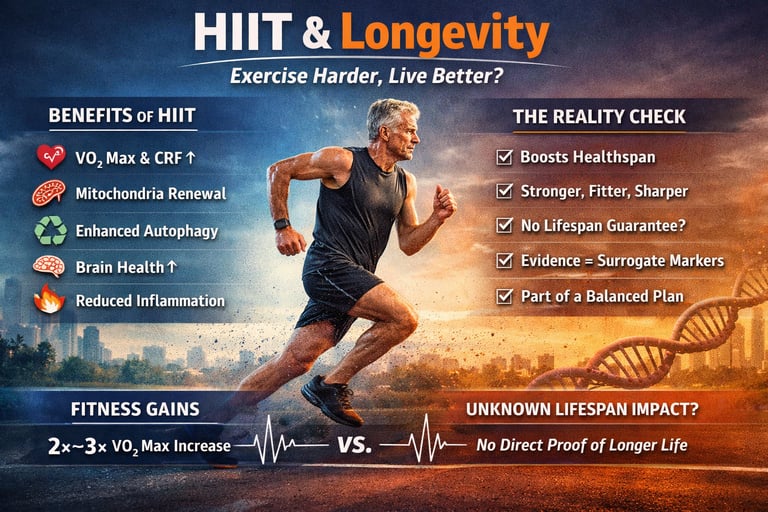
Can HIIT increase lifespan?
High-Intensity Interval Training (HIIT) can significantly improve key markers of longevity such as VO₂ max, cardiorespiratory fitness, insulin sensitivity, and mitochondrial function. These adaptations are strongly associated with reduced risk of cardiovascular disease and all-cause mortality. However, current scientific evidence shows that while HIIT enhances healthspan and lowers disease risk, there is no direct proof from long-term randomized trials that HIIT alone extends lifespan.
Bottom line: HIIT is one of the most time-efficient ways to improve survival-related fitness markers and overall health, but it should be combined with aerobic training, strength exercise, and healthy lifestyle habits for optimal longevity.
HIIT and Longevity — A Clinician’s Perspective
Longevity is no longer defined by lifespan alone, but by healthspan. The goal is not merely to live longer, but to preserve physiological function, independence, and cognitive vitality into advanced age. Exercise—particularly structured, progressive training—remains the most powerful non-pharmacological intervention to achieve this.
HIIT represents the most time-efficient strategy to improve CRF. Compared to traditional moderate-intensity training, HIIT induces faster and often greater improvements in VO₂ max, endothelial function, and metabolic health. For time-constrained populations, this efficiency has profound public health implications.
The biological impact of HIIT extends beyond fitness. High-Intensity Interval Training (HIIT) consistently improves validated surrogate markers of longevity, including cardiorespiratory fitness (VO₂ max), insulin sensitivity, endothelial function, and inflammatory profiles. Among these, cardiorespiratory fitness is one of the strongest predictors of all-cause and cardiovascular mortality in large epidemiological cohorts.
However, it is critical to distinguish association from causation. While higher fitness levels are linked to longer survival, there is currently no direct randomized controlled trial (RCT) evidence demonstrating that HIIT itself extends lifespan. Therefore, HIIT should be understood as a potent tool to enhance healthspan and reduce disease risk, primarily by improving upstream biological systems that influence aging. Its effect on actual lifespan is inferred, not definitively proven.
Clinical takeaway:
HIIT likely contributes to longevity indirectly by optimizing key survival predictors—but it is one component of a broader lifestyle matrix, including total physical activity, resistance training, nutrition, sleep, and risk factor control.Clinical application must be individualized. HIIT is safe and effective for most individuals when appropriately prescribed, but requires careful consideration in high-risk populations. Screening, progression, and recovery monitoring are non-negotiable.
The future of longevity medicine lies in integration, not extremes. HIIT should be viewed as one component of a comprehensive strategy that includes aerobic base training, resistance exercise, nutrition, sleep, and risk factor management.
Bottom line: HIIT does not replace the foundations of healthy living—it amplifies them.
In a world flooded with costly supplements, fad diets, and wellness gadgets, one of the most powerful longevity tools remains remarkably simple and accessible: High-Intensity Interval Training (HIIT). By alternating short bursts of near-maximal effort with recovery periods, HIIT is rapidly emerging as a science-backed strategy for extending both lifespan and, more importantly, healthspan (Viderman et al., 2025).
While traditional steady-state cardio has long been recommended for cardiovascular health, mounting evidence suggests that exercise intensity may matter more than total volume for slowing biological aging. Systematic reviews and meta-analyses conducted between 2023 and 2025 demonstrate that HIIT produces superior improvements in cardiometabolic health, cardiorespiratory fitness, and quality of life compared to moderate continuous training, often achieving these benefits in significantly less time (Sert et al., 2025; Zoila et al., 2025).
Central to HIIT’s longevity impact is its ability to enhance VO₂ max — widely regarded as the strongest single predictor of longevity. Large cohort studies consistently show that each 1 MET increase in cardiorespiratory fitness correlates with approximately an 18% reduction in all-cause mortality risk, independent of traditional risk factors such as age, BMI, smoking, and hypertension (Edwards et al., 2023).
Recent comparative research further reveals that HIIT can generate 2–3 times greater gains in VO₂ max than moderate-intensity training within similar timeframes, while simultaneously improving mitochondrial biogenesis, reducing chronic inflammation, and supporting cognitive resilience (Zoila et al., 2025; Viderman et al., 2025).
Lifespan refers to the total years lived. Healthspan refers to years lived free of disability, disease, and functional decline. HIIT appears to powerfully improve healthspan — and may extend lifespan through surrogate markers like VO₂ max and cardiorespiratory fitness (CRF).
What the Latest Research Tells Us: Five Landmark Studies
The evidence base for HIIT's longevity effects has grown substantially in recent years. Here is a synthesis of the most important studies shaping current understanding:
A 2025 systematic review and meta-analysis by Sert et al., published in BMC Sports Science, Medicine & Rehabilitation, evaluated HIIT interventions in older adults and demonstrated significant improvements in key cardiometabolic parameters, including blood pressure, lipid profiles, and glucose regulation. Importantly, these physiological benefits were accompanied by measurable gains in functional capacity and quality of life, supporting HIIT as a viable strategy even in aging populations.
Complementing these findings, Zoila et al. (2025), in Frontiers in Aging, conducted a comparative analysis between HIIT and moderate-intensity continuous training (MICT). While both modalities improved markers of active aging, HIIT consistently produced superior increases in cardiorespiratory fitness (VO₂ max) and more pronounced metabolic adaptations, achieving these benefits in significantly less time.
Expanding the scope further, Viderman et al. (2025), in the Journal of Clinical Medicine, synthesized evidence across multiple organ systems. Their review highlighted HIIT’s impact not only on cardiometabolic health, but also on neurological function, cancer-related outcomes, and chronic pain—positioning HIIT as a systemic intervention with broad relevance to age-related disease processes.
Earlier, Edwards et al. (2023), in a comprehensive meta-analysis published in Sports Medicine, pooled randomized controlled trials across diverse populations. Their findings confirmed that HIIT induces consistent and clinically meaningful improvements in cardiometabolic biomarkers, including insulin sensitivity, blood pressure, and body composition.
Taken together, this body of evidence reinforces that HIIT is not merely a time-efficient exercise modality, but a clinically meaningful intervention targeting multiple biological systems implicated in aging and chronic disease
VO₂ Max: The Single Most Powerful Predictor of How Long You Will Live
If you could measure one number to predict your odds of reaching age 85 in good health, exercise physiologists would point to VO₂ max — the maximum volume of oxygen your body can consume per minute during exhaustive exercise.
Large cohort studies, including data from the Aerobics Centre Longitudinal Study and the UK Biobank, have established a remarkably consistent finding: each 1 MET (metabolic equivalent) increase in cardiorespiratory fitness is associated with roughly a 13–18% reduction in all-cause mortality risk. This relationship holds even after adjusting for age, BMI, smoking, diabetes, and hypertension — traditional risk factors that doctors routinely screen for.
The clinical implication is striking: fitness may be a more powerful survival predictor than most conventional risk factors. A fit smoker, for example, can have a lower mortality risk than an unfit non-smoker.
Fitness — not just fatness — is the dominant predictor of survival.
HIIT is currently the most evidence-backed and time-efficient method to increase VO₂ max. In comparative trials, HIIT programs have consistently outperformed moderate-intensity continuous training (MICT) in raising VO₂ max — often producing 2–3 times greater gains within equivalent training durations. The landmark Generation 100 Study and SMARTEX trial both confirmed these findings in cardiac and aging populations, respectively.
VO₂ max should be considered a vital sign of longevity. Even modest improvements — achievable within 8–12 weeks of structured HIIT — translate to meaningful reductions in mortality risk. Ask your physician about a cardiorespiratory fitness assessment.
How HIIT Fights Aging at the Cellular Level
Understanding why HIIT extends healthspan requires looking beneath the surface — into the cellular and molecular machinery that governs how we age. HIIT activates at least five distinct biological pathways with direct relevance to longevity:
Mitochondrial Biogenesis
HIIT powerfully activates the PGC-1α pathway, the master regulator of mitochondrial production. Aging reduces mitochondrial density and efficiency — HIIT reverses this decline, restoring the energy-generating capacity of cells. This is arguably the most important anti-aging mechanism of exercise.3
Autophagy and Cellular Cleanup
HIIT activates AMPK (which promotes autophagy) and modulates mTOR (which regulates cellular growth and protein synthesis). This combination triggers cellular "self-cleaning" — removing damaged proteins, dysfunctional organelles, and senescent cells that accumulate with age and drive chronic disease.
Telomere Protection
Telomeres — the protective caps on chromosomes — shorten with age and are used as a biological clock. Studies comparing endurance training and HIIT suggest that vigorous exercise, particularly HIIT, upregulates telomerase activity, slowing telomere attrition and potentially decelerating biological aging at the genetic level.
Hormetic Oxidative Stress
HIIT generates a controlled burst of reactive oxygen species (ROS). Rather than causing damage, this triggers a powerful adaptive antioxidant response — the "mitohormesis" effect. The body responds by upregulating its own defense systems, making cells more resilient to future oxidative stress, a key driver of aging.
Insulin Sensitivity and Metabolic Health
A single HIIT session can improve insulin sensitivity for up to 24 hours. Regular practice reduces visceral fat, corrects metabolic syndrome markers, and restores glucose disposal capacity — all of which are strongly linked to both cardiovascular longevity and cognitive health.
Cardiovascular Longevity: HIIT and the Aging Heart
Heart disease remains the leading cause of premature death globally. HIIT addresses virtually every modifiable cardiovascular risk factor simultaneously — a property that has led researchers to describe exercise as a "polypill" for cardiovascular aging.
The cardiometabolic benefits are well-established across the studies reviewed here. Sert et al. (2025) found robust improvements in resting blood pressure, lipid profiles, and cardiac output in older adults undergoing HIIT protocols.1. Edwards et al. (2023) confirmed these findings across a broader general population sample, with HIIT producing statistically significant reductions in systolic blood pressure, fasting glucose, and waist circumference relative to control groups.
At the vascular level, HIIT improves endothelial function — the ability of blood vessel walls to dilate and constrict appropriately — through increased nitric oxide (NO) bioavailability. It also reduces arterial stiffness, which is an independent predictor of cardiovascular mortality and stroke. Both of these effects compound over years of training to meaningfully slow the cardiovascular aging trajectory.
HIIT and the Aging Brain: Dementia Prevention and Cognitive Resilience
Perhaps the most exciting frontier in HIIT longevity research is its impact on brain health. Viderman et al. (2025) specifically examined HIIT's neurological outcomes, highlighting robust evidence for several mechanisms.
HIIT robustly upregulates Brain-Derived Neurotrophic Factor (BDNF) — sometimes called "Miracle-Gro for the brain" — which promotes neurogenesis (the growth of new neurons) in the hippocampus, the brain region most critical for memory and most vulnerable to Alzheimer's disease. Exercise-induced increases in cerebral blood flow also nourish brain tissue, clearing metabolic waste and supporting synaptic plasticity.
Epidemiological data consistently show that higher cardiorespiratory fitness in midlife is associated with a 30–40% lower risk of dementia in later life. HIIT, as the most efficient CRF-improving strategy, may be the most potent behavioural intervention for brain longevity currently available.
Fighting "Inflammaging": HIIT as an Anti-Inflammatory Strategy
Chronic low-grade inflammation — now termed "inflammaging" — is a hallmark of biological aging and a driver of almost every age-related disease, from cardiovascular disease to cancer to neurodegeneration. Key biomarkers include C-reactive protein (CRP), interleukin-6 (IL-6), and tumour necrosis factor-alpha (TNF-α).
Regular HIIT consistently reduces circulating levels of these inflammatory markers. The mechanism is multifactorial: fat loss (particularly visceral fat, which secretes pro-inflammatory cytokines), improved immune surveillance, and direct anti-inflammatory signalling through myokines — proteins secreted by contracting muscle cells that have system-wide health effects.
HIIT vs Total Physical Activity Volume: What Matters More for Mortality?
Total physical activity volume remains the strongest and most consistently validated predictor of reduced mortality. Large epidemiological studies show that simply meeting recommended activity levels (e.g., ~150–300 minutes/week of moderate activity) significantly lowers all-cause and cardiovascular mortality risk, regardless of intensity.
However, exercise intensity modifies this relationship. HIIT improves cardiorespiratory fitness (VO₂ max) more efficiently, and higher fitness levels are independently associated with greater survival benefits. In other words, volume builds the foundation, while intensity amplifies the effect.
Current evidence suggests:
Individuals with higher total activity levels live longer
Within similar activity volumes, those achieving higher fitness (often via vigorous or interval training) tend to have lower mortality risk
Clinical takeaway:
Prioritize total weekly movement first, then incorporate HIIT strategically to maximize fitness and longevity benefits.
Practical Application: Evidence-Based HIIT Protocols
To maximize longevity, exercise must be prescriptive. Below are the most scientifically validated HIIT protocols, categorized by their primary physiological targets.
Key HIIT Protocols
4×4 Norwegian Protocol
Structure: 4 minutes at 85–95% HRmax, followed by 3 minutes of active recovery.
Frequency: 2× per week.
Clinical Benefit: The "gold standard" for increasing VO₂ max and improving cardiac stroke volume.
Sprint Interval Training (SIT)
Structure: 6–10 rounds of 30-second all-out sprints with 4-minute passive recovery.
Frequency: 2–3× per week.
Clinical Benefit: Rapidly improves insulin sensitivity and triggers mitochondrial signaling.
10-20-30 Protocol
Structure: 30s low, 20s moderate, 10s maximal intensity; repeated in 5-minute blocks.
Frequency: 3× per week.
Clinical Benefit: Effective for lowering blood pressure and highly sustainable for those new to interval training.
Reduced-Exertion HIIT (REHIT)
Structure: Two 20-second maximal sprints embedded in a 10-minute low-intensity session.
Frequency: 3× per week.
Clinical Benefit: The "minimum effective dose" for metabolic health and glycogen depletion.
Cycling Tabata
Structure: 8 rounds of 20s at 170% VO₂ max with 10s absolute rest.
Frequency: 2× per week.
Clinical Benefit: Simultaneously stresses both aerobic and anaerobic energy systems.
The Longevity Training Week
For optimal healthspan, HIIT should be integrated into a multimodal framework. A balanced weekly template includes:
High-Intensity (2 Days): HIIT sessions to drive peak aerobic capacity and mitochondrial biogenesis.
Aerobic Base (3 Days): Zone 2 training (steady-state) to build mitochondrial density and enhance fat oxidation.
Structural Strength (2 Days): Resistance training to combat sarcopenia and maintain bone mineral density.
Daily Maintenance: Mobility work to preserve functional independence and joint range of motion.
When HIIT Requires Caution
HIIT is powerful precisely because it stresses physiological systems significantly. This is also why appropriate screening and progressive implementation are essential — not to discourage HIIT, but to ensure it is applied safely.
✓ HIIT is generally safe for:
Healthy adults across all age groups
Older adults (60+) with appropriate supervision
Stable Type 2 diabetes patients
Stable coronary artery disease (supervised)
Overweight/obese individuals (modified protocols)
⚠ Extra caution required for:
Recent cardiac events or procedures
Uncontrolled hypertension (>160/100 mmHg)
Significant arrhythmias
Active musculoskeletal injury
Signs of overtraining (elevated HRV, persistent fatigue)
Clinicians recommend using the FITT principle (Frequency, Intensity, Time, Type) for exercise prescription, with heart rate variability (HRV) monitoring as an objective tool for gauging recovery and adjusting training load. The key message: HIIT is safe for the vast majority of people — but "start low, go slow" applies to intensity as much as volume.
Your Longevity Action Checklist
Baseline VO₂ max or fitness assessment completed
HIIT sessions scheduled this week
Resting heart rate tracked this morning
Zone 2 aerobic session completed
Resistance training session done
7+ hours of sleep last night
Ready to Start Your Longevity Training Journey?
The evidence is clear: structured, progressive HIIT — integrated into a well-rounded movement practice — is one of the most powerful tools available for a longer, more vital life. Here is your action plan:
Get a baseline assessment. Ask your doctor or a physiologist about a VO₂ max or cardiorespiratory fitness test. It is the single most predictive longevity measurement you can take.
Start with one session this week. Use the 10-20-30 protocol or a 5-round cycle interval. Log your perceived exertion and resting heart rate before and after.
Build the multimodal week. Over 6–8 weeks, progressively layer in Zone 2 aerobic work and resistance training around your HIIT sessions for a complete longevity training strategy.
Re-assess every 12 weeks. Track VO₂ max proxies (resting HR, RPE at a fixed workload, functional tests). Seeing improvement is the most powerful motivation to continue.
Clinical Pearls: HIIT & Longevity
1. VO₂ Max as a "Vital Sign"
Scientific Perspective: Cardiorespiratory fitness (CRF), quantified by VO₂ max, is a primary predictor of all-cause mortality. Each 1-MET increase correlates to a 13–18% reduction in mortality risk, making it a more potent predictor than traditional markers like BMI or smoking status.
Think of your fitness level as a "survival score." Improving how well your heart and lungs use oxygen is one of the best ways to add healthy years to your life. Even a small boost in your stamina can significantly lower your risk of early death.
2. Mitochondrial Rejuvenation (The Cellular Engine)
Scientific Perspective: HIIT is a powerful stimulator of mitochondrial biogenesis via the PGC-1α pathway. By reversing age-related declines in mitochondrial density and efficiency, HIIT restores cellular energy production and metabolic flexibility.
Your cells have tiny "power plants" called mitochondria that slow down as you age. High-intensity bursts act like a "factory reset," forcing your body to build newer, stronger power plants so you have more energy and better metabolic health.
3. The "Polypill" for Vascular Aging
Scientific Perspective: HIIT enhances endothelial function by increasing nitric oxide bioavailability and reducing arterial stiffness. These vascular adaptations outperform moderate-intensity training in reversing the structural aging of the cardiovascular system.
Think of HIIT as a natural "pipe cleaner" for your blood vessels. It keeps your arteries flexible and clear, which helps prevent heart disease and strokes better than just walking alone.
4. Neuroprotective "Miracle-Gro" (BDNF)
Scientific Perspective: Vigorous exercise robustly upregulates Brain-Derived Neurotrophic Factor (BDNF). This protein supports neurogenesis in the hippocampus, providing a buffer against cognitive decline and dementia.
Pushing your heart rate up isn't just for your body; it’s a workout for your brain. HIIT triggers a "fertilizer" for your brain cells that helps improve memory and protects you against Alzheimer's as you get older.
5. Efficient "Inflammaging" Suppression
Scientific Perspective: HIIT combats chronic low-grade inflammation (inflammaging) by reducing visceral adipose tissue and promoting the release of anti-inflammatory myokines from contracting skeletal muscle.
Aging often causes a "smoldering fire" of inflammation in the body that leads to disease. Intense exercise helps put that fire out by burning dangerous belly fat and releasing natural anti-inflammatory chemicals from your muscles.
Author’s Note
This article is written from the perspective of evidence-based clinical medicine and exercise physiology, with the intent to bridge the gap between emerging scientific research and real-world application. While High-Intensity Interval Training (HIIT) is often promoted as a powerful tool for improving fitness and metabolic health, it is important to interpret its role in longevity with scientific precision.
Current evidence strongly supports HIIT as an effective method to enhance cardiorespiratory fitness, mitochondrial function, insulin sensitivity, and vascular health—all of which are closely associated with reduced risk of chronic disease and improved healthspan. However, readers should understand that direct evidence linking HIIT to increased lifespan is still evolving, and most conclusions are based on surrogate markers and epidemiological associations rather than long-term randomized trials.
The goal of this work is not to promote intensity for its own sake, but to highlight how strategically applied physiological stress can drive meaningful biological adaptation. Exercise prescription should always be individualized, taking into account baseline fitness, comorbidities, and recovery capacity.
Finally, HIIT should not be viewed in isolation. Longevity is multifactorial, shaped by a combination of physical activity, nutrition, sleep, stress management, and medical care. When integrated thoughtfully into a balanced lifestyle, HIIT can serve as a highly effective, time-efficient component of a broader strategy aimed at extending not just life—but the quality of it.
Medical Disclaimer: This article is intended for educational and informational purposes only. It does not constitute medical advice and should not be used as a substitute for consultation with a qualified healthcare professional. Always discuss exercise programmes and cardiac risk assessment with your doctor, particularly if you have existing cardiovascular disease or significant risk factors.
Related Articles
Zone 2 vs HIIT: Fat Loss, VO2 Max, and Longevity – What Science Really Says
HIIT for Athletes: Boost VO₂ Max, Lactate Threshold, and Peak Performance – Science-Based Guide
HIIT vs Moderate Cardio: Which Improves Cardiovascular Fitness Faster?
HIIT Benefits: Evidence for Weight Loss, Heart Health, and Mental Well-Being
HIIT vs Aerobic Exercise: Which Burns More Fat, Reverses Insulin Resistance, and Extends Lifespan?
References
Sert, H., Gulbahar Eren, M., Gurcay, B., et al. (2025). The effectiveness of a high-intensity interval exercise on cardiometabolic health and quality of life in older adults: a systematic review and meta-analysis. BMC Sports Science, Medicine and Rehabilitation, 17, 128. https://doi.org/10.1186/s13102-025-01176-5
Zoila, F., Filannino, F. M., Panaro, M. A., Sannicandro, I., Cianciulli, A., & Porro, C. (2025). Enhancing active aging through exercise: a comparative study of high-intensity interval training and continuous aerobic training benefits. Frontiers in Aging, 6, 1493827. https://doi.org/10.3389/fragi.2025.1493827
Viderman, D., Rakhmanov, Y., Aubakirova, M., Kalikanov, S., & Fredericson, M. (2025). The impact of high-intensity interval training on cardiometabolic, neurologic, oncologic, and pain-related outcomes: a comprehensive review of systematic reviews. Journal of Clinical Medicine, 14(23), 8328. https://doi.org/10.3390/jcm14238328
Edwards, J. J., Griffiths, M., Deenmamode, A. H. P., et al. (2023). High-intensity interval training and cardiometabolic health in the general population: a systematic review and meta-analysis of randomised controlled trials. Sports Medicine, 53, 1753–1763. https://doi.org/10.1007/s40279-023-01863-8
Blair, S. N., Kampert, J. B., Kohl, H. W., Barlow, C. E., Macera, C. A., Paffenbarger, R. S., & Gibbons, L. W. (1996).
Influences of cardiorespiratory fitness and other precursors on cardiovascular disease and all-cause mortality in men and women.
Journal of the American Medical Association, 276(3), 205–210.
https://doi.org/10.1001/jama.1996.03540030039029
Mandsager, K., Harb, S., Cremer, P., Phelan, D., Nissen, S. E., & Jaber, W. (2018).
Association of cardiorespiratory fitness with long-term mortality among adults undergoing exercise treadmill testing.
JAMA Network Open, 1(6), e183605.
https://doi.org/10.1001/jamanetworkopen.2018.3605
Kodama, S., Saito, K., Tanaka, S., Maki, M., Yachi, Y., Asumi, M., Sugawara, A., Totsuka, K., Shimano, H., Ohashi, Y., Yamada, N., & Sone, H. (2009).
Cardiorespiratory fitness as a quantitative predictor of all-cause mortality and cardiovascular events in healthy men and women: A meta-analysis.
JAMA, 301(19), 2024–2035.
https://doi.org/10.1001/jama.2009.681