Zone 2 vs HIIT: Fat Loss, VO₂ Max & Longevity—What Science Really Says
HIIT vs Zone 2 explained: fat loss, VO₂ max, and longevity benefits backed by research. Learn which cardio approach is right for you.
EXERCISE
Dr. T.S. Didwal, M.D.(Internal Medicine)
4/14/202617 min read
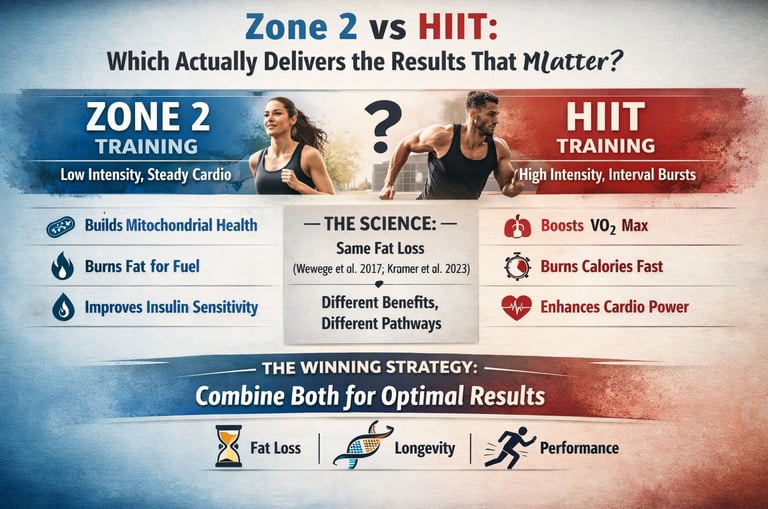
Zone 2 vs HIIT: Which Is Better?
Zone 2 training and High-Intensity Interval Training (HIIT) are both effective for fat loss, longevity, and performance—but they work through different physiological mechanisms. Research shows that when total energy expenditure is matched, both produce similar fat loss results. Zone 2 improves mitochondrial health, fat oxidation, and insulin sensitivity, making it ideal for long-term metabolic health and sustainability. HIIT, on the other hand, rapidly increases VO₂ max and cardiovascular fitness, offering greater time efficiency.
Best approach: combine both. Use Zone 2 to build your aerobic base and metabolic resilience, and HIIT to improve peak performance and cardiorespiratory capacity.
Bottom line: Zone 2 builds the engine, HIIT raises the ceiling—together, they deliver optimal results for fat
Clinician’s Perspective: Zone 2 vs HIIT (Evidence-Based Insights)
Not a Competition—Different Therapeutic Tools
Zone 2 and HIIT target distinct physiological systems; clinical value lies in integration, not substitution.Zone 2 = Foundation of Cardiometabolic Health
Enhances mitochondrial function and oxidative capacity
Improves insulin sensitivity and metabolic flexibility
First-line strategy in conditions like Type 2 Diabetes and metabolic syndrome
Lower injury and cardiovascular risk
High adherence due to tolerable intensity
Minimal sympathetic nervous system stress
HIIT = Potent Cardiovascular Stimulus
Rapidly improves VO₂ max (strong mortality predictor)
Enhances endothelial function and vascular health
Increases insulin-independent glucose uptake (AMPK-mediated)
Appropriate for stable, moderately fit individuals
Avoid early use in sedentary or high-risk populations
Needs adequate recovery capacity
Risks of Misapplication
Excess HIIT → overtraining, injury, autonomic imbalance
Poor adherence if intensity exceeds patient capacity
Best Practice: Periodized Hybrid Model
Build aerobic base with Zone 2 first
Introduce HIIT progressively
Align with patient goals, risk profile, and recovery
Clinical Bottom Line
Zone 2 builds resilience and metabolic health
HIIT enhances peak capacity and efficiency
Combined approach delivers optimal long-term outcomes
Zone 2 vs HIIT: Which Actually Delivers the Results That Matter?
If you had to choose just one form of cardio to lose fat, extend your lifespan, and improve performance, what would it be? Slow, steady aerobic training—or short, intense bursts that leave you breathless? This question has become one of the most debated topics in modern exercise science, with strong opinions on both sides. Yet when we move beyond fitness trends and examine the physiology and clinical evidence, the answer becomes far more nuanced—and far more powerful.
Low-intensity aerobic training, often referred to as Zone 2, has gained renewed attention for its profound effects on mitochondrial health, fat oxidation, and metabolic flexibility—key determinants of long-term cardiometabolic function (Cano et al., 2022). At the same time, High-Intensity Interval Training (HIIT) has been consistently shown to produce rapid improvements in cardiorespiratory fitness, particularly maximal oxygen uptake (VO₂ max), which is one of the strongest predictors of all-cause mortality across populations. From a fat loss perspective, large-scale meta-analyses demonstrate that both HIIT and moderate-intensity continuous training produce comparable reductions in body fat when total energy expenditure is accounted for (Wewege et al., 2017; Kramer et al., 2023).
So why does the debate persist?
These two training modalities target fundamentally different physiological systems. Zone 2 builds the metabolic foundation—enhancing mitochondrial efficiency and improving insulin sensitivity—while HIIT pushes the upper limits of cardiovascular performance and metabolic stress adaptation. In clinical and athletic settings alike, relying exclusively on one while neglecting the other creates an incomplete physiological profile.
This article moves beyond the false dichotomy. Instead of asking which is better, we will explore how each works, where each excels, and how combining both may represent the most evidence-based strategy for fat loss, longevity, and peak performance.2. Defining the Two Training Modalities
Zone 2 Training
~60–70% VO₂ max intensity
Blood lactate: 1.5–2.0 mmol/L
You can hold a full conversation (talk test)
Examples: brisk walking, easy cycling, light jog
Typical duration: 45–90 minutes per session
Primary fuel: fat oxidation
HIIT
≥85–95% HRmax during work intervals
Blood lactate: 6–12+ mmol/L
Speech is limited to broken phrases
Examples: sprint intervals, 4×4 cycling, Tabata
Typical duration: 20–40 minutes per session
Primary fuel: glycogen (glucose)
Zone 2 sits at an intensity sweet spot where your body predominantly burns fat for fuel and where lactate production is balanced by its clearance—a physiological state your mitochondria love. HIIT pushes you well beyond that threshold into glycolytic territory, demanding rapid energy from stored carbohydrates, creating significant metabolic stress in a short window of time.
The Physiology: What Happens Inside Your Body
Mitochondrial Adaptations
Mitochondria—the energy-producing organelles inside your muscle cells—are the central players in this story. Zone 2 exercise induces mitochondrial biogenesis, meaning it literally grows more mitochondria and upregulates oxidative enzymes such as citrate synthase and beta-hydroxyacyl-CoA dehydrogenase. Think of this as adding more engines to your car. Over weeks and months of consistent Zone 2 work, your muscles become extraordinarily efficient at burning fat for fuel, sparing glycogen and reducing fatigue at higher efforts.
HIIT, while it also stimulates mitochondrial adaptations, does so through a slightly different pathway—primarily via AMPK activation from rapid ATP depletion and through PGC-1α signaling from metabolic stress. HIIT remodels the mitochondrial network and can produce meaningful improvements in mitochondrial capacity even with shorter training volumes, which is one reason it appeals to time-pressed individuals.
Fuel Utilization and Metabolic Flexibility
A landmark European study (Cano et al., 2022) analyzed sex-based differences in energy substrate utilization during moderate-intensity aerobic exercise and confirmed that fat oxidation is maximized in a moderate-intensity zone—overlapping substantially with Zone 2 training. During HIIT, by contrast, the body relies heavily on rapid glycogenolysis (breaking down stored sugars), and fat oxidation is suppressed. This does not mean HIIT is inferior for fat loss overall—it simply means the mechanism is different, as we will explore in the next section.
The ideal long-term adaptation is metabolic flexibility: the capacity to efficiently switch between fat and carbohydrate fuel depending on intensity and context. Consistent Zone 2 training is the most effective known strategy for developing this flexibility, while HIIT builds the anaerobic ceiling and the cardiovascular engine necessary for peak performance.
Lactate Dynamics
Lactate, long misunderstood as a waste product, is actually a crucial metabolic fuel. During Zone 2 exercise, lactate is produced and cleared at near-equal rates, keeping circulating levels steady. This trains the lactate shuttle system—particularly important for endurance athletes—and improves the body's ability to use lactate as a clean fuel source across tissues. During HIIT, lactate accumulates sharply, and adaptation over time improves the body's buffering capacity and tolerance for high-intensity effort.
Fat Loss: What Does the Research Actually Say?
This is the question most people care about most, and the evidence is more nuanced—and more reassuring—than the polarized fitness debate suggests.
The HIIT vs. Continuous Training Debate
A widely cited systematic review and meta-analysis by Wewege et al. (2017), published in Obesity Reviews, examined 39 randomized controlled trials and found that both HIIT and moderate-intensity continuous training (MICT) produced comparable reductions in total body fat in overweight and obese adults—with HIIT achieving this in approximately 40% less time per session. This was a landmark finding that catapulted HIIT into mainstream fitness culture.
However, more recent evidence urges caution before declaring HIIT the clear winner. Kramer et al. (2023), publishing in the Journal of Exercise Science & Fitness, conducted a rigorous systematic review and meta-analysis of randomized clinical trials and concluded that HIIT is not superior to continuous aerobic training for reducing body fat. Their analysis highlighted that when total energy expenditure is equated across protocols, the fat loss outcomes converge significantly.
A 2024 study by Song et al. published in Scientific Reports examined college students with obesity and found that both HIIT and moderate-intensity continuous training produced meaningful improvements in body weight and metabolic health markers, with no statistically significant superiority for either modality when training was structured appropriately.
Research Takeaway
Both Zone 2/moderate-intensity training and HIIT produce meaningful fat loss. HIIT is time-efficient. Zone 2 is more sustainable and has fewer injury/overtraining risks. Neither is categorically superior—total weekly energy expenditure and long-term adherence are the dominant variables.
The EPOC Myth—and the Real Story
Proponents of HIIT often cite Excess Post-Exercise Oxygen Consumption (EPOC)—the "afterburn" effect—as a reason HIIT burns more fat. While EPOC is real, research consistently shows the absolute caloric contribution of EPOC is modest (typically 6–15% of exercise energy expenditure) and does not fundamentally alter the fat loss equation compared to simply doing more volume of any type of movement. The practical advantage of HIIT lies not in EPOC magic but in its time efficiency and its effects on VO₂ max, which has cascading metabolic benefits.
Longevity and Metabolic Health: Playing the Long Game
Zone 2 and the Hallmarks of Aging
If you are thinking about fitness through the lens of living well for longer, Zone 2 training deserves special attention. Mitochondrial dysfunction is now considered one of the primary hallmarks of cellular aging. Consistent aerobic base training—precisely the kind that Zone 2 provides—is the most potent known stimulus for preserving and improving mitochondrial health across the lifespan. Improved mitochondrial efficiency correlates with reduced oxidative stress, better insulin signaling, and lower systemic inflammation, all of which are mechanistically linked to all-cause mortality reduction.
Zone 2 training also produces significant improvements in insulin sensitivity—the ability of your cells to respond appropriately to insulin—and in lipid metabolism, reducing triglycerides and improving HDL cholesterol profiles. These adaptations translate directly into reduced cardiovascular disease risk and improved metabolic health.
HIIT and VO₂ Max: The Longevity Biomarker
Here is where HIIT earns its longevity credentials. VO₂ max—the maximum rate at which your body can consume oxygen during maximal effort—is arguably the single strongest predictor of long-term survival across populations. Individuals in the top quartile of VO₂ max have dramatically lower all-cause mortality than those in the bottom quartile, even after controlling for other risk factors. HIIT is the most time-efficient method for improving VO₂ max, stimulating adaptations in maximal cardiac output, oxygen extraction, and central and peripheral cardiovascular efficiency.
HIIT also improves endothelial function (the health of the inner lining of blood vessels) and can reduce arterial stiffness, both of which are independent cardiovascular risk factors that increase significantly with age.
Here is a breakdown of the longevity and health metrics for Zone 2 and HIIT, organized by physiological impact:
1. Mitochondrial Health
Zone 2 Advantage: ★★★★★ (Strong) – It is the gold standard for building mitochondrial volume (biogenesis), creating more "power plants" in your cells.
HIIT Advantage: ★★★☆☆ (Moderate) – Primarily improves mitochondrial efficiency (how well they work) rather than just how many you have.
2. Insulin Sensitivity
Zone 2 Advantage: ★★★★☆ (Strong) – Improves how your body manages blood sugar over long durations by increasing glucose transporters in the muscles.
HIIT Advantage: ★★★★☆ (Strong) – Provides a rapid, acute increase in sugar uptake due to the high metabolic demand of the intervals.
3. VO2 Max Improvement
Zone 2 Advantage: ★★★☆☆ (Moderate) – Necessary for building the aerobic base (the "floor"), but it rarely pushes your absolute limit.
HIIT Advantage: ★★★★★ (Strong) – The most effective way to raise your "aerobic ceiling," a metric which is one of the strongest predictors of a long life.
Getty Images
4. Endothelial Function (Blood Vessel Health)
Zone 2 Advantage: ★★★☆☆ (Moderate) – Good for general circulation and steady-state heart health.
HIIT Advantage: ★★★★☆ (Strong) – The intense "shear stress" of high-intensity blood flow helps keep artery walls flexible and youthful.
5. Injury & Overtraining Risk
Zone 2 Advantage: ★★★★★ (Very Low) – Very safe; can be performed frequently with minimal recovery time needed.
HIIT Advantage: ★★☆☆☆ (Moderate to High) – Puts significant stress on joints and the nervous system; requires 48–72 hours of recovery between sessions.
6. Metabolic Flexibility
Zone 2 Advantage: ★★★★★ (Strong) – Specifically trains the body to switch to burning fat as a primary fuel source, sparing sugar for when you need it.
HIIT Advantage: ★★☆☆☆ (Limited) – Relies almost exclusively on glucose (sugar); does little to improve the body’s ability to oxidize fat.
Zone 2 as the Aerobic Foundation
Elite endurance coaches and exercise physiologists often describe Zone 2 training as "building the engine." Without a robust aerobic base, an athlete cannot tolerate high training volumes, cannot recover adequately between hard sessions, and cannot sustain threshold efforts for extended periods. The world's best marathon runners, triathletes, and cyclists spend the majority—often 75–85%—of their training time in low-intensity aerobic zones, building the capillary density, oxidative enzyme activity, and cardiac efficiency that underpin elite performance.
HIIT for Performance Peaks
HIIT, applied strategically on top of an aerobic base, produces sharp improvements in lactate threshold, anaerobic capacity, and sport-specific power output. The classic 4×4 protocol—four minutes at 90–95% HRmax, four times, with three-minute recovery intervals—has been validated in numerous studies as a highly effective VO₂ max stimulus. Tabata-style protocols (8×20 seconds near-maximal effort) can improve both aerobic and anaerobic capacity simultaneously in trained individuals.
The 80/20 Polarized Model
Research on elite athletes strongly supports a polarized training distribution: approximately 80% of sessions at low intensity (Zone 1–2) and 20% at high intensity (Zone 4–5), with relatively little time spent in the "moderate" middle zone. This counterintuitive finding—that elite athletes avoid the "comfortable hard" intensity that recreational athletes often default to—has important practical implications for anyone serious about performance optimization.
Risks, Limitations, and Who Should Choose What
The Risks of Too Much HIIT
HIIT, while powerful, carries meaningful risks when overdone or implemented without proper progression. Elevated cortisol from repeated sympathetic nervous system activation, without adequate recovery, leads to overtraining syndrome—a state of chronic fatigue, declining performance, disrupted sleep, and impaired immunity. For beginners with low aerobic base fitness, jumping straight into HIIT can also significantly elevate injury risk due to musculoskeletal demands at high intensities.
The Limitations of Zone 2 Alone
Zone 2 is not without its own limitations. It requires longer durations to achieve meaningful caloric expenditure, making it impractical as a sole strategy for individuals with very limited time. Without higher-intensity stimulus, it also fails to drive meaningful VO₂ max improvements beyond a moderate level, and will not develop the anaerobic capacity required for power sports or high-intensity activities of daily life.
Patient Stratification Guide
Beginners / Deconditioned: Start with Zone 2 exclusively for 4–8 weeks. Build aerobic base before any HIIT.
Metabolic Disease (T2D, insulin resistance): Both modalities are beneficial; Zone 2 is lower risk and highly effective for insulin sensitivity.
Healthy adults, time-limited: 2–3× Zone 2 + 1–2× HIIT per week is an evidence-supported hybrid approach.
Competitive athletes: Polarized model (80/20) with periodized HIIT blocks.
Does Sex Matter? The Emerging Science
An often-overlooked dimension of this debate is sex-based variation in exercise response. Research by Cano et al. (2022) highlighted meaningful differences in energy substrate utilization during moderate-intensity aerobic exercise between males and females, with women generally demonstrating a higher relative reliance on fat oxidation at comparable exercise intensities. This has practical implications: women may derive relatively greater metabolic benefit from Zone 2 training in terms of fat oxidation, while HIIT responses—particularly VO₂ max and body composition changes—appear broadly similar across sexes when training is properly equated.
Industry data from Strava (2023) has also shown that women tend to exercise at different average intensities than men and may respond differently to training load recommendations. While population-level guidelines apply broadly to both sexes, individualized programming that considers hormonal cycle phases, recovery capacity, and personal preferences will consistently outperform generic prescriptions.
Practical Applications: How to Programme Both
General Health & Fat Loss (5 Days/Week)
Mon: Zone 2 — 45 min brisk walk or easy cycle (HR: 120–140 bpm)
Tue: HIIT — 4×4 intervals (4 min at ~90% HRmax, 3 min recovery) × 4 rounds
Wed: Zone 2 — 50 min, conversational pace
Thu: Rest or light mobility
Fri: Zone 2 — 60 min; longer easy aerobic session
Sat: HIIT — Tabata-style (8×20 sec sprint / 10 sec rest) or sport of choice
Sun: Complete rest or gentle walking
Busy Professional (3 Days/Week, Minimum Effective Dose)
Mon: HIIT — 25 min total (5 min warmup, 4×4 intervals, 5 min cooldown)
Wed: Zone 2 — 40 min brisk walk (can be split into two 20-min walks)
Fri: HIIT or Zone 2 depending on energy level; prefer Zone 2 if fatigued
Endurance Athlete (Polarized Model)
Mon–Wed–Fri–Sun: Zone 2 (60–90 min); total ~80% of weekly training volume
Tue: HIIT block — lactate threshold intervals or VO₂ max work (~20% of volume)
Sat: Long Zone 2 effort (90–120 min); the key weekly aerobic base session
Thu: Rest or easy active recovery
Monitoring Intensity: Know Your Zones
Intensity monitoring is the bridge between theory and results. A chest-strap heart rate monitor remains the gold standard for real-time feedback. Zone 2 corresponds to roughly 60–70% of your maximum heart rate (a useful estimate: 220 minus age) and is characterized by the ability to speak in full sentences. HIIT work intervals should feel genuinely hard—you should be able to speak only a few words at a time. Perceived exertion scales (RPE 3–4 out of 10 for Zone 2; RPE 8–9 for HIIT work intervals) provide a practical tool without any equipment.
The Evidence-Based Verdict
No Single Winner. A Clear Partnership.
The honest, research-supported conclusion is that Zone 2 and HIIT are not competitors—they are collaborators. Each addresses physiological systems the other neglects, and the combination, properly programmed, produces outcomes superior to either alone.
Fat loss → Both produce comparable results when energy expenditure is matched. Choose based on preference and lifestyle fit.
Longevity → Zone 2 wins on mitochondrial and metabolic health; HIIT wins on VO₂ max. Together, they address the full spectrum of longevity.
Performance → Zone 2 builds the engine. HIIT raises the ceiling. Neither is optional for a complete athlete.
Beginners → Start with Zone 2. Earn the right to add HIIT.
Time-limited → HIIT delivers the most return per minute, but don't neglect aerobic base entirely.
Frequently Asked Questions
Is Zone 2 better than HIIT for belly fat specifically?
Not inherently. Spot reduction is a myth—you cannot target where your body burns fat. Both modalities reduce total body fat through different mechanisms. Zone 2 burns fat directly during the session; HIIT creates a larger metabolic disturbance that promotes fat loss over 24–48 hours. Abdominal fat responds to total caloric deficit and hormonal balance. Both training types, combined with good nutrition, are effective. Chronically elevated cortisol from excessive HIIT may paradoxically increase abdominal fat retention, making Zone 2's lower-stress profile advantageous for stress-prone individuals.
How much HIIT is too much per week?
Most exercise scientists recommend no more than 2–3 high-intensity sessions per week for healthy adults, with at least 48 hours of recovery between HIIT sessions. Exceeding this—especially without adequate aerobic base training—risks overtraining, hormonal dysregulation, impaired immune function, and elevated injury risk. If you feel persistently fatigued, experience disturbed sleep, or notice declining performance after adding HIIT, reduce frequency before intensity.
Can complete beginners start with HIIT?
With appropriate modification, yes—but caution is warranted. Jumping into traditional HIIT without a basic aerobic foundation significantly increases injury risk and dropout rates. Beginners are typically better served by 4–8 weeks of Zone 2 base building first. If time is a constraint, "beginner HIIT" with very short intervals, lower absolute intensities, and ample recovery can be introduced earlier—but should be distinguished from the high-intensity protocols used in the research studies cited above.
Is walking enough to qualify as Zone 2 training?
For most deconditioned or sedentary individuals, a brisk walk absolutely falls within Zone 2—provided it elevates heart rate into the 60–70% HRmax range. For fitter individuals, a brisk walk may feel too easy to reach Zone 2 intensity, in which case incline walking, cycling, or jogging may be needed. The key test is the "talk test": you should be able to speak in full sentences, but not comfortably sing. If you can easily sing, you're likely below Zone 2.
Does HIIT cause muscle loss?
HIIT alone does not typically cause significant muscle loss in healthy individuals. However, very high volumes of any cardio, combined with inadequate protein intake and caloric deficit, can impair muscle retention. HIIT with a sprint or resistance component may even help preserve muscle mass better than pure steady-state cardio during a fat loss phase. Pairing either form of cardio with resistance training and adequate dietary protein (1.6–2.2 g/kg body weight) is the most effective strategy for preserving lean mass during fat loss.
Which is better for type 2 diabetes or insulin resistance?
Both modalities improve insulin sensitivity, but through somewhat different pathways. Zone 2 training enhances baseline mitochondrial glucose oxidation and increases GLUT4 transporter density in muscle cells. HIIT creates acute insulin-independent glucose uptake via AMPK activation. Research suggests HIIT may produce faster acute improvements in glycemic control, while Zone 2 provides more sustained, lower-risk improvements over time. For individuals with diabetes or at high metabolic risk, starting with Zone 2 under medical supervision and progressing to a hybrid approach is the safest and most effective route. Always consult your healthcare provider before beginning a new exercise program.
Can I do both Zone 2 and HIIT in the same week?
Absolutely—and this is the evidence-supported approach for most goals. The typical recommendation is 2–4 Zone 2 sessions and 1–2 HIIT sessions per week, with HIIT sessions separated by at least 48 hours for recovery. Doing HIIT on back-to-back days, or pairing a HIIT session with a very long Zone 2 effort on the same day, can compromise recovery and adaptation. Listen to your body: if HIIT sessions feel progressively harder rather than progressively more manageable, pull back frequency before cutting intensity.
Clinical Pearls: Zone 2 vs. HIIT
The following pearls synthesize the complex physiology of the article into actionable "nuggets" of wisdom, presented for both the clinician/researcher and the patient.
1. The Mitochondrial "Volume vs. Intensity" Rule
While HIIT increases mitochondrial efficiency through PGC-1α signaling and metabolic stress, Zone 2 is the primary driver of mitochondrial biogenesis (volume). A balanced protocol ensures both a high density of energy-producing organelles and optimal functional capacity.
Think of Zone 2 as building a bigger engine for your car, while HIIT is like tuning that engine to run faster. If you only do HIIT, you’re tuning a small engine; if you only do Zone 2, you have a huge engine that never hits top speed. You need both to be a high-performance machine.
2. The VO2 Max Survival Ceiling
VO2 max is a powerful independent predictor of all-cause mortality. While Zone 2 builds the aerobic base, HIIT is the most time-efficient stimulus for elevating the "aerobic ceiling" by increasing maximal cardiac output and stroke volume.
Your VO2 max is essentially your "fitness age." The higher it is, the longer you are likely to live healthily. HIIT is the "fast track" to raising this number, helping your heart pump more blood with every beat.
3. Metabolic Flexibility & Fuel Switching
Zone 2 training optimizes fat oxidation and enhances the "lactate shuttle," allowing for better metabolic flexibility. This preserves muscle glycogen for high-intensity efforts, delaying the onset of metabolic fatigue.
Zone 2 teaches your body how to burn fat as its primary fuel source. This makes you "metabolically flexible," meaning you won’t "crash" or "bonk" as easily during a long workout because your body has learned to save its sugar (glycogen) for when you really need to sprint.
4. The Cortisol-HIIT Relationship
Excessive high-intensity volume without an adequate aerobic base can lead to sympathetic overdrive and chronically elevated cortisol. This may paradoxically impair insulin sensitivity and promote visceral adiposity, counteracting fat loss goals.
More intensity isn't always better. If you do too much HIIT without enough rest, your body gets "stressed out" and pumps out a hormone called cortisol. This can actually make it harder to lose belly fat and leave you feeling burned out instead of fit.
5. The "Talk Test" as a Physiological Proxy
The ventilatory threshold (VT1) correlates strongly with the transition from Zone 2 to Zone 3. The "talk test" serves as a valid, non-invasive proxy for ensuring a patient remains below the lactate accumulation threshold (<2.0 mmol/L).
You don't need a fancy heart monitor to find your "Fat Burn Zone" (Zone 2). If you can comfortably hold a full conversation while jogging or cycling, you’re in the right spot. If you can only gasp out a few words at a time, you’ve moved into the high-intensity "Hard Zone."
Ready to Put This Into Practice?
You now have the research. Here is your three-step action plan to start building your optimal cardio programme today.
Assess Your Baseline. Take note of your resting heart rate, how long you can sustain a brisk walk, and how quickly you recover from effort. This tells you where to start.
Track Your Heart Rate Zones. Invest in a basic heart rate monitor or use your phone's camera sensor. Knowing your actual Zone 2 range removes the guesswork.
Start a Hybrid Programme. Use the templates above as a starting point. Commit to four weeks before evaluating results. Progress is rarely linear—consistency wins.
Author’s Note
This article was developed with a commitment to bridging the gap between exercise physiology research and real-world clinical application. The goal is not to promote a single training ideology, but to present a balanced, evidence-based perspective grounded in current literature, including randomized controlled trials, systematic reviews, and mechanistic studies.
As a clinician, I have consistently observed that the most effective exercise strategies are not those that are extreme or exclusive, but those that are sustainable, individualized, and physiologically sound. Both Zone 2 training and high-intensity interval training (HIIT) offer meaningful benefits across metabolic health, cardiovascular function, and performance when applied appropriately.
It is important to recognize that responses to exercise are highly variable. Factors such as baseline fitness, age, comorbidities, recovery capacity, and lifestyle constraints all influence outcomes. What works optimally for an athlete may not be suitable for someone managing chronic conditions such as Type 2 Diabetes or cardiovascular disease.
Readers are encouraged to interpret the information presented here as a framework—not a rigid prescription. Exercise programming should be adapted to individual needs and, where appropriate, undertaken in consultation with a qualified healthcare professional.
Ultimately, the most powerful training program is the one that you can perform consistently, safely, and progressively over time.
This article is intended for educational purposes and is not a substitute for individualized medical or coaching advice. Athletes with cardiovascular risk factors should consult a sports medicine physician before beginning high-intensity training.
Related Articles
How HIIT Improves VO2 Max: The Fastest Way to Boost Aerobic Capacity
The Physiology of HIIT: Mitochondria, Oxygen & Energy Systems
VO₂ Max vs Lactate Threshold Explained: What Truly Determines Your Fitness
HIIT vs Moderate Cardio: Which Improves Cardiovascular Fitness Faster?
Is Your Heart at Risk? How the TG/HDL Ratio Can Warn You Early | DR T S DIDWAL
Reference List
Cano, A., et al. (2022). Analysis of sex-based differences in energy substrate utilization during moderate-intensity aerobic exercise. European Journal of Applied Physiology, 122(1), 1–12. https://doi.org/10.1007/s00421-022-04984-y
Kramer, A. M., et al. (2023). High-intensity interval training is not superior to continuous aerobic training in reducing body fat: A systematic review and meta-analysis of randomized clinical trials. Journal of Exercise Science & Fitness, 21(4), 385–394. https://doi.org/10.1016/j.jesf.2023.09.002
Song, X., et al. (2024). Comparative effects of high-intensity interval training and moderate-intensity continuous training on weight and metabolic health in college students with obesity. Scientific Reports, 14(1), 1–15. https://doi.org/10.1038/s41598-024-52341-w
Strava. (2023). How women can train differently than men. Strava Journal. https://www.strava.com/athlete/journal
Wewege, M., Thom, J. M., Leyden, S. T., & Ward, R. E. (2017). The effects of high-intensity interval training vs. moderate-intensity continuous training on body composition in overweight and obese adults: A systematic review and meta-analysis. Obesity Reviews, 18(6), 635–646. https://doi.org/10.1111/obr.12532