VO₂ Max vs Lactate Threshold Explained: What Truly Determines Your Fitness?
VO₂ max vs lactate threshold explained. Learn which metric truly predicts endurance performance, guides training, and improves metabolic health.
EXERCISE
Dr. T.S. Didwal, M.D.(Internal Medicine)
7/4/202611 min read
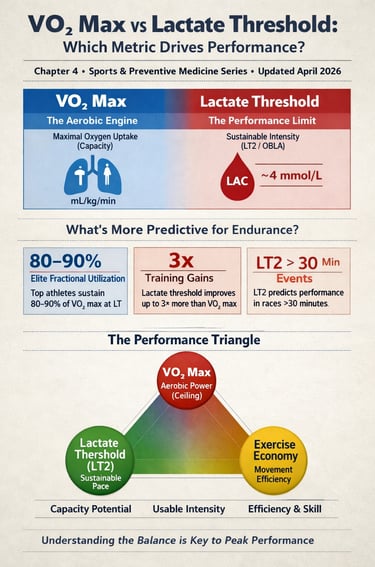
While VO2 max dictates your absolute physiological ceiling (the size of your "engine"), lactate threshold is a far more accurate predictor of real-world endurance performance.
Because endurance races—such as half-marathons, marathons, and triathlons—are run at submaximal intensities, your finishing time depends on how long you can sustain a fast pace without accumulating fatigue-inducing metabolic byproducts. Two athletes can have an identical VO2 max, but the athlete with a higher lactate threshold will always be able to sustain a faster pace for longer without hitting a wall.
The Key Differences:
VO2 Max: Measures peak oxygen capacity. It is highly influenced by genetics and acts as a better predictor for short, all-out efforts under 10 minutes (like a 1-mile or 5K race), as well as long-term cardiovascular health.
Runner's World
Lactate Threshold: Measures sustainable metabolic output. It is highly trainable and dictates the exact percentage of your VO2 max engine you can actually use before your muscles stall.
Key takeaway
1. Engine Capacity vs. Usable Horsepower
Think of your aerobic fitness as a vehicle. VO2 max is the total size of your engine—the maximum volume of oxygen your body can physically take up and use during all-out exertion. Lactate Threshold (LT), specifically LT2, is your usable horsepower—the highest percentage of that engine size you can maintain for an extended period without "stalling" due to rapid fatigue.
2. Threshold Predicts the Podium (and Personal Bests)
While a high VO2 max is required to enter the elite ranks, it does not guarantee victory. In endurance events lasting over 30 minutes (like half-marathons or marathons), lactate threshold is a far superior predictor of performance. Two athletes can have the exact same VO2 max, but the one who can sustain a higher percentage of that capacity without accumulating excess lactate will always run or cycle faster.
3. Lactate is a Fuel, Not a Toxin
A common myth is that lactate (or lactic acid) is a metabolic waste product that causes muscle burn. In reality, lactate is an essential, highly efficient fuel source that your heart, brain, and muscles actively recycle for energy. The "burn" and subsequent fatigue occur because your body reaches an intensity where it produces lactate faster than it can clear it—not because lactate itself is inherently toxic.
4. The Power of "Fractional Utilization" and Economy
Your ultimate athletic potential is governed by the Performance Triangle:
VO2 Max: Your ceiling (how much oxygen you can use).
Lactate Threshold: Your sustainability (what percentage of that oxygen you can maintain).
Exercise Economy: Your efficiency (how much oxygen it costs you to move at a specific speed or power).
Even if your VO2 max plateaus due to genetic limits, you can continue to run faster or ride farther by improving your economy (technique, gear, biomechanics) and pushing your lactate threshold closer to your absolute ceiling.
5. VO2 Max Doubles as a Vital Sign for Longevity
While lactate threshold wins for race-day predictions, VO2 max reigns supreme for long-term clinical health. Cardiologists and epidemiologists view VO2 max as a powerful indicator of cardiovascular resilience and all-cause mortality risk. A higher VO2 max essentially provides a "buffer" against chronic illness, aging, and surgical stress.
6. Train Smarter with a Polarized System
To effectively move the needle on both health and performance, modern exercise science heavily favors a polarized training approach:
The Foundation (70–80% of your time): Keep it in Zone 2 (below LT1). This is conversational, easy effort that builds mitochondrial density and teaches your body to flush out lactate efficiently.
The Engine & Ceiling (20–30% of your time): Divide the remainder between structured threshold work (comfortably hard) to push up your race pace, and brief, near-maximal VO2 max intervals to lift your physiological ceiling. Avoiding the middle "gray zone"—where efforts are too hard to be restorative but too easy to force high-level adaptation—is the key to injury-free progress.Oxygen-carrying capacity of the blood — largely a function of hemoglobin concentration
Muscle oxygen extraction — how efficiently mitochondria inside muscle fibers pull oxygen out of circulating blood and use it
Roughly half the variation in VO2 max between individuals appears to be inherited, which is why identical training programs produce different absolute numbers in different people. Training can raise VO2 max substantially in someone who starts sedentary — often by 15–20% — but the gains flatten out quickly once an athlete is well trained. A sedentary adult typically sits in the 30–40 mL/kg/min range; elite endurance cyclists and runners often sit at 70–85 mL/kg/min.
Why Cardiologists Care About VO2 Max
Outside of sports, VO2 max functions almost like a vital sign. Cardiopulmonary Exercise Testing (CPET) — the gold-standard test that measures VO2 max directly via breath-by-breath gas analysis — is used to decide heart transplant eligibility, assess surgical risk, and stratify long-term cardiovascular mortality risk. A VO2 max that falls under roughly 14–18 mL/kg/min is a recognized red flag for elevated mortality risk in clinical populations. This is one reason VO2 max is sometimes described as a more powerful predictor of long-term survival than traditional risk factors like blood pressure or cholesterol.
What Is Lactate Threshold?
Lactate threshold is the exercise intensity at which lactate starts accumulating in the bloodstream faster than your body can clear it. It is not, despite decades of gym folklore, a marker of "toxic buildup." Lactate is a fuel — one that your heart and even your brain actively burn — and the threshold simply marks the tipping point where production outpaces removal.
Physiologists generally split it into two stages:
LT1 — The Aerobic Threshold
This is the first small, measurable rise in blood lactate above your resting baseline, typically around 2 mmol/L. Physically, it feels like an easy, conversational pace — the kind of effort you could hold for hours. Training just below this intensity (commonly called Zone 2) is where most of your weekly volume should live.
LT2 — The Anaerobic Threshold (or OBLA)
This is the "turnpoint" where lactate accumulation sharply accelerates, traditionally anchored around 4 mmol/L, though the real number varies meaningfully between individuals. This is "comfortably hard" effort — the kind you can sustain for maybe 30–60 minutes if you're trained, but speaking in full sentences becomes difficult.
The Transporters Behind the Threshold
Your ability to clear lactate depends on proteins called monocarboxylate transporters:
MCT1 shuttles lactate into mitochondria, where it's recycled back into usable energy
MCT4 exports lactate out of fast-twitch fibers into the bloodstream so it can be redistributed and reused elsewhere
Endurance-trained athletes build a higher density of both transporter types, which is a major reason they can sustain a much higher percentage of their VO2 max before flooding the system — a concept called fractional utilization, covered below.
Unlike VO2 max, lactate threshold responds strongly and continuously to structured training, which is exactly why it's the more actionable lever for most athletes.
Head-to-Head: VO2 Max vs Lactate Threshold
Factor VO2 Max Lactate Threshold What it measures Peak aerobic capacity (ceiling) Highest sustainable intensity (usable output) Best test method CPET, treadmill/cycle ergometer gas analysis Blood lactate testing, ventilatory testing Genetic influence ~50% heritable Lower genetic ceiling, highly trainable Trainability once fit Plateaus quickly Continues improving with structured work Best predictor for Short, high-intensity efforts (5K, mile) Endurance events over 30 minutes Clinical use Mortality risk, surgical clearance, transplant eligibility Exercise prescription, metabolic health, safe training intensity
The short version: VO2 max tells you how big the engine is. Lactate threshold tells you how much of that engine you can actually use without stalling.
Two athletes with an identical VO2 max of 70 mL/kg/min can post marathon times more than 15 minutes apart. The difference is almost always explained by lactate threshold and how efficiently each athlete uses their aerobic ceiling — not the ceiling itself.
Fractional Utilization: The Concept That Explains Everything
Fractional utilization is the percentage of your VO2 max you can actually sustain during prolonged effort.
Elite endurance athletes typically sustain 80–90% of VO2 max at lactate threshold
Recreational athletes typically sustain only 60–70%
This single number — not VO2 max itself — is usually what separates two athletes with similar lab test results but very different race-day outcomes. It's also why lactate threshold, and the training that improves it, tends to move the needle more than chasing a slightly higher VO2 max once you're already reasonably fit.
The Missing Variable: Exercise Economy
Even matched VO2 max and lactate threshold don't guarantee matched performance. Exercise economy — the oxygen cost of moving at a given pace — is the third piece of the puzzle.
Economy is shaped by:
Running or cycling biomechanics
Tendon stiffness and elastic energy return
Muscle fiber type composition
Equipment (carbon-plated racing shoes are a well-documented example)
A roughly 4% improvement in running economy can meaningfully improve race times with no change at all in VO2 max or threshold — which is why coaches increasingly train form and efficiency alongside raw physiology.
Together, these three variables form what's sometimes called the performance triangle:
VO2 max — engine size (capacity)
Lactate threshold — sustainable output (usable power)
Exercise economy — efficiency (oxygen cost per unit of speed)
Insert infographic here: the performance triangle, with VO2 max, lactate threshold, and economy as the three corners.
Critical Power: A More Modern Performance Marker
Critical Power (cycling) and Critical Speed (running) define the highest output you can sustain before rapid fatigue sets in, tied to a finite anaerobic energy reserve known as W′. Below critical power, your metabolic state is essentially stable; above it, fatigue accumulates quickly and predictably.
Critical power closely tracks maximal lactate steady state and integrates aerobic capacity, lactate kinetics, and fatigue resistance into a single practical number — which is why some physiologists now consider it a more precise real-world performance marker than either VO2 max or a single-point lactate threshold measurement on its own.
Which Metric Matters More For You?
If You're Racing a Marathon or Half-Marathon
Prioritize lactate threshold. Since you cannot sustain VO2 max effort for more than a few minutes, your finishing time is governed almost entirely by your LT2 pace.
If You're Racing a 5K or Mile
Prioritize VO2 max. These events are run close to maximal aerobic capacity, so a higher ceiling provides a direct competitive advantage.
If You're Training for a Triathlon
Train all three. Longer events depend on lactate threshold for pacing, exercise economy for prolonged efficiency, and VO2 max for the upper physiological ceiling.
If Your Goal Is Cardiovascular Disease Prevention
Prioritize VO2 max. It remains one of the strongest available predictors of all-cause mortality, independent of body weight or genetics.
If Your Goal Is Managing Type 2 Diabetes or Metabolic Syndrome
Prioritize lactate threshold — specifically LT1/Zone 2 work. This intensity range improves insulin sensitivity, fat oxidation, and mitochondrial function.
If You're in Cardiac Rehabilitation
Track both. VO2 max informs prognosis and long-term risk; lactate threshold defines what intensity is safe day to day.
Training Zones That Build Both
Zone 2 (Below LT1) — The Aerobic Foundation
An easy, conversational effort that should make up 70–80% of total weekly volume. It builds mitochondrial density, improves fat oxidation, and strengthens the lactate-clearance machinery (MCT transporters) that underlies threshold gains.
Threshold Work (Zones 3–4, around LT2) — The Performance Engine
"Comfortably hard" tempo runs and sustained intervals, making up roughly 10–15% of weekly volume. This is the most direct way to raise your usable pace — the intensity you can actually hold on race day.
Zone 5 (VO2 Max Intervals) — The Ceiling Raiser
Near-maximal efforts of 3–8 minutes, used sparingly at 5–10% of total volume. These intervals push cardiac output and oxygen delivery to their limits and are the most effective (though smallest-volume) way to nudge VO2 max upward.
This polarized model — heavy on easy volume, light on threshold work, and a small dose of maximal intervals — consistently outperforms training plans that spend too much time in the moderate "gray zone" between easy and hard.
A Simple Periodization Framework
Phase Duration Focus Purpose Base Building 6–12 weeks Mostly Zone 2 Build the aerobic and mitochondrial foundation Threshold Development 4–8 weeks Structured LT2 sessions Convert capacity into usable, sustainable performance Peak Performance Final 4 weeks Add VO2 max intervals Sharpen the aerobic ceiling ahead of competition
Common Myths, Debunked
"A higher VO2 max always means better performance." Not once you're already well trained. Above roughly 65 mL/kg/min, threshold and economy tend to matter more than further gains in raw capacity.
"Lactate is a toxic waste product that causes the burn." No — lactate is a primary fuel source, especially for the heart and brain. The issue during hard exercise is an imbalance between production and clearance, not the presence of lactate itself.
"Heart rate zones are the same as metabolic zones." Not precisely. HR zones are useful approximations, but blood lactate testing or ventilatory testing gives a far more accurate picture of where your actual thresholds sit.
"The standard 4 mmol/L lactate threshold applies to everyone." It's a population average, not an individual constant. Depending on the athlete, a true threshold might sit closer to 3 mmol/L or 5 mmol/L — relying on the fixed number can misjudge training intensity by a meaningful margin.
FAQs
Can you still improve VO2 max once you're already fit? Yes, but gains shrink the closer you get to your genetic ceiling. At advanced fitness levels, improvements in lactate threshold and exercise economy tend to produce bigger real-world performance gains than squeezing out a slightly higher VO2 max.
How can I estimate my lactate threshold without a lab test? The talk test is a practical proxy: if you can speak in full sentences, you're likely below LT1; if only short phrases are possible, you've likely crossed LT2. A 30-minute maximal steady-effort time trial, with average heart rate from the final 20 minutes, is another commonly used field estimate of LT2. Wearables using heart rate, pace, and HRV algorithms can also provide a reasonable training-guidance estimate, though they're not a substitute for blood testing.
Is lactate threshold training useful for chronic disease management? Yes. LT1/Zone 2 work is a cornerstone of exercise prescription for type 2 diabetes and metabolic syndrome, improving insulin sensitivity and mitochondrial function. In cardiac rehab, it's typically paired with VO2 max tracking for prognosis.
Why do two athletes with identical VO2 max perform so differently? The gap usually comes down to fractional utilization (how much of that VO2 max they can actually sustain) and exercise economy (how efficiently they move). Together these factors can account for a 15–20% performance difference despite matching lab numbers.
What is OBLA and is it outdated? OBLA (Onset of Blood Lactate Accumulation) is the traditional fixed 4 mmol/L reference point. It's increasingly viewed as a rough population average rather than a precise individual marker, which is why modern coaching leans toward individualized threshold testing instead.
Are fitness trackers accurate for these metrics? They're reasonably good for spotting trends over time, since they estimate rather than directly measure oxygen consumption or blood lactate. For clinical-grade precision, CPET and blood lactate testing remain the standard.
What's the best overall training split? A polarized approach — roughly 70–80% easy, 10–15% threshold, 5–10% maximal intervals — is the most consistently supported model in current training research.
Does exercise economy really matter that much? Yes. A roughly 4% improvement in running economy can produce a meaningful race-time improvement without any change in VO2 max or threshold, which is part of why footwear, biomechanics, and running form have become such a focus in competitive distance running.
The Bottom Line
VO2 max sets your ceiling. Lactate threshold determines how much of that ceiling you can actually use. Exercise economy decides how efficiently you get there. None of the three tells the whole story alone.
If you're chasing a race time, your threshold and your efficiency probably deserve more of your training attention than your VO2 max. If you're thinking about your long-term health, VO2 max remains one of the most powerful single numbers available to you — but the threshold work that improves your daily stamina and metabolic health is what makes that fitness usable in ordinary life.
Train across all three zones, follow a structured progression from base to threshold to peak, and treat these numbers as dynamic and trainable rather than fixed labels.
This article is for educational purposes only and is not a substitute for individualized medical evaluation or cardiopulmonary exercise testing. If you have cardiovascular, metabolic, or other health conditions, talk with a qualified healthcare professional before starting or changing an exercise program.
Medical Disclaimer: This article is intended for educational and informational purposes only. It does not constitute medical advice and should not be used as a substitute for consultation with a qualified healthcare professional. Always discuss exercise programmes and cardiac risk assessment with your doctor, particularly if you have existing cardiovascular disease or significant risk factors.
Related Articles
HIIT for Athletes: Boost VO2 Max, Lactate Threshold, and Peak Performance – Science-Based Guide
VO2 Max in Cardiology: The Missing Vital Sign for Cardiovascular Risk and Longevity
Cardiorespiratory Fitness: The Most Important Predictor of Health and Longevity You Can Improve
VO2 Max and Longevity: The Ultimate Guide to Living Longer
Cardiorespiratory Fitness: The Most Important Predictor of Health and Longevity You Can Improve
Aerobic vs Anaerobic Threshold: Differences, Training Zones & Clinical Significance
HIIT for Athletes: Boost VO₂ Max, Lactate Threshold, and Peak Performance – Science-Based Guide
HIIT vs Moderate Cardio: Which Improves Cardiovascular Fitness Faster?
References
* Acharjee, M., Choudhury, R. D., & Atreya, G. (2025). Physiological relationship and differences in VO₂ max, lactate threshold, and peak blood lactate between power and endurance athletes. Asian Journal of Basic Science & Research, 7(3), 155–165. https://doi.org/10.38177/AJBSR.2025.7310
* Carrier, B., Helm, M. M., Cruz, K., Barrios, B., & Navalta, J. W. (2023). Validation of aerobic capacity (VO₂max) and lactate threshold in wearable technology for athletic populations. Technologies, 11(3), 71. https://doi.org/10.3390/technologies11030071
* Quittmann, O. J., Foitschik, T., Vafa, R., Freitag, F. J., Sparmann, N., Nolte, S., & Abel, T. (2023). Is maximal lactate accumulation rate promising for improving 5000-m prediction in running? International Journal of Sports Medicine, 44(4), 268–279. https://doi.org/10.1055/a-1958-3876
* Sablain, M., Sperlich, B., Meixner, B., et al. (2025). Evaluating the maximal rate of lactate accumulation and estimated maximal lactate steady state in cycling. European Journal of Applied Physiology, 125, 2173–2183. https://doi.org/10.1007/s00421-025-05751-z