How HIIT Improves VO₂ Max: The Fastest Way to Boost Aerobic Capacity
Boost your VO₂ max in 6–12 weeks. Learn how HIIT, training intensity, and recovery improve aerobic capacity and performance.
EXERCISE
Dr. T.S. Didwal, M.D.(Internal Medicine)
4/28/202614 min read
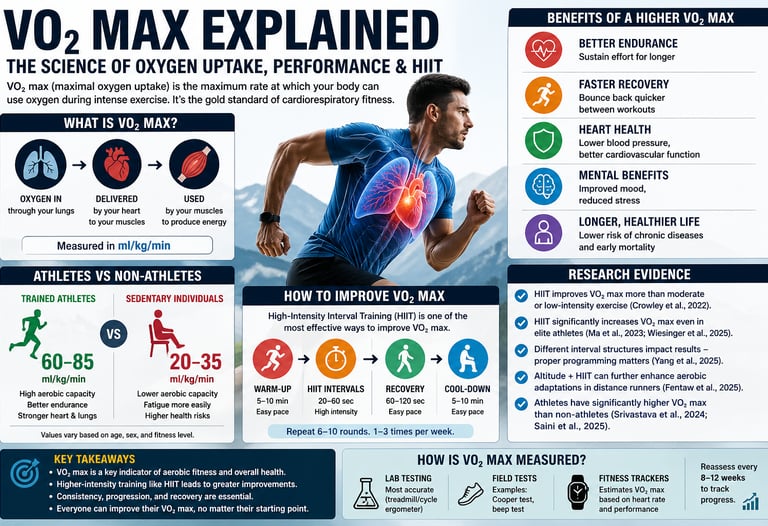
What is VO₂ max?
VO₂ max is the maximum rate at which your body uses oxygen during intense exercise. It reflects cardiorespiratory fitness and is measured in mL/kg/min. Higher values indicate better endurance, cardiovascular efficiency, and aerobic performance.
VO₂ max is a key indicator of aerobic fitness that reflects how efficiently the heart, lungs, and muscles use oxygen during exercise. Athletes have significantly higher VO₂ max than sedentary individuals due to long-term cardiovascular and muscular adaptations. Scientific evidence shows that high-intensity interval training (HIIT) is one of the most effective methods to improve VO₂ max, even in highly trained individuals. Consistent training, progressive overload, and recovery are essential for maximizing aerobic capacity and long-term health
How to Improve VO₂ Max Fast
The most effective way to improve VO₂ max is through High-Intensity Interval Training, which alternates short bursts of intense exercise with recovery periods. Research shows HIIT produces greater improvements in VO₂ max compared to moderate-intensity continuous training by increasing cardiac output, oxygen delivery, and mitochondrial adaptations.
Key Takeaways
VO₂ max is the gold standard for aerobic fitness
HIIT is the most time-efficient way to improve it
Athletes have higher VO₂ max due to long-term adaptation
Cardiovascular and mitochondrial changes drive improvement
Consistency matters more than intensity alone
Why Your Body's Oxygen Engine Matters More Than You Think
In modern clinical practice, few physiological markers bridge performance, prevention, and prognosis as powerfully as VO₂ max. Traditionally confined to sports laboratories and elite athletes, VO₂ max is now emerging as a vital sign of cardiometabolic health, with growing evidence linking it not only to endurance capacity but also to all-cause mortality, cardiovascular disease risk, and functional independence.
From a clinician’s standpoint, VO₂ max represents far more than a fitness metric—it is an integrated reflection of cardiac output, pulmonary efficiency, vascular function, and skeletal muscle metabolism. Patients with low VO₂ max frequently present with overlapping pathologies: insulin resistance, obesity, hypertension, and early cardiovascular dysfunction. In contrast, individuals with higher aerobic capacity demonstrate superior metabolic flexibility, improved mitochondrial function, and reduced systemic inflammation—key determinants of long-term health outcomes.
What is particularly compelling is the parameter's trainability. Comparative studies consistently show that trained individuals exhibit significantly higher VO₂ max than sedentary counterparts (Srivastava et al., 2024; Saini et al., 2025), reinforcing the concept that aerobic capacity is not genetically fixed but modifiable through targeted intervention. Among these interventions, High-Intensity Interval Training has emerged as a clinically efficient strategy. Meta-analyses demonstrate that HIIT induces robust improvements in oxygen uptake—even in elite athletes—by enhancing stroke volume, peripheral oxygen extraction, and mitochondrial biogenesis (Ma et al., 2023; Wiesinger et al., 2025).
For clinicians, this shifts the conversation from “exercise recommendation” to precision exercise prescription. The goal is no longer merely increasing physical activity, but strategically improving physiological capacity. When we prescribe interventions that elevate VO₂ max, we are not just improving fitness—we are modifying disease trajectories, extending healthspan, and enhancing quality of life.
Athletes vs. Non-Athletes: A Tale of Two Oxygen Engines
One of the most striking illustrations of VO₂ max's importance comes from comparing physically trained athletes with sedentary individuals. Research published in Cureus by Srivastava et al. (2024) assessed VO₂ max in both athletes and non-athletes in a controlled sports physiology laboratory. The findings were unambiguous: athletes demonstrated substantially higher VO₂ max values than their sedentary counterparts, underscoring the profound impact of consistent physical training on aerobic capacity.
This difference is not merely cosmetic. A higher VO₂ max means:
Better sustained energy during prolonged exercise
Faster recovery between bouts of effort
Reduced cardiovascular strain during everyday activities
Stronger long-term heart and lung health
Complementing this, Saini et al. (2025) conducted a direct comparative analysis of cardiorespiratory endurance between athletes and sedentary individuals, published in Lifestyle Medicine Research & Reviews. Their findings reinforced that regular athletic training produces measurable, significant gains in VO₂ max — and that sedentary lifestyles are directly linked to reduced aerobic capacity, with real consequences for metabolic health, energy levels, and disease risk.
The encouraging message embedded in both studies is this: the gap between athlete and non-athlete is not fixed. It is the product of years of training — and it can be narrowed with the right approach.
Athletes vs Non-Athletes: Key Differences
Athletes consistently show higher VO₂ max due to:
Increased stroke volume and cardiac output
Higher capillary density in muscles
Enhanced mitochondrial function
Better oxygen extraction
Sedentary individuals show reduced aerobic capacity, higher fatigue, and increased cardiometabolic risk.
The Role of Training Intensity: Not All Exercise Is Created Equal
Here is something that surprises many people: not all exercise improves VO₂ max equally. The intensity of your training matters enormously.
A landmark overview of systematic reviews and meta-analyses by Crowley et al. (2022), published in Translational Sports Medicine, examined the effect of different exercise training intensities on VO₂ max in healthy adults. Their analysis of multiple high-quality studies arrived at a clear conclusion: higher-intensity exercise tends to produce greater improvements in VO₂ max compared with moderate or low-intensity continuous training.
This does not mean you need to train until you collapse. But it does mean that periodically pushing your cardiovascular system to work harder — through interval training, tempo runs, or structured HIIT sessions — creates the physiological stimulus that your heart, lungs, and muscles need to adapt and grow stronger.
The biological reason is elegant: when you exercise at high intensity, your body experiences a demand for oxygen that temporarily exceeds its current capacity. In response to this stress, it rebuilds itself to handle that demand more efficiently — increasing cardiac output, improving oxygen delivery to muscles, and enhancing mitochondrial density in cells.
HIIT: The Most Powerful Tool for Boosting VO₂ Max
High-intensity interval training has become one of the most researched and recommended exercise strategies in sports science — and for good reason. It alternates short bursts of intense effort with recovery periods, allowing you to accumulate more high-intensity work than steady-state exercise allows.
Evidence From Elite Athletes
Ma et al. (2023) published a comprehensive meta-analysis in Heliyon specifically examining VO₂ max (or VO₂ peak) responses to HIIT in elite athletes. Elite athletes represent a particularly challenging population to improve, because they are already highly trained. Despite this, the meta-analysis found that HIIT produced significant improvements in VO₂ max even among elite performers — a finding that highlights just how potent a stimulus HIIT provides.
If HIIT can move the needle for elite athletes, it can certainly work for recreational exercisers and beginners.
Comparing Different Interval Training Methods
Not all HIIT programmes are structured the same way. Yang et al. (2025) addressed exactly this question in a systematic review with pairwise and network meta-analysis, published in BMC Sports Science, Medicine and Rehabilitation. Their study compared different interval training methods and their effects on athletes' oxygen uptake.
The findings reveal that the specific structure of interval training — including work-to-rest ratios, intensity levels, and session duration — influences the magnitude of VO₂ max improvements. This is practically important: it means that a thoughtfully designed HIIT programme will outperform a randomly assembled one. The research supports working with coaches or following evidence-based programme templates rather than guessing at intervals.
HIIT in Distance Runners and Altitude Training
Fentaw et al. (2025) took a particularly fascinating angle in their comprehensive meta-analysis, published in Physiological Reports. They examined how HIIT interacts with altitude training in distance runners — a combination that many elite coaches swear by. Their results confirm that high-intensity interval training, when appropriately implemented at various altitudes, leads to meaningful aerobic capacity adaptations. The unique physiological demand of reduced oxygen availability at altitude amplifies the training stimulus, accelerating VO₂ max gains.
While altitude training is not accessible to everyone, the underlying principle — that creating greater physiological challenges drives greater adaptation — applies universally.
Meta-Analysis of HIIT Across Elite Sports
In one of the most comprehensive analyses available, Wiesinger et al. (2025) published a major meta-analysis in Frontiers in Physiology examining the effects of HIIT across multiple performance measures in elite athletes. Their findings confirmed statistically significant mean effects of HIIT on various performance outcomes, with VO₂ max being a central beneficiary. Critically, the study highlighted that the performance-enhancing effects of HIIT are consistent and meaningful even at the highest levels of sport — further confirming HIIT's status as a cornerstone of athletic development.
Practical Applications: How to Use This Science in Your Life
Understanding the research is one thing. Applying it is another. Here is how these findings translate into real-world strategies you can start using today.
1. Get a Baseline Assessment
Before jumping into training, consider having your VO₂ max estimated. This can be done formally in a sports physiology laboratory (as used in Srivastava et al., 2024) or approximated through field tests like the Cooper 12-minute run or a treadmill step test. Many modern fitness trackers and smartwatches now provide VO₂ max estimates, which, while not laboratory-precise, offer a useful starting point.
Why it matters: Knowing your starting point lets you measure progress and set realistic goals.
2. Introduce HIIT Progressively
If you are new to high-intensity training, do not start with five days a week of maximum-effort intervals. Begin with one to two HIIT sessions per week, sandwiched between easier recovery workouts.
A beginner-friendly structure:
Warm-up: 5–10 minutes of easy jogging or cycling
Intervals: 6–8 rounds of 30 seconds at high effort, followed by 90 seconds of easy movement
Cool-down: 5–10 minutes of gentle movement and stretching
Gradually increase intensity, reduce rest periods, or extend intervals over 6–8 weeks as your fitness improves.
3. Vary Your Interval Structure
Inspired by the findings of Yang et al. (2025), do not become locked into one single interval format. Rotate between:
Short intervals (20–40 sec at near-maximal effort): excellent for peak power and speed
Moderate intervals (1–3 minutes at hard but sustainable effort): strong VO₂ max stimulus
Longer intervals (4–8 minutes at threshold pace): builds aerobic endurance and efficiency
Variety prevents stagnation and targets different physiological adaptations.
4. Prioritise Recovery
High-intensity training only works when paired with adequate rest. Sleep, nutrition, and lighter training days are not luxuries — they are the periods during which your body actually rebuilds stronger. Even elite athletes in the studies reviewed here follow structured periodisation, carefully balancing hard sessions with recovery.
5. Consistency Beats Intensity
While HIIT is powerful, the most important factor in raising VO₂ max over the long term is consistent training across months and years. The differences observed between athletes and non-athletes in Srivastava et al. (2024) and Saini et al. (2025) were not the product of a few weeks of effort — they reflected sustained, dedicated training over time.
Aim to make aerobic exercise a permanent habit, not a short-term fix.
6. Consider Your Environment
Inspired by Fentaw et al. (2025), if you live at altitude or have occasional access to higher-elevation environments, training there can accelerate VO₂ max development. Even for those at sea level, simulating the cardiovascular demand of altitude training through carefully programmed HIIT can deliver comparable benefits.
7. Track Progress and Adjust
Reassess your VO₂ max estimate every 8–12 weeks. If progress has stalled, consider adjusting the intensity, volume, or structure of your intervals — guided by the principle, demonstrated by multiple studies reviewed here, that training stimulus must be sufficient to drive adaptation.
Frequently Asked Questions About VO₂ Max
FAQ 1: What is a "good" VO₂ max score?
VO₂ max norms vary by age, sex, and fitness level. As a general guide: values above 50 mL/kg/min in men and above 43 mL/kg/min in women are considered excellent for recreational athletes. Elite endurance athletes often exceed 70–80 mL/kg/min. However, the most meaningful comparison is with your own previous scores — progress over time matters more than any single benchmark.
FAQ 2: Can beginners really improve their VO₂ max significantly?
Absolutely — and in fact, beginners tend to see the largest relative improvements because they are starting from a lower baseline. Research reviewed here consistently shows that structured training, including HIIT, produces meaningful VO₂ max gains across all fitness levels.
FAQ 3: How long does it take to see improvements in VO₂ max?
Most people notice measurable improvements within 6 to 12 weeks of consistent training. However, significant, sustained gains accumulate over months to years of dedicated exercise, as evidenced by the athlete-vs.-non-athlete differences documented by Srivastava et al. (2024) and Saini et al. (2025).
FAQ 4: Is HIIT safe for everyone?
HIIT is generally safe for healthy adults when introduced progressively. However, individuals with heart conditions, hypertension, diabetes, recent injuries, or who have been sedentary for extended periods should consult a healthcare professional or sports physiologist before starting high-intensity training. Start slower, listen to your body, and build up gradually.
FAQ 5: Is HIIT better than steady-state cardio for improving VO₂ max?
Research, including Crowley et al. (2022) and multiple meta-analyses reviewed here, suggests that higher-intensity training — including HIIT — tends to produce greater VO₂ max improvements compared to moderate-intensity steady-state cardio. That said, both have value, and a balanced programme incorporating both types of training is ideal for most people.
FAQ 6: Does VO₂ max decline with age, and can it be slowed?
Yes, VO₂ max naturally declines with age — typically around 1% per year after the age of 25 in sedentary individuals. However, regular aerobic training and HIIT can significantly slow this decline, allowing active older adults to maintain aerobic capacity well into their 60s, 70s, and beyond.
FAQ 7: Do I need laboratory equipment to train for VO₂ max improvement?
Not at all. While laboratory testing (as described in Srivastava et al., 2024) provides the most accurate VO₂ max measurements, all of the training strategies discussed in this article can be implemented with no equipment beyond comfortable workout clothing and a suitable surface. Running, cycling, swimming, rowing, and even jump rope training can all serve as effective HIIT modalities.
FAQ 8: How Long Does It Take to Improve VO₂ max?
Early improvements: noticeable within 6–12 weeks of consistent training
Substantial gains: typically achieved over 3–6 months with progressive overload
Elite-level adaptation: requires years of structured, high-level training
FAQ 9: What are the best HIIT Protocols for VO₂ Max?
Beginner
30 sec high intensity + 90 sec recovery
6–8 rounds
Intermediate
1–3 min high intensity + equal recovery
4–6 rounds
Advanced
4 min intervals at 85–95% max HR
3–5 rounds
Clinical pearls
1. The "Longevity Vital Sign"
Scientific Perspective: VO₂ max is an independent predictor of all-cause mortality. Research shows that moving from the lowest fitness category to the next highest (even without reaching "athlete" status) results in a 15–20% reduction in mortality risk. It reflects the integrity of the heart, lungs, and mitochondrial function combined.
Think of your VO₂ max like your "internal age." Even if you don't care about running a marathon, improving this number makes every daily task—like carrying groceries or playing with grandkids—feel 20% easier. It’s the ultimate insurance policy for your future self.
2. The Mitochondrial "Factory" Expansion
Scientific Perspective: HIIT triggers mitochondrial biogenesis—the creation of new energy-producing organelles—primarily through the activation of the PGC-1alpha protein. High intensity forces the body to optimize its "factory" capacity to process oxygen and fuel more rapidly than steady-state cardio alone.
Imagine your muscles are powered by tiny batteries. High-intensity training doesn't just charge your batteries; it actually builds new batteries inside your body. This is why you feel more energetic throughout the entire day, not just during your workout.
3. Stroke Volume: The Pump vs. The Beat
Scientific Perspective: VO₂ max is often limited by cardiac output, specifically stroke volume (the amount of blood ejected per beat). HIIT places a volume load on the left ventricle, leading to "eccentric hypertrophy"—a healthy stretching and strengthening of the heart wall—which allows the heart to pump more blood with less effort.
Think of your heart like a water pump. You can either make it pump faster (high heart rate) or make it pump stronger (more water per push). Training your VO₂ max makes your heart pump stronger. This means your heart doesn't have to work as hard when you’re resting, which is why your resting heart rate drops.
4. The 24-Hour Metabolic Afterburn (EPOC)
Scientific Perspective: High-intensity efforts create a significant Excess Post-exercise Oxygen Consumption (EPOC). The body requires elevated oxygen levels for hours after the workout to restore ATP/CP stores, re-oxygenate blood, and lower body temperature, keeping the metabolic rate elevated long after the session ends.
With HIIT, the workout isn't over when you stop sweating. Because you pushed yourself into the "red zone," your body has to work overtime for the next several hours just to get back to normal. You are essentially burning "bonus" calories while sitting on your couch recovering.
5. Genetic "Ceilings" vs. Training "Floors"
Scientific Perspective: While G times E (Genetics × Environment) determines your absolute peak VO₂ max, the "non-responder" myth has been largely debunked. Studies show that when the training stimulus (intensity and volume) is sufficient, virtually everyone shows measurable improvement in aerobic capacity.
You might not have the DNA to be an Olympic swimmer, but you are not "stuck" with the fitness level you have now. Your genes might set the ceiling, but your effort sets the floor. Science shows that if you do the work, your body must adapt—there is no such thing as someone who "can't" get fitter.
Author’s Note
As a clinician working at the intersection of internal medicine, metabolism, and exercise physiology, I have increasingly come to view VO₂ max not merely as a performance metric, but as a clinically meaningful biomarker of healthspan. In everyday practice, we often focus on blood sugar, lipids, and blood pressure—yet aerobic capacity remains one of the most powerful, and underutilized, predictors of long-term outcomes.
What makes this topic especially compelling is its actionability. Unlike many risk factors that require pharmacological intervention, VO₂ max can be significantly improved through structured lifestyle strategies—most notably High-Intensity Interval Training. The evidence is consistent: targeted exercise not only enhances cardiovascular performance but also drives deep physiological adaptations, including improved mitochondrial efficiency, vascular health, and metabolic resilience.
This article was written to bridge the gap between research evidence and real-world application. While the underlying science is complex, the takeaway is simple: small, consistent changes in how we train can produce profound improvements in how our bodies function.
For clinicians, this represents an opportunity to move beyond generic advice and toward precision exercise prescription. For patients and readers, it offers something even more valuable—a sense of control. Your aerobic capacity is not fixed. With the right approach, it can be improved at any age, and doing so may be one of the most impactful investments you can make in your long-term health.
Bottom Line
Your VO₂ max is highly trainable. Scientific evidence consistently shows that structured High-Intensity Interval Training is one of the most powerful tools to improve aerobic capacity, enhance cardiovascular health, and boost long-term performance.
Call to Action: Start Your VO₂ Max Journey Today
Are you ready to take your cardiorespiratory fitness seriously? Here is your three-step action plan:
Step 1 — Assess: Use a smartwatch VO₂ max estimate, a Cooper run test, or consult a sports physiologist to get your baseline score. Write it down and date it.
Step 2 — Act: Choose one HIIT format from the practical applications section above and commit to two sessions per week for the next eight weeks. Keep a simple training log.
Step 3 — Share & Engage: Did this article help you understand your aerobic fitness better? Share it with a friend, training partner, or coach — because better knowledge leads to better outcomes for everyone.
Join the conversation: Drop your current VO₂ max score (or your goal!) in the comments below. We would love to hear where you are starting from and where you want to go. Our community of health-conscious readers and fitness professionals is here to support your journey every step of the way.
This article is intended for educational and informational purposes. It does not constitute medical advice. Always consult a qualified healthcare professional or certified exercise physiologist before beginning a new exercise programme, especially if you have an existing health condition.
Related Articles
VO2 Max & Longevity: The Ultimate Guide to Living Longer
Zone 2 vs HIIT: Fat Loss, VO2 Max, and Longevity – What Science Really Says
HIIT for Athletes: Boost VO₂ Max, Lactate Threshold, and Peak Performance – Science-Based Guide
HIIT vs Moderate Cardio: Which Improves Cardiovascular Fitness Faster?
VO2 Max vs Lactate Threshold Explained: What Truly Determines Your Fitness
References
Crowley, E., Powell, C., Carson, B. P., & Davies, R. W. (2022). The effect of exercise training intensity on VO₂max in healthy adults: An overview of systematic reviews and meta-analyses. Translational Sports Medicine, 2022, Article 9310710. https://doi.org/10.1155/2022/9310710
Fentaw, S., Tadesse, T., & Birhanu, Z. (2025). Methodological and aerobic capacity adaptations of high-intensity interval training at different altitudes in distance runners: A comprehensive meta-analysis. Physiological Reports, 13, e70349. https://doi.org/10.14814/phy2.70349
Ma, X., Cao, Z., Zhu, Z., Chen, X., Wen, D., & Cao, Z. (2023). VO₂max (VO₂peak) in elite athletes under high-intensity interval training: A meta-analysis. Heliyon, 9(6), Article e16663. https://doi.org/10.1016/j.heliyon.2023.e16663
Saini, R., Gupta, K., & Tyagi, A. (2025). A comparative view of cardiorespiratory endurance (VO₂ max) between athlete and sedentary individuals. Lifestyle Medicine Research & Reviews, 3(1–2), Article 2. https://doi.org/10.37897/LMRR.2025.1-2.2
Srivastava, S., Tamrakar, S., Nallathambi, N., Vrindavanam, S. A., Prasad, R., & Kothari, R. (2024). Assessment of maximal oxygen uptake (VO₂ max) in athletes and nonathletes assessed in sports physiology laboratory. Cureus, 16(5), e61124. https://doi.org/10.7759/cureus.61124
Wiesinger, H.-P., Stöggl, T. L., Haller, N., Blumkaitis, J., Strepp, T., Kilzer, F., Schmuttermair, A., & Hopkins, W. G. (2025). Meta-analyses of the effects of high-intensity interval training in elite athletes — Part I: Mean effects on various performance measures. Frontiers in Physiology, 15, 1486526. https://doi.org/10.3389/fphys.2024.1486526
Yang, Q., Wang, J., & Guan, D. (2025). Comparison of different interval training methods on athletes' oxygen uptake: A systematic review with pairwise and network meta-analysis. BMC Sports Science, Medicine and Rehabilitation, 17, 156. https://doi.org/10.1186/s13102-025-01191-6