HIIT vs Aerobic Exercise: Which Burns More Fat, Reverses Insulin Resistance & Extends Lifespan?
Discover whether HIIT or aerobic exercise is better for fat loss, insulin sensitivity, and longevity. Evidence-based comparison with real-world exercise plans.
EXERCISE
Dr. T.S. Didwal, M.D.(Internal Medicine)
3/19/202618 min read
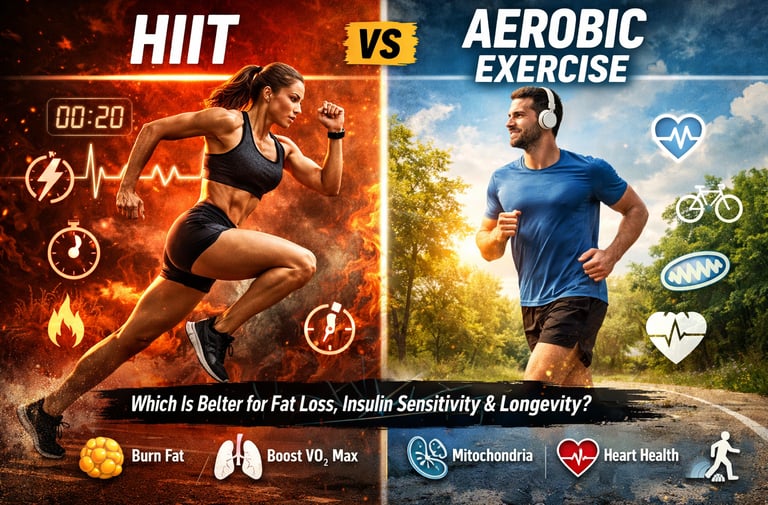
HIIT and aerobic exercise are both effective for fat loss, insulin sensitivity, and longevity, but they work differently. HIIT improves VO₂ max and insulin sensitivity faster, while aerobic exercise builds long-term cardiovascular health and fat-burning capacity. The best results come from combining both.
If you are trying to lose fat, reverse insulin resistance, or simply live longer, one question inevitably comes up: Should you do high-intensity interval training (HIIT) or stick with traditional aerobic exercise? It is a debate that dominates fitness circles, medical discussions, and patient consultations alike. But the real answer is far more nuanced—and far more powerful—than choosing one over the other.
At first glance, HIIT appears to be the superior option. Short, intense bursts of exercise promise rapid fat loss, improved insulin sensitivity, and dramatic gains in cardiovascular fitness—all in a fraction of the time. Research shows that HIIT can significantly improve VO₂ max, glucose metabolism, and metabolic flexibility, often within just a few weeks (Jagsz & Sikora, 2025). For time-constrained individuals, it seems like the perfect “exercise shortcut.”
On the other hand, aerobic exercise (Zone 2 training)—steady, moderate-intensity activity sustained over longer periods—has been the cornerstone of cardiometabolic health for decades. It enhances mitochondrial biogenesis, fat oxidation, endothelial function, and long-term cardiovascular health, making it one of the most evidence-backed interventions for reducing all-cause mortality and chronic disease risk (Wang et al., 2026).
So which is better for fat loss, insulin resistance, heart health, and longevity?
The truth is, this is the wrong question.
Emerging evidence suggests that HIIT and aerobic exercise activate distinct but complementary physiological pathways—from AMPK-driven metabolic signalling to PGC-1α-mediated mitochondrial adaptation—each contributing uniquely to metabolic health and performance (Wiens et al., 2025). Rather than competing, they function as two sides of the same metabolic coin.
Understanding how—and when—to use each may be one of the most powerful tools in modern preventive medicine.
Clinical Pearls
1. The "Lactate as Fuel" Principle
Scientific Perspective: During HIIT, lactate is not a waste product but a critical myokine and signaling molecule. It crosses the blood-brain barrier to stimulate the expression of Brain-Derived Neurotrophic Factor (BDNF), which promotes neuroplasticity and cognitive resilience.
Don't fear the "burn" in your muscles during high-intensity intervals. That sensation is a sign your body is producing a natural "brain fertilizer" that helps keep your mind sharp and protects against memory loss as you age.
2. The "Volume vs. Intensity" Hierarchy
Scientific Perspective: While HIIT provides rapid adaptations in VO2 max and insulin sensitivity, it cannot fully replace the mitochondrial biogenesis (volume-dependent) triggered by Zone 2 aerobic work. A base of aerobic volume is required to "clear" the metabolic byproducts of high-intensity work efficiently.
Think of aerobic exercise as "building a bigger engine" and HIIT as "tuning the engine for top speed." You need the bigger engine first so that your body can handle and recover from the high-speed sessions without breaking down.
3. The "Insulin-Independent" Shortcut
Scientific Perspective: HIIT triggers GLUT4 translocation to the cell membrane through muscle contraction-mediated pathways (AMPK-activated) rather than just the traditional insulin-signaling pathway. This makes it a potent tool for bypassing "clogged" insulin receptors in Type 2 diabetics.
When you do short, intense bursts of exercise, your muscles can "vacuum up" sugar directly from your blood without needing as much insulin. It’s like using a side door to get into a building when the front door (insulin) is stuck.
4. The "Recovery-Adaptation" Paradox
Scientific Perspective: The benefits of HIIT are realized during the post-exercise recovery phase, not during the effort itself. Excessive HIIT frequency leads to chronic elevation of cortisol and systemic inflammation, which can paradoxically worsen insulin resistance and lead to "overreaching."
You don't get fit at the gym; you get fit while you sleep after the gym. If you do high-intensity workouts every day, you never give your "stress hormones" a chance to come down, which can actually cause you to hold onto belly fat instead of losing it.
5. The "Capillary Density" Foundation
Scientific Perspective: Long-duration aerobic exercise increases capillary density around slow-twitch muscle fibers. This improves the "transit time" for oxygen and nutrients, enhancing the removal of metabolic waste and improving systemic lipid (cholesterol) profiles more effectively than HIIT alone.
Brisk walking or light cycling creates a denser "road network" of tiny blood vessels in your muscles. This makes it easier for your body to deliver energy and wash away "trash," which is why steady cardio is so effective at improving your "good" cholesterol (HDL).
What Is HIIT and What Is Aerobic Exercise?
Before diving into the research, it helps to clearly define both approaches.
High-Intensity Interval Training (HIIT) involves alternating short bursts of near-maximal effort — typically at 85–95% of your maximum heart rate — with brief recovery periods. A classic example is the 4×4 protocol: four minutes of vigorous effort followed by three minutes of active rest, repeated four times. Sessions typically last 20–30 minutes.
Aerobic exercise (also called steady-state or Zone 2 training) involves sustained, moderate-intensity movement at roughly 60–70% of your maximum heart rate. Think of a 45-minute brisk walk, a light jog, a cycling session, or a swim at a pace where you can still hold a conversation. These sessions typically last 30–60 minutes.
Both methods are legitimate. Both are evidence-based. And as you will see, both have distinct physiological advantages that make them complementary rather than competing.
Key Differences: Aerobic (Zone 2) vs. HIIT
Aerobic Exercise (Zone 2)
Primary Biological Pathway: Operates via PGC-1α, focusing on oxidative metabolism (using oxygen to burn fuel sustainably).
Mitochondrial Impact: Drives Mitochondrial Biogenesis, which increases the total quantity (density) of power plants within your cells.
Fat Loss Strategy: Promotes Metabolic Flexibility, teaching your body to efficiently switch between burning fat and carbohydrates at rest and during low effort.
VO₂ Max Contribution: Provides the steady, foundational growth of your aerobic base, which is essential for long-term endurance.
Recovery Requirements: Generally Low to Moderate; these sessions can often be performed daily as they don't overly tax the central nervous system.
High-Intensity Interval Training (HIIT)
Primary Biological Pathway: Operates via AMPK and Lactate signaling, shifting the body into glycolytic metabolism (high-speed energy production).
Mitochondrial Impact: Improves Mitochondrial Function, essentially upgrading the quality and efficiency of your existing cellular power plants.
Fat Loss Strategy: Highly effective at Visceral Fat Efficiency, targeting the dangerous "hidden" fat around internal organs more quickly per minute spent.
VO₂ Max Contribution: Delivers rapid, high-magnitude peaks in oxygen capacity, pushing your "top speed" and cardiovascular ceiling higher.
Recovery Requirements: High; due to the intense hormonal and mechanical stress, the body requires at least 48 hours between sessions to adapt safely.
Clinical Summary
While Aerobic training builds a "bigger engine" by increasing cellular machinery, HIIT "tunes the engine" to perform at maximum efficiency under stress. For optimal longevity and metabolic health, a hybrid approach using both is the gold standard.
The Physiology of Aerobic Exercise: What Happens Inside Your Body
When you exercise at a steady, moderate intensity, your body primarily relies on oxidative metabolism — it burns fat and carbohydrates in the presence of oxygen to generate energy sustainably over long periods.
Mitochondrial Biogenesis and Metabolic Flexibility
One of the most significant benefits of consistent aerobic training is its effect on your mitochondria — the energy-producing organelles in your cells. Sustained aerobic exercise activates a protein called PGC-1α (Peroxisome proliferator-activated receptor gamma coactivator 1-alpha), which triggers the creation of new mitochondria in your muscle cells. This process, called mitochondrial biogenesis, increases your cells' capacity to burn fat efficiently, even at rest.
Over weeks to months of aerobic training, your muscles become better at switching between fat and carbohydrate as fuel — a quality called metabolic flexibility. This is particularly important for individuals with metabolic syndrome, prediabetes, or early insulin resistance.
Cardiovascular Adaptations
Regular aerobic training improves your cardiovascular system in measurable, lasting ways:
Increased stroke volume: Your heart pumps more blood per beat, meaning it works more efficiently.
Greater capillary density: More blood vessels form around your muscle fibres, improving oxygen and nutrient delivery.
VO₂ max improvements: Your body's maximum oxygen utilization capacity rises — a metric consistently linked to longevity and reduced all-cause mortality.
These adaptations accumulate gradually but are remarkably durable when training is consistent.
The Physiology of HIIT: Why Short Bursts Deliver Big Results
HIIT works through a fundamentally different mechanism. When you push your body to near-maximal intensity, it rapidly depletes ATP (your cells' energy currency) and activates the glycolytic and phosphagen energy systems alongside the aerobic pathway.
The AMPK Pathway and Metabolic Signalling
The brief but intense muscular demand of HIIT activates AMPK (AMP-activated protein kinase) — a master metabolic regulator that senses energy depletion and responds by stimulating glucose uptake, fat oxidation, and even mitochondrial repair. Interestingly, lactate — often misunderstood as a waste product — acts as a critical signalling molecule during HIIT, stimulating adaptations in muscle and even the brain.
EPOC: The Afterburn Effect
One of HIIT's most discussed benefits is Excess Post-exercise Oxygen Consumption (EPOC) — the elevated metabolic rate that persists after a session ends. While the magnitude of EPOC is sometimes overstated, it does represent a real and meaningful increase in calorie burn that extends beyond the workout itself, particularly after high-intensity efforts.
Rapid Hormonal Responses
HIIT also triggers a significant surge in growth hormone and catecholamines (adrenaline and noradrenaline), hormones that promote fat mobilisation and lean tissue maintenance. This hormonal environment contributes to body composition improvements that go beyond simple calorie expenditure.
HIIT vs Aerobic Exercise for Fat Loss: What Does the Evidence Say?
This is where most people want to start — and the evidence here is nuanced.
A 2025 systematic review by Jagsz and Sikora, published in the Journal of Clinical Medicine, examined the effectiveness of HIIT versus traditional cardio for weight loss specifically in patients with obesity. The review found that both forms of exercise produced meaningful reductions in body weight and fat mass, but noted that HIIT produced comparable or superior reductions in visceral fat relative to time invested. Critically, the authors highlighted that total training volume and patient adherence were major determinants of outcome — a finding that challenges the simplistic "HIIT wins" narrative (Jagsz & Sikora, 2025).
Visceral Fat: The Fat That Really Matters
Not all body fat carries the same metabolic risk. Visceral fat — the fat stored deep in the abdomen around internal organs — is strongly associated with insulin resistance, cardiovascular disease, and systemic inflammation. Multiple studies have shown that both HIIT and aerobic exercise reduce visceral fat, but HIIT may do so more efficiently on a per-minute basis.
Muscle Preservation During Fat Loss
A 2025 systematic review and meta-analysis by Wiens et al., published in Sports, examined whether HIIT improves muscle strength, mass, and endurance. The findings were encouraging: HIIT — particularly when combined with resistance training — supported meaningful preservation of lean muscle mass during periods of fat loss, an important consideration for anyone pursuing body composition goals rather than weight loss alone (Wiens et al., 2025).
This matters because preserving muscle mass protects your resting metabolic rate, reduces injury risk, and supports long-term functional independence — especially as you age.
The Honest Bottom Line on Fat Loss
Fat loss ultimately depends on:
Total energy deficit (calories in vs calories out over time)
Training consistency (the modality you can stick to is the one that works)
Total weekly volume (more matters)
HIIT is efficient. Aerobic training is sustainable. The best fat-loss program is the one you show up for consistently.
Effects on Insulin Sensitivity and Glucose Metabolism
Insulin sensitivity — your cells' ability to respond appropriately to insulin and absorb glucose — is at the core of metabolic health. Poor insulin sensitivity underlies Type 2 diabetes, obesity, fatty liver disease, and cardiovascular risk.
How Aerobic Exercise Improves Insulin Sensitivity
Sustained aerobic training improves insulin signalling through several mechanisms. It enhances the expression of GLUT4 transporters — the proteins responsible for moving glucose from the bloodstream into muscle cells — and reduces inflammatory markers that impair insulin receptor function. Regular aerobic exercise is one of the most reliably effective non-pharmacological interventions for improving long-term glycaemic control.
How HIIT Improves Insulin Sensitivity — And Why It May Work Faster
HIIT can improve insulin sensitivity through insulin-independent glucose uptake — meaning muscles absorb glucose directly in response to the muscular contractions of intense exercise, bypassing the insulin signalling pathway entirely. This is particularly important for individuals who already have impaired insulin signalling.
Research shows that HIIT may produce faster improvements in insulin sensitivity compared to moderate aerobic exercise, with benefits sometimes detectable after just a few sessions. Studies in both healthy individuals and those with Type 2 diabetes have demonstrated comparable reductions in HbA1c (a three-month average of blood glucose levels) with both modalities — though the rapidity of HIIT's effects is increasingly recognised as clinically significant.
Clinical Recommendation
For individuals with Type 2 diabetes, prediabetes, or metabolic syndrome, the evidence increasingly supports a combination approach: aerobic training provides the long-term glucose-lowering foundation, while HIIT delivers faster, acutely potent improvements in insulin sensitivity. Neither alone is as powerful as both together.
Mitochondrial Health: Quantity vs Quality
A compelling way to understand how HIIT and aerobic exercise differ at the cellular level is through their effects on mitochondria.
Aerobic training consistently increases mitochondrial density — the sheer number of mitochondria in your muscle cells. More mitochondria means a greater capacity for fat oxidation and energy production. This is why trained endurance athletes can sustain high work outputs for hours without fatiguing.
HIIT, meanwhile, tends to improve mitochondrial efficiency and function — how well each mitochondrion performs under stress. HIIT triggers mitochondrial quality control processes, clearing out damaged mitochondria and stimulating repair mechanisms.
A useful mental model: aerobic training builds the quantity of your cellular power plants; HIIT improves their quality. Both are necessary for optimal metabolic health across the lifespan.
Cardiovascular Health, VO₂ Max, and Longevity
Perhaps the most clinically important metric in exercise science is VO₂ max — your body's maximum rate of oxygen consumption during exercise. It is, quite simply, the strongest known predictor of all-cause mortality. Higher VO₂ max is associated with dramatically lower risk of heart disease, cancer, metabolic disease, and premature death.
Both HIIT and aerobic exercise improve VO₂ max. However, HIIT consistently produces superior VO₂ max improvements per unit of time invested — a finding replicated across age groups and fitness levels.
A 2025 comparative study by Zoila et al., published in Frontiers in Aging, examined the benefits of HIIT versus continuous aerobic training in the context of active aging. The study found that both modalities significantly improved markers of cardiovascular fitness and functional capacity in older adults, with HIIT showing particular advantages in cardiac efficiency and peak oxygen uptake. Importantly, the authors noted that exercise of either type is a cornerstone of healthy aging, supporting independence, mobility, and cognitive function well into later life (Zoila et al., 2025).
For longevity, the takeaway is clear: the goal is to maximise your VO₂ max over time, and both training styles contribute meaningfully.
Dyslipidaemia, Cholesterol, and Children and Adolescents
Exercise affects lipid profiles — cholesterol and triglyceride levels — and this has important implications across all age groups, including younger populations.
A 2026 systematic review and meta-analysis by Wang et al., published in Public Health, compared the effects of HIIT versus aerobic training on dyslipidaemia in children and adolescents. The analysis found that both interventions significantly improved lipid profiles, with HIIT showing particular effectiveness in reducing triglycerides and LDL cholesterol while aerobic training demonstrated stronger effects on HDL (good) cholesterol increases. The authors concluded that both modalities should be considered valuable tools in addressing metabolic dysfunction in younger populations (Wang et al., 2026).
This is an important finding given the global rise in childhood obesity and early-onset metabolic disease. Exercise interventions in young people carry lifelong protective effects.
Hormonal and Inflammatory Responses
Chronic low-grade inflammation — sometimes called metaflammation — is a root driver of insulin resistance, cardiovascular disease, neurodegeneration, and accelerated aging.
Both HIIT and aerobic exercise reduce inflammatory markers such as CRP (C-reactive protein) and interleukin-6 over time. However, their acute inflammatory profiles differ:
Aerobic exercise produces a modest, controlled inflammatory response followed by a significant anti-inflammatory rebound. Regular training progressively lowers baseline inflammatory levels and normalises cortisol rhythms, reducing the chronic stress load on the body.
HIIT produces a more intense acute inflammatory and hormonal response — including surges in growth hormone, adrenaline, and noradrenaline — which, when followed by adequate recovery, stimulates powerful adaptive responses. Without sufficient recovery, however, HIIT can contribute to overtraining and elevated chronic cortisol, which paradoxically worsens inflammation and metabolic health.
The lesson: intensity demands recovery. For HIIT to work as intended, the rest days around it are as important as the training days themselves.
Safety, Adherence, and Who Should Choose What
Who Should Start with Aerobic Exercise
For the following individuals, steady-state aerobic exercise is the safer and more appropriate starting point:
Sedentary individuals beginning their fitness journey
Patients with advanced cardiovascular disease or recent cardiac events
Elderly individuals with frailty or limited functional capacity
Severely obese patients where high-impact movement poses injury risk
Anyone with uncontrolled hypertension or poorly managed diabetes
Aerobic exercise provides a foundation of cardiovascular conditioning that makes HIIT progressively safer and more effective over time.
Who Is a Good Candidate for HIIT
HIIT is particularly well-suited for:
Time-constrained individuals who cannot commit to long sessions
Those who have already built a baseline fitness level
People seeking rapid improvements in insulin sensitivity
Athletes and active individuals looking to improve performance and VO₂ max efficiently
Older adults who are already moderately active and medically cleared
The Adherence Factor
No exercise programme works if you do not follow it consistently. Research consistently shows that enjoyment, social context, and perceived competence are stronger predictors of long-term exercise adherence than the programme's theoretical efficiency. If you genuinely enjoy running and find HIIT dreadful, running will serve you far better. The best exercise is the one you actually do.
The Hybrid Model: The Gold Standard Strategy
The dichotomy of HIIT vs aerobic exercise is ultimately a false choice. The evidence supports combining both — along with resistance training — for optimal health outcomes.
A practical weekly framework to combine all three training modalities:
Monday — Aerobic (Zone 2) | 45 minutes Start the week with a steady-state session — a brisk walk, light jog, or cycle at a comfortable, conversational pace to build your aerobic base.
Tuesday — Resistance Training | 45 minutes Follow up with strength work. This preserves lean muscle mass, boosts resting metabolism, and complements the fat-oxidation benefits of Monday's session.
Wednesday — Rest or Light Walk. Allow your body to recover. A gentle walk is fine, but avoid anything strenuous. Recovery is where adaptation happens.
Thursday — HIIT (4×4 Protocol) | 25 minutes Four rounds of four minutes at near-maximal effort, separated by three minutes of active rest. This mid-week intensity spike drives rapid improvements in insulin sensitivity and VO₂ max.
Friday — Aerobic (Zone 2) | 40 minutes Return to steady-state cardio to reinforce mitochondrial development and keep your heart rate training volume on track.
Saturday — Resistance Training | 45 minutes A second strength session locks in muscle preservation, supports bone density, and rounds out your weekly metabolic workload.
Sunday — Rest or Active Recovery: Full rest, gentle stretching, or a light walk. Let your system consolidate the week's adaptations before the next cycle begins.
Together, this structure delivers the mitochondrial volume benefits of aerobic training, the intensity-driven adaptations of HIIT, and the muscle mass and metabolic benefits of resistance training — all within a realistic, sustainable weekly commitment.
Periodisation: Build Your Foundation First
If you are new to structured exercise, consider a base-build-peak periodisation model:
Weeks 1–4 (Base): Focus on aerobic training only, 3–4 days per week at comfortable intensity.
Weeks 5–8 (Build): Introduce 1 HIIT session per week alongside aerobic sessions.
Weeks 9–12 (Peak): Progress to 2 HIIT sessions, 2 aerobic sessions, and 2 resistance sessions per week.
This approach reduces injury risk, builds the cardiovascular base that makes HIIT effective, and improves long-term adherence.
Exercise Prescription Reference
Aerobic Exercise Prescription
Intensity: 60–70% of maximum heart rate (can still hold a conversation)
Duration: 30–60 minutes per session
Frequency: 4–5 days per week
Examples: Brisk walking, cycling, swimming, light jogging, elliptical
HIIT Prescription
Protocol options: 4×4 (4 min hard, 3 min easy, ×4) or 10×1 (1 min hard, 1 min easy, ×10)
Intensity: 85–95% of maximum heart rate during work intervals
Duration: 20–30 minutes total session
Frequency: 2–3 times per week (never on consecutive days)
Common Myths — Debunked
"HIIT is always better for fat loss." Not supported by the evidence. Fat loss depends on total volume and adherence. Jagsz and Sikora (2025) found both modalities to be comparably effective when matched for total energy expenditure.
"Steady-state aerobic exercise is useless." Entirely false. Aerobic training builds the mitochondrial, cardiovascular, and metabolic foundation that supports all other forms of exercise — and is the single most evidence-backed modality for long-term cardiometabolic health and longevity.
"More intensity always means better results." Intensity without recovery leads to overtraining, elevated cortisol, impaired immune function, and paradoxically worsened metabolic outcomes. Strategic intensity paired with adequate rest produces the best results.
Frequently Asked Questions (FAQ)
1. How long does it take to see results from HIIT vs aerobic exercise? HIIT can produce measurable improvements in insulin sensitivity and cardiovascular markers within 2–4 weeks. Aerobic exercise typically shows meaningful changes in endurance, resting heart rate, and fat oxidation within 4–8 weeks. Body composition changes from either modality generally become visible at 8–12 weeks of consistent training.
2. Is HIIT safe for people with Type 2 diabetes? HIIT can be highly beneficial for Type 2 diabetes and may improve insulin sensitivity faster than aerobic exercise alone. However, it should be introduced gradually, ideally with medical clearance and monitoring of blood glucose responses — particularly for those on insulin or sulphonylureas, where hypoglycaemia during intense exercise is possible.
3. Can I do HIIT every day? No. HIIT places significant stress on the cardiovascular system, muscles, and hormonal systems. Most evidence recommends a maximum of 2–3 HIIT sessions per week with at least 48 hours of recovery between sessions. More frequent HIIT without adequate recovery increases injury risk and can impair adaptation.
4. Which is better for older adults — HIIT or aerobic exercise? Both are beneficial for older adults. Zoila et al. (2025) found that both modalities improved cardiovascular fitness and functional capacity in aging populations. For beginners or those with frailty, aerobic exercise is the safer starting point. Older adults who are already moderately fit may safely incorporate modified HIIT, which has been shown to improve VO₂ max and reduce cardiovascular risk effectively.
5. Does HIIT build muscle? HIIT alone is not a primary driver of muscle hypertrophy. However, Wiens et al. (2025) found that HIIT can support muscle strength and endurance, particularly when combined with resistance training. For meaningful muscle building, dedicated resistance training remains essential.
6. What is Zone 2 training and why is it getting so much attention? Zone 2 training refers to aerobic exercise performed at roughly 60–70% of maximum heart rate — the intensity at which you can hold a conversation but feel a moderate effort. It is gaining attention because of its potent effects on mitochondrial biogenesis, fat oxidation, and metabolic flexibility. Many longevity-focused clinicians now consider consistent Zone 2 training one of the most powerful interventions for long-term health and disease prevention.
7. Is aerobic exercise or HIIT better for heart health? Both improve cardiovascular health, but through slightly different mechanisms. Aerobic exercise produces broad cardiac adaptations — increased stroke volume, capillary density, and VO₂ max over time. HIIT tends to produce faster improvements in VO₂ max and cardiac efficiency per unit of time. The combination of both offers the most comprehensive cardiovascular protection and is supported by the strongest longevity evidence.
Final Clinical Summary
The debate is misleading. Framing HIIT vs aerobic exercise as a competition oversimplifies human physiology. These are not opposing strategies—they are complementary metabolic tools targeting distinct biological pathways.
Aerobic exercise builds the foundation. Sustained, moderate-intensity training enhances mitochondrial density, fat oxidation, endothelial function, and cardiovascular efficiency. It is the most reliable modality for improving long-term cardiometabolic health and reducing all-cause mortality.
HIIT acts as a metabolic accelerator. High-intensity intervals rapidly activate AMPK, improve insulin-independent glucose uptake, and elevate VO₂ max. The result is faster gains in insulin sensitivity, metabolic flexibility, and cardiovascular performance—especially in time-constrained individuals.
Fat loss is not modality-dependent. Both HIIT and aerobic exercise produce comparable reductions in body fat when total energy expenditure is matched. The real drivers are consistency, adherence, and total weekly volume—not the training style itself.
Insulin resistance responds to both—but differently. Aerobic exercise provides sustained improvements in glucose control, while HIIT delivers rapid, potent metabolic effects, particularly valuable in early Type 2 diabetes and metabolic syndrome.
Mitochondrial health explains the synergy. Aerobic training increases the number of mitochondria, while HIIT improves their efficiency and function. Together, they optimize cellular energy metabolism.
Longevity depends on VO₂ max. Both modalities improve this powerful predictor of survival, but HIIT does so more efficiently. However, aerobic training ensures durability and sustainability of these gains.
The optimal strategy is integration. A hybrid model—combining Zone 2 aerobic training, HIIT, and resistance exercise—delivers the most comprehensive benefits across metabolism, cardiovascular health, and aging.
Clinical bottom line: The best exercise is not HIIT or aerobic—it is the one you can sustain, progress, and recover from consistently over years.
Author’s Note: Clinical Perspective on HIIT vs Aerobic Exercise
As a clinician managing patients with insulin resistance, Type 2 diabetes, obesity, and cardiovascular disease, I have found that the question is rarely whether HIIT or aerobic exercise is “better.” The more relevant question is: which modality can a patient adopt safely, sustain consistently, and progressively build upon over time?
In clinical practice, aerobic exercise remains the entry point for most patients. It is predictable, well-tolerated, and metabolically effective. Regular moderate-intensity activity improves glycaemic control, endothelial function, blood pressure, and lipid profiles, often with minimal risk when appropriately prescribed. For sedentary or high-risk individuals, it provides the physiological foundation upon which all other forms of training can be layered.
HIIT, however, is a powerful therapeutic tool when used judiciously. In selected patients—particularly those with early insulin resistance or limited time—it can produce rapid improvements in insulin sensitivity and cardiorespiratory fitness. That said, HIIT is not universally appropriate. Without adequate conditioning, supervision, and recovery, it may increase the risk of injury, cardiovascular strain, or poor adherence.
One of the most important observations in long-term patient care is this: outcomes are driven less by the “optimal protocol” and more by behavioral sustainability. Patients who engage in moderate, consistent exercise for years derive far greater benefit than those who intermittently follow high-intensity regimens.
From a physiological standpoint, the integration of both modalities is compelling. Aerobic training enhances mitochondrial density and metabolic stability, while HIIT improves mitochondrial efficiency and metabolic responsiveness. Together, they create a robust and adaptable metabolic system.
Clinical insight: Exercise should be prescribed like medication—individualized, progressive, and aligned with patient capacity and goals. The most effective program is not the most intense or the most efficient, but the one that becomes a lifelong habit.
Medical Disclaimer
The information in this article, including the research findings, is for educational purposes only and does not constitute medical advice, diagnosis, or treatment. Before starting an HIIT program, you must consult with a qualified healthcare professional, especially if you have existing health conditions (such as cardiovascular disease, uncontrolled hypertension, or advanced metabolic disease). Exercise carries inherent risks, and you assume full responsibility for your actions. This article does not establish a doctor-patient relationship.
Related Articles
Can Resistance Training Reverse Diabetes? The Muscle–mTOR Link | DR T S DIDWAL
Why Aerobic Exercise Is the Most Powerful ‘Drug’ for Heart, Fat Loss & Longevity | DR T S DIDWAL
Exercise Unlocks a Hidden Glucose Pathway in Muscle — Independent of Insulin | DR T S DIDWAL
No Time to Train? Science-Backed Workouts That Deliver | DR T S DIDWAL
References
Jagsz, S., & Sikora, M. (2025). The effectiveness of high-intensity interval training vs. cardio training for weight loss in patients with obesity: A systematic review. Journal of Clinical Medicine, 14(4), 1282. https://doi.org/10.3390/jcm14041282
Wang, S., Ni, J., Cheng, M., Li, Z., Wang, Y., & Wang, X. (2026). Differences in the effects of HIIT versus aerobic training on intervening in dyslipidemia in children and adolescents: A systematic review and meta-analysis. Public Health, 253, 106183. https://doi.org/10.1016/j.puhe.2026.106183
Wiens, L., Losciale, J. M., Fliss, M. D., Abercrombie, M. J., Darabi, D., Li, J., Barclay, R., & Mitchell, C. J. (2025). Does high-intensity interval training increase muscle strength, muscle mass, and muscle endurance? A systematic review and meta-analysis. Sports, 13(9), 293. https://doi.org/10.3390/sports13090293
Zoila, F., Filannino, F. M., Panaro, M. A., Sannicandro, I., Cianciulli, A., & Porro, C. (2025). Enhancing active aging through exercise: A comparative study of high-intensity interval training and continuous aerobic training benefits. Frontiers in Aging, 6, 1493827. https://doi.org/10.3389/fragi.2025.1493827