Body Recomposition Explained: A Doctor’s Evidence-Based Guide to Getting Leaner and Stronger
Discover the science of body recomposition — how to lose fat, build muscle, boost metabolism, and improve long-term health with evidence-based strategies.
EXERCISE
Dr. T.S. Didwal, M.D.(Internal Medicine)
5/20/202616 min read
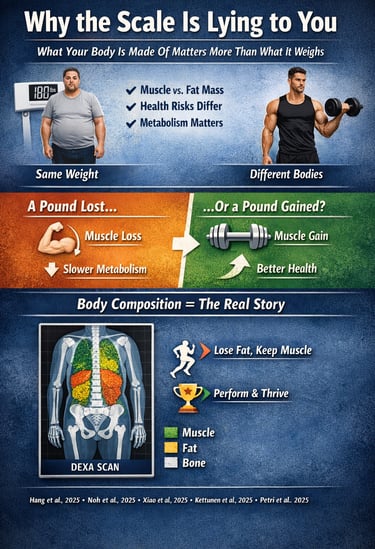
You exercise consistently. You start eating better. You cut back on sugar, increase your protein intake, and commit to morning walks or gym sessions. Weeks later, you step onto the scale expecting validation for your hard work — only to discover the number has barely changed. For millions of people, that moment feels discouraging enough to quit altogether. But modern exercise science suggests the problem may not be your progress. The problem may be the scale itself.
Body weight alone reveals remarkably little about true metabolic health. Two individuals with identical body weights can have profoundly different levels of visceral fat, lean muscle mass, insulin sensitivity, cardiovascular fitness, and long-term disease risk (Hang et al., 2025; Noh et al., 2025). One may be metabolically healthy and physically strong, while the other may already be developing insulin resistance, fatty liver disease, or sarcopenia despite appearing “normal weight.”
This is where the concept of body recomposition changes everything.
Body recomposition refers to the simultaneous loss of fat mass and gain or preservation of lean muscle mass — a physiological transformation that improves not just appearance, but metabolic resilience, functional capacity, and healthy aging. Once considered possible only for elite athletes, emerging evidence now confirms that body recomposition can occur across multiple age groups and fitness levels when resistance training, aerobic exercise, and adequate protein intake are strategically combined (Xiao et al., 2025; Noh et al., 2025).
The real goal, therefore, is not simply to weigh less. It is to build a body that is metabolically stronger, physically capable, and biologically healthier from the inside out.
Key Takeaways:
1. The Scale Does Not Measure True Health
Body weight alone cannot distinguish between fat mass and lean muscle mass. Two people with the same weight can have dramatically different metabolic health, insulin sensitivity, and cardiovascular risk profiles (Hang et al., 2025).
2. Body Recomposition Means Losing Fat While Building Muscle
Body recomposition is the scientifically supported process of reducing body fat while preserving or increasing lean muscle mass through structured exercise and nutrition strategies.
3. Resistance Training Is Essential for Muscle Preservation
Strength training protects lean muscle during weight loss, increases resting metabolic rate, and improves long-term metabolic health by stimulating muscle protein synthesis (Noh et al., 2025).
4. Aerobic Exercise Helps Reduce Dangerous Visceral Fat
Cardio training is highly effective for reducing visceral abdominal fat, improving cardiovascular fitness, enhancing insulin sensitivity, and lowering chronic disease risk.
5. Protein Intake Plays a Critical Role
Research shows that consuming approximately 1.2–1.6 g/kg/day of protein supports muscle preservation, recovery, satiety, and metabolic adaptation during body recomposition (Xiao et al., 2025).
6. Combined Training Produces the Best Results
The strongest scientific evidence supports combining resistance training, aerobic exercise, and adequate protein intake for optimal improvements in body composition, strength, metabolic function, and healthy aging.
Section 1: Understanding Body Composition — Beyond the BMI Myth
Before diving into strategies, it is essential to understand why body composition matters more than body weight — and why the tools most people use to assess their health are fundamentally inadequate.
The Problem With BMI
Body Mass Index (BMI) is calculated using only two variables: height and weight. It completely ignores tissue quality, muscle mass, fat distribution, and metabolic function. This creates two dangerous errors in clinical practice.
The first is the "False Positive" — a muscular individual classified as "overweight" or even "obese" by BMI despite having low body fat and exceptional cardiovascular health. The second, and arguably more dangerous, is the "False Negative" — a person with low muscle mass and high body fat classified as "normal weight" despite having what is now termed Normal Weight Obesity, a condition associated with insulin resistance, metabolic syndrome, and elevated cardiovascular risk (Hang et al., 2025).
Why Muscle Mass Is Your Most Valuable Metabolic Asset
Skeletal muscle is not simply the tissue that moves your limbs. It functions as a critical metabolic organ — one that regulates glucose disposal after meals, elevates resting energy expenditure, reduces systemic inflammation, and protects against the age-related muscle loss known as sarcopenia (Xiao et al., 2025).
Every pound of muscle you carry burns approximately three times more calories at rest than an equivalent pound of fat. This means that a body with more lean muscle is more metabolically efficient, more resistant to weight regain, and more capable of handling dietary carbohydrates without adverse effects on blood sugar.
In contrast, excess adipose tissue — particularly visceral fat stored around the abdominal organs — actively promotes insulin resistance, releases pro-inflammatory cytokines, and significantly increases risk of type 2 diabetes, cardiovascular disease, and certain cancers (Hang et al., 2025).
The goal of body recomposition is therefore not aesthetic in origin. It is deeply clinical: shift the body's composition toward more muscle and less fat, and you fundamentally change its metabolic trajectory.
Section 2: Resistance Training vs. Aerobic Training — What the Evidence Actually Shows
One of the most frequently asked questions in exercise science is deceptively simple: which type of exercise is better for improving body composition? The 2025 research provides a nuanced and important answer.
The Interventional Evidence
Hang et al. (2025) conducted a large interventional study specifically comparing resistance training and aerobic training in middle-aged adults with obesity — exactly the population where this question matters most. Their findings challenge the either/or framing that dominates gym culture.
Both modalities improved body composition. But they did so through different, complementary mechanisms:
Resistance training proved superior for preserving and building lean muscle mass during a period of weight loss. When the body enters a caloric deficit, it tends to break down both fat and muscle for energy. Resistance training sends a powerful biological signal — through mechanical tension and myofibrillar protein synthesis — that muscle tissue is essential and must be preserved. The result: the body preferentially burns fat. This is what keeps your metabolism elevated during a weight loss phase and protects you from the all-too-common "yo-yo" effect of regaining weight rapidly after a diet.
Aerobic training, on the other hand, demonstrated superior efficacy in reducing visceral adipose tissue — the dangerous fat stored around the organs. It also enhanced cardiovascular fitness, improved insulin sensitivity through enhanced glucose uptake in muscle cells, and generated a higher acute caloric expenditure per session compared to resistance work of equivalent duration.
The combined approach — incorporating both modalities — produced the greatest overall improvements in body composition, outperforming either method in isolation (Hang et al., 2025). This is not a compromise strategy. It is the scientifically superior strategy.
The Meta-Analytic Consensus
Noh et al. (2025) conducted a systematic review and meta-analysis synthesizing data from dozens of controlled studies examining exercise type, physical fitness, and body composition in men across multiple training modalities, including resistance training, aerobic training, high-intensity interval training (HIIT), and combined programs.
Their findings reinforced the interventional data. Resistance training consistently produced average lean mass gains of two to four pounds over eight to twelve weeks, along with significant increases in resting metabolic rate. Aerobic training reliably reduced total body fat, particularly visceral fat, and improved cardiovascular parameters. Combined training programs produced the most comprehensive body composition changes and the broadest improvements in physical fitness markers — from muscular strength and endurance to aerobic capacity and flexibility.
The practical implication is clear and evidence-backed: a training week that incorporates two to three sessions of resistance work alongside three to four sessions of moderate-intensity aerobic activity represents the optimal stimulus for body recomposition in most populations.
Section 3: The Role of Protein — More Important Than You Think
No discussion of body recomposition is complete without addressing nutrition, and specifically the role of dietary protein. Of all nutritional variables studied in body composition research, protein intake has the most robust and consistent evidence base.
What High-Volume Endurance Research Tells Us
Xiao et al. (2025) conducted a comprehensive systematic review and meta-analysis examining the effects of protein supplementation on body composition, physiological adaptations, and performance during endurance training — a context where the question of protein need is often underappreciated.
Endurance training is catabolic. Long runs, cycling sessions, and sustained aerobic work generate significant muscle protein breakdown as the body fuels itself through both fat and lean tissue. Without adequate dietary protein, this breakdown outpaces repair, leading to gradual loss of lean mass, impaired recovery, reduced immune function, and — in high-volume athletes — overtraining syndrome.
The research demonstrated that athletes consuming 1.6 to 2.0 grams of protein per kilogram of body weight per day showed significantly better muscle preservation during endurance training blocks, enhanced mitochondrial adaptation (improving cellular energy production), faster recovery between sessions, and better maintenance of immune function during high-volume periods (Xiao et al., 2025).
Protein for the General Population
For individuals pursuing body recomposition outside of elite sport, the evidence supports a target range of 1.2 to 1.6 grams of protein per kilogram of body weight daily. This is higher than most general dietary guidelines recommend — but the evidence for its importance during simultaneous fat loss and muscle preservation is compelling.
Protein achieves these effects through multiple mechanisms: it stimulates muscle protein synthesis directly, it has the highest thermic effect of any macronutrient (meaning you burn more calories simply digesting it), and it promotes satiety more effectively than carbohydrates or fats, making caloric moderation more sustainable.
Practical protein sources that support these targets include eggs, Greek yogurt, cottage cheese, chicken breast, fish, legumes, and tofu. For those training at higher volumes who struggle to meet targets through food alone, whey or plant-based protein supplements offer a convenient and evidence-supported complement — not a replacement — to whole food intake.
Section 4: Elite Athletes and the Power-to-Weight Ratio
Body recomposition is not exclusively a concern of those managing excess weight. At the elite performance level, the relationship between body composition and athletic output takes on a different dimension altogether.
What Elite Endurance Research Reveals
Kettunen et al. (2025) investigated the associations between body composition and performance in elite endurance athletes, using sophisticated assessment methods to examine whether specific tissue compositions predicted competitive outcomes in distance running, cycling, and related sports.
The findings were particularly instructive. They revealed that elite athletes with slightly greater lean mass in the lower limbs demonstrated superior running economy — defined as the oxygen cost of running at a given speed. In practical terms, leaner, stronger leg muscles act as biological springs: they store and return elastic energy more efficiently through the stretch-shortening cycle, allowing athletes to run faster while using less oxygen.
Crucially, the research also showed that excessively low body fat did not correlate with better performance. There appeared to be an optimal range, below which performance declined — likely due to hormonal disruption, impaired energy availability, and loss of contractile tissue. This challenges the dangerous cultural narrative in endurance sports that "lighter is always faster."
The Kinanthropometry Advantage
Petri et al. (2025) examined body composition and physical performance in elite rugby referees using kinanthropometry — the precision science of measuring human body dimensions including limb circumferences, bone diameters, skinfold thicknesses, and segment lengths. Their findings demonstrated that kinanthropometric profiles predicted physical performance outcomes far more accurately than simple body weight or BMI.
This research underscores a broader principle applicable to both athletes and general populations: the tools we use to assess body composition profoundly affect the quality of the decisions we make about training, nutrition, and health. DEXA (dual-energy X-ray absorptiometry) scans and bioelectrical impedance analysis represent accessible, practical options for most individuals seeking meaningful body composition data beyond what a scale can provide.
Section 5: Practical Applications — Your Evidence-Based Action Plan
Understanding the science is only valuable if it translates into action. The following framework is organized by goal and population, drawing directly from the research cited above.
For Weight Management and General Health
Adopt a combined training model: aim for two to three resistance training sessions per week using compound movements — squats, deadlifts, rows, presses — performing three sets of six to twelve repetitions per exercise. Complement this with 150 or more minutes of moderate-intensity aerobic activity weekly, such as brisk walking, cycling, swimming, or jogging.
Track your protein intake and target 1.2 to 1.6 grams per kilogram of body weight daily. Distribute intake across three to four meals rather than concentrating it in one or two.
Stop using scale weight as your primary progress metric. Take monthly circumference measurements at the waist, hips, and thighs. Note changes in clothing fit, physical strength, energy levels, and sleep quality. These are the true indicators of body recomposition.
Expect a timeline of eight to twelve weeks before significant body composition changes become visible. The first month may show little scale movement — but meaningful physiological adaptations are already underway.
For Serious and Competitive Athletes
Work with a sports dietitian to calculate sport-specific protein targets, particularly if training volume exceeds eight hours per week. Consider periodic DEXA or kinanthropometric assessment every eight to twelve weeks to monitor whether body composition is trending in the direction your sport demands.
Periodize your training to align body composition goals with competitive phases: use off-season periods to build lean mass through higher-volume resistance training and adequate caloric intake, and transition to fat optimization phases during preparation for competition — never during peak performance windows.
Resist the temptation to pursue minimum body fat. Target the composition that maximizes your sport-specific power-to-weight ratio, not the lowest number your body can sustain.
For Older Adults
Age-related muscle loss accelerates after 50, making resistance training not just beneficial but essential. Prioritize it three times per week using loads that create genuine muscular effort. Protein targets at the upper end of recommended ranges — 1.6 to 2.0 grams per kilogram — are supported by research in older populations due to age-related reductions in protein synthesis efficiency. Combined training remains superior to either modality alone for preserving metabolic health, functional capacity, and bone density.
Section 6: Assessment Methods — Measuring What Actually Matters
Body recomposition requires appropriate measurement tools. The following options span a range of accessibility and precision.
DEXA Scans provide the gold standard for body composition assessment, distinguishing fat mass, lean mass, and bone mineral density across different body regions. Available at many sports medicine clinics and increasingly at gyms, a DEXA scan every three to six months provides meaningful longitudinal data.
Bioelectrical Impedance Analysis (BIA) is widely available in modern scales and handheld devices. While less precise than DEXA, it provides directional data on fat mass and lean mass that is useful for tracking trends over time. Standardize the conditions of measurement — same time of day, same hydration state — for reliable comparisons.
Circumference Measurements using a simple tape measure at standardized anatomical sites (waist, hips, thighs, arms) are free, reproducible, and highly informative. Reductions in waist circumference are a particularly clinically meaningful marker of visceral fat loss.
Performance Metrics — how much weight you can lift, how fast you can run a given distance, how many push-ups or pull-ups you can complete — are direct functional indicators of the muscle quality gains that drive body recomposition. Track them.
Frequently Asked Questions
Q1: Can I really build muscle and lose fat at the same time? Yes — and this is precisely what body recomposition means. It is most pronounced in individuals new to resistance training, those returning after a training break, and those with higher initial body fat percentages. The process is slower than pursuing pure muscle gain or pure fat loss in isolation, but the combined outcome is superior for health, aesthetics, and long-term metabolic function (Noh et al., 2025).
Q2: How long does body recomposition take before I see results? Meaningful changes in body composition typically require eight to twelve weeks of consistent training and adequate protein intake. The first two to four weeks may show little change on the scale precisely because fat loss is occurring alongside muscle gain — a favorable trade that the scale cannot detect. Focus on strength progression and body measurements during this period.
Q3: Do I need protein powder to support body recomposition? Not necessarily. Whole food sources — eggs, poultry, fish, dairy, legumes — can meet protein targets for most people training at moderate volumes. Protein supplements are a convenient tool for individuals training at high volumes (eight-plus hours per week) or those who consistently struggle to meet targets through diet alone (Xiao et al., 2025). They complement but do not replace food-based protein.
Q4: Which is more important — diet or exercise — for body recomposition? Both are essential and work synergistically. Resistance training provides the anabolic stimulus for muscle preservation and growth. Aerobic training enhances fat oxidation and improves cardiovascular health. Adequate protein prevents lean mass loss during a caloric deficit. Removing any one of these elements significantly reduces the efficiency of the recomposition process. Think of them as three legs of the same stool.
Q5: Should I do cardio if my goal is to build muscle? Yes. The concern that aerobic training "kills muscle gains" is largely overstated in the research. Moderate-intensity aerobic training — when not performed to excessive volume without adequate nutrition — does not meaningfully impair muscle hypertrophy and offers significant independent health benefits, particularly in reducing visceral fat and improving cardiovascular function (Hang et al., 2025). The combination of both modalities consistently outperforms either alone.
Q6: What body fat percentage should I aim for? There is no universal ideal. For general health, the research supports ranges of 18–25% for women and 10–18% for men as associated with favorable metabolic markers. Elite athletes often sit lower, but pursuing elite-level body fat percentages without elite-level training infrastructure and genetic predisposition is unnecessary and potentially harmful — particularly in women, where excessively low body fat disrupts hormonal function. Focus on the composition that supports your health and performance, not a number derived from comparing yourself to others (Kettunen et al., 2025).
Q7: I'm over 60. Is it too late to recompose my body? Absolutely not. While the rate of muscle protein synthesis declines with age, the adaptive response to resistance training remains significant in older adults. Studies consistently demonstrate that older individuals who begin resistance training experience meaningful gains in lean mass, reductions in fat mass, improved insulin sensitivity, and enhanced functional capacity — often within the first twelve weeks. Higher protein intake (toward 1.6–2.0 grams per kilogram) amplifies these adaptations. Starting later is far better than not starting at all.
Clinical pearls
1. The Normal Weight Obesity (NWO) Paradox
Scientific Perspective: BMI lacks structural specificity and fails to account for phenotypic variations in tissue quality, making it an inadequate screen for metabolic risk. Normal Weight Obesity (NWO) is characterized by a "normal" BMI despite a high body fat percentage and deficient skeletal muscle mass. In clinical practice, relying solely on BMI results in a high false-negative rate, masking underlying insulin resistance, chronic systemic inflammation driven by visceral adiposity, and elevated cardiovascular risk.
The number on your bathroom scale doesn't tell the whole story. You can weigh exactly what the medical charts say you "should" weigh, but if that weight is mostly fat rather than muscle, you can still face the same health risks as someone who is visibly overweight—like high blood sugar and heart trouble. Don't let a "normal" scale weight trick you into thinking your metabolic health is optimized.
2. Visceral Fat Reduction vs. Lean Mass Preservation
Scientific Perspective: Optimizing body composition requires a dual-modality exercise prescription. While mechanical tension from resistance training is the primary stimulus to downregulate muscle proteolysis (muscle breakdown) and preserve lean mass during a caloric deficit, aerobic training is mechanistically superior for accelerating the lipolysis (fat breakdown) of visceral adipose tissue and improving insulin sensitivity through enhanced glucose disposal.
To completely transform your body, you shouldn't just pick between lifting weights or doing cardio—you need both. Lifting weights sends a loud signal to your body that your muscles are necessary, preventing your body from burning its own muscle for energy while dieting. Meanwhile, cardio acts like a targeted strike against visceral fat (the dangerous fat deep inside your belly wrapped around your organs).
3. Mitigating the Catabolic Cost of Endurance Training
Scientific Perspective: High-volume aerobic and endurance training exerts a heavy catabolic cost on skeletal muscle tissue. To prevent a negative net protein balance, muscle wasting, and subsequent metabolic slowing, individuals engaging in regular endurance training require elevated daily amino acid availability. Data supports a target of 1.6 to 2.0 grams of protein per kilogram of body weight per day to stimulate myofibrillar protein synthesis, protect immune function, and enhance mitochondrial adaptation.
f you love long cardio sessions like running or cycling, your body treats those workouts as a heavy energy drain and will actually start breaking down your muscles to fuel itself. To stop your body from eating its own muscle, you need to eat significantly more protein than the average person, aiming for roughly 1.6 to 2.0 grams per kilogram of your weight daily. This keeps your muscles intact and helps your body recover much faster.
4. The Biological Spring Effect (Power-to-Weight Optimization)
Scientific Perspective: In athletic performance and kinanthropometric assessment, tracking absolute body weight or pursuing ultra-low body fat thresholds yields diminishing returns and introduces hormonal risks. Optimization of the power-to-weight ratio is heavily dependent on regional lean mass distribution. For example, increased lower-limb skeletal muscle mass enhances the stretch-shortening cycle, improving running economy by allowing the musculotendinous unit to store and return elastic energy more efficiently.
Being lighter isn't always faster or healthier. In sports science, we look at how your muscle is distributed. Having stronger, leaner leg muscles actually turns your legs into "biological springs" that store and snap back energy with every stride, making you a more efficient runner. Dropping your body weight or body fat too low backfires, disrupting your hormones and draining your energy. Focus on building power, not shrinking your body.
5. Overcoming Age-Related Anabolic Resistance
Scientific Perspective: Sarcopenia (age-related muscle loss) accelerates significantly after age 50, driven in part by anabolic resistance—a blunted muscle protein synthesis response to both dietary protein and exercise. To override this resistance and alter the metabolic trajectory of older adults, the clinical intervention must combine progressive resistance training with a higher threshold of protein intake (1.6 to 2.0 g/kg/day) distributed evenly across meals to maximize muscle capital and preserve bone mineral density.
As we get older, our bodies naturally start losing muscle mass, and our muscles become a bit "deaf" to the protein we eat and the exercise we do. You can easily reverse this, but you have to be intentional. If you are over 50, lifting weights a few times a week and eating a higher amount of protein isn't just a bonus—it's essential medicine to protect your strength, keep your bones strong, and maintain your independence. It is truly never too late to start.
Clinician’s Perspective:
From a clinical medicine perspective, body recomposition represents a major shift in how we should evaluate health, aging, and metabolic disease. For decades, physicians focused heavily on total body weight and BMI as primary markers of health risk. However, emerging evidence now shows that what the body is composed of — particularly the balance between skeletal muscle and visceral fat — is far more important than weight alone (Hang et al., 2025).
In clinical practice, many patients become discouraged when the scale changes slowly despite regular exercise and dietary improvement. Yet this often reflects a favorable physiological adaptation: fat mass is decreasing while lean muscle mass is increasing. This distinction is critical because skeletal muscle functions as a powerful metabolic organ that improves insulin sensitivity, glucose disposal, resting metabolic rate, physical function, and long-term cardiometabolic health (Xiao et al., 2025).
Conversely, excess visceral adiposity promotes chronic inflammation, insulin resistance, fatty liver disease, hypertension, and accelerated biological aging. A patient may lose little overall weight yet experience profound reductions in visceral fat and substantial improvements in metabolic health markers — outcomes that are clinically far more meaningful than scale reduction alone.
Medical Disclaimer
The information in this article, including the research findings, is for educational purposes only and does not constitute medical advice, diagnosis, or treatment. Before starting a exercise program, you must consult with a qualified healthcare professional, especially if you have existing health conditions (such as cardiovascular disease, uncontrolled hypertension, or advanced metabolic disease). Exercise carries inherent risks, and you assume full responsibility for your actions. This article does not establish a doctor-patient relationship.
Related Articles
Irisin: The Powerful Exercise Hormone That Burns Fat, Protects the Heart, and May Slow Aging
How Exercise Rewires Metabolism: Molecular Control of Lipolysis and Lipid Metabolism | DR T S DIDWAL
How to Build a Disease-Proof Body: Master Calories, Exercise & Longevity | DR T S DIDWAL
How to Maximize Muscle Growth: Evidence-Based Strength Training Strategies | DR T S DIDWAL
Lower Blood Pressure Naturally: Evidence-Based Exercise Guide for Metabolic Syndrome | DR T S DIDWAL
Exercise vs. Diet Alone: Which is Best for Body Composition? | DR T S DIDWAL
Movement Snacks: How VILPA Delivers Max Health Benefits in Minutes | DR T S DIDWAL
References
Hang, S., Xiaoyu, L., Jue, W., et al. (2025). Effects of resistance training and aerobic training on improving body composition in middle-aged adults with obesity: An interventional study. Scientific Reports, 15, Article 33972. https://doi.org/10.1038/s41598-025-11076-w
Kettunen, O., Mikkola, J., & Ihalainen, J. K. (2025). Associations between body composition and performance in elite endurance athletes. International Journal of Sports Physiology and Performance, 20(11), 1530–1537. https://doi.org/10.1123/ijspp.2024-0506
Noh, K.-W., Seo, E.-K., & Park, S. (2025). Effect of exercise type on men's physical fitness and body composition: A systematic review and meta-analysis. Journal of Men's Health, 21(1), 1–16. https://doi.org/10.22514/jomh.2025.001
Petri, C., Spataro, F., Cancian, A., Tozzi, E., Gori, N., Russo, L., & Campa, F. (2025). Body composition and physical performance: Kinanthropometric assessment of elite male rugby referees. International Journal of Kinanthropometry, 5(3), 1–8. https://doi.org/10.34256/ijk2531
Xiao, Y., Deng, Z., Sun, W., Li, J., & Gao, W. (2025). Effects of protein supplementation on body composition, physiological adaptations, and performance during endurance training: A systematic review and meta-analysis. Frontiers in Nutrition, 12, Article 1663860. https://doi.org/10.3389/fnut.2025.1663860