The Neurobiology of Fitness: How Aerobic Capacity Shapes Neuroplasticity and Brain Aging
A deep dive into 2025-2026 research on cortical activation, BDNF, and cardiometabolic health. Learn why cardiorespiratory fitness is a disease-modifying intervention for the brain
EXERCISE
Dr. T.S. Didwal, M.D.(Internal Medicine)
1/30/202611 min read
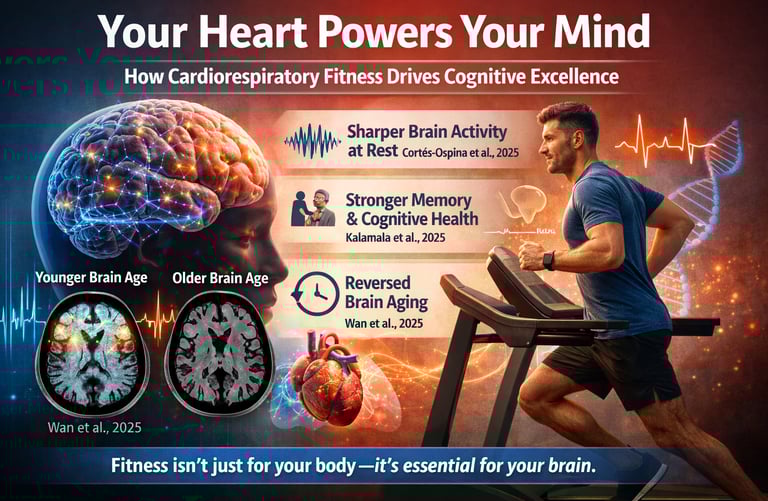
Your brain is not an isolated organ—it is biologically and functionally inseparable from the health of your heart. Emerging evidence from neuroscience, exercise physiology, and aging research now converges on a striking conclusion: cardiorespiratory fitness is a powerful determinant of cognitive performance and brain aging across the lifespan. Far beyond subjective feelings of mental clarity after exercise, modern neuroimaging and electrophysiological studies demonstrate that aerobic fitness reshapes the brain at structural, functional, and electrical levels.
Higher cardiorespiratory fitness is associated with altered resting-state cortical activation patterns, reflecting more efficient baseline neural organization even in the absence of cognitive tasks (Cortés-Ospina et al., 2025). In older adults, aerobic fitness and cardiometabolic health independently predict performance in distinct cognitive domains—suggesting that cardiovascular conditioning and metabolic regulation offer complementary, domain-specific protection against cognitive aging (Kałamała et al., 2025). Importantly, these benefits are not confined to later life. Even in young, cognitively healthy adults, superior cardiorespiratory fitness correlates with enhanced cognitive flexibility—the ability to rapidly adapt, switch tasks, and process complex information (Bookheimer et al., 2025).
Perhaps most compelling, randomized clinical trials now indicate that improvements in fitness can reduce biological brain age, as measured by advanced neuroimaging algorithms, effectively slowing—or partially reversing—neurobiological aging trajectories (Wan et al., 2025). Structural adaptations in gray matter volume and white-matter integrity emerge within weeks to months of exercise training, underscoring exercise as a genuine disease-modifying intervention for brain health rather than a passive lifestyle adjunct (Wan et al., 2025).
Together, this growing body of evidence reframes aerobic fitness not as optional self-optimization, but as a foundational requirement for maintaining cognitive resilience, mental agility, and long-term brain vitality.
Clinical pearls
## 1. The "Fertilizer" Effect (BDNF)
Aerobic exercise upregulates the expression of Brain-Derived Neurotrophic Factor (BDNF). This protein supports the survival of existing neurons and encourages neurogenesis—the growth of new neurons—specifically in the hippocampus.
Think of exercise as "Miracle-Gro" for your brain. It releases a special protein that helps grow new brain cells and keeps your memory center from shrinking as you age.
## 2. Brain Age vs. Chronological Age
High VO2max levels are inversely correlated with "Brain Age" gaps. Neuroimaging shows that physically fit individuals possess a structural brain profile that appears years younger than their biological age, particularly in white matter integrity.
You can’t change the year you were born, but you can change how old your brain "acts." Regular cardio can actually "rewind" your brain's biological clock, making it look and perform like the brain of someone much younger.
## 3. The Power of "Baseline Tuning"
:Cardiorespiratory fitness alters Resting-State Power Spectrum Density (PSD). EEG data suggests that fit individuals have more efficient baseline cortical activation, meaning the brain is better "primed" for action even when at rest.
Exercise doesn't just help while you're moving; it retunes your brain's background settings. It’s like upgrading your computer’s operating system so it runs faster and smoother even when you don't have any apps open.
## 4. Cognitive Flexibility and "The Switch"
Higher aerobic capacity is specifically linked to the Executive Function domain of cognitive flexibility. This involves the ability to transition between mental tasks with lower "switch costs" (the time/error penalty of moving between tasks).
If you find it hard to multitask or get "stuck" when plans change, cardio is the cure. It improves your "mental agility," making it easier to pivot between different projects at work or school without feeling overwhelmed.
## 5. Synergy of Heart and Metabolism
Cognitive protection is maximized when high cardiorespiratory fitness is paired with optimal cardiometabolic markers (e.g., insulin sensitivity and lipid profiles). Fitness and metabolic health provide independent but additive neuroprotective effects.
To keep your mind sharp, it’s a "double-team" effort. You need the exercise to strengthen your heart, but you also need a good diet to keep your blood sugar and cholesterol in check. They work together to shield your brain from decline.
## 6. The "Minimum Effective Dose"
Bayesian network meta-analyses indicate a dose-response relationship for cognitive benefit, where moderate-intensity training (approx. 60–75% of max heart rate) for 150 minutes per week provides the most significant neurological ROI for most adults.
You don't have to train for a marathon to see brain benefits. Consistency is more important than intensity. Aiming for 30 minutes of brisk walking five days a week is the "sweet spot" for keeping your cognitive gears turning.
How Cardiorespiratory Fitness Drives Cognitive Excellence
The Science Behind the Connection: Understanding Neuroplasticity and Aerobic Exercise
Before diving into the research, let's establish why cardiorespiratory fitness affects your brain at all. Your brain is the most metabolically demanding organ in your body, consuming roughly 20% of your oxygen supply despite being only 2% of your body weight. When you improve your cardiorespiratory fitness through aerobic exercise, you're directly enhancing oxygen delivery to brain tissues.
This increased oxygen supply triggers several cascading effects:
• Neurogenesis (the birth of new brain cells), particularly in the hippocampus (critical for memory), accelerates.
• Angiogenesis (the formation of new blood vessels) expands your brain's nutrient supply network.
• Neurotrophic factors like brain-derived neurotrophic factor (BDNF) surge, acting as fertilizer for neuronal growth and synaptic connections.
• Neuroinflammation decreases, protecting your brain from age-related cognitive decline.
These aren't theoretical mechanisms—they're now being measured directly in human brains using advanced neuroimaging. Let's see what the latest research reveals.
Study 1: Cortical Activation and Power Spectrum Density in the Resting Brain
Cortés-Ospina et al. (2025) used electroencephalography (EEG) to measure how cardiorespiratory fitness relates to brain wave activity at rest. The study focused on power spectrum density—essentially, the distribution of electrical activity across different frequency bands in your brain. This metric tells us how your brain "looks" electrically when you're not actively engaged in a task.
Key Takeaways
• Cardiorespiratory fitness correlates with distinct patterns of cortical activation in the resting state
• Higher fitness levels are associated with different EEG power spectrum distributions, suggesting more efficient brain function
• This demonstrates that aerobic fitness literally changes how your brain operates at baseline
• The findings support the idea that exercise-induced improvements in cardiovascular fitness translate into measurable neurophysiological changes
Your brain isn't static—it's constantly buzzing with electrical activity, even when you're resting. This study shows that when you build cardiorespiratory fitness, the electrical signature of your resting brain shifts toward patterns associated with better cognitive health. It's like tuning a musical instrument; improved cardiovascular fitness tunes your brain's baseline rhythm toward optimal functioning.
Study 2: Cognitive Domains, Cardiometabolic Health, and Aging
This comprehensive investigation by Kałamała et al.(2025) looked at how fitness and metabolic markers (like glucose control, cholesterol, and insulin sensitivity) relate to different cognitive abilities in older adults who hadn't yet developed cognitive decline. The brilliance of this study lies in its specificity: it didn't just measure "cognition" broadly but examined distinct cognitive domains, including memory, executive function, processing speed, and attention.
Key Takeaways
• Cardiorespiratory fitness and cardiometabolic health don't uniformly boost all cognitive abilities—they target specific domains
• Higher fitness levels showed stronger associations with certain cognitive functions compared to others
• Metabolic health markers (blood sugar control, lipid profiles) independently predicted cognitive performance
• The combination of good cardiovascular fitness and healthy metabolic parameters provided cumulative cognitive protection
Not all cognitive skills decline at the same rate or respond equally to fitness interventions. If you're concerned about maintaining sharp mental performance as you age, this study suggests you need both: sustained aerobic exercise (to build cardiorespiratory fitness) and attention to metabolic health (through diet, weight management, and healthy glucose levels). They work synergistically.
Study 3: Cognitive Flexibility in Young Adults
While the previous studies focused on older populations, this research Bookheimer et al., 2025) shifted attention to young adults at peak physical condition—college students. Rather than broad cognitive ability, the study zeroed in on cognitive flexibility: your ability to switch between tasks, adapt to new information, and think creatively. This is the "mental agility" of the cognitive world.
Key Takeaways
• Cardiorespiratory fitness positively associates with cognitive flexibility even in young, healthy adults
• The relationship suggests that aerobic fitness benefits extend across the lifespan, not just in aging
• Young people with higher cardiovascular fitness demonstrate quicker mental switching abilities
If you're a student or young professional, there's an immediate payoff to investing in cardiovascular fitness: sharper mental switching, quicker problem-solving, and better adaptability in complex situations. You don't have to wait decades to see cognitive benefits from exercise. The mental agility boost can help with studying, creative work, and managing multiple priorities.
Study 4: Exercise Prescription and Optimal Dosing for Cognitive Protection
This meta-analysis, Yang et al. (2026) synthesized data from multiple randomized controlled trials to identify not just whether exercise improves cognition, but which types and how much work best. The researchers used advanced Bayesian statistical methods to navigate conflicting evidence and identify optimal exercise prescriptions.
Key Takeaways
• Different exercise types (aerobic, resistance, combined) produce distinct cognitive benefits
• Dose-response relationships exist—more isn't always better, and less than optimal thresholds don't deliver benefits
• Consistency matters: regular, moderate-intensity exercise beats sporadic intense effort
If you're designing an exercise program for cognitive benefit, this research suggests you should go beyond just "working out." You want a prescription tailored to your current status. The research suggests combining aerobic training (for cardiovascular fitness) with resistance work (for muscle preservation and metabolic health), performed at moderate intensity consistently.
Study 5: Brain Age and Biological Aging
This randomized controlled trial by Wan et al (2025) tackled one of the most exciting frontiers in neuroscience: brain age. Researchers used advanced neuroimaging analysis to estimate the "age" of participants' brains—not the calendar age, but the biological aging visible in brain structure and function. They then assigned people to either exercise interventions or control conditions and measured whether fitness improvements could actually reverse biological brain aging.
Key Takeaways
• Fitness improvements and regular exercise are associated with younger biological brain age
• The relationship is dose-dependent: greater improvements in cardiorespiratory fitness correlate with greater reductions in brain age
• Some of the cognitive benefits from exercise appear to work through literally slowing or reversing brain aging
Imagine if a workout could make your brain biologically younger. This research suggests it can. If your brain is "aging" faster than your calendar age—due to sedentary lifestyle, stress, or poor health habits—exercise and fitness improvements can reverse that trajectory. You're not just maintaining cognitive function; you're potentially rewinding the clock on brain aging at a biological level.
The mechanisms aren't mysterious. When you start exercising regularly and improve your cardiovascular fitness, your brain begins structural remodeling almost immediately. You're not just feeling sharper—your brain is literally getting bigger and more robust in regions critical for memory and thinking. This makes consistent exercise feel less like a chore and more like a direct investment in your most important organ.
Addressing Common Questions: Your Fitness and Cognition FAQ
Q: Do I have to be already fit to see cognitive benefits from exercise?
A: No. The studies show benefits across the fitness spectrum. If you're currently sedentary, starting moderate-intensity aerobic activity will improve your cognitive function. The dose-response research suggests that going from zero to 150 minutes weekly shows dramatic benefits. You don't need to become an athlete.
Q: How long before I notice cognitive improvements from fitness training?
A: The brain age study suggests measurable neurological changes within 6-12 weeks. However, functional cognitive improvements might appear even sooner. Some people report sharper thinking within weeks of starting consistent aerobic exercise, though this is individual.
Q: Can fitness reverse cognitive decline that's already started?
A: These studies examined cognitively healthy people. However, the neuroprotective mechanisms—neurogenesis, reduced inflammation, improved blood flow—suggest fitness should help with early cognitive changes. If you have diagnosed cognitive impairment, consult your healthcare provider about exercise safety and effectiveness for your specific situation.
Q: Is it ever too late to start exercising for cognitive benefit?
A: The research includes older adults, and the benefits appear across age groups. If you're older and haven't exercised recently, consult your doctor before starting, but the science suggests it's never too late. The brain aging study showed that even relatively short-term fitness improvements in older adults correlate with biological brain rejuvenation.
Practical Application: How to Use This Research
For College Students and Young Professionals
Cognitive Flexibility: Target 150 minutes per week of moderate-intensity aerobic exercise (brisk walking, jogging, cycling). The research shows this is sufficient to enhance mental agility, helping you switch between tasks faster and think more creatively.
Implementation: A 30-minute run five days a week, or equivalent activities, keeps your brain optimally "tuned" for the demands of studying and professional work.
For Middle-Aged Adults
Dual Focus: Combine aerobic fitness with strength training twice per week.
Metabolic Health: Monitor cardiometabolic markers—blood glucose, cholesterol, blood pressure. The research shows that these work synergistically with fitness for cognitive preservation.
Implementation: 150 minutes weekly aerobic activity plus 2 days of resistance training, combined with dietary attention to metabolic health, creates your cognitive reserve against age-related decline.
For Older Adults
Personalized Prescription: If you're experiencing pre-sarcopenia (early muscle loss), lean toward combined exercise (aerobic plus heavier resistance training).
Brain Age Reversal: The research suggests 6-12 weeks of consistent exercise training can measurably reduce your biological brain age. This is a concrete, near-term goal.
Implementation: Work with a healthcare provider or trainer to establish a personalized exercise prescription rather than generic recommendations.
Key Takeaways: What You Need to Know
1. Your fitness level directly affects your brain's electrical activity. Higher cardiorespiratory fitness correlates with more efficient resting brain patterns.
2. Fitness and metabolic health target different cognitive abilities. You need both strong cardiovascular fitness and healthy cardiometabolic markers for comprehensive cognitive protection.
3. Cognitive benefits appear immediately. Even college-age adults show better mental flexibility with higher fitness levels.
4. Exercise dosing matters. Optimal cognitive enhancement comes from specific exercise prescriptions tailored to your status.
5. Exercise can reverse biological brain aging. Fitness improvements are associated with measurably younger biological brain age.
6. Structural brain changes happen relatively quickly. Aerobic training produces measurable changes in brain volume and white matter integrity within weeks to months.
.Author’s Note
This article was written to bridge the gap between rapidly advancing neuroscience research and practical, evidence-based lifestyle guidance. Over the past decade, the science of exercise and brain health has evolved far beyond observational associations, entering an era of mechanistic clarity supported by neuroimaging, electrophysiology, and randomized clinical trials. The studies discussed here were selected specifically for their methodological rigor, recency, and relevance to real-world cognitive health across the lifespan.
Importantly, this piece does not argue that exercise is a panacea or a substitute for medical care. Rather, it highlights cardiorespiratory fitness as a powerful, modifiable biological factor that directly influences brain structure, function, and aging trajectories. Wherever possible, distinctions are made between association and causation, and conclusions are limited to populations actually studied in the cited research.
The practical recommendations offered are intentionally conservative and aligned with established clinical guidelines, emphasizing consistency, individualization, and safety. Readers with chronic illness, cardiovascular disease, or cognitive impairment should seek professional medical advice before initiating new exercise regimens.
Ultimately, the goal of this article is to reframe aerobic fitness not as a discretionary wellness choice, but as a foundational component of long-term cognitive resilience. If it encourages even a small shift toward movement as an investment in brain health, it has served its purpose.
Disclaimer: This article is for informational purposes only and does not constitute medical advice. Always consult with a healthcare provider before starting any new exercise egimen, especially if you have existing health conditions or take medications.
Related Articles
How Exercise Protects Your Brain: New Evidence on Memory, Aging and Neuroprotection
How to Reverse Brain Aging: The Science Behind Fitness, Brain Age, and Dementia Risk | DR T S DIDWAL
How to Build a Disease-Proof Body: Master Calories, Exercise & Longevity | DR T S DIDWAL
How to Maximize Muscle Growth: Evidence-Based Strength Training Strategies | DR T S DIDWAL
Lower Blood Pressure Naturally: Evidence-Based Exercise Guide for Metabolic Syndrome | DR T S DIDWAL
References
Bookheimer, T. H., Caljkusich, S., Gupta, S., & Ahmed, F. (2025). Cardiorespiratory fitness and cognitive flexibility in college-age adults. Archives of Clinical Neuropsychology, 40(Suppl. 2), ii243. https://doi.org/10.1093/arclin/acaf084.234
Cortés-Ospina, M., Baumgartner, N. W., Nagy, C., Noh, K., Wang, C. H., & Kao, S. C. (2025). The relationship between cardiorespiratory fitness and resting-state cortical activation: An EEG study on power spectrum density. International Journal of Psychophysiology, 213, Article 112600. https://doi.org/10.1016/j.ijpsycho.2025.112600
Kałamała, P., Ware, N., Fabiani, M., Michie, P., Hunter, M., Wade, A., Simpson, F., Mellow, M. L., Low, K., Keage, H. A. D., Gratton, G., Smith, A. E., & Karayanidis, F. (2025). Cardiorespiratory fitness and cardiometabolic health are associated with distinct cognitive domains in cognitively healthy older adults. Scientific Reports, 15(1), Article 42849. https://doi.org/10.1038/s41598-025-26105-x
Wan, L., Molina-Hidalgo, C., Crisafio, M. E., Grove, G., Leckie, R. L., Kamarck, T. W., Kang, C., DeCataldo, M., Marsland, A. L., Muldoon, M. F., Scudder, M. R., Rasero, J., Gianaros, P. J., & Erickson, K. I. (2025). Fitness and exercise effects on brain age: A randomized clinical trial. Journal of Sport and Health Science, 15, Article 101079. https://doi.org/10.1016/j.jshs.2025.101079
Yang, Y., Pan, N., Liu, Y., et al. (2026). Optimal type and dose of exercise to improve cognitive function in healthy and pre-sarcopenic older adults: A Bayesian network meta-analysis of randomized controlled trials. European Review of Aging and Physical Activity, 23, Article 404. https://doi.org/10.1186/s11556-026-00404-2