HIIT, Overtraining & Heart Rate Variability (HRV): Science-Based Guide to Recovery & Performance
Discover how HIIT affects HRV, fatigue, and recovery. Learn to prevent overtraining with science-backed strategies, optimal HIIT frequency, and HRV-guided training.
EXERCISE
Dr. T.S. Didwal, M.D.(Internal Medicine)
4/17/202614 min read
High-intensity interval training (HIIT) can significantly improve cardiovascular fitness and metabolic health, but it also places substantial stress on the autonomic nervous system. Heart rate variability (HRV) is a key marker of recovery, reflecting the balance between sympathetic (stress) and parasympathetic (recovery) activity. After intense HIIT sessions, HRV is often suppressed for 24–72 hours, indicating the need for adequate recovery. Persistently low HRV, elevated resting heart rate, fatigue, and poor sleep may signal overtraining or inadequate recovery. Most individuals benefit from 2–3 HIIT sessions per week, combined with lower-intensity training and proper sleep and nutrition to optimize performance and prevent overtraining
.
Clinician’s Perspective: HIIT, HRV & Overtraining
HIIT is a potent but high-cost stimulus
In clinical and athletic populations, HIIT delivers rapid gains in VO₂ max and metabolic health—but it imposes a disproportionately high autonomic and endocrine load. The margin between optimal adaptation and maladaptation is narrower than most patients realise.HRV is best viewed as a trend, not a test
A single low HRV reading is clinically meaningless. What matters is persistent suppression over 3–7 days, especially when accompanied by fatigue or sleep disturbance. This pattern often precedes performance decline.Autonomic imbalance is the earliest warning sign
Before laboratory abnormalities or overt symptoms, we often see reduced parasympathetic activity (↓RMSSD) and elevated resting heart rate—a signature of sympathetic dominance and incomplete recovery.Fatigue is multi-system, not just muscular
Patients frequently misinterpret fatigue as “muscle soreness.” In reality, it reflects central (CNS), hormonal, immune, and psychological stress, with HRV acting as a global integrator of these systems.More HIIT is not better—dose is everything
For most individuals, including recreational exercisers, 2–3 sessions per week is sufficient. Beyond this, the risk of non-functional overreaching increases without additional benefit.Recovery capacity varies dramatically between individuals
Age, metabolic health, sleep quality, and baseline fitness all influence recovery kinetics.Older adults and metabolic patients often require longer recovery windows (48–72+ hours)
High performers may tolerate higher frequency—but only with structured monitoring
Sleep is the primary recovery intervention
In practice, sleep disruption is both a cause and consequence of overtraining. If sleep quality declines, training intensity should be reduced—even if motivation remains high.HRV-guided training improves safety and outcomes
Using HRV alongside subjective metrics allows for dynamic load adjustment, reducing injury risk and improving long-term adherence.Overtraining is a clinical condition—not just a training error
Persistent fatigue, mood disturbance, and declining performance should be treated as a systemic maladaptation, sometimes requiring weeks to months of recovery—not just a few rest days.Clinical rule of thumb
If HRV is down, resting heart rate is up, and the patient feels worse—reduce intensity immediately, regardless of the training plan.
The Minimum Effective Dose Principle
For metabolic patients, older adults, and beginners, the "minimum effective dose" approach is paramount. Start with 1 HIIT session per week, monitor HRV and subjective fatigue for 3–4 weeks, and only increase frequency when HRV has fully normalized between sessions and subjective energy remains consistent. Progressive overload applies to recovery capacity, not just training volume.
HIIT, Overtraining & Heart Rate Variability
If you’ve ever finished a hard HIIT session feeling powerful—only to wake up the next morning exhausted, mentally foggy, and strangely unmotivated—you’ve experienced the hidden side of high-intensity training. This isn’t just “normal tiredness.” It’s a signal from your autonomic nervous system that the stress you imposed yesterday hasn’t fully resolved. And in modern exercise science, that signal has a name: autonomic imbalance, often reflected through changes in heart rate variability (HRV).
HIIT is undeniably effective. In a fraction of the time required for traditional steady-state exercise, it can improve VO₂ max, insulin sensitivity, mitochondrial function, and cardiovascular health. But its potency comes with a physiological cost. Each session triggers a surge in sympathetic activity—elevating catecholamines, increasing cortisol, and temporarily suppressing parasympathetic (recovery) tone. In well-managed training, this stress is followed by recovery and adaptation. When recovery is insufficient, however, the same stimulus begins to erode performance rather than build it (Franklin & Zhu, 2026).
What makes this especially challenging is that overtraining doesn’t happen overnight. It develops gradually, often invisibly, as repeated bouts of high-intensity stress outpace the body’s ability to recover. Subtle warning signs—poor sleep, irritability, declining performance—often appear before any obvious physiological breakdown. Increasingly, research shows that HRV provides a valuable window into this process, capturing shifts in autonomic balance that precede overt fatigue and performance decline (Esco et al., 2025; Leal-Menezes et al., 2025).
60%: Longer HRV Recovery with HIIT vs. MICT
2–3×::Recommended Weekly HIIT Frequency
24–72h: HRV Suppression Window Post-Session
The Double-Edged Sword of HIIT
High-intensity interval training has earned its place at the top of the fitness world — and for good reason. Compared with moderate-intensity continuous training (MICT), HIIT produces comparable or superior improvements in cardiovascular fitness, metabolic health, body composition, and even cognitive function, often in a fraction of the time. Yet its very effectiveness is also its greatest risk.
Franklin and Zhu (2026) summarize this tension clearly: HIIT delivers exceptional cardiometabolic benefits, but it also carries a higher risk of adverse events — including cardiac arrhythmias, musculoskeletal injury, and, most insidiously, overtraining — when not dosed appropriately.5 The difference between a stimulus that builds you up and one that breaks you down often comes down to one factor: recovery.
What HIIT Does Well
Boosts VO₂ max, insulin sensitivity, mitochondrial density, and cardiovascular efficiency — often with 30–50% less weekly training time than steady-state exercise.
Where It Can Backfire
Without sufficient recovery, HIIT chronically suppresses autonomic balance, elevates cortisol, impairs immune function, and ultimately reverses the gains it was meant to create.
What Happens in Your Body During and After HIIT
During a HIIT session, your body experiences a controlled physiological storm. The sympathetic nervous system surges — flooding the bloodstream with adrenaline and cortisol — heart rate climbs sharply, lactate accumulates, and metabolic acidosis temporarily disrupts muscle contractility. At the neuromuscular level, fast-twitch motor units are recruited heavily, leading to both central (brain-driven) and peripheral (muscle-level) fatigue.
Kao and Cornell (2025) demonstrated that even moderate-to-high-intensity physical fatigue protocols significantly alter HRV indices in healthy young adults, confirming that the autonomic nervous system is genuinely disrupted — not just temporarily elevated — following intense exercise.4 Reactive oxygen species (ROS) generated during HIIT also create mitochondrial stress, which, in the right dose, triggers adaptation but in excess, accelerates cellular damage.
At the immune level, pro-inflammatory cytokines such as IL-6 and TNF-α rise acutely after each session. This is part of normal repair — but chronic elevation without resolution is a hallmark of non-functional overreaching and overtraining syndrome.
Understanding the Overtraining Continuum
Overtraining is best understood not as a binary state, but as a dynamic physiological spectrum. Athletes and active individuals continuously move along this continuum—sometimes toward adaptive performance gains, and at other times toward maladaptation and systemic fatigue.
The Overtraining Continuum
Functional Overreaching (FOR)
Short-term, intentional increase in training load
Temporary decline in performance (days)
Followed by supercompensation and improved capacity
Non-Functional Overreaching (NFOR)
Disproportionate training stress relative to recovery
Persistent fatigue lasting weeks to months
No meaningful performance gains
Often accompanied by sleep disturbance, irritability, and reduced motivation
Overtraining Syndrome (OTS)
Chronic maladaptive state
Lasts months to years
Characterized by systemic dysfunction:
Neuroendocrine imbalance
Autonomic dysregulation
Mood and cognitive changes
Requires structured recovery and, in some cases, clinical management
From Productive Stress to the Danger Zone
At the left end of the spectrum lies functional overreaching—a deliberate and strategic overload used in high-performance training. When followed by adequate recovery, this process drives supercompensation, allowing the body to rebuild at a higher functional baseline.
However, when training load chronically exceeds recovery capacity, the system shifts into non-functional overreaching. Here, the adaptive signal is lost. Instead of progressing, the individual experiences stagnation, persistent fatigue, and early signs of systemic strain.
If this imbalance persists, it may progress to overtraining syndrome (OTS)—a complex clinical condition marked by prolonged performance decline, psychological disturbance, and multi-system dysregulation.
Clinical Insight
The key differentiator across this continuum is not the intensity of training, but the adequacy of recovery.
Functional overreaching → Adaptation occurs
Non-functional overreaching → Adaptation fails
Overtraining syndrome → Systemic breakdown
Recovery is not passive—it is the biological process that converts training stress into performance gains.
When recovery is insufficient, even well-designed training becomes counterproductive. When recovery is optimized, even high training loads can be tolerated and translated into measurable improvement.
Heart Rate Variability (HRV): Your Autonomic Dashboard
HRV defined: Beat-to-beat variation in RR intervals; reflects autonomic nervous system (ANS) balance
High HRV → adaptable, resilient physiology (parasympathetic dominance)
Low HRV → physiological strain, reduced adaptability (sympathetic dominance)
A “metronomic” heart rhythm is often a marker of autonomic dysfunction or fatigue
Key HRV Metrics (Clinical Interpretation)
RMSSD (Root Mean Square of Successive Differences)
Best marker of short-term parasympathetic activity
Highly sensitive to acute training stress
Drops sharply after HIIT
SDNN (Standard Deviation of NN intervals)
Reflects overall HRV across longer durations
Useful for chronic adaptation and longitudinal trends
LF/HF Ratio (Low-/High-Frequency Power Ratio)
Proxy for sympatho-vagal balance
Elevated values suggest sympathetic dominance, often seen in overreaching/overtraining
Evidence: HIIT and HRV Response
Yang et al. (2024) systematic review
HIIT produces complex, modality-specific HRV responses
Greater acute HRV suppression vs moderate-intensity training
Long-term improvements possible only with adequate recovery
Leal-Menezes et al. (2025) meta-analysis
HIIT significantly delays HRV normalization
Recovery window: 24–72 hours, depending on intensity and fitness
HRV-Guided Training: Practical Model
Esco et al. (2025) review
Measure HRV daily (morning, standardized conditions)
Track 7–14-day rolling trends, not single readings
Use persistent suppression (not daily dips) to guide load reduction
Improves performance outcomes and reduces overtraining risk
Fatigue: A Multi-System Phenomenon
Central Fatigue
Origin: Central nervous system
Mechanism: Neurotransmitter imbalance (dopamine ↓, serotonin ↑)
Symptoms:
Mental fog
Low motivation
Reduced motor drive
Peripheral Fatigue
Origin: Skeletal muscle
Mechanism:
Glycogen depletion
Impaired calcium handling
Metabolite accumulation
Outcome: Reduced force production
Inflammatory Fatigue
Mechanism: Elevated IL-6, CRP, TNF-α
Symptoms:
Malaise (“flu-like”)
Immune suppression (“open window”)
Psychological Fatigue
Features:
Mood disturbance
Anxiety, burnout
Reduced motivation
Often precedes physiological markers
Georgieva-Tsaneva et al. (2025) study
HRV correlates with psychological stress and performance readiness
Confirms HRV as a bio-psychological integrator
Biomarkers of Overtraining & Recovery
No single diagnostic test → multi-marker strategy required
Key domains to monitor:
Autonomic
HRV (↓)
Resting heart rate (↑)
Hormonal
Testosterone:Cortisol ratio (↓ in overtraining)
Muscle damage / metabolic
Creatine kinase (↑)
Blood urea (↑)
Inflammatory
CRP (↑)
IL-6 (↑)
Performance
VO₂ max trend
Maximal power output
Sleep: The Master Recovery Regulator
Slow-wave sleep (SWS) is critical for:
Growth hormone release
Protein synthesis
Motor learning consolidation
Evening HIIT can:
Increase core body temperature
Prolonged sympathetic activation
Reduce deep sleep duration
Franklin & Zhu (2026) review
Sleep disruption is both a cause and a consequence of overtraining
Creates a self-reinforcing cycle of poor recovery
Nutrition & Recovery Physiology
Post-HIIT glycogen replenishment
0.8–1.2 g/kg carbohydrates within 30–60 minutes
Protein intake
1.6–2.2 g/kg/day for active individuals
Supports mTOR-mediated muscle protein synthesis
Benavides-Roca et al. (2025) study
Structured nutrition significantly improves autonomic recovery markers
Special Populations: Clinical Considerations
High BMI individuals
Increased mechanical load → injury risk (ankle/foot)
Prefer low-impact HIIT modalities (cycling, rowing)
Older adults
Reduced:
Hormonal recovery
Sleep quality
Mitochondrial repair
Recommendation:
1–2 HIIT sessions/week
Longer recovery intervals and deload cycles
Key Clinical Takeaway
HRV is not just a recovery metric—it is a systems-level biomarker integrating:
Autonomic balance
Psychological stress
Training load
Recovery status
Optimal adaptation occurs when training stress is matched by recovery capacity—and HRV provides one of the most practical tools to guide that balance in real time
Clinical Red Flags of Overtraining
If you're experiencing several of the following consistently (beyond 2–3 weeks), it's time to step back, not push through:
⚠ Overtraining Warning Signs
Persistent, unexplained fatigue lasting more than 2–3 weeks
Decline in performance despite normal or increased training volume
Resting heart rate elevated ≥5–7 bpm above personal baseline
Consistently suppressed morning HRV over 5–7 consecutive days
Significant sleep disturbance: difficulty falling asleep, frequent waking, non-restorative sleep
Mood changes: irritability, anxiety, low motivation, depression-like symptoms
Increased frequency of minor illnesses, infections, or injuries
Loss of appetite or unintended weight loss
A Practical Framework: Balancing HIIT and Recovery
The current evidence base consistently supports a moderate, strategically spaced approach to high-intensity training. For most individuals—including recreational exercisers and clinical populations—the optimal pattern is 2–3 HIIT sessions per week, each separated by at least 48 hours to allow for autonomic and metabolic recovery. The remaining weekly volume should be dedicated to Zone 2 aerobic work (≈60–70% HRmax), which promotes mitochondrial adaptations while facilitating recovery.
Evidence-Based Weekly Training Structure
Monday – HIIT Session
Tuesday – Zone 2 / Active Recovery
Wednesday – Rest or Mobility Work
Thursday – HIIT Session
Friday – Zone 2 Aerobic Training
Saturday – Strength Training or Rest
Sunday – Optional HIIT or Full Rest
Integrating Physiology with Practice: The HRV-Guided Approach
A static training plan is useful—but physiology should always have the final say.
Combine morning heart rate variability (HRV) with a subjective wellness score:
Perceived exertion (fatigue)
Sleep quality
Mood and mental clarity
When both HRV and subjective markers are suppressed:
→ Replace HIIT with Zone 2 or complete restWhen both are stable or elevated:
→ Proceed with or progress high-intensity trainingWhen signals are discordant (e.g., normal HRV but high fatigue):
→ Favor caution—reduce intensity
Clinical Rule: Respect Trends, Not Single Data Points
A single low HRV reading is often noise
Two or more consecutive days of suppressed HRV, especially with fatigue or poor sleep, signal incomplete recovery and rising allostatic load
Ignoring this pattern increases the risk of:
Non-functional overreaching
Performance stagnation
Sleep disruption and immune vulnerability
Effective training is not defined by how often intensity is applied—but by how well stress and recovery are balanced.
A structured weekly plan provides the framework, but adaptive decision-making using HRV and subjective feedback transforms it into precision exercise medicine.
Frequently Asked Questions
1. How often should I perform HIIT for optimal results?
The Evidence: Current research suggests a "sweet spot" of 2–3 sessions per week.
Why: Studies show that because HIIT creates a significant autonomic "storm," the body requires 48–72 hours for Heart Rate Variability (HRV) to return to baseline. Training more frequently often leads to "plateauing" where you work harder for fewer gains.
2. Can I use my Apple Watch or Garmin to track overtraining?
The Evidence: Yes, but with a caveat. Most wearables track RMSSD (the gold standard for short-term recovery).
The Protocol: Don't react to a single low score. Look for a 7-day rolling average. If your morning HRV trend is down for three consecutive days alongside a resting heart rate increase of >5 bpm, your nervous system is likely in a state of non-functional overreaching.
3. Is HIIT safe if I have a high BMI or joint issues?
The Evidence: While HIIT is metabolically excellent, 2025 Mendelian randomization studies highlight that higher BMI increases the mechanical load on the ankle and foot complex during high-impact intervals.
The Modification: Clinicians recommend low-impact HIIT (cycling, rowing, or swimming) for these populations to reap the cardiovascular rewards without the orthopedic risk.
4. Why does my HIIT workout make it harder to sleep?
The Evidence: High-intensity training spikes cortisol and core body temperature, both of which are "wakefulness" signals.
The Fix: Avoid HIIT within 3–4 hours of bedtime. If you must train late, prioritize immediate post-workout carbohydrate intake and a cool shower to help "force" the body back into a parasympathetic (rest-and-digest) state.
5. What is the difference between "feeling tired" and clinical overtraining?
The Evidence: Normal fatigue (Functional Overreaching) disappears after a day or two of rest. Clinical Overtraining Syndrome (OTS) involves systemic markers: persistent mood swings, loss of appetite, frequent colds, and a "metronomic" heart rate (low HRV).
The Warning: If your performance is dropping despite you training harder, you are likely crossing the line from productive stress into cellular damage.
6. Do I need a "recovery drink" after every session?
The Evidence: Recovery is a metabolic window. To stop the "breakdown" phase (catabolism), you need roughly 20–30g of protein and 1g of carbohydrates per kg of body weight within 60 minutes.
This isn't just for muscles; replenishing glycogen quickly is one of the fastest ways to tell your Autonomic Nervous System to stop producing stress hormones.
Clinical pearls
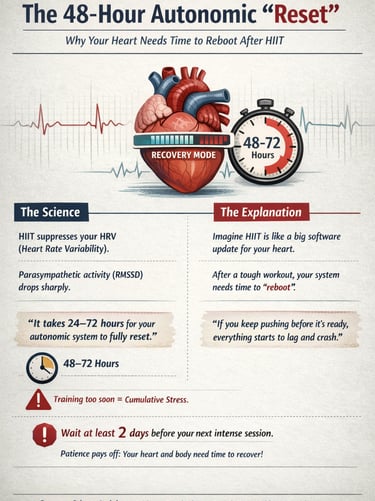
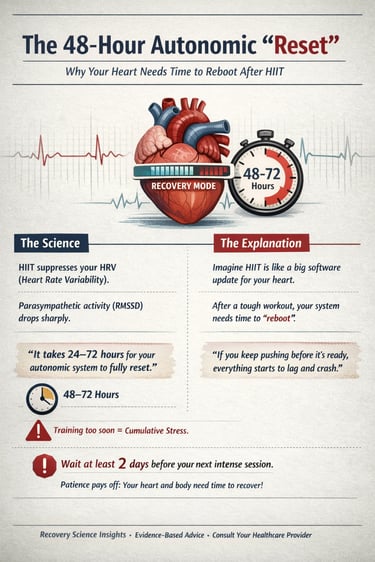
1. The 48-Hour Autonomic "Reset"
Acute HIIT-induced suppression of RMSSD(parasympathetic activity) typically requires 24 to 72 hours for full restitution. Executing subsequent high-intensity bouts within this window leads to cumulative autonomic strain.
Think of HIIT like a heavy software update for your heart. Your system needs about two days to "reboot" afterwards. If you keep hitting the update button before it’s finished, the whole system starts to lag.
2. HRV as a Bio-Psychological Mirror
HRV metrics correlate significantly with subjective psychological stress and cognitive fatigue (Georgieva-Tsaneva et al., 2025). Autonomic decline often precedes physical performance failure.
Your heart rate variability doesn’t just track your muscles; it tracks your mood and brainpower, too. If your HRV is low, your brain is just as "tired" as your legs, even if you haven't worked out yet today.
3. The "Black Hole" of Intensity (Zone 3)
Non-functional overreaching is frequently driven by "gray zone" training—intensity that is too high to allow for parasympathetic reactivation but too low to trigger maximal VO2 max adaptations.
Don’t get stuck in "medium-hard" land. To recover well, your easy days need to be truly easy (Zone 2). If every workout feels "kind of tough," you’re never giving your nervous system the green light to heal.
4. Sleep as a Performance Variable
HIIT performed within 3 hours of sleep onset can attenuate slow-wave sleep (SWS) duration via sustained core temperature elevation and sympathetic dominance, hindering GH-mediated tissue repair.
Late-night HIIT is like drinking a double espresso for your nervous system. Even if you fall asleep, your body stays "revved up" internally, which skips the deep sleep phase where your actual muscle repair happens.
5. Glycogen-Dependent Autonomic Recovery
Post-exercise carbohydrate ingestion (0.8–1.2 g/kg) modulates the hypothalamic-pituitary-adrenal (HPA) axis, accelerating the shift from sympathetic to parasympathetic dominance.
Carbs aren't just fuel; they are a "calm down" signal for your body. Eating healthy starches after a hard workout tells your brain the "emergency" is over, allowing your heart rate to return to its healthy, variable rhythm faster.
6. The "Two-Day" Rule for HRV Trends
Isolated 24-hour dips in HRV are often noise; however, a downward trend over 48–72 hours is a highly specific marker for systemic fatigue and impending "open window" immune vulnerability.
Don’t panic over one bad morning score. But if your recovery numbers are down two or three days in a row, your body is waving a red flag. That is the day to swap your sprints for a walk or a nap.
Author’s Note
High-intensity interval training has transformed modern exercise prescription—bridging the gap between time efficiency and physiological impact. Yet in clinical practice, one pattern is increasingly clear: patients and athletes are far more likely to overestimate their capacity to tolerate stress than their capacity to recover from it.
This article was written to address that imbalance.
While the benefits of HIIT are well-established, recovery science remains underemphasized in both fitness culture and routine clinical guidance. Heart rate variability (HRV) offers a practical, non-invasive window into autonomic regulation, but it is often misunderstood—treated as a performance metric rather than what it truly is: a reflection of systemic recovery status.
The goal here is not to discourage high-intensity training, but to contextualize it within the broader physiology of adaptation. Training does not make the body stronger—recovery does. HIIT simply provides the stimulus. Whether that stimulus leads to improved performance or progressive fatigue depends on how well recovery systems—sleep, nutrition, autonomic balance, and psychological resilience—are supported.
It is also important to emphasize that overtraining is not confined to elite athletes. Increasingly, it is being observed in recreational exercisers, high-stress professionals, and patients combining aggressive training with inadequate sleep and nutritional support. In such cases, HRV trends, subjective fatigue, and simple clinical markers often reveal dysfunction earlier than traditional diagnostics.
Ultimately, the most effective training programs are not the most intense, but the most sustainable and individualized. The integration of objective data (like HRV) with subjective awareness represents a shift toward precision exercise medicine—where training is adjusted not just to goals, but to real-time physiological readiness.Train hard—but more importantly, recover intelligently
Medical Disclaimer: This article is intended for educational and informational purposes only. It does not constitute medical advice and should not be used as a substitute for consultation with a qualified healthcare professional. Always discuss exercise programmes and cardiac risk assessment with your doctor, particularly if you have existing cardiovascular disease or significant risk factors.
Related Articles
Zone 2 vs HIIT: Fat Loss, VO2 Max, and Longevity – What Science Really Says
HIIT for Athletes: Boost VO₂ Max, Lactate Threshold, and Peak Performance – Science-Based Guide
HIIT vs Moderate Cardio: Which Improves Cardiovascular Fitness Faster?
HIIT Benefits: Evidence for Weight Loss, Heart Health, and Mental Well-Being
HIIT vs Aerobic Exercise: Which Burns More Fat, Reverses Insulin Resistance, and Extends Lifespan?
15-Minute HIIT: The Science-Backed Metabolic Reset for Fat Loss and Insulin Sensitivity
References
Yang, F., Ma, Y., Liang, S., Shi, Y., & Wang, C. (2024). Effect of exercise modality on heart rate variability in adults: A systematic review and network meta-analysis. Reviews in Cardiovascular Medicine, 25(1), 9. https://doi.org/10.31083/j.rcm2501009
Gu, X., Xue, X., Li, Y., Chen, Z., Wang, H., & Hua, Y. (2025). Higher BMI might increase risk of ankle–foot sprains: A Mendelian randomization study. Sports Medicine and Health Science. Advance online publication. https://doi.org/10.1016/j.smhs.2025.01.001
Leal-Menezes, R., Rodrigues-Krause, J., dos Santos, G. C., et al. (2025). High-intensity interval training and aerobic exercise delays recovery from heart rate variability: A systematic review with meta-analysis. Clinical Autonomic Research, 35, 365–379. https://doi.org/10.1007/s10286-024-01103-7
Kao, P.-C., & Cornell, D. J. (2025). Effects of induced physical fatigue on heart rate variability in healthy young adults. Sensors, 25(17), 5572. https://doi.org/10.3390/s25175572
Franklin, B. A., & Zhu, W. (2026). High-intensity interval training: Benefits, risks, and clinical implications. Journal of Science in Sport and Exercise, 8, 1–8. https://doi.org/10.1007/s42978-025-00352-w
Esco, M. R., Fields, A. D., Mohammadnabi, M. A., & Kliszczewicz, B. M. (2025). Monitoring training adaptation and recovery status in athletes using heart rate variability via mobile devices: A narrative review. Sensors (Basel, Switzerland), 26(1), 3. https://doi.org/10.3390/s26010003
Benavides-Roca, L., Miranda, M., Hernández, S., Vega, A., Campos, L., Benavides, M., & Benavides, G. (2025). Effects of high intensity interval training and resistance training on blood pressure and heart rate variability in young subjects. Journal of Human Sport and Exercise, 20(2), 694–705. https://doi.org/10.55860/qepkyn98
Georgieva-Tsaneva, G., Tsanev, Y.-A., Dechev, M., & Cheshmedzhiev, K. (2025). Impact on competitive performance and assessment of fatigue and stress based on heart rate variability. Applied Sciences, 15(20), 10892. https://doi.org/10.3390/app152010892