HIIT and Lactate Clearance: How High-Intensity Training Delays Fatigue and Boosts Performance & Brain Health
Discover why fatigue isn’t caused by lactic acid and how HIIT improves lactate clearance, boosts performance, speeds recovery, and supports brain health—backed by science.
EXERCISE
Dr. T.S. Didwal, M.D.(Internal Medicine)
4/14/202616 min read
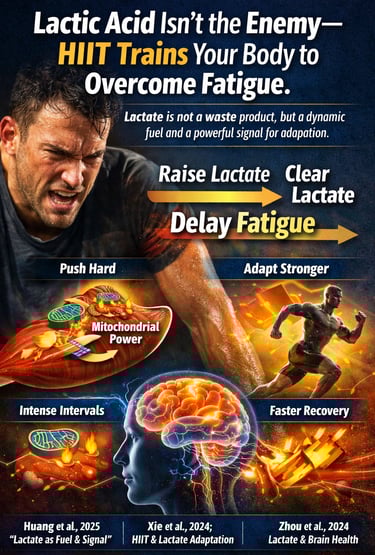
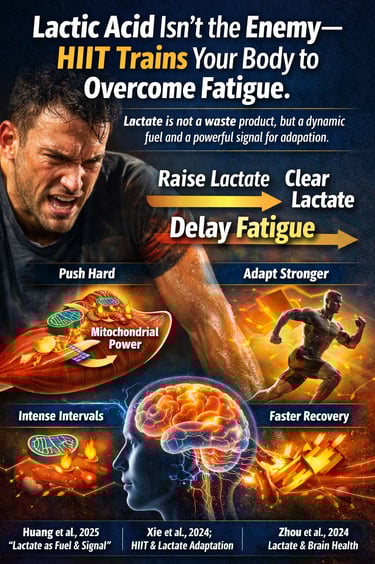
Why does your body get tired during exercise—and how does HIIT help?
Fatigue during intense exercise is not caused by “lactic acid buildup,” as commonly believed. Modern science shows that lactate is actually a beneficial molecule that serves as a fuel source and helps coordinate energy use between muscles, the heart, and the brain. The real cause of fatigue is the accumulation of hydrogen ions, energy depletion, and reduced muscle efficiency at high intensities.
High-Intensity Interval Training (HIIT) improves the body’s ability to manage this stress by enhancing both lactate production and clearance. It increases mitochondrial density, improves blood flow, and upregulates lactate transporters (MCT1 and MCT4), allowing the body to recycle lactate more efficiently. As a result, individuals can sustain higher exercise intensities, delay fatigue, and recover faster between efforts.
Research shows that HIIT is more effective than moderate continuous exercise for improving lactate clearance and metabolic performance. Emerging evidence also suggests that lactate produced during HIIT may support brain function and neuroplasticity, linking physical training with cognitive health.
Bottom line: HIIT trains your body to use lactate efficiently—helping you perform better, fatigue later, and recover faster.
Clinician’s Perspective
Fatigue is not caused by “lactic acid buildup” alone.
What you feel during intense exercise is a combination of factors—especially hydrogen ion accumulation, energy depletion, and muscle signaling changes. Lactate itself is not harmful; in fact, it plays a supportive role in energy metabolism.Lactate is a useful fuel—not a waste product.
Your heart, muscles, and even brain can use lactate as an energy source. A well-trained body becomes more efficient at recycling lactate rather than letting it accumulate.HIIT improves how your body handles metabolic stress.
High-intensity interval training teaches your muscles to both produce and clear lactate more efficiently. This means you can tolerate higher effort levels before fatigue sets in.Better lactate clearance = better performance and recovery.
When your body clears lactate faster, you recover more quickly between efforts—whether that’s during exercise or between workouts.These benefits extend beyond muscles.
Emerging research suggests lactate may support brain function and adaptability, potentially contributing to better cognitive health with regular exercise.You don’t need extreme workouts to benefit.
Even 2–3 structured HIIT sessions per week, tailored to your fitness level, can significantly improve metabolic efficiency.Safety matters, especially in medical conditions.
If you have heart disease, diabetes, or other chronic conditions, HIIT can still be beneficial—but it should be introduced gradually and ideally under medical guidance.The goal is adaptation, not exhaustion.
Effective training is about teaching your body to handle stress better—not simply pushing to the point of collapse.
Fatigue does not arrive suddenly—it builds silently, long before your legs burn or your pace collapses. For decades, this moment of breakdown was blamed on “lactic acid,” a supposed metabolic toxin that flooded muscles and forced them to stop. That narrative, still common in gyms and textbooks, is now scientifically outdated. In reality, lactate is not a waste product at all—it is a dynamic energy currency, a signaling molecule, and a critical player in how the body sustains high-intensity effort (Huang et al., 2025). The real problem is not lactate itself, but the body’s ability to produce, transport, and clear it efficiently under stress.
This is where high-intensity interval training (HIIT) fundamentally changes the equation. Unlike steady-state exercise, HIIT exposes the body to repeated surges of metabolic demand, forcing simultaneous adaptation in both lactate production and clearance pathways. Over time, this dual stress enhances mitochondrial capacity, upregulates lactate transporters, and improves whole-body metabolic coordination—allowing individuals to sustain higher intensities with less fatigue (Xie et al., 2024; Jacob et al., 2023). In effect, HIIT trains the body not to avoid fatigue, but to delay its onset by making lactate turnover faster and more efficient.
Emerging evidence suggests this adaptation extends beyond muscle. Lactate produced during intense exercise may serve as a fuel for the brain and a trigger for neuroplasticity-related pathways, linking physical performance to cognitive resilience (Zhou et al., 2024). Understanding this shift—from lactate as a limiter to lactate as an adaptive signal—redefines how we think about fatigue, performance, and even long-term brain health.
1. The Lactate Myth: What Science Actually Says
For most of the 20th century, lactic acid was exercise physiology's public enemy number one. The burning sensation in your muscles during intense effort? Lactic acid. The soreness the next morning? Lactic acid. The collapse at the finish line? Lactic acid. This narrative was taught in schools, repeated by coaches, and accepted as settled science.
It is almost entirely wrong.
At normal physiological pH, lactic acid does not exist in its acid form inside the body—it dissociates almost immediately into lactate and hydrogen ions (H⁺). Lactate itself is not toxic, not a waste product, and not the primary cause of fatigue. In fact, it is now understood to be one of the body’s most versatile metabolic molecules.
“Lactate is not the enemy of exercise—it is the currency of high-intensity energy exchange.” Huang et al. (2025) describe lactate as a critical participant in the metabolic cross-talk between tissues, emphasizing its role as both a fuel substrate and a fatigue biomarker in elite athlete recovery.
True fatigue arises from a cluster of interacting factors: accumulation of inorganic phosphate (Pi) from phosphocreatine breakdown, hydrogen ion-induced acidosis that inhibits contractile proteins, impaired calcium handling in muscle cells, and central nervous system fatigue signaling. Lactate, properly understood, is more bystander than perpetrator—and in the right context, it is actively helpful.
2. How Lactate Actually Works in Your Body
The Lactate Shuttle: A Biological Delivery Network
When you exercise intensely, fast-twitch muscle fibers generate lactate through anaerobic glycolysis at a rate that outpaces the mitochondria’s ability to process pyruvate. Rather than accumulating indefinitely, this lactate is exported into the bloodstream via specialized transporters called monocarboxylate transporters (MCTs)—specifically MCT4 for export from glycolytic fibers, and MCT1 for uptake into oxidative tissues.
This elegant system—called the lactate shuttle—means that the lactate produced in your sprinting fast-twitch fibers is simultaneously being consumed as fuel by your heart, your slow-twitch fibers, your liver (for glucose production), and even your brain. Lactate clearance, then, is not simply about removing a waste product; it is about optimizing a fuel distribution network under pressure.
What Happens When Clearance Fails to Keep Up?
When lactate production outstrips clearance capacity—a situation that occurs as exercise intensity rises above the lactate threshold—blood lactate concentrations escalate rapidly. The associated rise in hydrogen ions impairs glycolytic enzymes, reduces calcium release from the sarcoplasmic reticulum, and inhibits the force-generating capacity of muscle fibers. This is the physiological basis of the performance wall—and it is precisely the target of HIIT adaptation.
3. HIIT vs. Moderate Exercise: Why Intervals Win for Lactate
Not all exercise is equally effective at improving lactate kinetics. Moderate-intensity continuous training (MICT)—jogging, cycling, or swimming at a steady, comfortable pace—improves general aerobic fitness and provides meaningful health benefits. But when it comes to the specific metabolic machinery of lactate clearance, HIIT offers a qualitatively different and superior stimulus.
A direct head-to-head comparison was provided by Xie, Mao, and Wang (2024), who recruited adult men and assigned them to either HIIT or MICT protocols, then measured blood lactate clearance following a standardized high-intensity test. Their findings were clear: the HIIT group demonstrated significantly faster and more complete lactate clearance post-exercise than the MICT group. The interval structure—alternating between high-intensity glycolytic stress and active recovery—uniquely trained both the production and the clearance sides of the lactate equation simultaneously.
Key finding: Xie et al. (2024) demonstrated that HIIT produced superior blood lactate clearance compared with moderate continuous training in adult men—confirming that the interval structure is not just a time-efficiency hack but a mechanistically distinct training stimulus.
Why does this happen? The answer lies in the specific physiological adaptations that HIIT drives, which no amount of moderate jogging can fully replicate.
4. How HIIT Rewires Your Muscles for Lactate Clearance
HIIT triggers a cascade of molecular adaptations that collectively transform the lactate landscape in your muscles. Here are the four most important:
4.1 More Mitochondria = More Burning Power
HIIT activates PGC-1α, the master regulator of mitochondrial biogenesis. This protein switches on the genetic programs that build new mitochondria and increase oxidative enzyme density. More mitochondria means a larger ‘engine room’ for oxidizing lactate—converting it back to pyruvate and feeding it into the energy cycle for ATP production. In practical terms, more mitochondria means lactate gets burned faster.
4.2 Upgraded Transport Highways (MCT1 and MCT4)
HIIT upregulates both MCT1 (lactate uptake into oxidative fibers) and MCT4 (lactate export from glycolytic fibers). Think of these as the motorways connecting lactate production sites to oxidative disposal sites. More transporters mean higher throughput—lactate moves from where it is made to where it can be burned, faster. Huang et al. (2025) emphasize MCT upregulation as one of the primary lactate clearance mechanisms enhanced by structured high-intensity training, noting its direct relevance to athlete recovery and repeated-effort capacity.
4.3 Denser Blood Vessel Networks
Repeated metabolic stress during HIIT stimulates the growth of new capillaries (angiogenesis), driven by VEGF signaling. More capillaries reduce the distance lactate must travel between fiber types, improve oxygen delivery to working muscles, and increase blood flow to the liver and heart—both major sites of lactate clearance. This vascular adaptation is one reason elite endurance athletes show remarkably low blood lactate concentrations even at high exercise intensities.
4.4 Better Buffering and Enzyme Profiles
HIIT also shifts the isoform profile of lactate dehydrogenase (LDH) toward the oxidative variant that preferentially converts lactate back to pyruvate. Simultaneously, adaptations in intramuscular buffering capacity—including increased concentrations of the dipeptide carnosine in fast-twitch fibers—help attenuate the hydrogen ion accumulation that accompanies intense exercise, preserving the activity of pH-sensitive metabolic enzymes and delaying the contractile impairment that causes fatigue.
5. The Protocol Question: Does It Matter How You Do HIIT?
With the popularity of HIIT has come an explosion of protocols—everything from 4x4-minute Norwegian intervals to 20-second Tabata sprints to hour-long bootcamp classes marketed as HIIT. Does the specific protocol matter for lactate adaptation?
The answer is a nuanced yes. Jacob, So, Sharma, et al. (2023) conducted a systematic review and meta-regression of studies examining different HIIT protocols and their effects on blood lactate and cognitive outcomes in healthy adults. Their meta-regression revealed that protocol variables—particularly work interval duration and exercise intensity—significantly modulated the magnitude of the lactate response.
Jacob et al. (2023) found that work interval length and intensity are key drivers of HIIT’s lactate effects, and that the same training stimulus that reduces blood lactate may also enhance cognitive performance—pointing to lactate’s dual role as muscle fuel and brain substrate.
For most people seeking to improve lactate clearance and delay fatigue, the evidence favors:
Work intervals of 2–4 minutes at ≥90% maximum heart rate
Active (low-intensity) recovery between intervals to promote lactate redistribution
4–6 intervals per session, 2–3 sessions per week
Progressive overload over weeks, not just intensity spikes
Sprint interval training (10–30 second all-out efforts) generates the highest peak lactate and is excellent for buffering capacity and anaerobic power, but longer intervals are generally more effective for shifting the lactate threshold and improving sustained high-intensity performance.
6. HIIT, Lactate, and Your Brain: The Neuroplasticity Connection
Perhaps the most exciting frontier in lactate research is its role in the brain. For years, the brain was assumed to run almost exclusively on glucose. Emerging research has upended this assumption: the brain can and does use lactate as a significant fuel source, particularly during periods of intense neural activity or glucose scarcity. Lactate produced during exercise may be taken up directly by neurons, where it supports energy metabolism and may even drive the production of brain-derived neurotrophic factor (BDNF)—a key protein for learning, memory, and neuroprotection.
This connection takes on profound clinical significance in the context of aging. Zhou, Mozaffaritabar, Kawamura, Koike, Kolonics, Kéringer, Pinho, Sun, Shangguan, and Radák (2024) investigated the effects of long-term lactate supplementation and HIIT on brain neuroplasticity in aged mice. Their findings demonstrated that both lactate administration and HIIT produced measurable improvements in markers of neuroplasticity in the aging brain, suggesting that the metabolic benefits of HIIT extend beyond muscle and cardiovascular tissue to the central nervous system.
Zhou et al. (2024): Both lactate and HIIT improved neuroplasticity markers in aged mice brains—raising the possibility that HIIT’s lactate-mediated effects represent a non-pharmacological strategy for preserving cognitive function in aging populations.
For older adults in particular, these findings add a neurological dimension to the already compelling case for HIIT. The exercise that trains your muscles to clear lactate faster may simultaneously be feeding your brain with the fuel it needs to stay sharp.
7. Lactate as a Recovery and Monitoring Tool
Beyond its role in performance, lactate is emerging as a sophisticated biomarker for recovery monitoring—an application Huang et al. (2025) explore in depth in their comprehensive review of lactate metabolism and fatigue monitoring in athletes.
Blood lactate concentration measured at standardized time points after a maximal effort reflects the efficiency of the clearance machinery. Athletes with well-trained clearance systems return to near-baseline lactate within 15–20 minutes of ceasing exercise; poorly conditioned individuals may take twice as long. This kinetic profile provides a more sensitive readout of training adaptation and recovery status than heart rate or subjective wellness scores alone.
Huang et al. (2025) highlight lactate clearance rate as a key fatigue monitoring metric in competitive athletes, noting that individual variation in clearance kinetics should inform training load decisions and recovery protocols—a shift toward precision exercise medicine.
For coaches and clinicians without access to lactate analyzers, proxy markers can approximate this information: heart rate recovery after a standardized effort, power output or pace at perceived threshold, and session RPE trends over weeks of training all reflect the underlying lactate kinetics that drive them.
8. Practical Applications: Training Smarter, Not Just Harder
Understanding the science is only valuable if it changes what you do on Monday morning. Here are evidence-based, actionable applications for different populations:
For Athletes
Design your HIIT sessions around 2–4 minute work intervals at ≥90% HRmax. This intensity reliably pushes lactate above threshold while keeping interval duration long enough to stress the oxidative clearance system.
Use active recovery between intervals—keep moving at 40–50% HRmax. Blood flow continues redistributing lactate to oxidative tissues; stopping completely slows this process.
Combine HIIT with Zone 2 base training. Zone 2 builds the mitochondrial and vascular foundation upon which HIIT adaptations are layered. A polarized 80/20 distribution (80% easy, 20% hard) is well-supported for endurance athletes.
Track lactate or proxy markers (HR recovery, threshold pace/power) every 4–6 weeks to confirm adaptation is occurring and adjust load accordingly.
For Older Adults
Supervised HIIT is safe and effective in healthy older adults. Begin with shorter intervals (30–60 seconds) and longer recovery periods, progressing gradually over 8–12 weeks.
Given the neuroplasticity findings of Zhou et al. (2024), HIIT may offer cognitive benefits beyond physical conditioning—making it especially valuable as part of a healthy aging strategy.
Combining HIIT with resistance training preserves muscle mass (sarcopenia prevention) while delivering the metabolic adaptations described in this article.
For Clinical Populations (Consult Your Doctor First)
Patients with type 2 diabetes benefit from improved mitochondrial function and insulin sensitivity following HIIT—both of which are mediated, at least in part, through improvements in lactate metabolism.
Cardiac rehabilitation programs increasingly incorporate interval-based protocols. Lactate threshold is an independent predictor of functional capacity and prognosis in heart failure; improving it through exercise is one of the most powerful interventions available.
Any high-intensity exercise in individuals with known cardiovascular disease, uncontrolled hypertension, or significant comorbidities should be undertaken only under medical supervision with appropriate screening.
For Everyday Exercisers
You do not need a laboratory to benefit. Two HIIT sessions per week—alternating with easier aerobic activity—is sufficient to generate meaningful lactate adaptations over 6–12 weeks.
Perceived exertion is your most accessible guide: work intervals should feel like an 8–9 out of 10. If you can hold a conversation, you are not working hard enough to stress the lactate system.
Recovery matters as much as training. Inadequate sleep and poor nutrition impair the molecular adaptations (PGC-1α signaling, mitochondrial biogenesis) that make HIIT effective.
9. Frequently Asked Questions (FAQs)
FAQ 1: Does lactic acid really cause the burn I feel during exercise?
Not directly. The burning sensation is primarily caused by hydrogen ion (H⁺) accumulation and its effects on muscle pH, along with inorganic phosphate from energy breakdown. Lactate itself is not an acid at physiological pH and is not the primary cause of muscle burning. The confusion stems from early biochemistry that conflated lactic acid (the molecule in a test tube) with lactate (the ion in your body).
FAQ 2: How long does it take for HIIT to improve lactate clearance?
Meaningful improvements in lactate kinetics begin to emerge within 4–6 weeks of consistent HIIT training (2–3 sessions per week). More substantial shifts in lactate threshold and MCT expression are typically observed at 8–12 weeks. Full adaptation—including mitochondrial biogenesis and capillary remodeling—continues to develop over months of progressive training.
FAQ 3: Is HIIT safe for people with heart disease?
For many patients with stable cardiovascular disease, supervised HIIT is safe and effective—and is increasingly recommended in cardiac rehabilitation guidelines. However, individuals with unstable angina, decompensated heart failure, severe valvular disease, or uncontrolled arrhythmias should avoid high-intensity exercise until medically stabilized. Always consult your cardiologist before beginning any new high-intensity exercise program.
FAQ 4: Can HIIT really help protect my brain as I age?
Emerging evidence suggests yes. Zhou et al. (2024) demonstrated that both HIIT and direct lactate administration improved neuroplasticity markers in the brains of aged mice. While human trials are still limited, these findings—alongside evidence that exercise-induced lactate elevations correlate with BDNF production—support the hypothesis that HIIT offers neuroprotective benefits beyond its cardiovascular and metabolic effects. Larger human trials are underway.
FAQ 5: What is the lactate threshold and why does it matter?
The lactate threshold is the exercise intensity at which blood lactate begins to accumulate faster than it can be cleared. Below this threshold, the system is in relative balance; above it, lactate rises progressively and fatigue follows. Raising your lactate threshold through HIIT means you can sustain higher intensities before hitting the wall—a direct performance benefit. In clinical populations, a higher lactate threshold is independently associated with lower mortality risk and better functional outcomes.
FAQ 6: Is HIIT better than regular cardio for weight loss?
For fat loss and metabolic health, both HIIT and moderate continuous training are effective—and their outcomes are more similar than popular media suggests when total caloric expenditure is equated. HIIT’s advantage lies in time efficiency, greater post-exercise oxygen consumption (the ‘afterburn effect’), and superior adaptations in insulin sensitivity and mitochondrial function. For individuals with limited time, HIIT offers a higher metabolic return per minute of exercise.
FAQ 7: How do I know if my lactate clearance is improving without a lab test?
Several practical proxy markers reflect improving lactate kinetics: (1) Heart rate recovery—how quickly your heart rate drops in the 60–120 seconds after a maximal effort improves as lactate clearance improves; (2) Performance at perceived threshold—the pace, power, or workload that feels like a sustainable hard effort increases over weeks; (3) Reduced perceived effort at previously challenging intensities—if yesterday’s sprint feels easier today at the same speed, your metabolic machinery is adapting. Huang et al. (2025) support the use of these field-based markers as practical surrogates for laboratory lactate assessment.
Clinical pearls
1. The "Metabolic Clearinghouse" Effect
HIIT upregulates MCT1 and MCT4 (monocarboxylate transporters). This improves the "lactate shuttle" efficiency, increasing the Vmax of lactate uptake by oxidative fibers and the heart.
Think of HIIT as adding more "exit ramps" and "fast lanes" to your muscles' internal highway. It helps your body move energy-rich fuel to where it’s needed most, rather than letting traffic back up and cause a "stall."
2. Mitochondria: Density vs. Efficiency
High-intensity stimulus is a more potent trigger for PGC-1α, the master regulator of mitochondrial biogenesis, compared to steady-state cardio. This increases the mitochondrial volume density in Type IIa fibers.
You aren't just burning calories during the workout; you are building more "power plants" inside your cells. More power plants mean you can handle higher intensities with less effort over time.
3. The "Lactate is Brain Food" Hypothesis
Systemic lactate crosses the blood-brain barrier via MCTs and acts as a signaling molecule for BDNF (Brain-Derived Neurotrophic Factor), promoting synaptic plasticity and neuroprotection.
When your legs "burn" during intervals, you are actually sending a high-energy fertilizer to your brain. This helps keep your mind sharp and may protect against age-related cognitive decline.
4. Active vs. Passive Recovery Kinetics
Scientific: Post-interval blood lactate clearance is significantly accelerated by active recovery (approx. 40–50% $VO_2$ max) because it maintains periphral blood flow and keeps oxidative muscle fibers "primed" to consume circulating lactate.
Patient-Friendly: Don’t just collapse on the floor after a hard sprint. Keep your legs moving at a very slow pace. This keeps the "pumps" working to flush out metabolic byproducts and helps you recover much faster for the next round.
5. The "Afterburn" (EPOC) Reality
Scientific: HIIT induces a higher Excess Post-exercise Oxygen Consumption (EPOC) than moderate-intensity exercise. This is due to the increased metabolic cost of restoring ATP-CP stores, re-oxygenating blood, and clearing accumulated metabolites.
Patient-Friendly: HIIT is the gift that keeps on giving. Because the workout is so demanding, your body spends several hours afterward "cleaning up" and returning to baseline, which keeps your metabolic rate elevated long after you’ve left the gym.
6. Sarcopenia and Glycolytic Stress
Scientific: HIIT specifically recruits Type II (fast-twitch) motor units, which are the first to atrophy with age (Sarcopenia). The high glycolytic demand of HIIT preserves the functional integrity of these high-threshold units.
Patient-Friendly: Most people lose their "power" and "speed" as they age, not just their endurance. By pushing yourself into those high-intensity zones, you are specifically protecting the muscles that help you catch your balance or lift heavy objects.
Author’s Note
This article was written with a deliberate goal: to bridge the gap between modern exercise physiology and real-world understanding. Despite decades of research, the concept of “lactic acid” as a harmful byproduct still persists in popular fitness culture. As clinicians and scientists, we have a responsibility to correct these misconceptions—not just for accuracy, but because they directly influence how people train, recover, and perceive their own bodies.
The science of lactate has evolved dramatically. Today, it is recognized not as a metabolic dead-end, but as a central player in energy transfer, cellular signaling, and adaptation. High-intensity interval training (HIIT) provides a practical, evidence-based way to harness this physiology—improving not only performance, but also metabolic health and potentially even brain function.
At the same time, it is important to emphasize that exercise is not one-size-fits-all. The protocols and insights discussed here should be adapted to individual health status, fitness level, and clinical context. For some, HIIT may be transformative; for others, a more gradual or supervised approach is appropriate.
Finally, while this article draws on current peer-reviewed research, science is always evolving. Ongoing studies—particularly in humans—will continue to refine our understanding of lactate’s role in fatigue, recovery, and neurobiology.
The aim here is not just to inform, but to empower: to help readers train smarter, interpret fatigue more accurately, and engage with exercise as a scientifically grounded, lifelong tool for health
Medical Disclaimer: This article is intended for educational and informational purposes only. It does not constitute medical advice and should not be used as a substitute for consultation with a qualified healthcare professional. Always discuss exercise programmes and cardiac risk assessment with your doctor, particularly if you have existing cardiovascular disease or significant risk factors.
Related Articles
Zone 2 vs HIIT: Fat Loss, VO2 Max, and Longevity – What Science Really Says
HIIT for Athletes: Boost VO₂ Max, Lactate Threshold, and Peak Performance – Science-Based Guide
HIIT vs Moderate Cardio: Which Improves Cardiovascular Fitness Faster?
HIIT Benefits: Evidence for Weight Loss, Heart Health, and Mental Well-Being
HIIT vs Aerobic Exercise: Which Burns More Fat, Reverses Insulin Resistance, and Extends Lifespan?
15-Minute HIIT: The Science-Backed Metabolic Reset for Fat Loss and Insulin Sensitivity
References
Huang, T., Liang, Z., Wang, K., Miao, X., & Zheng, L. (2025). Novel insights into athlete physical recovery concerning lactate metabolism, lactate clearance and fatigue monitoring: A comprehensive review. Frontiers in Physiology, 16, 1459717. https://doi.org/10.3389/fphys.2025.1459717
Jacob, N., So, I., Sharma, B., et al. (2023). Effects of high-intensity interval training protocols on blood lactate levels and cognition in healthy adults: Systematic review and meta-regression. Sports Medicine, 53, 977–991. https://doi.org/10.1007/s40279-023-01815-2
Xie, H., Mao, X., & Wang, Z. (2024). Effect of high-intensity interval training and moderate-intensity continuous training on blood lactate clearance after high-intensity test in adult men. Frontiers in Physiology, 15, 1451464. https://doi.org/10.3389/fphys.2024.1451464
Zhou, L., Mozaffaritabar, S., Kawamura, T., Koike, A., Kolonics, A., Kéringer, J., Pinho, R. A., Sun, J., Shangguan, R., & Radák, Z. (2024). The effects of long-term lactate and high-intensity interval training (HIIT) on brain neuroplasticity of aged mice. Heliyon, 10(2), Article e24421. https://doi.org/10.1016/j.heliyon.2024.e24421