Just 30 Minutes a Week: The Science-Backed Strength Habit That Protects Health at Any Age
You don't need hours at the gym. New meta-analyses show the "minimum effective dose" of strength training for heart health, bone density, and cancer prevention.
EXERCISE
Dr. T.S. Didwal, M.D.(Internal Medicine)
12/27/202512 min read
What if just 30 minutes a week could measurably lower your risk of heart disease, diabetes, fractures, cognitive decline, and even premature death? This isn’t fitness hype—it’s what modern exercise science consistently shows. Large population studies and meta-analyses now confirm that muscle-strengthening activities are among the most powerful, yet underused, tools for long-term health across the lifespan.
Research published in the British Journal of Sports Medicine demonstrates that as little as 30–60 minutes per week of strength training is associated with a 10–17% reduction in all-cause mortality, along with lower risks of cardiovascular disease, cancer, and type 2 diabetes (Momma et al., 2022). Importantly, these benefits appear across ages—from young adults to older populations—and do not require intense or prolonged gym sessions.
Why does such a small dose work? Skeletal muscle is not just for movement; it is a metabolic, endocrine, and protective organ. Maintaining muscle improves insulin sensitivity, stabilizes blood sugar, supports bone density, and enhances brain health—mechanisms increasingly recognized in aging and chronic disease prevention (Singh et al., 2025; Feng et al., 2025).
In a world where time is limited and health risks rise with age, strength training stands out for its efficiency. Just 30 minutes a week may be enough to shift your health trajectory—making strength not merely exercise, but preventive medicine for every age.
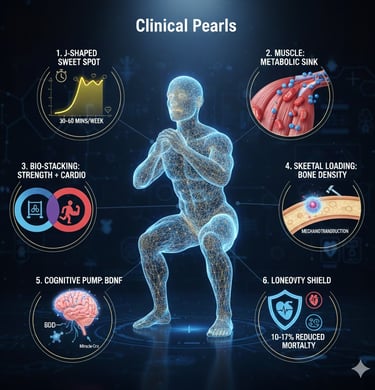
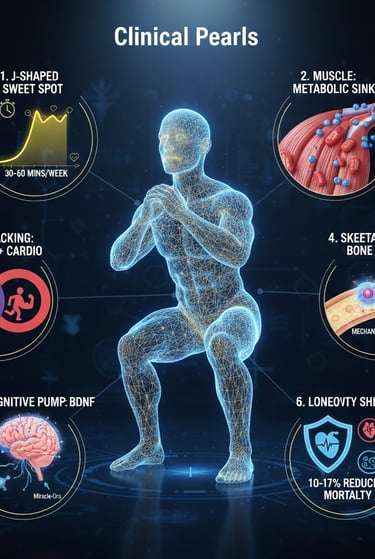
Clinical pearls
1. The "J-Shaped" Sweet Spot: Less is More
The most surprising find in recent longevity research is that you don’t need to live in the gym to save your life. Maximum risk reduction for heart disease and cancer occurs at just 30 to 60 minutes of strength training per week. This "J-shaped" association shows that while some is vital, the "minimum effective dose" is remarkably small. Consistency over a few short sessions is scientifically superior to rare, grueling marathons.
2. Muscle is Your "Metabolic Sink"
Think of your muscle mass not as armor, but as a sponge for blood sugar. Every kilogram of muscle you gain acts as a "metabolic sink," pulling glucose out of your bloodstream to use as fuel. This is why strength training reduces diabetes risk by 17%—it essentially upgrades your body's plumbing, allowing you to process sugar more efficiently even while you are resting
3. "Bio-Stacking": The Synergy of Strength and Cardio
While many people choose either "weights" or "cardio," the 2025 research confirms they are better together. Combining resistance training with aerobic activity creates a synergistic effect on your mitochondria (your cell's power plants). This "combined training" improves body composition and metabolic health more effectively than either approach alone, as the weights build the "machinery" and the cardio improves the "fuel efficiency."
4. Skeletal Loading: Better Than a Pill for Bone Density
To keep bones strong, you must "load" them. Heavy resistance training triggers mechanotransduction, a process where mechanical tension signals bone-forming cells (osteoblasts) to get to work. This is particularly critical for the hips and spine. Science shows this physical stimulus is often more effective at preventing osteoporosis than pharmaceutical interventions alone, because it builds a living, resilient framework.
5. The "Cognitive Pump": Lifting for Brain Longevity
Strength training isn't just a physical act; it's a neurological one. Resistance exercise stimulates the release of BDNF (Brain-Derived Neurotrophic Factor), which acts like "Miracle-Gro" for your brain cells. This helps improve memory and executive function, providing a powerful defense against age-related cognitive decline. When you lift weights, you are quite literally "thickening" the connections in your brain.
What Does the Research Really Say About Strength Training?
Recent meta-analyses and systematic reviews have fundamentally changed our understanding of strength training's impact on overall health. Let's explore what the science tells us.
The Longevity Connection: Living Longer Through Strength
One of the most compelling reasons to start strength training is its profound effect on lifespan. Research examining muscle-strengthening activities across major non-communicable diseases found that engaging in muscle-strengthening activities was associated with a 10-17% lower risk of all-cause mortality, along with significant reductions in cardiovascular disease, total cancer, diabetes, and lung cancer (Momma et al., 2022).
The findings revealed a J-shaped association, meaning maximum risk reduction (approximately 10-20%) occurred at about 30-60 minutes per week of resistance training—a completely achievable goal for most people. This suggests that a modest investment of time yields remarkable longevity benefits.
Another landmark longitudinal study investigated the relationship between skeletal muscle mass and mortality risk, finding that each additional kilogram of muscle mass was associated with a 19% reduction in mortality risk (Bernabe-Ortiz et al., 2023). Those in the highest muscle mass tertile experienced a remarkable 56% lower mortality risk.
Key takeaway: Building and maintaining lean muscle mass isn't vanity—it's one of the most powerful longevity strategies available, with research demonstrating direct associations between muscle and lifespan.
Cardiovascular Health: A Stronger Heart from the Weight Room
While aerobic exercise gets most of the credit for heart health, strength training deserves equal recognition. Research shows that resistance exercises lower blood pressure, improve cholesterol levels, and enhance overall cardiovascular function.
A J-shaped association was documented between muscle-strengthening activities and cardiovascular disease, with maximum risk reduction (10-20%) occurring at 30-60 minutes weekly (Momma et al., 2022). This means you don't need hours in the gym—strategic, focused strength training sessions deliver real heart benefits.
Key takeaway: Combining strength training with aerobic activities creates synergistic effects that provide even greater cardiovascular protection than either exercise type alone.
Metabolic Health and Diabetes Prevention: Blood Sugar Control Through Muscle
Here's something remarkable: your muscles are metabolic powerhouses. Strength training improves insulin sensitivity, regulates blood sugar levels, and is associated with a 17% lower incidence of type 2 diabetes.
The research reveals an L-shaped association between muscle-strengthening activities and diabetes risk, showing substantial risk reduction with up to 60 minutes weekly of resistance exercise. This makes sense physiologically—muscle tissue acts as a glucose sink, pulling sugar from your bloodstream more efficiently.
Examining resistance exercise training in older adults with type 2 diabetes, researchers confirmed that resistance training significantly improved metabolic health, body composition, and muscle strength in this vulnerable population (Feng et al., 2025). The findings highlight that strength training works across age groups and health statuses.
Key takeaway: If you're concerned about diabetes prevention or management, strength training may be one of your most powerful tools.
Cancer Risk Reduction: An Unexpected Benefit
While the relationship between exercise and cancer is complex, emerging evidence suggests strength training may reduce cancer risk. Research found that muscle-strengthening activities were associated with lower risk of total cancer and lung cancer specifically, with maximum risk reduction (10-20%) at 30-60 minutes weekly (Momma et al., 2022).
A comprehensive analysis examined the association between muscle strength, cardiorespiratory fitness, and cancer-specific mortality, revealing that higher muscle strength and fitness levels were protective factors against cancer-specific death (Bettariga et al., 2025). The protective effects likely stem from strength training's ability to improve immune function, reduce inflammation, and maintain healthy body composition.
Key takeaway: The cancer-preventive benefits add another compelling reason to prioritize resistance exercises in your health strategy.
Bone Health: Building a Stronger Skeleton
Osteoporosis affects millions worldwide, yet one of the most effective prevention strategies is often overlooked: strength training. The stress placed on bones during resistance exercises stimulates bone-forming cells, increasing bone density and slowing bone loss.
Research examining how heavy resistance training affects bone formation in older adults demonstrated that intensive strength training can actively build bone even in aging populations (Bloch-Ibenfeldt et al., 2025). This is particularly important for targeting high-fracture sites: the hips, spine, and wrists. By building muscle strength in these areas, you're literally building a framework that protects your most vulnerable bones.
Key takeaway: Strength training is superior to many pharmaceutical interventions for preventing osteoporosis and fractures, without the side effects.
Brain Health: Strength Training for Cognitive Function
The benefits of strength training extend above the neck. A comprehensive analysis examining the effectiveness of exercise for improving cognition, memory, and executive function confirmed that resistance training enhances cognitive function, potentially helping to stave off age-related cognitive decline (Singh et al., 2025).
This finding challenges the outdated perception that strength work is purely physical. The neurological benefits—improved focus, sharper memory, and better decision-making—make strength training a holistic wellness intervention.
Key takeaway: Regular strength training sessions may be one of your best defenses against memory loss and cognitive aging.
Mental Health: The Mood-Boosting Power of Resistance Training
Beyond the physical benefits, strength training significantly impacts mental health. Research consistently shows that resistance exercises improve mood, reduce anxiety and depression, and boost self-esteem. The sense of accomplishment from progressive strength gains creates psychological momentum that carries into other life areas.
Key takeaway: If you struggle with anxiety or mild depression, strength training offers scientifically-backed relief without medication.
Training Specificity: Understanding What Works
Research comparing long-term cluster training versus traditional resistance training for enhancing maximum strength revealed important insights about training structure and its effectiveness (Cui et al., 2025). While both training approaches build strength, understanding your specific goals helps you choose the most efficient strength training method.
A narrative review emphasizing strength-power training specificity for athletes highlighted that effective training programs must align with sport-specific demands and movement patterns (Stone et al., 2022).
Key takeaway: Whether you're an athlete or fitness enthusiast, training specificity ensures you're building the exact strength qualities you need.
Free Weights vs. Machines: Which Is Better?
A comprehensive analysis comparing free-weight versus machine-based strength training found meaningful differences in how these approaches affect athletic performance (Haugen et al., 2023). Free-weight resistance training often produces superior results for functional strength and athletic performance, likely because it requires greater stabilizer muscle activation.
Key takeaway: If your goal is maximal strength and athletic performance, free-weight resistance training typically outperforms machines. However, machines remain valuable for beginners and injury rehabilitation.
Exercise Science Consensus: Endurance Athletes Need Strength
Research examining how strength training affects endurance performance in distance runners revealed that resistance training enhances endurance performance determinants in middle- and long-distance athletes (Ramos-Campo et al., 2025). This systematic review of multiple studies demonstrated that endurance athletes who skip strength training are missing a key performance enhancer.
Key takeaway: A well-rounded training program for endurance athletes includes dedicated resistance work to optimize performance.
Combined Training: The Synergistic Effect
Multiple studies confirm what experts have long suspected: combining strength training with aerobic exercise produces superior results. Research examining aerobic exercise combined with resistance training in children and adolescents with overweight or obesity demonstrated that combined training improved body composition and metabolic health more effectively than either approach alone (Liu et al., 2024).
Key takeaway: A well-rounded fitness routine incorporating both strength training and cardio maximizes health benefits and creates measurable improvements faster than single-modality training.
Getting Started: Your Practical Strength Training Guide
Now that you understand the science, let's talk implementation. Here's how to begin your strength training journey:
Start with the fundamentals. Begin with bodyweight exercises or light weights. Master movements like push-ups, squats, lunges, and planks before adding load. This builds confidence, develops proper form, and prevents injury.
Focus on compound movements. Exercises like deadlifts, squats, bench press, and rows work multiple muscle groups simultaneously. You'll accomplish more in less time with these efficient resistance exercises.
Build consistency. Aim for at least two strength training sessions per week—the baseline for meaningful benefits. This aligns perfectly with the 30-60 minutes weekly recommendation from research.
Gradually increase intensity. As you adapt, increase weight, repetitions, or sets. Progressive overload—continuously challenging your muscles—drives ongoing adaptation and results.
Respect recovery. Allow at least one day between strength training sessions targeting the same muscle groups. Recovery is when your body builds muscle tissue and gets stronger.
Add aerobic activity. Walk, run, swim, or cycle on your non-strength training days. The combination maximizes health benefits.
Consider professional guidance. A certified personal trainer ensures proper form and creates a training program tailored to your goals and abilities, reducing injury risk and accelerating progress.
Common Questions About Strength Training
Is strength training safe for older adults? Absolutely. Research demonstrates that even well-functioning older adults benefit from heavy resistance training. Always start gradually and consult a healthcare provider if you have existing conditions.
Can I build strength without weights? Yes. Bodyweight exercises effectively build strength, especially for beginners. Push-ups, squats, lunges, and planks provide excellent resistance without equipment.
How much weight should I lift? Choose a weight that challenges you while maintaining perfect form. You should feel fatigued after 8-12 repetitions, but never so heavy that you sacrifice technique.
How long before I see results? Beginners notice strength gains within 2-3 weeks. Muscle growth and body composition changes typically appear within 4-6 weeks of consistent strength training.
Should I do strength training if I'm trying to lose weight? Definitely. Strength training preserves muscle mass during weight loss, ensuring more weight loss comes from fat rather than muscle. It also boosts resting metabolism.
Can strength training help with arthritis? Yes. Appropriate resistance exercises strengthen muscles around affected joints, improving stability and reducing pain. Work with your healthcare provider to design a training program suited to your condition.
How do free weights compare to machines? Free-weight resistance training typically produces superior results for maximal strength and athletic performance. However, machines are safer for beginners and those rehabilitating injuries.
Is combining strength and aerobic exercise necessary? Combined training produces better results, but either modality alone offers significant benefits. Combine them when possible for maximum advantage.
What's the minimum effective dose? The research consensus suggests 30-60 minutes weekly across 2+ sessions provides substantial benefits across most health outcomes.
Can women build significant muscle? Yes. While women typically have lower testosterone than men, they build muscle tissue effectively with proper strength training and nutrition. The benefits for cardiovascular health and longevity are particularly pronounced in women.
The Bottom Line: Strength Training Is Medicine
The scientific evidence is overwhelming: strength training is one of the most powerful health interventions available. Whether you're seeking longevity, disease prevention, improved mental health, or better functional capacity, resistance exercises deliver measurable results.
The remarkable aspect? The optimal dose is achievable for virtually everyone. Just 30-60 minutes weekly of muscle-strengthening activities across two sessions provides the maximum benefit for most health outcomes. This isn't an extreme time commitment—it's an investment that pays dividends across every dimension of health.
The barrier isn't capability; it's awareness and action. Now that you understand what the research demonstrates, you have the knowledge to transform your health. Whether you're picking up weights for the first time or intensifying your current strength program, every repetition moves you closer to a stronger, healthier, more vibrant future.
Ready to Transform Your Health?
Don't let another week pass without starting your strength training journey. Begin today with a simple program: three compound movements, twice weekly, with proper form and progressive intensity. Within weeks, you'll feel stronger and more energized. Within months, you'll see the transformative results science has documented.
Your future self will thank you for starting now. Let's build strength—and a better life.
Medical Disclaimer
The information in this article, including the research findings, is for educational purposes only and does not constitute medical advice, diagnosis, or treatment. Before starting any new strength training exercise program, you must consult with a qualified healthcare professional, especially if you have existing health conditions (such as cardiovascular disease, uncontrolled hypertension, or advanced metabolic disease). Exercise carries inherent risks, and you assume full responsibility for your actions. This article does not establish a doctor-patient relationship.
Related Articles
How to Build a Disease-Proof Body: Master Calories, Exercise & Longevity | DR T S DIDWAL
Exercise vs. Diet Alone: Which is Best for Body Composition? | DR T S DIDWAL
Movement Snacks: How VILPA Delivers Max Health Benefits in Minutes | DR T S DIDWAL
Anabolic Resistance: Why Muscles Age—and How to Restore Their Growth Response | DR T S DIDWAL
Breakthrough Research: Leptin Reduction is Required for Sustained Weight Loss | DR T S DIDWAL
The Psychology of Strength Training: Building Resilience Beyond the Gym | DR T S DIDWAL
HIIT Benefits: Evidence for Weight Loss, Heart Health, & Mental Well-Being | DR T S DIDWAL
References
Bernabe-Ortiz, A., Carrillo-Larco, R. M., Gilman, R. H., Smeeth, L., Checkley, W., & Miranda, J. J. (2023). Skeletal muscle mass and all-cause mortality: Findings from the CRONICAS Cohort Study. Tropical Medicine & International Health, 28(2), 107. https://doi.org/10.1111/tmi.13844
Bettariga, F., Galvão, D. A., Taaffe, D. R., Bishop, C., Lopez, P., Maestroni, L., Quinto, G., Crainich, U., Verdini, E., Bandini, E., Natalucci, V., & Newton, R. U. (2025). Association of muscle strength and cardiorespiratory fitness with all-cause and cancer-specific mortality in patients diagnosed with cancer: A systematic review with meta-analysis. British Journal of Sports Medicine, 59(10), 722–732. https://doi.org/10.1136/bjsports-2024-108671
Bloch-Ibenfeldt, M., Gates, A. T., Jørgensen, N. R., Linneberg, A., Aadahl, M., Kjær, M., & Boraxbekk, C. J. (2025). Heavy resistance training provides short-term benefits on bone formation in well-functioning older adults. Bone, 193, 117393. https://doi.org/10.1016/j.bone.2025.117393
Cui, J., Yu, Y., Xu, Y., & Wu, H. (2025). Effectiveness of long-term cluster training and traditional resistance training in enhancing maximum strength in young adults: A systematic review and meta-analysis. Frontiers in Physiology, 16, Article 1568247. https://doi.org/10.3389/fphys.2025.1568247
Feng, M., Gu, L., Zeng, Y., Gao, W., Cai, C., Chen, Y., & Guo, X. (2025). The efficacy of resistance exercise training on metabolic health, body composition, and muscle strength in older adults with type 2 diabetes: A systematic review and meta-analysis. Diabetes Research and Clinical Practice, 222, 112079. https://doi.org/10.1016/j.diabres.2025.112079
Haugen, M. E., Vårvik, F. T., Larsen, S., et al. (2023). Effect of free-weight vs. machine-based strength training on maximal strength, hypertrophy and jump performance – a systematic review and meta-analysis. BMC Sports Science, Medicine and Rehabilitation, 15, 103. https://doi.org/10.1186/s13102-023-00713-4
Liu, X., Li, Q., Lu, F., & Zhu, D. (2024). Effects of aerobic exercise combined with resistance training on body composition and metabolic health in children and adolescents with overweight or obesity: Systematic review and meta-analysis. Frontiers in Public Health, 12, 1409660. https://doi.org/10.3389/fpubh.2024.1409660
Momma, H., Kawakami, R., Honda, T., & Sawada, S. S. (2022). Muscle-strengthening activities are associated with lower risk and mortality in major non-communicable diseases: A systematic review and meta-analysis of cohort studies. British Journal of Sports Medicine, 56(13), 755–763. https://doi.org/10.1136/bjsports-2021-105061
Ramos-Campo, D. J., Andreu-Caravaca, L., Clemente-Suárez, V. J., & Rubio-Arias, J. Á. (2025). The effect of strength training on endurance performance determinants in middle- and long-distance endurance athletes: An umbrella review of systematic reviews and meta-analyses. Journal of Strength and Conditioning Research, 39(4), 492–506. https://doi.org/10.1519/JSC.0000000000005056
Singh, B., Bennett, H., Miatke, A., Dumuid, D., Curtis, R., Ferguson, T., Brinsley, J., Szeto, K., Petersen, J. M., Gough, C., Eglitis, E., Simpson, C. E., Eekegren, C. L., Smith, A. E., Erickson, K. I., & Maher, C. (2025). Effectiveness of exercise for improving cognition, memory and executive function: A systematic umbrella review and meta-meta-analysis. British Journal of Sports Medicine. Advance online publication. https://doi.org/10.1136/bjsports-2024-108589
Stone, M. H., Hornsby, W. G., Suarez, D. G., Duca, M., & Pierce, K. C. (2022). Training specificity for athletes: Emphasis on strength-power training: A narrative review. Journal of Functional Morphology and Kinesiology, 7(4), 102. https://doi.org/10.3390/jfmk7040102