The Psychology of Strength Training: Building Resilience Beyond the Gym
Discover how strength training builds more than muscle. Learn the psychological science behind mental resilience, habit formation, and the discipline required for lifelong health.
EXERCISE
Dr. T.S. Didwal, M.D.
12/21/20259 min read
Strength training is traditionally prescribed for improving musculoskeletal health, metabolic regulation, and functional capacity. Emerging evidence from neuroscience, psychology, and exercise medicine suggests that resistance training also induces profound psychological and neurobiological adaptations that extend beyond physical performance. This narrative review synthesizes recent literature (2016–2025) examining the effects of strength training on mental resilience, self-efficacy, emotional regulation, and neuroplasticity. We explore the neurochemical mechanisms underlying these adaptations, including changes in brain-derived neurotrophic factor (BDNF), monoaminergic signaling, and autonomic regulation. Psychological constructs such as mental toughness, attentional control, and stress inoculation are discussed in relation to resistance exercise. Clinical implications are emphasized, particularly for patients with chronic disease, mood disorders, and age-related functional decline. Strength training is proposed not only as a physical intervention but as a form of structured psychological rehabilitation with transferable benefits to daily life and long-term health behavior adherence
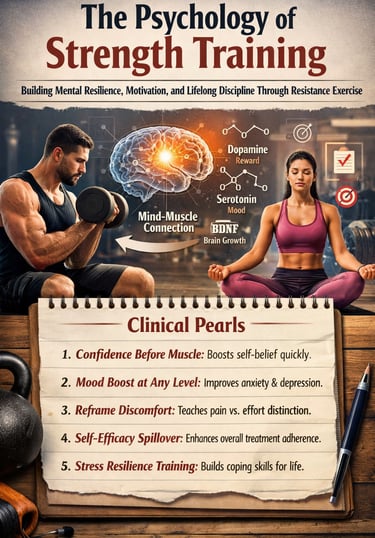
Clinical Pearls
A Neurochemical Pharmacy: Every set of resistance exercise triggers the release of Brain-Derived Neurotrophic Factor (BDNF) and optimizes dopamine signaling. This biological shift doesn't just improve mood; it enhances neuroplasticity, making the brain more resilient to cognitive decline and emotional fatigue.
The Laboratory of Self-Efficacy: For a patient, the weight room is a controlled environment to practice overcoming "impossible" tasks. This builds self-efficacy—the internal belief that you can handle life's challenges—which research shows carries over into better medication adherence and dietary habits.
Stress Inoculation: Lifting weights is a form of voluntary, controlled stress. By repeatedly exposing the nervous system to physical load, we "tone" the autonomic nervous system, teaching the body to remain calm and focused under pressure rather than spiraling into a fight-or-flight response.
Building Lifelong Autonomy: True strength is the ability to remain independent as we age. By treating the barbell as a tool for "psychological rehabilitation," patients move from a mindset of frailty to one of agency, reclaiming both physical power and mental discipline.
Lifting Weights Builds Mental Resilience, Motivation, and Lifelong Discipline
Strength as a Psychological Adaptation
Strength training is commonly prescribed to improve muscle mass, bone density, and metabolic health. Yet its most profound and durable effects often occur at the psychological level. Beneath the visible adaptations of hypertrophy and strength lies a systematic reprogramming of the brain—one that reshapes motivation, emotional regulation, confidence, and resilience.
For patients and athletes alike, long-term success depends less on physiology alone and more on the mind’s ability to tolerate discomfort, persist through plateaus, and adapt to setbacks. Resistance training uniquely develops these traits because it repeatedly exposes individuals to controlled stress, delayed reward, and objective feedback, creating conditions known to foster mental toughness and adaptive coping (Hsieh et al., 2023).
Mental Toughness: From Trait to Trainable Skill
Mental toughness is often misunderstood as an innate personality trait. Contemporary sport psychology, however, defines it as a trainable psychological capacity encompassing persistence, emotional control, confidence under pressure, and adaptability to stress (Gandrapu & Rakesh, 2024).
Strength training provides an ideal environment for cultivating these attributes. Each training session requires individuals to voluntarily confront discomfort, regulate emotional responses, and maintain task focus despite fatigue. Over time, this repeated exposure conditions the nervous system to interpret stress as manageable rather than threatening, a process central to resilience development (Hsieh et al., 2023).
For patients with chronic disease, pain syndromes, or anxiety disorders, this reframing of stress perception is clinically significant.
The Mind–Muscle Connection: Focus as Psychological Training
The mind–muscle connection is frequently discussed in performance settings, yet its psychological relevance extends well beyond muscle activation. Experimental evidence shows that consciously focusing on the working muscle during resistance exercise significantly enhances neuromuscular activation without compromising overall movement efficiency (Calatayud et al., 2016).
From a psychological perspective, this focused attention represents attentional control under load—a skill closely related to mindfulness. For patients, cultivating this internal focus:
Improves body awareness
Reduces fear-driven compensatory movement
Enhances perceived control during exercise
Thus, resistance training becomes a form of mindfulness in motion, reinforcing presence, emotional regulation, and cognitive engagement.
Neurochemical Effects Relevant to Mental and Metabolic Health
Resistance training induces a robust neurochemical response that directly influences mood, cognition, and emotional resilience. Acute and chronic training increase the availability of endorphins, dopamine, serotonin, and brain-derived neurotrophic factor (BDNF), collectively supporting pain modulation, motivation, sleep regulation, and neuroplasticity.
Importantly, controlled trials demonstrate that resistance training significantly reduces symptoms of depression and anxiety even when improvements in strength or cognition are modest (Cunha et al., 2022). This finding highlights a direct psychobiological effect, rather than a secondary benefit of physical improvement.
Clinically, this positions strength training as a viable non-pharmacological adjunct in the management of mood disorders, particularly among older adults and individuals with metabolic disease.
Psychological Architecture of Strength Development
Goal Setting as Behavioral Therapy
Strength training naturally incorporates structured goal setting, transforming abstract health advice into measurable actions. This structure supports motivation and persistence, particularly during periods of slow progress.
SMART goal frameworks provide psychological stability by shifting focus from outcome obsession to process engagement. For patients, this restores a sense of agency and predictability—factors strongly associated with long-term adherence and psychological well-being (Park & Jeon, 2023).
Self-Efficacy: The Core Determinant of Adherence
Self-efficacy—the belief in one’s capacity to perform behaviors necessary for desired outcomes—is a critical determinant of exercise adherence and health behavior change.
A systematic review and meta-analysis confirmed that structured exercise interventions, including resistance training, significantly improve overall and task-specific self-efficacy in adults (Ghayour Baghbani et al., 2023). These improvements occur through repeated mastery experiences, positive physiological feedback, and social reinforcement.
Clinically, increased self-efficacy often generalizes beyond exercise, improving adherence to dietary recommendations, medication use, and follow-up care.
Overcoming Psychological Barriers to Training
Psychological barriers such as fear of failure, gym anxiety, impostor syndrome, and discouragement during plateaus are common across all experience levels. These responses reflect normal threat-processing mechanisms rather than personal inadequacy.
Evidence-Based Psychological Tools
Visualisation has demonstrated efficacy in improving strength performance and mitigating strength loss during immobilization, particularly when combined with physical practice (Slimani et al., 2016).
Positive self-talk restructures internal dialogue, replacing threat-based appraisals with task-oriented cues, thereby improving performance and emotional regulation (Ramesberger, 2022).
Breathing regulation, especially slow-paced breathing practiced longitudinally, improves physical performance and autonomic stability, reducing anxiety during effort (Laborde et al., 2022).
Social Context and Psychological Safety
The social environment of training significantly influences psychological outcomes. Supportive communities and competent coaching foster psychological safety, encouraging patients to engage with challenging tasks without fear of judgment.
Research consistently demonstrates that positive coach–athlete relationships enhance confidence, stress management, and resilience, contributing to both performance and mental well-being (Park & Jeon, 2023).
Transfer Effects: From Gym Adaptation to Life Resilience
The most meaningful psychological outcome of strength training is its transfer beyond the gym. A meta-analysis of mental toughness and performance found a moderate-to-high association between mental toughness and functional outcomes, particularly in adults and individual sports contexts (Hsieh et al., 2023).
Patients frequently report improved coping with workplace stress, greater emotional regulation, and a more structured approach to problem-solving—mirroring the mindset developed during resistance training.
Setbacks, Injury, and Psychological Recovery
Injuries and interruptions are inevitable, particularly in clinical populations. Strength training fosters a growth mindset, encouraging individuals to interpret setbacks as temporary adaptations rather than permanent failures.
This mindset is associated with improved rehabilitation adherence, faster return to training, and reduced psychological distress—outcomes of critical importance in chronic disease management (Ciaccioni et al., 2023).
Cognitive Stacking: Dual-Tasking for Maximum Neuroplasticity
While resistance training inherently supports brain health, "Cognitive Stacking"—the practice of layering specific mental drills onto physical movements—can further amplify the production of Brain-Derived Neurotrophic Factor (BDNF). This approach, often referred to in clinical literature as Concurrent Dual-Tasking, forces the brain to manage executive function and motor control simultaneously, mimicking the complex demands of real-world environments.
Evidence-Based Stacking Strategies
Attentional Shifting: During a set, alternate your focus between an internal cue (squeezing the muscle) and an external cue (the speed of the bar). Research suggests this improves "cognitive flexibility," or the ability to switch between tasks efficiently under stress.
The "Counting Delta": Instead of simple counting, count your repetitions backward from 20 or in increments of 3 (3, 6, 9...). This engages the working memory and the prefrontal cortex while the motor cortex manages the lift.
Visual Anchoring: Fix your gaze on a specific point during a balance-heavy movement (like a split squat). This trains the vestibular system and forces the brain to filter out visual "noise," improving concentration.
Timed Problem Solving: Use your rest periods (90–120 seconds) for high-order cognitive tasks, such as reviewing a complex work problem or practicing a new language. This leverages the "post-exercise window" where blood flow to the brain is peaked, enhancing memory consolidation.
Clinical Pearl: Cognitive stacking is particularly effective for older adults. By challenging both the muscular and nervous systems at once, we create a "neuroprotective shield" that may slow the progression of age-related cognitive decline more effectively than physical exercise alone.
Key Points
Strength Training Builds Confidence Before Muscle
Psychological confidence often improves before measurable physical gains, making resistance training especially valuable for patients with low motivation or fear of movement (Ghayour Baghbani et al., 2023).
Mental Health Benefits Occur at Low Intensities
Meaningful improvements in mood and anxiety occur even with light-to-moderate resistance, emphasizing consistency over load (Cunha et al., 2022).
Reframing Discomfort Improves Adherence
Educating patients to distinguish effort-related discomfort from injury reduces fear avoidance and premature dropout (Ramesberger, 2022).
Self-Efficacy Drives Global Treatment Compliance
Increased confidence gained through strength training often transfers to improved dietary adherence, medication compliance, and self-management behaviors (Ghayour Baghbani et al., 2023).
Strength Training Functions as Psychological Rehabilitation
Progressive loading acts as controlled exposure to stress, rebuilding emotional regulation and resilience relevant to daily life challenges (Hsieh et al., 2023).
Conclusion: The Barbell as a Catalyst for the Human Spirit
The weight room is often mistaken for a place where we go to change how we look; in reality, it is a laboratory where we change how we think. As the research from 2023–2025 confirms, resistance training is not merely a physical intervention—it is a sophisticated system for neurological and psychological reprogramming. By engaging with progressive load, you are doing more than building muscle tissue. You are cultivating a "neuroprotective shield" through BDNF release, refining your stress-response through autonomic "toning," and practicing the exact type of cognitive flexibility required to navigate a complex world.
The true "gains" of strength training are found in the moments after you leave the gym:
The resilience to handle a high-pressure meeting without spiraling.
The self-efficacy to manage a chronic health diagnosis with agency.
The discipline to choose long-term health over immediate comfort.
Strength is a skill, and resilience is a biological adaptation. Whether you are lifting for longevity or using "cognitive stacking" to sharpen your mind, remember that the nervous system is a mirror of your consistent efforts. By treating the barbell as a lifelong teacher, you reclaim not just your physical power, but your mental autonomy. The weight doesn't get lighter; you simply become someone capable of carrying more.
Medical Disclaimer
The information in this article, including the research findings, is for educational purposes only and does not constitute medical advice, diagnosis, or treatment. Before starting any new exercise program, you must consult with a qualified healthcare professional, especially if you have existing health conditions (such as cardiovascular disease, uncontrolled hypertension, or advanced metabolic disease). Exercise carries inherent risks, and you assume full responsibility for your actions. This article does not establish a doctor-patient relationship.
Related Articles
How to Build a Disease-Proof Body: Master Calories, Exercise & Longevity | DR T S DIDWAL
How to Maximize Muscle Growth: Evidence-Based Strength Training Strategies | DR T S DIDWAL
Lower Blood Pressure Naturally: Evidence-Based Exercise Guide for Metabolic Syndrome | DR T S DIDWAL
Exercise vs. Diet Alone: Which is Best for Body Composition? | DR T S DIDWAL
Movement Snacks: How VILPA Delivers Max Health Benefits in Minutes | DR T S DIDWAL
Breakthrough Research: Leptin Reduction is Required for Sustained Weight Loss | DR T S DIDWAL
HIIT Benefits: Evidence for Weight Loss, Heart Health, & Mental Well-Being | DR T S DIDWAL
References
Calatayud, J., Vinstrup, J., Jakobsen, M. D., Sundstrup, E., Brandt, M., Jay, K., Colado, J. C., & Andersen, L. L. (2016). Importance of mind–muscle connection during progressive resistance training. European Journal of Applied Physiology, 116(3), 527–533. https://doi.org/10.1007/s00421-015-3305-7
Ciaccioni, S., Castro, O., Bahrami, F., Tomporowski, P. D., Capranica, L., Biddle, S. J. H., Vergeer, I., & Pesce, C. (2023). Martial arts, combat sports, and mental health in adults: A systematic review. Psychology of Sport and Exercise, 70, 102556. https://doi.org/10.1016/j.psychsport.2023.102556
Cunha, P. M., Werneck, A. O., Nunes, J. P., Stubbs, B., Schuch, F. B., Kunevaliki, G., Zou, L., & Cyrino, E. S. (2022). Resistance training reduces depressive and anxiety symptoms in older women: A pilot study. Aging & Mental Health, 26(6), 1136–1142. https://doi.org/10.1080/13607863.2021.1922603
Gandrapu, A., & Rakesh, K. R. (2024). Sports psychology: Mental skills training and performance enhancement strategies for athletes. Innovations in Sports Science, 1(3), 1–4. https://doi.org/10.36676/iss.v1.i3.13
Ghayour Baghbani, S. M., Arabshahi, M., & Saatchian, V. (2023). The impact of exercise interventions on perceived self-efficacy and other psychological outcomes in adults: A systematic review and meta-analysis. European Journal of Integrative Medicine, 62, 102281. https://doi.org/10.1016/j.eujim.2023.102281
Hsieh, Y.-C., Lu, F. J. H., Gill, D. L., Hsu, Y.-W., Wong, T.-L., & Kuan, G. (2023). Effects of mental toughness on athletic performance: A systematic review and meta-analysis. International Journal of Sport and Exercise Psychology, 22(6), 1317–1338. https://doi.org/10.1080/1612197X.2023.2204312
Laborde, S., Zammit, N., Iskra, M., Mosley, E., Borges, U., Allen, M. S., & Javelle, F. (2022). The influence of breathing techniques on physical sport performance: A systematic review and meta-analysis. International Review of Sport and Exercise Psychology, 17(2), 1222–1277. https://doi.org/10.1080/1750984X.2022.2145573
Park, I., & Jeon, J. (2023). Psychological skills training for athletes in sports: A bibliometric analysis. Healthcare, 11(2), 259. https://doi.org/10.3390/healthcare11020259
Ramesberger, R. (2022). Psychological training in sports. Quality in Sport, 8(2), 33–44. https://doi.org/10.12775/qs.2021.08.02.003
Slimani, M., Tod, D., Chaabene, H., Miarka, B., & Chamari, K. (2016). Effects of mental imagery on muscular strength in healthy and patient participants: A systematic review. Journal of Sports Science & Medicine, 15(3), 434–450. https://pmc.ncbi.nlm.nih.gov/articles/PMC4974856/