AMPK vs mTOR: The Molecular Switch That Controls Muscle, Fat Loss, and Aging
Discover how the AMPK vs mTOR metabolic switch controls muscle growth, fat burning, autophagy, and healthy aging. Get science-backed strategies using exercise, intermittent fasting, protein timing, and nutrition to optimize both pathways for peak performance and longevity.
NUTRITIONEXERCISE
Dr. T.S. Didwal, M.D.(Internal Medicine)
6/10/202615 min read
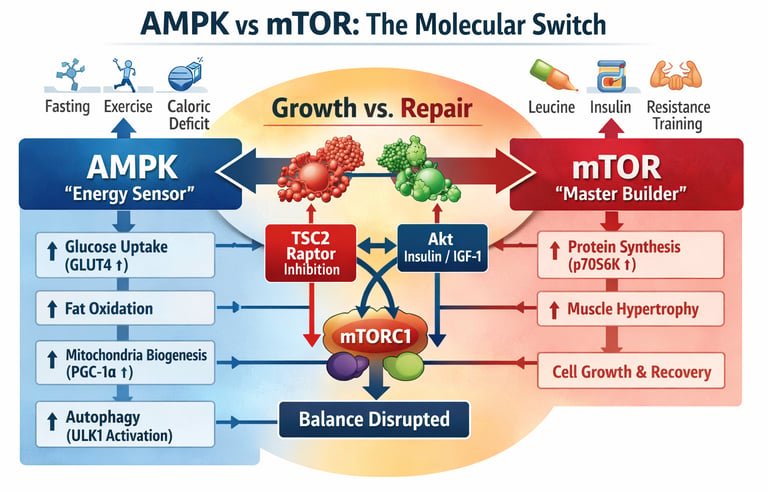
AMPK and mTOR are two master metabolic pathways that regulate cellular repair and muscle growth. AMPK is activated during fasting and exercise, promoting fat burning and autophagy, while mTOR is activated by protein and resistance training, stimulating muscle protein synthesis. Optimal health requires strategic cycling between both pathways
Clinical Perspective:
1. Your Body Needs Both Growth and Repair
Many people think they must choose between building muscle and promoting longevity. In reality, your body needs both. mTOR helps build and maintain muscle, while AMPK supports cellular repair, fat burning, and metabolic health. The goal is balance, not extremes.
2. Muscle Is One of the Most Important Organs for Healthy Aging
Maintaining muscle mass is not just about strength or appearance. Healthy muscle improves blood sugar control, supports mobility, reduces fall risk, and is strongly associated with longer life expectancy.
3. Regular Resistance Training Activates Healthy Growth Signals
Strength training beneficially stimulates mTOR, helping preserve muscle, bone density, and physical function. For most adults, resistance exercise remains one of the most effective anti-aging interventions available.
4. Periods of Fasting Allow the Body to Perform Maintenance
Short fasting periods, such as an overnight fast of 12–14 hours, can activate AMPK and support cellular cleanup processes. These repair mechanisms help remove damaged cellular components and promote metabolic health.
5. Protein Intake Becomes More Important With Age
As we grow older, muscles become less responsive to dietary protein. Consuming adequate high-quality protein at each meal can help overcome anabolic resistance and support healthy muscle maintenance.
6. Aerobic Exercise Improves Metabolic Flexibility
Activities such as brisk walking, cycling, swimming, or Zone 2 exercise activate AMPK, improve mitochondrial function, and enhance the body's ability to use fat and glucose efficiently.
7. Chronic Overeating and Constant Snacking May Work Against Long-Term Health
Continuously stimulating growth pathways through excessive calorie intake can reduce opportunities for cellular repair. Structured meal timing and avoiding constant grazing may support a healthier metabolic balance.
8. The Best Long-Term Strategy Is Rhythm, Not Extremes
From a clinical perspective, the healthiest approach is a natural cycle of feeding and fasting, exercise and recovery, growth and repair. Regular strength training, adequate protein, daily movement, good sleep, and sensible meal timing create the ideal environment for both muscle preservation and healthy aging.
Bottom Line: As clinicians, we encourage patients to think of AMPK and mTOR not as competing pathways but as complementary partners. When properly balanced through exercise, nutrition, sleep, and recovery, they help support strength, metabolic health, functional independence, and longevity throughout life.
Introduction
Imagine your body as a highly efficient machine that constantly decides whether to invest resources in building muscle or performing essential maintenance and repair. This decision happens at the cellular level, orchestrated by two master regulators: AMPK (AMP-activated protein kinase) and mTOR (mechanistic target of rapamycin).
AMPK acts like your cell’s energy crisis manager—flipping on during fasting, calorie deficits, or aerobic exercise to promote fat burning, glucose efficiency, cellular cleanup (autophagy), and longevity pathways. mTOR, conversely, is the growth director, activated by ample nutrients (especially leucine), insulin, and resistance training to drive protein synthesis, muscle hypertrophy, and tissue repair.
The delicate AMPK vs mTOR balance determines your metabolic flexibility—the ability to seamlessly switch between burning fat and building muscle. Chronic imbalance contributes to modern epidemics: insulin resistance, sarcopenia (age-related muscle loss), obesity, and accelerated aging. Too much constant mTOR signaling from nonstop eating promotes inflammation and disease risk, while insufficient mTOR in older adults leads to frailty.
In this ultimate guide you’ll uncover the latest mechanisms, evidence-based protocols, practical weekly blueprints, training and nutrition strategies, common pitfalls, and actionable steps to harness this switch. Whether your goal is sustainable fat loss, muscle gain after 40, or extending healthspan, mastering AMPK vs mTOR will transform how you eat, train, and age.
What Is AMPK? Your Cellular Energy Guardian and Longevity Promoter
AMPK functions as a highly sensitive energy sensor. When cellular energy drops (rising AMP/ATP ratio from exercise, fasting, or low calories), AMPK activates to restore balance by promoting catabolic processes and inhibiting energy-consuming ones.
Primary Mechanisms and Benefits:
- Fat Oxidation: Phosphorylates and inhibits acetyl-CoA carboxylase (ACC), increasing fatty acid transport into mitochondria for burning.
- Glucose Uptake: Stimulates GLUT4 translocation to cell membranes, improving insulin sensitivity even without insulin.
- Mitochondrial Biogenesis: Activates PGC-1α, creating more efficient cellular power plants.
- Autophagy Activation: Phosphorylates ULK1 and inhibits mTOR, enabling cellular recycling of damaged components.
- Anti-Inflammatory and Metabolic Effects: Reduces chronic low-grade inflammation linked to metabolic syndrome.
A 2025 review emphasizes AMPK's protective role against sarcopenic obesity through exercise-mediated autophagy crosstalk. Reduced AMPK activity is common in insulin resistance and type 2 diabetes; drugs like metformin partially work by activating it.
Triggers for AMPK Activation:
Overnight or intermittent fasting (12–16+ hours)
Zone 2 aerobic exercise or fasted walking
Caloric restriction or low-glycogen states
Polyphenols (green tea EGCG, berries, resveratrol)
Cold exposure (emerging evidence)
What Is mTOR? The Master Builder for Muscle and Tissue Repair
mTOR (especially mTORC1) senses nutrient abundance, growth factors, and mechanical stress to promote anabolism. It is essential for muscle protein synthesis (MPS) and preventing muscle wasting.
Key Functions:
- Phosphorylates downstream targets like p70S6K and 4E-BP1 to ramp up protein translation.
- Responds strongly to leucine via Sestrin2: Leucine binds Sestrin2 (Kd ~20 μM), disrupting its inhibition of GATOR2, allowing mTORC1 lysosomal translocation and full activation. Typically requires ~2–3g leucine per meal (e.g., 20–40g high-quality protein).
- Mechanical tension from resistance training synergizes with amino acids for maximal hypertrophic response.
- mTORC2 supports cell survival, insulin signaling, and cytoskeletal dynamics.
mTOR in Aging: Acute activation builds muscle; chronic overactivation (from constant overfeeding) suppresses autophagy and accelerates aging in models. Rapamycin (mTOR inhibitor) extends lifespan but requires careful use.
AMPK vs mTOR: Key Differences and the Molecular Tug-of-War
AMPK Pathway (The Repair & Clean-Up Mode)
Triggers: Activated by low energy states, fasting, and aerobic exercise.
Main Effects: Stimulates fat burning, triggers autophagy (cellular cleanup), improves mitochondrial health, and enhances insulin sensitivity.
Longevity & Metabolic Impact: Promotes cellular repair, increases metabolic flexibility, and acts as a powerful anti-aging mechanism.
Risks of Imbalance: Prolonged excess can lead to potential muscle wasting or loss.
mTOR Pathway (The Growth & Build Mode)
Triggers: Activated by amino acids (especially leucine/protein), resistance training, and insulin.
Main Effects: Drives protein synthesis, muscle hypertrophy (growth), and tissue repair.
Longevity & Metabolic Impact: Supports muscle mass and strength, which is vital for preventing age-related muscle loss (sarcopenia).
Risks of Imbalance: Chronic excess leads to accelerated aging, inflammation, and insulin resistance.
The Metabolic Tug-of-War & Modern Insights
Reciprocal Inhibition: These two pathways naturally oppose each other. AMPK shuts down mTOR (via TSC2 phosphorylation and direct Raptor inhibition) to save energy, while mTOR suppresses AMPK when the body is well-fed.
Survival vs. Growth: This constant "tug-of-war" ensures that your cells prioritize survival and repair during stress and growth when resources are abundant.
The Blueprint for Optimal Health: The latest insights show that optimal health doesn't come from suppressing one pathway entirely. Instead, it requires dynamic equilibrium—strategically cycling between periods of growth (mTOR) and periods of repair (AMPK)
The Critical Role of Autophagy: AMPK’s Longevity Gift
One of AMPK’s most clinically significant functions is the induction of autophagy—the cellular "self-cleaning" process. Autophagy is vital for removing damaged mitochondria, misfolded proteins, and cellular debris. This process is critical for preventing neurodegenerative diseases, combating cancer, and promoting healthy aging .
Conversely, when mTOR is highly active, it directly inhibits autophagy. This highlights a fundamental growth-vs-repair trade-off: a cell cannot efficiently build new proteins and dismantle old ones simultaneously. Chronic mTOR overactivation, often seen in conditions like obesity and hyperinsulinemia, impairs autophagy, accelerates cellular aging, and is linked to increased disease risk .
This connection underscores the importance of regular fasting periods, even for otherwise healthy individuals, to allow AMPK to activate and drive these crucial cellular repair mechanisms.
Key Takeaway: Autophagy & Longevity
AMPK Activates Autophagy: Essential for cellular recycling, removing damaged components.
mTOR Inhibits Autophagy: High mTOR activity suppresses this vital repair process.
Fasting Benefits: Regular fasting periods are crucial for activating AMPK and promoting autophagy, contributing to longevity.
Impact on Muscle Growth, Fat Loss, and the Aging Paradox
Muscle & Sarcopenia (Overcoming Anabolic Resistance)
The Aging Barrier: As the body ages, it develops anabolic resistance, meaning muscles become less responsive to traditional signals for growth.
The mTOR Solution: To successfully trigger mTOR and drive muscle hypertrophy, older adults require higher nutritional thresholds—specifically 35–40g of protein per meal containing 3–4g of leucine, paired with consistent resistance training.
The AMPK Balance: While AMPK is crucial for overall cellular recovery, chronic overactivation can blunt muscle gains by continuously shutting down growth pathways.
Fat Loss (The Dual-Pathway Strategy)
AMPK for Burning: AMPK acts as the primary engine for fat loss, actively promoting lipolysis (breaking down fat) and fat oxidation.
mTOR for Protection: mTOR plays a vital defensive role during a calorie deficit by preserving lean muscle mass, which prevents the metabolic slowdown typically caused by dieting.
The Combined Result: A strategy that leverages both pathways yields sustainable fat loss without sacrificing metabolic rate or muscle tissue.
The Aging Paradox (The Feast-Famine Solution)
The Double-Edged Sword: Chronic mTOR overdrive accelerates aging and shortens lifespan in animal models (which is why mTOR-inhibiting drugs like rapamycin extend life). However, chronic underactivation of mTOR in elderly humans leads to frailty and muscle wasting.
The Ancestral Solution: To resolve this paradox, you cannot permanently suppress or activate either pathway. The ideal approach is cyclical activation—intentionally mimicking ancestral feast-and-famine cycles through structured periods of fasting/restriction (AMPK) and strategic feeding/building (mTOR).
Practical Strategies to Optimize AMPK and mTOR Balance
The Weekly Blueprint: Metabolic Cycle Protocol
1. Build Phase (mTOR-Dominant | 3–4× per Week)
Resistance Training: Focus on compound movements (squats, deadlifts, bench, rows, overhead presses). Perform 3–5 sets of 6–12 reps, strictly applying progressive overload.
Post-Workout Nutrition: Consume 30–40g of protein combined with carbohydrates within 1–2 hours post-exercise to amplify the mTOR growth signal.
2. Clean Phase (AMPK-Dominant)
Time-Restricted Eating: Implement a 12–16 hour overnight fast (e.g., finish dinner by 7 PM, break fast between 9–11 AM the next day).
Aerobic Conditioning: Complete 2–3 sessions per week of 30–60 minutes of Zone 2 cardio (conversational pace) or fasted walking.
Dietary Focus: Build meals around polyphenol-rich foods during your eating window.
3. Concurrent Training Tips & Daily Schedule
Managing the Interference Effect: Recent meta-analyses show minimal long-term muscle interference with smart programming. To optimize results, lift weights first or separate cardio and lifting sessions by 6+ hours.
Sample Intermediate Schedule:
7:00 AM: Fasted Zone 2 walk (AMPK activation)
12:00 PM: First meal (Protein-focused)
4:00 PM: Resistance training session + immediate post-workout meal (mTOR activation)
7:00 PM: Final meal of the day, beginning the overnight fast
Nutrition: Protein Timing, Leucine, and Meal Strategies
Pulsatile mTOR Activation: Distribute your daily protein across 3–5 distinct meals. This creates clear "pulses" of growth signaling rather than chronic, harmful overstimulation. Avoid constant grazing by leaving 4–5 hours between meals.
Leucine-Rich Sources: Prioritize high-quality proteins such as whey, eggs, beef, chicken, dairy, and fish to hit your muscle-building thresholds.
Carbohydrate Timing: Concentrate carbs around your resistance training sessions to maximize the insulin-mTOR synergy. Keep carbs lower during AMPK phases to optimize fat oxidation.
AMPK-Activating Foods: Regularly include green tea, berries, dark chocolate, olive oil, cruciferous vegetables, and fermented foods.
Sample High-Protein Day (For an 80kg individual | ~160g Protein)
Meal 1: Greek yogurt + berries + whey protein (30g protein)
Meal 2: Chicken salad (40g protein)
Post-Workout: Whey protein shake + cream of rice (40g protein)
Meal 3: Salmon + roasted vegetables (50g protein)
Exercise Protocols: Muscle vs. Endurance
Resistance for mTOR: Prioritize mechanical tension and metabolic stress to force muscular adaptation.
Aerobic for AMPK: Rely on Zone 2 cardio to efficiently build mitochondrial density without overtaxing the nervous system.
HIIT (High-Intensity Interval Training): Offers hybrid benefits across both pathways, but use it sparingly to avoid systemic overtraining.
The Reality of Interference: While acute AMPK activation from cardio can temporarily blunt short-term mTOR signaling, separating your sessions or prioritizing your lifts eliminates any meaningful long-term negative impact on muscle hypertrophy.
Age-Specific Adjustments & Tracking
Special Considerations for Older Adults (Ages 50+)
Elevated Protein Targets: Target a higher intake of 2.0–2.2g of protein per kg of body weight to combat age-related anabolic resistance.
Training Priority: Place heavy emphasis on resistance training to preserve bone density and prevent frailty.
Medication Awareness: Carefully monitor medications like metformin, which can interact with muscle-building goals.
Tracking Your Progress
Monitor your protocol's success by tracking these key metrics:
Body Composition: Utilize DEXA scans or skinfold calipers.
Metabolic Health: Track fasting blood glucose levels.
Vital Signs: Monitor daily energy levels, strength training logs, and sleep quality.
Pharmacological and Supplemental Considerations
⚠️ Warning: Supplements and medications are strictly adjuncts. Lifestyle, sleep, and nutrition remain the foundational drivers of metabolic health. Always consult a healthcare provider before introducing these substances.
Metformin: A potent prescription AMPK activator excellent for metabolic health. However, data (such as the MASTERS trial) indicate it may blunt muscle hypertrophy in healthy older adults who are actively resistance training.
Berberine: A potent, over-the-counter botanical alternative that acts as a natural AMPK activator.
Creatine Monohydrate: Heavily supported by literature to improve mTOR sensitization and combat muscle loss, particularly in aging muscle.
Resveratrol & NMN act as indirect AMPK supporters by boosting NAD+ levels and activating SIRT1 pathways.
Rapamycin: A prominent tool in longevity research for inhibiting mTOR overdrive. It is not recommended for casual or unmonitored use due to significant risks of immunosuppression
Common Myths and Mistakes
1. Myth: Cardio completely kills muscle gains.
The Reality: The "interference effect" is largely overstated. While intense cardio does acutely activate AMPK (which temporarily turns off mTOR), you can easily mitigate this. By separating your running and lifting sessions by at least 6 hours, or prioritizing your weights first, you can build cardiovascular endurance without sacrificing your hard-earned muscle.
2. Myth: More constant protein equals more muscle.
The Reality: Chugging protein shakes all day long backfires. Your body adapts to constant amino acid availability, causing the mTOR pathway to become desensitized. A pulsatile intake—eating distinct, high-protein meals spaced 4–5 hours apart—is far superior. This allows your body to hit the necessary leucine threshold to trigger muscle synthesis, reset, and trigger it effectively again later.
3. Mistake: Late-night eating.
The Consequence: Eating close to bedtime severely disrupts your natural circadian rhythm and halts overnight recovery. Your body is biologically primed to enter a deep, AMPK-dominant "clean-up" mode while you sleep. Flooding your system with calories late at night spikes insulin, forces the body into an unwanted mTOR/growth state, and robs you of critical nighttime cellular repair (autophagy).
4. Mistake: Maintaining a chronic calorie deficit without resistance training.
The Consequence: If you rely solely on dieting to lose weight, your body will happily burn muscle alongside fat. While a calorie deficit naturally activates the fat-burning benefits of AMPK, you must give your body a reason to keep its muscle. Pairing your deficit with heavy resistance training sends a local mTOR signal to the muscles, telling your body to preserve lean mass and burn fat instead.
5. Mistake: Ignoring sleep deprivation and chronic stress.
The Consequence: You cannot out-diet or out-train high stress and poor sleep. Chronic stress and exhaustion flood your body with elevated cortisol. Cortisol triggers a specific protein called REDD1, which acts as a master emergency brake on the mTOR pathway. Even if your nutrition and training are flawless, high stress will actively block your body's ability to recover and build muscle.
Evidence Summary and Key Studies
1. Walton et al. (2019) – Metformin and Resistance Training
Study Design: Randomized controlled trial
Participants: 94 adults aged 65 years and older
Intervention: Progressive resistance training with either metformin or placebo for 14 weeks
Key Findings: Participants receiving metformin experienced smaller gains in muscle mass and muscle hypertrophy despite completing the same training program.
Clinical Relevance: Excessive AMPK activation through metformin may partially blunt mTOR-mediated muscle growth in some older adults.
2. Jeong et al. (2025) – AMPK and mTOR in Skeletal Muscle Hypertrophy
Study Design: Narrative review
Participants: Review of human and experimental studies
Key Findings: Muscle health depends on dynamic cycling between AMPK-mediated repair pathways and mTOR-mediated anabolic pathways.
Clinical Relevance: Neither chronic AMPK dominance nor chronic mTOR activation appears optimal for long-term metabolic health and healthy aging.
3. Mingzheng and You (2025) – Exercise Regulation of AMPK/mTOR Signaling
Study Design: Comprehensive review
Participants: Human and animal exercise studies
Key Findings: Aerobic exercise preferentially activates AMPK, whereas resistance exercise preferentially stimulates mTOR signaling.
Clinical Relevance: Combining aerobic and resistance exercise may improve metabolic flexibility while preserving muscle mass.
4. Smiles et al. (2024) – AMPK–mTOR Cross-Talk
Study Design: Mechanistic review
Participants: Human and laboratory studies
Key Findings: AMPK inhibits mTOR through TSC2 and Raptor signaling, creating a highly regulated cellular energy-sensing network.
Clinical Relevance: Strategic timing of nutrition and exercise may optimize both pathways without significant interference.
5. Vergara Nieto et al. (2025)-Intermittent Fasting and AMPK Activation
Study Design: Systematic reviews and meta-analyses
Participants: Thousands of individuals across multiple studies
Key Findings: Time-restricted eating consistently improves insulin sensitivity, metabolic flexibility, and markers associated with AMPK activation.
Clinical Relevance: Intermittent fasting may enhance fat oxidation and cellular repair mechanisms when combined with adequate protein intake and resistance training.
6. Roark and Iffland (2025-)Rapamycin and Longevity Research
Study Design: Animal lifespan studies
Participants: Multiple rodent models
Key Findings: Pharmacological inhibition of mTOR extends lifespan and improves healthspan in numerous experimental models.
Clinical Relevance: Supports the concept that periodic suppression of mTOR may contribute to healthy aging, although human evidence remains limited.
Frequently Asked Questions
1. Can I activate both AMPK and mTOR at the same time?
Not optimally in the same cell at the same moment — they reciprocally inhibit each other. However, over the course of a day or week, you can structure exercise and nutrition to activate each pathway at appropriate times. Morning fasted cardio activates AMPK; afternoon resistance training + protein activates mTOR. The key is temporal separation.
2. Is intermittent fasting safe if I'm trying to build muscle?
Yes, when designed correctly. A 12–16 hour overnight fast does not meaningfully impair muscle protein synthesis if daily protein targets (1.6–2.2g/kg) are met during the feeding window. The AMPK activation from fasting actually improves insulin sensitivity and mitochondrial health, supporting long-term training capacity.
3. Does metformin prevent muscle growth?
Evidence suggests metformin may blunt some hypertrophic signaling from resistance training by activating AMPK during the post-exercise mTOR window. The effect appears modest in most patients but is worth monitoring in individuals specifically training for hypertrophy. The cardiovascular and metabolic benefits of metformin almost always outweigh this concern.
4. What foods best activate mTOR?
Leucine-rich protein sources are the most potent dietary mTOR activators: whey protein, eggs, chicken breast, beef, salmon, and Greek yogurt. A meal containing at least 2–3g of leucine is generally considered sufficient to cross the mTOR activation threshold.
5. What is "anabolic resistance" and how do I overcome it?
Anabolic resistance is the blunted mTOR response to protein and exercise seen in older adults (generally over 60). The muscle's sensitivity to leucine and mechanical loading diminishes with age. Practical solutions include increasing per-meal protein to 35–40g, ensuring leucine content of 3–4g, performing resistance training consistently, and considering supplemental creatine, which has independent evidence for sensitizing mTOR signaling in aging muscle.
6. How does sleep affect the AMPK–mTOR balance?
Sleep deprivation suppresses mTOR signaling and impairs muscle protein synthesis while simultaneously dysregulating AMPK — the worst of both worlds. Poor sleep also elevates cortisol, which directly inhibits anabolic signaling. Optimizing sleep (7–9 hours) is arguably as important as nutrition and training for managing this axis.
7. Can supplements like berberine or NMN meaningfully shift this balance?
Berberine has solid evidence for AMPK activation comparable to that of low-dose metformin in metabolic syndrome patients. NMN (nicotinamide mononucleotide) is a precursor to NAD+, which supports AMPK activation indirectly through SIRT1. Neither is a substitute for exercise and nutrition, but in appropriately selected patients, they may augment the AMPK arm of the balance.
8 .What is the best time to activate AMPK?
The optimal time to activate AMPK is during energy-deficit states, such as morning fasted periods or aerobic exercise sessions. Overnight fasting (12–16 hours) naturally increases AMPK activity, promoting fat oxidation and cellular repair.
9 .Does fasting increase autophagy?
Yes. Fasting is one of the most potent activators of autophagy, primarily through AMPK activation and suppression of mTOR. Autophagy typically increases after 12–16 hours of fasting, enhancing cellular cleanup and metabolic health.
10 .How to activate mTOR naturally?
mTOR is best activated through a combination of resistance training and adequate protein intake, especially leucine-rich sources (20–40g protein per meal). Post-exercise nutrition and mechanical muscle loading are the strongest natural stimulators of mTOR signaling.
Conclusion and 30-Day Action Plan
The AMPK vs mTOR switch is not about choosing sides—it’s about intelligent cycling that aligns with your biology for lifelong vitality. By integrating resistance training, strategic fasting, protein timing, and recovery, you can achieve superior body composition, metabolic health, and graceful aging.
30-Day Starter Plan:
1. Establish a consistent 12–14 hour overnight fast.
2. Complete 3 full-body or push-pull resistance sessions.
3. Add 2–3 Zone 2 sessions, ideally fasted.
4. Hit protein targets with leucine-rich meals.
5. Track sleep, energy, and weekly measurements.
6. Consult your doctor, especially if on medications or with conditions.
Commit to these fundamentals, and you’ll likely notice better energy, easier fat loss, and strength gains within weeks. Share your progress in the comments or with your healthcare team.
This article is intended for educational purposes only and does not constitute medical advice. Always consult a qualified healthcare provider before beginning a new exercise or nutrition program, especially if you have an existing medical condition.
Related Articles
Struggling to Lose Fat or Build Muscle? Your AMPK-mTOR Balance May Be the Missing Link
You’re Missing This: Why mTOR Activation Is the Real Goal of Strength Training | DR T S DIDWAL
The mTOR Switch: Why Your Cells Stopped Listening to Insulin | DR T S DIDWAL
Why Aerobic Exercise Is the Most Powerful ‘Drug’ for Heart, Fat Loss & Longevity | DR T S DIDWAL
Exercise Unlocks a Hidden Glucose Pathway in Muscle — Independent of Insulin | DR T S DIDWAL
No Time to Train? Science-Backed Workouts That Deliver | DR T S DIDWAL
References
Jeong S. Y. (2025). The Role of Mammalian Target of Rapamycin (mTOR) and Adenosine Monophosphate-Activated Protein Kinase (AMPK) Signaling in Skeletal Muscle Hypertrophy: A Literature Review With Implications for Health and Disease. Cureus, 17(11), e96018. https://doi.org/10.7759/cureus.96018
Walton RG, Dungan CM, Long DE, et al. Metformin blunts muscle hypertrophy in response to progressive resistance exercise training in older adults: A randomized, double-blind, placebo-controlled, multicenter trial: The MASTERS trial. Aging Cell. 2019;18:e13039. https://doi.org/10.1111/acel.13039
Vergara Nieto, Á.A., Diaz, A.H., Hernández, M. et al. A Narrative Review about Metabolic Pathways, Molecular Mechanisms and Clinical Implications of Intermittent Fasting as Autophagy Promotor. Curr Nutr Rep 14, 78 (2025). https://doi.org/10.1007/s13668-025-00666
Al-Kuraishy, H. M., Sulaiman, G. M., Mohsin, M. H., Mohammed, H. A., Dawood, R. A., Albuhadily, A. K., Al-Gareeb, A. I., Albukhaty, S., & Abomughaid, M. M. (2025). Targeting of AMPK/MTOR signaling in the management of atherosclerosis: Outmost leveraging. International Journal of Biological Macromolecules, 309(Pt 2), 142933. https://doi.org/10.1016/j.ijbiomac.2025.142933
Audet-Walsh, É., Vernier, M., & Viollet, B. (2021). Editorial: AMPK and mTOR beyond signaling: Emerging roles in transcriptional regulation. Frontiers in Cell and Developmental Biology, 8, 641552. https://doi.org/10.3389/fcell.2020.641552
Dubek Kazyken, D., et al. (2019). AMPK directly activates mTORC2 to promote cell survival during acute energetic stress. Science Signaling, 12, eaav3249. https://doi.org/10.1126/scisignal.aav3249
Mingzheng, X., & You, W. (2025). AMPK/mTOR balance during exercise: Implications for insulin resistance in aging muscle. Molecular and Cellular Biochemistry, 480, 5941–5953. https://doi.org/10.1007/s11010-025-05362-4
Smiles, W. J., Ovens, A. J., Kemp, B. E., Galic, S., Petersen, J., & Oakhill, J. S. (2024). New developments in AMPK and mTORC1 cross-talk. Essays in Biochemistry, 68(3), 321–336. https://doi.org/10.1042/EBC20240007