Struggling to Lose Fat or Build Muscle? Your AMPK–mTOR Balance May Be the Missing Link
Learn how your body switches between fat burning and muscle growth. Discover simple strategies to balance AMPK and mTOR for better metabolism and energy.
EXERCISE
Dr. T.S. Didwal, M.D.(Internal Medicine)
4/21/202616 min read
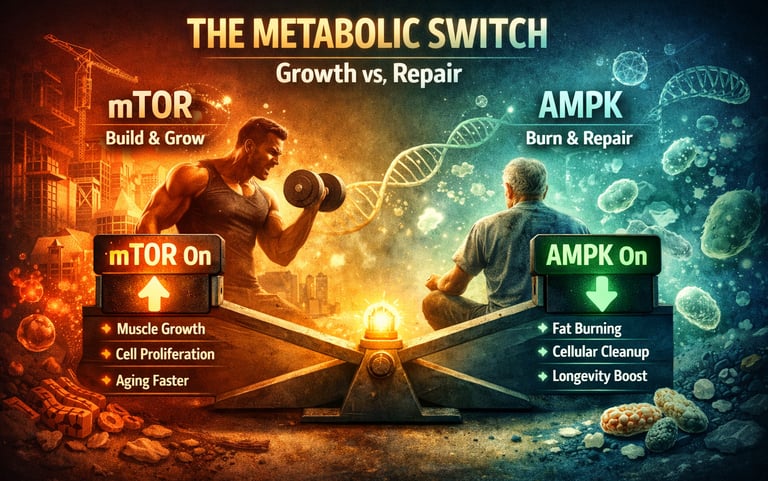
What is AMPK vs mTOR?
AMPK and mTOR are two key cellular pathways that control whether your body burns fat or builds muscle. AMPK activates during low-energy states like fasting and exercise, promoting fat burning and cellular repair. mTOR activates after eating, especially protein, supporting muscle growth and recovery. For optimal health, your body needs to switch between both states rather than staying in one continuously.
AMPK (Energy Deficit / Repair Mode)
Activated during low-energy states (fasting, exercise)
Promotes fat burning and energy production
Enhances cellular repair and autophagy
Stimulated by fasting, calorie restriction, and aerobic activity
Associated with improved longevity and metabolic health
mTOR (Energy Abundance / Growth Mode)
Activated during fed states (especially after protein intake)
Promotes muscle growth and protein synthesis
Supports cell growth and tissue repair
Stimulated by dietary protein (especially leucine) and resistance training
Chronic overactivation linked to accelerated aging and metabolic disease
Key Insight:
Optimal health depends on cycling between AMPK (repair) and mTOR (growth) rather than staying in one state continuously.
Clinical pearls
1. The "Mental Flexibility" Axis
Emerging neuro-metabolic research (2025) suggests the mTOR-AMPK axis regulates more than just muscle; it controls synaptic plasticity. mTORC1 hypofunction is now linked to depressive states and impaired fear extinction, while AMPK over-activation under chronic stress may lead to "synapse weakening" and cognitive fatigue.
Your metabolic health directly affects your mood. Just as your muscles need a "growth" signal to stay strong, your brain needs periodic mTOR activation to form new memories and stay resilient against stress. Being in a "permanent fast" or constant calorie deficit might actually make you more prone to anxiety or low mood.
2. Leucine & the "Sestrin2 Lock"
We now know Leucine doesn't just "signal" mTOR; it acts by "de-phosphorylating" a protein called Sestrin2. When Leucine is absent, Sestrin2 "locks" the GATOR2 complex, preventing mTOR from moving to the lysosome to begin protein synthesis.
Think of Sestrin2 as a security guard standing in front of your muscle-building machinery. Only Leucine has the "ID badge" to make that guard step aside. This is why sipping on "low-leucine" protein throughout the day won't build muscle—you need a high enough "pulse" of Leucine to unlock the guard and let the construction crew in.
3. The "Mitochondrial Hijack" (mTOR's Secret Job)
While we traditionally view AMPK as the sole driver of mitochondria (via PGC-1α), 2025 studies show that mTOR also promotes mitochondrial biogenesis in specific contexts. mTOR ensures that as a cell grows larger, it builds the energy infrastructure to support that new mass.
mTOR isn't just a "dumb" builder that stacks bricks; it’s also an electrician. When you lift weights (mTOR), your body doesn't just make muscles bigger—it also upgrades their internal power plants so they can handle the new workload. Growth and energy production are more "partners" than we previously thought.
4. MASLD and the "AMPK Exhaustion"
In Metabolic Dysfunction-Associated Steatotic Liver Disease (MASLD, formerly NAFLD), hepatic AMPK activity is significantly suppressed. This "AMPK exhaustion" leads to a failure of fatty acid oxidation, locking the liver into a lipogenic (fat-making) state regardless of diet.
If your liver is struggling with fat buildup, its "fuel gauge" (AMPK) is likely broken. It "thinks" it has plenty of energy, so it keeps storing fat instead of burning it. Activating AMPK through Zone 2 exercise or specific nutrients (like Berberine) helps "reset" that gauge so the liver can finally start cleaning itself out.
5. The "SASP" and Senomorphic Therapy
Chronic mTOR over-activation drives the SASP (Senescence-Associated Secretory Phenotype)—the inflammatory "toxic soup" leaked by aging cells. Inhibiting mTOR (via Rapamycin or Metformin) acts as a "senomorphic," meaning it doesn't necessarily kill the old cell, but it "muffles" its inflammatory signals.
Think of aging "zombie cells" like noisy, disruptive neighbors. Chronic growth signaling (mTOR) makes them shout louder, causing inflammation throughout your body. By "pulsing" the switch toward AMPK, you essentially put a muffler on those cells, reducing body-wide aches, pains, and "inflammaging."
6. The "Circadian Gating" of Autophagy
Autophagy (AMPK-driven) is not just a response to "not eating"; it is circadian-gated. The peak of cellular "housekeeping" naturally occurs during the late sleep phase. Late-night eating (activating mTOR via insulin/amino acids) completely disrupts this scheduled maintenance, regardless of total daily calories.
Your "cellular janitors" have a night shift. If you eat a late-night snack, you flip the switch to "Growth Mode" right when the janitors are supposed to start cleaning. Even if you fast the next morning, you've missed the primary window for deep cellular repair. To maximize AMPK, keep your "Build" mode in the daylight and your "Repair" mode at night.
Introduction: The Seesaw of Cellular Fate
What if your ability to burn fat, build muscle, and slow aging wasn’t determined by a single diet or workout—but by how efficiently your body switches between two internal states?
This ability is known as metabolic flexibility, and it is governed by two master regulators inside your cells: AMPK and mTOR. Understanding AMPK vs mTOR is no longer just an academic exercise—it is central to modern strategies for fat loss, muscle growth, and longevity.
When your body is in a low-energy state—such as during AMPK fasting, caloric restriction, or aerobic exercise—AMPK (AMP-activated protein kinase) is activated. This pathway enhances fat oxidation, improves insulin sensitivity, and stimulates cellular repair processes like autophagy fasting, where damaged proteins and organelles are recycled to maintain cellular health (Audet-Walsh et al., 2021). These AMPK benefits extend beyond metabolism, influencing mitochondrial function, inflammation, and even aging trajectories.
In contrast, after you eat—especially protein-rich meals—mTOR (mechanistic target of rapamycin) becomes dominant. This pathway drives mTOR muscle growth by stimulating protein synthesis, promoting cell growth, and supporting recovery after resistance training. Without adequate mTOR activation, muscle mass declines, metabolic rate slows, and the risk of frailty increases with age (Jeong, 2025).
However, the story becomes more complex when these pathways are chronically activated in the wrong context. Persistent mTOR signaling—often driven by excess calories, frequent eating, and sedentary behaviour—is strongly associated with mTOR aging, insulin resistance, and increased risk of cancer. On the other hand, insufficient mTOR activation can impair muscle maintenance and physical resilience (Smiles et al., 2024).
This is why the goal is not to maximize one pathway, but to strategically alternate between them. Interventions such as intermittent fasting, exercise, and targeted use of AMPK activators (e.g., metformin or berberine) and mTOR inhibitors (e.g., rapamycin in clinical contexts) are now being studied as tools to restore this balance (Mingzheng & You, 2025).
In essence, your metabolic health depends on timing: knowing when to switch on fat burning and repair, and when to activate growth and rebuilding.
Part I: Defining the Players
mTOR — The Growth Engine
mTOR (Mammalian Target of Rapamycin) is a protein kinase that acts as your body's "general contractor." When nutrients — particularly amino acids and glucose — are plentiful, and when insulin and IGF-1 (Insulin-like Growth Factor 1) signal abundance, mTOR fires up anabolic processes:
Protein synthesis via ribosome biogenesis
Cell proliferation and tissue growth
Lipid synthesis for new cell membranes
Think of mTOR as the signal your body receives after a protein-rich meal or an intense resistance training session. It says: "Resources are available. Build."
mTOR exists in two functional complexes — mTORC1 and mTORC2. For most longevity and metabolic discussions, mTORC1 is the primary focus, as it is the direct regulator of protein synthesis and autophagy suppression (Smiles et al., 2024).
AMPK — The Fuel Gauge
AMPK (AMP-activated Protein Kinase) operates on the opposite principle. It is activated when cellular energy is low — specifically when the ratio of AMP (adenosine monophosphate) to ATP (adenosine triphosphate) rises. This happens during:
Fasting or caloric restriction
Intense aerobic exercise
Hypoxia (low oxygen)
Cellular stress
When AMPK is active, it puts the brakes on energy-consuming anabolic processes and accelerates energy-generating pathways:
Fatty acid oxidation (burning fat for fuel)
Enhanced glucose uptake into muscle cells
Mitochondrial biogenesis (building new energy-producing organelles)
Autophagy — the cellular clean-up process
As Mingzheng and You (2025) note in their analysis of aging muscle physiology, the AMPK/mTOR balance is central to how muscle responds to metabolic stress, particularly in the context of age-related insulin resistance.
The Zero-Sum Game
Here is the critical insight: mTOR actively suppresses AMPK, and AMPK actively suppresses mTOR. They are not simply different pathways — they are mutually inhibitory switches. When one is dominant, the other is diminished.
Smiles et al. (2024) provide an elegant mechanistic overview of this crosstalk, demonstrating that mTORC1 phosphorylates and inhibits upstream AMPK activators, while AMPK phosphorylates TSC2 (a tumor suppressor protein) to dampen mTORC1 activity. The molecular cross-talk is bidirectional and precise.
Part II: Growth vs. Repair Biology
The Anabolic State: What mTOR Builds
When mTOR is dominant, your body enters a feast-mode biology:
mTOR-Driven Process Biological Outcome Ribosome biogenesis More protein-making machinery S6K1 & 4EBP1 phosphorylation Translation of structural proteins Inhibition of autophagy Preservation of existing cellular structures Lipid synthesis New cell membrane construction
This is the biology of growth, repair of acute muscle damage, and recovery. It is essential — without periodic mTOR activation, you cannot build or maintain muscle, cannot recover from injury, and cannot grow new tissue.
Jeong (2025) provides a thorough literature review confirming that mTOR signaling, particularly through the PI3K/Akt/mTOR pathway, is indispensable for skeletal muscle hypertrophy. Both mechanical loading (resistance exercise) and nutritional inputs (leucine, in particular) are potent mTOR activators in muscle tissue.
The Catabolic State: What AMPK Cleans
When AMPK dominates, your body enters conservation and maintenance mode:
Autophagy: The Body's Cellular Housekeeping
Autophagy — literally "self-eating" — is one of AMPK's most important downstream effects. When AMPK inhibits mTOR, it releases the brake on autophagy, allowing cells to:
Break down and recycle misfolded proteins (implicated in Alzheimer's and Parkinson's disease)
Eliminate damaged mitochondria (mitophagy)
Clear out dysfunctional organelles
Recycle amino acids for critical functions during nutrient scarcity
Think of autophagy as your cellular immune system — constantly pruning the weak and dysfunctional to keep the whole system operating efficiently.
Mitochondrial Biogenesis
AMPK activates PGC-1α, the master regulator of mitochondrial biogenesis. More mitochondria means better energy production, improved endurance capacity, and greater metabolic flexibility. This is one of the primary reasons Zone 2 aerobic training and caloric restriction have such profound anti-aging effects.
Audet-Walsh et al. (2021) highlight that both AMPK and mTOR extend their influence far beyond simple signaling — they directly regulate transcriptional programs that determine whether a cell invests in growth or stress resistance.
Part III: The Muscle vs. Longevity Paradox
This is where the science gets genuinely fascinating — and personally relevant.
The Case for mTOR (Muscle, Strength, and Metabolic Rate)
Sarcopenia — the progressive loss of muscle mass with age — is one of the most underappreciated health crises of our time. Muscle is not simply cosmetic. It is your:
Metabolic engine (the primary site of glucose disposal)
Longevity organ (associated with reduced all-cause mortality in multiple cohort studies)
Skeletal protector (reduced fall risk, fracture prevention)
Reservoir of amino acids for immune function
Without adequate mTOR activation through resistance training and sufficient protein intake, muscle mass declines, insulin sensitivity worsens, and metabolic health deteriorates. Chronic under-activation of mTOR in muscle tissue accelerates frailty.
The Case for AMPK (Longevity, Cancer Prevention, and Cellular Repair)
Yet chronic, unrelenting mTOR activation carries serious long-term costs:
Cancer promotion: mTOR drives uncontrolled cellular proliferation when chronically elevated — it is hyperactivated in many cancer subtypes
Accelerated aging: mTOR suppresses autophagy, allowing cellular debris to accumulate — a hallmark of neurodegeneration
Insulin resistance: Chronic mTOR/S6K1 signaling creates a negative feedback loop that impairs insulin receptor sensitivity
Suppressed immune surveillance: Reduced autophagy impairs the immune system's ability to identify and clear abnormal cells
This is why populations with chronically elevated IGF-1 (a major mTOR activator) and insulin levels — often reflective of excess caloric intake and sedentary behavior — face elevated risks of metabolic disease and certain cancers.
The Resolution: Metabolic Flexibility
The answer is not to permanently favor one pathway over the other. It is to develop what researchers call metabolic flexibility — the capacity to efficiently cycle between anabolic (mTOR-dominant) and catabolic (AMPK-dominant) states.
Leung and Rangamani (2023) model this dynamic elegantly in their computational analysis of AMPK and mTOR crosstalk in glutamatergic synapses, demonstrating that the precise timing and amplitude of calcium signals — themselves responsive to activity and nutrition — determine which pathway predominates. This supports the concept that timing is everything in metabolic signaling.
Part IV: Clinical Applications and Intervention Strategies
Pharmacological Tools
Metformin: The AMPK Activator
Metformin, the world's most prescribed diabetes medication, works primarily by activating AMPK in liver cells, which reduces hepatic glucose production and improves insulin sensitivity. Beyond its glycemic effects, metformin has attracted enormous longevity research interest.
The TAME (Targeting Aging with Metformin) trial — the first FDA-approved clinical trial specifically targeting the biology of aging — is testing whether metformin can delay the onset of age-related diseases. The hypothesis is grounded in AMPK biology: by chronically nudging the balance toward the AMPK/repair axis, metformin may slow multiple aging pathways simultaneously.
Patient Note: Metformin is a prescription medication. Discuss its appropriateness for your individual situation with your physician, particularly if you are not diabetic.
Rapamycin: The mTOR Inhibitor
Rapamycin (sirolimus) directly inhibits mTORC1 and has demonstrated life extension in multiple animal models, including mice. In longevity circles, low-dose rapamycin is gaining traction as a potential geroprotective agent, though robust human longevity trial data remain limited.
The challenge with rapamycin is its immunosuppressive effects at therapeutic doses (it was originally developed as an anti-rejection drug for organ transplants), and the complex, sometimes paradoxical effects of long-term mTORC2 inhibition.
Patient Note: Rapamycin is not currently approved for healthy aging in humans. Its use outside of transplant medicine is off-label and should only be considered under close medical supervision.
Lifestyle Interventions: The Safer Path
For most people, lifestyle interventions offer the most accessible and evidence-supported tools for cycling between AMPK and mTOR states.
1. Time-Restricted Feeding (TRF) / Pulsed Fasting
Compressing your eating window to 8–10 hours (e.g., 10 AM to 6 PM) creates a natural AMPK-dominant fasting phase each night and morning. During the fasted state:
mTOR activity falls as amino acid and insulin signaling subsides
AMPK rises in response to declining ATP ratios
Autophagy is upregulated, clearing cellular debris
Fat oxidation increases
Crucially, when you do eat — particularly a leucine-rich, protein-dense meal — you re-activate mTOR for muscle protein synthesis. This pulsed cycling is metabolically ideal for both muscle retention and longevity.
Practical Application:
Target a 14–16-hour
fast (including sleep)
Break your fast with a protein-rich meal (30–40g high-quality protein)
Space protein intake across 2–3 meals within your eating window
2. Exercise Specificity: Using the Right Tool for the Right Job
Exercise Type Primary Pathway Key Benefit Heavy Resistance Training mTOR → Muscle protein synthesis Muscle mass, strength, metabolic rate Zone 2 Aerobic (conversational pace) AMPK → Mitochondrial biogenesis Fat oxidation, insulin sensitivity, VO₂ max High-Intensity Interval Training (HIIT) Both (sequentially) Metabolic flexibility, cardiovascular fitness
Mingzheng and You (2025) emphasize that regular physical activity — particularly the combination of resistance and aerobic exercise — is the most powerful physiological tool for restoring AMPK/mTOR balance in aging muscle, partially reversing the insulin resistance and impaired AMPK signaling that characterizes sarcopenic aging.
Practical Application:
Aim for 3–4 resistance training sessions per week (mTOR stimulus)
Add 2–3 Zone 2 sessions of 30–60 minutes (AMPK stimulus)
Consume 30–40g of protein within 1–2 hours post-resistance training to maximize the mTOR anabolic window
3. Phytocompounds: Natural Metabolic Modulators
Several plant-derived compounds have demonstrated meaningful AMPK-activating or mTOR-modulating effects:
Berberine — Perhaps the most clinically impressive natural AMPK activator, berberine has been compared to metformin in small head-to-head trials for its effects on blood glucose and insulin sensitivity. It activates AMPK through inhibition of mitochondrial complex I.
Resveratrol — Found in red grape skin, resveratrol activates SIRT1 (a sirtuin deacetylase), which in turn activates AMPK and suppresses mTOR. Its bioavailability in standard dietary amounts is low, but concentrated supplementation has shown effects on metabolic markers.
Quercetin — A flavonoid with senolytic properties (clearing senescent "zombie" cells), quercetin also modulates AMPK/mTOR signaling and has shown benefit in reducing inflammatory markers associated with chronic mTOR overactivation.
Patient Note: Supplements interact with medications and individual biochemistry. Always discuss new supplements with your healthcare provider, especially if you are on medications affecting glucose, blood pressure, or immune function.
Part V: Biomarkers and the Longevity Blueprint
Tracking Your Metabolic Switch: Key Biomarkers
Biomarker What It Tells You Optimal Direction Fasting Insulin Degree of insulin (mTOR) signaling at baseline Low (< 5 µIU/mL ideal) HbA1c 3-month average blood glucose exposure < 5.4% (metabolically optimal) IGF-1 Systemic mTOR activation signal Moderate (not suppressed, not excessive) Fasting Glucose Immediate glycemic status 70–85 mg/dL (fasting) Triglycerides Lipid metabolism efficiency < 100 mg/dL
The Longevity Blueprint: Timing is the Intervention
The core framework is elegantly simple:
Fast overnight (14–16 hours) → AMPK rises, autophagy activates, repair mode engages
Train in a fasted or semi-fasted state → Amplifies AMPK response, maximizes mitochondrial signal
Breakfast with protein post-training → Triggers mTOR precisely when muscle is most receptive
Eat protein-rich, whole-food meals within a compressed window → Sustains anabolic signaling without chronic elevation
Repeat → Metabolic flexibility deepens over weeks and months
This framework does not require pharmaceutical intervention for most healthy individuals. It leverages evolutionary biology — your cells are exquisitely designed to alternate between feast and famine states. Modern chronic nutrition (constant snacking, ultra-processed foods, sedentary behavior) locks you into a chronically mTOR-dominant, AMPK-suppressed state. The intervention is, in many ways, simply removing the obstacle.
Frequently Asked Questions (FAQs)
Q1: Can I activate AMPK and mTOR at the same time?
Not simultaneously at maximum levels — they are mutually inhibitory. However, you can activate them sequentially within the same day: fasting and aerobic exercise activate AMPK, while post-workout protein and resistance training then trigger mTOR. This sequential cycling is the goal of metabolic flexibility training.
Q2: Is a high-protein diet bad for longevity because it activates mTOR?
This is a nuanced question. Chronically elevated mTOR from excess protein and calories (especially in the absence of exercise) is associated with accelerated aging. However, adequate protein intake combined with resistance exercise produces pulsed mTOR activation, which builds muscle without the chronic inflammatory mTOR tone that causes harm. Context, timing, and quantity all matter.
Q3: Should I take metformin even if I'm not diabetic?
This is an active area of research (see: TAME trial). Some longevity-focused physicians prescribe low-dose metformin to non-diabetic patients based on its AMPK-activating effects. However, metformin may blunt some of the adaptation signals from exercise (particularly mitochondrial biogenesis). This is a decision that should be made with your physician, considering your individual metabolic health, goals, and risk profile.
Q4: How long does it take to improve metabolic flexibility?
Most people notice meaningful improvements in energy stability, appetite regulation, and exercise performance within 4–8 weeks of consistently implementing time-restricted feeding combined with regular aerobic and resistance training. Biomarker improvements (fasting insulin, triglycerides) are often measurable within 8–12 weeks.
Q5: Is intermittent fasting safe for everyone?
Intermittent fasting (TRF) is not appropriate for everyone. Individuals with a history of disordered eating, those who are pregnant or breastfeeding, people with type 1 diabetes or those on insulin/sulfonylureas (hypoglycemia risk), and those who are underweight should approach fasting with caution and under medical guidance. Always consult your healthcare provider before making significant dietary changes.
Q6: What is the relationship between AMPK and cancer?
AMPK is generally considered a tumor suppressor pathway — it activates TSC2 and other mechanisms that inhibit uncontrolled proliferation. Chronic mTOR activation, conversely, is associated with cancer progression in multiple tumor types. This is one reason why lifestyle factors that chronically suppress AMPK (sedentary behavior, obesity, chronic hyperinsulinemia) are associated with elevated cancer risk, while exercise and caloric restriction — potent AMPK activators — are associated with reduced cancer incidence.
Q7: Do I need supplements like berberine or resveratrol to balance AMPK and mTOR?
No. Lifestyle interventions — particularly regular exercise, time-restricted feeding, adequate sleep, and whole-food nutrition — produce robust AMPK/mTOR cycling without supplementation. Phytocompounds like berberine may offer additional benefit, particularly for individuals with metabolic dysfunction, but they are adjuncts, not replacements, for foundational lifestyle practices.
Q8 . Is AMPK or mTOR better for health?
Neither is “better”—both are essential. AMPK supports fat burning, cellular repair, and longevity, while mTOR is crucial for muscle growth and recovery. Problems arise when one pathway stays constantly active. The healthiest approach is to cycle between them through fasting, exercise, and balanced nutrition.
Summary: Engineering Your Metabolic Balance
The AMPK/mTOR axis is not a problem to be solved — it is a dial to be calibrated. The goal is not permanent AMPK dominance (frailty, muscle loss) nor permanent mTOR dominance (accelerated aging, metabolic disease), but the dynamic cycling between these states that mirrors the feast-famine, activity-rest cycles our biology evolved within.
The research of Smiles et al. (2024), Jeong (2025), Audet-Walsh et al. (2021), Mingzheng and You (2025), and Leung and Rangamani (2023) collectively paint a coherent picture: metabolic health is not a fixed state but a capacity — the capacity to shift efficiently between growth and repair as circumstances demand.
How to Activate AMPK Naturally
Intermittent fasting (12–16 hours)
Aerobic exercise (walking, Zone 2 cardio)
Calorie restriction
Low insulin levels
Compounds like berberine or metformin
AMPK helps your body burn fat and repair cells.
How to Activate mTOR for Muscle Growth
Eat protein-rich meals (especially leucine)
Do resistance training (weights)
Maintain adequate calorie intake
Get proper recovery and sleep
mTOR is essential for building muscle and strength.
Signs of Poor AMPK–mTOR Balance
Constant hunger or low energy
Difficulty losing fat
Muscle loss or weakness
Insulin resistance
Increased risk of aging-related diseases
A healthy body switches between fat-burning and muscle-building modes.
Best Daily Routine for Metabolic Balance
How to balance AMPK and mTOR daily?
Fast overnight (12–16 hours)
Exercise regularly (cardio + strength)
Eat protein after workouts
Avoid constant snacking
Sleep 7–8 hours
This improves fat loss, muscle health, and longevity. Structured fasting windows (14–16 hours)
Best Time to Activate AMPK vs mTOR
Morning → AMPK (fasted state)
Post-workout → mTOR
Night → AMPK (autophagy phase)
Call to Action: Your Next Step Toward Metabolic Mastery
Understanding the AMPK/mTOR switch is the beginning — applying it is where transformation happens.
Here's how to take action today:
Step 1: Know Your Numbers
Request a basic metabolic panel from your physician that includes fasting insulin, HbA1c, IGF-1, and a lipid panel. These four biomarkers give you a real-time snapshot of where your AMPK/mTOR balance currently sits.
Step 2: Start a 14-Hour Fasting Window
Begin with a simple 10 PM to 12 PM fast (14 hours). No supplements required — just compress your eating window. Track energy, hunger patterns, and mental clarity over 4 weeks.
Step 3: Match Your Training to Your Goals
If muscle building is your priority, → prioritize resistance training + post-workout protein. If longevity and metabolic health are your focus → add Zone 2 cardio sessions 2–3x/week.
This article is for educational purposes only and does not constitute medical advice. Always consult a qualified healthcare professional before making changes to your diet, exercise program, or medication regimen.
Author’s Note (Clinician’s Perspective)
As a physician working at the intersection of internal medicine, metabolism, and exercise physiology, I have come to view the AMPK–mTOR axis not merely as a biochemical curiosity, but as a unifying clinical framework for understanding modern chronic disease.
In day-to-day practice, we often treat conditions like type 2 diabetes, obesity, sarcopenia, and cardiovascular disease as separate entities. Yet at a cellular level, many of these disorders share a common root: a loss of metabolic flexibility—the inability to appropriately transition between anabolic (mTOR-driven) and catabolic (AMPK-driven) states.
What I find most compelling is that this framework bridges molecular biology with real-world interventions. The same pathways discussed in high-impact journals are directly influenced by everyday clinical prescriptions: meal timing, protein intake, physical activity, sleep, and pharmacotherapy. When a patient adopts time-restricted feeding, engages in resistance training, or improves insulin sensitivity, they are not just “changing lifestyle”—they are actively reprogramming intracellular signaling networks.
However, it is equally important to avoid reductionism. AMPK is not inherently “good,” nor is mTOR inherently “bad.” Both are essential. Chronic suppression of mTOR leads to frailty and muscle loss; chronic activation contributes to insulin resistance and accelerated aging. The goal, therefore, is not to favor one pathway, but to restore physiological oscillation between them—a rhythm that modern lifestyles have largely disrupted.
From a clinical standpoint, this shifts our role from simply managing biomarkers to engineering metabolic environments. The question is no longer just “What is the patient’s glucose or HbA1c?” but “Is their biology capable of switching between growth and repair when required?”
This article reflects an attempt to translate that deeper understanding into a framework that is both scientifically rigorous and clinically actionable.
Share this article with someone navigating metabolic health, diabetes management, or healthy aging — the AMPK/mTOR framework applies across all these contexts.
Comment below (or reach out directly): Which intervention are you most curious about — time-restricted feeding, exercise specificity, or pharmacological tools like metformin? Your question may become the basis of our next deep-dive article.
“If you’re new to this topic, start with this simplified explanation…”AMPK vs mTOR: The Molecular Switch That Controls Muscle, Fat Loss, and Aging | DR T S DIDWAL
This article is intended for educational purposes only and does not constitute medical advice. Always consult a qualified healthcare provider before beginning a new exercise or nutrition program, especially if you have an existing medical condition.
Related Articles
mTOR, Protein, and Autophagy: How to Build Muscle Without Compromising Longevity
The mTOR Switch: Why Your Cells Stopped Listening to Insulin | DR T S DIDWAL
Can Resistance Training Reverse Diabetes? The Muscle–mTOR Link | DR T S DIDWAL
References
Audet-Walsh, É., Vernier, M., & Viollet, B. (2021). Editorial: AMPK and mTOR beyond signaling: Emerging roles in transcriptional regulation. Frontiers in Cell and Developmental Biology, 8, 641552. https://doi.org/10.3389/fcell.2020.641552
Jeong, S. Y. (2025). The role of mammalian target of rapamycin (mTOR) and adenosine monophosphate-activated protein kinase (AMPK) signaling in skeletal muscle hypertrophy: A literature review with implications for health and disease. Cureus, 17(11), e96018. https://doi.org/10.7759/cureus.96018
Leung, A., & Rangamani, P. (2023). Computational modeling of AMPK and mTOR crosstalk in glutamatergic synapse calcium signaling. npj Systems Biology and Applications, 9, 34. https://doi.org/10.1038/s41540-023-00295-4
Mingzheng, X., & You, W. (2025). AMPK/mTOR balance during exercise: Implications for insulin resistance in aging muscle. Molecular and Cellular Biochemistry, 480, 5941–5953. https://doi.org/10.1007/s11010-025-05362-4
Smiles, W. J., Ovens, A. J., Kemp, B. E., Galic, S., Petersen, J., & Oakhill, J. S. (2024). New developments in AMPK and mTORC1 cross-talk. Essays in Biochemistry, 68(3), 321–336. https://doi.org/10.1042/EBC20240007