mTOR, Protein & Autophagy: How to Build Muscle Without Compromising Longevity
Learn how to balance mTOR activation and autophagy to build muscle without sacrificing longevity. Evidence-based protein timing, fasting, and training guide. (
AGING
Dr. T.S. Didwal, M.D.(Internal Medicine)
6/10/202625 min read
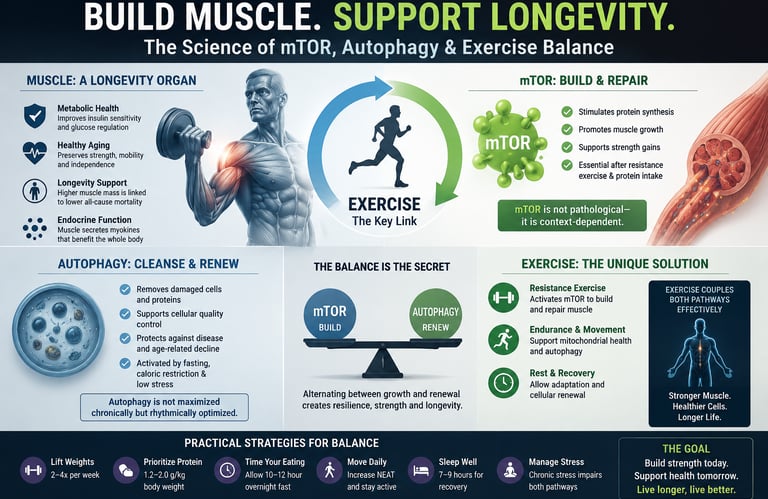
Can you build muscle and support longevity at the same time?
Yes. Current research shows that muscle growth and longevity are not opposing goals. Skeletal muscle acts as a longevity organ that supports metabolic health, glucose regulation, and healthy aging. The key is balancing mTOR activation, which drives muscle growth and repair, with autophagy, which removes damaged cellular components. Resistance exercise uniquely stimulates both pathways, while strategic protein intake and overnight fasting help maintain metabolic flexibility. Rather than maximizing either pathway continuously, the healthiest approach is to alternate between periods of growth and cellular renewal, allowing the body to build stronger tissues while preserving long-term health and function.
Clinical Interpretation: Why the mTOR–Autophagy Balance May Be the Foundation of Healthy Aging
1. Skeletal Muscle Is Emerging as a Major Longevity Organ
Modern geroscience increasingly recognizes skeletal muscle as far more than a tissue responsible for movement. Muscle functions as an endocrine organ that releases myokines, regulates glucose disposal, supports mitochondrial health, and influences systemic inflammation. Numerous studies show that higher muscle mass and strength are associated with lower all-cause mortality, improved metabolic health, greater functional independence, and healthier aging. Preserving muscle should therefore be viewed as a longevity strategy rather than merely an aesthetic goal.
2. mTOR Is Not the “Aging Pathway” It Is Often Portrayed to Be
mTOR is frequently misunderstood as a harmful pathway because chronic overactivation is linked to aging-related diseases. In reality, mTOR is an essential biological regulator that drives muscle protein synthesis, tissue repair, immune function, and recovery from exercise. The problem is not mTOR activation itself but persistent activation in the absence of physical activity and metabolic recovery periods.
3. Autophagy Is a Cellular Maintenance System, Not a Goal to Maximize
Autophagy serves as the body's quality-control mechanism by removing damaged proteins, dysfunctional mitochondria, and cellular debris. However, excessive autophagy can contribute to muscle loss and impaired physical function. Current evidence suggests that optimal health depends on maintaining sufficient autophagic activity rather than continuously maximizing it.
4. Health Depends on Metabolic Flexibility
One of the strongest themes emerging from recent research is the importance of metabolic flexibility—the ability to transition efficiently between anabolic (growth) and catabolic (repair) states. Healthy individuals can activate mTOR after protein intake and exercise while also engaging autophagy during fasting and recovery periods. Loss of this flexibility is associated with obesity, insulin resistance, and accelerated biological aging.
5. Exercise Creates a Unique Biological State
Unlike nutrition or fasting alone, exercise activates multiple signaling pathways simultaneously. Resistance training stimulates mTOR-driven muscle growth, while energetic stress generated during exercise activates AMPK and autophagic pathways. Emerging evidence suggests that exercise-induced lactate may further modulate this interaction, creating a physiological environment where growth and repair coexist.
6. Protein Intake Should Be Pulsed Rather Than Constant
Clinical evidence increasingly supports consuming adequate protein in distinct meals rather than continuous grazing throughout the day. Well-spaced protein-rich meals produce strong anabolic responses while allowing periods of lower nutrient signaling between meals. This pattern appears to support both muscle maintenance and cellular housekeeping mechanisms.
7. Aging Increases the Need for Strategic mTOR Activation
Older adults experience anabolic resistance, meaning muscles become less responsive to protein and exercise. As a result, higher protein doses, adequate leucine intake, and regular resistance training become increasingly important with age. Simultaneously, preserving autophagic capacity becomes critical for maintaining mitochondrial quality and preventing sarcopenia.
8. The Future of Longevity Is Rhythmic Biology, Not Constant Restriction
The latest evidence suggests that longevity is not achieved by permanently suppressing growth pathways or continuously activating repair pathways. Instead, optimal aging appears to depend on rhythmic biological cycling: periods of feeding, protein intake, and exercise stimulate growth, while fasting, recovery, and sleep facilitate repair. This oscillation between mTOR-driven anabolism and autophagy-driven renewal may represent one of the central principles of healthy aging and lifespan extension.
The latest research suggests that longevity is not achieved by constantly suppressing mTOR or maximizing autophagy. Instead, healthy aging depends on metabolic flexibility—the ability to alternate between growth and repair states through protein intake, exercise, fasting, and recovery. This rhythmic balance supports muscle preservation, mitochondrial health, and long-term metabolic resilience.
What if the two goals you assumed were opposites — building muscle and living a long, healthy life — were actually designed to work together?
For years, researchers studying longevity warned that activating mTOR, the molecular switch that drives muscle growth, might accelerate cellular aging. Meanwhile, athletes and coaches were told to maximize protein and keep anabolic signals running as high as possible, as often as possible. Both camps were partially right. Both were also missing the bigger picture.
The latest 2025–2026 research is resolving this tension in a way that changes how we think about protein, fasting, and training. The emerging science is clear: your body does not thrive by staying permanently in growth mode or permanently in repair mode. It thrives on the rhythmic alternation between the two.
This article breaks down the complete science of mTOR signaling, autophagy, and protein intake — and translates it into a practical, evidence-based framework you can apply starting today. Whether you're a competitive athlete, an older adult worried about muscle loss, or someone who simply wants to feel strong and energized for decades, this guide is built for you.
What you'll learn:
Exactly what mTOR does — and why chronic activation is dangerous
How autophagy protects your cells, muscles, and metabolic health
The optimal amount and timing of protein for muscle growth without longevity trade-offs
A 2025 breakthrough showing exercise creates a unique signaling state neither fasting nor diet alone can replicate
A practical daily framework with meal templates, training guidelines, and population-specific adjustments
1. What Is mTOR? The Molecular Switch Explained
mTOR stands for mechanistic target of rapamycin. It is a protein kinase — a molecular on/off switch embedded inside virtually every cell in your body — that integrates signals from nutrients, hormones, and physical stress to decide whether your cells should grow, divide, or repair.
mTOR exists in two distinct multi-protein complexes: mTORC1 and mTORC2. For muscle building and cellular longevity, mTORC1 is the central player. When activated, mTORC1 drives:
Muscle protein synthesis (MPS): The construction of new contractile proteins
Ribosomal biogenesis: Building the cellular machinery needed to manufacture proteins at scale
Cell growth and proliferation
Suppression of autophagy (cellular cleanup — more on this shortly)
How mTOR Gets Activated
The Three Primary Activation Signals
mTORC1 is turned on by three main inputs, which often work together after a meal or a workout:
Amino Acids (Specifically Leucine): Sourced from dietary protein, leucine activates Rag GTPases, which physically recruit mTORC1 to the surface of the lysosome.
Insulin / IGF-1: Triggered by carbohydrate intake and growth hormone, this activates the PI3K–Akt signaling pathway.
Mechanical Tension: Stimulated by resistance exercise, this activates mTORC1 via the Rheb GTPase and PI3K pathways.
The Activation Cascade (Step-by-Step)
When you eat a protein-rich meal and exercise, the following process takes place inside your muscle cells:
Leucine Delivery: Leucine from the digested protein enters the muscle cells.
Lysosomal Docking: This influx triggers a cellular cascade that causes mTORC1 to dock directly onto the surface of lysosomes (the organelles usually responsible for degrading cellular waste).
Downstream Targeting: Once docked and activated, mTORC1 turns on two primary downstream targets:
S6K1
4E-BP1
Muscle Protein Synthesis: The activation of these two targets collectively ramps up the translation of new muscle proteins, leading to muscle growth and repair.
Key Insight: A 2023 review in the International Journal of Molecular Sciences (Han et al.) confirmed that mTOR functions as a multi-layer metabolic integrator, not simply a protein synthesis switch. It simultaneously coordinates energy sensing, ribosomal capacity, and mitochondrial function — meaning its role extends far beyond building muscle.
2. What Is Autophagy? Your Body's Cellular Cleanup Crew
Autophagy — from the Greek autos (self) + phagein (to eat) — is the process by which your cells identify, dismantle, and recycle damaged proteins, dysfunctional organelles, and accumulated cellular debris. Far from being destructive, autophagy won the 2016 Nobel Prize in Physiology or Medicine because it is one of the most fundamental survival mechanisms in human biology.
In skeletal muscle specifically, autophagy serves three irreplaceable functions:
Proteostasis maintenance: Removes misfolded proteins before they accumulate into toxic aggregates linked to neurodegenerative and metabolic disease
Mitophagy: A specialized form of autophagy that selectively eliminates dysfunctional mitochondria — the energy factories of your cells — and triggers the production of healthier replacements
Stress adaptation: Selectively clears cellular structures that are no longer functional after intense training or metabolic stress
Research highlight: Han et al. (2023) in the International Journal of Molecular Sciences demonstrated that both insufficient AND excessive autophagy lead to skeletal muscle dysfunction — confirming that autophagy is not "more is always better," but must be dynamically balanced with anabolic signaling.
Zorzano et al. (2020) further showed that autophagy is tightly coupled to energy metabolism in muscle, acting as a critical regulator of metabolic flexibility — your muscle's ability to efficiently switch between fat and carbohydrates as fuel. Loss of autophagic capacity is now strongly associated with:
Insulin resistance and type 2 diabetes
Metabolic syndrome
Age-related muscle wasting (sarcopenia)
Accelerated cellular aging
3. The mTOR–Autophagy Axis: Why Balance Is Everything
Here is the central biological tension this article is built around: mTOR and autophagy directly inhibit each other.
When mTOR is active, it phosphorylates and inactivates ULK1 — the enzyme that initiates autophagy. When energy falls (as detected by the cellular energy sensor AMPK during fasting or intense exercise), AMPK simultaneously shuts down mTOR and activates ULK1, switching the cell from growth mode into repair mode.
Phase 1: The Anabolic "Building" State (Fed)
Catalyst: High amino acid and insulin availability
Active pathway: mTORC1 → S6K1, 4E-BP1
Result: Muscle protein synthesis increases; autophagy is suppressed
Optimal duration: 3–5 hours post-meal
Phase 2: The Catabolic "Cleanup" State (Fasted or Exercising)
Catalyst: Low energy availability; elevated AMP-to-ATP ratio
Active pathway: AMPK → ULK1 → autophagosome formation
Result: Cellular debris cleared; mitochondrial quality restored
Optimal duration: 12–16 hours overnight; augmented during aerobic exercise
The Critical Principle: Metabolic Oscillation
Health is not defined by how much time you spend in either state. It is defined by how fluidly your body transitions between them — a property researchers call metabolic flexibility.
Chronic overnutrition (particularly with physical inactivity) locks the cellular switch in "growth mode." The result is accumulated cellular clutter, impaired mitochondrial turnover, insulin resistance, and accelerated biological aging. This is the biological mechanism underlying what the research identifies as the most dangerous modern lifestyle pattern: overeating + sedentary behavior.
⚠️ The key distinction: The concern is not acute post-meal mTOR activation. It is chronic, uninterrupted mTOR dominance across the entire day and night. This distinction matters enormously for interpreting protein and fasting recommendations correctly.
4. How Much Protein Do You Actually Need?
This is among the most searched questions in sports nutrition — and the evidence-based answer is more nuanced than most popular articles suggest.
The current consensus from multiple meta-analyses, including the landmark 2018 systematic review by Morton et al. in the British Journal of Sports Medicine (the largest of its kind, covering 49 studies and 1,800 participants), places the average effective dose for muscle protein synthesis in resistance-trained adults at approximately 1.6 g of protein per kilogram of body weight per day (g/kg/day).
Beyond this, additional protein yields diminishing returns for most people — though individuals in a caloric deficit or under heavy training loads may benefit from up to 2.2 g/kg/day.
Protein Intake Targets by Population
Here is a clean, structured breakdown of daily protein targets tailored to specific physical demands, age groups, and metabolic goals:
Performance & Body Composition Goals
Active Adults (Maintenance)
Daily Target: 1.2–1.6 g/kg/day
Primary Goal: Support lean mass maintenance, general recovery, and optimal immune function for daily activity.
Resistance Athletes
Daily Target: 1.6–2.2 g/kg/day
Primary Goal: Maximize muscle hypertrophy (growth) and accelerate heavy tissue repair from strength training.
Caloric Deficit / Cutting
Daily Target: 1.8–2.4 g/kg/day
Primary Goal: Protect existing muscle tissue from catabolism (muscle breakdown) when overall energy intake is restricted.
Age-Specific & Clinical Needs
Adults 50+
Daily Target: 1.4–1.7 g/kg/day
Primary Goal: Counteract age-related anabolic resistance and proactively prevent sarcopenia (progressive muscle loss).
Clinical / Post-Surgical Recovery
Daily Target: 1.5–2.0 g/kg/day
Primary Goal: Manage hypermetabolic stress states, optimize wound healing, and support tissue regeneration during recovery.
🔑 For a 75 kg (165 lb) active adult, the practical target is approximately 120–165 g of protein per day, distributed across structured meals — not consumed continuously.
Does Very High Protein Harm Longevity?
In healthy individuals without pre-existing kidney disease, the evidence does not support the claim that intakes of 1.6–2.2 g/kg/day cause kidney damage or accelerate aging in physically active people. The nuance lies here: the major human risk factor for impaired longevity appears to be high protein intake combined with physical inactivity — not high protein in exercising individuals. The exercise context fundamentally changes how mTOR activation is interpreted by the body.
5. Protein Timing: Why When You Eat Matters as Much as How Much
Total daily protein intake matters. But a frequently overlooked body of evidence shows that how you distribute that protein across the day has an independent and significant impact on both muscle growth and cellular health.
The "Muscle Full" Phenomenon
After a protein-rich meal, muscle protein synthesis peaks and then enters a refractory period — a window during which the muscle becomes temporarily unresponsive to further amino acid stimulation, regardless of how much additional protein is consumed. This is sometimes called the "muscle full" effect.
This means:
Eating 200 g of protein in one meal is not equivalent to eating it spread across four meals
Continuous grazing — nibbling protein throughout the day — maintains mildly elevated insulin and mTOR without ever delivering the leucine spike needed to maximally stimulate MPS
You get the autophagy suppression without the full anabolic benefit
The Optimal Distribution Strategy
A 2025 review in Nutrition & Metabolism (Xinyan et al.) confirmed that structuring protein intake into 3–4 evenly spaced, leucine-rich meals per day creates discrete anabolic pulses that are more effective than continuous grazing — for both muscle building and cellular health. This spacing also preserves natural inter-meal windows during which autophagic activity can partially recover.
The practical template:
Meal 1 (breakfast): 30–40 g protein
Meal 2 (lunch): 35–45 g protein
Meal 3 (post-training or dinner): 35–45 g protein
Optional 4th meal (if total daily target requires it): 25–30 g protein
💡 Think of protein meals like watering a plant. You cannot water it continuously all day and expect better results. Three to four well-timed, leucine-rich meals are more effective than constant snacking — and they preserve the natural repair windows your cells depend on.
6. The Leucine Threshold: The Key to Triggering Muscle Protein Synthesis
Not all amino acids are equally anabolic. Leucine is the primary trigger for mTORC1 activation in muscle, and research consistently shows that a threshold of approximately 2.5–3.0 grams of leucine per meal is required to maximally stimulate MPS. Below this threshold, the anabolic "switch" is never fully thrown.
In practical terms, this threshold is reached by consuming approximately 25–40 grams of high-quality protein per sitting, depending on the leucine content of the source.
Leucine Content by Protein Source
Here is a clean, easy-to-read breakdown of how different protein sources stack up when it comes to leucine content (per 25g of total protein) and their ability to trigger Muscle Protein Synthesis (MPS):
Whey Protein (~2.7 g) — ✅ Yes: The gold standard for triggering MPS. It is highly bioavailable and easily clears the typical ~2 g "leucine trigger" threshold in a standard serving.
Eggs (Whole) (~2.2 g) — ✅ Yes: Excellent source. The leucine content, combined with the high biological value of whole eggs, efficiently stimulates muscle repair.
Chicken Breast (~2.1 g) — ✅ Yes: A staple lean protein that comfortably hits the leucine threshold required to signal muscle growth.
Salmon (~2.0 g) — ✅ Yes: Right on the sweet spot for the leucine trigger, with the added benefit of anti-inflammatory omega-3 fatty acids.
Soy Protein (~1.9 g) — ✅ Yes (at adequate dose): Just borders the threshold. While a standard 25g dose can work, slightly larger servings ensure a robust MPS response compared to animal proteins.
Rice + Lentils Combined (~1.8 g) — ✅ Yes (combined): Pairing a grain and a legume creates a complementary amino acid profile that elevates the total leucine content closer to the trigger zone.
Lentils Alone (~0.9 g) — ⚠️ Requires larger serving: On its own, a standard 25g protein serving of lentils falls short of the leucine trigger. You would need to eat a significantly larger portion size to get enough leucine to optimize muscle synthesis.
The Takeaway
The key to muscle growth isn't just total protein; it's hitting that ~2.0 g to 2.5 g leucine threshold in a single sitting. Animal-based sources and smart plant pairings do this effortlessly, while standalone plant sources usually require you to eat a bit more to achieve the same effect.
Plant Proteins: Do They Work?
Animal proteins (whey, eggs, meat, fish) generally have a higher leucine content and a more complete amino acid profile, giving them a slight advantage for mTORC1 activation per gram. However, plant proteins are absolutely effective — the key is ensuring sufficient leucine per meal, which may require consuming somewhat larger serving volumes or combining complementary sources (e.g., rice + lentils + tofu). At intakes of 1.6 g/kg/day from high-quality sources, plant and animal proteins produce comparable muscle-building outcomes in studies of adequate duration (Xinyan et al., 2025).
7. Fasting Windows: How Long Is Long Enough?
The idea that "intermittent fasting destroys muscle" is one of the most persistent myths in fitness culture. The science tells a more nuanced story.
A 12–16 hour overnight fast — the most widely studied and practically sustainable approach — is:
Sufficient to promote meaningful autophagic activity in most adults
Unlikely to impair muscle protein synthesis, provided total daily protein and resistance training volume are adequate
Potentially beneficial for optimizing the mTOR–autophagy axis, according to Xinyan et al. (2025) in Nutrition & Metabolism, who found that strategic intermittent fasting can actually promote skeletal muscle growth and differentiation by improving the quality of the anabolic response during feeding windows
Very long fasting periods (24+ hours), however, are generally not recommended for active individuals focused on muscle retention, as they increase the risk of net muscle protein breakdown — particularly in untrained individuals.
What Actually Triggers Autophagy in Humans?
The most well-documented autophagy inducers in human research are:
Fasting (12+ hours) — via falling insulin and mTOR activity
Caloric restriction — via AMPK activation
Endurance and HIIT exercise — via AMPK and energy stress
Fasting-mimicking diets — Espinoza et al. (2025) demonstrated in a randomized controlled trial published in GeroScience that fasting-mimicking diets can modulate autophagic markers, though the effect magnitude depends on duration and the degree of caloric restriction
⚠️ Safety note: Extended fasting protocols should be approached with medical guidance, especially in older adults, individuals with diabetes, or those with a history of eating disorders. Always consult a healthcare provider before starting any structured fasting regimen.
8. Exercise as a Dual Modulator: The 2025 Lactate Discovery
This is perhaps the most exciting development in the mTOR–autophagy field in years.
For decades, lactate was dismissed as a mere metabolic waste product — the "burn" you feel during intense exercise, produced when oxygen supply can't keep up with energy demand. A landmark 2025 study published in Cell Chemical Biology (Li et al.) has fundamentally revised this picture.
The Discovery: Lactylation of mTOR
Li et al. (2025) demonstrated that during exercise, lactate functions as a signaling molecule that directly modifies mTOR through a post-translational process called lactylation — the attachment of a lactyl group to specific amino acid residues on the mTOR protein.
Critically, this lactylation of mTOR enhances autophagic flux in skeletal muscle during exercise — meaning exercise simultaneously supports anabolic signaling AND accelerates cellular cleanup in a way that fasting alone cannot replicate.
Why This Changes Everything
Pure fasting activates autophagy by suppressing mTOR. Pure feeding activates mTOR and suppresses autophagy. Exercise modifies mTOR rather than simply switching it off — creating a hybrid signaling environment where both pathways can be engaged in a carefully regulated window.
This is a strong, mechanistic explanation for why exercise is irreplaceable in any longevity or body composition strategy. It is not just a mechanical stimulus for muscle protein synthesis. It is a biochemical context your body cannot enter through dietary manipulation alone.
⚠️ Study limitation to note: The lactate–mTOR lactylation findings from Li et al. (2025) are early-stage. While the mechanistic data is compelling, large-scale human trials confirming the magnitude and clinical significance of this effect are still needed.
9. The Danger of Chronic mTOR Overactivation
If mTOR drives muscle growth, why not keep it maximally activated at all times? Because chronically elevated mTOR — without adequate periods of autophagy — creates a cascade of downstream harms:
Consequence Mechanism Insulin resistance Persistent S6K1 activity impairs IRS-1 (insulin receptor substrate), blunting the cellular response to insulin Suppressed immune surveillance Reduced autophagic capacity impairs the clearance of intracellular pathogens and aberrant cells Accelerated cellular senescence Accumulated protein aggregates and damaged organelles trigger senescence pathways Disrupted proteostasis Inability to clear misfolded proteins — a hallmark of neurodegenerative diseases Potential cancer risk context mTOR signaling is upregulated in many cancers; chronic unregulated activation may theoretically increase risk (though note: this arises primarily from genetic mutations, not dietary protein in healthy individuals)
📌 Important context from a 2025 human study: Singh et al. (2025), published in JCI Insight, examined whether a single high-protein meal acutely changes autophagy markers in human peripheral blood mononuclear cells. Their finding — that high protein alone does not significantly alter autophagy within 1 hour — actually supports the oscillatory model. Single meals do not catastrophically suppress autophagy. It is the chronic pattern of eating (constant grazing, no fasting windows, sedentary lifestyle) that determines long-term autophagic health.
10. Evidence Summary
Key Studies at a Glance
Protein Intake & Muscle Synthesis
Morton et al. (2018) | Br J Sports Med
Key Finding: Protein intake up to 1.62 g/kg/day maximizes muscle protein synthesis (MPS) in resistance-trained adults. Consuming protein beyond this threshold results in a plateau for muscle gains.
Singh et al. (2025) | JCI Insight
Key Finding: Eating a single high-protein meal does not significantly alter autophagy (the body's cellular cleanup process) within the first hour of consumption.
The mTOR & Autophagy Balance
Deleyto-Seldas & Efeyan (2021) | Front Cell Dev Biol
Key Finding: mTOR (muscle growth signaling) and autophagy are temporarily regulated metabolic complements, rather than competing systems.
Han et al. (2023) | Int J Mol Sci
Key Finding: Muscle health requires balance; both insufficient and excessive autophagy impair proper skeletal muscle function.
Zorzano et al. (2020) | Dev Cell
Key Finding: Autophagy acts as a critical regulator of metabolic flexibility in skeletal muscle, allowing it to efficiently switch energy sources.
Exercise, Fasting & Optimization (2025 Updates)
Xinyan et al. (2025) | Nutr Metab
Key Finding: Strategic intermittent fasting actually promotes skeletal muscle growth by optimizing the relationship between mTOR and autophagy.
Li et al. (2025) | Cell Chem Biol
Key Finding: Exercise causes the lactylation of mTOR, which enhances autophagic flux. This creates a "dual-benefit" signaling state that supports both muscle adaptation and cellular cleanup simultaneously.
Espinoza et al. (2025) | GeroScience
Key Finding: Fasting-mimicking diets modulate autophagic markers in a dose- and duration-dependent manner, meaning the depth of cellular cleanup depends strictly on how long and strictly you protocol.
11. Common Myths and Mistakes
Myth 1: "Eating protein every 2–3 hours maximizes muscle growth"
The truth: Continuous protein grazing keeps insulin and mTOR moderately elevated without ever delivering the leucine spike needed to maximally stimulate MPS. You suppress autophagy without getting the full anabolic benefit. Three to four well-spaced, leucine-rich meals are more effective.
Myth 2: "Intermittent fasting destroys muscle"
The truth: A 12–16 hour overnight fast does not meaningfully impair muscle growth when total daily protein and training are adequate. In fact, the recovery and repair enabled by fasting may enhance the quality of the anabolic response during eating windows.
Myth 3: "mTOR is bad for longevity"
The truth: Acute, pulsatile mTOR activation after protein meals and resistance exercise is essential — not harmful. The pathology arises from chronic, uninterrupted activation driven by overnutrition and physical inactivity. Context is everything.
Myth 4: "More autophagy is always better"
The truth: Excessive or prolonged autophagy — especially with inadequate nutrition — can impair muscle mass and functional capacity. Han et al. (2023) confirmed that both too little and too much autophagy are harmful. Balance, not maximization, is the goal.
Myth 5: "Plant proteins can't build muscle as well as animal proteins"
The truth: At adequate intake levels (1.6 g/kg/day), high-quality plant proteins produce comparable muscle-building outcomes to animal proteins. The key is ensuring sufficient leucine per meal through volume and combination strategies.
Myth 6: "High protein diets damage kidneys"
The truth: In healthy individuals without pre-existing kidney disease, intakes of 1.6–2.2 g/kg/day are not associated with kidney damage. If you have chronic kidney disease, consult your physician before increasing protein intake.
12. Practical Framework: Your Daily Protocol
You do not need extreme dietary protocols or obsessive tracking to apply this science. The following framework integrates the best available evidence into an approach that is both effective and sustainable.
Step 1: Set Your Protein Target
Active adults: 1.6 g/kg/day
Resistance athletes: 1.6–2.2 g/kg/day (upper range during caloric deficit)
Adults 50+: 1.4–1.7 g/kg/day
Minimum floor (any population): 1.2 g/kg/day
Step 2: Distribute Across 3–4 Structured Meals
Each meal should contain 25–40 g of high-quality, leucine-rich protein. Prioritize:
Eggs and egg whites
Whey or casein protein
Chicken, turkey, or lean beef
Salmon, tuna, or other fatty fish
Greek yogurt or cottage cheese
Tofu, tempeh, or edamame
Lentils + rice (combined)
Step 3: Create a 12–16-hour overnight fasting window
The simplest implementation: finish dinner by 7–8 PM; eat breakfast at 7–9 AM. This is sufficient to promote meaningful autophagic activity for most people without requiring extreme restriction.
Step 4: Prioritize Resistance Training
Lift 3–4 times per week with progressive overload (gradually increasing weight, volume, or difficulty over time). Resistance exercise is the most potent physiological mTOR activator you have access to — and, via lactate-mediated signaling, it is also a uniquely effective autophagy enhancer.
Step 5: Include Aerobic Exercise
2–3 sessions of moderate aerobic or HIIT training per week activate AMPK and enhance autophagic signaling, improving metabolic flexibility and cardiovascular health.
Step 6: Avoid Continuous Grazing
Eating small amounts of protein throughout the day suppresses autophagy without delivering the leucine threshold needed to spike MPS. Give your body clear "on" windows (meals) and "off" windows (fasting periods).
Sample Day Template: 75 kg Individual (~120 g protein target)
Morning: Fast Break & First Fuel
7:00 AM — Fasting Window Ends
Activity: Black coffee or tea.
Detail: Gently transitions your body out of the 12–14 hour fasting window without a massive insulin spike.
8:00 AM — Meal 1: The Breakfast Base
Menu: 3 whole eggs + 200 g Greek yogurt + mixed berries.
Macronutrient Focus: ~38 g protein. This high-quality protein combo comfortably hits the leucine trigger early in the day to kickstart muscle repair.
Mid-Day: Sustained Energy & Training
1:00 PM — Meal 2: Pre-Training Fuel
Menu: 150 g chicken breast + 100 g lentils + mixed vegetables.
Macronutrient Focus: ~45 g protein. This meal pairs lean animal protein with complex carbs from lentils, providing sustained energy for your afternoon workout.
4:30 PM — Training Session
Activity: 45–60 minutes of resistance training, followed immediately by 15 minutes of aerobic cardio.
Evening: Recovery & Fast Initiation
6:00 PM — Meal 3: Post-Workout Recovery
Menu: 150 g salmon (or firm tofu) + quinoa + leafy greens.
Macronutrient Focus: ~40 g protein. High in essential fatty acids and clean proteins to immediately support muscle remodeling after your workout.
7:30 PM – 8:00 PM — Final Meal & Fast Start
Activity: Small final protein snack or meal completion.
Detail: The 12–14–hour fasting window officially begins. This timing keeps your metabolic health flexible and aligns with the cellular cleanup benefits of autophagy overnight.✅ Total: ~123 g protein / ~1.64 g/kg | Fasting window: ~12 hours | Training: fed state
13. Special Populations
Older Adults (50+) and Sarcopenia Prevention
Aging introduces anabolic resistance — a progressive decline in how sensitively muscle tissue responds to protein and exercise. Older adults require:
Higher per-meal protein doses: 35–40 g (rather than 25 g) to achieve the same mTORC1 activation response as younger individuals
Higher leucine content per meal: May benefit from leucine-enriched protein sources or supplementation
Consistent resistance training: The most potent strategy to counteract anabolic resistance — exercise partially overcomes the blunted mTOR response seen with age
Simultaneously, preserving autophagic capacity becomes more critical with age. Impaired autophagy is directly linked to the accumulation of dysfunctional mitochondria, accelerated sarcopenia, and increased frailty.
Competitive Athletes
Athletes face a unique challenge: maximizing mTOR for hypertrophy and recovery while avoiding chronic autophagy suppression. Practical strategies include:
Periodizing protein intake: Eating more on heavy training days, less on active recovery or rest days
Incorporating lower-protein training days to allow fuller autophagic recovery
Structuring fasting windows around training blocks, not just within a single day
Individuals With Metabolic Disease
Insulin resistance and type 2 diabetes are associated with both impaired mTOR signaling and reduced autophagic flux. Exercise — particularly resistance training combined with moderate aerobic activity — represents the most evidence-supported intervention for restoring both pathways simultaneously, with or without dietary modification.
14. Frequently Asked Questions
Q1: What is mTOR and why does it matter for muscle growth?
mTOR (mechanistic target of rapamycin) is a protein kinase that acts as a master switch inside your cells, integrating signals from amino acids, insulin, and physical activity to determine whether your body builds new proteins or repairs existing structures. For muscle growth, mTOR activation — particularly mTORC1 — is essential: it drives muscle protein synthesis by activating the downstream proteins S6K1 and 4E-BP1. Without adequate mTOR signaling, resistance training alone cannot maximally stimulate muscle hypertrophy.
Q2: What is autophagy and how does it relate to longevity?
Autophagy is the cellular process by which damaged proteins, dysfunctional mitochondria, and cellular debris are identified, dismantled, and recycled. It is one of the primary mechanisms through which your body maintains cellular quality over time. Impaired autophagy is now strongly linked to accelerated aging, sarcopenia, insulin resistance, neurodegeneration, and metabolic disease. It won the 2016 Nobel Prize in Physiology or Medicine for its central role in cellular survival and health.
Q3: Does eating protein every 2–3 hours maximize muscle growth?
Not necessarily — and it may be counterproductive. Eating small amounts of protein continuously keeps insulin and mTOR moderately elevated without delivering the leucine threshold (~2.5–3 g) needed to maximally stimulate muscle protein synthesis. You get the autophagy suppression without the full anabolic benefit. Research supports 3–4 evenly spaced, leucine-rich meals per day as more effective than constant grazing for both muscle building and cellular health.
Q4: Does intermittent fasting hurt muscle growth?
A 12–16 hour overnight fast is unlikely to impair muscle growth in most people when total daily protein and resistance training are adequate. A 2025 study in Nutrition & Metabolism (Xinyan et al.) found that strategic intermittent fasting can actually promote skeletal muscle growth and differentiation by optimizing the mTOR–autophagy axis. Very long fasts (24+ hours) in untrained individuals may increase muscle protein breakdown and are generally not recommended for those focused on muscle retention.
Q5: How does exercise affect mTOR and autophagy simultaneously?
Exercise is biochemically unique: it engages both anabolic and autophagic signaling at the same time. A 2025 study in Cell Chemical Biology (Li et al.) discovered that lactate produced during exercise modifies mTOR through a process called lactylation, which enhances autophagic flux in skeletal muscle. This means exercise creates a signaling environment where both cellular repair and muscle building can occur — something dietary strategies alone cannot fully replicate.
Q6: What is anabolic resistance, and who is affected?
Anabolic resistance is the progressive decline in how sensitively muscle protein synthesis responds to amino acids and exercise — a hallmark of aging that typically becomes clinically relevant after age 50. It means a 65-year-old may need 35–40 g of protein per meal (compared to 20–25 g for a 25-year-old) to achieve the same mTOR activation and MPS response. Regular resistance training partially reverses anabolic resistance and is the most evidence-based intervention for preventing sarcopenia.
Q7: Is a high-protein diet bad for your kidneys?
In healthy individuals without pre-existing kidney disease, protein intakes of 1.6–2.2 g/kg/day are not associated with kidney damage. For individuals with chronic kidney disease, higher protein intakes may accelerate disease progression — always consult your physician before changing intake. For longevity concerns, the major risk factor appears to be high protein combined with physical inactivity, not high protein in physically active, otherwise healthy individuals.
Q8: Do plant proteins build muscle as effectively as animal proteins?
Animal proteins have a higher leucine content and more complete amino acid profiles, giving them a modest advantage for mTORC1 activation per gram. However, at adequate intake levels (1.6 g/kg/day), plant and animal proteins produce comparable muscle-building outcomes in studies of sufficient duration. The key for plant-based eaters is ensuring adequate leucine per meal through higher total volume and/or combining complementary sources such as rice plus lentils plus tofu or soy.
Q9: What actually triggers autophagy in humans?
The most well-documented autophagy inducers in human research are fasting (12+ hours), caloric restriction, and endurance or HIIT exercise (via AMPK activation). A 2025 randomized controlled trial (Espinoza et al.) published in GeroScience showed that fasting-mimicking diets can modulate autophagic markers in humans, with the effect depending on duration and degree of caloric restriction. Cold exposure and compounds like resveratrol or rapamycin have been studied but are not currently recommended for general public use.
Q10: Can I build muscle and support longevity at the same time?
Yes — and this is the core message of the latest research. Muscle growth and longevity are not opposing goals. They are two phases of the same biological rhythm. The key is preserving metabolic flexibility: your body's ability to enter "growth mode" when you feed and train, and "repair mode" when you fast and recover. A structured approach — 3–4 leucine-rich protein meals, a 12–16 hour overnight fast, resistance training 3–4x/week, and aerobic activity 2–3x/week — supports both goals simultaneously.
Q11: Is mTOR linked to cancer risk?
mTOR signaling is upregulated in many cancers, and mTOR inhibitors (rapamycin derivatives) are used in cancer therapy. However, the clinical picture is more nuanced: mTOR overactivation in cancer typically arises from genetic mutations (such as PTEN loss) rather than from dietary protein intake alone. Normal post-meal mTOR responses in otherwise healthy individuals are not considered a cancer risk factor. Additionally, adequate muscle mass — supported by protein and resistance exercise — is actually associated with better cancer treatment outcomes in clinical research.
Q12: How do I know if my autophagy is working well?
Currently, no simple consumer-grade test for autophagic flux in humans exists — this remains an active research gap. Proxy indicators of healthy autophagic function include good metabolic flexibility (stable energy, low fasting insulin), absence of chronic inflammation markers (CRP, IL-6), and strong responsiveness to exercise and fasting. The most evidence-based strategy for supporting autophagic health remains: structured fasting windows, regular exercise, and avoiding chronic overnutrition.
15. Conclusion and Action Steps
The science is clear: building muscle and supporting cellular longevity are not competing goals — they are complementary phases of the same biological system. mTOR activation builds; autophagy repairs. Your body needs both, in the right rhythm.
The outdated "either-or" framing — maximize anabolism for athletes, suppress mTOR for longevity — is being replaced by a more sophisticated and empowering paradigm: metabolic oscillation. Health is defined not by how high you push one pathway, but by how fluidly you cycle between both.
Your 6-Step Action Plan
Target 1.6 g/kg/day of protein as your baseline; adjust upward to 2.0–2.2 g/kg if training intensely or in a caloric deficit.
Distribute protein across 3–4 meals of 25–40 g each, with 2.5–3 g of leucine per sitting — not constant small snacks.
Create a 12–16 hour overnight fasting window by finishing dinner early and having breakfast after waking. This is your autophagy window.
Lift weights 3–4 times per week with progressive overload. This is your most powerful physiological tool — both anabolic and, via lactate signaling, uniquely pro-autophagic.
Add 2–3 aerobic or HIIT sessions per week to activate AMPK and enhance metabolic flexibility.
Avoid the chronic grazing trap: small, frequent protein snacks without a leucine threshold suppress autophagy without delivering the anabolic benefit.
⚠️ Medical Disclaimer: This article is intended for educational purposes only and does not constitute medical advice. Consult a qualified healthcare provider before beginning a new exercise or nutrition program, particularly if you have a pre-existing medical condition, chronic kidney disease, or are taking medications that may interact with significant dietary changes.
References
Morton, R. W., Murphy, K. T., McKellar, S. R., Schoenfeld, B. J., Henselmans, M., Helms, E., Aragon, A. A., Devries, M. C., Banfield, L., Krieger, J. W., & Phillips, S. M. (2018). A systematic review, meta-analysis and meta-regression of the effect of protein supplementation on resistance training-induced gains in muscle mass and strength in healthy adults. British Journal of Sports Medicine, 52(6), 376–384. https://doi.org/10.1136/bjsports-2017-097608
Deleyto-Seldas, N., & Efeyan, A. (2021). The mTOR–autophagy axis and the control of metabolism. Frontiers in Cell and Developmental Biology, 9, 655731. https://doi.org/10.3389/fcell.2021.655731
Han, X., Goh, K. Y., Lee, W. X., Choy, S. M., & Tang, H.-W. (2023). The importance of mTORC1–autophagy axis for skeletal muscle diseases. International Journal of Molecular Sciences, 24(1), 297. https://doi.org/10.3390/ijms24010297
Zorzano, A., Liesa, M., & Palacín, M. (2020). Self-eating for muscle fitness: Autophagy in the control of energy metabolism. Developmental Cell, 54(2), 268–281. https://doi.org/10.1016/j.devcel.2020.06.030
Xinyan, C., Yajie, W., Shangfan, H., Yuefei, Y., Junwei, L., Jiaqiao, Z., & Huiming, J. (2025). mTOR–autophagy axis regulation by intermittent fasting promotes skeletal muscle growth and differentiation. Nutrition & Metabolism, 22(1), 109. https://doi.org/10.1186/s12986-025-01001-3
Li, Y., Xue, L., Wang, F., Wang, Y., Sun, Y., Niu, Z., … Wang, L. (2025). Lactylation of mTOR enhances autophagy in skeletal muscle during exercise. Cell Chemical Biology, 32(11), 1367–1380.e5. https://doi.org/10.1016/j.chembiol.2025.08.008
Singh, S., Fourrier, C., Hattersley, K. J., Hein, L. K., Gore, J., Martin, A., … Sargeant, T. J. (2025). High protein does not change autophagy in human PBMCs after 1 hour. JCI Insight, 10(16), Article e188845. https://doi.org/10.1172/jci.insight.188845
Espinoza, S. E., Park, S., Connolly, G., Qi, W., Zhang, N., Semwal, M., Li, Y., Lauzon, M., Salmon, A. B., Hsu, W., Wei, M., & Musi, N. (2025). Effect of fasting-mimicking diet on markers of autophagy and metabolic health in human subjects. GeroScience. https://doi.org/10.1007/s11357-025-02035-4
Schoenfeld, B. J., & Aragon, A. A. (2018). How much protein can the body use in a single meal for muscle-building? Implications for daily protein distribution. Journal of the International Society of Sports Nutrition, 15(1), 10. https://doi.org/10.1186/s12970-018-0215-1
Stokes, T., Hector, A. J., Morton, R. W., McGlory, C., & Phillips, S. M. (2018). Recent perspectives regarding the role of dietary protein for the promotion of muscle hypertrophy with resistance exercise training. Nutrients, 10(2), 180. https://doi.org/10.3390/nu10020180
Levine, B., & Kroemer, G. (2019). Biological functions of autophagy genes: A disease perspective. Cell, 176(1–2), 11–42. https://doi.org/10.1016/j.cell.2018.09.048
Moore, D. R., Tang, J. E., Burd, N. A., Rerecich, T., Tarnopolsky, M. A., & Phillips, S. M. (2009). Differential stimulation of myofibrillar and sarcoplasmic protein synthesis with protein ingestion at rest and after resistance exercise. Journal of Physiology, 587(4), 897–904. https://doi.org/10.1113/jphysiol.2008.164087
Mitchell, C. J., Churchward-Venne, T. A., West, D. W. D., Burd, N. A., Breen, L., Baker, S. K., & Phillips, S. M. (2012). Resistance exercise load does not determine training-mediated hypertrophic gains in young men. Journal of Applied Physiology, 113(1), 71–77. https://doi.org/10.1152/japplphysiol.00307.2012
Paddon-Jones, D., & Rasmussen, B. B. (2009). Dietary protein recommendations and the prevention of sarcopenia. Current Opinion in Clinical Nutrition and Metabolic Care, 12(1), 86–90. https://doi.org/10.1097/MCO.0b013e32831cef8b
Kim, I.-Y., Schutzler, S., Schrader, A., Spencer, H., Kortebein, P., Deutz, N. E. P., Wolfe, R. R., & Ferrando, A. A. (2015). Quantity of dietary protein intake, but not pattern of intake, affects net protein balance primarily through differences in protein synthesis in older adults. American Journal of Physiology – Endocrinology and Metabolism, 308(1), E21–E28. https://doi.org/10.1152/ajpendo.00374.2014
Article reviewed for medical accuracy. Last updated: June 2026.