Why Resistance Training Is the New Cardio: A 2026 Scientific Review of Health and Performance
2026 scientific review examining resistance training as a primary exercise modality for cardiometabolic health, performance, longevity, and disease prevention.
EXERCISE
Dr. T.S. Didwal, M.D.(Internal Medicine)
1/31/202613 min read
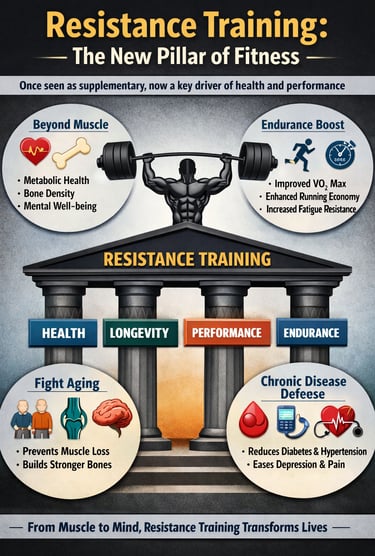
For much of the twentieth century, resistance training occupied a narrow and often misunderstood niche. It was viewed as the domain of bodybuilders, powerlifters, or elite athletes—useful for building muscle size and maximal strength, but peripheral to cardiovascular fitness, disease prevention, or longevity. Aerobic exercise was positioned as the cornerstone of health, while strength training was relegated to a supplementary role. Over the past decade, however, this paradigm has undergone a fundamental and irreversible shift. A rapidly expanding body of high-quality evidence now demonstrates that resistance training is not merely complementary to endurance exercise—it is a primary biological stimulus for physical adaptation, metabolic health, and functional resilience across the lifespan (Chaabene et al., 2025).
Contemporary research reveals that resistance exercise induces systemic adaptations extending far beyond skeletal muscle. These include improvements in insulin sensitivity, blood pressure regulation, lipid metabolism, bone mineral density, neuromuscular efficiency, and even neuropsychological health (Pośpiech et al., 2025). Importantly, these benefits are observed not only in athletes, but also in children, older adults, and individuals living with chronic diseases such as type 2 diabetes, hypertension, osteoporosis, and depression. In several domains, resistance training rivals—or surpasses—traditional aerobic exercise as a therapeutic intervention (Chen et al., 2025).
Perhaps most striking is the growing recognition that strength training enhances endurance performance itself. Once believed to interfere with aerobic development, resistance training is now shown to improve running economy, lactate threshold, and fatigue resistance in middle- and long-distance athletes when appropriately integrated into training programs (Ramos-Campo et al., 2025). Together, these findings signal a decisive transition in exercise science: resistance training has emerged as a foundational pillar of health, performance, and longevity, demanding evidence-based implementation rather than outdated assumptions.
Six Evidence-Based Clinical Pearls That Translate Resistance Training Science Into Daily Health
To bridge the gap between advanced sports science and real-world health application, here are six clinically relevant pearls derived from contemporary resistance training research. These insights convert complex physiological mechanisms into actionable guidance for clinicians, athletes, and patients seeking better health, performance, and longevity.
1. Resistance Training as “Mechanical Medicine” for Bone Health
Scientific Insight:
Bone is a living, adaptive tissue that responds to mechanical loading through osteocyte mechanotransduction. Only loads exceeding the minimal essential strain threshold stimulate osteoblastic activity and meaningful increases in bone mineral density.Practical Takeaway:
Walking supports general health, but it is not enough to prevent osteoporosis. Progressive resistance training acts like a high-interest investment for your bones, delivering the structural stress required to strengthen skeletal integrity and reduce fracture risk.
2. Endurance Gains Come From Efficiency, Not Exhaustion
Scientific Insight:
Strength training improves running economy by enhancing musculotendinous stiffness and motor unit recruitment, allowing athletes to generate force at a lower relative oxygen cost.Practical Takeaway:
Lifting weights does not slow endurance athletes down. Instead, it makes muscles more efficient “springs,” helping runners, cyclists, and walkers maintain pace with less fatigue.
3. Skeletal Muscle as a Powerful “Metabolic Sink”
Scientific Insight:
Skeletal muscle is the primary site of glucose disposal. Resistance training increases lean muscle mass and GLUT4 translocation, markedly improving insulin sensitivity and glycemic control.Practical Takeaway:
Muscle functions like a metabolic sponge for blood sugar. The more active muscle you have, the better your body manages glucose—making resistance training a cornerstone therapy for type 2 diabetes and metabolic syndrome.
4. Strength Gains Begin in the Nervous System
Scientific Insight:
Early improvements in strength are driven by neurological adaptations, including enhanced motor unit synchronization and firing rate, with hypertrophy occurring later.Practical Takeaway:
Visible muscle growth takes time. Early progress reflects your nervous system learning to use existing muscle more effectively—proof that strength training is working even before size changes appear.
5. Resistance Training Is the Only Defense Against Sarcopenia
Scientific Insight:
Age-related sarcopenia disproportionately affects fast-twitch (Type II) muscle fibers. Resistance training uniquely preserves these fibers and high-threshold motor units.Practical Takeaway:
Strength training protects power, balance, and reaction speed as we age—critical factors for preventing falls and maintaining independence.
6. Resistance Training as a Neuropsychological Buffer
Scientific Insight:
Resistance exercise modulates the HPA axis and increases BDNF, producing neuroprotective, antidepressant, and anxiolytic effects.Practical Takeaway:
Lifting weights supports mental health as effectively as physical health, helping reduce stress, anxiety, and cognitive fatigue.
Bottom Line:
Resistance training is no longer optional—it is foundational medicine for metabolic health, musculoskeletal resilience, mental well-being, and healthy aging.
Why Resistance Training Has Become the Primary Form of Physical Activity
Discover how strength training transforms physical fitness, prevents muscle loss, and enhances endurance performance based on cutting-edge research
According to groundbreaking research by Chaabene, Ramirez-Campillo, Moran, and colleagues (2025), we're witnessing a paradigm shift in how we approach physical activity and fitness development. The era of resistance training as a primary—rather than supplementary—form of physical activity has definitively arrived.
Research Focus: This landmark study by Chaabene et al. (2025), published in Sports Medicine (2025) examines the transition of resistance training from a specialty practice to a foundational component of youth fitness programs.
Significance: The research demonstrates that strength training protocols provide comprehensive benefits that traditional aerobic training cannot match, making it essential for developing physically literate youth and preventing chronic diseases.
Key Takeaways
Resistance training should be positioned as a primary activity in youth fitness curricula, not merely supplementary to cardio
Strength training develops physical literacy and movement competency across multiple domains
Early exposure to evidence-based strength training establishes lifelong fitness habits and injury resilience
Resistance protocols prevent metabolic disorders and chronic disease development in younger populations
This shift reflects a growing scientific consensus: resistance exercise offers unparalleled benefits for physical adaptation, metabolic health, and functional capacity development that should anchor modern fitness programming.
Evidence-Based Strength Training: Best Practices for Athletic Performance
The pursuit of athletic performance enhancement requires scientifically grounded training methodologies. Research by Cao and Li (2025) provides comprehensive insights into implementing optimal strength training strategies for competitive athletes.
Study Overview: Evidence-Based Best Practices
Research Focus: This study, published in the International Journal of Education and Humanities, synthesises current evidence on optimal training protocols to maximise athletic performance through resistance exercise.
Scope: The research evaluates training variables including load selection, volume prescription, frequency optimization, and recovery integration for different athletic populations.
Key Takeaways
Periodized training approaches that manipulate volume, intensity, and exercise selection yield superior performance gains
Individual variability in strength adaptations requires personalized program design rather than one-size-fits-all protocols
Integration of sport-specific movement patterns with resistance training enhances transfer to competitive performance
Proper recovery protocols and nutrition strategies are equally important as training stimulus for achieving performance objectives
Best Practices for Athletic Enhancement
Load Management
Systematic progression of external load, from 60-80% of 1RM for hypertrophy to 85-95% for strength development, ensures continued adaptation.
Training Volume
Adequate training volume (8-12 sets per muscle group weekly) paired with appropriate intensity produces optimal physiological adaptations.
Movement Specificity
Sport-specific resistance training that mirrors competitive movement patterns enhances athletic transfer and performance expression.
Recovery Integration
Programmed recovery days, sleep optimization, and strategic deloading weeks prevent overtraining and sustain long-term performance progression.
Resistance Training's Comprehensive Health Impact Across Multiple Conditions
Beyond athletic performance, resistance training functions as a powerful therapeutic tool for managing and preventing numerous health conditions. Research by Pośpiech et al. (2025) provides comprehensive evidence of this therapeutic potential.
Research Focus: Published in Archiv EuroMedica, this extensive review synthesizes evidence on how resistance training effects numerous health conditions including cardiovascular disease, metabolic dysfunction, musculoskeletal disorders, and psychological health.
Clinical Significance: The research positions strength training as a primary intervention for multiple chronic conditions, often matching or exceeding pharmaceutical interventions in effectiveness.
Key Takeaways
Cardiovascular adaptations from resistance training significantly reduce hypertension, improve lipid profiles, and lower cardiovascular disease risk
Metabolic improvements including enhanced insulin sensitivity and glucose homeostasis reduce type 2 diabetes incidence and progression
Bone density enhancement through resistance work prevents osteoporosis and fracture risk in aging populations
Neuropsychological benefits including depression reduction, anxiety management, and cognitive enhancement occur through multiple mechanisms
Musculoskeletal pain conditions including chronic lower back pain and arthritis pain respond effectively to appropriately prescribed resistance training
Specific Health Conditions Impacted by Resistance Training
The therapeutic applications of strength training span an impressive array of conditions:
Type 2 Diabetes: Resistance training improves glycemic control, reduces HbA1c levels, and enhances insulin sensitivity through myocellular adaptations
Hypertension: Strength training produces reductions in both systolic and diastolic blood pressure comparable to pharmaceutical interventions
Osteoporosis: Progressive resistance exercise stimulates osteoblastic activity, increasing bone mineral density and fracture resilience
Depression & Anxiety: Regular resistance training produces neurochemical adaptations reducing depressive symptoms and anxiety severity
Chronic Pain Syndromes: Controlled strength training addresses pain through neural desensitization and functional capacity enhancement
Obesity & Metabolic Syndrome: Resistance training improves body composition, metabolic rate, and functional capacity in overweight populations
Preventing Muscle Atrophy and Bone Loss: Critical Applications for Aging and Sedentary Populations
One of the most compelling applications of resistance training involves preventing age-related muscle atrophy (sarcopenia) and bone loss. Research by Chen et al. (2025) specifically examines these prevention mechanisms in populations at high risk for both conditions.
Research Focus: This systematic review and meta-analysis published in Frontiers in Physiology examines resistance training effects on preventing muscle wasting and bone density loss in simulated weightless environments—a condition relevant to spaceflight, extended bed rest, and severe immobilization.
Practical Application: The findings translate directly to aging populations, sedentary individuals, and anyone experiencing prolonged physical inactivity or reduced loading.
Key Takeaways
Progressive resistance training preserves lean muscle mass even in gravity-reduced conditions, preventing rapid atrophy
Mechanical loading through resistance exercise maintains bone mineral density through osteocyte mechanotransduction
Combination protocols incorporating strength and endurance training provide superior protection against muscle loss and bone density reduction
Resistance training effectiveness for atrophy prevention persists across diverse populations and conditions
Early intervention with resistance protocols prevents the deconditioning cascade that accelerates aging and functional decline
Mechanisms of Muscle and Bone Preservation
Understanding the biological mechanisms through which resistance training prevents muscle loss and bone deterioration reveals why this intervention is so powerful:
Muscle Preservation Mechanisms: Mechanical tension from resistance exercise activates mTOR signaling pathways, increasing protein synthesis above baseline. This prevents the net protein loss that characterizes sarcopenia. Additionally, resistance training preserves neuromuscular junction integrity and motor unit recruitment capacity, maintaining muscular function even if mass slightly decreases.
Bone Preservation Mechanisms: The mechanical loading imposed by strength training stimulates osteoblast activation through strain sensing by osteocytes. This increases bone formation and maintains mineral density. The effect is load-dependent—greater mechanical stress produces greater bone adaptation—making resistance exercise uniquely effective for bone health compared to non-loading activities.
Enhancing Endurance Performance Through Strength Training Integration
A surprising and increasingly recognized benefit of resistance training involves enhancing endurance performance. Rather than competing with aerobic training, strategic strength training integration actually improves endurance capacities. Research by Ramos-Campo et al. (2025) provides comprehensive evidence of these synergistic effects.
Research Focus: Published in the Journal of Strength and Conditioning Research, this umbrella review and meta-analysis synthesizes evidence from systematic reviews examining how strength training affects critical endurance performance determinants in middle- and long-distance athletes.
Population Studied: Elite and competitive endurance athletes, showing applicability across performance levels.
Key Takeaways
Concurrent training (combining strength and endurance work) improves endurance performance metrics including VO₂ max, lactate threshold, and running economy
Strength training enhances running economy—the metabolic cost of maintaining a given pace—providing competitive advantages in distance events
Improved neuromuscular efficiency from resistance training reduces fatigue accumulation and extends sustainable performance duration
Lower-body strength development produces greater endurance performance transfer than upper-body training in distance athletes
Strategic strength training periodization avoids interference with endurance development while capturing performance benefits
How Strength Training Improves Endurance Performance
The mechanisms through which resistance training enhances endurance performance involve several interconnected physiological adaptations:
Neuromuscular Efficiency: Strength training improves force production per motor unit activation, allowing endurance athletes to maintain pace with lower neural drive and reduced neuromuscular fatigue. This extends sustainable performance duration before fatigue accumulation.
Running Economy: Enhanced strength development improves musculotendinous stiffness, allowing more efficient energy transfer during repeated contractions. This reduces the metabolic cost of maintaining a given running pace—a critical competitive advantage.
Metabolic Capacity: Resistance training increases mitochondrial density and oxidative enzyme capacity in trained muscles, improving aerobic capacity and lactate threshold—both critical endurance performance determinants.
Injury Prevention: Stronger muscles, tendons, and connective tissues reduce injury risk during high-volume endurance training, enabling consistent training that drives adaptations.
Synthesizing the Research: Comprehensive Resistance Training Framework
Across all five research studies, consistent themes emerge regarding optimal resistance training implementation. A comprehensive framework incorporating these evidence-based principles maximizes benefits across all outcomes:
The Five-Pillar Resistance Training Framework
Progressive Overload
Systematic increases in training stress through load, volume, or density progression drive continued adaptation. This prevents accommodation and ensures sustained performance gains.
Periodization Strategy
Cycling through phases emphasizing different adaptations (strength, hypertrophy, endurance) prevents plateaus while managing fatigue and injury risk.
Exercise Selection
Multi-joint movements combined with targeted accessory work provide comprehensive stimulus while allowing sport-specific application.
Recovery Integration
Sleep, nutrition, and strategic deloading weeks allow physiological adaptation to training stimulus and prevent overtraining pathology.
Individualization
Personalized program design accounting for individual differences in training response, genetics, and environmental factors optimizes outcomes.
Frequently Asked Questions About Resistance Training
Is resistance training safe for youth and adolescents?
Absolutely. According to Chaabene et al. (2025), appropriately supervised resistance training is safe and beneficial for youth populations. The research demonstrates that proper program design with qualified supervision actually reduces injury risk compared to unsupervised activity. Progressive, controlled resistance exercise develops movement competency and physical literacy while building injury resilience—benefits that extend throughout the lifespan.
How much resistance training is needed for health benefits?
Research across all five studies suggests that 2-3 sessions weekly of resistance training, lasting 30-45 minutes per session, produces significant health adaptations. For specific health conditions like type 2 diabetes or hypertension (Pośpiech et al., 2025), this frequency and duration reduces disease markers substantially. For athletic performance enhancement (Cao & Li, 2025), 3-4 sessions weekly may provide optimal adaptations depending on sport demands.
Can resistance training prevent age-related muscle loss?
Yes, definitively. Chen, Guo & Zhou (2025) provide compelling evidence that regular resistance training effectively prevents sarcopenia and maintains muscle mass across the lifespan. Even in extreme conditions simulating weightlessness, progressive resistance exercise preserved muscle tissue. For aging populations, consistent strength training maintains functional capacity, independence, and quality of life—making it arguably the single most important intervention for healthy aging.
Does strength training interfere with endurance training?
No—quite the opposite. Research by Ramos-Campo et al. (2025) demonstrates that properly periodized concurrent training combining strength and endurance produces superior endurance performance compared to endurance training alone. The key is strategic sequencing and appropriate recovery to prevent excessive fatigue. Most elite endurance athletes now incorporate 1-2 weekly strength training sessions to enhance performance.
What are the most important exercises for comprehensive benefits?
According to Cao & Li (2025), multi-joint exercises recruiting large muscle groups produce the most comprehensive adaptations. Essential movements include: squats or leg presses (lower body), deadlifts or hinges (posterior chain), chest press variations (pushing), rows (pulling), and core stabilization work. Sport-specific variations enhance transfer to competitive performance. A balanced program includes all movement patterns and allows comprehensive stimulus for cardiovascular, metabolic, and musculoskeletal adaptations.
Can resistance training treat chronic health conditions?
Yes, significantly. Pośpiech et al. (2025) provide comprehensive evidence that resistance training effectively manages numerous chronic conditions including type 2 diabetes, hypertension, osteoporosis, depression, and chronic pain syndromes. In many cases, the effectiveness matches or exceeds pharmaceutical interventions. However, resistance training should complement—not replace—medical treatment. Consult healthcare providers to develop appropriate protocols for your specific condition.
How does resistance training improve mental health?
Through multiple mechanisms. Regular resistance training increases endorphin production (natural mood elevators), promotes neurogenesis in the hippocampus (memory and mood regulation), improves sleep quality (critical for mental health), and provides psychological benefits through achievement and self-efficacy. Pośpiech et al. (2025) document significant reductions in depression and anxiety symptoms through consistent strength training. The physical challenge and mastery experience involved in progressive resistance training produces powerful psychological benefits
Converting research evidence into practical training involves several key considerations:
For General Health and Disease Prevention
Begin with 2-3 sessions weekly of whole-body, multi-joint resistance training. Progress gradually using 8-12 repetition ranges for moderate intensity development. Include all movement patterns (squat, hinge, push, pull, core stability). Prioritize consistency over intensity—adherence matters most for long-term health benefits. Combine with appropriate nutrition and sleep for optimal adaptations.
For Athletic Performance Enhancement
Implement periodized programming with 3-4 weekly sessions utilizing varied intensity and volume. Integrate sport-specific movement patterns alongside general strength development. Emphasize the competition phase for performance expression while building capacity during off-season periods. Maintain detailed training records to optimize individual response and adjust programming accordingly.
For Muscle Atrophy Prevention
Maintain consistent resistance training throughout life with appropriate modifications for age and ability. Progressive loading remains important—challenging muscles is essential for maintaining mass. Combine with adequate protein intake (0.6-0.8 g per pound of body weight daily) and sufficient caloric intake to support maintenance. Even light resistance training is far superior to complete inactivity for preventing sarcopenia.
For Endurance Performance
Incorporate 1-2 weekly strength training sessions targeting lower-body development with emphasis on force production and power. Schedule strength sessions on different days than high-intensity endurance work to manage fatigue. Focus on compound movements with sport-specific carryover. Periodize training to emphasize strength development during the off-season while maintaining capacity during competition.
Author’s Note
This article was written with the aim of synthesizing contemporary, peer-reviewed evidence on resistance training into a clinically and practically meaningful framework. The intent was not merely to summarize individual studies, but to integrate findings across exercise physiology, sports performance, metabolic health, and aging biology to reflect the current scientific consensus. All interpretations emphasize translational relevance—bridging laboratory research with real-world application for clinicians, coaches, athletes, and health-conscious individuals.
The literature cited was selected based on methodological rigor, recency, and relevance, with preference given to systematic reviews, meta-analyses, and high-quality narrative syntheses published in 2025. While resistance training prescriptions are discussed broadly, it is acknowledged that individual responses vary due to genetics, training history, health status, and environmental factors. Consequently, the principles outlined should be adapted to individual needs rather than applied rigidly.
This work also reflects a growing shift in exercise science: resistance training is no longer viewed as an adjunct to aerobic activity, but as a foundational intervention for physical fitness, disease prevention, and healthy aging. Where applicable, mechanistic explanations were included to clarify why these adaptations occur, reinforcing evidence-based practice over tradition or anecdote.
Medical Disclaimer
The information in this article, including the research findings, is for educational purposes only and does not constitute medical advice, diagnosis, or treatment. Before starting a resistance exercise program, you must consult with a qualified healthcare professional, especially if you have existing health conditions (such as cardiovascular disease, uncontrolled hypertension, or advanced metabolic disease). Exercise carries inherent risks, and you assume full responsibility for your actions. This article does not establish a doctor-patient relationship.
Related Articles
How to Build a Disease-Proof Body: Master Calories, Exercise & Longevity | DR T S DIDWAL
How to Maximize Muscle Growth: Evidence-Based Strength Training Strategies | DR T S DIDWAL
Lower Blood Pressure Naturally: Evidence-Based Exercise Guide for Metabolic Syndrome | DR T S DIDWAL
Exercise vs. Diet Alone: Which is Best for Body Composition? | DR T S DIDWAL
Movement Snacks: How VILPA Delivers Max Health Benefits in Minutes | DR T S DIDWAL
References
Cao, Y., & Li, J. (2025). Evidence-Based Strength Training: Best Practices for Enhancing Athletic Performance. International Journal of Education and Humanities, 5(2), 187–196. https://doi.org/10.58557/(ijeh).v5i2.298
Chaabene, H., Ramirez-Campillo, R., Moran, J., & et al. (2025). The Era of Resistance Training as a Primary Form of Physical Activity for Physical Fitness and Health in Youth Has Come. Sports Medicine, 55, 2073–2090. https://doi.org/10.1007/s40279-025-02240-3
Chen, A., Guo, C., & Zhou, Y. (2025). Effects of resistance training on preventing muscle atrophy and bone loss in simulated weightless population: A systematic review and meta-analysis. Frontiers in Physiology, 16, Article 1694891. https://doi.org/10.3389/fphys.2025.1694891
Pośpiech, S., Schendzielorz, J., Prosowski, J., Piotrowski, M., Serwicki, P., Początek, J., Zabrzeński, B., & Paks, K. (2025). The effects of resistance training on multiple health conditions: A comprehensive review. Archiv EuroMedica, 15(4), Article 020. https://doi.org/10.35630/2025/15/4.020
Ramos-Campo, D. J., Andreu-Caravaca, L., Clemente-Suárez, V. J., & Rubio-Arias, J. Á. (2025). The Effect of Strength Training on Endurance Performance Determinants in Middle- and Long-Distance Endurance Athletes: An Umbrella Review of Systematic Reviews and Meta-Analysis. Journal of Strength and Conditioning Research, 39(4), 492–506. https://doi.org/10.1519/JSC.0000000000005056