Stop the Clock: Proven Ways to Reverse Early Aging if You Have Diabetes
Explore the multi-organ impact of Type 2 Diabetes on aging. Get evidence-based clinical pearls to protect your DNA, heart, and mind from metabolic decline.
DIABETES
Dr. T.S. Didwal, M.D.(Internal Medicine)
12/24/202512 min read
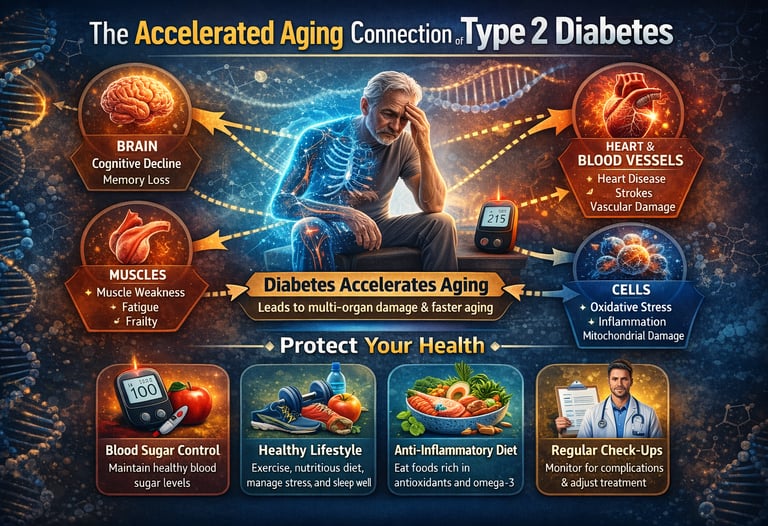
For many years, type 2 diabetes was viewed mainly as a problem of high blood sugar. But modern research tells a far more important—and surprising—story. Diabetes does not only affect glucose levels; it speeds up the biological aging process itself. In simple terms, it can make the body behave as if it is older than the number of years you have lived.
Scientists now describe type 2 diabetes as a condition that presses a “fast-forward” button on aging. Persistently high blood sugar triggers chronic inflammation, damages blood vessels, weakens muscles, and stresses the body’s energy-producing cells. Over time, these changes can cause the heart, brain, immune system, and muscles to decline 10 to 15 years earlier than expected, even when compared with people of the same chronological age (Zhang et al., 2025).
Importantly, this process is not silent. Early muscle weakness, slower healing, memory changes, fatigue, and reduced stamina are not just “normal aging”—they are often signs of diabetes-driven biological wear and tear.
The most hopeful finding from recent research is this: accelerated aging in diabetes is not inevitable. Large prospective studies show that individuals who improve metabolic health through physical activity, nutrition, and vascular risk control can significantly slow biological aging and disease progression (Pan et al., 2025).
Understanding diabetes through the lens of aging shifts the goal from simply controlling a disease to protecting long-term vitality, cognition, and independence.
Clinical pearls :
1. Muscle is Your "Metabolic Armor"
Clinical research now shows that skeletal muscle in those with Type 2 Diabetes can age 10 to 15 years faster than in peers without the condition. This isn't just about strength; muscle is your primary site for glucose disposal.
The Pearl: Treat resistance training as a non-negotiable prescription. By building "younger" muscle, you create a larger sink for blood sugar, effectively slowing your biological clock.
2. The "Inflammaging" Feedback Loop
Diabetes triggers "inflammaging"—a state of chronic, low-grade inflammation that accelerates cellular wear and tear. This creates a vicious cycle: inflammation worsens insulin resistance, which in turn fuels more inflammation.
The Pearl: Think of "lifestyle as fire safety." Every anti-inflammatory choice—like eating fatty fish (Omega-3s) or getting 7+ hours of sleep—is a direct "extinguisher" for the cellular fire that causes premature aging.
3. Your "Phenotypic Age" vs. Chronological Age
The date on your birth certificate matters less than your biological markers. 2025 studies highlight that phenotypic aging (how your body actually functions) is a better predictor of diabetes progression than your actual age.
The Pearl: You can "de-age" your phenotype. Aggressive control of blood pressure, cholesterol, and blood sugar doesn't just manage a disease; it shifts your biological profile back toward a younger state.
4. The Brain-Vascular Connection
Cognitive decline in diabetes isn't just about "sugar on the brain"; it’s largely about the health of your microscopic blood vessels. When these vessels age prematurely, they struggle to deliver oxygen to the brain’s high-traffic areas.
The Pearl: Heart health is brain health. What protects your arteries (aerobic exercise and fiber-rich foods) acts as a structural shield for your memory and executive function as you age.
5. Immunosenescence: The Invisible Risk
Diabetes accelerates the aging of your immune system, making it harder to fight new infections and clear out damaged cells. This is why small wounds heal slower and viruses can hit harder.
The Pearl: Glucose control is an "immune booster." Keeping your blood sugar in range ensures your T-cells and macrophages remain "youthful" and responsive, maintaining your body’s natural defense system against both illness and aging.
Type 2 Diabetes and Accelerated Aging: Understanding the Connection and Protecting Your Health
The Big Picture: Diabetes as an Accelerated Aging Model
Imagine your body as a complex machine. Type 2 diabetes mellitus acts like someone hitting the fast-forward button on wear and tear across virtually every system. Recent research from Zhang et al. (2025) demonstrates that diabetes functions as a metabolic model of accelerated aging, triggering multi-organ mechanisms that compromise everything from your muscles to your brain.
The key insight? It's not just about glucose control. Metabolic dysfunction in diabetes creates a cascading effect—inflammation, oxidative stress, insulin resistance, and cellular damage—that mimics and accelerates normal aging processes. Understanding this relationship is crucial because it opens new doors for intervention.
Study 1: Cognitive Health and Multidimensional Approaches
Lucia et al. (2025). examined how cognitive aging occurs in people with type 2 diabetes, taking a comprehensive, multidimensional approach. Their research highlights that diabetes doesn't just threaten your waistline—it threatens your mind.
Key Takeaways
Cognitive decline accelerates in individuals with type 2 diabetes at rates significantly faster than age-matched controls
Multidimensional interventions—addressing metabolic, vascular, inflammatory, and lifestyle factors simultaneously—show promise in preserving cognitive function
The relationship between blood sugar control and brain health is more intricate than previously understood, involving multiple pathways including vascular damage, neuroinflammation, and altered glucose metabolism in the brain
Early intervention with comprehensive strategies can substantially slow cognitive aging
Study 2: Multi-Organ Mechanisms and Intervention Approaches
Zhang et al. (2025) conducted an extensive review establishing type 2 diabetes as a metabolic model of accelerated aging. Rather than treating diabetes as an isolated disease, they examined how it affects multiple organ systems simultaneously.
Key Takeaways
Accelerated aging mechanisms in diabetes operate across the cardiovascular system, nervous system, endocrine system, and immune system
Multi-organ dysfunction in diabetes mirrors patterns seen in significantly older individuals without diabetes
Intervention approaches must address metabolic pathways, vascular health, inflammatory cascades, and mitochondrial function
Personalized medicine strategies that target individual aging pathways show greater efficacy than one-size-fits-all approaches
The importance of viewing diabetes through an aging medicine lens rather than purely as an endocrine disorder
Study 3: Lifestyle Factors and Editorial Perspective
This editorial by Duarte-Mendes,et al. (2025) emphasizes the critical role of lifestyle modifications in the bidirectional relationship between unhealthy lifestyles, accelerated aging, and type 2 diabetes development and progression.
Key Takeaways
Lifestyle choices aren't just a minor factor—they're fundamental drivers of both diabetes risk and aging acceleration
Sedentary behavior, poor dietary patterns, inadequate sleep, and chronic stress create a vicious cycle that simultaneously promotes diabetes and ages the body
Physical activity, nutritious eating, proper sleep hygiene, and stress management can interrupt this cycle at multiple points
The editorial underscores that healthy aging with diabetes requires viewing lifestyle as medicine, not an optional improvement
Prevention through lifestyle modification is exponentially more effective than trying to reverse established damage
Study 4: Patient Expectations and Aging Experiences
Yao et al.(2025) conducted a cross-sectional study examining how older adults with type 2 diabetes perceive aging and what factors influence their expectations and quality of life during the aging process.
Key Takeaways
Patient expectations about aging significantly impact adherence to diabetes management and overall health outcomes
Individuals with poorly controlled diabetes report more negative aging experiences and diminished quality of life
Psychosocial factors—including social support, perceived control, and optimism—substantially influence how people age with diabetes
Individualized education addressing both physical management and psychological adjustment improves aging experiences
Understanding patient perspectives is essential for developing interventions that people will actually maintain long-term
Study 5: Immune Aging and Metabolic Dysfunction
Chakrabarti et al. (2025) explore the fascinating connection between immune system aging (called immunosenescence) and type 2 diabetes development and progression.
Key Takeaways
Immune aging and metabolic aging are interconnected processes that mutually accelerate each other
Chronic inflammation in diabetes drives immune system dysfunction, characterized by reduced T-cell function, altered macrophage activity, and increased proinflammatory cytokines
Inflammaging—chronic, low-grade inflammation with age—is simultaneously a cause and consequence of type 2 diabetes
Immunological interventions targeting specific aging pathways may offer novel therapeutic approaches
The bidirectional relationship means that controlling blood sugar provides immune system benefits beyond traditional diabetes management
Study 6: Phenotypic Aging, Genetics, and Lifestyle Progression
Pan et al. (2025) conducted a prospective study examining how accelerated phenotypic aging, genetic predisposition, and lifestyle factors collectively influence the progression of type 2 diabetes.
Key Takeaways
Phenotypic aging markers—visible biological signs of aging—strongly predict diabetes progression independent of chronological age
Genetic risk and accelerated aging interact; some individuals are genetically susceptible to both premature aging and diabetes
Lifestyle factors moderate genetic risk—people with high genetic risk can substantially slow disease progression through aggressive lifestyle modification
Multi-state modeling reveals that diabetes progression isn't linear; it occurs through distinct biological stages
Early identification of individuals with accelerated phenotypic aging enables targeted preventive interventions before diabetes develops or worsens
Study 7: Skeletal Muscle and Accelerated Aging
This commentary by Henson et al (2025).discussses an important dimension of accelerated aging in diabetes: skeletal muscle dysfunction and atrophy. Henson and colleagues emphasize that muscle aging may be one of the most visible and functionally significant aging accelerators in diabetes.
Key Takeaways
Skeletal muscle aging occurs 10–15 years earlier in people with type 2 diabetes compared to those without
Muscle insulin resistance creates a vicious cycle where muscles become less responsive to insulin, worsening glycemic control and accelerating further muscle loss
Sarcopenia (age-related muscle loss) develops earlier and more severely in diabetes, compromising strength, mobility, and metabolic function
Resistance training and adequate protein intake are powerful interventions specifically targeting muscle aging in diabetes
Preserving muscle mass and function is essential not just for physical capability but for overall metabolic health and longevity
How Does Diabetes Accelerate Aging? The Mechanisms Explained
Understanding why diabetes accelerates aging helps you understand what to do about it. Here are the primary mechanisms:
Chronic Inflammation and Oxidative Stress
Type 2 diabetes triggers persistent low-grade inflammation that damages cells throughout your body. This inflammatory state combined with oxidative stress from impaired glucose metabolism creates damage similar to what normally takes decades to accumulate.
Vascular Dysfunction
High blood sugar damages blood vessels (both large and small), reducing oxygen and nutrient delivery throughout your body. This vascular aging accelerates aging in the brain, heart, kidneys, and limbs.
Mitochondrial Dysfunction
Your cells' energy factories—mitochondria—become less efficient with diabetes and aging. This compounds: metabolic dysfunction impairs mitochondria, which worsens metabolic dysfunction.
Insulin Resistance and Metabolic Dysregulation
Insulin resistance is both a cause and consequence of accelerated aging. It disrupts nutrient sensing pathways and cellular repair mechanisms throughout the body.
Immune System Aging (Immunosenescence)
Diabetes accelerates immune system aging, reducing your ability to fight infections and increasing vulnerability to diseases typically seen in older adults.
Neurological and Cognitive Aging
Diabetes-induced cognitive decline occurs through multiple pathways: vascular damage, neuroinflammation, altered glucose metabolism in the brain, and accumulation of pathological proteins.
Muscular and Skeletal Aging
Accelerated muscle loss in diabetes is driven by insulin resistance, inflammation, and altered protein synthesis—creating weakness and reduced mobility decades earlier than expected.
Evidence-Based Strategies to Slow Aging with Type 2 Diabetes
The encouraging news from all this research? You have tremendous power to slow these processes. Here are evidence-supported approaches:
Optimize Blood Sugar Control
Maintaining target blood glucose levels addresses the root cause of multiple aging mechanisms. Work with your healthcare team to determine appropriate HbA1c targets (typically <7% for most adults).
Prioritize Regular Physical Activity
Exercise is perhaps the single most powerful intervention. Aim for:
150 minutes of moderate aerobic activity weekly (walking briskly, cycling, swimming)
Resistance training 2–3 times weekly to preserve muscle mass and combat sarcopenia
Flexibility and balance training to maintain mobility and prevent falls
Adopt an Anti-Inflammatory Diet
Choose foods that reduce oxidative stress and inflammation:
Whole grains and fiber-rich foods
Fatty fish rich in omega-3s (salmon, sardines, mackerel)
Colorful vegetables and fruits (berries, leafy greens, orange vegetables)
Nuts, seeds, and plant-based proteins
Minimize processed foods, added sugars, and trans fats
Prioritize Sleep and Stress Management
Poor sleep and chronic stress both accelerate aging and worsen blood sugar control:
Aim for 7–9 hours quality sleep nightly
Establish consistent sleep schedules
Practice stress-reduction techniques: meditation, yoga, deep breathing, or time in nature
Maintain Social Connections
Social engagement supports both mental health and physical resilience. Research shows strong social connections slow aging and improve diabetes outcomes.
Regular Health Monitoring
Proactive monitoring catches complications early:
Regular HbA1c testing (every 3 months if adjusting therapy)
Annual comprehensive eye, foot, and kidney function assessments
Regular cardiovascular risk assessment
Cognitive screening if you notice memory concerns
Consider Appropriate Medications
Modern diabetes medications offer benefits beyond blood sugar control:
GLP-1 receptor agonists reduce cardiovascular aging and promote weight loss
SGLT2 inhibitors protect kidney and heart function
Metformin may have anti-aging properties beyond glucose control
Frequently Asked Questions
Q: Can diabetes acceleration of aging be reversed?
A: Partial reversal is possible, especially if caught early. While you can't completely reverse years of damage, aggressive lifestyle modification combined with appropriate medications can substantially slow progression and improve function. Think of it as applying brakes to a runaway car—the sooner you apply them, the better.
Q: How quickly does diabetes affect aging?
A: Effects begin almost immediately at the cellular level, though you may not notice symptoms for months or years. Research suggests that biological aging accelerates measurably within weeks of sustained high blood sugar. This emphasizes the importance of early intervention.
Q: Does weight loss help slow the aging process in diabetes?
A: Absolutely. Even modest weight loss (5–10% of body weight) significantly improves insulin sensitivity, reduces inflammation, decreases vascular aging, and improves multiple aging markers. Weight loss is particularly effective when achieved through dietary changes and exercise rather than medication alone.
Q: Is cognitive decline inevitable with type 2 diabetes?
A: No. While diabetes increases risk of cognitive decline, research shows that multidimensional interventions addressing blood sugar, vascular health, physical activity, cognitive engagement, and social connection can substantially preserve cognitive function.
Q: Can young people with type 2 diabetes catch up to normal aging?
A: The younger someone is when they achieve good diabetes control, the better their prognosis. Young people who gain control now can prevent substantial aging acceleration. However, this requires sustained effort—glucose control must be maintained over decades.
Q: Is muscle loss preventable in diabetes?
A: Yes. Resistance training combined with adequate protein intake (typically 1.0–1.2 grams per kilogram of body weight daily) effectively prevents accelerated muscle aging in diabetes.
Q: What's the most important thing I can do right now?
A: Start moving. Physical activity addresses multiple aging mechanisms simultaneously—improving insulin sensitivity, reducing inflammation, preserving muscle, protecting the heart and brain, and improving mental health. Even modest activity is profoundly beneficial.
Key Takeaways: What You Need to Know
Type 2 diabetes accelerates aging across multiple body systems, including the brain, heart, muscles, immune system, and blood vessels
This acceleration is not inevitable—evidence shows that aggressive lifestyle modification and appropriate medications can substantially slow these processes
Early intervention is crucial—the sooner you address blood sugar control and lifestyle factors, the more aging you can prevent
A multidimensional approach works best—combining blood sugar control, physical activity, optimal nutrition, stress management, sleep, and social connection provides synergistic benefits
Muscle preservation is particularly important and requires specific attention to resistance training and adequate protein
Cognitive health can be protected through comprehensive approaches addressing vascular, metabolic, and lifestyle factors
Your genetics aren't destiny—lifestyle factors substantially modify genetic risk for both diabetes and accelerated aging
Psychological factors matter—maintaining optimism, social connection, and realistic expectations improves both adherence and outcomes
Call to Action: Take Control of Your Aging
You now understand the science. You know the mechanisms. You've seen the evidence of what works. The question isn't whether you can slow the aging process with diabetes—you absolutely can. The question is whether you'll start today.
Here's your action plan:
Schedule a comprehensive health assessment with your healthcare team this week. Discuss your current aging markers and develop a personalized plan based on your individual risk factors.
Start moving today. You don't need to train for a marathon. A 20-minute walk today, followed by another tomorrow, begins interrupting the aging cascade immediately.
Evaluate your diet this week. Identify one or two high-impact changes: perhaps adding one more vegetable serving daily, reducing added sugars, or incorporating fatty fish twice weekly.
Assess your sleep. Most adults sleep 1–2 hours less than they need. Improving sleep may be as powerful as any medication.
Join a community. Whether it's a diabetes support group, fitness class, or social club, strong social connection is medicine for aging.
Share this knowledge. If you know others managing type 2 diabetes, share what you've learned. Understanding these connections empowers better decisions.
The research is clear: you have remarkable power to determine how you age. Type 2 diabetes is a serious condition, but it's not a sentence to premature old age. With knowledge, commitment, and support, you can preserve your health, cognitive function, strength, and vitality.
Your future self will thank you for the choices you make today.
Disclaimer: This article is for informational purposes only and does not constitute medical advice. Individual circumstances vary, and treatment decisions should always be made in consultation with qualified healthcare professionals.
Related Articles
Insulin vs. Blood Sugar: Why Fasting Insulin Detects Diabetes Years Earlier | DR T S DIDWAL
Low-Fat vs. Low-Carb: Which Diet is Best for Weight Loss? | DR T S DIDWAL
5 Steps to Reverse Metabolic Syndrome: Diet, Habit, & Lifestyle Plan | DR T S DIDWAL
The Role of Cholesterol in Health and Disease: Beyond the "Bad" Label | DR T S DIDWAL
Lowering Cholesterol with Food: 4 Phases of Dietary Dyslipidemia Treatment | DR T S DIDWAL
High Triglyceride Levels: 5 New Facts to Help You Lower Your Risk | DR T S DIDWAL
The Best Dietary Fat Balance for Insulin Sensitivity, Inflammation, and Longevity | DR T S DIDWAL
Manage Diabetes Naturally: How Beta-Glucans Control Blood Sugar | DR T S DIDWAL
References
Chakrabarti, S. K., Chattopadhyay, D., & The Author(s). (2025). The link between immune aging and type 2 diabetes: A review of mechanisms and implications. Exploratory Research and Hypothesis in Medicine, 000–000.
Duarte-Mendes, P., Silva, F. M., & Teixeira, A. M. (2025). Editorial: (Un)healthy lifestyles, aging, and type 2 diabetes. Frontiers in Aging, 6, 1696856. https://doi.org/10.3389/fragi.2025.1696856
Henson, J., Baker, L. A., Watson, E., Yates, T., & Davies, M. J. (2025). Type 2 diabetes and accelerated ageing in skeletal muscle. The Lancet Diabetes & Endocrinology, 13(5), 362–364. https://doi.org/10.1016/s2213-8587(25)00061-0
Lucia, S., Fornaro, S., Federici, M., & Rumiati, R. I. (2025). The impact of type 2 diabetes on aging: Multidimensional approaches to preserve cognitive health. Acta Diabetologica, 10(1007), s00592-025-02583-3. https://doi.org/10.1007/s00592-025-02583-3
Pan, L., Liu, Y., Huang, C., Huang, Y., Lin, R., Wei, K., Yao, Y., Qin, G., & Yu, Y. (2025). Association of accelerated phenotypic aging, genetic risk, and lifestyle with progression of type 2 diabetes: A prospective study using multi-state model. BMC Medicine, 23(1), 62. https://doi.org/10.1186/s12916-024-03832-y
Yao, T., Jiang, Q., Zhang, F., Cao, H., Li, D., Yan, J., Wang, Y., Yang, J., Zhuang, R., & Sun, J. (2025). Exploring expectations regarding aging and related influencing factors in older people with type 2 diabetes mellitus: A cross-sectional study. Clinical Interventions in Aging, 20, 1039–1048. https://doi.org/10.2147/CIA.S530212
Zhang, Z., He, X., Sun, Y., Li, J., & Sun, J. (2025). Type 2 diabetes mellitus: A metabolic model of accelerated aging—Multi-organ mechanisms and intervention approaches. Aging and Disease, 17(3), 3. https://doi.org/10.14336/AD.2025.0233