High Triglyceride Levels: 5 New Facts to Help You Lower Your Risk
Struggling with high triglycerides? 2025 studies reveal personalized ways to lower levels, prevent pancreatitis, and understand your specific metabolic subtype.
METABOLISM
Dr. T.S. Didwal, M.D.(Internal Medicine)
12/19/20259 min read
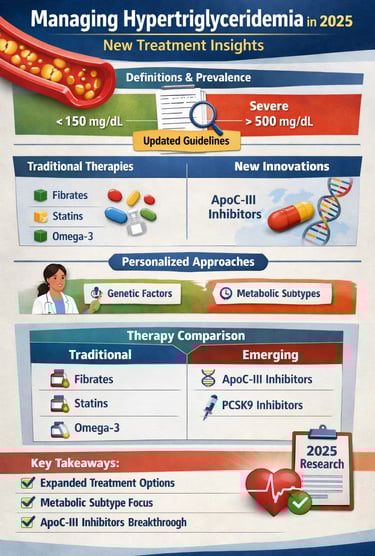
If you've been told your triglyceride levels are too high, you're not alone. Hypertriglyceridemia—a condition characterized by elevated triglycerides in the bloodstream—affects millions worldwide and represents a significant cardiovascular risk factor. Most people think high triglycerides are just a side effect of a bad diet. They’re wrong. 2025 research has revealed that for millions, the 'standard' treatment plan is missing the mark because it ignores the unique way their body processes fat. Whether you're struggling to get your numbers down or you’ve just received your first high lab result, these five new clinical breakthroughs are about to change everything you know about your cardiovascular health. .
Clinical pearls
1. The "Pancreatitis Threshold" is a Hard Line
While we often worry about heart health with high triglycerides, the most immediate danger of "very high" levels (over 500 mg/dL) is actually acute pancreatitis—a painful and serious inflammation of the pancreas. 2025 guidelines emphasize that once you cross this 500 mg/dL threshold, the medical priority shifts from long-term artery protection to urgent prevention of organ damage.
2. Not All "Highs" are Created Equal
The groundbreaking work by Zhou et al. (2025) on metabolic subtypes shows that two people with the same triglyceride number might need completely different treatments. One person’s high levels might be driven by insulin resistance (linked to blood sugar), while another’s might be purely genetic (linked to how the body clears fat). Identifying your "subtype" ensures you aren't taking a medication that doesn't target your specific root cause.
3. ApoC-III: The "Brake" You Want to Cut
Think of Apolipoprotein C-III as a chemical "brake" in your bloodstream that prevents your body from clearing out fats. The 2025 meta-analysis highlights new drugs that effectively "cut the brakes." By inhibiting ApoC-III, your body can finally process and remove triglycerides that were previously stuck in your blood, even if traditional drugs like fibrates didn't work for you.
4. The "Carbohydrate Paradox"
Many patients focus strictly on avoiding dietary fat to lower blood fats. However, clinical evidence reminds us that refined carbohydrates and sugars are often the bigger culprits. When you eat excess sugar, your liver "repackages" it into triglycerides. Research shows that for many metabolic subtypes, reducing liquid sugars and white flours is more effective at lowering numbers than cutting out healthy fats like avocado or olive oil.
5. Synergy Over Monotherapy
The 2025 review by Zimodro and colleagues highlights that the future of management is synergy. Instead of just increasing the dose of one drug (which can increase side effects), clinicians are now using "low-dose combinations." Combining a statin (for cholesterol) with a new-generation omega-3 or an ApoC-III inhibitor creates a multi-pronged attack on cardiovascular risk that is often better tolerated by the body.
Hypertriglyceridemia Treatment Options: What 2025 Research Reveals About Managing High Triglyceride
Understanding Hypertriglyceridemia: The Latest Definitions and Prevalence
Triglycerides are a type of fat found in your blood. When you consume food—especially carbohydrates and fats—your body converts excess calories into triglycerides for storage. While some triglycerides are necessary for energy, elevated levels can lead to serious health complications. A 2025 comprehensive review by Baass and colleagues examined the precise definitions and epidemiology of this condition, revealing important insights into how we classify and measure severe hypertriglyceridemia.
Key Findings on Prevalence and Incidence
Recent research shows that severe hypertriglyceridemia—typically defined as triglyceride levels exceeding 500 mg/dL—affects a substantial portion of the population. The Baass team (2025) conducted a detailed analysis of prevalence, incidence, and definitional criteria across multiple studies, providing clinicians with clearer diagnostic guidelines. Their weighted summary indicates that understanding the distinction between mild, moderate, and severe forms is crucial for determining appropriate treatment strategies.
Key takeaway: The 2025 research emphasizes that hypertriglyceridemia definitions continue to evolve, with severity classifications directly influencing treatment decisions and cardiovascular risk assessment (Baass et al., 2025).
Current and Emerging Treatment Options: A State-of-the-Art Overview
Traditional Approaches Meet Modern Innovation
Managing elevated triglyceride levels has traditionally relied on lifestyle modifications and established pharmaceutical interventions. However, Zimodro, Rizzo, and Gouni-Berthold (2025) published a comprehensive state-of-the-art review examining both conventional and cutting-edge treatment options for hypertriglyceridemia. This landmark review synthesizes decades of evidence while highlighting novel therapeutic agents that are revolutionizing clinical management.
The study covers the full spectrum of hypertriglyceridemia treatment, from foundational approaches to emerging pharmacological solutions. Traditional therapies—including fibrates, statins, and omega-3 fatty acids—remain cornerstone treatments, but the landscape is expanding rapidly. The review identifies how these established interventions work alongside newer agents to provide more comprehensive cardiovascular protection.
Key takeaway: The Zimodro et al. (2025) review demonstrates that current treatment options for hypertriglyceridemia now include both time-tested and innovative approaches, offering clinicians multiple pathways to optimize patient outcomes
Diagnosis and Management: A Comprehensive Clinical Framework
Evaluating Your Triglyceride Status
Proper diagnosis and evaluation of hypertriglyceridemia requires more than a simple blood test. Krishnamurthy, Homan, and Kim (2025) recently published a comprehensive guide addressing how clinicians should approach diagnosis, evaluation, and management of severe hypertriglyceridemia. This framework is particularly important for patients with more severe presentations who need intensive intervention.
The evaluation process involves assessing not only triglyceride levels but also understanding the underlying causes, genetic factors, and metabolic context. This approach ensures that treatment is personalized rather than one-size-fits-all. For patients with severe hypertriglyceridemia, this comprehensive evaluation becomes even more critical, as these individuals face elevated risks of acute pancreatitis and accelerated atherosclerosis.
Key takeaway: Krishnamurthy et al. (2025) emphasize that effective management of severe hypertriglyceridemia requires systematic evaluation of multiple clinical parameters beyond triglyceride numbers alone
Metabolic Subtypes: Personalized Understanding of Hypertriglyceridemia
Beyond One-Size-Fits-All Treatment
A major breakthrough in hypertriglyceridemia research involves recognizing that not all elevated triglycerides are created equal. Zhou and colleagues (2025) explored metabolic subtypes in hypertriglyceridemia using advanced population-based metabolome analysis. This research reveals that individuals with high triglycerides often have distinct metabolic profiles that influence both their disease presentation and treatment response.
The study utilized metabolomic profiling—examining thousands of metabolic markers—to identify distinct metabolic subtypes in hypertriglyceridemia. These subtypes show different associations with various diseases, suggesting that understanding a patient's specific metabolic pattern could lead to more targeted, effective interventions. Some individuals might have insulin resistance-driven hypertriglyceridemia, while others have genetic or inflammatory components.
This research has profound implications for clinical practice. Rather than treating all hypertriglyceridemia patients identically, clinicians can now consider metabolic subtype information when selecting interventions. A patient with metabolic syndrome-driven hypertriglyceridemia might benefit from different approaches than someone with genetic predisposition.
Key takeaway: Zhou et al. (2025) demonstrate that metabolic subtypes in hypertriglyceridemia show distinct disease associations, enabling more personalized treatment approaches based on individual metabolic profiles .
Apolipoprotein C-III Inhibitors: The Next Frontier in Treatment
Revolutionizing Triglyceride Management
Perhaps the most exciting development in hypertriglyceridemia treatment is the emergence of apolipoprotein C-III inhibitors—a novel class of drugs targeting a previously underutilized therapeutic pathway. De Moura de Souza and colleagues (2025) conducted a comprehensive meta-analysis of randomized controlled trials examining these innovative agents.
Apolipoprotein C-III (ApoC-III) is a protein that plays a crucial regulatory role in triglyceride metabolism. By inhibiting this protein, new medications can significantly reduce triglyceride levels through a distinct mechanism compared to traditional therapies. This approach is particularly valuable for patients who don't respond adequately to conventional hypertriglyceridemia medications or who have severe hypertriglyceridemia requiring aggressive intervention.
The meta-analysis reviewed multiple randomized controlled trials of apolipoprotein C-III inhibitors, synthesizing data on efficacy, safety, and patient outcomes. Results demonstrate that these agents offer substantial triglyceride reduction, often achieving decreases of 30-50% in patients with elevated baseline levels. This efficacy is remarkable, especially considering that some patients have already failed conventional therapies.
What makes ApoC-III inhibitors particularly exciting is their mechanism of action. By targeting this specific protein, they address a fundamental process in triglyceride metabolism without directly affecting cholesterol—offering a complementary approach to existing treatments. For patients with severe hypertriglyceridemia or those at high risk of triglyceride-related pancreatitis, this represents a genuine therapeutic advance.
Key takeaway: De Moura de Souza et al. (2025) show that apolipoprotein C-III inhibitors represent a breakthrough approach to hypertriglyceridemia treatment, with randomized controlled trials demonstrating significant efficacy in reducing triglyceride levels and offering new hope for treatment-resistant cases
Integrating Evidence Into Practice: What This Means for You
Personalized Treatment Strategies
The convergence of these 2025 studies reveals an exciting trend: hypertriglyceridemia management is becoming increasingly sophisticated and personalized. Rather than a single treatment pathway, modern approaches now consider:
Severity and definitions based on the latest classification systems, metabolic subtype determined through advanced testing, treatment responsiveness to existing medications, and emerging options like apolipoprotein C-III inhibitors for difficult-to-treat cases.
This integrated approach means that your healthcare provider can now tailor treatment more precisely to your individual situation. Someone with metabolic syndrome-driven hypertriglyceridemia might benefit from lifestyle optimization and insulin-sensitizing approaches. A patient with genetic hypertriglyceridemia might require more aggressive pharmaceutical intervention. Someone with severe hypertriglyceridemia facing pancreatitis risk might benefit from emerging therapies like ApoC-III inhibitors.
Frequently Asked Questions About Hypertriglyceridemia
Q: What triglyceride level is considered high? A: According to recent guidelines, normal triglycerides are below 150 mg/dL, borderline high is 150-199 mg/dL, high is 200-499 mg/dL, and very high is 500 mg/dL or above. The Baass et al. (2025) study provides updated definitional criteria for severe hypertriglyceridemia.
Q: Can lifestyle changes alone manage hypertriglyceridemia? A: For some people with mild to moderate elevation, yes. Diet modifications, regular exercise, weight loss, and reducing refined carbohydrates can significantly lower triglycerides. However, individuals with genetic predisposition or severe hypertriglyceridemia typically require medications alongside lifestyle changes.
Q: What are the main medications for hypertriglyceridemia? A: Traditional options include fibrates (like fenofibrate), statins, and omega-3 fatty acids. Newer options include PCSK9 inhibitors and, most recently, apolipoprotein C-III inhibitors highlighted in the 2025 meta-analysis by de Moura de Souza and colleagues.
Q: How do the new apolipoprotein C-III inhibitors work? A: These ApoC-III inhibitors target a protein that regulates triglyceride metabolism. By blocking this protein's activity, they enable the body to clear triglycerides from the bloodstream more efficiently, reducing levels through a mechanism distinct from traditional hypertriglyceridemia medications.
Q: Do metabolic subtypes really matter for treatment? A: Yes, according to Zhou et al. (2025). Understanding your metabolic subtype can help clinicians select interventions more likely to work for your specific metabolic pattern, improving treatment effectiveness and personalizing your hypertriglyceridemia management.
Q: Is severe hypertriglyceridemia dangerous? A: Severe hypertriglyceridemia carries significant risks, including acute pancreatitis, accelerated atherosclerosis, and cardiovascular events. This is why the Krishnamurthy et al. (2025) framework emphasizes comprehensive evaluation and management of severe cases.
Q: Are these new treatments covered by insurance? A: Coverage varies by insurance plan and medication. Emerging apolipoprotein C-III inhibitors may have different coverage than established therapies. Check with your insurance provider about specific coverage.
Moving Forward: Your Action Plan
If you have hypertriglyceridemia or elevated triglyceride levels, the 2025 research provides reasons for optimism:
Schedule a comprehensive evaluation with your healthcare provider to determine your specific situation, including severity level and metabolic subtype if appropriate. Review your current treatment in light of emerging options—you might benefit from newer approaches like apolipoprotein C-III inhibitors. Implement lifestyle changes alongside medical management, as diet, exercise, and weight management remain foundational to hypertriglyceridemia management. Stay informed about emerging treatments, particularly ApoC-III inhibitors and other novel hypertriglyceridemia medications entering clinical practice.
The convergence of these 2025 studies demonstrates that managing hypertriglyceridemia has never been more sophisticated or personalized. Whether you're dealing with mild elevation or severe hypertriglyceridemia, modern medicine now offers more options than ever before to reduce your cardiovascular risk and improve your health outcomes.
Disclaimer: This article is for informational purposes only and does not constitute medical advice. Individual circumstances vary, and treatment decisions should always be made in consultation with qualified healthcare professionals.
Related Articles
High Cholesterol Isn’t Just LDL: The New Science of Heart Risk | DR T S DIDWAL
hsCRP Explained: What Inflammation Means for Your Heart | DR T S DIDWAL
What’s New in the 2025 Blood Pressure Guidelines? A Complete Scientific Breakdown | DR T S DIDWAL
Low-Fat vs. Low-Carb: Which Diet is Best for Weight Loss? | DR T S DIDWAL
5 Steps to Reverse Metabolic Syndrome: Diet, Habit, & Lifestyle Plan | DR T S DIDWAL
The Role of Cholesterol in Health and Disease: Beyond the "Bad" Label | DR T S DIDWAL
Lowering Cholesterol with Food: 4 Phases of Dietary Dyslipidemia Treatment | DR T S DIDWAL
The Best Dietary Fat Balance for Insulin Sensitivity, Inflammation, and Longevity | DR T S DIDWAL
References
Baass, A., Paquette, M., Lam, O., Hofer, K., Collet, J., & McClain, M. R. (2025). Prevalence, incidence, and definition of severe hypertriglyceridemia: A comprehensive review and weighted summary. Journal of Clinical Lipidology, S1933-2874(25)00376-9. https://doi.org/10.1016/j.jacl.2025.08.012
de Moura de Souza, M., Mendes, B. X., Defante, M. L. R., de Athayde de Hollanda Morais, B. A., Martins, O. C., Prizão, V. M., & Romaniello, G. (2025). Apolipoprotein C-III inhibitors for the treatment of hypertriglyceridemia: A meta-analysis of randomized controlled trials. Metabolism: Clinical and Experimental, 167, 156187. https://doi.org/10.1016/j.metabol.2025.156187
Krishnamurthy, A., Homan, E., & Kim, S. M. (2025). Diagnosis, evaluation, and management of severe hypertriglyceridemia. Current Cardiovascular Risk Reports, 19, 6. https://doi.org/10.1007/s12170-025-00758-9
Zhou, M., Sun, T., Yan, Y., et al. (2025). Metabolic subtypes in hypertriglyceridemia and associations with diseases: Insights from population-based metabolome atlas. Journal of Translational Medicine, 23, 256. https://doi.org/10.1186/s12967-025-06171-5
Zimodro, J. M., Rizzo, M., & Gouni-Berthold, I. (2025). Current and emerging treatment options for hypertriglyceridemia: State-of-the-art review. Pharmaceuticals, 18(2), 147. https://doi.org/10.3390/ph18020147