Metabolic Flexibility: Train Your Body to Switch Between Fat and Sugar for Better Diabetes Control
Discover how metabolic flexibility is redefining Type 2 Diabetes treatment. Explore 2025 research on personalized lifestyle interventions and precision medicine.
DIABETES
Dr. T.S. Didwal, M.D.
5/9/20269 min read
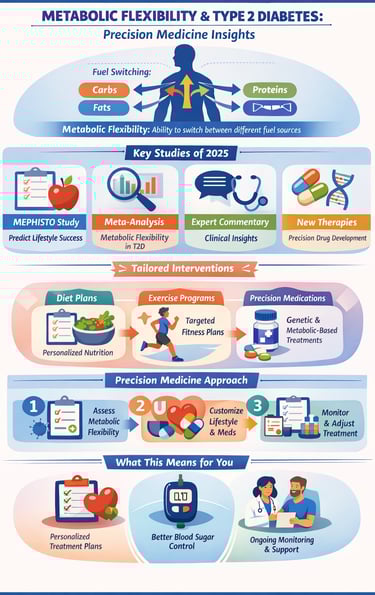
If you've been following diabetes research lately, you've probably heard the term metabolic flexibility popping up everywhere. But what exactly is it, and why should you care? Metabolic flexibility refers to your body's ability to switch between using different fuel sources—carbohydrates, fats, and proteins—depending on availability and energy demands. Think of it like having a versatile engine that can run on multiple fuel types seamlessly.
Recent groundbreaking research is reshaping how we understand and treat type 2 diabetes, suggesting that metabolic flexibility might be the key to predicting which patients will benefit most from lifestyle interventions. This discovery has profound implications for precision medicine and personalized diabetes management.
In this comprehensive guide, we'll explore four pivotal 2025 studies that illuminate the relationship between metabolic flexibility and type 2 diabetes, and how these findings could revolutionize your treatment options.
Key Takeaways
Metabolic flexibility predicts lifestyle response
Zone 2 exercise improves fat oxidation
Precision medicine is replacing one-size-fits-all diabetes care
Mitochondrial dysfunction contributes to insulin resistance
Clinical pearls
1. The "Hybrid Engine" Efficiency
Think of your body like a hybrid car. A healthy metabolism should switch seamlessly between burning "electricity" (stored fat) and "gasoline" (glucose from food). In type 2 diabetes, the "switch" often gets stuck.
Clinical Pearl: Being metabolically flexible means your body doesn't panic when you skip a meal. If you can go 4–5 hours without a snack and still feel focused, your "hybrid engine" is likely switching over to fat-burning mode efficiently.
2. Muscle as the "Flexibility Factory"
The 2025 MEPHISTO study highlights that your muscles are where the most fuel-switching happens. Inside your muscle cells, tiny power plants called mitochondria decide what to burn.
Clinical Pearl: "Zone 2" exercise—activity where you can still hold a conversation but are breathing heavily—is the gold standard for fixing a "rusty" switch. It forces your muscle mitochondria to become fat-burning specialists, improving your overall flexibility.
3. The "Mitochondrial Traffic Jam"
Metabolic inflexibility is often just a "traffic jam" at the cellular level. When we eat too frequently, the mitochondria get overwhelmed with too many fuel signals at once, leading to cellular "indecision" and insulin resistance.
Clinical Pearl: Giving your body a "rest period" from digestion (like 12–14 hours of overnight fasting) acts like a traffic controller. It clears the backlog of fuel and allows your cells to recalibrate their ability to burn fat.
4. Precision Over Procrastination
The research by Hansen et al. (2025) shows that not every person with diabetes is "inflexible." This is why a one-size-fits-all diet often fails.
Clinical Pearl: If a low-carb diet makes you feel energized, you likely have some fat-burning flexibility. If it makes you feel weak and "foggy" for weeks, your cellular machinery may need a more gradual approach, like "Carb Cycling," to retrain the switch slowly.
5. The "Fuel Priority" Rule
Your body has a strict hierarchy for burning fuel. It will always try to burn alcohol first, then sugar, then fat. If there is always sugar in the system, the "fat-burning" door stays locked.
Clinical Pearl: To improve flexibility, try the "Fiber, Protein, Fat, then Carb" eating order. By slowing down the sugar entry, you prevent the massive insulin spike that "locks" your fat stores, allowing your body to keep its fuel-switching options open throughout the day.
Metabolic Flexibility and Type 2 Diabetes
The Game-Changing 2025 Research on Metabolic Flexibility
Study 1: MEPHISTO Protocol – Can We Predict Who Will Succeed with Lifestyle Changes?
Ludlova et al. (2025) designed the MEPHISTO study to answer one of the most frustrating questions in diabetes care: Why do some people dramatically improve with diet and exercise while others see little benefit?
This ongoing randomized controlled trial is testing whether measuring a person’s metabolic flexibility before starting treatment can accurately predict their success. Researchers assess how well participants switch between burning sugar and fat, then follow them through structured lifestyle programs. The goal is to create a practical test that doctors could use to match patients with the right intervention — rather than using the current “try this and see” approach.
Key Insight: Early results suggest that people with better baseline metabolic flexibility respond more strongly to lifestyle changes. This study could mark the beginning of true precision lifestyle medicine in diabetes.
Study 2: Are All Type 2 Diabetes Patients Metabolically Inflexible?
Hansen et al. (2025) conducted a large systematic review and meta-analysis to challenge a common assumption — that everyone with Type 2 diabetes has poor metabolic flexibility.
After analyzing multiple studies, they found a more nuanced reality:
Many people with Type 2 diabetes do show reduced ability to switch fuels.
However, a significant portion still retains reasonable metabolic flexibility.
Critical Takeaway: Metabolic inflexibility is common but not universal in Type 2 diabetes. This variation explains why some patients thrive on low-carb diets while others struggle, and why identical exercise programs produce very different results. This heterogeneity strongly supports moving away from one-size-fits-all recommendations.
Study 3: Bridging Research and Real-World Practice
Koudelkova et al. (2025) wrote an expert commentary on the Hansen meta-analysis, translating the complex findings into practical clinical advice.
They emphasize that doctors should stop treating all Type 2 diabetes patients the same. Instead, they recommend stratifying patients based on their level of metabolic flexibility.
“Flexible” patients may do well with standard lifestyle advice.
“Inflexible” patients likely need more targeted strategies — such as carefully timed fasting, Zone 2 training, or medications that specifically improve mitochondrial function.
Patient-Friendly Translation: If a popular diet or exercise plan didn’t work for you, it may not be your fault or lack of willpower. Your metabolic profile may simply require a different approach.
Study 4: Precision Medicine – The Next Generation of Diabetes Drugs
Tian et al. (2025) reviewed how precision medicine is changing drug development for Type 2 diabetes. Instead of creating drugs meant for the “average patient,” researchers are now designing therapies that target specific underlying problems — particularly mitochondrial dysfunction and impaired fuel switching.
They highlight promising directions including:
Drugs that repair and improve mitochondrial function (helping cells switch fuels better)
Better use of existing medications like GLP-1 agonists, tailored to patients who show poor fat-burning capacity
Genetic and metabolic markers to predict who will respond best to specific treatments
Key Insight: The future is moving from “try this drug and see if it lowers your sugar” to “let’s identify your specific metabolic weakness and choose the tool designed to fix it.”
How These Studies Work Together
These four studies create a powerful new framework:
MEPHISTO shows we can predict who will succeed with lifestyle changes.
Hansen proves not everyone with diabetes has the same level of metabolic stiffness.
Koudelkova tells doctors what to do with that information.
Tian extends the same precision logic to medications.
Unified Message: Type 2 diabetes care is shifting from generic advice to personalized strategies based on how well your body switches between fuel sources.
Zone 2 Exercise: The "Mitochondrial Tune-Up"
The article calls muscle the "Flexibility Factory." Zone 2 exercise is the specific intensity that forces your mitochondria to stop relying on easy-access sugar and start burning fat efficiently.
The Intensity: You should be moving at a pace where you can still hold a conversation, but you are breathing heavily enough that you'd rather not. If you can sing, you’re going too slow; if you’re gasping for air, you’re going too fast.
The Goal: 60% - 70% of your maximum heart rate.
The Routine: Aim for 30–45 minutes, 3-4 times a week.
Why it works: High-intensity "sprints" burn sugar (anaerobic). Stable, moderate Zone 2 activity "cleans the rust" off the fat-burning machinery in your muscle cells.
Carb Cycling: The "Slow Retrain"
If you have been type 2 diabetic for a long time, the article suggests your "switch" might be stuck. Jumping straight into a strict low-carb diet can lead to "brain fog" because your body has forgotten how to access fat stores.
The "Step-Down" Approach:
Training Days: On days you do your Zone 2 exercise, include healthy complex carbohydrates (sweet potatoes, berries, oats) to fuel the movement.
Rest Days: On days you are sedentary, focus strictly on high protein, healthy fats, and fiber-rich vegetables.
The "Eating Order": Regardless of the day, always eat in this order:
Fiber (Salad/Greens)
Protein/Fat (Meat/Eggs/Nuts)
Carbs (Starches/Fruits)
Why this works: Eating fiber and protein first creates a "mesh" in your gut that slows down the absorption of sugar, preventing the insulin spike that locks the "fat-burning door."
Practical Implications: What This Means for Patients
For Patients with Type 2 Diabetes
Metabolic assessment could soon become standard before starting lifestyle interventions
Your intervention plan should be tailored to your individual metabolic flexibility status
Combining lifestyle changes with precision pharmacotherapy offers better outcomes than either alone
Monitoring metabolic flexibility over time helps track real physiological improvements, not just blood glucose levels
The "Metabolic Switch" Progress Tracker
As your "hybrid engine" becomes more efficient, you should notice these changes in your daily life:
1. The "Hunger" Test
The Inflexible State: You get "hangry" (irritable/shaky) if you miss a meal by 30 minutes. You feel like you must snack between lunch and dinner.
The Flexible State: You can comfortably go 4–6 hours between meals without a drop in mood or focus. This is a sign your body has successfully "switched" to burning fat stores to keep your brain fueled.
2. Morning Energy Levels
The Inflexible State: You wake up feeling "foggy" and feel you need coffee or a sugary breakfast just to start your brain.
The Flexible State: You wake up with clear-headed energy before you even eat. This indicates your body maintained steady fuel levels overnight via fat oxidation.
3. Post-Meal Focus
The Inflexible State: You experience a "food coma" or extreme sleepiness 30–60 minutes after a meal (especially a high-carb one).
The Flexible State: You feel satisfied but energized after eating. Your body is handling the glucose entry without a massive insulin spike that "shuts down" the system.
FAQs: Answering Your Burning Questions
What exactly is metabolic flexibility, and why does it matter?
Metabolic flexibility is your body's ability to switch between different fuel sources—carbs, fats, and proteins. It matters because individuals with good metabolic flexibility can adapt to dietary changes and exercise more effectively, making them better candidates for lifestyle-based interventions.
Does everyone with type 2 diabetes have metabolic inflexibility?
No. Hansen's meta-analysis shows that while some people with type 2 diabetes have impaired metabolic flexibility, others maintain relatively normal switching capacity. This variation is why precision assessment is so valuable.
How soon will the MEPHISTO protocol be available clinically?
As a validation study, MEPHISTO is ongoing. Results will likely inform clinical guidelines within the next few years, but widespread adoption will depend on regulatory approval and healthcare system integration.
Can lifestyle interventions alone fix metabolic inflexibility?
For many patients, yes—but not all. That's why the research emphasizes precision medicine approaches that combine metabolic assessment, tailored lifestyle interventions, and when necessary, targeted medications.
What's the difference between traditional and precision medicine approaches to type 2 diabetes?
Traditional approaches use the same treatment recommendations for everyone. Precision medicine assesses individual metabolic markers, genetic factors, and lifestyle capacity to create customized treatment plans that work with your unique biology rather than against it.
How are new drugs being developed differently under precision medicine?
Instead of creating drugs that work for most people, researchers now identify specific therapeutic targets that address the root causes of disease in particular patient subgroups. This results in more effective treatments with fewer side effects for individuals who match the metabolic profile the drug was designed for.
Should I ask my doctor for metabolic flexibility testing?
While still not routine, it's worth discussing. As this research becomes more mainstream, metabolic flexibility assessment may become standard. Your doctor can help determine if testing is appropriate for your situation.
Conclusion
Metabolic flexibility—the body’s ability to switch between fuel sources like carbohydrates, fats, and proteins—is emerging as a key factor in type 2 diabetes management. Recent research shows that not all patients with type 2 diabetes exhibit metabolic inflexibility, highlighting the importance of individualized assessment. The MEPHISTO study demonstrates that measuring baseline metabolic flexibility can predict which patients will respond best to lifestyle interventions, such as diet and exercise. Complementing this, systematic reviews indicate significant variability in metabolic flexibility among diabetic populations, reinforcing the need for personalized approaches. Expert commentaries emphasize standardized assessment methods and bridging research with clinical practice.
In parallel, precision medicine is reshaping drug development, identifying genetic, metabolic, and molecular targets to optimize therapy. Combining lifestyle interventions with targeted medications tailored to a patient’s metabolic profile offers superior outcomes compared with conventional, one-size-fits-all approaches. For patients, this means personalized treatment plans, better blood glucose control, and ongoing monitoring. For clinicians, integrating metabolic flexibility assessment into routine care can guide intervention choices and improve long-term outcomes.
Future diabetes care may depend less on lowering glucose alone and more on restoring the body’s capacity to efficiently adapt fuel utilization.
Disclaimer: This article is for informational purposes only and does not constitute medical advice. Individual circumstances vary, and treatment decisions should always be made in consultation with qualified healthcare professionals.
Related Articles
The Metabolic Triad: Why Diabetes, Obesity & CVD Are One Epidemic | DR T S DIDWAL
What’s New in the 2025 Blood Pressure Guidelines? A Complete Scientific Breakdown | DR T S DIDWAL
Manage Diabetes Naturally: How Beta-Glucans Control Blood Sugar | DR T S DIDWAL
Exercise as Metabolic Medicine: Latest Research on Glucose and Heart Health| DR T S DIDWAL
References
Hansen, M., Lange, K. K., Stausholm, M. B., & Dela, F. (2025). Are individuals with type 2 diabetes metabolically inflexible? A systematic review and meta-analysis. Endocrinology, Diabetes & Metabolism, 8(3), e70044. https://doi.org/10.1002/edm2.70044
Koudelkova, K., Moro, C., & Gojda, J. (2025). Commentary on "Are individuals with Type 2 Diabetes metabolically inflexible? A systematic review and meta‐analysis." Endocrinology, Diabetes & Metabolism, 8(4), e70068. https://doi.org/10.1002/edm2.70068
Ludlova, M., Koudelková, K., Pallova, J., Koudelkova, B., Siklova, M., Cahova, M., Vetrovsky, T., Steffl, M., & Gojda, J. (2025). Metabolic flexibility to predict lifestyle interventions outcomes (MEPHISTO): Protocol for predictive validation study and randomized controlled trial. JMIR Research Protocols, 14, e67570. https://doi.org/10.2196/67570
Tian, X., Wang, L., Zhang, L., et al. (2025). New discoveries in therapeutic targets and drug development pathways for type 2 diabetes mellitus under the guidance of precision medicine. European Journal of Medical Research, 30, 450. https://doi.org/10.1186/s40001-025-02682-5