Fasted Cardio: Is Training on an Empty Stomach a Fat Loss Myth?
Training on an empty stomach to burn more fat? See what new studies reveal about fasted cardio, metabolism, and real fat loss results.
EXERCISE
Dr. T.S. Didwal, M.D.(Internal Medicine)
2/26/202613 min read
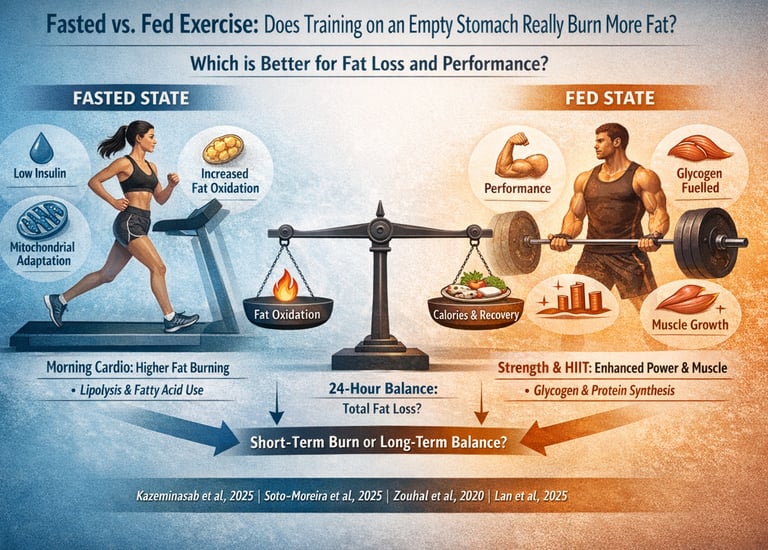
Fasted vs. Fed Exercise: Does Training on an Empty Stomach Really Burn More Fat?
Should you exercise on an empty stomach or eat before your workout? This question has become one of the most debated topics in exercise physiology, fat loss, and metabolic health. From social media claims about “fasted cardio burning more fat” to concerns about muscle loss and low energy, the advice can feel confusing and contradictory. Fortunately, recent clinical trials, systematic reviews, and meta-analyses now provide clearer answers grounded in science rather than hype.
Research consistently shows that fasted exercise increases fat oxidation during exercise, particularly during low-to-moderate intensity aerobic activity, due to lower insulin levels and greater reliance on fatty acids (Kazeminasab et al., 2025; Soto-Moreira et al., 2025). However, when scientists measure total 24-hour fat loss, body composition, and weight reduction, these advantages often disappear once calorie intake, energy balance, and training volume are matched (Zouhal et al., 2020). In contrast, fed-state exercise consistently supports better exercise performance, strength training output, and muscle protein synthesis, particularly during high-intensity or resistance-based workouts (Lan et al., 2025).
Importantly, individual responses vary widely based on metabolic flexibility, training status, circadian rhythm, and overall nutritional status. Rather than a universal rule, the science suggests a more personalized approach—where consistency, recovery, and total daily nutrition matter far more than whether you train fasted or fed.
Recent scientific research has finally given us concrete answers about how exercise timing and nutritional status affect your body's metabolism, fat burning, and performance. Let's break down what six major studies reveal about fasted versus fed exercise—and what this means for your fitness go
Clinical pearls
1. The "Fat-Burning" Snapshot vs. The Big Picture
While it’s true that training on an empty stomach can increase fat oxidation (burning) during the workout by about 15–20%, your body is a master of compensation. If you burn more fat during your morning session, your body often shifts to burning more carbohydrates later in the day to maintain balance.
The Pearl: Don't get hyper-focused on the "fat-burning zone" of a single workout. Total daily movement and nutrition are the real drivers of weight loss.
2. Metabolic Flexibility is a Skill
Think of your body like a hybrid car. Ideally, it should switch seamlessly between using "electricity" (stored fat) and "gasoline" (carbohydrates). Consistent fasted training teaches your body to access fat stores more efficiently, which is a hallmark of metabolic health.
The Pearl: Occasional fasted walks or light jogs are "training sessions" for your metabolism, helping you become more fuel-efficient over time.
3. High Intensity Requires High-Octane Fuel
For activities like heavy weightlifting or sprinting, your body relies on glycolysis—the rapid breakdown of carbohydrates. Without food in your system, your "top speed" and "max strength" usually drop because fat cannot be converted into energy fast enough to meet high demands.
The Pearl: If you are chasing a New Personal Record (PR) or doing a high-intensity class, eat some carbs 60–90 minutes beforehand to ensure you have the "fuel" to perform at 100%.
4. The Circadian Advantage
Research suggests that your internal clock influences how you process fuel. Morning exercise in a fasted state aligns with your body’s natural cortisol rhythm, which helps mobilize fatty acids.
The Pearl: If your schedule allows, "Low and Slow" (moderate aerobic activity) is best served in the morning, while "Heavy and Hard" (strength/intensity) often peaks in the afternoon or evening when body temperature is higher.
5. Protection Against "Muscle Wasting"
A common fear is that fasted exercise "eats" your muscle. Science shows that for a standard 45–60 minute workout, your body has plenty of internal reserves (glycogen and fat) to protect muscle tissue. However, this protection depends on your total daily protein intake.
The Pearl: You don't need to eat before you lift to save your muscles, but you definitely need to eat a high-protein meal after a fasted session to kickstart repair.
6. The "Feel-Good" Metric
The most rigorous study in the world cannot override your personal biology. Some people experience "bonking" (dizziness or extreme fatigue) when training fasted, which leads to a poor-quality workout or overeating later in the day.
The Pearl: The "best" protocol is the one that leaves you feeling energized, not depleted. If fasting makes you miserable, the metabolic "edge" isn't worth the loss in consistency.
What Is Fasted Exercise, Really?
Fasted exercise means working out when your body is in a post-absorptive state, typically after an overnight fast of 8-12 hours. During this time, your insulin levels are low, glycogen stores are partially depleted, and your body shifts toward using fat as fuel.
On the flip side, fed-state exercise occurs after you've eaten, when glucose availability is higher and your body preferentially burns carbohydrates for energy.
But does this metabolic difference translate into real-world benefits? Let's examine what the research actually shows.
Study 1: Soto-Moreira et al. (2025) - Mixed Results on Fat Oxidation
Soto-Moreira, Camacho-Forero, and Sabaté (2025) conducted a systematic review examining how acute bouts of fasted versus fed exercise affect glucose metabolism and lipid metabolism in healthy adults. Their analysis revealed nuanced findings that challenge oversimplified claims about fasted training.
Key Takeaways:
Fat oxidation rates were moderately higher during fasted exercise compared to fed-state workouts
The effect was most pronounced during moderate-intensity aerobic exercise (around 60-70% of maximum heart rate)
Post-exercise metabolism showed similar patterns regardless of feeding status
Individual responses varied considerably based on training status and metabolic flexibility
This study suggests that while fasted cardio can increase immediate fat burning, the advantage might not be as dramatic as fitness gurus claim.
Study 2: Kazeminasab et al. (2025) - Comprehensive Clinical Trial Analysis
Kazeminasab and colleagues (2025) published a more extensive meta-analysis of randomized clinical trials examining the same question. Their rigorous approach included only well-controlled studies to minimize bias and confounding variables.
Key Takeaways:
Acute fasted exercise increased fat oxidation during exercise by approximately 15-20% compared to fed conditions
No significant differences in 24-hour fat oxidation between fasted and fed exercise groups
Blood glucose levels remained stable in both conditions for healthy individuals
Lipid profiles showed minimal acute changes regardless of nutritional state
The metabolic advantages of fasting before exercise appeared to be compensated for by increased calorie intake post-workout
This comprehensive analysis reveals a critical insight: what happens during your workout doesn't necessarily predict long-term fat loss outcomes. Your body is remarkably adaptive and compensates throughout the day.
The Extreme Fasting Study: Seven Days Without Food
Study 3: Kolnes et al. (2025) - Extended Fasting and Performance
In a fascinating (and somewhat extreme) investigation, Kolnes and colleagues (2025) examined what happens to physical performance and metabolic adaptation when people fast for an entire week while still exercising.
Key Takeaways:
Aerobic capacity declined significantly by day seven of fasting
Muscular strength and power output decreased progressively
Fat oxidation capacity increased dramatically as the body adapted to ketosis
Participants experienced substantial fatigue and reduced exercise tolerance
Metabolic flexibility improved, but at the cost of immediate performance
Recovery to baseline performance took several days after refeeding
This study demonstrates that while your body can adapt to extreme energy deprivation, the trade-off is reduced athletic performance. It's a clear reminder that chronic fasting and acute fasted exercise are very different scenarios.
Energy Metabolism During Fasted Aerobic Exercise
Study 4: Zamir (2022) - Metabolic Pathways Explained
Zamir's (2022) comprehensive review examined the specific metabolic pathways activated during fasted aerobic exercise in healthy adults. This research helps us understand the biochemistry behind the anecdotal claims.
Key Takeaways:
Fasted cardio increases reliance on lipolysis (fat breakdown) and fatty acid oxidation
Glycogen-sparing effects occur, preserving carbohydrate stores for high-intensity efforts
Mitochondrial adaptations may be enhanced with regular fasted training
Substrate utilization shifts toward fat at lower exercise intensities in fasted states
Metabolic flexibility—your body's ability to switch between fuel sources—improves with consistent fasted exercise
This study clarifies that fasted training does create real metabolic adaptations, particularly for endurance athletes looking to improve their fat-burning capacity during prolonged exercise.
Does Exercise Timing Matter? Morning vs. Evening
Study 5: Lan et al. (2025) - The Circadian Connection
Lan and colleagues (2025) investigated whether the time of day you exercise affects fat oxidation, comparing morning versus evening workouts in young men.
Morning exercise in a fasted state produced the highest rates of fat oxidation
Circadian rhythms significantly influence substrate metabolism during exercise
Evening workouts showed higher carbohydrate oxidation regardless of feeding status
Body temperature, hormone levels, and metabolic rate follow circadian patterns that affect exercise response
Consistency in training time may be more important than the specific time chosen
This research adds another layer to the fasted exercise debate: it's not just about whether you eat before exercise, but when you exercise altogether. Your body's internal clock plays a significant role in energy metabolism.
The Comprehensive Review: Training Adaptations Over Time
Study 6: Zouhal et al. (2020) - Long-Term Perspectives
Zouhal and colleagues (2020) published an extensive review examining both acute effects and long-term adaptations to exercise training during fasting. Their work bridges the gap between single-bout studies and practical training applications.
Key Takeaways:
Chronic fasted training may enhance metabolic flexibility and insulin sensitivity
Body composition changes from fasted exercise show minimal differences compared to fed training when total calorie intake is controlled
Performance adaptations are similar between fasted and fed training protocols for most fitness goals
Muscle protein synthesis may be compromised if fasted training is combined with overall caloric restriction
Intermittent fasting protocols combined with exercise show promise for metabolic health markers
Individual variability is substantial—some people thrive with fasted training while others perform poorly
This comprehensive analysis reminds us that exercise and nutrition exist on a continuum. Short-term metabolic snapshots don't always predict long-term outcomes.
The Leucine Trigger & Fasted Recovery
When you train in a fasted state, your body enters a catabolic (breakdown) environment. To flip the switch back to anabolic (growth), you must reach the "Leucine Trigger." * The Mechanism: Leucine is a key amino acid that acts as a chemical "on-switch" for mTOR, the primary pathway for muscle protein synthesis ($MPS$).
The Requirement: Without pre-workout amino acids, fasted trainees must prioritize a high-quality protein source (providing 2.5–3g of leucine) immediately post-exercise.
The Goal: This rapid influx of leucine "rescues" the muscle from a negative protein balance, ensuring that the metabolic benefits of fasting don't come at the expense of lean muscle tissue.
Practical Recommendations Based on the Science
For Fat Loss Goals
If fat loss is your primary objective:
Focus on creating a sustainable caloric deficit through diet and exercise
Choose the fasted or fed approach based on what helps you maintain workout consistency and intensity
Prioritize resistance training to preserve lean muscle mass
Don't expect fasted cardio to be a magic bullet—it's just one tool in the toolbox
Monitor your overall daily nutrition rather than fixating on pre-workout timing
For Performance Goals
If you're training for athletic performance:
For endurance events, periodic fasted training may enhance fat oxidation capacity
For strength and power sports, fed-state training generally supports better performance
Consider your training intensity—higher intensities require more readily available glucose
Periodize your approach: use fasted training strategically rather than exclusively
Pay attention to recovery nutrition regardless of pre-workout eating
For Metabolic Health
If you're focused on metabolic health and insulin sensitivity:
Both fasted and fed exercise improve metabolic markers when done consistently
Fasted training may provide modest additional benefits for insulin sensitivity
Combine exercise with other lifestyle factors like adequate sleep and stress management
Consider an intermittent fasting approach if it fits your lifestyle and preferences
Regular exercise matters more than the fed/fasted distinction for long-term metabolic health
Common Myths Debunked
Myth 1: "Fasted Cardio Burns Muscle"
While extended fasting (like the seven-day protocol in the Kolnes study) can compromise performance, typical overnight fasts before morning exercise don't cause significant muscle catabolism in healthy, well-nourished individuals. Your body is more intelligent than that.
Myth 2: "You Must Eat Before Exercise to Have Energy"
Many people perform perfectly well in a fasted state, especially during moderate-intensity exercise. Individual tolerance varies, but don't assume you'll bonk without pre-workout food.
Myth 3: "Fasted Exercise Doubles Fat Loss"
The research is clear: the metabolic advantage during exercise doesn't translate to doubled fat loss. Total daily energy balance matters far more than exercise timing.
Myth 4: "Everyone Should Train Fasted"
The studies show considerable individual variation. Some people thrive with fasted training, while others experience poor performance, irritability, and reduced motivation. There's no one-size-fits-all approach.
Frequently Asked Questions
Q: Can I build muscle while doing fasted exercise?
A: Yes, but with caveats. Muscle protein synthesis requires adequate protein intake throughout the day. If you train fasted, prioritize a protein-rich meal within a few hours post-workout. The research suggests fed-state training might have slight advantages for hypertrophy, but consistent training and nutrition matter more than timing.
Q: How long should I fast before exercise?
A: Most studies use an overnight fast of 8-12 hours. This is the "sweet spot" where you get metabolic benefits without severe performance degradation. Longer fasts (like the seven-day protocol studied by Kolnes et al.) significantly impair performance.
Q: Is fasted exercise safe for everyone?
A: For healthy adults, fasted exercise is generally safe during moderate-intensity workouts. However, people with diabetes, blood sugar regulation issues, eating disorders, or those who are pregnant should consult healthcare providers before adopting fasted training protocols.
Q: Will I feel dizzy or weak training fasted?
A: Some people adapt quickly while others consistently feel poor. The Kazeminasab et al. study showed that blood glucose remains stable during fasted exercise in healthy individuals, but perceived energy and performance vary individually. Start with shorter, lower-intensity sessions if you're new to fasted training.
Q: Does coffee before a fasted workout break the fast?
A: Black coffee doesn't significantly affect the metabolic state of fasting and may even enhance fat oxidation. Adding cream, sugar, or significant calories would shift you toward a fed state.
Q: Should I do fasted exercise every day?
A: The research doesn't support daily fasted training as superior. Consider periodizing your approach—perhaps 2-3 fasted sessions weekly for endurance adaptations, with fed-state training for higher-intensity workouts.
Q: What about working out during Ramadan or other religious fasts?
A: The Zouhal et al. review included research on Ramadan fasting and exercise. While challenging, people can maintain fitness with adjusted training schedules and proper rehydration and nutrition during eating windows.
Key Takeaways
1️⃣ The Core Question: Acute Fat Oxidation vs. Long-Term Fat Loss
Fasted exercise reliably increases acute fat oxidation during low-to-moderate intensity aerobic activity.
Mechanism: lower insulin → increased lipolysis → greater reliance on fatty acids.
However, multiple meta-analyses show that 24-hour fat oxidation and body composition changes are similar when total calories and training load are matched.
The body compensates metabolically across the day.
Editorial takeaway: What you burn during the workout does not equal what you lose over time.
2️⃣ Metabolic Flexibility: The Real Physiological Prize
Repeated fasted training may enhance metabolic flexibility—the ability to switch between carbohydrate and fat oxidation.
This adaptation may improve mitochondrial efficiency, fatty acid transport, and endurance substrate utilization.
Particularly relevant for endurance athletes and metabolically inflexible individuals.
However, improvements are modest and context-dependent.
Editorial takeaway: Fasted training is a metabolic tool—not a fat-loss shortcut.
3️⃣ Performance Trade-Offs
High-intensity interval training (HIIT), resistance training, and sprint-based efforts rely heavily on glycogen and glycolysis.
Fed-state exercise typically improves:
Power output
Strength performance
Training volume
Perceived exertion
Extended fasting significantly impairs performance capacity.
Editorial takeaway: Fuel availability determines training quality.
4️⃣ Insulin Sensitivity & Metabolic Health
Both fasted and fed exercise improve insulin sensitivity when performed consistently.
Some evidence suggests fasted sessions may produce slightly greater short-term improvements in glucose regulation.
However, overall energy balance and habitual exercise frequency are far stronger determinants.
Editorial takeaway: Consistency outweighs timing.
5️⃣ Muscle Protein Synthesis & The Leucine Threshold
Fasted training places the body temporarily in a catabolic environment.
Muscle preservation depends on adequate daily protein intake and post-exercise leucine availability (~2.5–3g).
Fed-state resistance training may slightly enhance muscle protein synthesis, but total daily protein remains the dominant variable.
Editorial takeaway: Muscle growth is nutrition-dependent, not timing-obsessed.
6️⃣ Circadian Biology Matters
Morning fasted exercise aligns with natural cortisol rhythms and may enhance fat oxidation.
Afternoon/evening sessions may support greater strength and neuromuscular output due to higher body temperature.
Editorial takeaway: Timing interacts with physiology—but adaptation follows consistency.
7️⃣ Psychological & Behavioral Reality
Some individuals feel energized training fasted.
Others experience fatigue, dizziness, irritability, or compensatory overeating.
Sustainability determines long-term success.
Editorial takeaway: Adherence beats metabolic micromanagement.
8️⃣ The Big Picture: Energy Balance Still Reigns
Weight loss ultimately reflects caloric deficit over time.
Fasted training does not override thermodynamics.
Nutrient timing fine-tunes physiology but does not replace foundational principles:
Progressive overload
Adequate recovery
Sufficient protein
Sleep optimization
🏛 Final Verdict
The fasted vs. fed debate reflects a broader issue in exercise science: overemphasis on acute metabolic snapshots while underestimating long-term adaptation.
Fasted exercise increases fat oxidation during the session.
Fed exercise often improves performance and training quality.
Neither strategy independently guarantees superior fat loss.
The hierarchy of importance remains clear:
Total energy balance
Training consistency
Progressive overload
Recovery quality
Nutritional adequacy
Nutrient timing is a refinement strategy—not a primary driver.
For most individuals, the optimal protocol is the one that enhances performance, recovery, and adherence over months and years—not just the one that maximizes fat oxidation for 45 minutes.
Author’s Note
As a physician trained in internal medicine and deeply engaged in metabolic research, I approach the fasted vs. fed exercise debate from a clinical and physiological perspective—not a trend-driven one.
Over the past decade, fasting protocols, intermittent fasting, and “fasted cardio” have been widely promoted as metabolic game-changers. At the same time, strength coaches and sports nutrition experts have emphasized pre-workout fueling for performance and muscle preservation. Both sides present compelling arguments. Both cite real physiology. And both, at times, oversimplify the science.
The purpose of this article is not to promote one camp over the other. It is to clarify what the current evidence actually shows.
Acute metabolic responses—such as increased fat oxidation in a fasted state—are real and measurable. However, physiology is dynamic. The human body compensates across 24 hours, across weeks of adaptation, and across changes in energy balance. When we step back and examine high-quality randomized trials and meta-analyses, a consistent theme emerges: total caloric balance, training quality, and recovery practices exert far greater influence on long-term body composition and metabolic health than pre-workout feeding status alone.
As clinicians, we must also remember variability. A metabolically flexible endurance athlete is not the same as a sedentary patient with insulin resistance. A strength-focused lifter pursuing hypertrophy has different physiological demands than someone walking for general health. Context matters.
My goal is always to bridge molecular physiology with practical application. Science should inform training decisions—not complicate them unnecessarily.
If there is one principle I hope readers take away, it is this:
Exercise consistency, adequate protein intake, progressive overload, sleep quality, and sustainable nutrition habits will always outweigh narrow timing strategies.
Use fasted or fed training as tools. Do not let them become dogma.
Medical Disclaimer
The information in this article, including the research findings, is for educational purposes only and does not constitute medical advice, diagnosis, or treatment. Before starting any new exercise program, you must consult with a qualified healthcare professional, especially if you have existing health conditions (such as cardiovascular disease, uncontrolled hypertension, or advanced metabolic disease). Exercise carries inherent risks, and you assume full responsibility for your actions. This article does not establish a doctor-patient relationship.
Related Articles
Jump Higher. Run Faster. Recover Smarter. The 2026 Science of Plyometric Training | DR T S DIDWAL
How to Build a Disease-Proof Body: Master Calories, Exercise & Longevity | DR T S DIDWAL
Exercise vs. Diet Alone: Which is Best for Body Composition? | DR T S DIDWAL
Movement Snacks: How VILPA Delivers Max Health Benefits in Minutes | DR T S DIDWAL
Anabolic Resistance: Why Muscles Age—and How to Restore Their Growth Response | DR T S DIDWAL
Breakthrough Research: Leptin Reduction is Required for Sustained Weight Loss | DR T S DIDWAL
The Psychology of Strength Training: Building Resilience Beyond the Gym | DR T S DIDWAL
HIIT Benefits: Evidence for Weight Loss, Heart Health, & Mental Well-Being | DR T S DIDWAL
References
Kazeminasab, F., Rafiee, P., Miraghajani, M., Santos, H. O., Symonds, M. E., & Rosenkranz, S. K. (2025). The effects of acute bouts of exercise in fasted vs. fed states on glucose and lipid metabolism in healthy adults: A systematic review and meta-analysis of randomized clinical trials. Clinical Nutrition ESPEN, 66, 320–331. https://doi.org/10.1016/j.clnesp.2025.02.002
Kolnes, K. J., Nilsen, E. T. F., Brufladt, S., Hansen, J., Ludviksen, M., Sollie, O., Jensen, J., Dalen, K. T., & Sandbakk, Ø. (2025). Effects of seven days' fasting on physical performance and metabolic adaptation during exercise in humans. Nature Communications, 16, Article 122. https://doi.org/10.1038/s41467-024-55418-0
Lan, H., Wu, K., Deng, C., & Wang, S. (2025). Morning vs. evening: The role of exercise timing in enhancing fat oxidation in young men. Frontiers in Physiology, 16, Article 1574757. https://doi.org/10.3389/fphys.2025.1574757
Soto-Moreira, P., Camacho-Forero, L., & Sabaté, J.-M. (2025). The effects of acute bouts of exercise in fasted vs. fed states on glucose and lipid metabolism in healthy adults: A systematic review and meta-analysis. Clinical Nutrition ESPEN, 25, Article S2405-4577(25)00062-2. https://doi.org/10.1016/j.clnesp.2025.00062-2
Zamir, M. A. (2022). Aerobic exercise in the fasted state: The effects on energy metabolism in healthy adults. International Journal of Sport, Exercise and Health Research, 6(1), 55–62. https://www.sportscienceresearch.com/IJSEHR_202261_09.pdf
Zouhal, H., Saeidi, A., Salhi, A., Li, H., Essop, M. F., Laher, I., Rhibi, F., Amani-Shalamzari, S., & Ben Abderrahman, A. (2020). Exercise training and fasting: Current insights. Open Access Journal of Sports Medicine, 11, 1–28. https://doi.org/10.2147/OAJSM.S224919