Why Your Scale Isn’t Moving: The Science of Fat Burning Beyond Weight Loss
Stop obsessing over the scale. Learn how your body burns fat at a cellular level—and why combining cardio and strength training drives lasting obesity treatment.
OBESITYEXERCISE
Dr. T.S. Didwal, M.D.(Internal Medicine)
1/21/202614 min read
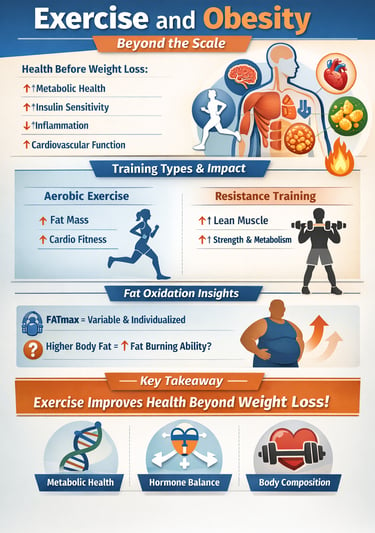
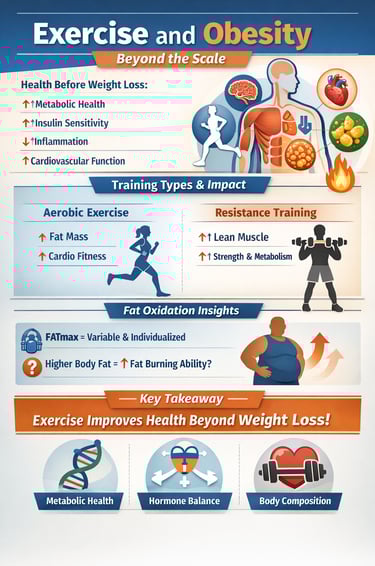
Recent research reframes the role of exercise in obesity by shifting attention away from weight loss alone toward metabolic health, fat oxidation, and hormonal regulation. Contemporary evidence shows that physical activity improves cardiovascular function, insulin sensitivity, inflammation, and metabolic flexibility even in the absence of substantial weight reduction (Jakicic et al., 2025; James & Stanford, 2025). These findings challenge the scale-centric model of obesity treatment and emphasize health benefits that occur at the cellular and endocrine levels.
Comparative studies demonstrate that both aerobic exercise and resistance training improve body composition through distinct but complementary mechanisms. Aerobic training preferentially reduces fat mass and enhances cardiorespiratory fitness, while resistance training preserves and increases lean mass, protecting long-term metabolic rate (Hang et al., 2025). Importantly, emerging evidence suggests that lean mass quality—its aerobic and metabolic capacity—may be more critical for maximal fat oxidation than muscle quantity alone, with cardiorespiratory fitness acting as a key mediator (Opazo-Díaz et al., 2025).
Methodological reviews caution against overinterpreting precise measures such as FATmax, as fat oxidation assessments show substantial interindividual variability and limited reproducibility (Chávez Guevara & Amaro-Gahete, 2025). Nonetheless, fat oxidation is physiologically meaningful, and paradoxically, individuals with obesity may exhibit preserved or even elevated exercise fat oxidation capacity, challenging traditional models of impaired metabolic flexibility (Chávez-Guevara et al., 2021).
Collectively, these studies support a paradigm shift in obesity management: prioritizing consistent, mixed-mode exercise to improve metabolic health, hormonal balance, and functional fitness rather than focusing exclusively on weight loss. The evidence underscores that regular physical activity rapidly initiates beneficial adaptations, reinforcing exercise as a cornerstone therapy for obesity beyond changes on the scale.
Clinical pearls
1. The "Invisible Win": Metabolic Health Precedes Weight Loss
The Pearl: Your blood chemistry improves long before your silhouette changes.
The Science: Even if the scale is stuck, consistent movement begins repairing insulin sensitivity and lowering systemic inflammation within just a few weeks. Exercise "reprograms" your endocrine system to manage blood sugar more effectively, reducing the risk of type 2 diabetes regardless of your actual weight.
Takeaway: Don't let a "stalled" scale stop your momentum; your internal organs are already reaping the rewards.
2. Muscle Quality vs. Muscle Quantity
The Pearl: It’s not about how much muscle you have, but how well that muscle "breathes."
The Science: New research highlights that cardiorespiratory fitness—the ability of your heart and lungs to supply oxygen to your muscles—is the primary driver of fat burning. You don't need bodybuilder-sized muscles to burn fat efficiently; you need muscles that are metabolically active and aerobically fit.
Takeaway: Focus on activities that get you slightly out of breath (cardio) alongside strength training to ensure your muscles are high-quality energy burners.
3. The "Hybrid Advantage" for Body Composition
The Pearl: Cardio burns the fat, but weights keep the "furnace" running.
The Science: Resistance training is essential during obesity treatment because it prevents the loss of lean muscle mass. If you only do cardio while losing weight, your body may burn muscle for fuel, which eventually slows your metabolism. A hybrid approach ensures you lose fat while keeping the metabolically expensive muscle that keeps your weight stable long-term.
Takeaway: Mix a brisk walk with a few sets of bodyweight squats or resistance bands to get the best of both worlds.
4. FATmax is Personal, Not Universal
The Pearl: Your "fat-burning zone" isn't a setting on a treadmill; it's a moving target inside your body.
The Science: The intensity at which you burn the most fat ($FATmax$) is highly individual and varies based on your sleep, nutrition, and current fitness level. Research shows that standardized "zones" on fitness trackers are often inaccurate for those with obesity.
Takeaway: Listen to your body. Moderate intensity—where you can still talk but would prefer not to—is generally a more reliable "fat-burning" guide than a generic number on a screen.
5. The Myth of the "Broken" Metabolism
The Pearl: Obesity does not "break" your ability to burn fat; it just changes the environment.
The Science: 2025 studies have defied the old paradigm by showing that men with obesity can actually have higher rates of fat oxidation than previously thought. Your body still knows how to use fat for fuel; it just needs the consistent signal of physical activity to "unlock" that pathway.
Takeaway: You aren't fighting against a broken machine. Your body is a highly adaptable system that is ready to respond to movement at any size.
Exercise and Fat Oxidation in Obesity: What the Latest Research Reveals About Health Beyond the Scale.
Before diving into the specifics, it's important to know what researchers are actually studying. When scientists talk about fat oxidation (also called fat burning capacity), they're measuring how efficiently your body converts stored fat into energy during exercise. This is different from simple weight loss—it's about metabolic health and how well your body functions.
The five studies we're examining today represent cutting-edge research published in 2025 and include landmark research that challenges conventional thinking about obesity physiology and exercise metabolism.
Study 1: Physical Activity and Obesity Treatment—Beyond Weight Loss
This comprehensive review by Jakicic et al.(2025) shifts the conversation about obesity management in a crucial direction. Researchers, led by Jakicic and colleagues, argue that we shouldn't view exercise therapy solely through the lens of weight reduction.
The key finding? Physical activity produces health benefits that extend far beyond what appears on the scale. This includes improved cardiovascular function, better metabolic flexibility (your body's ability to switch between burning carbs and fat), enhanced insulin sensitivity, and stronger mental health outcomes.
Key Takeaways
Exercise improves metabolic markers independently of significant weight loss
Cardiovascular health, blood sugar regulation, and muscle function all improve with consistent activity
Obesity treatment should prioritize movement quality over rapid weight loss
Physical activity creates lasting behavioral health changes that support long-term wellness
If you've ever felt discouraged because the scale isn't moving fast enough, this research validates an important truth: your body is changing for the better even when you don't see dramatic weight loss. Obesity exercise interventions are working at the cellular level, improving how your organs function and how efficiently your body processes energy.
Study 2: Resistance vs. Aerobic Training in Middle-Aged Adults
This interventional study by Hang et al. (2025). compared two of the most popular forms of exercise: resistance training (weightlifting and strength exercises) and aerobic training (cardio). Researchers wanted to know: which approach better improves body composition in people with obesity?
The research examined how these different exercise modalities affected lean mass, fat mass, and overall body composition in middle-aged adults. This is particularly important because body composition matters more than total weight—two people at the same weight can have vastly different health profiles depending on how much of that weight is muscle versus fat.
Key Takeaways
Both resistance training and aerobic training improve body composition, but through different mechanisms
Resistance training is particularly effective for building and preserving lean muscle mass
Aerobic exercise excels at reducing overall fat mass and improving cardiovascular fitness
A combined approach may offer the most comprehensive benefits for obesity treatment
Middle-aged adults (typically the highest-risk group for weight-related health issues) showed meaningful improvements with both modalities
This study answers a common question: "Should I do cardio or weights?" The answer isn't either/or—it's both. If you have obesity, understanding that resistance training protects your muscle while you lose fat is crucial. Many people lose both fat and muscle during weight loss, which actually slows their metabolism long-term. This research suggests a balanced exercise program that includes both types of training produces superior results for body composition improvement.
Study 3: The FATmax Problem—Why Fat Oxidation Measurement Is Complex
Here's something that might surprise you: measuring how much fat someone burns during exercise is actually quite complicated. This narrative review examines the methodological challenges in assessing maximal fat oxidation (often called FATmax)—essentially, the exercise intensity at which your body burns the most fat.
Research by iChávez and, Amaro-Gahete (2025) identified significant reproducibility issues in how fat oxidation is measured across different studies and laboratories. They found that factors like the type of exercise equipment used, the testing protocol, individual variations, and even nutritional factors can all affect measurements.
Key Takeaways
Fat oxidation measurement lacks standardized protocols across research settings
FATmax (the intensity at which maximum fat burning occurs) varies significantly between individuals
Environmental and methodological factors substantially influence maximal fat oxidation measurements
Personalized testing approaches may be more meaningful than one-size-fits-all measurements
Current research on fat burning should be interpreted with caution regarding reproducibility
If you've used a fitness tracker that claims to tell you your "fat-burning zone," this research provides important context. The science behind measuring exactly when your body burns the most fat is still being refined. This doesn't mean fat oxidation isn't real—it absolutely is—but it means you shouldn't get too attached to precise numbers from consumer devices. The bigger picture of regular physical activity and overall fitness improvement matters more than obsessing over exact fat oxidation rates.
Study 4: New Perspectives on Obesity and Exercise Performance
What This Study Shows
This research by James & Stanford (2025) provides a comprehensive update on how obesity affects exercise physiology and how physical activity interventions can reverse these effects. James and Stanford synthesize recent findings about the hormonal and metabolic complications of obesity and how exercise can restore normal endocrine function.
The study particularly emphasizes how obesity disrupts hormone signaling related to energy regulation, insulin sensitivity, and inflammatory responses—and how exercise can restore these systems.
Key Takeaways
Obesity disrupts multiple hormonal systems that regulate energy and metabolism
Exercise is a powerful tool for restoring hormonal balance in people with obesity
Regular physical activity reduces inflammation associated with obesity-related complications
Cardiovascular exercise and strength training both restore endocrine function
The benefits emerge relatively quickly—within weeks, hormonal improvements can be detected
If you have obesity, you're not just dealing with extra weight—your hormones are telling your body to hold onto fat and feel hungrier. This review shows that exercise is literally reprogramming these hormonal signals. Within weeks of starting exercise interventions, your body begins to shift back toward healthier hormone regulation, which makes the entire process of weight management easier over time.
Study 5: Does Body Fat Increase Fat Oxidation? Challenging the Paradigm
This research by Chávez-Guevara (2021) challenges conventional wisdom about how body fatness and fat oxidation capacity relate to each other. Researchers examined men with obesity and found something unexpected: higher body fatness was actually positively associated with higher exercise fat oxidation.
This contradicts the popular "metabolic flexibility" model, which suggests that people with obesity have reduced ability to burn fat during exercise. Instead, the data suggests a more nuanced reality: having more body fat doesn't necessarily mean you can't burn fat efficiently during exercise.
Key Takeaways
Body fatness and fat oxidation capacity don't follow the expected inverse relationship
Men with obesity may actually have higher maximal fat oxidation rates than previously thought
The metabolic flexibility paradigm needs revision based on this evidence
Exercise training can improve fat oxidation even in individuals with significant obesity
Individual variation in fat metabolism is greater than traditional models suggest
This is genuinely reassuring news. If you have obesity, you might worry that your metabolism is permanently broken. This research suggests otherwise. Your body may be quite capable of burning fat during exercise—it's not a matter of your physiology being fundamentally different, but rather about engaging in consistent physical activity. The "I can't burn fat" myth doesn't hold up against this evidence.
Study 6: Lean Mass Quality and Fat Oxidation Capacity
What This Study Shows
Here's a fascinating question: is it the amount of muscle you have that determines fat-burning capacity, or is it how good that muscle is at aerobic function? Researchers explored whether lean mass quality (how metabolically active and aerobically fit your muscles are) matters more than simply lean mass quantity (how much muscle you have).
The study by Opazo-Díaz (2025) found that cardiorespiratory fitness appears to play a crucial mediating role—meaning your aerobic fitness level might be the real driver of fat oxidation capacity, more so than raw muscle mass.
Key Takeaways
Lean mass quality (aerobic function) may matter more than lean mass quantity alone
Cardiorespiratory fitness is a key determinant of maximal fat oxidation capacity
Building metabolically active, aerobically fit muscle is more important than simply gaining muscle size
Aerobic training combined with strength training optimizes fat oxidation capacity
Fitness level is a better predictor of fat-burning ability than body composition alone
This research suggests that it's not just about having big muscles—it's about having muscles that function well aerobically. This means that both cardio exercise and strength training that emphasizes muscular endurance and aerobic capacity are more effective for improving fat burning than strength training focused purely on size. For obesity management, this means building cardiovascular fitness while building muscle is the winning combination.
How These Studies Connect: The Big Picture
The Paradigm Shift
Together, these studies represent a shift in how science views obesity treatment. Rather than focusing narrowly on weight loss, modern research emphasizes:
Metabolic health over body weight
Exercise quality and consistency over intensity alone
Body composition improvement (building muscle while losing fat) rather than simple weight reduction
Hormonal restoration through regular activity
Individual variation in how bodies respond to exercise
The Complete Picture of Exercise Benefits
Immediate Benefits: Exercise begins improving metabolic markers and hormone regulation within weeks, sometimes without significant weight loss
Body Composition Changes: Both aerobic and resistance training change how your body is composed, with resistance training protecting muscle during fat loss
Fat Oxidation Improvements: Your body becomes more efficient at burning fat during exercise, even if you currently have obesity
Cardiovascular Adaptation: Your heart and lungs become more efficient, improving your ability to deliver oxygen to muscles during exercise
Long-term Sustainability: These changes support lasting behavioral modifications and healthier lifestyle patterns
Frequently Asked Questions
Q: Does exercise have to lead to significant weight loss to be worthwhile?
A: Absolutely not. The research clearly shows that physical activity improves health markers—blood sugar, cholesterol, blood pressure, and hormone function—independently of substantial weight loss. You're getting healthier even when the scale moves slowly. This is why health professionals now emphasize fitness and metabolic health alongside weight management.
Q: I have obesity. Can my body actually burn fat effectively during exercise?
A: Yes. Research directly contradicts the idea that obesity prevents fat oxidation. People with obesity may even have higher maximal fat oxidation rates than previously thought. Your body is capable of burning fat efficiently—consistent exercise training improves this capacity even further.
Q: Which is better for weight loss: cardio or weights?
A: They work differently and complement each other. Aerobic training is excellent for burning calories and losing fat mass. Resistance training preserves and builds muscle while you lose fat, which is crucial because muscle keeps your metabolism elevated. Combining both gives you the best body composition results.
Q: How long before I see health improvements from exercise?
A: Health improvements happen relatively quickly. Research shows metabolic markers and hormone function can improve within weeks of starting exercise interventions. Body composition changes typically become noticeable within 4-8 weeks of consistent activity. These improvements often occur before significant weight loss.
Q: What if my fitness tracker says I'm in the "fat-burning zone"?
A: Take that with a grain of salt. The measurement of maximal fat oxidation is complex, and consumer devices use simplified models. What matters more is that you're doing regular physical activity at an intensity you can sustain. Consistency beats obsessing over precise fat-burning zones.
Q: Can exercise fix my metabolism if I have obesity?
A: Yes, to a significant degree. Obesity disrupts hormonal systems that regulate energy and appetite, but regular physical activity restores these systems. Your metabolism can be retrained and improved, though the process requires consistent effort over weeks and months.
Q: Do I need to be fit to start exercising?
A: No. The beauty of these research findings is that exercise benefits begin immediately, regardless of starting fitness level. Even moderate activity produces measurable health improvements within weeks. Start where you are, and your body will adapt.
Key Takeaways: What You Need to Know
Exercise changes far more than your weight. The most important benefits of physical activity for obesity management are metabolic improvements, hormonal restoration, and body composition changes—many of which happen independent of significant weight loss.
Your body can burn fat efficiently. If you have obesity, you don't have a fundamentally broken metabolism. Research shows your body is quite capable of fat oxidation with consistent exercise training.
Combine cardio and strength training. Aerobic exercise burns fat and improves cardiovascular fitness, while resistance training preserves muscle and improves lean mass quality. Together, they optimize fat oxidation capacity.
Health improvements happen fast. You don't need to wait months for results. Metabolic markers and hormonal function improve within weeks of starting regular physical activity.
Consistency matters more than intensity. Sustainable exercise routines that you can maintain long-term produce better results than sporadic intense efforts. Metabolic adaptation comes from regular, repeated activity.
Individual variation is real. How your body responds to exercise is unique. Your fat oxidation capacity, your rate of body composition change, and your hormonal response all vary based on individual factors. This means finding what works for you is crucial.
Weight loss isn't the whole story. A person can be healthier and have a better body composition without dramatic weight loss. Focus on becoming stronger, more cardiovascularly fit, and metabolically healthier—the body composition changes follow.
What This Means for Your Health Journey
If you're managing obesity or simply want to understand how exercise improves health, these research findings are genuinely encouraging. Your body isn't broken. It's not incapable of fat oxidation or metabolic improvement. What it needs is consistent physical activity.
The research suggests a practical approach: move regularly, combine aerobic and strength training, focus on how you feel rather than obsessing over the scale, and recognize that your body is improving at the metabolic level even before significant weight loss occurs.
The goal isn't achieving some perfect number on a scale—it's building a body that functions well, has good cardiovascular fitness, metabolically active muscle, and the capacity to efficiently use fat for energy. That's what the latest science tells us matters most.
Call to Action: Start Your Movement Journey
Ready to apply this research to your own life? Here's how to get started:
This week: Choose one form of aerobic activity you enjoy (walking, cycling, swimming) and commit to doing it 3-4 times weekly
This month: Add resistance training 2-3 times per week—even simple bodyweight exercises count
Track the right things: Rather than obsessing over the scale, notice improvements in energy, how your clothes fit, your cardiovascular endurance, and how you feel
Be patient with the process: These research findings take 4-8 weeks to become noticeable. Give your body time to adapt
Consider professional support: A fitness professional can help you design a personalized exercise program that addresses your specific health goals and current fitness level
Remember: you're not starting from a broken place. You're starting from where you are, and consistent physical activity will improve your health in profound ways—many of which won't show up on a scale at all.
Author’s Note
This article was written to move the conversation around obesity and exercise beyond a narrow focus on body weight. While weight loss is often treated as the primary marker of success, contemporary research in exercise physiology, endocrinology, and metabolism consistently shows that physical activity delivers profound health benefits independent of changes on the scale. Improvements in fat oxidation, insulin sensitivity, hormonal regulation, cardiovascular fitness, and body composition frequently occur long before meaningful weight loss becomes visible.
The studies discussed here were selected for their scientific rigor and relevance to modern obesity management, with particular emphasis on research published in 2025. Together, they highlight a paradigm shift in how clinicians, researchers, and individuals should think about exercise—as a metabolic and endocrine therapy, not merely a calorie-burning tool. The evidence also challenges outdated assumptions about impaired fat metabolism in obesity and underscores the importance of individualized responses to exercise.
This piece is intended for a broad audience, including clinicians, exercise professionals, researchers, and individuals living with obesity who seek a science-based understanding of how movement improves health. Every effort has been made to present complex physiological concepts in an accessible manner without oversimplifying the underlying science.
Ultimately, the goal of this article is to empower readers with evidence-based insight, reduce frustration linked to scale-centric expectations, and reinforce a more sustainable, health-focused approach to physical activity—one grounded in physiology, not myths.
Disclaimer: This article is for informational purposes only and does not constitute medical advice. Individual circumstances vary, and treatment decisions should always be made in consultation with qualified healthcare professionals.
Related Articles
Obesity as a Cardiometabolic Disease: New Science & Treatments | DR T S DIDWAL
Activate Your Brown Fat: A New Pathway to Longevity and Metabolic Health | DR T S DIDWAL
Leptin vs. Adiponectin: How Your Fat Hormones Control Weight and Metabolic Health | DR T S DIDWAL
Lower Blood Pressure Naturally: Evidence-Based Exercise Guide for Metabolic Syndrome | DR T S DIDWAL
Movement Snacks: How VILPA Delivers Max Health Benefits in Minutes | DR T S DIDWAL
The BMI Paradox: Why "Normal Weight" People Still Get High Blood Pressure | DR T S DIDWAL
How Insulin Resistance Accelerates Cardiovascular Aging | DR T S DIDWAL
References
Chávez Guevara, I. A., & Amaro-Gahete, F. J. (2025). Methodological issues related to maximal fat oxidation and FATmax reproducibility: A narrative review. International Journal of Obesity, 49(10), 1984–1994. https://doi.org/10.1038/s41366-025-01861-y
Chávez-Guevara, I. A., Hernández-Torres, R. P., Trejo-Trejo, M., González-Rodríguez, E., Moreno-Brito, V., Wall-Medrano, A., Pérez-León, J. A., & Ramos-Jiménez, A. (2021). Exercise fat oxidation is positively associated with body fatness in men with obesity: Defying the metabolic flexibility paradigm. International Journal of Environmental Research and Public Health, 18(13), Article 6945. c
Hang, S., Xiaoyu, L., Jue, W., et al. (2025). Effects of resistance training and aerobic training on improving the composition of middle-aged adults with obesity in an interventional study. Scientific Reports, 15, Article 33972. https://doi.org/10.1038/s41598-025-11076-w
James, N. M., & Stanford, K. I. (2025). Obesity and exercise: New insights and perspectives. Endocrine Reviews, 46(6), 763–789. https://doi.org/10.1210/endrev/bnaf017
Jakicic, J. M., Behrens, C. E., Deemer, S. E., Forseth, B., Katsanos, C. S., Nickerson, B. S., Prado, W. L., Wang, X., Deru, L. S., & Rogers, R. J. (2025). Physical activity and exercise within the context of obesity treatment: Enhancing health beyond weight loss. Journal of Sport and Health Science, 15, Article 101097. https://doi.org/10.1016/j.jshs.2025.101097
Opazo-Díaz, E., Corral-Pérez, J., Pérez-Bey, A., Marín-Galindo, A., Montes-de-Oca-García, A., Rebollo-Ramos, M., Velázquez-Díaz, D., Casals, C., & Ponce-González, J. G. (2025). Is lean mass quantity or quality the determinant of maximal fat oxidation capacity? The potential mediating role of cardiorespiratory fitness. Journal of the International Society of Sports Nutrition, 22(1), Article 2455011. https://doi.org/10.1080/15502783.2025.2455011