Reset Your Metabolism: How Nutrient Sensing Pathways Control Aging, Cellular Energy, and Longevity
Discover how AMPK, mTOR, NAD+, and FOXO regulate metabolism, aging, and energy—and learn science-backed strategies to improve longevity
AGINGMETABOLISM
Dr. T.S. Didwal, M.D.(Internal Medicine)
6/1/202624 min read
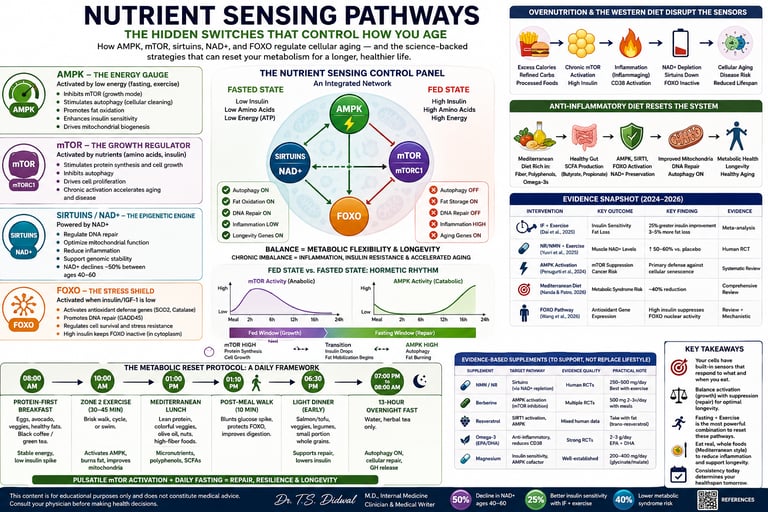
Nutrient Sensing Pathways: The Hidden Switches That Control Aging
Scientists have identified four nutrient-sensing pathways—AMPK, mTOR, sirtuins/NAD+, and FOXO—as key regulators of biological aging. These molecular sensors continuously monitor food intake, energy status, and physical activity, deciding whether cells grow, store energy, or repair damage. Studies suggest that intermittent fasting, exercise, and a Mediterranean-style diet can help rebalance these pathways, promoting autophagy, metabolic flexibility, and healthy longevity.
Aging is not a fixed timeline but a biological conversation between your cells and your environment. Nutrient-sensing pathways — AMPK, mTOR, sirtuins/NAD+, and FOXO — serve as the switches in that conversation, deciding whether your body builds, stores, or repairs (Dagbasi et al., 2025). Modern life keeps these switches stuck in “growth mode”: constant eating drives mTOR and insulin signaling, while suppressing AMPK, autophagy, and FOXO’s protective gene programs (Wang et al., 2026).
The result is inflammaging — a low-grade inflammatory loop that accelerates mitochondrial decline and DNA damage (Nanda & Patro, 2026). Yet the same pathways are remarkably plastic. A 12–16 hour overnight fast meaningfully activates AMPK, inhibits mTOR, and permits autophagic cleanup — the cellular equivalent of taking out the trash (Penugurti et al., 2024). Pair that with Zone 2 exercise, and you get 25% greater insulin sensitivity than either alone (Dai et al., 2025), because movement creates the energy deficit AMPK reads, while fasting provides the low-insulin window FOXO needs to enter the nucleus and switch on antioxidant defenses.
Sirtuins can’t work without NAD+, which falls by ~50% by age 60 (Yusri et al., 2025). But NAD+ loss is driven by inflammation; a Mediterranean pattern cuts metabolic syndrome risk 40% by cooling that inflammation and feeding the gut microbes that activate SIRT1 (Sah et al., 2025).
The takeaway is hopeful and practical: you’re not hostage to your genes. Pulsatile mTOR, daily AMPK, and supported NAD+ reset the control panel. Aging is inevitable. Accelerated aging is a signaling error — one you can correct with timing, movement, and food.
Key Takeaways
Your cells run on switches, not a clock. AMPK, mTOR, sirtuins/NAD+, and FOXO read your food, fasting, and exercise to decide between growth vs. repair (Dagbasi et al., 2025). Balance them, and you slow biological aging.
Modern eating jams the “growth” switch on. Constant meals keep mTOR and insulin high, which blocks autophagy and silences FOXO’s antioxidant defences (Wang et al., 2026; Zhang et al., 2025).
A 12–13-hour overnight fast is powerful medicine. Even this modest window activates AMPK, suppresses mTOR, and triggers cellular cleanup without extreme diets (Penugurti et al., 2024).
Exercise + fasting = metabolic synergy. Together they boost insulin sensitivity 25% more than either alone by hitting both energy deficit and low-insulin signals (Dai et al., 2025).
NAD+ is the fuel sirtuins need to fix damage. Levels drop ~50% by age 60, but exercise, anti-inflammatory eating, and fiber can refill the tank (Yusri et al., 2025; Nanda & Patro, 2026).
Think “pulsatile,” not “always off.” You need mTOR for muscle after resistance training. The goal is timed activation, then fasting windows for repair — not chronic suppression.
Nutrient-sensing pathways are the body's biochemical compasses. They detect the levels of glucose, amino acids, lipids, and cellular energy (ATP) and translate those signals into decisions about whether to grow, reproduce, store, or repair. The primary players are:
AMPK The Energy Gauge
AMP-activated protein kinase detects low cellular energy and switches the body from growth mode to fat-burning and cellular cleanup.
mTOR The Growth Regulator
Mechanistic target of rapamycin drives protein synthesis and cell growth when amino acids and insulin are abundant.
Sirtuins / NAD+ The Epigenetic Engine
NAD+-dependent enzymes that regulate DNA repair, mitochondrial health, and inflammatory gene expression across all tissues.
FOXO The Stress Shield
FOXO transcription factors activate antioxidant defenses and DNA repair genes when insulin signaling is low.
A 2025 white paper published in Nutrition Bulletin by Dagbasi and colleagues — representing a consortium of leading UK research institutions — established that these pathways are not isolated molecular curiosities. They function as an integrated network that links what and when you eat to how quickly your cells age at the biological level. This integrated understanding is now reshaping both clinical medicine and public health guidance.
AMPK: The Metabolic Master Switch
AMPK — adenosine monophosphate-activated protein kinase — is the cell's primary energy sensor. When ATP levels fall (during fasting, exercise, or caloric restriction), the ratio of AMP to ATP rises, and AMPK is activated. Think of it as a low-fuel alarm that simultaneously slashes energy expenditure on non-essentials and opens new fuel lines.
What AMPK Does When Activated
Inhibits mTOR: Switches off the costly protein-synthesis machinery.
Stimulates autophagy: Triggers cellular "self-cleaning" to recycle damaged proteins and organelles.
Promotes fat oxidation: Mobilizes stored fat as an energy source.
Enhances insulin sensitivity: Increases glucose uptake in muscle tissue independent of insulin.
Drives mitochondrial biogenesis: Signals the creation of new, healthy mitochondria via PGC-1α activation.
2024 Research Highlight
A major review by Penugurti and colleagues in Seminars in Cancer Biology (2024) positions AMPK as a critical crossroads between metabolic health, aging, and oncology. AMPK suppresses early-stage tumor formation by inhibiting mTOR-driven cell proliferation, but — crucially — it may paradoxically support cell survival in established nutrient-deprived tumors. This dual role underscores why AMPK activation should come from lifestyle interventions rather than pharmacological shortcutting.
In metabolic medicine, AMPK activation through metformin or its natural mimetic berberine has been associated with a 30–50% reduction in cancer risk in preclinical models — an effect attributed primarily to mTOR suppression.
Clinical Analogy
"Think of your body like a hybrid car. If you're always snacking, you only run on the electric motor — glucose. Fasting lets the combustion engine kick in: your body burns fat, and in doing so, also clears out the 'exhaust' — cellular debris that makes you age faster."
How to Activate AMPK Naturally
A 12–16-hour overnight fast is sufficient to meaningfully raise the AMP/ATP ratio in most tissues
Zone 2 aerobic exercise (sustained moderate intensity for 30–45 minutes) creates the energy deficit AMPK requires
Polyphenols such as resveratrol, quercetin, and EGCG from green tea act as mild AMPK activators
Cold exposure activates AMPK in brown adipose tissue via adrenergic signaling
mTOR: The Growth–Repair Trade-Off Explained
mTOR — mechanistic target of rapamycin — is the cell's primary anabolic driver. It integrates signals from amino acids (especially leucine), insulin, and growth factors to decide whether to synthesize new proteins, build muscle, and expand in size. When nutrients are abundant, mTOR is the body's "party mode." When it is chronically on, it is one of the most potent accelerators of biological aging.
mTOR Complex 1 vs. Complex 2
There are two distinct mTOR complexes. mTORC1 is the one most relevant to aging: it drives protein synthesis, inhibits autophagy, and responds acutely to amino acids and insulin. mTORC2 plays a separate role in cytoskeletal organization and cell survival. Most longevity research focuses on pulsatile — rather than continuous — suppression of mTORC1.
2025 Research Highlight
Zhang et al.'s landmark review in Signal Transduction and Targeted Therapy (2025) synthesizes decades of mTOR research into a translational roadmap for disease. In the context of neurodegeneration, mTOR overactivity inhibits autophagy, leading to the accumulation of misfolded protein aggregates seen in Alzheimer's and Parkinson's diseases. In cardiology, a separate 2025 paper (Wang et al. in Biomedicines) documents how chronic nutrient overload drives hyper-activation of the mTOR/insulin axis in cardiac tissue, contributing to hypertrophy, fibrosis, and ultimately heart failure.
The clinical implication: chronic mTOR suppression (as with the drug rapamycin) carries real risks, including immune suppression. The goal is pulsatile inhibition — periods of mTOR activation for growth (especially after resistance training), alternating with periods of mTOR suppression for repair.
Clinical Analogy
"You can't renovate a house while the party is still going on. mTOR is the party — it's loud, expensive, and great in the short term. But to fix the foundations so the house lasts a century instead of fifty years, you need quiet nights when the cleaning crew can work."
Sirtuins and NAD+: The Epigenetic Engine of Longevity
Sirtuins are a family of seven NAD+-dependent enzymes (SIRT1–7) that perform some of the most important maintenance functions in the cell: repairing DNA strand breaks, deacetylating histones to silence damage-promoting genes, optimizing mitochondrial metabolism, and reducing inflammatory signaling. They are, in a biological sense, the guardians of genomic stability.
The NAD+ Bottleneck
The key constraint is NAD+ availability. Sirtuins cannot perform their repair work without it, and NAD+ levels decline by approximately 50% between the ages of 40 and 60. This depletion occurs for several reasons:
Chronic low-grade inflammation activates CD38, an enzyme that consumes NAD+ as a byproduct
Reduced NAMPT expression (the rate-limiting enzyme in NAD+ biosynthesis) in aging tissue
Increased DNA damage requires PARP1 activation, which also consumes NAD+
2025 Research Highlight
A comprehensive review by Yusri and colleagues in npj Metabolic Health and Disease (2025) provides the most current synthesis of NAD+ metabolism and mitochondrial aging. The review underscores that supplementation with NAD+ precursors — specifically nicotinamide riboside (NR) and nicotinamide mononucleotide (NMN) — can increase muscle tissue NAD+ levels by 50–60% in human trials. However, the authors emphasize an important caveat: supplementation alone is suboptimal without also addressing the inflammatory "leaks."
A newly published 2025 study by Sah et al. in Exploration of Digestive System connects sirtuin activity to gut microbiome composition, showing that SIRT1 activation reduces gut dysbiosis and the systemic frailty associated with it — highlighting a critical gut-longevity axis that is only beginning to be mapped.
Clinical Analogy
"Your sirtuins are master mechanics who can fix almost any cellular damage. But NAD+ is the fuel for their tools. As you age, the fuel tank quietly leaks. Anti-inflammatory nutrition and regular exercise are how you plug the leak — so the mechanics can actually do their jobs."
How to Support NAD+ Levels
Aerobic exercise is among the most powerful natural stimulators of NAMPT expression and NAD+ synthesis
Caloric restriction and time-restricted eating reduce inflammatory NAD+ consumption via CD38
NR/NMN supplementation has the strongest current human trial evidence for raising muscle NAD+
Anti-inflammatory diet (Mediterranean pattern) reduces the PARP1 and CD38 activation that depletes NAD+
Tryptophan-rich foods (turkey, eggs, legumes) support the Preiss-Handler and de novo NAD+ biosynthesis pathways
FOXO Transcription Factors: The Longevity Gene at the Centre of Aging
The FOXO family — particularly FOXO3 — is among the most studied longevity-associated gene families in human biology. FOXO3 polymorphisms are consistently enriched in centenarian populations worldwide, earning it the informal title of the "centenarian gene." What FOXO3 actually does is translate nutrient signals into a survival programme at the transcriptional level.
How FOXO Works
When insulin and IGF-1 levels are low — as they are during fasting, moderate exercise, or caloric restriction — the PI3K/Akt pathway becomes less active. This allows FOXO transcription factors to enter the cell nucleus, where they activate genes that produce:
Superoxide dismutase 2 (SOD2) — the cell's primary mitochondrial antioxidant enzyme
Catalase — neutralizes hydrogen peroxide generated during metabolism
GADD45 — promotes DNA repair
Bcl-2 family regulators — governs the balance between cell survival and programmed death
2026 Research Highlight
Wang and colleagues' 2026 review in Biogerontology provides a detailed mechanistic account of FOXO's role as a key regulator of aging and age-related disease. The authors document how high-carbohydrate, high-insulin diets chronically suppress FOXO function by keeping it phosphorylated and sequestered in the cytoplasm — effectively locking the cell's stress-resistance programme offline. The review identifies FOXO mimetics as a priority target for next-generation longevity therapeutics, with projections that effective FOXO activation could extend healthy lifespan by 15–25% in preclinical models.
Clinical Analogy
"FOXO is your body's umbrella. When blood sugar is stable, and insulin is low, that umbrella is open — protecting your cells from the oxidative 'rain.' A consistently high-insulin diet keeps the umbrella folded shut, and over time, your cells get soaked."
Overnutrition and the Western Diet: How Modern Eating Disrupts the Sensors
The mechanisms described above evolved in an environment of food scarcity and high physical demand. They were never designed for the modern reality: continuous availability of energy-dense, nutrient-poor foods, eaten in a near-constant feeding state across 16 or more hours per day.
The Pathophysiology of Chronic Nutrient Excess
In a state of chronic nutrient surplus, the following cascade occurs:
Persistent high insulin and amino acids drive chronic mTORC1 hyperactivation → lysosomal dysfunction, inhibited autophagy, and protein aggregate accumulation
Elevated insulin keeps FOXO locked in the cytoplasm → loss of antioxidant gene expression and DNA repair suppression
Inflammatory cytokines from excess adipose tissue activate CD38 → accelerated NAD+ depletion and sirtuin dysfunction
Reduced AMPK activity → decreased mitochondrial biogenesis and impaired fat oxidation
Clinical Downstream Effects
This molecular cascade translates into recognizable clinical conditions across multiple organ systems:
Non-Alcoholic Fatty Liver Disease (NAFLD): Arises from chronic mTOR/insulin-driven lipid synthesis within hepatocytes.
Cardiovascular Disease: Accelerates as persistent mTOR overactivation drives maladaptive cardiac remodeling.
Type 2 Diabetes: Reflects the systemic exhaustion and ultimate failure of insulin sensitivity pathways.
Sarcopenia: Develops as FOXO-driven muscle protein synthesis and tissue repair mechanisms are chronically suppressed.
Early Cognitive Decline: Linked directly to upstream nutrient-sensor dysregulations that trigger neuroinflammation and impair cerebral autophagy (cellular clean-up).
A 2026 comprehensive review by Nanda and Patro in the International Journal of Advanced Biochemistry Research synthesizes dietary pattern research and concludes that adopting a Mediterranean-style diet — rich in polyphenols, dietary fiber, and monounsaturated fats, while low in refined carbohydrates — can reduce the risk of metabolic syndrome by approximately 40%, primarily through the recalibration of AMPK, SIRT1, and FOXO signaling.
A separate 2025 systems biology analysis by Müller, Di Benedetto, and Müller in Frontiers in Molecular Neuroscience frames nutrition as a "systems regulator" of brain aging trajectories — underscoring that the same nutrient-sensing pathways governing peripheral metabolism are equally operative in neuronal maintenance and cognitive longevity.
Inflammaging: The Feedback Loop Accelerating Biological Age
Inflammaging — the term coined to describe the chronic, low-grade, sterile inflammation that accompanies biological aging — is not simply a consequence of aging. It is increasingly recognized as a driver of it, operating through nutrient-sensing pathways in a self-reinforcing feedback loop.
How Overnutrition Feeds Inflammaging
Chronic excess caloric intake generates what researchers now call nutrient-induced inflammation. The mechanism involves several parallel processes:
Excess free fatty acids activate TLR4 (toll-like receptor 4) on immune cells, triggering NF-κB-mediated inflammatory gene expression
Visceral adipose tissue secretes pro-inflammatory adipokines (TNF-α, IL-6) that further suppress FOXO and SIRT1
Gut barrier dysfunction from low-fiber, high-fat diets increases circulating bacterial lipopolysaccharides (endotoxemia), a potent AMPK suppressor
Reduced short-chain fatty acid (SCFA) production by a fiber-depleted microbiome diminishes the key signals needed to activate SIRT1 and FOXO in colonic and hepatic cells
Nanda and Patro (2026) emphasize that this gut-systemic axis is among the most actionable targets for intervention: consuming 25–38 grams of dietary fiber daily — the current evidence-based recommendation — restores SCFA production, which in turn meaningfully reinforces sirtuin and FOXO signaling throughout the body.
Evidence Summary: Key Studies on Nutrient Sensing and Longevity
1. Dai et al. (2025)
Journal: Current Obesity Reports
Intervention: Intermittent Fasting (IF) combined with High-Intensity Interval Training (HIIT) versus either intervention alone.
Primary Outcome: Insulin sensitivity and adipose tissue loss.
Key Finding: The combination protocol yielded a 25% greater improvement in insulin sensitivity and an additional 3% to 5% reduction in body fat compared to monotherapy.
Evidence Level: Meta-analysis.
2. Yusri et al. (2025)
Journal: npj Metabolic Health & Disease
Intervention: NAD+ precursors (Nicotinamide Riboside [NR] / Nicotinamide Mononucleotide [NMN]) paired with exercise.
Primary Outcome: Skeletal muscle NAD+ concentrations.
Key Finding: The combination regimen increased intramuscular NAD+ levels by 50% to 60% compared to the placebo group.
Evidence Level: Human Randomized Controlled Trial (RCT) data.
3. Penugurti et al. (2024)
Journal: Seminars in Cancer Biology
Intervention: AMPK activation models.
Primary Outcome: Downstream mTOR suppression and oncogenic risk profiling.
Key Finding: Confirmed that AMPK serves as a primary endogenous defense mechanism against cellular senescence and early tumorigenesis.
Evidence Level: Systematic Review.
4. Wang et al. (2026)
Journal: Biogerontology
Intervention: FOXO pathway analysis.
Primary Outcome: Downstream antioxidant gene expression profiles.
Key Finding: Demonstrated that a high-insulin, nutrient-dense diet chronically suppresses FOXO nuclear translocation, inhibiting endogenous cellular defense.
Evidence Level: Mechanistic review.
5. Zhang et al. (2025)
Journal: Signal Transduction & Targeted Therapy
Intervention: Upstream mTOR inhibition models.
Primary Outcome: Macro-autophagy flux and neurodegenerative pathways.
Key Finding: Chronic mTOR overactivity inhibits baseline autophagy, directly leading to the cytotoxic accumulation of misfolded proteins.
Evidence Level: Preclinical and mechanistic review.
6. Nanda & Patro (2026)
Journal: International Journal of Advanced Biochemistry Research
Intervention: Mediterranean dietary pattern versus a traditional Western diet.
Primary Outcome: Overall metabolic syndrome risk criteria.
Key Finding: Adherence to a Mediterranean-style dietary pattern reduces the relative risk of metabolic syndrome development by approximately 40%.
Evidence Level: Comprehensive Review.
7. Dagbasi et al. (2025)
Journal: Nutrition Bulletin
Intervention: Nutrient sensing optimization in longevity.
Primary Outcome: Healthspan and cellular longevity biomarkers.
Key Finding: Established an integrated nutritional framework identifying the AMPK/mTOR/FOXO network as the primary actionable targets for healthspan extension.
Evidence Level: White Paper / Expert Consensus.
8. Sah et al. (2025)
Journal: Exploration of Digestive System
Intervention: Molecular sirtuin activators.
Primary Outcome: Gut microbiota dysbiosis and clinical systemic frailty.
Key Finding: Target SIRT1 activation significantly reduces age-related gut dysbiosis and downregulates systemic inflammatory frailty markers.
Evidence Level: Mechanistic review
Fasting + Exercise: The Most Powerful Combination for Pathway Recalibration
Among all lifestyle interventions studied for nutrient-sensing pathway modulation, the combination of intermittent fasting and structured exercise consistently produces the greatest biological effect — and the mechanisms explain exactly why.
Why Combining Both Is Uniquely Powerful
Exercise and fasting target the same pathways through complementary, non-overlapping mechanisms:
Exercise creates an acute energy deficit that spikes AMPK within minutes, improving insulin sensitivity and triggering mitochondrial biogenesis
Fasting provides the sustained low-insulin window — typically 12+ hours — necessary for deep mTOR suppression and meaningful autophagic flux
Together, they produce a dual signal: "energy is low AND nutrients are unavailable" — the strongest possible stimulus for cellular repair programming
2025 Meta-Analysis: Dai et al.
A 2025 systematic review and meta-analysis by Dai and colleagues in Current Obesity Reports analyzed the combined effect of intermittent fasting and exercise (including both HIIT and resistance training) in adults with overweight or obesity. The findings demonstrated a 25% greater improvement in insulin sensitivity and a 3–5% additional reduction in fat mass compared to either intervention performed alone. The authors identified the AMPK-mTOR axis as the primary mediator of this synergistic effect.
Practical Exercise Recommendations for Pathway Optimization
Zone 2 aerobic exercise (30–45 min, 3–4×/week): Sustained aerobic work at 60–70% max heart rate maximally activates AMPK and promotes mitochondrial biogenesis via PGC-1α
Resistance training (2–3×/week): Provides the necessary mTOR-activation stimulus for muscle protein synthesis and anti-sarcopenia benefits
Post-meal walking (10 min after eating): Significantly reduces postprandial glucose spikes, protecting FOXO from insulin-driven suppression
HIIT (1–2×/week): Provides acute metabolic stress with the highest AMPK response per minute of training
The Metabolic Reset Protocol: A Practical Daily Framework
This evidence-based framework is designed to optimize nutrient-sensing pathways by balancing AMPK activation, mTOR signaling, FOXO activity, and sirtuin/NAD+ function throughout the day. The goal is to create periods of growth and muscle maintenance while preserving adequate time for cellular repair, autophagy, and metabolic recovery.
Note: This framework is for educational purposes only. Individuals with diabetes, cardiovascular disease, eating disorders, or other medical conditions should consult a qualified healthcare professional before making significant dietary or exercise changes.
8:00 AM — Protein-First Breakfast (The Metabolic Prime)
Prioritize protein and healthy fats over refined carbohydrates.
Example:
Scrambled eggs with spinach and mushrooms cooked in olive oil
Half an avocado
Black coffee or green tea
Benefits:
Reduces early-morning insulin spikes
Supports sustained energy and satiety
Helps maintain FOXO activity during the morning hours
Provides leucine for muscle protein synthesis
Green tea catechins may mildly activate AMPK
10:00 AM — Zone 2 Exercise (AMPK Activation Window)
Perform 30–45 minutes of moderate-intensity aerobic exercise:
Brisk walking
Cycling
Swimming
Benefits:
Strong activation of AMPK
Enhanced fat oxidation
Improved insulin sensitivity
Increased mitochondrial biogenesis
Exercising in a fasted or semi-fasted state may amplify these effects.
1:00 PM — Mediterranean-Style Lunch (The Micronutrient Load)
Focus on fiber, polyphenols, and high-quality protein.
Example:
Large mixed-vegetable salad
Grilled chicken, fish, or legumes
Walnuts
Olive oil and lemon dressing
Benefits:
Supports gut microbiome diversity
Increases short-chain fatty acid (SCFA) production
Activates SIRT1 and other longevity pathways
Helps preserve NAD+ availability
Add a 10-minute walk after lunch to reduce post-meal glucose excursions and support FOXO activity.
6:30 PM — Light Early Dinner (The Autophagy Bridge)
Keep dinner moderate in size and relatively early.
Example:
Baked salmon or tofu
Steamed asparagus or other non-starchy vegetables
Small serving of quinoa or lentils
Benefits:
Facilitates overnight insulin decline
Supports nocturnal autophagy
Promotes growth hormone pulsatility during sleep
Provides omega-3 fatty acids and prebiotic fiber
Aim to finish caloric intake by approximately 7:00 PM.
7:00 PM–8:00 AM — 13-Hour Circadian Fast (Overnight Cellular Repair)
Consume only:
Water
Herbal tea
Non-caloric beverages
Avoid late-night snacking.
Benefits:
Supports AMPK activation
Promotes mTOR suppression during the overnight period
Enhances cellular maintenance and repair processes
Improves fasting insulin and metabolic flexibility
May help reduce inflammatory markers when practiced consistently
Key Principles of the Protocol
Protein first to support muscle maintenance and metabolic stability.
Exercise daily to activate AMPK and improve mitochondrial health.
Eat a Mediterranean-style diet rich in fiber, polyphenols, and healthy fats.
Finish dinner early to create a meaningful overnight fasting window.
Combine fasting and exercise for the strongest nutrient-sensing pathway response.
Prioritize consistency over extremes—long-term adherence matters more than aggressive interventions.
Bottom line: The objective is not continuous mTOR suppression or constant fasting. Healthy aging appears to require a rhythmic balance between periods of growth (mTOR activation) and periods of repair (AMPK, FOXO, and sirtuin activation), allowing cells to remain both resilient and metabolically flexible.
Evidence-Based Supplements for Nutrient Sensing Support
Supplements should complement — never replace — the lifestyle interventions above. The following have the strongest current evidence for directly modulating nutrient-sensing pathways.
1. NMN / NR (Nicotinamide Mononucleotide / Nicotinamide Riboside)
Primary Pathway Target: Sirtuins (via direct NAD+ repletion).
Evidence Quality: Human Randomized Controlled Trials (RCTs).
Practical Note: Typically dosed at 250–500 mg/day. The greatest clinical benefit is observed in individuals over the age of 40 or those presenting with a high baseline inflammatory load.
2. Berberine
Primary Pathway Target: AMPK activation (which downstream inhibits mTOR).
Evidence Quality: Multiple robust human RCTs.
Practical Note: Administered at 500 mg, 2–3 times per day with meals. Its molecular mechanism closely mirrors that of metformin.
3. Resveratrol
Primary Pathway Target: SIRT1 activation and AMPK signaling.
Evidence Quality: Mixed human clinical data.
Practical Note: Trans-resveratrol is the highly active form. It demonstrates optimal bioavailability and absorption when taken alongside a lipid-rich (healthy fat) meal.
4. Quercetin
Primary Pathway Target: AMPK activation and anti-senolytic pathways.
Evidence Quality: Emerging human clinical data.
Practical Note: Frequently co-administered with fisetin. At higher targeted pulses, it exhibits senolytic properties, aiding in the clearance of senescent cells.
5. Omega-3 Fatty Acids (EPA/DHA)
Primary Pathway Target: Systemic anti-inflammatory pathways; reduces CD38 enzyme activation.
Evidence Quality: Strong, well-established RCT evidence base.
Practical Note: Target clinical dosing is 2–3 g/day of combined EPA and DHA. By downregulating the NAD+-consuming enzyme CD38, it indirectly preserves systemic NAD+ pools and mitigates FOXO suppression.
6. Magnesium
Primary Pathway Target: Insulin sensitivity optimization and acts as an essential AMPK enzymatic cofactor.
Evidence Quality: Exceptionally well-established nutritional data.
Practical Note: Dosed at 200–400 mg/day. Given widespread deficiency profiles in Western dietary patterns, supplementation is highly practical; highly bioavailable chelated forms like glycinate or malate are preferred.
Always consult your physician before starting any supplement regimen, particularly if you are taking medications or managing a chronic condition.
Common Myths and Misconceptions
Myth: "You need to fast for 24 hours to activate autophagy."
Reality: Meaningful autophagic flux begins after as little as 12–14 hours of fasting in most tissues. The liver shows autophagy activation even faster. The popular notion that you must undertake extended 24-hour or multi-day fasts for cellular benefit is not supported by current evidence — and carries risks of muscle catabolism and electrolyte imbalance in most people. A consistent 12–13 hour overnight fast is a safe, sustainable foundation.
Myth: "High-protein diets are always optimal for longevity."
Reality: Leucine and other branched-chain amino acids are potent mTOR activators. While adequate protein (1.2–1.6 g/kg body weight) is essential for preserving muscle mass and preventing sarcopenia, chronically high protein intake keeps mTOR continuously activated, reducing the periods of mTOR suppression necessary for autophagic cellular repair. The evidence supports protein sufficiency — not excess — for optimized longevity outcomes.
Myth: "NAD+ supplements alone will reverse aging."
Reality: NR and NMN can meaningfully increase NAD+ availability, and the early human trial data is encouraging. However, Yusri et al. (2025) explicitly caution that supplementation without addressing the underlying inflammatory processes that deplete NAD+ (through CD38 and PARP1 activation) has limited efficacy. Supplements amplify the benefit of lifestyle interventions — they do not replace them.
Myth:" Ageing is genetic — diet and exercise can't really change it."
Reality: Epigenetic research now clearly demonstrates that nutrient-sensing pathway activity is highly malleable in response to lifestyle inputs. A 2025 systems and precision nutrition perspective by Carlberg et al. in npj Aging shows that food-derived signals modulate biological aging trajectories at the epigenomic level. While genetic variation matters, the scientific consensus is that lifestyle decisions exert a substantially larger influence on biological age than genetic inheritance alone.
Frequently Asked Questions
What are nutrient sensing pathways, and why do they matter for aging?
Nutrient-sensing pathways are molecular systems inside every cell that detect the availability of glucose, amino acids, and energy (ATP) and use that information to regulate cellular behavior. The four primary pathways — AMPK, mTOR, sirtuins/NAD+, and FOXO — collectively govern whether cells invest resources in growth, reproduction, energy storage, or maintenance and repair. When balanced, they support metabolic health and cellular resilience. When chronically dysregulated by overnutrition and physical inactivity, they drive the major hallmarks of aging including genomic instability, mitochondrial dysfunction, cellular senescence, and chronic inflammation.
How does intermittent fasting activate AMPK and trigger autophagy?
During fasting, cellular ATP consumption exceeds production, causing the AMP-to-ATP ratio to rise. AMPK acts as a molecular sensor of this ratio. When AMP rises, AMPK is activated, which simultaneously inhibits mTOR (the brake on autophagy) and activates ULK1 (the autophagy initiator). This triggers the formation of autophagosomes — vesicles that engulf damaged proteins and organelles and deliver them to lysosomes for degradation and recycling. This process, autophagic flux, is essentially the cellular equivalent of a deep clean. A 12–16 hour overnight fast is sufficient to meaningfully activate this pathway in most healthy adults.
Can mTOR inhibitors like rapamycin extend human lifespan?
In animal models — from yeast to mice — mTOR inhibition consistently extends maximum lifespan by 10–20%, even when started in middle age. Human trials with rapamycin and its analogues are currently ongoing. Zhang et al. (2025) note that the primary concern with pharmacological mTOR inhibition is immune suppression and metabolic side effects with chronic use. The more clinically practical approach is pulsatile inhibition through lifestyle: time-restricted eating and periodic caloric restriction provide the mTOR suppression benefits without the adverse effects of continuous pharmacological blockade.
What is the most effective way to raise NAD+ levels naturally?
The evidence points to a combination approach. Aerobic exercise is among the strongest natural stimulators of NAMPT (the rate-limiting enzyme in NAD+ synthesis). Anti-inflammatory eating — particularly a Mediterranean dietary pattern with adequate polyphenols and fiber — reduces the inflammatory processes (CD38 activation, PARP1 activation) that consume NAD+. Supplementation with NR or NMN builds on this foundation: Yusri et al. (2025) report that exercise combined with NAD+ precursor supplementation can raise muscle NAD+ by 50–60%. Adequate sleep also matters, as circadian disruption downregulates NAMPT expression.
How does insulin resistance suppress the FOXO longevity pathway?
When blood insulin and IGF-1 levels are chronically elevated — as occurs with insulin resistance — the PI3K/Akt signaling pathway is persistently active. Akt phosphorylates FOXO3 transcription factors, which adds a chemical tag that prevents them from entering the cell nucleus. Since FOXO3 must enter the nucleus to activate protective genes (antioxidant enzymes like SOD2 and catalase, DNA repair genes), its cytoplasmic sequestration effectively disables the cell's innate stress-protection system. Wang et al. (2026) document this as a primary mechanism by which the metabolic milieu of type 2 diabetes accelerates cellular aging across all tissue types.
Is exercise or intermittent fasting better for metabolic health?
They are not competing interventions — they work through complementary mechanisms, and the evidence strongly supports combining them. Exercise provides acute AMPK activation through energy expenditure, improves insulin sensitivity through glucose transporter translocation (GLUT4), and stimulates mitochondrial biogenesis. Fasting provides the sustained low-insulin environment that allows FOXO to remain active in the nucleus and mTOR to be suppressed long enough for meaningful autophagic repair. Dai et al.'s 2025 meta-analysis showed that the combination delivers 25% better insulin sensitivity and 3–5% more fat loss than either intervention alone.
What role does the gut microbiome play in nutrient sensing and aging?
The gut microbiome is emerging as a critical interface between dietary patterns and systemic nutrient-sensing pathway regulation. When dietary fiber is insufficient, beneficial bacteria that produce short-chain fatty acids (SCFAs) — particularly butyrate, propionate, and acetate — decline. SCFAs are direct activators of SIRT1 and FOXO signaling in colonic cells and the liver. Gut dysbiosis also increases intestinal permeability ("leaky gut"), allowing bacterial lipopolysaccharides to enter circulation and chronically activate inflammatory pathways that suppress AMPK and deplete NAD+. Sah et al. (2025) specifically document the SIRT1–gut microbiome axis as a key mediator of systemic frailty in aging populations.
What dietary pattern best supports longevity pathway balance?
The Mediterranean dietary pattern has the most robust evidence base for harmonizing nutrient-sensing pathways. Its characteristics align with multiple mechanistic targets simultaneously: high polyphenol content (from olive oil, fruits, vegetables) activates AMPK and SIRT1; high fiber content supports SCFA production and gut FOXO signaling; moderate protein from legumes and fish provides leucine for muscle maintenance without chronic mTOR overactivation; omega-3 fatty acids reduce the inflammatory NAD+ depletion from CD38 activation. Nanda and Patro (2026) associate consistent Mediterranean dietary adherence with a 40% reduction in metabolic syndrome risk.
Are there any drugs that mimic the effects of fasting on nutrient sensing?
Several compounds act as pharmacological mimetics of the nutrient-sensing state induced by fasting. Metformin (the most prescribed diabetes drug globally) activates AMPK and inhibits mTOR through inhibition of Complex I of the mitochondrial electron transport chain. Rapamycin directly inhibits mTORC1. NAD+ precursors (NR, NMN) replenish the sirtuin "fuel tank." Among natural compounds, berberine has AMPK-activating properties comparable to metformin in mechanistic studies. However, Penugurti et al. (2024) caution that pharmacological AMPK activation produces different tissue-specific effects than physiological activation through exercise and fasting — and that the latter should remain the primary approach for healthy individuals.
Clinical pearls
1. The "Metabolic Switch" (AMPK)
Scientific Perspective: AMPK activation via a 12–16 hour fast or Zone 2 exercise triggers the "fuel gauge" to shift from glucose oxidation to fatty acid oxidation and autophagy. According to Penugurti et al. (2024), this is the primary defense against cellular senescence.
"Think of your body like a hybrid car. If you’re always snacking, you’re only running on electricity (sugar). Fasting lets the engine kick in to burn the 'backup fuel' (fat) and clears out the 'exhaust' (cellular junk) that makes you feel sluggish."
2. The mTOR "Growth vs. Repair" Trade-off
Scientific Perspective: Chronic mTORC1 hyperactivation—driven by high-leucine protein and refined carbs—inhibits lysosomal function and proteostasis (Zhang et al., 2025). This accelerates tissue aging even while promoting muscle growth.
You can’t renovate a house while the party is still going on. mTOR is the 'party' (growth). You need quiet periods—like time-restricted eating—to let the 'cleaning crew' (repair) come in and fix the floorboards so the house lasts 100 years instead of 50."
3. The NAD+ "Gas Tank" (Sirtuins)
Scientific Perspective: Sirtuins are NAD+-dependent; they cannot repair DNA if NAD+ is depleted by chronic inflammation (which activates CD38). Yusri et al. (2025) note that restoring NAD+ isn't just about supplements; it's about lowering the "leak" caused by systemic inflammation.
"Your Sirtuins are like expert mechanics, but NAD+ is the fuel for their power tools. As we age, the fuel tank leaks. By eating anti-inflammatory foods and staying active, we plug the leaks so the mechanics can actually do their jobs."
4. The FOXO "Stress Shield"
Scientific Perspective: FOXO3 is the "longevity gene" that moves into the nucleus when insulin levels are low. It activates antioxidant enzymes like SOD2 and Catalase (Wang et al., 2026). High-insulin diets keep FOXO "locked out" of the nucleus where it can’t protect the cell.
"FOXO is your body's internal umbrella. When you keep your blood sugar stable, that umbrella stays open to protect you from the 'rain' of oxidative stress. If your insulin is always high, the umbrella stays closed, and your cells get soaked."
5. The "Inflammaging" Feedback Loop
Scientific Perspective: Overnutrition causes "nutrient-induced inflammation." This dysregulates the gut-brain axis and suppresses the production of short-chain fatty acids (SCFAs), which are essential for FOXO and SIRT1 signaling (Nanda & Patro, 2026).
"Overeating isn't just about calories; it’s about 'noise.' Too much food creates biological static that drowns out the signals your body uses to stay young. Eating fiber-rich, Mediterranean-style meals clears that static so your cells can hear the 'stay healthy' instructions again."
6. The Synergy of "The Big Two" (Fasting + Exercise)
Scientific Perspective: Exercise creates an acute energy deficit (AMPK spike), while fasting provides the prolonged low-insulin window for mTOR suppression. Dai et al. (2025) found that the combination yields a 25% better improvement in insulin sensitivity than either alone.
If you only exercise but eat all day, or only fast but never move, you’re only using half the toolkit. Combining a brisk walk with a consistent eating window is the '1-2 punch' that forces your metabolism to stay flexible and resilient."
Conclusion: Aging Is Often a Biological Miscommunication — One You Can Fix
What we call "aging" in the clinic rarely arrives with a label. It shows up as rising fasting glucose, accumulating abdominal fat, a slowly climbing blood pressure, the fatigue that won't resolve, the muscle that seems harder to build and easier to lose. We assign it names — metabolic syndrome, insulin resistance, sarcopenia, cardiovascular risk — but these are downstream expressions of a common upstream problem: nutrient-sensing pathways chronically pushed out of their intended operating range.
The biology reviewed in this article makes one thing unmistakably clear: these pathways are not fixed. They are exquisitely dynamic. A 2025 white paper from a consortium of major UK research institutions (Dagbasi et al.) concludes exactly this — that nutritional interventions represent some of the most potent available modulators of biological aging trajectories, acting directly on the same molecular switches that control cellular lifespan.
The practical implications are not abstract. The evidence supports specific, actionable strategies:
Create a consistent 12–13-hour overnight fasting window to allow nocturnal mTOR suppression and autophagic repair
Combine aerobic exercise (Zone 2) and resistance training to activate AMPK and provide the pulsatile mTOR stimulus needed for muscle maintenance
Eat a Mediterranean dietary pattern rich in fiber, polyphenols, and omega-3 fatty acids to support SIRT1, FOXO, and gut SCFA production
Manage insulin load by prioritising protein and fiber at meals and minimizing refined carbohydrates — especially early in the day
Address inflammation systemically, since inflammaging is both a consequence and a cause of pathway dysregulation
Consider targeted supplementation (particularly NMN/NR and omega-3) to amplify the benefit of lifestyle interventions, not substitute for them
Longevity science is no longer the domain of futurists and supplement marketers. It is becoming applied internal medicine — a framework for understanding, predicting, and modifying the rate at which your cells age. The levers are known. The mechanisms are mapped. What remains is translation into daily life.
Aging is inevitable. Accelerated aging is often a miscommunication in biological signaling — one that, with the right inputs, you can choose to correct.
Medical Disclaimer: This article is intended for educational purposes only and does not constitute medical advice, diagnosis, or treatment. The information presented reflects current scientific understanding but should not replace individualised guidance from a qualified healthcare provider. Individuals with existing medical conditions — particularly diabetes, cardiovascular disease, eating disorders, or those taking medications — should consult their physician before implementing any dietary, fasting, exercise, or supplementation protocol.
Related Articles
The Cardiometabolic Cascade: How Disease Starts—and How to Reverse It (2026 Science) | DR T S DIDWAL
How SCFAs from Gut Bacteria Boost Metabolic Health
References
Carlberg, C., Blüthner, A., Schoeman-Giziakis, I., & et al. (2025). Modulating biological aging with food-derived signals: A systems and precision nutrition perspective. npj Aging, 11, Article 76. https://doi.org/10.1038/s41514-025-00266-5
Dagbasi, A., Holliday, A., Carroll, B., de Lucia, C., Shannon, O. M., Mathers, J., McLaughlin, J., French, C., Hanyaloglu, A., Burden, S., Morrison, D., Korolchuk, V., & Frost, G. (2025). White Paper on Nutrition Sensing and Ageing. Nutrition Bulletin, 50(3), 505–513. https://doi.org/10.1111/nbu.70020
Dai, Z. H., Wan, K. W., Wong, P. S., Huang, W. Y., Yu, A. P., & Wong, S. H. (2025). Additional effect of exercise to intermittent fasting on body composition and cardiometabolic health in adults with overweight/obesity: A systematic review and meta-analysis. Current Obesity Reports, 14(1), Article 54. https://doi.org/10.1007/s13679-025-00645-9
Goel, F., Garg, V. K., Singh, P., & Tripathi, P. N. (2025). Nutrient-sensing pathways: Gatekeepers of longevity. In A. Kumar Singh & S. Nand Rai (Eds.), Rejuvenating the Brain: Nutraceuticals, Autophagy, and Longevity (pp. 115–134). Springer. https://doi.org/10.1007/978-981-95-2790-8_8
Müller, L., Di Benedetto, S., & Müller, V. (2026). Nutrition as a systems regulator of brain aging trajectories. Frontiers in Molecular Neuroscience, 19, Article 1825800. https://doi.org/10.3389/fnmol.2026.1825800
Nanda, A., & Patro, S. M. (2026). Dietary patterns and their impact on metabolic disorders: A comprehensive review. International Journal of Advanced Biochemistry Research, 10(2S), 751–758. https://doi.org/10.33545/26174693.2026.v10.i2Sj.7712
Penugurti, V., Manne, R. K., Bai, L., Kant, R., & Lin, H.-K. (2024). AMPK: The energy sensor at the crossroads of aging and cancer. Seminars in Cancer Biology, 106–107, 15–27. https://doi.org/10.1016/j.semcancer.2024.08.002
Sah, P., Rai, A. K., & Syiem, D. (2025). Sirtuin activators as an anti-aging intervention for longevity. Exploration of Digestive System. Advance online publication. https://doi.org/10.37349/eds.2025.100881
Wang, J., Huang, Y., Wang, Z., Liu, J., Liu, Z., Yang, J., & He, Z. (2025). The mTOR signaling pathway: Key regulator and therapeutic target for heart disease. Biomedicines, 13(2), Article 397. https://doi.org/10.3390/biomedicines13020397
Wang, W., Zhu, H., Jiang, Q., Shi, Y., & Wang, X. (2026). FOXO: A key target in regulating aging and age-related diseases. Biogerontology, 27(1), Article 38. https://doi.org/10.1007/s10522-025-10380-2
Yusri, K., Jose, S., Vermeulen, K. S., & et al. (2025). The role of NAD+ metabolism and its modulation of mitochondria in aging and disease. npj Metabolic Health and Disease, 3, Article 26. https://doi.org/10.1038/s44324-025-00067-0
Zhang, H., Xiao, X., Pan, Z., & et al. (2025). mTOR signaling networks: Mechanistic insights and translational frontiers in disease therapeutics. Signal Transduction and Targeted Therapy, 10, Article 428. https://doi.org/10.1038/s41392-025-02493-4