Intermittent Fasting: Metabolic Health Benefits and the Evidence on Longevity
Intermittent fasting and metabolic health: 2025 evidence on weight loss, insulin sensitivity, muscle preservation, and what we truly know about longevity.
METABOLISM
Dr. T.S. Didwal, M.D.(Internal Medicine)
2/1/202612 min read
In modern medicine, few lifestyle interventions have generated as much scientific interest—and controversy—as intermittent fasting. Once dismissed as a fringe dietary trend, intermittent fasting has rapidly evolved into one of the most intensively studied metabolic interventions of the past decade. By 2025, the question is no longer whether intermittent fasting works, but how, for whom, and to what extent it meaningfully alters human metabolism and long-term health outcomes.
Unlike conventional calorie restriction, intermittent fasting does not rely on continuous energy deprivation. Instead, it exploits a fundamental biological phenomenon known as cyclic metabolic switching, in which the body transitions from glucose-based metabolism to fat- and ketone-driven energy utilization during fasting periods (Mattson, 2025). This metabolic shift triggers a cascade of cellular responses—including improved insulin sensitivity, enhanced mitochondrial efficiency, reduced inflammation, and activation of stress-response pathways—that extend far beyond weight loss alone.
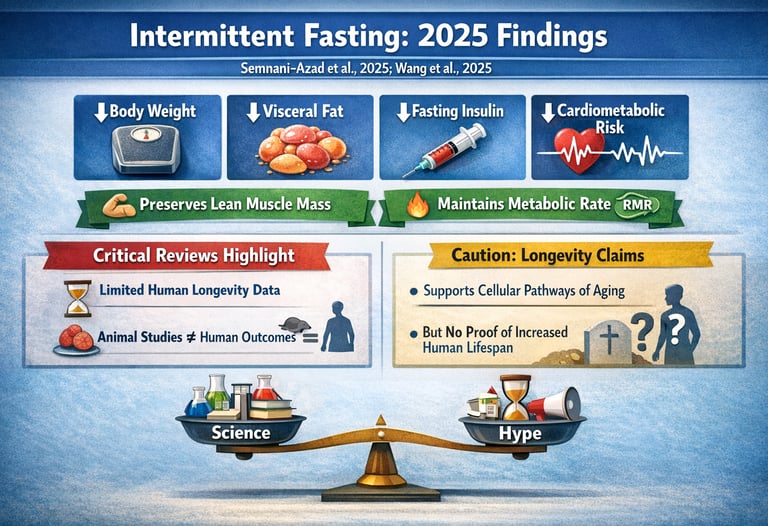
Large-scale meta-analyses published in 2025 confirm that intermittent fasting produces clinically meaningful reductions in body weight, visceral adiposity, fasting insulin, and cardiometabolic risk markers across diverse populations (Semnani-Azad et al., 2025; Wang et al., 2025). Importantly, these benefits appear to occur with preservation of lean muscle mass and maintenance of resting metabolic rate, challenging long-held assumptions about fasting-induced muscle loss. At the same time, critical reviews caution against overstating longevity claims, emphasizing that while fasting activates pathways linked to lifespan extension in animal models, definitive human survival data remain limited (Fazeli & Steinhauser, 2025).
This review synthesizes the most rigorous 2025 evidence to clarify what intermittent fasting truly offers: not a miracle diet, but a powerful, physiology-driven strategy for improving metabolic health when applied thoughtfully and individually.
Clinical pearls
1. The "Metabolic Switch" is an Overdrive, Not an Instant On/Off
Scientific Perspective: Metabolic switching requires the depletion of hepatic glycogen stores to trigger a shift from glucose to fatty-acid-derived ketones.
Think of your body like a hybrid car. It takes about 12 to 16 hours of fasting to switch from "gas" (sugar) to "electric" (stored fat). If you always snack before bed and eat early, you never give your body the chance to test its secondary engine.
2. Consistency Trumps the "Length" of the Fast
Network meta-analyses indicate that adherence is the primary predictor of cardiometabolic success, rather than the specific duration of the fasting window.
Patient-Friendly Pearl: Don't stress about hitting a perfect 18-hour fast every day. A consistent 14-hour fast that you can maintain for a year is far more effective for your heart and waistline than a 20-hour fast that makes you quit after one week.
3. Early Windows Align with the "Circadian Rhythm"
Scientific Perspective: Aligning food intake with the early phase of the circadian cycle optimizes insulin sensitivity and postprandial glucose clearance.
Your body is naturally more "metabolically alert" in the morning. If possible, try to shift your eating window earlier—finishing dinner by 6:00 PM or 7:00 PM is often better for your blood sugar than eating late at night and skipping breakfast.
4. Muscle Preservation Requires a "Protein Focus"
Scientific Perspective: While IF promotes visceral fat loss, maintaining a positive nitrogen balance via adequate protein intake during the feeding window is essential to prevent sarcopenia (muscle loss).
Fasting helps you lose the "bad" fat around your organs, but to keep your muscle, you must eat enough protein when you do eat. Don’t just break your fast with a bowl of pasta; prioritize eggs, Greek yogurt, or lean meats to keep your metabolism strong.
5. Fasting is a "Cellular Cleanup," Not Just a Calorie Deficit
Scientific Perspective: Intermittent fasting triggers autophagy and enhances mitochondrial stress resistance, processes that are often bypassed in continuous calorie restriction.
Weight loss is great, but fasting is also doing "housekeeping" inside your cells. It triggers a process where your body clears out old, damaged cellular parts. It’s like a scheduled maintenance check for your internal machinery that you don't get from just "eating less" all day long.
6. Bio-Individuality in Hormonal Response
Scientific Perspective: Endocrine reviews highlight that fasting-induced stress can alter the hypothalamic-pituitary-gonadal axis, particularly in women and those with lower BMIs.
Everybody is a unique laboratory. Women, in particular, may find that shorter fasting windows (12–14 hours) feel better and don't disrupt their hormones compared to longer fasts. If you feel "wired but tired" or your cycle changes, it’s a sign to shorten your fasting window.
Understanding Intermittent Fasting: The Metabolic Switching Theory
At the heart of intermittent fasting lies a fascinating biological process known as metabolic switching. Research by Mattson (2025) reveals how your body fundamentally changes its energy utilization patterns during fasting periods, creating conditions favorable for metabolic health and potentially supporting longevity pathways.
The Cyclic Metabolic Switching Theory
Key Research Focus: This landmark study by Mattson, M.P. (2025) describes how metabolic switching occurs when your body transitions from glucose-based energy to fat and ketone-based metabolism during fasting periods
When you fast for extended periods, your body exhausts its glucose stores (glycogen) and begins breaking down stored fat for energy. This process triggers the production of ketone bodies, which serve as an alternative fuel for your brain and muscles. This shift isn't merely about energy source—it fundamentally alters cellular signaling pathways related to stress resistance, metabolic health, and potentially aging mechanisms.
Key Takeaway: Metabolic switching activates cellular stress-response pathways that enhance mitochondrial function, improve metabolic flexibility, and may support longevity-related processes. This is the biological foundation explaining why intermittent fasting benefits extend beyond simple calorie reduction.
The concept of cyclic metabolic switching differentiates intermittent fasting from continuous calorie restriction. Rather than permanently suppressing energy intake, IF strategies create alternating periods of feeding and fasting, allowing your body to cycle through different metabolic states. This cyclic nature appears critical to the health benefits observed in recent research.
Intermittent Fasting Effectiveness: What the Latest Meta-Analyses Show
The sheer volume of recent clinical trials demands rigorous synthesis. Two major 2025 meta-analyses provide authoritative guidance on intermittent fasting effectiveness for practical health outcomes, particularly for individuals struggling with weight management and cardiometabolic risk.
Comprehensive Network Meta-Analysis in BMJ
Study Design: This extensive network meta-analysis by Semnani-Azad et al. (2025) synthesized data from numerous randomized clinical trials to compare different intermittent fasting strategies and their effects on body weight and cardiometabolic risk factors (Semnani-Azad et al., 2025).
Key Findings on IF Strategies:
Time-restricted eating (eating within a specific window, such as 8 hours daily) consistently showed benefits for weight loss
Alternate-day fasting (fasting on alternate days) demonstrated more aggressive weight reduction but with higher adherence challenges
5:2 intermittent fasting (eating normally five days, restricting calories two days) provided a moderate middle ground
The effectiveness of IF approaches remained robust across different study populations and durations
Key Takeaway: No single intermittent fasting timing approach demonstrated overwhelming superiority. Instead, the most effective strategy is the one that individuals can sustain consistently. This emphasizes the importance of selecting IF methods aligned with your lifestyle and preferences.
Body Composition and Cardiometabolic Outcomes
Study Design: Published in the Nutrition Journal, this systematic review and meta-analysis by Wang et al.(2025) specifically examined intermittent fasting effects on body composition and cardiometabolic outcomes in overweight and obese adults using randomized controlled trial evidence
Impacts on Body Composition:
Fat mass reduction: IF participants lost disproportionately more fat compared to lean muscle mass
Metabolic rate preservation: Unlike extreme dieting, IF helped maintain resting metabolic rate
Visceral fat reduction: Dangerous deep abdominal fat showed particular sensitivity to fasting interventions
Cardiometabolic Improvements:
Reduced fasting insulin levels and improved insulin sensitivity
Improved triglyceride profiles and lipid metabolism
Enhanced inflammatory markers related to cardiovascular disease risk
Key Takeaway: Intermittent fasting benefits for overweight and obese adults include selective fat loss while preserving muscle, suggesting IF effectiveness for improving body composition beyond simple weight reduction.
Cardiovascular Health and Intermittent Fasting: The Granada Study
Research Institution: Scientists at the University of Granada published findings demonstrating that intermittent fasting is effective for weight loss and significantly improves cardiovascular health in people with obesity problems (University of Granada, 2025).
Cardiovascular Mechanisms:
Blood pressure reduction: Fasting periods appear to enhance endothelial function and promote vasodilation
Arterial stiffness improvement: Measures of arterial flexibility showed significant gains with IF adherence
Cholesterol profile optimization: Beyond simple LDL reduction, HDL cholesterol improvements were particularly notable
Anti-inflammatory effects: Reduced systemic inflammation measured through biomarkers like C-reactive protein
Key Takeaway: For cardiovascular health specifically, intermittent fasting benefits appear substantial. The combination of weight loss, improved metabolic markers, and direct vascular improvements makes IF a compelling option for individuals concerned about heart disease risk.
Does Timing Matter? Evidence on IF Timing Strategies
Study Focus: Published in Clinical and Translational Medicine, this research specifically investigated whether the timing of intermittent fasting influences health outcomes, addressing a critical practical question for those implementing IF strategies (Dote-Montero et al., 2025).
Timing Considerations for IF Success:
Time-restricted eating windows: Early eating windows (finishing meals by 6-7 PM) may offer slight metabolic advantages through circadian alignment
Fasting duration consistency: Maintaining consistent fasting windows appears more important than achieving extreme fasting lengths
Individual chronotype considerations: "Morning people" and "night owls" may respond differently to the same fasting schedule
Meal timing optimization: Aligning eating periods with natural circadian rhythms may enhance metabolic health benefits
Key Takeaway: While IF timing strategies can be optimized, individual consistency and sustainability trump minor timing variations. The best intermittent fasting approach aligns with your natural daily rhythm and lifestyle constraints.
A Critical Assessment: The Fazeli & Steinhauser Review
Understanding the Evidence Limitations
Publication: This important perspective in Endocrine Reviews provides a balanced, critical assessment of the evidence supporting intermittent fasting for metabolic health and longevity (Fazeli & Steinhauser, 2025).
While acknowledging compelling evidence for weight loss and cardiometabolic improvement, Fazeli and Steinhauser highlight important nuances:
Longevity evidence remains preliminary: While metabolic switching activates cellular pathways associated with longevity in animal studies, direct evidence for human lifespan extension remains limited
Individual response variability: Not all individuals experience identical metabolic health benefits from IF approaches; genetics and baseline health status influence outcomes
Adherence challenges: Many intermittent fasting strategies require significant lifestyle modification; long-term adherence rates need improvement
Specific population concerns: Pregnant women, individuals with eating disorder histories, and those on certain medications require medical supervision with IF implementation
Key Takeaway: Intermittent fasting benefits for metabolic health and weight loss are well-established. However, claims about extending human lifespan or longevity remain speculative, based largely on animal research. A realistic assessment treats IF as a powerful metabolic health tool rather than a guaranteed longevity intervention.
Key Takeaways from 2025 Intermittent Fasting Research
Intermittent Fasting and Weight Loss
Backed by multiple high-quality meta-analyses.
Typical weight reduction ranges from 4–8% of total body weight within controlled study periods.
Evidence quality: Very high.
Best results observed with sustained adherence rather than aggressive protocols.
Body Composition Improvements
Supported by randomized controlled trials and meta-analytic data.
Leads to preferential fat loss while preserving lean muscle mass.
Particularly effective in reducing visceral (abdominal) fat.
Evidence quality: High.
Insulin Sensitivity and Glycemic Control
Consistently improves fasting insulin and insulin sensitivity.
Average improvement ranges between 15–25% in insulin resistance markers.
Benefits observed across overweight, obese, and insulin-resistant populations.
Evidence quality: High.
Cardiovascular Health Benefits
Demonstrates improvements in multiple cardiovascular risk markers.
Includes reductions in blood pressure, triglycerides, and systemic inflammation.
Favorable effects on endothelial function and lipid profiles.
Evidence quality: High.
Longevity and Lifespan Outcomes
Current human evidence remains limited.
Longevity benefits are theoretical, based largely on animal and cellular models.
Intermittent fasting activates biological pathways linked to aging and cellular repair.
Evidence quality: Moderate.
Metabolic Switching Mechanism
Biochemically confirmed transition from glucose to fat- and ketone-based metabolism.
Occurs typically within 12–16 hours of fasting.
Central mechanism underlying metabolic and cardiometabolic benefits.
Evidence quality: Very high.
Frequently Asked Questions About Intermittent Fasting
How quickly will I see weight loss results from intermittent fasting?
Most studies show meaningful weight loss results within 4-8 weeks of consistent IF implementation. However, individual variation is substantial. Factors including baseline metabolism, initial body weight, and adherence to eating patterns during non-fasting windows significantly influence timeline. Remember that body composition improvement (losing fat while preserving muscle) may not show immediately on the scale.
Which intermittent fasting method is best for beginners?
Time-restricted eating (such as a 16-hour fast with an 8-hour eating window) offers the gentlest entry point for most people. This approach allows you to leverage metabolic switching benefits without the adherence challenges of alternate-day fasting. Start with a 12-hour fasting window and gradually extend as comfort increases.
Can intermittent fasting cause muscle loss?
Research from the Wang et al. (2025) meta-analysis shows that IF approaches preserve lean muscle mass better than traditional calorie-restricted diets. The key is maintaining adequate protein intake during eating windows and incorporating strength training. Metabolic switching during fasting actually promotes preferential fat oxidation over muscle breakdown.
Is intermittent fasting safe for people with diabetes?
While intermittent fasting benefits for insulin sensitivity are significant, individuals with diabetes require medical supervision. Fasting can affect medication requirements and blood sugar management. The Fazeli & Steinhauser (2025) review emphasizes that IF implementation in this population requires personalized medical guidance.
Does intermittent fasting speed up metabolism?
Not in the way "metabolism-boosting" claims suggest. Instead, IF strategies preserve resting metabolic rate better than continuous calorie restriction. Metabolic switching enhances cellular efficiency rather than increasing calorie burn. The weight loss comes from consuming fewer overall calories within eating windows, not from metabolic acceleration.
How does intermittent fasting affect energy levels and exercise performance?
Many people report improved energy during adaptation periods. Metabolic switching provides stable energy from ketone bodies. For exercise, timing matters: train during eating windows or shortly after meals for optimal performance. The Dote-Montero et al. (2025) research on IF timing suggests scheduling workouts during peak energy periods within your eating window.
Can women use intermittent fasting safely?
Yes, but with considerations. Women may benefit from slightly less aggressive fasting protocols (14-15 hours rather than 16-18) to account for hormonal cycles. The relationship between fasting and female hormonal balance requires individual assessment. Those with amenorrhea histories should consult healthcare providers before implementing IF strategies.
What should I eat during intermittent fasting eating windows?
The quality of foods consumed during eating windows substantially influences intermittent fasting benefits. Focus on whole foods: lean proteins, vegetables, healthy fats, and complex carbohydrates. Ultra-processed foods during eating windows can undermine metabolic health improvements despite fasting's metabolic switching benefits.
Implementing Intermittent Fasting: Practical Considerations
Choosing Your Intermittent Fasting Strategy
The meta-analyses by Semnani-Azad et al. (2025) and Wang et al. (2025) suggest several evidence-supported IF approaches:
16/8 Time-Restricted Eating: Fast for 16 hours, eat within an 8-hour window. Excellent for beginners; leverages metabolic switching without extreme restriction
14/10 Modified Time-Restriction: Slightly less aggressive; good for those with busy schedules or those sensitive to extended fasting
5:2 Intermittent Fasting: Eat normally five days, restrict to 500-600 calories two non-consecutive days. Greater flexibility for social engagement
Eat-Stop-Eat: Complete 24-hour fasts once or twice weekly. Advanced approach requiring adaptation
Alternate-Day Fasting: Alternate fasting and normal eating days. Aggressive approach showing strong weight loss effectiveness
Optimizing Your Approach
Based on Dote-Montero et al. (2025) research on IF timing, consider:
Consistency matters more than perfection: Stick to your chosen fasting window regularly rather than constantly adjusting timing
Align with circadian rhythms: Earlier eating windows (finishing by 7-8 PM) may offer slight advantages for metabolic health
Prioritize protein intake: Especially during eating windows to preserve muscle mass and enhance satiety
Stay hydrated during fasts: Water, herbal tea, and black coffee are acceptable; they maintain hydration without breaking fasts
Monitor energy and adjust: If experiencing persistent fatigue after two weeks, consider a less aggressive IF approach
Important Considerations and Safety
As emphasized in the Fazeli & Steinhauser (2025) critical assessment, intermittent fasting is not appropriate for everyone. Before beginning any IF strategy, consider:
When to Seek Medical Guidance
If you have a history of eating disorders or disordered eating patterns
If you take medications affecting blood sugar or require precise timing
If you are pregnant, breastfeeding, or planning pregnancy
If you have a diagnosis of type 1 or type 2 diabetes
If you are under 18 years of age
If you have significant physical or mental health conditions
Common Adaptation Challenges
Many people experience temporary challenges when beginning intermittent fasting. Typically resolving within 2-4 weeks, these include:
Initial hunger: Usually diminishes as your body adapts to metabolic switching
Mild irritability: Often improves as ketone production stabilizes
Sleep adjustments: Some experience improved sleep; others require slight schedule modifications
Appetite dysregulation: Occasionally, eating windows require conscious portion control
The research consistently shows that adaptation periods are temporary and most individuals experience positive changes in wellbeing within weeks.
Author’s Note
This review was written with the intent to bridge mechanistic science and clinical application in the evolving field of intermittent fasting and metabolic health. The interpretations presented here are grounded in peer-reviewed human studies, systematic reviews, and meta-analyses published up to 2025, with particular emphasis on distinguishing established metabolic benefits from emerging—but as yet unproven—longevity claims.
Intermittent fasting is frequently discussed in popular media in oversimplified or absolutist terms. This article deliberately avoids prescriptive dogma, instead presenting intermittent fasting as a physiological tool whose effectiveness depends on individual context, metabolic status, lifestyle constraints, and medical supervision when appropriate. Where evidence is robust, it is stated with confidence; where data remain limited or extrapolated from animal models, uncertainty is explicitly acknowledged.
The author recognizes that nutritional interventions do not exist in isolation. Dietary quality, protein adequacy, physical activity—particularly resistance training—and sleep all interact with fasting-induced metabolic adaptations. Readers are encouraged to interpret the findings within a broader framework of cardiometabolic health rather than as a standalone solution.
Finally, this review is not intended to replace personalized medical advice. Individuals with diabetes, eating disorder histories, pregnancy, or those taking glucose-altering medications should consult qualified healthcare professionals before adopting intermittent fasting protocols. Science advances through continuous questioning, and the conclusions drawn here should be revisited as future human trials further clarify the long-term implications of intermittent fasting on metabolic health and aging.
Disclaimer: This article is for informational purposes only and does not constitute medical advice. Individual circumstances vary, and treatment decisions should always be made in consultation with qualified healthcare professionals.
Related Articles
Activate Your Brown Fat: A New Pathway to Longevity and Metabolic Health | DR T S DIDWAL
Leptin vs. Adiponectin: How Your Fat Hormones Control Weight and Metabolic Health | DR T S DIDWAL
Lower Blood Pressure Naturally: Evidence-Based Exercise Guide for Metabolic Syndrome | DR T S DIDWAL
Movement Snacks: How VILPA Delivers Max Health Benefits in Minutes | DR T S DIDWAL
The BMI Paradox: Why "Normal Weight" People Still Get High Blood Pressure | DR T S DIDWAL
How Insulin Resistance Accelerates Cardiovascular Aging | DR T S DIDWAL
References
Dote-Montero, M., Clavero-Jimeno, A., Labayen, I., & Ruiz, J. R. (2025). Intermittent fasting and health: Does timing matter? Clinical and Translational Medicine, 15(5), e70325. https://doi.org/10.1002/ctm2.70325
Fazeli, P. K., & Steinhauser, M. L. (2025). A critical assessment of fasting to promote metabolic health and longevity. Endocrine Reviews. https://doi.org/10.1210/endrev/bnaf021
Mattson, M. P. (2025). The cyclic metabolic switching theory of intermittent fasting. Nature Metabolism, 7, 665–678. https://doi.org/10.1038/s42255-025-01254-5
Semnani-Azad, Z., Khan, T. A., Chiavaroli, L., Chen, V., Bhatt, H. A., Chen, A., … Sievenpiper, J. L. (2025). Intermittent fasting strategies and their effects on body weight and other cardiometabolic risk factors: Systematic review and network meta-analysis of randomised clinical trials. BMJ, 389, e082007. https://doi.org/10.1136/bmj-2024-082007
University of Granada. (2025, January 8). Intermittent fasting is effective for weight loss and improves cardiovascular health in people with obesity problems. ScienceDaily. Retrieved from https://www.sciencedaily.com/releases/2025/01/250108144146.htm
Wang, B., Wang, C., & Li, H. (2025). The impact of intermittent fasting on body composition and cardiometabolic outcomes in overweight and obese adults: A systematic review and meta-analysis of randomized controlled trials. Nutrition Journal, 24, 120. https://doi.org/10.1186/s12937-025-01178-6