Can Light Weights Build as Much Muscle as Heavy Weights? What Research Shows
Heavy or light weights—which works best? Evidence-based guide covering hypertrophy, strength, quality of life, and healthy aging from leading studies.
EXERCISE
Dr. T.S. Didwal, M.D.(Internal Medicine)
6/20/202624 min read
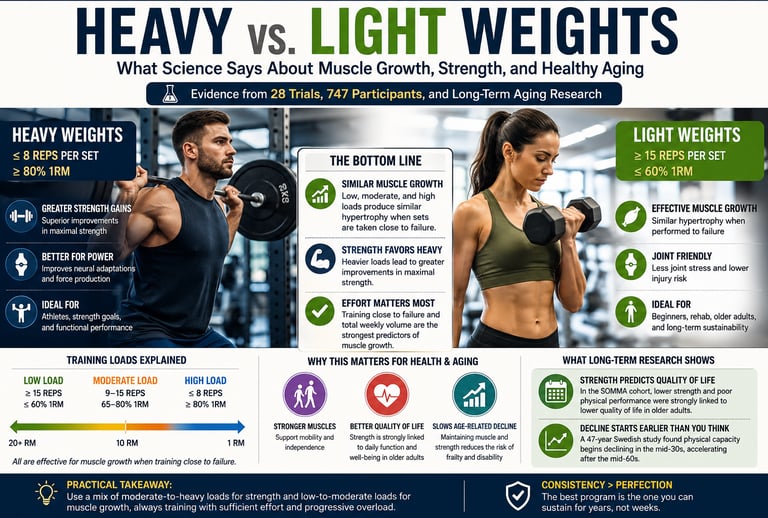
Recent 2025–2026 data confirms that heavy, moderate, and light weights produce nearly identical muscle growth, provided your training sets are pushed close to volitional failure. While raw muscle size does not depend on the weight you choose, the specific load you lift changes your physical capabilities entirely.
Key training trade-offs include:
Maximal Strength: Heavier loads (weights at or above 80% of your one-rep max) maintain a statistically superior advantage for building raw strength and bone density over light weights.
Proximity to Failure: Light weights only build comparable muscle if sets are driven to near-total effort (0 to 2 repetitions left in reserve); stopping high-rep sets early destroys their effectiveness.
Lifespan & Quality of Life: Your physical capacity naturally begins to decline around age 35. To preserve independence into your 70s and 80s, you must prioritize functional leg power and movement capacity over raw muscle size alone.
Key Takeaways
1. Does lifting heavy or light weights build more muscle?
For muscle size (hypertrophy), recent meta-analyses show that heavy, moderate, and light weights produce nearly identical results, provided your sets are performed close to volitional failure. The specific load you choose matters far less for raw muscle growth than the level of effort you put into pushing each set to its limit.
2. Do heavy weights have an advantage over light weights?
Yes. For building maximal strength, heavier loads (lifting weights at or above 80% of your one-rep maximum) show a clear, statistically significant advantage over light weights. If your goal is to maximize physical power, joint resilience, or your overall strength reserve, heavier lifting blocks are superior.
3. What is the single most important variable for muscle growth?
Accumulated training volume and proximity to failure are the primary levers for muscle growth. Comprehensive umbrella reviews suggest targeting roughly 10 or more hard sets per muscle group per week as a primary benchmark, making consistent weekly volume far more high-leverage than agonizing over a specific repetition range.
4. Do you have to train to complete failure to see results?
The scientific finding that "light weights work just as well as heavy weights" only applies when sets are taken to or very near true failure (0 to 2 repetitions left in reserve). If you stop a high-repetition set far short of failure, light weights lose their effectiveness because they fail to generate enough mechanical tension to stimulate the muscle.
5. At what age does physical strength and capacity start declining?
Rare, 47-year longitudinal data reveals that physical capacity, fitness, and muscular endurance naturally begin a gradual decline as early as age 35, regardless of your baseline activity level. This underscores the urgency of building a robust physical capital and muscle reserve during early adulthood and mid-life.
6. Does muscle size automatically guarantee a better quality of life as you age?
No. Large-scale clinical aging cohorts (like the SOMMA study) show that physical performance metrics—such as leg power, walking speed, and stair-climb performance—are far more tightly linked to real-world quality of life and independence in older adults than raw muscle size or isolated grip strength alone. You must train the movement function, not just the mirror.
7. How should you structure your training across your lifespan?
To combat the biological decline that begins in your mid-30s, prioritize long-term consistency over short-term optimization. A sustainable framework combines moderate-to-heavy structural compound movements (like squats or leg presses) to build structural power, utilizing lighter loading blocks periodically to preserve joint health and manage cumulative fatigue.
8. Is the science connecting weight training to muscle growth definitive?
While the data is robust, the vast majority of controlled training trials last between 6 and 24 weeks and evaluate healthy, younger adult populations. Because long-term, multi-decade randomized trials are non-existent, individual loading strategies should prioritize safety, strict movement technique, and long-term joint tolerance over multiple decades.
Introduction
If you've spent any time in a gym, a Reddit thread, or the comments section of a fitness influencer's video, you've run into the same argument: do you need to lift heavy to build muscle, or will lighter weights done to failure get you just as far?
It's not a trivial question. The load you choose affects your joints, your recovery, your motivation, and — over years — whether you actually stick with training at all. And the stakes go beyond aesthetics. Muscle mass and strength are two of the strongest predictors we have of how independently and comfortably people move through their 60s, 70s, and 80s.
This article is a deep, evidence-first answer. We're not going to summarize a few blog posts. We're going to walk through what a 2021 systematic review and network meta-analysis published in Medicine & Science in Sports and Exercise actually found when it pooled 28 controlled trials and 747 participants, what a 2022 umbrella review of 14 meta-analyses concluded about training variables beyond load, and — critically — why this matters clinically, using two recent studies that connect muscular capacity directly to quality of life and to the trajectory of aging itself.
By the end, you'll understand:
What "training load" technically means, and why the low/moderate/high-load categories used in research aren't arbitrary
What the actual effect sizes were in the key hypertrophy and strength studies — not just the conclusion headlines
Where the evidence is strong, where it's shaky, and which populations it does and doesn't generalize to
How muscle strength and physical performance connect to real-world quality of life in older adults, based on the SOMMA cohort
What a 47-year Swedish longitudinal study tells us about when physical capacity actually starts declining — and why that reframes how urgently you should think about resistance training
A practical, load-and-volume framework you can use regardless of your training age or goal
A note on safety: This article is educational and not a substitute for individualized medical or coaching advice. If you have joint pain, cardiovascular disease, are pregnant, or are returning to exercise after an injury or long layoff, talk to a physician or physical therapist before starting a new resistance training program.
1. What "Load" Means in Resistance Training Research
Before interpreting any study, you need to know how researchers define their categories, because "heavy," "moderate," and "light" are not vibes — they're operationalized as a percentage of how many repetitions you can perform before reaching technical failure, known as repetition maximum (RM).
In the research we'll discuss, loads are typically grouped as:
Low load: roughly 15+ repetitions per set (≤ ~50–60% of one-rep max)
Moderate load: roughly 9–15 repetitions per set (~65–80% of one-rep max)
High load: roughly ≤8 repetitions per set (≥ ~80% of one-rep max)
One detail matters more than the load category itself: proximity to failure. Most of the strongest hypertrophy research, including the network meta-analysis we cover below, specifically studied training performed to or near volitional failure. That detail is the hidden variable behind a lot of the "light weights work just as well" claims — they're not saying light weights work if you stop 10 reps shy of failure. They're saying light weights work if you push the set hard enough.
2. The Core Evidence: Lopez et al. (2021) Network Meta-Analysis
Study Overview
The most rigorous single piece of evidence on this question is the systematic review and network meta-analysis by Lopez and colleagues, published in Medicine & Science in Sports and Exercise (2021). This is a useful study to anchor on for several reasons: it used PRISMA-guided methodology across five major databases (MEDLINE, CINAHL, EMBASE, SPORTDiscus, Web of Science), it restricted the question specifically to resistance training performed to volitional failure, and — unlike a standard pairwise meta-analysis — it used a network meta-analysis, which allows indirect comparisons across studies that didn't directly compare all three load categories to each other. That's a methodological strength: it increases statistical power and lets researchers rank interventions even when the direct head-to-head data is sparse.
Study characteristics:
28 controlled trials
747 healthy adult participants
Low- (≥15RM), moderate- (9–15RM), and high-load (≤8RM) resistance training compared
Outcomes: muscle hypertrophy and muscle strength
Covariates assessed: training status, number of sessions, sex, and other design factors
What the Data Actually Showed
This is where interpretation matters more than the headline. The key results were:
For muscle hypertrophy: No statistically significant differences were found between load categories in the overall analysis (P = 0.113–0.469) or in subgroup analyses (P = 0.871–0.995). In plain terms — when sets are taken to failure, low, moderate, and high loads produced statistically indistinguishable hypertrophy outcomes.
For muscle strength: This is where the story changes. Both high-load and moderate-load training produced significantly greater strength gains than low-load training, with standardized mean differences (SMD) of 0.60–0.63 for high-load and 0.34–0.35 for moderate-load comparisons (P < .001–.003). High-load training also showed a non-significant trend toward superiority over moderate-load training (SMD 0.26–0.28, P = 0.068).
Important covariates the researchers identified:
Untrained participants showed greater hypertrophy responses overall (P = 0.033) — a classic "newbie gains" effect that's consistent across the broader literature.
In participants with some training background, doing more weekly sessions was associated with superior gains (P = 0.031–0.045), suggesting that as training experience accumulates, frequency and volume become more important levers than load selection alone.
Interpreting the Clinical Relevance and Validity of This Data
This is the part most articles skip, and it's the part that actually matters if you're trying to make a real decision.
Effect size context. An SMD of 0.60 (high-load vs. low-load for strength) is a moderate-to-large effect in behavioral and exercise science terms. An SMD around 0.30 (moderate-load vs. low-load) is a small-to-moderate effect. These aren't trivial differences — if your goal is maximal strength (for sport, for occupational demands, or simply to have a larger strength reserve as you age), load selection clearly matters, and lower loads are measurably inferior for this specific outcome.
Statistical non-significance is not proof of equivalence. The fact that hypertrophy differences between loads were non-significant (P-values ranging up to 0.995) tells us we failed to detect a difference — it does not prove there is no true difference. With 747 total participants spread across three load categories and 28 separate trials with their own measurement methods (ultrasound, MRI, circumference, DXA — all with different sensitivity), the statistical power to detect small hypertrophy differences may simply have been limited. The honest conclusion is "we have no strong evidence load matters for hypertrophy when training to failure," not "we have proven load is irrelevant."
The strength finding is the more decision-relevant one for most readers. If your primary goal is strength — which carries direct functional and aging-related relevance, discussed below — this study gives a clear, statistically robust signal: heavier loads (closer to 80%+ of 1RM) outperform light loads, and probably outperform moderate loads too, even though that last comparison didn't reach conventional significance.
3. Confirming the Pattern: The Bernárdez-Vázquez Umbrella Review
Why an Umbrella Review Matters
Bernárdez-Vázquez and colleagues, publishing in Frontiers in Sports and Active Living (2022), searched PubMed/MEDLINE, SPORTDiscus, and Web of Science and identified 52 candidate meta-analyses, of which 14 met inclusion criteria, collectively representing 178 primary studies and 4,784 participants.
What It Found
The umbrella review's central conclusion was that several training variables reliably influence hypertrophy: training volume, frequency, intensity (load), contraction type, repetition duration, and blood-flow restriction all showed evidence of an effect. Other variables — exercise order, time of day, and periodization model — did not show a clear, direct influence on hypertrophy magnitude based on existing meta-analytic evidence, though the authors noted more research is needed before ruling those factors out entirely.
One specific, actionable finding worth highlighting: the umbrella review identified a dose-response relationship between training volume and hypertrophy, suggesting roughly 10 or more sets per muscle group per week as a useful benchmark for maximizing muscle growth — broadly consistent with other volume-focused meta-analytic work in the field (e.g., Schoenfeld and colleagues' volume-dose research).
Clinical and Practical Interpretation
This is the piece that should reshape how you think about the heavy-vs-light debate: load is just one lever among several, and it may not be the most important one.
If load differences for hypertrophy genuinely wash out when training is taken to failure (as Lopez et al. found), but volume shows a consistent dose-response relationship across 14 pooled meta-analyses, then the practical takeaway shifts: instead of agonizing over whether to use 8 reps or 15 reps, the higher-leverage question becomes "Am I doing enough total hard sets per muscle group per week?"
4. Why This Isn't Just Academic: Muscle, Strength, and Quality of Life
Here's where the conversation needs to widen. Most hypertrophy debates stay locked in the gym — bigger arms, bigger photos. But muscle and strength aren't just cosmetic variables. They are functional capital that your body draws on for the rest of your life, and recent research lets us see that connection with real numbers.
The SOMMA Study
The Study of Muscle, Mobility and Aging (SOMMA), analyzed by Petnehazy and colleagues (2024, The Journal of Frailty & Aging), looked at 875 community-dwelling adults aged 70 and older (519 women, 356 men; mean age 76.3) across two academic medical centers (University of Pittsburgh and Wake Forest). Researchers measured an unusually comprehensive battery of muscle and performance metrics — MRI-based thigh muscle volume, D3-creatine dilution muscle mass, grip strength, leg extension power and strength, walking speed (4m and 400m), the Short Physical Performance Battery, stair-climb and chair-stand tests, and VO2 peak — and compared all of them against the EQ-5D, a validated health-related quality-of-life questionnaire.
What they found, and why it's clinically important:
Walking tests and overall physical performance were the metrics most consistently — though only modestly — associated with overall quality of life (correlation coefficients around r ≈ 0.20, P < .001), more so than raw muscle size.
Muscle size measures (MRI volume, D3-creatine mass) were the least consistently associated with quality-of-life subcomponents, compared with functional performance tests.
Grip strength, despite being a standard component of most clinical sarcopenia definitions, showed surprisingly weak associations with several quality-of-life domains in men — challenging its centrality in some current diagnostic frameworks.
Pain and discomfort, and difficulty with usual daily activities, were the quality-of-life domains most strongly tied to muscle and performance metrics — more so than anxiety/depression or self-care, the latter likely because this cohort was relatively high-functioning to begin with (a "ceiling effect" the authors explicitly flagged as a limitation).
Interpreting the Validity Here
This is an observational, cross-sectional study — it shows association, not causation. The authors themselves were careful to state this: poor performance and quality of life move together, but we can't conclude from this design alone that improving muscle performance causes better quality of life, only that the two are linked, and that future trials should test this causally by training people and measuring whether their quality of life improves.
What this means for the heavy-vs-light debate: It reframes the stakes. The reason the load question matters isn't only about which biceps photo looks better at 12 weeks. The functional capacities that resistance training builds — particularly leg power, stair-climb ability, and walking performance — are the same capacities most tightly linked to maintaining independence and quality of life in your 70s and 80s. Strength training, done consistently with adequate load and volume across decades, isn't vanity. It's preventive infrastructure.
5. The Lifespan Lens: A 47-Year Study on When Capacity Declines
The Study
If SOMMA shows why muscle and performance matter for quality of life in older age, a newer Swedish study shows when the decline actually begins — and the answer should change how urgently younger and middle-aged readers think about this topic.
Westerståhl and colleagues (2025, Journal of Cachexia, Sarcopenia and Muscle) published results from the Swedish Physical Activity and Fitness (SPAF) study — a genuinely rare dataset: the same randomly selected men and women, tracked with repeated physical testing across 47 years, from age 16 to 63. Most of what we know about age-related decline in fitness and strength comes from cross-sectional studies (comparing different people of different ages at one point in time), which can be confounded by generational, lifestyle, and survivor-bias differences. A genuine multi-decade longitudinal design avoids most of that confounding.
What They Found
The headline finding: physical capacity — fitness, strength, and muscular endurance — begins to decline as early as age 35, regardless of training volume. This mirrors a pattern long observed in elite athletes, where peak performance is typically reached before age 35 despite continued training, but this is one of the first studies to confirm the same underlying pattern in a general, randomly sampled population using direct longitudinal tracking rather than cross-sectional inference.
Interpreting the Clinical Relevance
This finding does not mean resistance training is futile or that decline is only cosmetic; the researchers explicitly noted that staying active remains highly beneficial despite the unavoidable biological trajectory. What does it mean, clinically:
The "use it or lose it" window opens earlier than most people assume. If underlying capacity peaks and starts a slow decline in the mid-30s, the common mental model of "I'll deal with strength training when I'm older, and it starts to matter" is built on a false premise — the relevant biology is already running by then.
This reframes the heavy-vs-light load debate as a long-game question, not a 12-week question. Most of the trials behind the Lopez et al. network meta-analysis run for a matter of weeks. But the real question for most people isn't "what builds the most muscle in a 10-week trial" — it's "what training approach will I actually sustain for the next 20–40 years, while preserving strength against a known, biologically inevitable downward trend." That favors whichever loading strategy supports long-term adherence, joint health, and consistent training frequency — which, per the evidence above, can validly include both lighter and heavier loads, used intelligently and varied over time.
A note on validity: this is still an observational cohort, and "regardless of training volume" should be read carefully — it likely reflects the fact that even physically active individuals in the general population experience the same underlying biological decline curve, not that training has zero effect on the rate or magnitude of decline. The study describes the natural trajectory; it doesn't claim training is powerless against it, and other intervention trials (including the load research above) show resistance training measurably improves strength and muscle mass at any age tested.
6. Putting It Together: A Unified, Evidence-Based Framework
Synthesizing all four lines of evidence above, here's the coherent picture:
Core Evidence Points
Weight Selection (Lopez et al., 2021): Light and heavy weights build muscle equally well, provided you train close to failure. However, if your goal is maximal strength, you must lift heavier loads ($\ge$ ~80% 1RM).
The Growth Drivers (Bernárdez-Vázquez et al., 2022): Muscle growth (hypertrophy) is driven by a combination of volume, frequency, intensity, and rep speed. Aiming for a baseline of 10+ sets per muscle group per week is the gold standard.
Function Over Size (Petnehazy et al. / SOMMA, 2024): In older adults, your real-world quality of life is determined by your physical performance and functional capacity—not just raw muscle size or grip strength.
The Biological Clock (Westerståhl et al., 2025): Physical capacity peaks and begins a slow, permanent decline around age 35, no matter how active you are. This makes early and consistent strength training a lifelong necessity, not a temporary phase.
The Unified Takeaway
The Levers: Volume and consistency are your primary drivers for overall fitness. Choosing heavy vs. light weight is just a secondary dial (crucial for strength, flexible for muscle size).
The Big Picture: You aren't just training for your current body; you are banking physical capacity for your future. The strength you build today directly protects your independence and quality of life decades down the road, acting as a critical buffer against an aging process that starts much earlier than most people think.practical-application
7. How to Apply This: Practical Programming
The Core Principles, Translated Into Action
Train close to failure, most of the time. The hypertrophy-load equivalence findings only apply when sets are taken to or near volitional failure (commonly described as 0–2 reps in reserve, or RIR). If you stop sets far short of failure, load becomes more important again because lighter loads that stop early simply won't generate enough mechanical and metabolic stimulus.
Hit roughly 10+ hard sets per muscle group per week if hypertrophy is a primary goal, per the dose-response pattern identified in the umbrella review — built up gradually, not all at once.
Use moderate-to-heavy loads (≥65% 1RM, roughly 6–15 reps) as your default, reserving very light, high-rep work for joint-friendly accessory days, deload periods, or when training around an injury — this gets you most of the strength benefit while keeping the hypertrophy stimulus intact.
Don't neglect heavier loading blocks if strength matters to you. Given the SMD advantage for high-load training on strength outcomes, periodically training in the 1–6 rep range with loads ≥80% 1RM is well-supported if maximal or near-maximal strength is a goal (sport performance, manual labor demands, long-term functional reserve).
Train for decades, not for 12 weeks. Because capacity decline begins around the mid-30s regardless of activity level, the highest-value strategy is the one you can sustain. That often means rotating loading schemes, managing joint stress with periodic lighter blocks, and prioritizing consistency in weekly training frequency over chasing the "optimal" rep range.
Prioritize functional movement patterns as you age — squat/leg-press, step-up, and carrying-type patterns in particular — since SOMMA found leg power, stair-climb, and walking performance to be the metrics most tied to real-world quality of life, more so than isolated muscle size.
Sample Weekly Structures by Training Background
Beginner (0–1 year of consistent training):
2–3 full-body sessions/week
2–3 sets per major movement, moderate load (10–15 reps), 1–2 reps in reserve
Focus on technique and consistency before load progression — beginners show the largest hypertrophy response per the Lopez et al. covariate analysis, so don't overcomplicate this phase.
Intermediate (1–3 years):
3–5 sessions/week, upper/lower or push/pull/legs split
10–20 weekly sets per muscle group, varying rep ranges across the week (e.g., one heavier day at 5–8 reps, one moderate day at 10–15 reps)
Train most sets to 0–2 RIR
Advanced / long-term lifters:
Periodized blocks: hypertrophy-focused phases (moderate load, higher volume) alternating with strength-focused phases (heavier load, lower volume)
Monitor joint tolerance; rotate exercise variations to manage cumulative load on tendons and joints over years of training
Older adults (50+, especially 65+):
Emphasize leg press/squat pattern, step-ups, chair stands, and carries — the movement patterns most tied to functional quality-of-life outcomes in the SOMMA data
Moderate loads with controlled tempo are usually well-tolerated and effective; very light loads can still work if true effort/failure proximity is maintained
Medical clearance is especially relevant here — discuss new resistance programs with a physician, particularly with existing joint, cardiovascular, or bone-density conditions
8. Evidence Summary Tables
1. The Load & Strength Baseline
Source: Lopez et al., 2021 (MSSE)
Design: Systematic review + network meta-analysis
Population: 747 healthy adults across 28 trials
Key Finding: When sets are taken to failure, the weight used doesn't significantly change muscle growth. However, high-to-moderate loads are clearly superior for building raw strength.
Strength of Evidence: High. Built on rigorous, PRISMA-guided network meta-analysis methodology.
2. The Muscle Growth Blueprint
Source: Bernárdez-Vázquez et al., 2022 (Front. Sports Act. Living)
Design: Umbrella review of 14 meta-analyses
Population: 4,784 participants across 178 primary studies
Key Finding: Hypertrophy is a multifactorial puzzle driven by training volume, frequency, intensity, contraction type, and rep duration. A target of 10+ weekly sets per muscle group serves as the ideal benchmark.
Strength of Evidence: High. Strong synthesis of multiple meta-analyses, though some primary study overlap exists.
3. The Quality of Life Driver
Source: Petnehazy et al., 2024 (J Frailty Aging / SOMMA)
Design: Cross-sectional cohort
Population: 875 older adults (aged 70+)
Key Finding: Real-world quality of life is much more closely tied to physical performance (like walking speed and stair climbing) than to raw muscle size or grip strength alone.
Strength of Evidence: Moderate. It is observational and shows associations rather than direct causation, with some data ceiling effects.
4. The Biological Timeline
Source: Westerståhl et al., 2025 (JCSM)
Design: 47-year longitudinal cohort
Population: General Swedish population, tracking individuals from ages 16 to 63
Key Finding: Your peak physical capacity begins a steady decline starting right around age 35, and this trajectory happens regardless of your training volume.
Strength of Evidence: High. Exceptional, rare long-duration longitudinal data tracking the same people across decades.
The Technical Synthesis
Here is the entire breakdown—the strategy, the technical load data, and the long-term rationale—reformatted into a direct, highly scannable bulleted list.
How to Train Now
The Volume Target: Hit a baseline of 10+ weekly working sets per muscle group to maximize growth.
For Muscle Size: Focus on effort rather than the specific weight. Choose any load, but ensure you push your sets close to failure.
For Raw Strength: Prioritize heavier weights to maximize force production and nervous system adaptations.
The Training Load Breakdown
High Loads ($\ge$ 80% 1RM / $\le$ 8 reps to failure):
Muscle Growth: No different than moderate or low loads.
Strength Gains: Superior (SMD: 0.60–0.63).
Moderate Loads (~65–80% 1RM / 9–15 reps to failure):
Muscle Growth: No different than high or low loads.
Strength Gains: Moderate (SMD: 0.34–0.35).
Low Loads ($\le$ 50–60% 1RM / 15+ reps to failure):
Muscle Growth: No different than high or moderate loads.
Strength Gains: Baseline (produces the lowest strength outcomes).
Why It Matters Long-Term
The Age 35 Pivot: Physical capacity naturally peaks and begins a structural decline starting around age 35, making early and consistent training a necessity.
Function Over Aesthetics: The ultimate goal of training isn't just a better reflection in the mirror; it is building real-world speed, power, and mobility.
The Independence Payoff: These exact functional performance metrics are what shield you from frailty, preserve your independence, and dictate your quality of life decades down the road.
9. Common Myths and Mistakes
Myth: "Light weights are useless for building muscle." Not supported. When taken to genuine failure, light-load training produced statistically comparable hypertrophy to moderate- and high-load training in the pooled trial data.
Myth: "If load doesn't matter for hypertrophy, I should never lift heavy." Incorrect, and it ignores the strength data from the same study. Heavier loads showed a clear, moderate-to-large advantage for strength gains — and strength carries its own independent value for performance, injury resilience, and long-term functional capacity.
Mistake: Stopping sets far from failure and assuming "I trained, so it counts." The hypertrophy-load-equivalence finding is contingent on training to or near failure. Submaximal effort with light loads is the scenario where load differences are most likely to actually matter and where light-load training underperforms.
Mistake: Chasing the "perfect" rep range instead of tracking total weekly volume. The umbrella review evidence points to volume and frequency as more consistently influential variables than the precise rep range used, once a reasonable, varied range is in play.
Mistake: Assuming muscle size alone is the relevant health marker as you age. The SOMMA data specifically found muscle size measures were less consistently tied to quality of life than functional performance metrics like walking speed and stair-climb ability — train the function, not just the mirror.
Mistake: Believing decline starts "later" and delaying training. The 47-year Swedish data suggests the decline curve is already underway from the mid-30s. Earlier, consistent training has a longer runway to build a strength reserve before that curve takes effect.
10. Frequently Asked Questions
Is it better to lift heavy or light weights for muscle growth? For hypertrophy specifically, current network meta-analysis evidence shows no significant difference between low, moderate, and high loads, provided sets are taken close to failure. For maximal strength, heavier loads (roughly 80%+ of your one-rep max) show a clear, statistically significant advantage.
How many sets per week do I need for muscle growth? Pooled meta-analytic evidence summarized in the Bernárdez-Vázquez umbrella review points to roughly 10 or more hard sets per muscle group per week as a useful benchmark, though individual responses vary and beginners can grow on less.
Do I have to train to failure to build muscle? The "load doesn't matter much" finding specifically applies to training performed to or near volitional failure. Sets stopped well short of failure, particularly with light loads, are less well supported by this same evidence base.
Does lifting weights help with quality of life as I get older? Observational data from the SOMMA cohort found that physical performance measures built through strength and functional training — walking speed, stair-climb ability, chair-stand performance — were more consistently associated with quality-of-life scores in adults 70+ than muscle size alone. This is association, not proof of causation, but it lines up with decades of broader research on exercise and aging.
At what age does physical capacity start declining? A 47-year Swedish longitudinal study found that physical capacity — strength, fitness, and muscular endurance — begins a gradual decline starting around age 35 in the general population, a pattern previously observed mainly in elite athletes.
If decline starts at 35 "regardless of training," does training even help? Yes — the study describes the natural underlying trajectory of capacity over time; it does not claim training has no effect. Separate intervention research, including the load studies discussed above, consistently shows resistance training measurably improves strength and muscle mass in people of nearly any age tested. Training shifts where you sit on the curve and how steep your decline is; it doesn't eliminate the curve.
Is grip strength the best indicator of muscle health in older adults? Surprisingly, the SOMMA analysis found grip strength — despite being a standard component in many clinical sarcopenia definitions — had weaker associations with several quality-of-life measures than walking and performance-based tests, particularly in men. It remains a useful, easy-to-measure clinical marker, but it may not be the single best proxy for functional quality of life.
How much weight should beginners use? Beginners can use a wide range of loads effectively and tend to show the largest hypertrophy gains of any training-status group, according to the Lopez et al. covariate analysis. Prioritizing consistent technique and gradually building toward training near failure matters more than picking a "perfect" starting load.
Can older adults safely train with heavy loads? Many can, with appropriate progression, supervision, and medical clearance — but moderate loads trained with good effort are also effective and often more joint-friendly as a starting point. Discuss your specific health history with a physician or qualified trainer before starting a heavier-load program.
Is more training volume always better for muscle growth? No — meta-analytic evidence generally describes a dose-response relationship with diminishing returns and a plateau (and potentially counterproductive results) beyond a certain volume threshold, rather than a straight line where "more is always better."
What's the single biggest mistake people make in this debate? Treating "load" and "effort" as the same variable. Most of the apparent disagreement between "heavy weights only" and "light weights work fine" camps disappears once you control for whether sets were actually taken close to failure.
Should I just stick to one rep range forever? The evidence supports variety: moderate-to-heavy loads as a default, with periodic heavier blocks for strength and lighter blocks for joint recovery or variety, all built around consistent weekly volume and effort.
11. Conclusion and Action Steps
The heavy-vs-light debate has a more nuanced answer than either camp on social media usually gives it credit for. The best current evidence — a 28-trial network meta-analysis and a 14-meta-analysis umbrella review — suggests that load is a secondary variable for muscle growth (as long as you train near failure) but a primary variable for maximal strength, and that total weekly training volume and frequency are at least as important as the specific rep range you choose.
Zoom out further, and the stakes become clearer. Functional capacities built through resistance training are tied to real-world quality of life in older age, and the biological decline in physical capacity appears to begin earlier in adulthood than most people assume. That reframes resistance training not as a short-term aesthetic project, but as a long-term investment in how independently and comfortably you'll move decades from now.
Your next steps:
Audit your current program: are most working sets taken within 0–2 reps of failure?
Total your weekly sets per major muscle group — aim toward the ~10+ set range if hypertrophy is a primary goal, adjusting for recovery and training age.
Build in at least one heavier-load block per training cycle if strength is a goal, alongside your moderate-load hypertrophy work.
Prioritize compound, functional movement patterns — squat, press, hinge, carry, step-up — that mirror the capacities tied to long-term quality of life.
If you're new to resistance training, returning after injury, or managing a chronic condition, get individualized guidance from a qualified coach, physical therapist, or physician before progressing load.
Consistency, applied for decades rather than weeks, is the variable the evidence keeps pointing back to.
Medical Disclaimer
The information in this article, including the research findings, is for educational purposes only and does not constitute medical advice, diagnosis, or treatment. Before starting a exercise program, you must consult with a qualified healthcare professional, especially if you have existing health conditions (such as cardiovascular disease, uncontrolled hypertension, or advanced metabolic disease). Exercise carries inherent risks, and you assume full responsibility for your actions. This article does not establish a doctor-patient relationship.
Related Articles
Exercise Doesn’t Just Build Muscle—It Reprograms Aging Cells
What Happens Inside Your Muscles During a Workout | DR T S DIDWAL
How Exercise Rewires Metabolism: Molecular Control of Lipolysis and Lipid Metabolism | DR T S DIDWAL
How to Build a Disease-Proof Body: Master Calories, Exercise & Longevity | DR T S DIDWAL
Sources and References
Lopez, P., Radaelli, R., Taaffe, D. R., Newton, R. U., Galvão, D. A., Trajano, G. S., Teodoro, J. L., Kraemer, W. J., Häkkinen, K., & Pinto, R. S. (2021). Resistance Training Load Effects on Muscle Hypertrophy and Strength Gain: Systematic Review and Network Meta-analysis. Medicine and Science in Sports and Exercise, 53(6), 1206–1216. https://doi.org/10.1249/MSS.0000000000002585
Bernárdez-Vázquez, R., Raya-González, J., Castillo, D., & Beato, M. (2022). Resistance Training Variables for Optimization of Muscle Hypertrophy: An Umbrella Review. Frontiers in Sports and Active Living, 4, 949021. https://doi.org/10.3389/fspor.2022.949021
Petnehazy, N., Barnes, H. N., Newman, A. B., Kritchevsky, S. B., Cummings, S. R., Hepple, R. T., & Cawthon, P. M. (2024). Muscle Mass, Strength, Power and Physical Performance and Their Association with Quality of Life in Older Adults, the Study of Muscle, Mobility and Aging (SOMMA). The Journal of Frailty & Aging, 13(4), 384–390. https://doi.org/10.1016/j.jnha.2024.100392
Westerståhl, M., Jörnåker, G., Jansson, E., Aasa, U., Ingre, M., Pourhamidi, K., Ulfhake, B., & Gustafsson, T. (2025). Rise and Fall of Physical Capacity in a General Population: A 47-Year Longitudinal Study. Journal of Cachexia, Sarcopenia and Muscle, 16(6), e70134. https://doi.org/10.1002/jcsm.70134
Cummings, S. R., Newman, A. B., Coen, P. M., Hepple, R. T., Collins, R., Kennedy, K., et al. (2023). The Study of Muscle, Mobility and Aging (SOMMA): A Unique Cohort Study about the Cellular Biology of Aging and Age-related Loss of Mobility. Journal of Gerontology: Series A. https://doi.org/10.1093/gerona/glad052
Cruz-Jentoft, A. J., Bahat, G., Bauer, J., Boirie, Y., Bruyère, O., Cederholm, T., et al. (2019). Sarcopenia: Revised European Consensus on Definition and Diagnosis. Age and Ageing, 48(1), 16–31. https://doi.org/10.1093/ageing/afy169
Guralnik, J. M., Ferrucci, L., Simonsick, E. M., Salive, M. E., & Wallace, R. B. (1995). Lower-extremity Function in Persons over the Age of 70 Years as a Predictor of Subsequent Disability. New England Journal of Medicine, 332(9), 556–561. https://doi.org/10.1056/NEJM199503023320902
Schoenfeld, B. J., & Grgic, J. (2017). Evidence-Based Guidelines for Resistance Training Volume to Maximize Muscle Hypertrophy. Strength & Conditioning Journal, 40(1).
Schoenfeld, B. J., Grgic, J., Ogborn, D., & Krieger, J. W. (2017). Strength and Hypertrophy Adaptations Between Low- vs. High-Load Resistance Training: A Systematic Review and Meta-analysis. Journal of Strength and Conditioning Research, 31(12), 3508–3523.
Krieger, J. W. (2010). Single vs. Multiple Sets of Resistance Exercise for Muscle Hypertrophy: A Meta-Analysis. Journal of Strength and Conditioning Research, 24(4), 1150–1159.
Lasevicius, T., Schoenfeld, B. J., Silva-Batista, C., Barros, T. D. S., Aihara, A. Y., Brendon, H., et al. (2022). Muscle Failure Promotes Greater Muscle Hypertrophy in Low-load but Not in High-load Resistance Training. Journal of Strength and Conditioning Research, 36(2), 346–351.
Lopes, C. R., Aoki, M. S., Crisp, A. H., de Mattos, R. S., Lins, M. A., da Mota, G. R., et al. (2017). The Effect of Different Resistance Training Load Schemes on Strength and Body Composition in Trained Men. Journal of Human Kinetics, 58, 177–186.
Schoenfeld, B. J., Ogborn, D., & Krieger, J. W. (2017). Dose-response Relationship Between Weekly Resistance Training Volume and Increases in Muscle Mass: A Systematic Review and Meta-analysis. Journal of Sports Sciences, 35(11), 1073–1082.
Pelland, J. C., et al. (2024). The Influence of Resistance Exercise Training Prescription Variables on Skeletal Muscle Mass, Strength, and Physical Function in Healthy Adults: An Umbrella Review. (as indexed in PMC, PMC10818109).
Sayer, A. A., Syddall, H. E., Martin, H. J., Dennison, E. M., Roberts, H. C., & Cooper, C. (2006). Is Grip Strength Associated with Health-Related Quality of Life? Findings from the Hertfordshire Cohort Study. Age and Ageing, 35(4), 409–415.
Veronese, N., Koyanagi, A., Cereda, E., Maggi, S., Barbagallo, M., Dominguez, L. J., et al. (2022). Sarcopenia Reduces Quality of Life in the Long-Term: Longitudinal Analyses from the English Longitudinal Study of Ageing. European Geriatric Medicine, 13(3), 633–639.
Groessl, E. J., Kaplan, R. M., Rejeski, W. J., Katula, J. A., Glynn, N. W., King, A. C., et al. (2019). Physical Activity and Performance Impact Long-term Quality of Life in Older Adults at Risk for Major Mobility Disability. American Journal of Preventive Medicine, 56(1), 141–146.
Karolinska Institutet (2025). Long-term Study Reveals Physical Ability Peaks at Age 35 [Press release/research summary].
National Institute on Aging — Exercise and Physical Activity guidance, NIH (general background reference for older-adult exercise safety).
American College of Sports Medicine — Position Stand: Progression Models in Resistance Training for Healthy Adults (general background ).