Zone 2: Mitochondrial Biogenesis, Endurance, and Aerobic Science
The science of Zone 2 training explained. Learn how this low-intensity pace drives mitochondrial capacity, improves fat oxidation, and builds your aerobic foundation.
EXERCISE
Dr. T.S. Didwal, M.D.
6/10/202618 min read
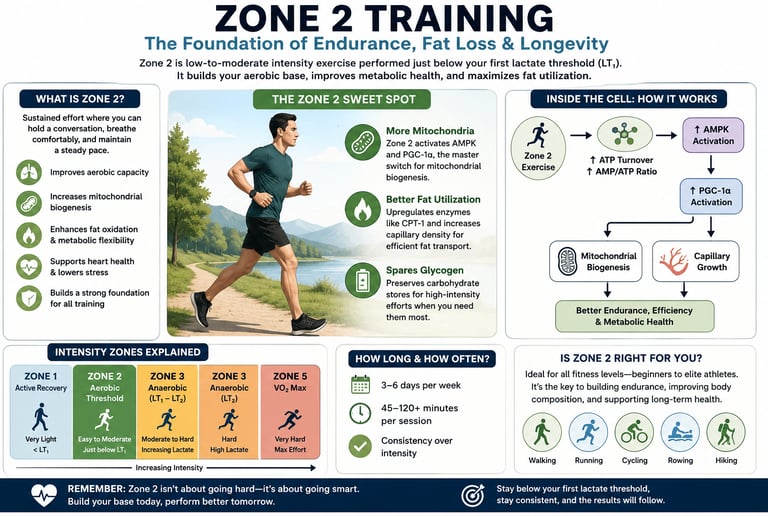
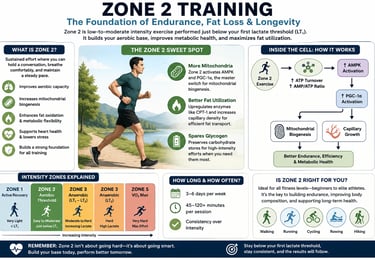
What is Zone 2 Training and Why Is It Important?
Zone 2 training is a low-to-moderate intensity form of aerobic exercise performed just below the first lactate threshold, where the body primarily uses oxygen and fat to produce energy. Research shows that Zone 2 training stimulates mitochondrial biogenesis, improves fat oxidation, enhances metabolic flexibility, and strengthens cardiovascular fitness while generating minimal fatigue. Regular Zone 2 exercise helps build a powerful aerobic foundation, supports healthy aging, improves endurance performance, and may reduce the risk of metabolic diseases by improving mitochondrial and metabolic health.
Key Takeaways: Why Zone 2 Training May Be the Most Important Exercise You Are Not Doing
Zone 2 Is the Foundation of Human Aerobic Health
Zone 2 training is not simply “easy cardio.” It represents exercise performed near the first lactate threshold (LT₁), where the body can sustainably produce energy using oxygen without significant lactate accumulation. This intensity forms the physiological foundation upon which endurance, recovery, and long-term cardiovascular health are built.
Your Mitochondria Adapt Most Efficiently in Zone 2
Sustained Zone 2 exercise activates key cellular pathways such as AMPK and PGC-1α, the master regulator of mitochondrial biogenesis. Over time, this leads to the creation of new mitochondria and improved function of existing ones, enhancing the body's ability to generate energy efficiently.
Better Mitochondria Mean Better Aging
Mitochondrial dysfunction is increasingly recognized as a hallmark of aging and chronic disease. By improving mitochondrial density and function, Zone 2 training may support healthy aging, preserve physical function, and enhance metabolic resilience throughout life.
Zone 2 Trains the Body to Burn Fat More Effectively
One of the most valuable adaptations of Zone 2 training is improved fat oxidation. The body becomes better at using stored fat as fuel, preserving glycogen reserves and improving metabolic flexibility—a key marker of metabolic health and endurance performance.
Most People Train Too Hard and Miss the Benefits
Many exercisers unintentionally drift into moderate-intensity “gray zone” training. While it feels productive, it often generates more fatigue without producing the unique mitochondrial and metabolic adaptations associated with true Zone 2 work.
Heart Rate Formulas Are Often Inaccurate
Generic calculations such as “220 minus age” can misclassify training intensity by 10–15 beats per minute or more. The most practical approach is often the Talk Test: if you can comfortably speak in full sentences while exercising, you are likely near the appropriate Zone 2 range.
Elite Athletes Spend Most of Their Training Time Here
Contrary to popular belief, world-class endurance athletes perform approximately 60–80% of their training volume at low intensities. This large aerobic base allows them to tolerate and benefit from high-intensity training while minimizing excessive fatigue and injury risk.
Consistency Matters More Than Intensity
The greatest benefits of Zone 2 training come from regular, sustained practice rather than occasional hard efforts. Two to five sessions per week lasting 45–90 minutes can gradually improve aerobic fitness, recovery capacity, insulin sensitivity, cardiovascular function, and overall longevity.
For decades, mainstream fitness culture has conditioned us to believe that if a workout doesn't leave you gasping for air, drenched in sweat, and completely exhausted, it isn't working. We’ve chased the high of high-intensity interval training (HIIT), pushed through gruelling metabolic conditioning, and assumed that maximum intensity equals maximum results.
But what if the most critical component of your physical health, longevity, and athletic performance happens at a pace that feels surprisingly easy? A pace where you can comfortably hold a full conversation without losing your breath?
Welcome to Zone 2 training—the foundational, low-intensity aerobic stimulus that is quietly revolutionizing how sports scientists, cardiologists, and elite endurance athletes approach human performance.
What is Zone 2 Training? Defining the Aerobic Foundation
To understand Zone 2 training, it is important to first understand how exercise intensity is classified. Modern exercise physiology typically divides training into distinct intensity zones based on physiological thresholds, including lactate production, oxygen utilization, and ventilatory responses.
Exercise Intensity Continuum
Easy Recovery Exercise (Zone 1)
↓
Zone 2: Aerobic Base and Mitochondrial Development
↓ First Lactate Threshold (LT₁)
Moderate-to-Hard Exercise with Rising Lactate Levels (Zones 3–4)
↓ Second Lactate Threshold (LT₂)
High-Intensity Performance and VO₂ Max Training (Zone 5)
From a physiological perspective, Zone 2 training refers to sustained low-to-moderate intensity aerobic exercise performed at or slightly below the first lactate threshold (LT₁) or ventilatory threshold (VT₁). At this intensity, the body relies predominantly on oxidative metabolism, using oxygen efficiently to generate energy while minimizing lactate accumulation.
Often described as the “aerobic sweet spot,” Zone 2 represents the highest exercise intensity that can be maintained in a true metabolic steady state. This unique training zone maximizes mitochondrial function, enhances fat oxidation, improves metabolic flexibility, and strengthens cardiovascular fitness without generating excessive fatigue. As a result, Zone 2 training has emerged as one of the most effective strategies for improving endurance performance, metabolic health, and healthy aging. At this precise intensity, your skeletal muscles rely almost entirely on oxidative (aerobic) metabolism to generate energy. It represents the highest exercise intensity at which your body can maintain a true metabolic steady-state, matching oxygen supply perfectly with cellular energy demands.
In practical terms, Zone 2 is an effort level where you can speak continuously in full, grammatically correct sentences, but your listener can still hear the clear undertone of physical exertion in your voice. It is a pace that requires focus, yet remains completely sustainable for hours.
The Cellular Machinery: How Zone 2 Drives Mitochondrial Biogenesis
To appreciate why low intensity yields such high-level adaptations, we must peer inside the sarcoplasm of your working muscle fibers. The ultimate objective of Zone 2 training is simple: upgrading your cellular engines.
Your mitochondria are intracellular organelles responsible for producing adenosine triphosphate (ATP) via oxidative phosphorylation. When you consistently train in Zone 2, you subject Type I (slow-twitch) muscle fibers to prolonged, low-grade metabolic stress. This stress acts as a powerful molecular switch.
The PGC-1α Pathway: How Zone 2 Training Builds New Mitochondria
The remarkable health and performance benefits of Zone 2 training begin deep inside your muscle cells. At the center of this process lies PGC-1α (Peroxisome Proliferator-Activated Receptor Gamma Coactivator-1 Alpha), a molecule often called the master regulator of mitochondrial biogenesis.
During prolonged Zone 2 exercise, muscles continuously consume and regenerate adenosine triphosphate (ATP), the body's primary energy currency. As ATP turnover increases, the cellular energy sensor AMP-activated protein kinase (AMPK) becomes activated. Simultaneously, repeated muscle contractions trigger calcium-dependent signaling pathways that further amplify the adaptive response.
This coordinated signaling cascade ultimately stimulates PGC-1α, initiating a powerful genetic program that drives mitochondrial growth and adaptation.
Once activated, PGC-1α increases the expression of both nuclear and mitochondrial genes involved in cellular energy production. This produces two major adaptations that are critical for endurance, metabolic health, and healthy aging:
1. Mitochondrial Biogenesis
Zone 2 training stimulates the creation of entirely new mitochondria within skeletal muscle fibers. A larger mitochondrial network increases the muscle's ability to utilize oxygen, oxidize fat, and generate ATP efficiently during exercise and daily activities.
2. Mitochondrial Remodeling and Efficiency
Beyond creating new mitochondria, Zone 2 training improves the quality of existing mitochondria. Damaged components are repaired, mitochondrial enzymes become more active, and oxidative capacity improves, allowing cells to produce more energy while generating less metabolic stress.
Why Zone 2 Is the Mitochondrial Sweet Spot
A landmark 2025 review by Storoschuk and colleagues highlighted that Zone 2 training occupies a unique physiological "sweet spot." Exercise intensity is high enough to strongly activate AMPK and PGC-1α signaling, yet low enough to avoid excessive glycogen depletion, nervous system fatigue, and prolonged recovery demands.
While high-intensity interval training (HIIT) can also stimulate mitochondrial adaptations, it imposes substantially greater metabolic and neurological stress. Consequently, HIIT sessions must be limited in frequency, whereas Zone 2 training can be performed repeatedly throughout the week.
This ability to accumulate large volumes of aerobic work with minimal recovery cost is one of the primary reasons elite endurance athletes devote most of their training time to Zone 2 exercise. Over months and years, this repeated stimulus leads to profound increases in mitochondrial density, capillary growth, aerobic efficiency, and metabolic flexibility.
Clinical Takeaway
The primary purpose of Zone 2 training is not simply burning calories—it is upgrading the cellular machinery responsible for energy production. By activating the AMPK–PGC-1α pathway, Zone 2 exercise builds healthier, more efficient mitochondria, improves fat metabolism, enhances endurance performance, and supports long-term metabolic and cardiovascular health.Metabolic Flexibility: Teaching Your Body to Burn Fat
One of the most profound health benefits of establishing a solid Zone 2 foundation is the development of metabolic flexibility—the body's seamless ability to shift between utilizing carbohydrates and fats for fuel based on availability and exercise intensity.
At rest and during very low-intensity activities, a healthy metabolic system relies heavily on fat oxidation (burning free fatty acids via beta-oxidation). As exercise intensity climbs, the body requires ATP at a faster rate than fat oxidation can provide. Consequently, it shifts its reliance toward anaerobic glycolysis, breaking down stored glycogen (carbohydrates) into glucose and lactate.
When your Zone 2 foundation is weak or underdeveloped, your body crosses this threshold prematurely. Even at relatively slow paces, a metabolically inflexible individual will rely heavily on carbohydrate metabolism, rapidly depleting limited glycogen stores and accumulating early metabolic byproducts that induce fatigue.
Optimizing Fat Oxidation: How Zone 2 Training Transforms Your Metabolism
One of the most powerful adaptations produced by Zone 2 training is the enhancement of fat oxidation capacity. Over weeks and months of consistent aerobic training, the body becomes increasingly efficient at using stored fat as a primary fuel source, reducing dependence on limited carbohydrate reserves.
This metabolic adaptation occurs because Zone 2 training stimulates multiple cellular and vascular changes that improve the transport, uptake, and utilization of fatty acids within skeletal muscle.
Key Adaptations That Improve Fat Burning
Increased CPT-1 Activity
Zone 2 training upregulates carnitine palmitoyltransferase-1 (CPT-1), a critical enzyme responsible for transporting long-chain fatty acids into mitochondria, where they can be oxidized for energy. Because CPT-1 acts as a rate-limiting step in fat metabolism, increased expression significantly enhances the body's ability to utilize fat during exercise.
Greater Capillary Density
Prolonged aerobic training stimulates the growth of new capillaries around Type I (slow-twitch) muscle fibers. This expanded microvascular network improves oxygen delivery, nutrient transport, and fatty acid availability, creating an ideal environment for aerobic energy production.
Improved Glycogen Conservation
As fat oxidation becomes more efficient, the body relies less heavily on glycogen stores during submaximal exercise. This preserves valuable carbohydrate reserves for situations that demand rapid energy production, such as sprinting, climbing steep inclines, resistance training, or high-intensity intervals.
Why Fat Oxidation Matters
A landmark study by Carey demonstrated that the true value of aerobic-threshold training extends beyond simple calorie burning. While long-term fat loss depends primarily on overall energy balance, Zone 2 training specifically improves the cellular machinery responsible for fat metabolism.
In other words, Zone 2 does not merely help you burn fat during exercise—it trains your body to become better at burning fat all the time.
Over time, this leads to improved metabolic flexibility, greater endurance, enhanced exercise efficiency, and more stable energy levels throughout the day.
A useful analogy is to think of your body as a hybrid vehicle. The better your aerobic engine becomes, the farther and faster you can travel while relying on abundant fat reserves, saving your limited carbohydrate fuel for moments when maximum performance is required.
Why Personalization Matters
Training above your true Zone 2 threshold may increase lactate accumulation, glycogen depletion, and recovery demands, reducing many of the mitochondrial benefits that make Zone 2 training effective.
Conversely, training significantly below your aerobic threshold may not provide a sufficient stimulus for optimal mitochondrial adaptation and cardiovascular improvement.
The goal of Zone 2 training is precision, not simply staying within a generic heart rate range. For this reason, the most accurate methods involve lactate testing, cardiopulmonary exercise testing (CPET), or validated field assessments such as the Talk Test and Functional Threshold Heart Rate testing.
Clinical Takeaway
Zone 2 training is highly individualized. Age-based formulas provide only rough estimates and frequently misclassify exercise intensity. To maximize mitochondrial biogenesis, fat oxidation, aerobic fitness, and metabolic health, exercise intensity should be tailored to your unique physiology rather than relying solely on population averages.
How to Find Your Exact Zone 2 Heart Rate
Zone 2 Training: How to Find Your Aerobic Zone + Sample Workouts
Want to boost endurance, burn fat, and improve recovery? Zone 2 training is the foundation. Here’s how to find your Zone 2 heart rate and structure your weekly training for max results.
4 Ways to Find Your Zone 2 Training Range
1. Blood Lactate Testing - Clinical Gold Standard
Lab test using finger-pricks during increasing exercise intensity.
Zone 2 marker: Ends at your first lactate threshold (LT1) when blood lactate rises above baseline. For most people: 1.5 to 2.0 mmol/L.
2. CPET Test - Lab Alternative
Cardiopulmonary exercise test with a metabolic mask measuring VO 2 and VCO2
Zone 2 marker: Ventilatory Threshold 1 (VT1) — when breathing increases disproportionately to oxygen use.
3. FTHR Field Test - No Lab Needed
Use a chest strap heart rate monitor.
Protocol: 30-min all-out time trial after warm-up.
Calculation: Average HR from the final 20 minutes = Functional Threshold HR (FTHR). Zone 2 ceiling is 80% to 85% of FTHR.
4. Talk Test - Daily Practical Method
Protocol: Talk or read aloud during exercise.
Zone 2 marker: You can speak full sentences but need a conscious breath between them. Easy speech = Zone 1. Short phrases = Zone 3+.
Pyramidal Training Model: Zone 2 Weekly Volume
Research by Festa et al. 2020, Frontiers in Sports and Active Living) Found runners doing 60% to 70% of weekly volume in Zone 2 had better VO2 max, running economy, and race performance than. high-intensity groups.
Optimal Weekly Training Distribution:
- Zone 2 Aerobic Base: 60-70% of total volume
- Zone 3-4 Tempo: 15-20%
- Zone 5 HIIT: 10-15%
Zone 2 builds mitochondrial density and capillary beds. This lets you recover from hard sessions and avoid burnout, inflammation, and performance plateaus.
3 Sample Zone 2 Workouts
1. Steady-State Cycling - Beginner Friendly
Frequency: 2–3x per week | Duration: 45–90 minutes
Execution: 80–90 RPM cadence. Keep HR in Zone 2. Gear down on hills. Low joint impact.
2. Conversational Run or Power Walk
Frequency: 1–2x per week | Duration: 45–60 minutes
Execution: Easy jog for runners. Brisk incline walk for beginners or injury recovery. Use the talk test to stay in the zone.
3. Zone 2 Cross-Training Circuit
Frequency: 1x per week | Duration: 60 minutes
Execution: Maintain constant Zone 2 HR. Rotate every 15 min: Rowing → Elliptical → Bike → Incline Treadmill Walk. Beats boredom.
Safety Note: Consult your physician before starting any new cardio program, especially with metabolic, respiratory, or heart conditions.
Comparing the Science: Key Studies on Low-Intensity Training
Zone 2 Training Science: 5 Key Studies Explained
1. Sitko et al. 2025: What Zone 2 Actually Is
Key Focus Area: Consensus definition of Zone 2 training
Physiological Findings: Zone 2 is sustained work at or below the first aerobic threshold $LT_1$
Practical Takeaway: Zone 2 is a distinct metabolic state. Stop using random heart rate percentages. Find your $LT_1$ through testing or the Talk Test.
2. Storoschuk et al. 2025: How It Builds Your Engine
Key Focus Area: Mitochondrial biogenesis
Physiological Findings: Optimal AMPK and PGC-1$\alpha$ activation occurs with minimal systemic fatigue
Practical Takeaway: Consistent volume in Zone 2 drives better mitochondrial synthesis than high-intensity work. More mitochondria means better endurance and energy. Storoschuk 2025 also argues that Zone 2 is efficient, not necessarily maximal — HIIT can drive higher PGC-1α per minute, just with more recovery cost.
3. Meixner et al. 2025: Why Personal Testing Matters
Key Focus Area: Threshold variability between people
Physiological Findings: Massive individual differences exist when comparing age-based formulas vs lab metrics
Practical Takeaway: “220 minus age” is often wrong. Individualized pacing via lactate testing or the Talk Test is required for proper adaptation.
4. Festa et al. 2020: How Much Zone 2 Do You Need
Key Focus Area: Ideal training intensity distribution
Physiological Findings: 60–70% of weekly hours in Zone 2 yield superior performance vs high-intensity programs
Practical Takeaway: Dedicate most of your weekly exercise hours to low-intensity volume. Polarize your training.
5. Carey 2009: Long-Term Metabolic Benefits
Key Focus Area: Substrate oxidation and fuel use
Physiological Findings: Structural improvements in long-term fat oxidation pathways
Practical Takeaway: Zone 2 builds the cellular machinery for superior metabolic flexibility. You get better at burning fat for fuel.
SEO Summary: Low-intensity Zone 2 training below LT 1 is scientifically proven to improve mitochondrial density, fat oxidation, and endurance when done for 60-70% of weekly training volume.
Zone 2 Training and Insulin Sensitivity (Metabolic Glucose Regulation)
Zone 2 exercise represents a low-intensity, steady-state aerobic workload that primarily relies on oxidative phosphorylation. From a metabolic standpoint, its most important clinical effect is the enhancement of skeletal muscle insulin sensitivity.
Key Mechanisms
1. GLUT4 translocation (glucose transport activation)
Zone 2 training increases insulin-independent movement of GLUT4 transporters to the muscle cell membrane, improving glucose uptake even at lower insulin levels. This is a foundational mechanism in reversing early metabolic dysfunction.
2. Improved skeletal muscle glucose disposal
Regular aerobic activity increases mitochondrial density and capillary perfusion, allowing skeletal muscle to act as a “metabolic sink” for circulating glucose. This enhances postprandial glucose clearance.
3. Reduction in insulin resistance
Consistent Zone 2 exposure improves insulin receptor signaling efficiency and reduces intramyocellular lipid accumulation—two key drivers of insulin resistance.
4. Type 2 diabetes prevention pathway
Long-term adaptation leads to improved HbA1c trajectories and reduced progression risk from prediabetes to Type 2 diabetes through sustained improvements in peripheral insulin sensitivity.
Zone 2 Training and Healthy Aging (Longevity Physiology)
Zone 2 training also plays a central role in biological aging modulation, primarily through mitochondrial and inflammatory pathways.
Key Mechanisms
1. Mitochondrial aging attenuation
Aging is associated with reduced mitochondrial efficiency and biogenesis. Zone 2 training activates PGC-1α signaling, promoting mitochondrial renewal and improving cellular energy efficiency.
2. Reduction in inflammaging
Chronic low-grade inflammation (“inflammaging”) is attenuated through improved myokine signaling, enhanced lipid oxidation, and reduced visceral fat accumulation.
3. Sarcopenia prevention
By improving oxidative capacity in Type I muscle fibers, Zone 2 training helps preserve muscle endurance and function, slowing age-related muscle loss (sarcopenia).
4. Functional longevity improvement
Improved VO₂ efficiency, capillary density, and metabolic flexibility collectively enhance mobility, independence, and cardiovascular resilience in older adults.
Clinical interpretation: Zone 2 is not only a performance tool but a “biological aging modulator” that preserves mitochondrial and musculoskeletal integrity over time.
Common Zone 2 Myths and Mistakes
Mistake 1: Letting Your Ego Dictate the Pace
The most common mistake people make is going too fast. You will naturally want to speed up when someone passes you on a trail or a treadmill next to you. However, a slight increase in speed can easily push your body out of oxidative metabolism and into anaerobic glycolysis. Leave your ego at the door, watch your heart rate monitor, and slow down if needed.
Mistake 2: Relying Blindly on Smartwatches
While smart devices are exceptional tools for tracking resting heart rate trends, their automatic zone calculations are typically based on age-predicted maximum heart rate equations. Unless you manually input your tested lactate threshold or ventilatory values, your device's predefined "Zone 2" could easily be inaccurate by 10 to 15 beats per minute.
Mistake 3: Insufficient Workout Duration
While a 20-minute HIIT session can be metabolically demanding, Zone 2 adaptations rely on prolonged, steady cellular signaling. It takes time for the molecular pathways governing mitochondrial biogenesis to fully activate and register. Aim for a minimum duration of 45 minutes per session to maximize your results.
Mistake 4: Introducing "Micro-Intervals"
Many fitness enthusiasts get bored during a steady-state session and decide to throw in a 30-second uphill sprint every 10 minutes. These short bursts cause a sharp spike in blood lactate and a flood of epinephrine. This disrupts the steady-state oxidative environment, altering the metabolic focus of your entire workout.
Frequently Asked Questions (FAQs)
Q1: Will Zone 2 training make me slow?
A: Absolutely not. It builds the aerobic foundation that allows you to perform faster work down the road. Elite marathon runners, triathletes, and cyclists perform up to 80% of their training volume in Zone 2 because it allows them to sustain high absolute speeds at a lower relative heart rate and energy cost
.
Q2: How many weeks does it take to see noticeable adaptations?
A: At the cellular level, enzymes and signalling pathways adjust within 2 to 3 weeks. However, visible structural adaptations—such as a lower resting heart rate, a faster running pace at the same heart rate, and improved recovery—typically require 8 to 12 weeks of consistent weekly volume.
Q3: Can I perform Zone 2 training every day?
A: Yes, assuming you have built up your tolerance gradually. Because Zone 2 creates minimal muscle tissue tear and negligible central nervous system fatigue, it can be performed almost daily. This is why it is an ideal tool for accumulating healthy movement volume without overloading your recovery capacity.
Q4: Is Zone 2 training the same thing as "steady-state cardio"?
A: Not necessarily. "Steady-state" simply means maintaining a constant, unchanging pace, which can be done in any zone (such as a hard Zone 4 tempo run). Zone 2 refers explicitly to your biological intensity zone. Performing steady-state work within your Zone 2 threshold is simply one of the most effective ways to implement this training.
Q5: Can I split a 60-minute Zone 2 session into three 20-minute blocks?
A: For general cardiovascular health and daily calorie expenditure, splitting your sessions works well. However, for maximizing mitochondrial biogenesis, a single continuous block is superior. The molecular pathways (AMPK and PGC-1alpha) require sustained, unbroken stimulation to fully signal the creation of new mitochondria.
Q6: What should I do if my heart rate spikes on hills while running outdoors?
A: This is incredibly common, especially when first building your aerobic base. When encountering an incline, consciously drop your pace down to a very slow jog or a power walk. Do not hesitate to walk if it keeps your heart rate below your Zone 2 ceiling. Over time, your fitness will improve, allowing you to jog up those same hills while maintaining a steady Zone 2 heart rate.
Q7: Is Zone 2 training effective for fat loss?
A: Yes, it is a highly effective tool. Zone 2 allows you to burn a high percentage of calories from fat while minimizing your recovery demands. Because it doesn't leave you feeling exhausted or ravenously hungry like a grueling high-intensity workout often can, it supports sustainable lifestyle changes and long-term energy balance.
Q8: Should beginners jump straight into Zone 2 training?
A: Beginners actually stand to gain the most from Zone 2 work. It provides an approachable entry point to cardiorespiratory fitness, gently strengthens connective tissues, builds foundational capillary density, and keeps the risk of overtraining and overuse injuries exceptionally low.
Summary and Next Steps
Building a strong aerobic foundation is a long-term investment in your physical health, longevity, and performance. The scientific consensus is clear: prioritizing consistent, low-intensity volume upgrades your health at the cellular level.
Ready to put this science into action? Here is your immediate three-step blueprint:
Find Your Ceiling: Utilize the Talk Test during your next workout or calculate your Functional Threshold Heart Rate (FTHR) to establish your personalized Zone 2 heart rate boundaries.
Commit to Consistency: Schedule at least two 45-to-60 minute continuous sessions this week using a low-impact modality like cycling, rowing, or power walking.
Track Your Progress: Monitor your resting heart rate and take note of your movement speed at your target Zone 2 heart rate over the next 8 to 12 weeks. You will quickly find yourself moving faster and recovering with ease—all while maintaining a comfortable conversation.
LT₁ can be 50% VO₂max in deconditioned adults vs 75%+ in elites.
Because beginners have lower LT₁ — often 50-60% of max HR — Zone 2 starts at a much lighter effort, and their HR spikes quickly with any incline. Trained athletes have built bigger mitochondrial and capillary networks, so their LT₁ sits at 75-85% of max HR. The same “talk test” applies to both, but the actual pace and power output are worlds apart. That’s why pace or watts comparisons are useless — only internal effort matters.
Your cellular powerhouses are waiting. Slow down your training today to unlock your true athletic potential tomorrow.
Author's Note (Clinician Perspective)
As a physician, I view Zone 2 training as one of the most underappreciated tools in preventive medicine. Many people assume exercise must be intense to be effective, yet some of the most powerful adaptations occur during sustained, comfortable aerobic activity. At the cellular level, Zone 2 training improves mitochondrial function, enhances fat metabolism, increases capillary density, and strengthens the cardiovascular system with relatively little physical stress.
I often explain this concept to patients using a simple example. Consider a 52-year-old office worker with prediabetes, excess abdominal weight, and poor exercise tolerance. Rather than starting with exhausting workouts, we begin with brisk walking at a pace where conversation remains possible. After several months of consistent Zone 2 training, many patients notice improved energy, lower resting heart rate, better blood sugar control, easier weight management, and greater endurance during daily activities.
The goal is not to train harder but to train smarter. Zone 2 exercise builds the metabolic engine that supports long-term health, healthy aging, and athletic performance. In many ways, it represents one of the closest things we have to a scientifically validated longevity exercise prescription.
Disclaimer: This article is for informational purposes only and does not constitute medical advice. Individual circumstances vary, and treatment decisions should always be made in consultation with qualified healthcare professionals.
.Related Articles
Mitochondrial Dysfunction: The Core Driver of Aging and How Exercise Reverses It | DR T S DIDWAL
Exercise as Medicine: Reversing Cellular Aging and Type 2 Diabetes Risk | DR T S DIDWAL
The Science of Healthy Brain Aging: Microglia, Metabolism & Cognitive Fitness | DR T S DIDWAL
The Aging Muscle Paradox: How Senescent Cells Cause Insulin Resistance and The Strategies to Reverse It | DR T S DIDWAL
VO2 Max & Longevity: The Ultimate Guide to Living Longer | DR T S DIDWAL
Blue Zones Secrets: The 4 Pillars of Longevity for a Longer, Healthier Lifepost | DR T S DIDWAL
Sources / References
Carey, D. G. (2009). Quantifying differences in the "fat burning" zone and the aerobic zone: Implications for training. Journal of Strength and Conditioning Research, 23(7), 2090–2095. https://doi.org/10.1519/JSC.0b013e3181bac5c5
Festa, L., Tarperi, C., Skroce, K., La Torre, A., & Schena, F. (2020). Effects of different training intensity distribution in recreational runners. Frontiers in Sports and Active Living, 1, 70. https://doi.org/10.3389/fspor.2019.00070
Meixner, B., Filipas, L., Holmberg, H., & Sperlich, B. (2025). Zone 2 intensity: A critical comparison of individual variability in different submaximal exercise intensity boundaries. Translational Sports Medicine, 2025(1), 2008291. https://doi.org/10.1155/tsm2/2008291
Sitko, S., Artetxe, X., Bonnevie-Svendsen, M., Galán-Rioja, M. Á., Gallo, G., Grappe, F., Leo, P., Mateo, M., Mujika, I., Sanders, D., Seiler, S., Zabala, M., Valenzuela, P. L., & Viribay, A. (2025). What is "zone 2 training"?: Experts' viewpoint on definition, training methods, and expected adaptations. International Journal of Sports Physiology and Performance, 20(11), 1614–1617. https://doi.org/10.1123/ijspp.2024-0303
Storoschuk, K. L., Moran-MacDonald, A., Gibala, M. J., & Gurd, B. J. (2025). Much ado about zone 2: A narrative review assessing the efficacy of zone 2 training for improving mitochondrial capacity and cardiorespiratory fitness in the general population. Sports Medicine (Auckland, N.Z.), 55(7), 1611–1624. https://doi.org/10.1007/s40279-025-02261-y
Seiler, S. (2010). What is best for training intensity distribution? International Journal of Sports Physiology and Performance, 5(3), 276-291.
Hood, M. S., Little, J. P., Targonsky, A. M., Gillen, J. B., Montgomery, P. W., & Gibala, M. J. (2011). Low-volume high-intensity interval training in a municipal clinic setting improves markers of cardiovascular and metabolic health in sedentary humans. Journal of Applied Physiology, 111(6), 1554-1560.
Egan, B., & Zierath, J. R. (2013). Exercise metabolism and the molecular regulation of skeletal muscle adaptation. Cell Metabolism, 17(2), 162-184.
San-Millán, I., & Brooks, G. A. (2018). Assessment of metabolic flexibility by means of measuring blood lactate, fat, and carbohydrate oxidation responses to exercise in professional endurance athletes and individuals with metabolic syndrome. Sports Medicine, 48(2), 467-479.
Hawley, J. A. (2002). Adaptations of skeletal muscle to prolonged intense endurance training. Journal of Applied Physiology, 92(3), 1145-1156.