Exercise as Medicine: Reversing Cellular Aging and Type 2 Diabetes Risk
Discover how exercise reduces cellular senescence, improves insulin sensitivity, and lowers Type 2 diabetes risk. Learn the science behind HIIT, mitochondria, and anti-aging metabolism.
EXERCISEAGING
Dr. T.S. Didwal, M.D.(Internal Medicine)
4/28/202612 min read
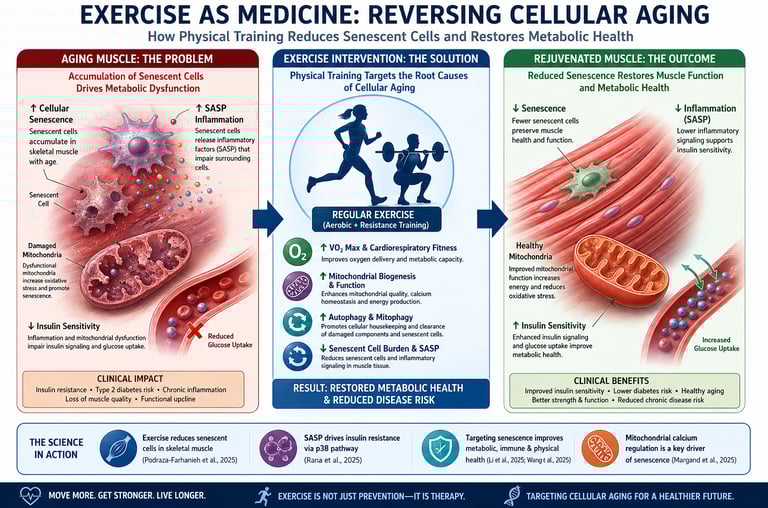
Exercise reduces cellular aging by lowering senescent cells in muscle, improving insulin sensitivity, and decreasing Type 2 diabetes risk. High-intensity and resistance training enhance mitochondrial function, suppress inflammation (SASP), and restore metabolic health, making exercise a powerful therapy for reversing age-related metabolic dysfunction.
Key Takeaways
Exercise directly reduces Cellular Senescence in muscle
Lower senescence = improved Insulin Resistance
Mitochondrial Dysfunction is a central driver of aging
SASP-driven inflammation accelerates metabolic disease
HIIT + resistance training provides maximum anti-aging benefit
Exercise acts as a disease-modifying therapy, not just prevention
From a clinician’s perspective, the convergence of exercise physiology and aging biology has reached a decisive inflection point. For decades, we framed physical activity as preventive—useful for weight control, cardiovascular health, and glycemic management. Emerging 2025 evidence now compels a reframing: structured exercise functions as a disease-modifying therapy targeting the root biology of aging—specifically Cellular Senescence in skeletal muscle. The study by Podraza-Farhanieh et al. (2025) demonstrates that physical training can reduce senescent cell burden and restore insulin signaling, directly improving glucose homeostasis. This is not merely an association; it represents a mechanistic reversal of Insulin Resistance—the central pathology underlying Type 2 Diabetes.
Clinically, this aligns with what we observe at the bedside: patients who improve cardiorespiratory fitness and muscle function often demonstrate disproportionate metabolic benefits relative to weight loss alone. The underlying biology is increasingly clear. Senescent cells accumulate with age and secrete pro-inflammatory mediators—the Senescence-Associated Secretory Phenotype—which impair insulin signaling and propagate tissue dysfunction (Rana et al., 2025). Exercise appears to interrupt this cycle through multiple converging pathways: enhancing mitochondrial efficiency, stimulating autophagy, and promoting the clearance or functional suppression of senescent cells (Ajoolabady et al., 2025; Li et al., 2025).
For practicing clinicians, the implication is profound. We are no longer prescribing exercise solely to “burn calories” or “improve fitness,” but to modulate fundamental aging pathways that drive cardiometabolic disease. In this context, declining VO₂ max is not just a marker of deconditioning—it is a surrogate for accelerating biological aging and rising metabolic risk. The therapeutic target, therefore, shifts toward restoring physiological reserve and cellular resilience through structured, progressive training interventions.
The 2025 Research Landscape: Key Discoveries in Cellular Senescence
Recent studies illuminate the intricate pathways connecting cellular aging to metabolic disease and offer hope through targeted interventions. Here's what the latest research reveals.
Study 1: Physical Training Reverses Senescence-Driven Insulin Resistance
Podraza-Farhanieh et al. (2025) conducted groundbreaking research demonstrating that physical training can actively reduce cell senescence and associated insulin resistance in skeletal muscle tissue. This study represents a major advancement in understanding the relationship between muscle senescence, metabolic dysfunction, and exercise interventions.
Key Findings
The research shows that exercise training doesn't just improve fitness—it fundamentally reverses the cellular aging process in muscle (Podraza-Farhanieh et al., 2025). By reducing the burden of senescent cells in skeletal muscle, physical training restores the muscle's ability to respond properly to insulin, thereby improving glucose homeostasis and metabolic health.
This discovery has profound implications: senescence in muscle tissue is a direct driver of age-related insulin resistance, a condition affecting millions globally. The good news? It's reversible through consistent physical activity.
Key Takeaway
Physical training is a powerful, non-pharmacological intervention for reducing cellular senescence and improving insulin sensitivity in skeletal muscle, offering a practical approach to preventing and managing metabolic disease in aging populations.
Study 2: The Senescent-Associated Secretory Phenotype and Glucose Regulation
Rana et al. (2025) investigated how the senescent-associated secretory phenotype (SASP)—the inflammatory signals released by senescent cells—affects glucose homeostasis in muscle cells. Their work specifically examined the role of the p38 pathway as a potential therapeutic target.
Key Findings
Senescent cells don't simply stop dividing; they actively secrete harmful inflammatory molecules that disrupt glucose metabolism (Rana et al., 2025). The study identified that the p38 signaling pathway plays a central role in this process. Importantly, the research suggests that p38 inhibitors could potentially reverse the metabolic damage caused by SASP, offering a promising pharmacological approach to treating senescence-driven insulin resistance.
This breakthrough connects cellular senescence to the chronic inflammation observed in aging and metabolic disease, revealing how senescent cell secretions directly impair muscle's glucose-handling capacity.
Key Takeaway
The senescent-associated secretory phenotype (SASP) is a primary mechanism linking cellular senescence to metabolic dysfunction. p38 pathway inhibition represents a viable therapeutic strategy for restoring glucose homeostasis in senescent muscle tissue.
Study 3: Hallmarks and Mechanisms of Cellular Senescence
Ajoolabady et al. (2025) provided a comprehensive review of the hallmarks of cellular senescence and their mechanisms in aging and disease. This paper synthesizes current knowledge about what defines a senescent cell and how senescence contributes to multiple age-related pathologies.
Key Findings
The authors identified and detailed the core hallmarks of cellular senescence, which include persistent cell cycle arrest, altered cell morphology, increased senescence-associated β-galactosidase activity, telomere dysfunction, and the establishment of the SASP (Ajoolabady et al., 2025). Critically, the research clarifies how senescence mechanisms vary across different tissues and cell types, which has implications for developing tissue-specific therapeutic approaches.
The paper emphasizes that cellular senescence is not simply a consequence of aging—it actively drives disease progression through multiple interconnected pathways. Understanding these mechanisms of cellular senescence is essential for developing effective interventions.
Key Takeaway
A comprehensive understanding of cellular senescence hallmarks and their underlying mechanisms is fundamental to developing targeted therapeutic strategies. Senescence represents a critical intervention point for preventing and reversing age-related diseases.
Study 4: From Homeostasis to Pathology: Senescence as a Therapeutic Target
Li et al. (2025) explored the transition from normal cellular homeostasis to pathological states driven by senescence, and critically, how to reverse this process through targeted interventions. This work bridges fundamental senescence biology with practical therapeutic applications.
Key Findings
The research demonstrates that cellular senescence exists on a spectrum—from a protective mechanism under normal circumstances to a pathological driver of disease when accumulated (Li et al., 2025). The study identifies multiple therapeutic strategies targeting senescence, including senolytics (drugs that eliminate senescent cells) and senomorphics (drugs that modify senescent cell behavior).
Importantly, Li et al. highlighted that effective senescence-targeting therapies must account for the complexity of senescence mechanisms and the tissue-specific consequences of removing senescent cells. The research also emphasizes the role of immunosenescence in allowing senescent cells to persist and cause damage.
Key Takeaway
Cellular senescence can be therapeutically targeted through multiple strategies. Moving forward, precision approaches accounting for tissue type and the specific senescence mechanisms involved will be essential for safe and effective senescence-targeting therapies.
Study 5: Aging, Immunosenescence, and Emerging Therapeutic Strategies
Wang et al. (2025) focused on immunosenescence—the age-related decline in immune function—and its relationship to cellular senescence. The study reviewed recent advances in understanding how aging immune cells become senescent and contribute to chronic inflammation and disease.
Key Findings
The research reveals that immunosenescence is characterized by the accumulation of senescent immune cells that lose their protective capacity while maintaining inflammatory activity (Wang et al., 2025). This paradoxical dysfunction—loss of protection combined with persistent inflammation—is a hallmark of aging and contributes to increased susceptibility to infections and chronic disease.
Wang et al. identified emerging therapeutic strategies targeting immunosenescence, including immune checkpoint inhibitors, senolytic drugs, and interventions targeting specific senescence pathways like p38 signaling. The study emphasizes that restoring immune function requires simultaneous reduction of senescent cell burden and restoration of healthy immune cell production.
Key Takeaway
Immunosenescence. Combined approaches targeting senescent immune cells and restoring healthy immune function offer promising avenues for improving health outcomes in aging populations. Immunosenescence represents a partially reversible contributor to age-related disease, with improvements dependent on intervention timing, immune reserve, and overall health status
Study 6: Mitochondrial Calcium and Senescence: A New Frontier
Margand et al. (2025) identified an emerging mechanism linking mitochondrial calcium levels to cellular senescence and cell fate decisions. This work opens new therapeutic perspectives by targeting mitochondrial dysfunction in aging cells.
Key Findings
Mitochondrial calcium homeostasis emerges as a critical regulator of whether cells undergo senescence or alternative fates. Dysregulation of mitochondrial calcium promotes senescence through multiple pathways, including energy depletion, oxidative stress, and activation of stress-response signaling. Conversely, restoring proper mitochondrial calcium levels can prevent or reverse senescence in certain contexts.
This discovery suggests that therapies targeting mitochondrial calcium regulation could represent a novel approach to preventing cellular senescence at its source. The research highlights how fundamental cellular processes—in this case, mitochondrial ion handling—directly influence aging phenotypes.
Key Takeaway
Mitochondrial calcium regulation represents an emerging therapeutic target for preventing cellular senescence. Interventions designed to restore mitochondrial calcium homeostasis could offer new strategies for combating age-related diseases.
Integrating the Research: A Unified Understanding of Senescence
The six studies paint a comprehensive picture of cellular senescence in 2025. Here's how they connect:
Cellular senescence is driven by multiple, overlapping mechanisms—from telomere dysfunction and mitochondrial calcium dysregulation to p38 pathway activation. Once senescent, cells establish the SASP, releasing inflammatory molecules that damage surrounding tissues and impair metabolism, particularly in skeletal muscle where insulin resistance develops.
The good news: these pathways are therapeutically targetable. Physical training works through one mechanism (reducing senescent cell burden), while p38 inhibitors target the inflammatory consequences of senescence. Future therapies will likely combine approaches—exercise, pharmacological interventions targeting senescence pathways, and potentially mitochondrial-targeted therapies—for comprehensive anti-aging effects.
Practical Applications: What This Means for You
Exercise as Medicine
The evidence from Podraza-Farhanieh et al. is unequivocal: physical training is among the most effective anti-senescence interventions available. Regular resistance and aerobic exercise reduce cellular senescence in muscle and improve insulin sensitivity. This applies to all ages, but becomes increasingly important with advancing age.
Recommendation: Aim for 150 minutes of moderate-intensity aerobic activity plus 2-3 sessions of resistance training weekly. Consistency matters more than intensity.
Metabolic Health Monitoring
If you have risk factors for metabolic disease (family history, sedentary lifestyle, overweight), understanding your insulin sensitivity becomes crucial. The research showing how senescent cells drive insulin resistance underscores the importance of early intervention before metabolic dysfunction becomes established.
Emerging Pharmacological Interventions
While p38 inhibitors and senolytic drugs are still largely in research phases, several are entering clinical trials. Staying informed about these developments could allow you to participate in trials or access therapies as they become available.
Mitochondrial Health
Support mitochondrial function through antioxidant-rich diet, adequate sleep, stress management, and—yes—exercise. While mitochondrial-targeted drugs are still emerging, these lifestyle factors support optimal mitochondrial calcium regulation and reduce senescence risk.
Frequently Asked Questions
Q: Can senescent cells be completely eliminated?
A: Currently, no. However, reducing the burden of senescent cells through lifestyle interventions (especially exercise) and emerging pharmacological approaches significantly improves health outcomes. Research on senolytic drugs aims to safely eliminate senescent cells, but this remains an active research area.
Q: Is insulin resistance reversible if caused by senescence?
A: Yes, according to Podraza-Farhanieh et al., physical training can reverse senescence-driven insulin resistance. The key is consistent exercise intervention. Pharmacological approaches targeting the p38 pathway also show promise for restoring glucose homeostasis.
Q: How quickly does exercise reduce senescence?
A: While the exact timeline varies, research suggests meaningful reductions in senescent cell burden occur within weeks to months of consistent physical training. Benefits continue to accumulate with continued exercise.
Q: Are there dietary approaches to reduce senescence?
A: While the studies reviewed don't specifically detail diet, emerging research suggests antioxidant-rich foods, caloric restriction, and certain compounds may support anti-senescence pathways. Always consult healthcare providers before making significant dietary changes.
Q: What's the difference between senolytics and senomorphics?
A: Senolytics eliminate senescent cells, while senomorphics modify senescent cell behavior without removing them. Both approaches have theoretical advantages and disadvantages currently under investigation.
Q: Can immunosenescence be reversed?
A: Wang et al.'s research suggests that while complete reversal may be difficult, targeted interventions can improve immune function significantly. Combined approaches addressing senescent cell burden and supporting healthy immune cell production show the most promise.
The Future of Anti-Aging Medicine
The 2025 research landscape reveals that aging is not inevitable—it's a targetable biological process. We now understand the specific mechanisms driving cellular senescence and have identified multiple intervention points. The transition from understanding senescence mechanisms to implementing effective therapies is accelerating.
The next decade will likely see:
Clinical validation of senolytic and senomorphic drugs
Personalized anti-senescence regimens based on individual senescence burden
Integration of lifestyle and pharmacological approaches for maximum efficacy
Development of mitochondrial-targeted therapies for senescence prevention
Refined understanding of immunosenescence leading to improved vaccines and therapies for aging adults
Clinical Pearls
1. Pearl: Personalized Senescence Triage
Scientific Principle: Therapeutic targeting of senescence is moving towards precision medicine, requiring individual quantification of the senescence burden using circulating biomarkers (e.g., SASP components like IL-6 and TNF-alpha
Know Your Inflammatory Status. Since we lack a single "Aging Cell Test," monitor your general metabolic and inflammatory markers (like C-Reactive Protein, or advanced markers like GDF-15, if available). Higher chronic inflammation is an indirect proxy—not a diagnostic marker—of an accumulating senescent cell burden. Discuss advanced inflammation panels with your healthcare provider
2. Pearl: Intensity is the Anti-Senescence "Dose"
Scientific Principle: Physical training reverses senescence-driven insulin resistance by actively clearing senescent cells. This process appears to be most effective when exercise elicits significant physiological stress, maximizing fitness gains (VO2 Max)
Exercise with Intensity. While 150 minutes of moderate activity is necessary for general health, to maximize the anti-ageing benefits of exercise—specifically clearing senescent cells—aim to incorporate sessions of High-Intensity Interval Training (HIIT) or vigorous activity. The goal is to reach your peak aerobic fitness capacity. High-intensity training should be individualized and introduced progressively, particularly in older adults or individuals with cardiometabolic disease, to avoid injury or adverse cardiovascular events.
3. Pearl: The Nuance of Senescent Cell Clearance
Scientific Principle: Senescent cells serve a paradoxical role, temporarily aiding acute processes (e.g., wound healing, stopping early tumors). Therefore, future pharmacological interventions (senolytics) must achieve high specificity to safely target only the chronic, disease-driving senescent populations.
Precision is Key to Safety. Think of senescent cells like construction debris: they're useful during the initial demolition but must be removed quickly to avoid causing a long-term hazard. Researchers are developing smarter therapies that can distinguish harmful, aged cells from temporarily protective ones, emphasizing the need for precision over blanket removal.
4 Pearl: Mitochondrial Health and Cellular Recycling
Scientific Principle: Mitochondrial calcium dysregulation is an early driver of senescence, specifically by disrupting the critical self-cleaning processes of autophagy and mitophagy (mitochondrial quality control).
Fast and Clean Your Cell Powerhouses. Your mitochondria (the cell's power plants) must be kept clean to prevent cellular aging. Lifestyle strategies like intermittent fasting or caloric restriction are believed to work by activating autophagy—your body's mechanism for clearing out damaged components, including old mitochondria—which prevents them from becoming senescent.
5. Pearl: Looking to Repurposed Compounds
Scientific Principle: Initial breakthroughs in senescence-targeting pharmacology involved the repurposing of existing, sometimes accessible, compounds (like the flavonoid Quercetin or the drug Dasatinib) to serve as senolytics or senomorphics.
Accessible Anti-Aging is Emerging. While pharmaceutical senolytics are in trials, the foundational research shows that compounds already available are active against senescence. Stay informed about accessible compounds (like Quercetin) that are currently being studied for their potential to target cellular aging, bridging the gap between current health practices and future therapeutics.These compounds should not be self-prescribed for anti-aging purposes, as dosing, timing, and long-term safety for senescence targeting in humans remain under investigation.
Author’s Note
The science of aging is undergoing a fundamental shift—from viewing aging as an inevitable decline to recognizing it as a modifiable biological process. One of the most compelling developments in this space is the growing understanding of Cellular Senescence and its central role in driving metabolic disease, particularly Type 2 Diabetes.
As a clinician, what stands out is not just the complexity of these molecular pathways, but their clinical relevance and reversibility. The idea that structured exercise can directly reduce senescent cell burden and improve Insulin Resistance challenges long-standing paradigms in medicine. We are no longer limited to managing downstream consequences—we are beginning to influence upstream biological drivers.
However, it is important to maintain perspective. While emerging therapies targeting senescence—such as senolytics and pathway-specific interventions—are promising, they remain largely experimental. In contrast, exercise is immediately available, low-cost, and supported by robust evidence across multiple domains of health. Its effects extend beyond metabolism, influencing cardiovascular function, immune health, and even cognitive resilience.
This article aims to bridge cutting-edge research with practical clinical insight. The goal is not to oversimplify the biology, but to translate it into actionable strategies that can be implemented today. At its core, the message is clear: improving fitness is not merely about performance or longevity—it is about preserving cellular integrity and metabolic function at the most fundamental level.
As research evolves, the integration of lifestyle interventions with targeted therapies may redefine how we approach aging and chronic disease. Until then, exercise remains our most powerful—and underutilized—tool in clinical medicine.Targeting cellular senescence is a rapidly evolving field. While lifestyle interventions such as exercise carry low risk and broad benefit, pharmacological senescence-targeting strategies remain experimental. Until large-scale human trials establish long-term safety, these therapies should be pursued only within clinical research settings
Disclaimer: This article is for informational purposes only and does not constitute medical advice. Individual circumstances vary, and treatment decisions should always be made in consultation with qualified healthcare professionals.
.Related Articles
Mitochondrial Dysfunction: The Core Driver of Aging and How Exercise Reverses It | DR T S DIDWAL
Zone 2: Mitochondrial Biogenesis, Endurance, and Aerobic Science | DR T S DIDWAL
The Science of Healthy Brain Aging: Microglia, Metabolism & Cognitive Fitness | DR T S DIDWAL
The Aging Muscle Paradox: How Senescent Cells Cause Insulin Resistance and The Strategies to Reverse It | DR T S DIDWAL
VO2 Max & Longevity: The Ultimate Guide to Living Longer | DR T S DIDWAL
Blue Zones Secrets: The 4 Pillars of Longevity for a Longer, Healthier Lifepost | DR T S DIDWAL
References
Ajoolabady, A., Pratico, D., Bahijri, S., et al. (2025). Hallmarks and mechanisms of cellular senescence in aging and disease. Cell Death Discovery, 11, 364. https://doi.org/10.1038/s41420-025-02655-x
Li, C., Yuan, Y., Jia, Y., Zhou, Q., Wang, Q., & Jiang, X. (2025). Cellular senescence: From homeostasis to pathological implications and therapeutic strategies. Frontiers in Immunology, 16, 1534263. https://doi.org/10.3389/fimmu.2025.1534263
Margand, C., Morgado-Cáceres, P., Ahumada-Castro, U., et al. (2025). Emerging role of mitochondrial calcium levels in cellular senescence and in switching cell fates. Nature Aging, 5, 1177–1180. https://doi.org/10.1038/s43587-025-00887-1
Podraza-Farhanieh, A., Spinelli, R., Zatterale, F., Nerstedt, A., Gogg, S., Blüher, M., & Smith, U. (2025). Physical training reduces cell senescence and associated insulin resistance in skeletal muscle. Molecular Metabolism, 95, 102130. https://doi.org/10.1016/j.molmet.2025.102130
Rana, K. S., Marwah, M. K., Raja, F. N. S., Dias, I., Hindalekar, Y. S., Al Tahan, M. A., … Bellary, S. (2025). The influence of senescent associated secretory phenotype on glucose homeostasis in C2C12 muscle cells: Insights into potential p38 inhibitor interventions. Journal of Receptors and Signal Transduction, 45(2), 118–127. https://doi.org/10.1080/10799893.2025.2475441
Wang, S., Huo, T., Lu, M., Zhao, Y., Zhang, J., He, W., & Chen, H. (2025). Recent advances in aging and immunosenescence: Mechanisms and therapeutic strategies. Cells, 14(7), 499. https://doi.org/10.3390/cells14070499