The Neuroscience of Obesity: How Excess Adiposity Causes Vascular Dementia and Brain Atrophy
Beyond correlation: 2025-2026 Mendelian randomization studies confirm high BMI as a causal risk factor for dementia. A comprehensive clinical look at neuroinflammation and metabolic brain health
OBESITY
Dr. T.S. Didwal, M.D.(Internal Medicine)
6/9/202612 min read
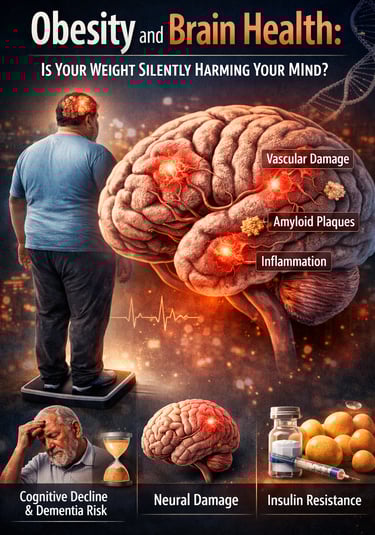
Does Obesity Cause Dementia?
Yes. 2025-2026 Mendelian randomization studies prove high BMI causes vascular dementia. Excess body fat damages the brain through 5 pathways: reduced blood flow, chronic inflammation, insulin resistance, direct lipotoxicity, and blood-brain barrier disruption. Brain scans show grey matter shrinkage and weaker neural connections in cognitively normal adults with obesity. Midlife obesity is the strongest predictor. Weight loss of 5-10% improves brain blood flow and inflammation within weeks.
Obesity physically shrinks your brain. Managing weight in your 40s-50s is one of the most powerful ways to prevent dementia
Key Takeaways
1. Your weight affects your brain, not just your heart.
New 2025-2026 science shows extra body fat can directly cause memory problems and dementia years later. It’s not just a “maybe” anymore.
2. Brain changes start quietly in midlife.
You can feel totally sharp in your 40s and 50s while excess weight is already affecting your brain’s wiring. That’s why acting early matters so much.
3. It’s about blood flow.
Extra fat makes your blood vessels stiff. Your brain needs a ton of blood every minute. When it gets less “fuel,” memory and focus suffer over time.
4. “Healthy obesity” isn’t brain-safe.
Even if your cholesterol and blood sugar look fine, extra fat tissue still sends out signals that irritate your brain. It’s the fat itself that can be harmful.
5. The longer you carry extra weight, the bigger the impact.
Think of it like wear and tear. A few years matters less than 20 years. The good news: lowering your weight even a little helps at any age.
6. You can cool brain inflammation fast.
Losing just 5-10% of your body weight often improves blood flow and lowers brain irritation within weeks. Small, steady changes add up.
7. Move, eat real food, and sleep well.
Walking 30 minutes a day, strength training twice a week, eating less ultra-processed food, and getting 7-9 hours of sleep all protect your brain’s blood vessels.
8. It’s rarely too late to help your brain.
Starting now still gives you benefits. But starting in your 40s and 50s gives you the biggest head start for keeping your memory strong at 80.
Introduction
Could the number on your scale today shape how clearly you think at 80? For decades we treated obesity as a heart and diabetes problem. The latest science says it’s also a brain problem. Large neuroimaging and genetic studies from 2024-2026 show excess body fat doesn’t just travel alongside cognitive decline. It drives it Nordestgaard.
Mendelian randomization data now prove high BMI causally increases risk for vascular-related dementia, independent of lifestyle or income. Brain scans of cognitively normal adults reveal that obesity quietly damages neural wiring years before memory slips Chwa. Even so-called “metabolically healthy obesity” shows measurable brain structure changes Wang.
This guide gives you the full picture. You’ll learn exactly how excess adiposity harms the brain, what 2024-2026 studies found, how to spot early risk, and the specific actions that protect grey matter and blood flow. We’ll translate complex mechanisms into clear steps you can use this week. Let’s start with what your brain looks like on obesity.
The New Consensus: Obesity Causes Dementia, Not Just Correlates
For years, researchers saw that people with obesity developed dementia more often. The question was: does fat cause brain decline, or do other factors explain both? The answer is now clear.
Mendelian randomization: Nature’s randomized trial
Nordestgaard et al. (2026) used genetic variants that predispose people to higher BMI. Because genes are assigned randomly at birth, this method mimics a clinical trial. The result: high BMI directly increases the risk for vascular-related dementia This is causation, not correlation.
Why this changes everything
If obesity causes brain damage, then weight management becomes primary prevention for dementia. It moves from a cosmetic or cardiovascular issue to a neurological priority. Public health guidelines from the 2024 ESC report on atherosclerosis already link vascular health to brain outcomes.
Key insight: Your vascular system is your brain’s supply chain. Obesity stiffens and inflames small vessels. The brain, which uses 20% of your body’s blood flow, gets less oxygen and nutrients. Over decades, that starvation translates to atrophy and cognitive loss.
How Excess Fat Physically Changes Your Brain
Obesity remodels brain architecture in measurable ways, often before you feel different.
Structural & Functional Changes in the Brain
Grey Matter Volume: Long-term obesity is associated with a 2–4% reduction in the frontal and temporal lobes, leading to reduced processing power and slower decision-making.
White Matter Integrity: DTI scans reveal decreased fractional anisotropy, which results in slower communication between different brain regions.
Hippocampus Alterations: Volume loss and impaired neurogenesis in this region cause weaker memory formation and recall.
Neural Connectivity: Coherence is reduced within both the default mode and executive networks, manifesting as poor attention, difficulties with task switching, and impaired mood regulation.
Cerebral Blood Flow: Perfusion in the microvasculature drops by 10–15%, causing chronic "brain fog" and lowering overall cognitive reserve.
Key Research Insights
Dose-Dependent Damage (Zhang et al., 2025): Tracking adults with sustained obesity revealed that the longer a person's BMI remains elevated, the more severe their grey matter loss and white matter disruption become. These structural shifts directly predict lower memory scores and slower processing speeds.
The Silent Phase (Chwa et al., 2025): In cognitively normal adults aged 40–60, higher body fat correlates with weaker neural connectivity in memory and executive networks. This indicates that the brain's internal wiring begins to fray well before any outward cognitive symptoms appear.
The 5 Core Mechanisms: From Blood Vessels to Inflammation
Obesity damages the brain through overlapping pathways. Understanding them helps you target the right interventions.
1. Vascular Dysfunction: The “Fuel Shortage” Pathway
Visceral fat increases inflammation and reduces nitric oxide, the molecule that keeps vessels flexible. Stiff, narrowed vessels deliver less blood. Because neurons have zero energy reserves, even mild hypoperfusion impairs function. Over time, this drives vascular dementia and accelerates amyloid buildup Visseren.
2. Chronic Neuroinflammation: The “Fire” Pathway
Fat tissue is an active endocrine organ. It releases cytokines like IL-6, TNF-alpha, and adipokines that cross the blood-brain barrier. These molecules activate microglia, your brain’s immune cells. Chronic microglial activation damages synapses and promotes tau pathology.
3. Insulin Resistance: The “Energy Crisis” Pathway
The brain is insulin sensitive. In obesity, systemic insulin resistance extends to neurons, impairing glucose uptake. PET studies show reduced brain glucose metabolism years before Alzheimer’s diagnosis. Wang et al. (2026) found that metabolic dysfunction amplifies obesity’s brain effects.
4. Lipotoxicity: The “Direct Damage” Pathway
Excess free fatty acids and ceramides accumulate in brain tissue, disrupting cell membranes and mitochondrial function. This is why “metabolically healthy obesity” still harms the brain. Fat itself is neurotoxic when in excess.
5. Blood-Brain Barrier Disruption: The “Broken Fence” Pathway
Obesity increases BBB permeability. That lets inflammatory molecules, lipids, and immune cells into brain tissue that should be protected. The result is a pro-inflammatory brain environment 24/7.
What 2024-2026 Studies Prove About Obesity and Brain Atrophy
Obesity and Cognitive Decline: The Latest Clinical Evidence
Causal Link to Vascular Dementia: A large-scale Mendelian randomization study by Nordestgaard et al., 2026 established that a high Body Mass Index (BMI) causally increases the risk of developing vascular dementia.
Weight Loss as Prevention: Because this relationship is causal, targeted weight loss interventions serve as a direct, evidence-based method for dementia prevention.
The "Metabolically Healthy" Obesity Myth: A 12-year prospective cohort study tracking 38,000 adults by Wang et al., 2026 revealed that even individuals classified as "metabolically healthy" but obese face an elevated risk for depression and cognitive decline.
BMI Matters Independently: This indicates that a high BMI negatively impacts long-term brain health completely independent of traditional laboratory blood markers or metabolic profiles.
Neuroimaging Findings & Brain Structural Changes
Progressive Grey Matter Loss: Longitudinal neuroimaging by Zhang et al., 2025, tracked 2,100 adults over 8 years and demonstrated that long-term obesity results in progressive grey matter loss and measurably slower cognitive performance.
Duration as a Predictor: The overall duration of time an individual lives with obesity directly predicts the severity of subsequent structural brain damage.
Silent Middle-Age Disruption: Cross-sectional MRI data on 500 cognitively normal adults aged 45–65 showed that higher adiposity correlates with weaker neural connectivity in the present moment. (Chwa et al., 2025)
Pre-Symptomatic Fraying: This proves that neural connectivity damage begins silently during midlife, long before any outward cognitive symptoms surface.
Shared Vascular Pathways: Global disease burden analyses utilizing WHO and GBD data show that Atherosclerotic Cardiovascular Disease (ASCVD) and metabolic diseases share identical vascular pathways with cognitive decline. (Visseren et al., 2024)
Dual-Benefit Interventions: Treating systemic vascular risks simultaneously protects both cardiovascular health and long-term cognitive function.
The "Midlife Mirror" Effect & Critical Intervention Window
The 30-Year Predictor: Data aggregated across multiple studies reveal that obesity between the ages of 45 and 60 predicts dementia risk at age 75 far more accurately than obesity measured at age 75.
The Metabolic Reflection: A person's brain structure and cognitive health at age 70 directly reflect their metabolic health and adiposity levels from age 45.
The Optimal Prevention Window: Midlife represents the critical, high-leverage window for therapeutic and lifestyle interventions to prevent late-life cognitive decline..
Midlife Weight vs Late-Life Weight: Why Timing Matters
Age 40-60: The critical window
Brain reserve is highest, but vascular damage begins. Weight loss here produces the largest risk reduction because you prevent cumulative damage. Think of it as paying into a “cognitive retirement account.”
Age 65+: The paradox
Some studies show late-life weight loss can be a marker of underlying disease. Unintentional weight loss may precede dementia diagnosis. However, intentional weight management still improves vascular function and inflammation. The message: it’s rarely too late, but sooner is superior.
Practical application: If you’re in your 40s or 50s with a BMI over 25, treat brain protection as a medical priority, not a future concern. Get a baseline: blood pressure, HbA1c, lipids, and if possible, a cognitive screen or brain MRI for high-risk individuals.
The “Healthy Obesity” Myth: Lipotoxicity and Silent Damage
The term “metabolically healthy obesity” refers to high BMI with normal blood sugar, lipids, and blood pressure. Wang et al. (2026) tested this directly. Result: these individuals still had higher rates of depression and brain structure changes than lean controls.
Why: Fat tissue itself releases inflammatory adipokines and free fatty acids. You can have perfect cholesterol and still have chronic low-grade brain inflammation. Imaging studies show reduced neural connectivity in this group Chwa.
Takeaway: Don’t wait for your labs to “go bad.” Adiposity itself is the risk. Waist circumference and visceral fat are better markers of brain risk than BMI alone.
How to Assess Your Personal Brain Risk Right Now
Use this 5-point checklist. More “yes” answers = higher priority for intervention.
1. BMI and waist: BMI >27 or waist >40 in men, >35 in women?
2. Midlife status: Are you age 40-65 with 10+ years of elevated weight?
3. Vascular markers: Blood pressure >130/80 or HbA1c >5.7%?
4. Family history: Parents or siblings with dementia before age 80?
5. Symptoms: New trouble with focus, word-finding, or mood not explained by sleep/stress?
If you scored 3+, discuss brain-focused metabolic screening with your clinician. Ask about: HOMA-IR for insulin resistance, hs-CRP for inflammation, and cognitive baseline testing.
Evidence-Based Protection Plan: Diet, Exercise, Sleep, Stress
You can’t change genetics, but you can change physiology. These interventions target all 5 mechanisms above.
1. Exercise: The single best brain drug
Aerobic: 150-300 min/week moderate intensity, e.g. brisk walking, cycling. Improves cerebral blood flow within 12 weeks.
Resistance: 2-3x/week. Preserve lean mass, improve insulin sensitivity, lowers lipotoxicity.
Protocol: Combined aerobic + resistance beats either alone for brain volume preservation.
Mechanism: Increases BDNF, improves endothelial function, reduces neuroinflammation.
2. Diet: Feed vessels, starve inflammation
- Pattern > calories: Mediterranean or DASH-style, or lower refined-carb approach. All show cognitive benefit if they reduce inflammation and improve insulin signaling.
Protein target: 1.2-1.6 g/kg/day to preserve muscle during weight loss.
Key nutrients: Omega-3s for BBB integrity, polyphenols for microglia modulation, fiber for gut-brain axis.
Limit: Ultra-processed foods, liquid sugar, seed oils in excess. They drive all 5 damage pathways.
Sleep: The brain’s nightly detox
Chronic <6 hours sleep worsens insulin resistance and impairs glymphatic clearance of amyloid-beta. Goal: 7-9 hours with consistent timing. Treat sleep apnea. It doubles dementia risk and is common in obesity.
4. Stress and social engagement: Lower the fire
Chronic cortisol increases visceral fat and hippocampal atrophy. Mindfulness, purposeful activity, and social connection lower inflammatory cytokines. Cognitive engagement builds reserve.
5. Weight loss targets that matter
5-10% loss: Improves blood flow and inflammation markers in 8-12 weeks.
15%+ loss: Needed for major visceral fat reduction and potential brain volume recovery, per 2025 imaging data.
Speed: 0.5-1% bodyweight per week is sustainable and protects lean mass.
Safety note: Rapid weight loss or GLP-1 medications should be supervised by a clinician. Discuss risks, benefits, and monitoring. This is not medical advice. Consult your doctor before making changes.
Common Myths and Mistakes About Weight and Cognition
Myth 1: “My labs are fine, so my weight is fine.”
Truth: Adiposity itself is lipotoxic. Brain changes occur before labs change
Myth 2: “Dementia is genetic, so weight doesn’t matter.”
Truth: Genes load the gun, lifestyle pulls the trigger. Nordestgaard 2026 shows BMI is causal even after genetic controls.
Myth 3: “Exercise alone protects me, even if I stay obese.”
Truth: Exercise helps, but adiposity has independent effects. Best outcomes come from both fitness and lower fat mass.
Myth 4: “It’s too late, I’m 70.”
Truth: Vascular function and inflammation improve at any age. You can slow progression and improve quality of life now.
Mistake 1: Chasing the scale only
Focus on waist loss, muscle preservation, and inflammation markers. That’s what the brain cares about.
Mistake 2: Extreme diets that sacrifice protein or sleep
Crashing diets raise cortisol and cause muscle loss, worsening metabolic health. Sustainability beats speed.
FAQs on Obesity, Brain Health, and Dementia Prevention
1. How much does obesity increase dementia risk exactly?
Mendelian randomization data suggest each 5-point BMI increase raises vascular dementia risk by 15-30%, depending on genetics and age of onset. Risk is dose-dependent and cumulative.
2. Can the brain damage from obesity be reversed?
Partially. Inflammation and blood flow improve within weeks of weight loss. Some grey matter volume recovery has been seen in 2025 MRI studies after 10-15% weight loss sustained 1 year. Earlier intervention = more reversal.
3. Is belly fat worse than overall weight for brain health?
Yes. Visceral adiposity is most metabolically active and pro-inflammatory. Waist-to-height ratio >0.5 is a better brain risk predictor than BMI alone.
4. Do GLP-1 drugs like semaglutide help the brain directly?
Early 2024-2025 trials show GLP-1RAs reduce brain inflammation and improve cognitive scores, independent of weight loss. But long-term dementia data are pending. Use only under medical supervision.
5. What’s the fastest way to lower brain inflammation from obesity?
Combine 3 things: 7+ hours sleep, 30 min brisk walk daily, and cut ultra-processed carbs. CRP and IL-6 can drop measurably in 2-4 weeks.
6. Does yo-yo dieting hurt the brain?
Weight cycling may increase inflammation and vascular stress. The goal is sustained, gradual loss with muscle retention, not repeated rapid gain/loss.
7. Are there brain scans I can get to check for damage?
Clinically, MRI with volumetrics or DTI can assess structure. Functionally, fMRI shows connectivity. These are usually research tools, but some preventive clinics offer them. Discuss with a neurologist if you’re high risk.
8. How does obesity compare to smoking or alcohol for dementia risk?
Midlife obesity confers similar population-level dementia risk as hypertension and smoking. Combined with poor sleep or diabetes, the risk multiplies.
9. Can children and teens have brain changes from obesity?
Yes. 2024 pediatric MRI studies show altered executive network connectivity in adolescents with obesity. Early prevention matters.
10. What blood tests predict obesity-related brain risk?
Key markers: hs-CRP >2 mg/L, fasting insulin >10, HOMA-IR >2.5, triglyceride/HDL ratio >3, and HbA1c >5.7%. Ask your doctor which are appropriate for you.
Conclusion and Your 30-Day Brain Protection Checklist
Obesity is not just a metabolic condition. It is a neurological condition. The 2024-2026 data closes the debate: excess adiposity causes vascular dementia and brain atrophy through vascular damage, inflammation, insulin resistance, and lipotoxicity
The good news: this is modifiable. Your brain responds to blood flow, inflammation, and fuel status daily. That means actions you take this month change your cognitive trajectory years from now.
30-Day Brain Protection Kickstart
Week 1: Measure. Get waist, blood pressure, and baseline labs. Walk 20 min daily.
Week 2: Diet audit. Remove liquid sugar and ultra-processed snacks. Add 30 g of protein per meal.
Week 3: Sleep anchor. Set fixed sleep/wake time. Screen for sleep apnea if you snore.
Week 4: Strength x2. Add resistance training. Review progress and plan for the next 90 days.
Disclaimer: This article is for informational purposes only and does not constitute medical advice. Individual circumstances vary, and treatment decisions should always be made in consultation with qualified healthcare professionals.
Related Articles
Managing Diabesity: A Complete Guide to Weight Loss and Blood Sugar Control | DR T S DIDWAL
Stop the Clock: Proven Ways to Reverse Early Aging if You Have Diabetes | DR T S DIDWAL
Low-Fat vs. Low-Carb: Which Diet is Best for Weight Loss? | DR T S DIDWAL
5 Steps to Reverse Metabolic Syndrome: Diet, Habit, & Lifestyle Plan | DR T S DIDWAL
References
Chwa, W. J., Rahmani, F., Dolatshahi, M., et al. (2025). Identifying obesity and dementia risk: Body adiposity and neural connectivity in cognitively normal, mid-life adults. npj Dementia, 1, 24. https://doi.org/10.1038/s44400-025-00028-w
Nordestgaard, L. T., Luo, J., Emanuelsson, F., Leyden, G., Sanderson, E., Davey Smith, G., Christoffersen, M., Afzal, S., Benn, M., Nordestgaard, B. G., Tybjærg-Hansen, A., & Frikke-Schmidt, R. (2026). High body mass index as a causal risk factor for vascular-related dementia: A Mendelian randomization study. The Journal of Clinical Endocrinology & Metabolism, dgaf662. https://doi.org/10.1210/clinem/dgaf662
Visseren, F. L. J., Mach, F., Smulders, Y. M., Carballo, D., Koskinas, K. C., Bäck, M., Benetos, A., Biffi, A., Boavida, J.-M., Casper, D., Čelutkienė, J., Cosentino, F., Deaton, C., Hansen, J. B., Mellbin, L. G., Sanz, G., Seferović, P. M., Shlyakhto, E. V., Simpson, I. A., & Williams, B. (2024). The global burden of atherosclerotic cardiovascular disease. Atherosclerosis, 391, 117404. https://doi.org/10.1016/j.atherosclerosis.2024.117404
Wang, M., Yu, L., Tong, Z., Sun, G., Zhang, X., Zhang, Q., Xing, X., Zhao, J. V., Zhang, X., & Yang, X. (2026). Obesity, metabolic health, and brain health: Insights from a prospective cohort study. Journal of Affective Disorders, 392, 120184. https://doi.org/10.1016/j.jad.2025.120184
Zhang, D., Shen, C., Chen, N., et al. (2025). Long-term obesity impacts brain morphology, functional connectivity and cognition in adults. Nature Mental Health, 3, 466–478. https://doi.org/10.1038/s44220-025-00396-5