Post-Meal Exercise: The Simple Habit That Can Flatten Blood Sugar Spikes Naturally
Walking or exercising after meals may significantly reduce postprandial glucose. Learn the ideal timing, duration, intensity, and evidence from recent clinical studies.
EXERCISEDIABETES
Dr. T.S. Didwal, M.D.(Internal Medicine)
7/25/202622 min read
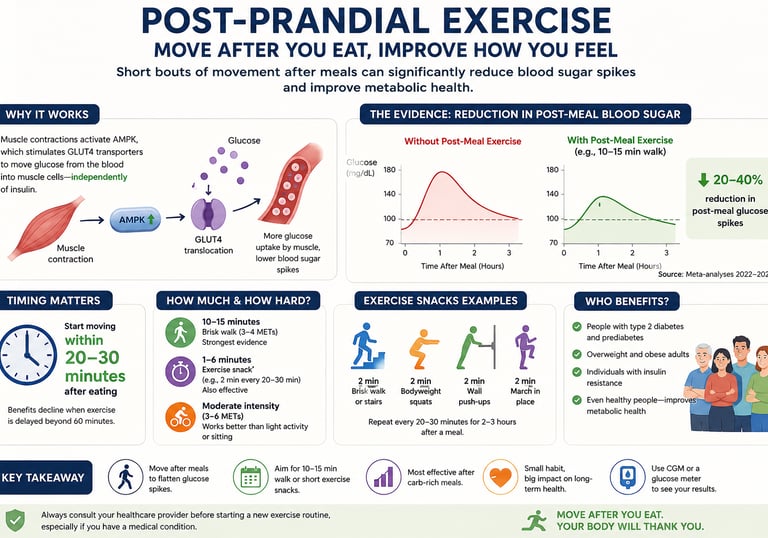
Post-meal exercise reduces blood sugar spikes by 20% to 40%. Moving within 20 to 30 minutes after eating—before glucose reaches its peak—triggers insulin-independent muscle contraction pathways, allowing muscles to clear sugar from the bloodstream immediately. Continuous 15- to 30-minute walks and "exercise snacks" (1 to 6 minutes of bodyweight squats or brisk walking repeated throughout the day) are equally effective at flattening postprandial glucose surges and reducing glycemic variability.
Clinical pearls
1. Leverage the "Bypass Channel" (Insulin-Independent Pathway)
Muscle contraction activates AMP-activated protein kinase (AMPK) signaling, which recruits GLUT4 glucose transporters to cell membranes without relying on insulin (Bellini et al., 2024). This contraction-mediated pathway allows skeletal muscle tissue to clear glucose from the bloodstream even in the presence of marked insulin resistance (Kang et al., 2023).
2. Prioritize Post-Meal Timing Over Workout Length
The interval between your last bite and your first step directly dictates the glucose-lowering outcome. Starting movement within 20 to 30 minutes after eating catches the glucose tide before it reaches its peak; exercising before a meal shows negligible impact on post-meal glycemic surges (Engeroff et al., 2023).
3. "Exercise Snacks" Provide Equal Metabolic Leverage
You do not need an uninterrupted 30-minute workout to flatten postprandial spikes. Intermittent "exercise snacks"—1 to 6 minutes of movement repeated every 20 to 60 minutes—trigger immediate cellular glucose uptake comparable to continuous session blocks, making desk-bound micro-bouts highly effective (Frontiers in Endocrinology, 2026; Zhang et al., 2022).
4. Simple Bodyweight Resistance Works via the "Muscle Pump"
Walking isn't the only option—bodyweight squats, wall sits, and calf raises engage large muscle groups, restoring lower-limb vascular shear stress and blood flow that prolonged sitting degrades (Bellini et al., 2024). This physical movement mechanically enhances glucose delivery to active muscle tissue (Frontiers in Endocrinology, 2026).
5. Expect the Largest Absolute Drops if Baseline Glycemia Is Elevated
Following the "higher risk, greater benefit" principle, individuals with type 2 diabetes or prediabetes experience larger absolute reductions in glucose area under the curve (AUC) than metabolically healthy individuals, making post-meal movement a high-yield intervention for impaired glucose tolerance (Kang et al., 2023; Lazić & Trajković, 2026).
6. Beware the "Already Hyperglycemic" Blunting Effect
Beginning exercise when blood sugar is already excessively high can blunt the expected metabolic response (Kang et al., 2023). Proactively moving after every major meal is far more effective than reactively lacing up shoes only after a continuous glucose monitor (CGM) alerts you to an ongoing severe spike.
7. Target Spike Variability, Not Immediate HbA1c Changes
Postprandial exercise reliably flattens same-day peak glucose and reduces real-world glycemic variability (Babir et al., 2026). However, these acute daily wins require sustained long-term consistency alongside dietary structure before they translate into measurable 3-month HbA1c improvements (Munan et al., 2020).
8. Factor in Hypoglycemia Risk with Secretagogues and Insulin
Because contraction-induced glucose uptake operates independently of insulin, combining post-meal movement with exogenously administered insulin or sulfonylureas can accelerate glucose disposal (Bellini et al., 2024). Patients on these therapies should monitor CGM trends to safely adjust timing and prevent late-onset hypoglycemia (Lazić & Trajković, 2026).
Introduction
If you've ever felt a sugar crash an hour after lunch, or watched a continuous glucose monitor spike after dinner, you've experienced postprandial hyperglycemia — the blood sugar surge that follows eating. It's not just uncomfortable. Repeated glucose spikes are increasingly recognized as an independent contributor to cardiovascular risk, oxidative stress, and long-term glycemic decline, even in people whose fasting glucose and HbA1c look "fine" on paper.
The good news is that one of the most effective tools for blunting these spikes isn't a drug — it's movement, timed strategically around meals. Over the past three years, researchers have published an unusually large wave of systematic reviews and randomized crossover trials on this exact question: does exercising after eating actually lower post-meal glucose, and if so, how much, when, and how intensely should you move?
1. What Is Postprandial Exercise, and Why Does It Matter?
Postprandial exercise simply means physical activity performed after a meal, as opposed to before eating (preprandial) or as a standalone session unrelated to meal timing. It ranges from a single continuous 20–30 minute walk to "exercise snacks" — extremely brief, repeated bouts of activity (often just 1–6 minutes) scattered through the hours after eating.
The clinical interest in this topic has grown because postprandial glucose excursions matter for more than just diabetes management. Large cohort and physiological data have linked repeated glucose spikes to endothelial dysfunction, oxidative stress, and elevated cardiovascular risk — independent of fasting glucose. For the roughly 40% of American adults who are overweight or obese, and the hundreds of millions living with prediabetes or type 2 diabetes worldwide, a low-cost, drug-free strategy to flatten these spikes has obvious appeal.
What makes 2023–2026 a pivotal window for this topic is that the research base finally matured enough to support formal meta-analyses — several of them published in just the last few months — rather than relying on scattered, small single-arm trials.
2. The Physiology: How Movement Lowers Blood Sugar
Skeletal muscle takes up glucose from the bloodstream through two largely separate pathways:
The insulin-dependent pathway, driven mainly by the PI3K/Akt signaling cascade, which is activated by rising insulin after a meal.
The contraction-dependent, insulin-independent pathway, driven by AMP-activated protein kinase (AMPK) and calcium/calmodulin signaling, which activates the moment muscle fibers contract — regardless of insulin levels.
This second pathway is the key mechanistic reason why even very brief bouts of movement can lower glucose. As little as 1–2 minutes of continuous muscle contraction can trigger GLUT4 transporter translocation to the cell surface, pulling glucose out of the bloodstream and into muscle tissue without waiting for insulin signaling to catch up.
This matters enormously for people with insulin resistance or type 2 diabetes, whose insulin-dependent pathway is impaired. Because the contraction-dependent pathway tends to remain relatively intact — and may even be compensatorily upregulated — brief exercise offers what researchers describe as a "bypass channel" around the insulin-resistance bottleneck. This is sometimes called the "higher risk, greater benefit" hypothesis: the people who benefit least from insulin often benefit most from muscle contraction itself.
There's a second, related mechanism specific to interrupting sitting: prolonged, uninterrupted sitting reduces lower-limb blood flow and shear stress, which itself impairs glucose uptake and endothelial function. Standing up and contracting muscles reactivates the "muscle pump," restoring blood flow, shear stress, and — in some studies — measurably improving vascular markers like flow-mediated dilation and endothelin-1.
3. What the Evidence Shows: A Study-by-Study Breakdown
3.1 Kang et al. (2023) — The foundational meta-analysis
Published in Nutrients, this systematic review and meta-analysis pooled 31 studies examining postprandial exercise in people who were overweight, had obesity, or had type 2 diabetes. The headline finding: postprandial exercise significantly reduced glucose area under the curve (Hedges' g = −0.317) and 24-hour mean glucose levels (Hedges' g = −0.328) compared with a no-exercise control, both statistically significant. The authors also examined how exercise duration, timing after the meal, and participants' disease status moderated the effect — establishing the framework that later, more granular reviews would build on.
3.2 Engeroff, Groneberg & Wilke (2023) — Timing is everything
This Sports Medicine meta-analysis directly compared pre-meal versus post-meal exercise. Pre-meal exercise showed no significant benefit for postprandial glucose (SMD = −0.13, 95% CI −0.42 to 0.17) — essentially no effect. But the time elapsed between the meal and exercise significantly moderated the outcome: the sooner exercise began after eating, the greater the glucose-lowering benefit. Their overall conclusion — that activity undertaken as soon as possible after eating outperforms exercise timed before a meal or delayed well afterward — has become one of the most cited practical takeaways in this field.
3.3 Zhang, Zheng & Ho et al. (2022) — Accumulated vs. continuous exercise
This Sports Medicine – Open review compared "accumulated" exercise (multiple shorter bouts spread across a day) against a single, energy-matched continuous session. Among non-diabetic adults, accumulated exercise — particularly physical activity breaks and lower-to-moderate intensity bouts — produced greater same-day postprandial glucose benefits than one continuous session. For people with diabetes, the two patterns performed comparably. This finding underpins much of the current enthusiasm for "exercise snacking" over traditional 30-minute workout blocks.
3.4 Bellini et al. (2024) — A practical exercise-prescription framework
Published in Nutrients, this narrative review synthesized the acute and chronic evidence into prescription-style guidance, addressing how meal composition, exercise modality, and individual feeding status interact with the glucose-lowering effect of movement. It reinforces that the effect isn't purely about calories burned — timing, contraction pattern, and baseline metabolic status all shape the outcome.
3.5 The 2026 Frontiers in Endocrinology meta-analysis — The most rigorous look yet at "exercise snacks"
Published in July 2026, this meta-analysis is the most methodologically stringent to date. The authors deliberately excluded standing-only interventions and continuous bouts of 10+ minutes, isolating the effect of true "exercise snacks" — brief (under 10 minutes), high-frequency bouts that interrupt sitting.
Pooling five trials that reported postprandial glucose incremental area under the curve (iAUC), they found a statistically significant reduction with exercise snacks compared with continuous sitting: a mean difference of −5.69 mmol·h/L. That's a meaningful effect
For postprandial insulin, the pooled effect showed a numerical downward trend that did not reach statistical significance and the result was highly sensitive to which studies were included. Exploratory analysis of whether people with diabetes or insulin resistance benefit more than metabolically healthy overweight individuals found a directionally larger effect in the higher-risk group
3.6 Babir, Marcotte-Chénard et al. (,) — Real-world testing, not just the lab
Most exercise-snack research happens in tightly controlled laboratory settings. This 2026 Diabetologia randomized crossover study broke that pattern by testing exercise snacks in participants' actual daily lives. Previously inactive adults with non-insulin-treated type 2 diabetes (average age ~58, BMI ~31) completed four 1-minute bouts of vigorous bodyweight exercise (guided by instructional videos) on two consecutive days, compared with two no-exercise control days, while wearing continuous glucose monitors under a standardized diet.
The result: exercise snacks performed in the real world — not the lab — measurably reduced postprandial hyperglycemia and overall glycemic variability. This is a significant contribution because it addresses one of the biggest criticisms of earlier research: that laboratory conditions don't reflect how people actually move (or fail to move) at home, at work, or between errands.
3.7 A second 2025–2026 "exercise snacks" meta-analysis — Independent confirmation
A separate meta-analysis focused specifically on adults with obesity pooled 17 crossover and parallel trials (261 participants) comparing activity breaks against uninterrupted sitting. It found a moderate, statistically significant reduction in both glucose iAUC and insulin AUC This is a useful cross-check: it used a broader inclusion strategy than the 2026 Frontiers review discussed above, yet arrived at a similar directional conclusion — activity breaks help, insulin effects are smaller and noisier than glucose effects, and heterogeneity remains a persistent feature of this literature rather than an artifact of any single study's methods.
3.8 Lazić & Trajković (2026) — CGM outcomes specifically in type 2 diabetes
Published in Reviews in Endocrine and Metabolic Disorders, this systematic review and meta-analysis of crossover trials narrows the focus specifically to continuous glucose monitoring (CGM) outcomes in people with type 2 diabetes, rather than lab-measured venous glucose. This distinction matters: CGM captures glucose in the free-living, real-world sense — interstitial fluid glucose sampled continuously — which is a more ecologically meaningful outcome than a handful of blood draws in a lab chair. Its inclusion alongside the other 2026 papers reflects a broader shift in the field toward wearable-based outcome measures, which sidestep some of the artificiality of single-day laboratory crossover designs and better reflect how postprandial exercise performs in ordinary daily life.
3.9 CGM-based reviews more broadly — Confirming the pattern with wearables
A related body of work, including meta-analyses of continuous glucose monitoring (CGM) outcomes in type 2 diabetes, has consistently shown that structured exercise reduces mean 24-hour glucose in short-term studies, even though effects on fasting glucose specifically are weaker and less consistent. This reinforces a key theme: exercise's glucose benefit is concentrated in the postprandial window, not necessarily in fasting values — which is exactly why timing exercise around meals, rather than at a random time of day, appears to matter so much.
3.10 A caveat worth knowing: starting glucose level may change the response
One smaller but mechanistically important randomized crossover trial found that the glucose-lowering benefit of exercise can be blunted when a person is already hyperglycemic before they start moving. In other words, the metabolic starting point at the moment exercise begins — not just the exercise itself — shapes how much benefit you get. This helps explain part of the heterogeneity seen across the larger meta-analyses: two people doing an identical post-meal walk can have meaningfully different glucose responses depending on where their glucose already was when they laced up their shoes.
4. Evidence Summary Table
Kang et al. (2023) — Nutrients
Population: Adults with overweight, obesity, or Type 2 Diabetes (31 studies).
Design: Systematic review and meta-analysis.
Key Finding: Postprandial exercise significantly reduced total glucose area under the curve (AUC, $g = -0.317$) and 24-hour mean glucose levels ($g = -0.328$).
Statistical Strength: Statistically significant ($p < 0.05$).
Engeroff et al. (2023) — Sports Medicine
Population: Individuals with healthy to impaired glucose tolerance.
Design: Meta-analysis.
Key Finding: Post-meal exercise outperformed pre-meal exercise, with earlier initiation after eating yielding the greatest glucose-lowering benefit.
Statistical Strength: Statistically significant timing effect.
Zhang et al. (2022) — Sports Medicine - Open
Population: Adults with and without diabetes.
Design: Meta-analysis.
Key Finding: Accumulated short bouts performed as well as or better than a single continuous session; breaking up activity was specifically superior in non-diabetic individuals.
Statistical Strength: Statistically significant in the non-diabetic subgroup.
Frontiers Meta-Analysis (2026) — Frontiers in Endocrinology
Population: Adults with overweight, obesity, or Type 2 Diabetes ($8\text{ crossover trials}, n = 159$).
Design: Meta-analysis and meta-regression.
Key Finding: Exercise snacks significantly reduced incremental glucose AUC (iAUC) by $5.69\text{ mmol}\cdot\text{h/L}$.
Statistical Strength: Statistically significant average effect, though marked by high heterogeneity ($I^2 = 85\%$) and a prediction interval that crosses the null value.
Babir et al. (2026) — Diabetologia
Population: Non-insulin-treated Type 2 Diabetes ($n = 31$).
Design: Real-world randomized crossover trial.
Key Finding: Four 1-minute daily bouts of vigorous bodyweight exercise measurably reduced postprandial hyperglycemia and glycemic variability in free-living conditions.
Statistical Strength: Statistically significant within a real-world, non-laboratory setting.
Munan et al. (2020) — Continuous Glucose Monitoring Meta-Analysis
Population: Adults with Type 2 Diabetes (28 studies).
Design: Meta-analysis of CGM outcomes.
Key Finding: Short-term exercise reduced 24-hour mean glucose by $0.5\text{ mmol/L}$, whereas fasting glucose levels remained largely unaffected.
Statistical Strength: Statistically significant specifically for the postprandial/24-hour glycemic window.Note: Effect sizes across studies use different metrics (Hedges' g, mmol·h/L, mmol/L) because they measure glucose differently (AUC, iAUC, mean concentration). They are not directly interchangeable — see the Interpretation section below.
5. How Long After Eating Should You Exercise? Timing Matters
This is one of the most searched — and most evidence-backed — questions in this space.
Start as soon as reasonably possible after eating, ideally within 20–30 minutes, and definitely before your individual glucose peak. The Engeroff meta-analysis found that the interval between eating and exercising directly predicted the size of the glucose-lowering benefit — the shorter the gap, the better. A related randomized crossover study went a step further, individually timing walking to begin 20 minutes before each participant's predicted glucose peak (determined via CGM), and found this "pre-peak" timing outperformed waiting until the peak had already occurred.
Pre-meal exercise, by contrast, does not reliably blunt the subsequent glucose response. The pooled effect for pre-meal exercise in the Engeroff review was small and not statistically significant.
Practical takeaway: if you only have one window to move today, put it in the 20–40 minutes immediately following your largest or most carbohydrate-heavy meal — not before it, and not hours later.
6. Exercise Snacks vs. Continuous Exercise: Which Wins?
Both work — but they may not be interchangeable in every context.
Exercise snacks (short, frequent, high-intensity-potential bouts, typically 1–6 minutes, repeated every 20–60 minutes) are attractive because they fit into a normal workday. The 2026 Frontiers meta-analysis found a numerically larger glucose reduction with vigorous-intensity snacks compared to light-intensity ones
Accumulated moderate bouts (2–3 sessions of 10+ minutes) vs. one continuous session showed a more nuanced pattern in Zhang et al.'s 2022 review: in people without diabetes, breaking activity into pieces outperformed one continuous bout for same-day postprandial control. In people with diabetes, the two approaches performed similarly — meaning neither pattern has a clear-cut advantage in that population, and adherence and convenience should probably guide the choice.
The bottom line: if your barrier to exercise is "I don't have 30 free minutes," the evidence supports exercise snacks as a legitimate, physiologically grounded alternative — not just a consolation prize. If you already have time for a continuous session, there's no strong evidence you need to break it up.
7. Who Benefits Most?
Not everyone will see the same-sized effect, and understanding where you fall on this spectrum helps set realistic expectations.
Most likely to see a meaningful benefit:
People with type 2 diabetes or diagnosed insulin resistance — mechanistically plausible and directionally supported, even though the statistical confirmation is still preliminary.
People who eat large, carbohydrate-heavy meals and currently do nothing afterward but sit.
People with desk-bound jobs who accumulate long, uninterrupted sitting stretches — the "muscle pump" and blood-flow restoration benefits are largest when sitting has been prolonged.
Anyone starting from a low activity baseline — the biggest jumps in benefit generally come from going from "no movement" to "some movement," not from optimizing an already-active routine.
Likely to see a smaller, but still real, benefit:
Metabolically healthy, normal-weight individuals — the effect exists in this group too, but the relative size of the glucose spike being blunted is smaller to begin with.
People who are already fairly active throughout the day (e.g., on-your-feet jobs), since they've already captured some of the "break up sitting" benefit before adding a deliberate protocol.
Should proceed cautiously and individualize with a clinician:
People on insulin or sulfonylureas, due to hypoglycemia risk when exercise is layered onto medication.
People with advanced diabetic complications (retinopathy, neuropathy, nephropathy) or unstable cardiovascular disease.
People whose pre-meal glucose is already very high — as noted above, starting in a hyperglycemic state may blunt the benefit and, in some cases, warrants medical guidance before adding exercise on top.
8. Practical Protocols You Can Start Today
Protocol A: The Post-Meal Walk (best evidence base, lowest barrier)
When: Begin within 20–30 minutes of finishing your meal.
Duration: 15–30 minutes.
Intensity: Brisk walking pace — enough to raise your heart rate noticeably, but still conversational.
Best for: Anyone, especially after your largest or highest-carbohydrate meal of the day.
Protocol B: Exercise Snacks (best for busy schedules or desk jobs)
When: Every 20–60 minutes during a prolonged sitting period, ideally after meals.
Duration: 1–6 minutes per bout.
Examples: Bodyweight squats, calf raises, walking in place, stair climbing, brief brisk walking.
Intensity: Light to vigorous — vigorous bouts (e.g., fast-paced bodyweight circuits) showed numerically larger effects in some trials, though beginners should start lighter.
Real-world example: In the Babir et al. 2026 study, participants performed just four 1-minute bouts of vigorous bodyweight exercise per day and saw measurable reductions in postprandial hyperglycemia and glucose variability.
Protocol C: Accumulated Moderate Bouts
When: 2–3 times across the day, ideally anchored to meals.
Duration: 10+ minutes per bout.
Intensity: Moderate (brisk walking, light cycling).
Best for: People without diabetes seeking same-day glycemic benefits, or anyone who prefers structure over spontaneity.
A note on resistance-based snacks: Several included trials used simple bodyweight resistance moves (half-squats, calf raises, sit-to-stands) rather than walking, with comparable glucose benefits — useful for people who work at a desk without easy access to a walking route.
9. Interpreting the Results: What the Data Can and Can't Tell You
This is the section most health content skips, and it's the most clinically important.
1. Statistical significance is not the same as universal applicability. The 2026 Frontiers meta-analysis found a statistically significant average reduction in glucose iAUC — but its prediction interval crossed zero. That means the average effect across a population of studies is real and reasonably reliable, but the effect in any single future study, and by extension any single person's specific situation, could plausibly range from a strong benefit to no benefit at all. This isn't a flaw unique to this study — it's an honest reflection of high between-study heterogeneity, driven by differences in participants' baseline metabolic status, exercise modality, intensity, and how glucose was measured.
2. "Higher risk, greater benefit" is plausible but not yet proven. The mechanistic case for people with insulin resistance or type 2 diabetes benefiting more from contraction-based glucose uptake is strong on paper. But when researchers have tried to statistically confirm this in meta-regression, the moderating effect of baseline metabolic status has not reached statistical significance — point estimates trend in that direction, but confidence intervals overlap substantially between metabolically healthy and metabolically impaired groups. Translation: it's a reasonable hypothesis clinicians can act on cautiously, not a confirmed, quantified clinical rule.
3. Insulin effects are less certain than glucose effects. Across multiple analyses, postprandial insulin reductions trend downward but frequently fail to reach statistical significance, and results are sensitive to which individual studies are included. If you're tracking glucose via CGM, you're on firmer evidential ground than if you're trying to infer insulin changes from indirect proxies.
4. Acute effects are not the same as long-term HbA1c improvement. Nearly all of this evidence comes from single-day, laboratory-style crossover trials measuring same-day glucose. Whether repeatedly blunting daily glucose spikes translates into meaningfully lower HbA1c, better long-term insulin sensitivity, or reduced complication risk over months and years remains an open question that the field itself flags as a priority for future research. The Babir et al. real-world study is an encouraging step toward ecological validity, but it, too, measured days, not months.
5. Study quality caveats. Across the crossover trials pooled in the 2026 meta-analysis, all were rated as having "some concerns" for risk of bias — largely because blinding participants to whether they're exercising or sitting still is simply impossible. This is a structural limitation of the entire field, not a flaw specific to any one study, but it means effect sizes should be treated as directionally reliable rather than precisely exact.
What this means practically: the evidence strongly supports post-meal movement as a low-risk, physiologically sound strategy worth adopting. It does not yet support treating a specific protocol (e.g., "exactly 4 minutes, 3 times a day") as a precisely dosed medical prescription. Think of it the way you'd think of dietary fiber recommendations — well-supported in direction and magnitude, but not so precisely quantified that deviating slightly undoes the benefit.
10 Common Myths and Mistakes
Myth: "Any exercise timing works the same." Reality: Pre-meal exercise shows little to no significant effect on the subsequent glucose response; post-meal exercise, started promptly, has the strongest evidence base.
Myth: "You need at least 30 minutes for it to count." Reality: Trials using bouts as short as 1 minute, repeated several times, have shown measurable reductions in postprandial glucose and glycemic variability.
Myth: "More intense is always better." Reality: Light-intensity walking has solid supporting evidence on its own. Vigorous exercise snacks showed a numerically larger effect in exploratory analysis, but the evidence for outright superiority of higher intensity is preliminary and based on very few trials.
Myth: "This is only relevant if you have diabetes." Reality: Benefits have been demonstrated in overweight and obese individuals without diagnosed diabetes as well; the "higher risk, greater benefit" pattern is a trend, not an exclusivity rule.
Myth: "One good post-meal walk will meaningfully lower my HbA1c." Reality: The evidence for acute, single-day glucose reduction is strong; evidence connecting that directly to long-term HbA1c change is still limited and is explicitly flagged by researchers as an area needing more study.
Myth: "If my glucose is already high, exercise will fix it fast." Reality: The evidence suggests the opposite in some cases — starting already hyperglycemic can blunt the benefit of exercise rather than amplify it. Consistency between meals matters as much as reacting to a single high reading.
Mistake: Treating this as a substitute for medication or a balanced diet. Postprandial exercise is a complementary strategy shown to add benefit on top of medication in some trials — not a replacement for prescribed treatment or for the foundational role of diet composition in glucose control.
Mistake: Skipping medical clearance with complications. People with significant cardiovascular disease, advanced neuropathy, or joint disease should start light and get individualized guidance before adopting vigorous exercise snacks (see Safety section below).
11. Safety Considerations
Postprandial exercise is generally low-risk for most adults, but a few precautions matter:
People with diabetes on insulin or insulin secretagogues should be aware that combining post-meal exercise with these medications can occasionally increase hypoglycemia risk later in the day; discuss timing and monitoring with your care team.
Older adults or those with cardiovascular disease, peripheral neuropathy, or joint conditions should start with light-intensity, short-duration bouts and progress gradually.
Always consult your doctor before starting a new exercise routine, particularly if you have diagnosed diabetes, cardiovascular disease, or other chronic conditions. This article is educational and does not replace individualized medical advice.
12. Frequently Asked Questions
How soon after eating should I walk to lower blood sugar? Within about 20–30 minutes, and ideally before your individual glucose peak. The sooner activity starts after the meal, the greater the observed benefit in meta-analytic data.
How long should a post-meal walk be? Studies showing benefit range from very brief "exercise snacks" (1–6 minutes) to full 15–30 minute walks. Both approaches have supporting evidence; longer sessions aren't strictly required for a measurable effect.
Do exercise snacks really work, or is a full workout necessary? Multiple 2022–2026 meta-analyses and real-world trials support exercise snacks — brief, frequent bouts — as an effective, evidence-backed alternative to longer continuous sessions, particularly for people with limited time.
Is walking after a meal better than walking before a meal? Yes, based on current evidence. Pre-meal exercise has shown minimal to no significant effect on the subsequent glucose response, while post-meal exercise consistently shows benefit.
Does this work if I don't have diabetes? Yes. Benefits have been documented in people who are overweight or have obesity without a diabetes diagnosis, though the effect may be numerically larger in those with impaired glucose metabolism (a trend, not yet statistically confirmed).
What type of exercise is best — walking, squats, or resistance training? Both walking and simple bodyweight resistance movements (squats, calf raises, sit-to-stands) have shown comparable glucose-lowering benefits in trials. Choose what you can realistically repeat.
Can 1 minute of exercise really make a difference? Real-world data from 2026 shows that four 1-minute bouts of vigorous bodyweight exercise per day measurably reduced postprandial hyperglycemia and glycemic variability in adults with type 2 diabetes — so yes, in aggregate, very brief bouts can matter.
Will post-meal exercise lower my HbA1c? The current evidence base mostly demonstrates acute, same-day glucose reduction. Whether this consistently translates into lower HbA1c over months is not yet well established and remains an active research question.
Does higher-intensity exercise work better than light walking? Some exploratory data suggests vigorous exercise snacks may produce a numerically larger effect than light-intensity ones, but this finding is based on limited trials and did not reach strict statistical significance — so it should be treated as a hypothesis, not a firm recommendation.
Is it safe to exercise right after eating a large meal? For most healthy adults, yes — light-to-moderate activity shortly after eating is well tolerated and is the exact protocol used in most of the supporting research. People with GI conditions, cardiovascular disease, or other complications should individualize this with their physician.
How does this compare to just taking a diabetes medication? Postprandial exercise is a complementary, not a replacement, strategy. Some trials have specifically tested exercise on top of glucose-lowering medication and found it provides additional benefit beyond medication alone — but it should not be used to replace prescribed treatment without medical guidance.
What's the single most evidence-backed thing I can do starting today? Take a 10–15 minute brisk walk within 30 minutes of your largest meal. It's the intervention with the deepest, most consistent evidence base across the studies reviewed here.
Does breaking up sitting help even if I don't specifically time it around meals? Yes — interrupting prolonged sitting in general has independent evidence for improving glucose and insulin markers, largely through restoring blood flow and muscle contraction. Timing those breaks around meals appears to add an extra, meal-specific benefit on top of the general "don't sit too long" effect.
Can strength training replace walking for this purpose? Bodyweight resistance movements like squats, calf raises, and sit-to-stands have shown comparable postprandial glucose benefits to walking in several trials, so yes — strength-based exercise snacks are a valid substitute, especially for people who can't easily walk (e.g., due to space, weather, or mobility considerations).
13 Conclusion and Action Steps
The weight of evidence through 2026 is genuinely encouraging: moving your body — even briefly — soon after eating measurably blunts the glucose spike that follows a meal, through a well-understood, insulin-independent physiological pathway. This holds up across laboratory crossover trials, real-world CGM studies, and multiple independent meta-analyses spanning different populations.
At the same time, the most rigorous recent reviews are refreshingly candid about the limits of this evidence: effect sizes vary considerably between studies, insulin effects are less certain than glucose effects, and long-term outcomes like HbA1c change remain unproven. This isn't a reason to dismiss postprandial exercise — it's a reason to adopt it as a low-risk, physiologically grounded habit rather than a precisely dosed prescription.
Three action steps to start today:
Pick one meal — ideally your largest or most carbohydrate-heavy — and commit to a 10–15 minute walk within 30 minutes of finishing it.
If you're desk-bound, set a timer for a 1–3 minute movement break (squats, calf raises, or a lap around the office) every 30–60 minutes after eating.
Track it if you can — a continuous glucose monitor, even used temporarily, is the most direct way to see your personal response and fine-tune timing and intensity.
If you have diabetes, cardiovascular disease, or other chronic conditions, loop in your healthcare provider before changing your exercise routine — this article is educational, not a substitute for individualized medical advice.
Related Articles
Low-Carb Diets Don't Just Lower Blood Sugar—They May Reduce Chronic Inflammation Too
Reversing Type 2 Diabetes: Skeletal Muscle as a Master Regulator of Metabolic Health | DR T S DIDWAL
How to Build a Disease-Proof Body: Master Calories, Exercise & Longevity | DR T S DIDWAL
Lower Blood Pressure Naturally: Evidence-Based Exercise Guide for Metabolic Syndrome | DR T S DIDWAL
Exercise vs. Diet Alone: Which is Best for Body Composition? | DR T S DIDWAL
Cardiorespiratory Fitness: The Most Important Predictor of Health and Longevity You Can Improve
Movement Snacks: How VILPA Delivers Max Health Benefits in Minutes | DR T S DIDWAL
References
Hu, X., Sang, X., Xu, J., & Chen, P. (2026). Acute effects of "exercise snacks" on postprandial glucose and insulin responses in populations at metabolic risk: a meta-analysis with exploratory meta-regression and vascular outcomes. Frontiers in Endocrinology, 17. https://doi.org/10.3389/fendo.2026.1912963
Kang, J., Fardman, B. M., Ratamess, N. A., Faigenbaum, A. D., & Bush, J. A. (2023). Efficacy of Postprandial Exercise in Mitigating Glycemic Responses in Overweight Individuals and Individuals with Obesity and Type 2 Diabetes—A Systematic Review and Meta-Analysis. Nutrients, 15(20), 4489. https://doi.org/10.3390/nu15204489
Bellini, A., Scotto di Palumbo, A., Nicolò, A., Bazzucchi, I., & Sacchetti, M. (2024). Exercise Prescription for Postprandial Glycemic Management. Nutrients, 16(8), 1170. https://doi.org/10.3390/nu16081170
Zhang, X., Zheng, C., Ho, R. S. T., Miyashita, M., & Wong, S. H. S. (2022). The Effects of Accumulated Versus Continuous Exercise on Postprandial Glycemia, Insulin, and Triglycerides in Adults with or Without Diabetes: A Systematic Review and Meta-Analysis. Sports Medicine – Open, 8, 14. https://doi.org/10.1186/s40798-021-00401-y
Engeroff, T., Groneberg, D. A., & Wilke, J. (2023). After Dinner Rest a While, After Supper Walk a Mile? A Systematic Review with Meta-analysis on the Acute Postprandial Glycemic Response to Exercise Before and After Meal Ingestion in Healthy Subjects and Patients with Impaired Glucose Tolerance. Sports Medicine, 53, 849–869. https://doi.org/10.1007/s40279-022-01808-7
Lazić, A., & Trajković, N. (2026). Effect of acute postprandial exercise on continuous glucose monitoring outcomes in type 2 diabetes: A systematic review and meta-analysis of crossover trials. Reviews in Endocrine and Metabolic Disorders. https://doi.org/10.1007/s11154-026-10073-2
Babir, F. J., Marcotte-Chénard, A., Sandilands, R. E., D'Amico, A., Falkenhain, K., Mulkewich, N., Islam, H., Richards, D. L., Madden, K., Singer, J., Riddell, M., Gibala, M. J., & Little, J. P. (2026). Exercise snacks performed in real-world settings reduce postprandial hyperglycaemia and glycaemic variability in individuals living with type 2 diabetes: a randomised crossover study. Diabetologia, 69, 2200–2211. https://doi.org/10.1007/s00125-026-06741-2
Zhang, X., Wongpipit, W., Sun, F., et al. Walking Initiated 20 Minutes before the Time of Individual Postprandial Glucose Peak Reduces the Glucose Response in Young Men with Overweight or Obesity: A Randomized Crossover Study. Journal of Nutrition. https://doi.org/10.1093/jn/nxab444
Impact of pre- and post-meal exercise on 24-H glucose profiles in young adults who are overweight and obese. Journal of the Chinese Medical Association. https://www.sciencedirect.com/science/article/pii/S1728869X25000814
Munan, M., Oliveira, C. L. P., Marcotte-Chénard, A., Rees, J. L., Prado, C. M., Riesco, E., & Boulé, N. G. (2020). Acute and Chronic Effects of Exercise on Continuous Glucose Monitoring Outcomes in Type 2 Diabetes: A Meta-Analysis. Frontiers in Endocrinology, 11, 495. https://doi.org/10.3389/fendo.2020.00495
Loh, R., Stamatakis, E., Folkerts, D., Allgrove, J. E., & Moir, H. J. (2020). Effects of interrupting prolonged sitting with physical activity breaks on blood glucose, insulin and triacylglycerol measures: a systematic review and meta-analysis. Sports Medicine, 50, 295–330.
Gillen, J. B., Estafanos, S., Williamson, E., et al. (2021). Interrupting prolonged sitting with repeated chair stands or short walks reduces postprandial insulinemia in healthy adults. Journal of Applied Physiology, 130, 104–113.
Reynolds, A. N., Mann, J. I., Williams, S., & Venn, B. J. (2016). Advice to walk after meals is more effective for lowering postprandial glycaemia in type 2 diabetes mellitus than advice that does not specify timing: a randomised crossover study. Diabetologia, 59(12), 2572–2578.
Bellini, A., Nicolò, A., Bazzucchi, I., & Sacchetti, M. (2022). The Effects of Postprandial Walking on the Glucose Response after Meals with Different Characteristics. Nutrients, 14(5), 1080.
American College of Sports Medicine / Kanaley, J. A., Colberg, S. R., Corcoran, M. H., et al. (2022). Exercise/Physical Activity in Individuals with Type 2 Diabetes: A Consensus Statement from the American College of Sports Medicine. Medicine & Science in Sports & Exercise, 54, 353–368.
Wilmot, E. G., Edwardson, C. L., Achana, F. A., et al. (2012). Sedentary time in adults and the association with diabetes, cardiovascular disease and death: systematic review and meta-analysis. Diabetologia, 55, 2895–2905.
Hamilton, M. T., Hamilton, D. G., & Zderic, T. W. (2007). Role of low energy expenditure and sitting in obesity, metabolic syndrome, type 2 diabetes, and cardiovascular disease. Diabetes, 56, 2655–2667.
Padilla, J., & Fadel, P. J. (2017). Prolonged sitting leg vasculopathy: contributing factors and clinical implications. American Journal of Physiology – Heart and Circulatory Physiology, 313, H722–H728.
Acute effects of exercise snacks on postprandial glucose and insulin metabolism in adults with obesity: a systematic review and meta-analysis. Frontiers in Nutrition. https://doi.org/10.3389/fnut.2025.1708301
Carter, S., & Solomon, T. P. J. (2020). Exercise-Induced Improvements in Postprandial Glucose Response Are Blunted by Pre-Exercise Hyperglycemia: A Randomized Crossover Trial in Healthy Individuals. Frontiers in Endocrinology, 11, 566548. https://doi.org/10.3389/fendo.2020.566548
This article is for educational purposes and does not constitute individualized medical advice. Speak with your physician or a certified diabetes care and education specialist before starting a new exercise routine, especially if you have diabetes, cardiovascular disease, or other chronic health conditions.