Leucine Foods Chart: Exactly How Much You Need Per Meal for Muscle Growth
Discover the highest leucine-rich foods ranked by grams per serving. Learn how to hit the 2.5–3g leucine threshold per meal to maximize muscle growth, prevent sarcopenia, and optimize protein intake.
NUTRITION
Dr. T.S. Didwal, M.D.(Internal Medicine)
3/30/202616 min read
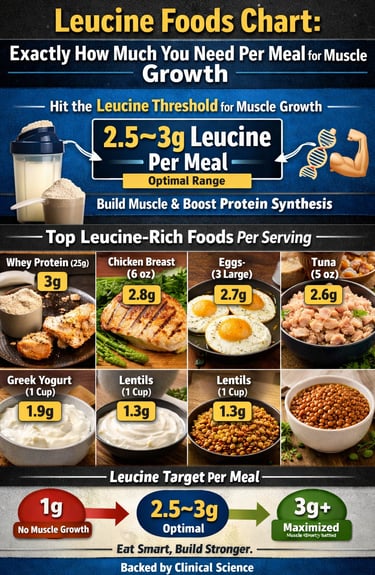
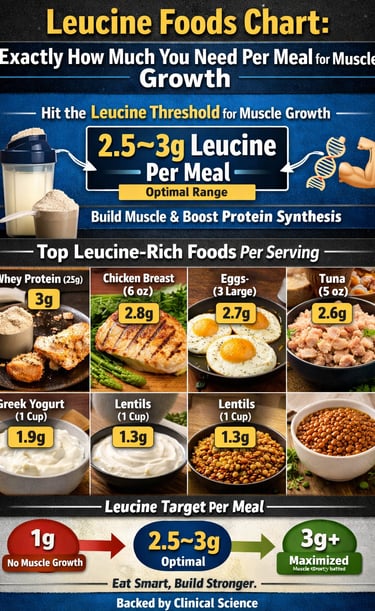
What foods are highest in leucine?
Leucine is the metabolic switch that turns protein into muscleThe foods highest in leucine include whey protein isolate (~3.0 g per serving), chicken breast (~2.5–2.7 g), lean beef (~2.5 g), tuna (~2.4 g), salmon (~2.3 g), eggs (~2.1 g), and soy protein (~2.2 g). To maximally stimulate muscle protein synthesis, each meal should provide approximately 2.5–3.0 g of leucine, with higher requirements in older adults.
Clinical pearls
1. The "Light Switch" vs. "Bricks" Analogy
Scientific Perspective: Leucine acts as the primary nutritional activator of the mTORC1 pathway. However, while leucine signals the initiation of protein translation, the actual accretion of muscle tissue requires a full complement of all nine Essential Amino Acids (EAAs). In the absence of the other eight EAAs, the intracellular pool is insufficient to sustain the protein synthetic response.
Think of leucine as a light switch and the other amino acids as the light bulb. You can flip the switch (leucine) as much as you want, but if the bulb (the other 8 essential amino acids) isn't plugged in, the room stays dark. Taking BCAA supplements alone is often like flipping a switch in an empty house—nothing actually gets built.
2. Caloric Efficiency & The Leucine-to-Calorie Ratio
Scientific Perspective: Achieving the anabolic threshold (approx 2.5 g leucine) requires different volumetric and caloric loads depending on the protein source. In energy-restricted states (hypocaloric diets), the leucine-to-calorie ratio becomes a critical metric for maintaining lean body mass while hitting a fat-loss target.
Not all "muscle-building" foods are diet-friendly. To get enough leucine from eggs, you might need to eat 4 or 5 of them, which pack about 300 calories and 20g of fat. In contrast, one scoop of whey protein gives you the same leucine "kick" for only 120 calories. Choose your "tool" based on how many calories you have left for the day.
3. Overcoming Anabolic Resistance in the Elderly
Scientific Perspective: Aging is characterized by anabolic resistance, where the skeletal muscle sensitivity to amino acids is blunted. Research indicates that older adults require a higher "leucine bolus" (3.0--4 g) per meal to achieve a fractional synthetic rate (FSR) comparable to younger cohorts.
As we get older, our muscles get "hard of hearing." To get them to listen and grow, we have to "yelp" the message louder. This means seniors should aim for a bit more protein at every meal—especially at breakfast—than they did in their 20s.
4. The Importance of "Leucinaemia" (Blood Spikes)
Scientific Perspective: The rate of appearance of leucine in the blood (leucinaemia) influences the peak amplitude of muscle protein synthesis. Rapidly digested proteins like Whey Isolate create a sharp spike that is more effective at triggering the "anabolic switch" than the slow, sustained release of proteins like Casein.
Speed matters. A fast-digesting protein shake after a workout is like a "turbo-charge" for your muscles because it floods your system with leucine all at once. Whole foods are great for keeping you full, but shakes are the champions of the "quick spike" your muscles crave after the gym.
5. The "Threshold" is Per Meal, Not Per Day
Scientific Perspective: Muscle protein synthesis (MPS) is a transient process that resets every few hours (the "Muscle Full" effect). Consequently, leucine intake must be evaluated on a per-bolus (per-meal) basis. Consuming 100g of protein in one sitting does not yield the same cumulative MPS as four 25g doses distributed throughout the day.
You can't "bank" your protein. Eating a tiny breakfast and a giant steak dinner is like trying to water your plants for the whole month in one day—most of it just goes to waste. To keep your muscles growing, you need to hit that leucine "trigger" 3 to 4 times a day, spaced out.
6. Bioavailability & The Plant-Based "Leucine Gap"
Scientific Perspective: Plant proteins generally possess lower leucine concentrations and lower digestibility scores (DIAAS) than animal proteins. Furthermore, the presence of anti-nutrients (like phytates) in whole plant foods can further inhibit amino acid absorption, necessitating a "leucine correction factor" (increasing serving size by 20% or more).
If you are eating plant-based, you have to be more strategic. A bowl of beans doesn't have nearly as much muscle-building power as a piece of chicken. To close the gap, you should either eat larger portions of plant protein or mix different types (like pea and rice protein) to make sure you’re hitting that magic leucine number.
You're Eating Protein — But Are You Actually Building Muscle?
If you've been diligently hitting your daily protein targets but still feel like your muscles aren't responding the way they should, you may be missing one critical piece of the puzzle: leucine.
Not all protein sources are created equal. While total protein intake matters, emerging research shows it's the leucine content per meal — not just your daily protein total — that acts as the biological "switch" that turns on muscle protein synthesis (MPS). This concept, known as the leucine threshold, suggests your body needs approximately 2.0–3.0g of leucine per meal to maximally trigger muscle-building signals (Ely et al., 2023).
Here's the eye-opener: a bowl of lentils and a chicken breast may contain similar protein grams, but their leucine profiles are dramatically different. One meal triggers MPS. The other barely registers.
In this evidence-based guide, you'll get a fully ranked list of leucine-rich foods with exact grams per serving, practical meal strategies, a plant-based protocol, and clinical applications — everything you need to stop guessing and start building.
What Foods Are Highest in Leucine?
To make this data easily accessible for your patients and blog readers, here is the Leucine Density Guide reorganised into a clinical checklist format, categorized by protein efficiency.
High-Efficiency "Fast" Proteins (Best for Post-Workout)
Whey Protein Isolate
Leucine: ~3.0g
Serving Size: 25g protein (approx. 1 scoop)
Soy Protein Powder
Leucine: ~2.2g
Serving Size: 30g powder
Pea Protein Powder
Leucine: ~1.8g
Serving Size: 30g powder
Animal-Based Whole Foods (The "Gold Standard" for Meals)
Chicken Breast (Cooked)
Leucine: ~2.5–2.7g
Serving Size: 120g
Lean Beef (Cooked)
Leucine: ~2.5g
Serving Size: 120g
Tuna (Canned)
Leucine: ~2.4g
Serving Size: 120g
Salmon (Cooked)
Leucine: ~2.3g
Serving Size: 120g
Whole Eggs
Leucine: ~2.1g
Serving Size: 3 large eggs
Dairy-Based Whole Foods (Excellent for Evening/Snacks)
Greek Yogurt
Leucine: ~2.0g
Serving Size: 200g (approx. ¾ cup)
Cottage Cheese
Leucine: ~2.0g
Serving Size: 200g (approx. 1 cup)
Plant-Based Whole Foods (Requires Higher Volume)
Lentils (Cooked)
Leucine: ~1.3g
Serving Size: 200g
Note: To hit the 3g threshold, you would need to consume nearly 450g of lentils or fortify with a leucine supplement.
Clinical Application Note
For your older patients (60+) who need to hit a higher threshold of 3.5g–4.0g of leucine per meal, they should aim for 1.5 servings of the animal-based proteins above or pair a whole-food meal with a half-scoop of whey protein.
Core Ranked List: Leucine-Rich Foods by Tier
You can hit your protein goal and still miss muscle growth if leucine is too low
Tier 1: High-Leucine Foods — Hit the Threshold Easily (≥2.5g per serving)
These foods are the gold standard for leucine delivery. A single standard serving puts you firmly above the anabolic threshold.
1. Whey Protein Isolate
Leucine: ~3.0g per 25g protein
Protein content: 25g per scoop
Absorption speed: Very fast (peaks in blood within 60–90 minutes)
Clinical use: Optimal post-workout, elderly sarcopenia prevention
Whey protein isolate is the undisputed leucine king. Its rapid digestion produces a sharp spike in blood leucine levels — a phenomenon researchers call leucinaemia — which directly and powerfully activates the mTORC1 pathway, the molecular switch for muscle protein synthesis. Rondanelli et al. (2021) specifically highlighted whey supplementation as one of the most effective dietary strategies for counteracting muscle loss in elderly populations. If you can tolerate dairy, whey isolate belongs in your post-workout routine.
Whey protein delivers the fastest and most powerful leucine spike
2. Chicken Breast
Leucine: ~2.5–2.7g per 120g cooked
Protein content: ~31g per 120g
Absorption speed: Moderate (whole food digestion)
Clinical use: Muscle hypertrophy, fat-loss phases, general MPS optimization
Chicken breast is the everyday workhorse. It delivers a solid leucine payload alongside a high protein-to-calorie ratio, making it ideal for body recomposition goals. Because it's a whole food, leucine release is more gradual than whey — which actually suits most meal contexts outside of post-workout windows.
3. Lean Lamb (Sirloin/Extra Lean Mince)
Leucine: ~2.5g per 120g cooked
Protein content: ~30g per 120g
Absorption speed: Moderate
Clinical use: Muscle hypertrophy, elderly populations (also provides creatine, zinc, iron)
Lean Lamb earns its place in Tier 1 not only for leucine but for its co-nutrients. Zinc and creatine found in beef further support muscular performance. Rondanelli et al. (2021) noted that animal-sourced proteins, including beef, consistently outperform plant proteins in leucine density per gram, making them particularly valuable in clinical sarcopenia protocols.
4. Tuna (Canned in Water)
Leucine: ~2.4g per 120g
Protein content: ~28g per 120g
Absorption speed: Moderate
Clinical use: Lean muscle building, budget-friendly high-leucine option
Tuna sits right at the top of Tier 1, offering excellent leucine content at a fraction of the cost of fresh fish. It's shelf-stable, portable, and pairs well with complex carbohydrates to optimize post-exercise recovery.
5. Eggs
Leucine: ~2.1g per 3 large eggs (note: 4 eggs recommended for full threshold)
Protein content: ~18g per 3 eggs
Absorption speed: Moderate (slightly slower than whey)
Clinical use: Versatile; breakfast MPS optimization
Eggs are nutritionally complete, but there's an important caveat: three eggs deliver borderline leucine levels. For those targeting the full 2.5g threshold, four eggs are recommended, especially for older adults whose muscle sensitivity to leucine is reduced (Ely et al., 2023). Pairing eggs with a leucine-rich dairy product like Greek yogurt at breakfast is a smart strategy.
Tier 2: Moderate-Leucine Foods — Near Threshold (2.0–2.4g per serving)
These foods can get you to or very close to the leucine threshold, but may require slightly larger portions or smart pairing.
6. Salmon
Leucine: ~2.3g per 120g cooked
Protein content: ~25g per 120g
Absorption speed: Moderate
Bonus: Rich in omega-3 fatty acids, which have independent anti-inflammatory effects on muscle tissue
Salmon sits comfortably in Tier 2. The omega-3 content may even enhance the muscle-building response by improving anabolic signalling sensitivity — making it more than just a leucine source. Increasing to 150g brings leucine close to 3.0g for those seeking maximum MPS.
7. Greek Yogurt
Leucine: ~2.0g per 200g serving
Protein content: ~17–20g per 200g
Absorption speed: Moderate-slow (casein-dominant)
Clinical use: Snacks, breakfast, pre-bed protein
Greek yogurt is a convenient, affordable leucine source. The presence of casein protein means slower digestion and a more sustained leucine release — making it excellent before sleep to protect against overnight muscle protein breakdown.
8. Cottage Cheese
Leucine: ~2.0g per 200g
Protein content: ~22–24g per 200g
Absorption speed: Slow (casein-dominant)
Clinical use: Pre-sleep protein, elderly muscle preservation
Like Greek yogurt, cottage cheese is casein-rich and delivers a slow, steady leucine profile. Rondanelli et al. (2021) specifically referenced dairy-based casein sources as beneficial for overnight muscle protein protection in elderly individuals.
9. Soy Protein Isolate
Leucine: ~2.2g per 30g powder
Protein content: ~25g per 30g
Absorption speed: Moderate (faster than casein, slower than whey)
Clinical use: Vegan athletes, plant-based MPS optimization
Soy is the highest-quality plant protein for leucine delivery. With a complete amino acid profile and moderate leucine content, it's the anchor of any plant-based muscle-building strategy. That said, leucine bioavailability from plant proteins may be slightly lower than from animal sources due to fibre and antinutrient content (Ely et al., 2023).
Tier 2 Tip: If your meal relies on Tier 2 foods alone, aim for slightly larger portions (150g for fish, 250g for Greek yogurt) or combine with a Tier 1 food to confidently hit the threshold.
Tier 3: Low-Leucine Foods — Below Threshold Alone (<2.0g per serving)
To help your vegan and vegetarian readers understand how to bridge the "leucine gap," here is the plant-based data reorganized into a clinical scannable format.
Plant-Based Protein Powders (Concentrated Sources)
Pea Protein Powder
Leucine: ~1.8g
Serving Size: 30g powder
Clinical Note: This is the closest plant-based equivalent to whey, though it still requires a slightly larger serving (approx. 45g) to hit the 2.5g anabolic threshold.
Rice Protein Powder
Leucine: ~1.3g
Serving Size: 30g powder
Clinical Note: Rice protein is lower in leucine but high in methionine; it is best used in a 50/50 blend with pea protein to create a complete amino acid profile.
Legumes & Pulses (Whole Food Bases)
Lentils (Cooked)
Leucine: ~1.3g
Serving Size: 200g (approx. 1 cup)
Black Beans (Cooked)
Leucine: ~1.2g
Serving Size: 200g (approx. 1 cup)
Clinical Note: While healthy, these sources require a very high volume to trigger mTORC1. Patients should consider "fortifying" these meals with a scoop of plant protein or a leucine supplement.
Nuts & Seeds (Supplemental Sources)
Pumpkin Seeds
Leucine: ~0.6g
Serving Size: 30g (approx. 1 handful)
Almonds
Leucine: ~0.5g
Serving Size: 30g (approx. 23 almonds)
Clinical Note: These should be viewed as "leucine boosters" rather than primary protein sources, as the caloric cost to hit 2.5g of leucine from almonds alone would be over 900 calories.
The "Vegan Hack" for Sarcopenia
For patients following a plant-heavy diet, I recommend the "Plus-One" Strategy:
Combine a whole-food source (like lentils) with a concentrated source (like pea protein) in the same meal. This ensures the 2.5g–3.0g leucine threshold is crossed without the digestive distress of eating massive quantities of beans.
Plant-Based Strategy: Hitting the Leucine Threshold on a Vegan Diet
Plant proteins require strategy—not just quantity—to reach the leucine threshold.
Plant-based eaters face a real but solvable leucine challenge. Here's a science-backed protocol:
Strategy 1 — Combine Complementary Plant Proteins Pairing soy protein with pea protein creates a combined leucine profile that approaches whey. A 20g soy + 20g pea protein blend can deliver ~3.5–3.8g leucine.
Strategy 2 — Scale Your Servings Instead of 30g of plant protein, use 40–45g total protein per serving. This naturally increases absolute leucine content to threshold levels.
Strategy 3 — Add a Leucine Supplement Supplementing 2–3g of free-form L-leucine alongside lower-leucine plant meals is an evidence-supported approach. Ely et al. (2023) noted that leucine supplementation can effectively "rescue" the anabolic response of otherwise sub-threshold meals.
Best Whole Food Plant Sources:
Tofu (200g): ~1.8g leucine — use 250g+ servings
Tempeh (150g): ~1.8g leucine — fermented for better bioavailability
Edamame (200g): ~1.5g leucine — combine with soy or pea protein
Absorption & Kinetics: Fast vs. Slow Proteins
Understanding how quickly leucine enters your bloodstream matters — especially around exercise.
Whey Protein → Rapid Leucinaemia Whey is digested rapidly, producing a sharp, high-amplitude spike in blood leucine (leucinaemia). This rapid rise is a potent trigger for MPS and is particularly important in the 1–2 hour post-workout window (Ely et al., 2023).
Whole Food Animal Proteins → Moderate Release Chicken, beef, salmon, and eggs produce a moderate, sustained leucine curve. This suits main meals where a prolonged anabolic response over 3–5 hours is desirable.
Casein → Slow Overnight Protection Greek yogurt and cottage cheese release leucine slowly over 5–7 hours. While the MPS spike is lower, they provide anti-catabolic protection during overnight fasting — critical for muscle preservation, particularly in older adults.
Key Insight: The concept of leucinaemia — the height and duration of blood leucine elevation — explains why protein source and timing both matter, not just total daily protein.
Clinical Applications: Best Leucine Strategy by Goal
Muscle Hypertrophy (Athletes & Active Adults)
Anchor each meal with a Tier 1 food (whey, chicken, lean beef)
Target 2.5–3.0g leucine per meal, 3–4 times daily
Time whey protein within 60 minutes post-training for maximal leucinaemia
Fat Loss (Body Recomposition)
Prioritise leucine-dense, calorie-efficient foods: chicken breast, tuna, egg whites + whole eggs, Greek yogurt
High leucine per meal helps preserve lean mass during caloric restriction
Aim for ≥2.5g leucine per mea even in a deficit
Healthy Ageing & Sarcopenia Prevention
This is where leucine research is most compelling. older adults need more leucine per meal due to anabolic resistance.” Rondanelli et al. (2021) demonstrated that older adults need ≥3.0g leucine per meal — not 2.0g — because ageing muscle becomes "anabolically resistant," requiring a stronger leucine signal to achieve the same MPS response. Strategies include:
Whey protein supplementation (most evidence-backed)
Redistributing protein from evening-heavy to even distribution across 3–4 meals
Fortifying lower-protein meals with leucine-rich additions (whey, Greek yogurt)
Ely et al. (2023) confirmed that leucine's role in preserving skeletal muscle is critical not only in ageing but also during muscle-unloading states such as bed rest or injury recovery.
Practical Leucine-Optimised Meal Examples
Breakfast — Target: ≥2.5g Leucine
Meal: 3-egg omelette + 150g Greek yogurt + ½ scoop whey in yogurt
Eggs: ~2.1g + Greek yogurt: ~1.5g + Whey (½ scoop): ~1.5g
Total leucine: ~5.1g | Total protein: ~45g
Lunch — Target: ≥2.5g Leucine
Meal: 150g chicken breast + 80g cooked quinoa + roasted vegetables
Chicken: ~3.0g + Quinoa: ~0.4g
Total leucine: ~3.4g | Total protein: ~38g
Dinner — Target: ≥2.5g Leucine + Overnight Protection
Meal: 150g salmon fillet + 200g cottage cheese (side/dessert)
Salmon: ~2.8g + Cottage cheese: ~2.0g
Total leucine: ~4.8g | Total protein: ~50g
Casein from cottage cheese provides slow overnight leucine release
Plant-Based Day — Target: ≥2.5g Leucine Per Meal
Lunch: 200g firm tofu + 20g pea protein in sauce + edamame
Tofu: ~1.8g + Pea protein: ~1.2g + Edamame (100g): ~0.7g
Total leucine: ~3.7g | Total protein: ~42g
Common Leucine Mistakes to Avoid
Mistake 1: Eating "Healthy" but Low-Leucine Meals A salad with almonds, chickpeas, and hummus may be nutritious, but it delivers under 1.5g leucine — well below the MPS threshold. Adding a leucine anchor (grilled chicken, a scoop of protein) transforms it.
Mistake 2: Relying Entirely on Plant Protein Without Adjusting Standard servings of pea or rice protein alone don't hit the threshold. Combining, upsizing, or supplementing leucine directly are non-negotiable for plant-based athletes.
Mistake 3: Front-Loading Protein at Dinner Many people eat minimal protein at breakfast and lunch, then consume 50–60g at dinner. Research consistently shows this is suboptimal. Three to four meals, each with ≥2.5g leucine, outperform two large protein meals for total daily MPS (Ely et al., 2023).
Mistake 4: Ignoring Leucine Completely and Counting Only Total Protein Eating 150g of protein per day matters. But if it's distributed across low-leucine sources without hitting the per-meal threshold, you're leaving significant muscle-building potential on the table.
Frequently Asked Questions (FAQ)
Q1: What food has the most leucine per gram of protein? Whey protein isolate has the highest leucine concentration at approximately 11–12% of total protein as leucine. Among whole foods, chicken breast and lean beef are leaders, with around 8–9% of their protein as leucine.
Q2: How much leucine is in eggs? Three large whole eggs provide approximately 2.1g of leucine. For those specifically targeting the full anabolic threshold (2.5g+), four eggs or a combination with a leucine-rich dairy product is recommended, especially for older adults.
Q3: Can I get enough leucine from a fully plant-based diet? Yes — but it requires deliberate strategy. Combining soy protein with pea protein, increasing serving sizes to 40–45g total protein, focusing on tofu, tempeh, and edamame, and considering free-form leucine supplementation (2–3g per meal) are all effective approaches supported by current evidence (Ely et al., 2023).
Q4: Is whey protein the best source of leucine? From a concentration and bioavailability standpoint, yes. Whey protein isolate delivers the highest leucine per gram, absorbs fastest, and produces the sharpest leucinaemia spike — making it the gold standard, particularly post-exercise and for sarcopenia prevention (Rondanelli et al., 2021).
Q5: Does cooking reduce leucine content in food? Leucine content is relatively stable through normal cooking methods (grilling, baking, boiling). Unlike some vitamins, amino acids are not significantly degraded by heat. However, cooking reduces food weight due to water loss, so always measure cooked weights against the values in this guide.
Q6: How much leucine do older adults need per meal? Research indicates older adults need a higher per-meal leucine threshold of approximately 3.0–3.5g per meal — compared to the 2.0–2.5g threshold for younger adults — because ageing muscle shows reduced sensitivity to leucine signalling, a concept called "anabolic resistance" (Rondanelli et al., 2021; Ely et al., 2023).
Q7: Should I take a leucine supplement, or is food enough? For most healthy, active adults, animal protein sources are sufficient. Leucine supplements become particularly useful for: plant-based eaters at meals that can't reach threshold through food alone, elderly individuals needing ≥3g per meal, and those in caloric restriction who can't increase portion sizes.
Q 8. How much leucine do I need per meal?
Most adults need 2.5–3.0 grams of leucine per meal to maximally stimulate muscle protein synthesis. Older adults may require 3.0–3.5 grams due to reduced muscle sensitivity.
9 . What is the leucine threshold?
The leucine threshold is the minimum amount of leucine required per meal—typically 2.5 to 3.0 grams—to activate muscle protein synthesis via the mTOR pathway. Older adults may require closer to 3.0–3.5 grams due to anabolic resistance.
10 . Is total protein or leucine more important for muscle growth?
Both matter, but leucine acts as the trigger for muscle protein synthesis, while total protein provides the building blocks. Without enough leucine per meal, even high daily protein intake may fail to fully activate muscle-building pathways.
Key Points
1 . Leucine Per Meal > Total Protein Per Day
Leucine stimulates muscle protein synthesis in a dose-dependent manner up to ~2.5–3.0 g per meal, after which the anabolic response plateaus. Intakes beyond ~3–4 g do not further increase MPS, reflecting a “ceiling effect” in mTORC1 activation.
2 . Leucine vs Essential Amino Acids (EAA Context)
Leucine acts as the trigger for muscle protein synthesis, but sustained muscle building requires a full complement of essential amino acids. A leucine-rich meal lacking sufficient total protein or EAAs may initiate MPS but cannot maintain it effectively. Leucine triggers muscle protein synthesis—but total amino acids sustain it
3 . Muscle Full Effect (Meal Timing Insight)
After protein ingestion, muscle protein synthesis rises rapidly but plateaus within ~2–3 hours—even if amino acids remain elevated. This “muscle full effect” means additional protein won’t further stimulate MPS in that window, reinforcing the need to space protein-rich, leucine-threshold meals every 3–5 hours for repeated anabolic activation. The duration of the muscle's full effect may be prolonged in older adults and shortened in trained individuals, suggesting that optimal meal spacing may vary based on age and training status.
4 . It's not enough to hit a daily protein number. What matters is whether each meal delivers enough leucine to cross the anabolic threshold and activate muscle protein synthesis.
5 . To build and preserve muscle effectively:
Anchor every meal with a Tier 1 or Tier 2 leucine food
Target 2.5–3.0g leucine per meal (3.0–3.5g if you're over 60)
Distribute protein across 3–4 meals rather than loading it all at dinner
If plant-based, combine sources and consider targeted supplementation
Use whey strategically — especially post-workout — to maximise leucinaemia
Your leucine strategy is arguably more important than any specific diet trend for long-term muscle health and metabolic resilience.
Call to Action — Your Leucine Action Plan
Ready to put this into practice? Here's your 3-step engagement path:
Step 1 — Audit Your Current Meals Look at your last 3 days of eating. Identify which meals hit 2.5g+ leucine and which fall short. Most people are surprised to discover 1–2 of their daily meals are entirely sub-threshold.
Step 2 — Use Our Free Leucine Calculator (link your interactive calculator here) Input your meals and instantly see your leucine per meal, daily total, and whether you're hitting threshold. Takes 60 seconds and changes how you plan meals permanently.
Step 3 — Go Deeper
Leucine and Muscle Health: The Essential Amino Acid for Fighting Sarcopenia | DR T S DIDWAL
Share this article with someone who tracks protein but hasn't yet discovered leucine threshold science — you might just change how they eat for good.
Related Articles
AMPK vs mTOR: The Molecular Switch That Controls Muscle, Fat Loss, and Aging | DR T S DIDWAL
Intermittent Fasting: Metabolic Health Benefits and the Evidence on Longevity | DR T S DIDWAL
Activate Your Brown Fat: A New Pathway to Longevity and Metabolic Health | DR T S DIDWA
References
Ely, I. A., Phillips, B. E., Smith, K., Wilkinson, D. J., Piasecki, M., Breen, L., Larsen, M. S., & Atherton, P. J. (2023). A focus on leucine in the nutritional regulation of human skeletal muscle metabolism in ageing, exercise and unloading states. Clinical Nutrition, 42(10), 1849–1865. https://doi.org/10.1016/j.clnu.2023.08.010
Rondanelli, M., Nichetti, M., Peroni, G., Faliva, M. A., Naso, M., Gasparri, C., Perna, S., Oberto, L., Di Paolo, E., Riva, A., Petrangolini, G., Guerreschi, G., & Tartara, A. (2021). Where to find leucine in food and how to feed elderly with sarcopenia in order to counteract loss of muscle mass: Practical advice. Frontiers in Nutrition, 7, 622391. https://doi.org/10.3389/fnut.2020.622391
Mitchell, W. K., Phillips, B. E., Hill, I., Greenhaff, P., Lund, J. N., Williams, J. P., Rankin, D., Wilkinson, D. J., Smith, K., & Atherton, P. J. (2017). Human skeletal muscle is refractory to the anabolic effects of leucine during the postprandial muscle-full period in older men. Clinical science (London, England : 1979), 131(21), 2643–2653. https://doi.org/10.1042/CS20171230
Evidence base: Peer-reviewed clinical nutrition research