How to Lose Visceral Fat Fast: The Science of HIIT, Zone 2 & Strength Training
Reduce visceral fat with science-backed exercise. Compare HIIT vs cardio, Zone 2, and resistance training to improve metabolism and burn belly fat.
OBESITYEXERCISE
Dr. T.S. Didwal, M.D.(Internal Medicine)
4/2/202614 min read
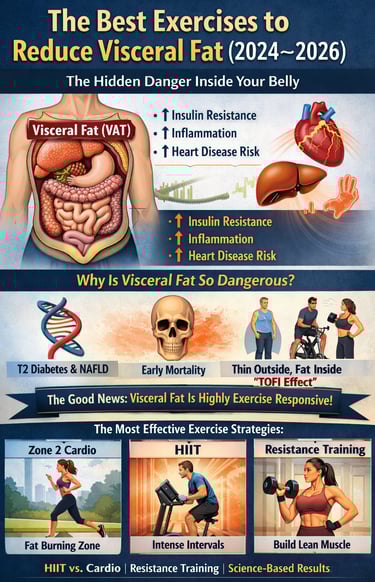
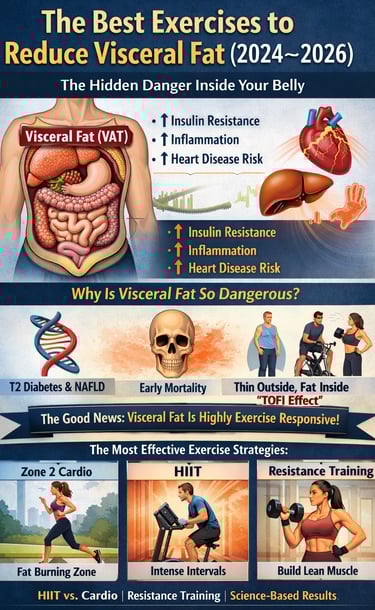
Visceral fat can be reduced most effectively through a combination of aerobic exercise, high-intensity interval training (HIIT), and resistance training. Research shows that Zone 2 cardio improves fat oxidation and metabolic flexibility, while HIIT increases post-exercise calorie burn (EPOC) and accelerates visceral fat loss. Resistance training enhances insulin sensitivity and preserves lean muscle mass, making it essential for long-term metabolic health. Combining these exercise types produces significantly greater reductions in visceral adipose tissue than any single method alone.
Exercise is one of the most effective interventions to reduce metabolically harmful belly fat
Not all exercise burns belly fat equally
Targeting visceral adipose tissue (VAT) requires specific, evidence-based training strategies
The latest clinical research highlights major differences between exercise modalities
A 5–10% reduction in visceral fat is achievable within 8–12 weeks of regular exercise
3× greater visceral fat loss seen with combined training (cardio + resistance) vs single-mode exercise
Consistency and structured programming matter more than intensity alone
Clinical Pearls
1. The Adrenergic Advantage
Scientific Perspective: Visceral adipose tissue (VAT) has a higher density of beta-adrenergic receptors compared to subcutaneous fat. This makes it more sensitive to the lipolytic effects of catecholamines (adrenaline/noradrenaline) released during high-intensity exercise.
Your belly fat is actually "easier" to burn than the fat under your skin. Because it's more sensitive to adrenaline, intense exercise acts like a key that specifically unlocks these deep fat stores first.
2. The "Metabolic Engine" Expansion
Scientific Perspective: Zone 2 training targets mitochondrial biogenesis and increases the efficiency of the electron transport chain. This improves "metabolic flexibility," allowing the body to prioritize lipid oxidation over glucose at higher sub-maximal intensities.
Think of Zone 2 cardio (like brisk walking) as "upgrading your engine." It creates more fat-burning factories in your cells so that even when you aren't working out, your body is better at using fat for fuel instead of storing it.
3. The Non-Scale Victory (NSV)
Scientific Perspective: Resistance training can significantly reduce VAT volume and improve GLUT-4 translocation (insulin sensitivity) even in the absence of total body mass reduction. This is often masked by a concomitant increase in lean muscle mass.
Don’t trust the scale alone. You might weigh the same after two months of lifting weights, but your waistline will be smaller because you've swapped dangerous internal fat for healthy, metabolically active muscle.
4. The Myokine Connection
Scientific Perspective: Skeletal muscle functions as an endocrine organ. Contraction-induced myokines (like Irisin) facilitate "browning" of white adipose tissue and systemic anti-inflammatory effects, directly counteracting the pro-inflammatory cytokines (TNF-alpha, IL-6) secreted by visceral fat.
Your muscles are like a pharmacy. Every time they contract during a workout, they release "medicine" into your blood that travels to your belly fat and tells it to stop causing inflammation and start burning off.
5. The Hybrid Synergy
Scientific Perspective: Network meta-analyses confirm that concurrent training (combining aerobic and resistance modalities) is superior to single-mode training. This is due to the overlapping pathways of AMPK activation (from cardio) and mTOR/protein synthesis (from weights).
You don't have to choose between the treadmill and the weights. Doing both is the "secret sauce." The cardio burns the fat now, and the weights ensure your metabolism stays high enough to keep it off later.
6. The Cortisol Threshold
Scientific Perspective: While HIIT is a potent stimulus for VAT loss, excessive volume can lead to chronic HPA-axis activation and elevated basal cortisol, which paradoxically promotes visceral fat deposition. Moderate-volume HIIT (the 4x4 protocol) optimizes the benefit-to-recovery ratio.
More is not always better. If you do "all-out" sprints every single day, you might stress your body so much that it holds onto belly fat. Stick to 2–3 intense sessions a week and use the other days for recovery and walking.
The Best Exercises to Reduce Visceral Fat: HIIT, Zone 2 & Resistance Training Explained
The most dangerous fat in your body isn’t the one you can see in the mirror—it’s the fat you can’t. Known as visceral fat or visceral adipose tissue (VAT), this metabolically active fat surrounds vital organs like the liver and pancreas, silently driving insulin resistance, chronic inflammation, and cardiometabolic disease. Unlike subcutaneous fat, visceral fat releases inflammatory cytokines and free fatty acids directly into the portal circulation, accelerating the pathogenesis of type 2 diabetes, non-alcoholic fatty liver disease (NAFLD), and cardiovascular disease (Maeyens et al., 2026).
What makes visceral fat particularly concerning is not just its association with disease, but its predictive power. Large-scale analyses now identify VAT as one of the strongest independent predictors of metabolic dysfunction and mortality risk, even in individuals with a “normal” body mass index (BMI) (Maeyens et al., 2026). This explains why two people with identical weight can have vastly different metabolic health profiles—a phenomenon often described as “TOFI” (thin outside, fat inside).
The encouraging news? Visceral fat is also the most exercise-responsive fat depot in the human body. Unlike weight loss alone, which may reduce both lean and fat mass, targeted exercise interventions—particularly Zone 2 cardio, high-intensity interval training (HIIT), and resistance training—activate distinct physiological pathways that preferentially reduce visceral fat (Chen et al., 2024). These include enhanced fat oxidation, AMPK activation, mitochondrial biogenesis, and improved insulin sensitivity, creating a metabolic environment that actively suppresses fat accumulation.
But here’s where most people get it wrong: not all exercise is equally effective. The debate between HIIT vs cardio, the role of resistance training for fat loss, and the optimal exercise protocol to reduce visceral fat are often misunderstood—even among health-conscious individuals.
This evidence-based guide breaks down exactly what the latest research reveals—and how to apply it in real life.
How Exercise Specifically Targets Visceral Fat
Here's something that surprises many people: visceral fat does not disappear simply because you're burning calories. Exercise targets it through several distinct biological pathways that make it uniquely effective compared to diet alone.
1. Enhanced Lipolysis (Fat Breakdown)
Visceral fat cells carry a higher density of beta-adrenergic receptors than subcutaneous fat. When exercise causes your body to release adrenaline and noradrenaline (catecholamines), visceral fat responds more aggressively — breaking down its stored triglycerides for fuel. This is one reason exercise specifically reduces VAT even when total body weight changes are modest.
2. AMPK Activation and Mitochondrial Improvements
Both aerobic and resistance exercise activate AMPK (AMP-activated protein kinase), a cellular energy sensor that switches the body into fat-burning mode and stimulates mitochondrial biogenesis — essentially creating more "engines" in your cells to burn fat. This effect accumulates with training, meaning the longer you exercise consistently, the more efficient your fat-burning machinery becomes.
3. Reduction in Chronic Inflammation
Visceral fat is a major source of pro-inflammatory cytokines like TNF-α and interleukin-6. Regular exercise progressively shrinks VAT depots, reducing this inflammatory output. At the same time, exercise raises circulating adiponectin — a hormone that improves insulin sensitivity and suppresses further fat accumulation.
4. Myokines — Exercise as a "Drug"
When your muscles contract, they release signalling proteins called myokines (including irisin and IL-6). These myokines communicate directly with adipose tissue, promoting fat oxidation and even stimulating the conversion of white fat cells into more metabolically active "beige" fat. This cross-talk between muscle and fat tissue is one of the most exciting areas of current metabolic research.
Zone 2 Cardio vs HIIT: What the Research Reveals
This is the question almost every patient asks. Both Zone 2 cardio and high-intensity interval training (HIIT) have strong clinical evidence behind them — but they work through different mechanisms and suit different goals and lifestyles.
What Is Zone 2 Cardio?
Zone 2 refers to low-to-moderate intensity aerobic exercise performed at roughly 60–70% of your maximum heart rate — the pace at which you can hold a full conversation without gasping. Think brisk walking, easy cycling, a gentle swim, or a slow jog. At this intensity, your body predominantly uses fat as fuel, and training in this zone over time significantly improves mitochondrial density and what researchers call metabolic flexibility — your ability to switch fluidly between carbohydrate and fat as fuel sources.
What Is HIIT?
High-Intensity Interval Training alternates short bursts of near-maximal effort (85–95% maximum heart rate) with recovery periods. The classic protocol used in research is the 4×4 model: four 4-minute intervals at ≥85% HRmax, with 3-minute active recovery periods between them. HIIT creates a powerful catecholamine surge and generates significant post-exercise oxygen consumption (EPOC) — meaning your body continues burning fat at an elevated rate for hours after the session ends.HIIT is powerful and time-efficient, but it carries a higher cortisol response if sessions are too frequent or intense — especially relevant since chronic cortisol elevation can promote visceral fat storage, as discussed in earlier chapters. For best results, limit HIIT to 2–3 sessions per week with adequate recovery, and pair it with Zone 2 training to balance intensity and sustainability.
Key Research Finding: A 2024 umbrella review of 39 meta-analyses by Poon et al. in Sports Medicine found that interval training significantly improved body composition in healthy adults, with visceral fat showing particularly robust reductions. Notably, the effect was consistent across different HIIT formats, suggesting flexibility in protocol design matters less than consistent application (Poon et al., 2024).
Head-to-Head: Zone 2 vs HIIT for Visceral Fat
Zone 2 Cardio
Primary fuel: High-fat oxidation
Mitochondrial adaptations: Strong (improves metabolic flexibility)
Post-exercise calorie burn (EPOC): Low to moderate
Time per session: 30–60 minutes
Long-term adherence: Excellent (easy to sustain)
Visceral fat reduction: Strong (depends on total training volume)
Cortisol and recovery burden: Low
Suitable for beginners: Yes (ideal starting point)
High-Intensity Interval Training (HIIT)
Primary fuel: Mixed (carbohydrates + fat)
Mitochondrial adaptations: Moderate
Post-exercise calorie burn (EPOC): High (afterburn effect)
Time per session: 15–25 minutes (time-efficient)
Long-term adherence: Moderate (more demanding)
Visceral fat reduction: Strong (driven by intensity)
Cortisol and recovery burden: Higher, especially if overdone
Suitable for beginners: Yes, but requires guidance and gradual progression
Clinical Takeaway
Both Zone 2 and HIIT are highly effective for reducing visceral fat
Zone 2 builds the metabolic base, while HIIT accelerates fat loss
The most effective strategy is a combination of both approaches
2025 HIIT Research Update A 2025 study by BaiQuan et al. in Scientific Reports examined post-exercise energy metabolism characteristics across different HIIT protocols in obese adults. They found that all HIIT formats significantly reduced visceral fat, but moderate-volume protocols (rather than maximal-intensity short bursts) produced the most favourable metabolic response — with lower cortisol elevation and better fat oxidation profiles in the hours following exercise (BaiQuan et al., 2025).
The verdict: For most people, the answer isn't "either/or" — it's both. HIIT is time-efficient and produces faster early results. Zone 2 builds the metabolic foundation for long-term fat burning. Together, they are considerably more effective than either alone.
Resistance Training: The Overlooked Game-Changer
If you've been focusing exclusively on cardio for belly fat, you're leaving the most powerful tool in the toolbox unused. Resistance training — weight training, bodyweight exercises, resistance bands — has compelling evidence for reducing visceral fat that many people simply don't know about.
Landmark FindingA major 2022 systematic review and meta-analysis by Wewege et al. in Sports Medicine, covering 58 studies and over 3,000 participants, found that resistance training in healthy adults significantly reduces both fat mass and visceral fat percentage — even in the absence of significant weight loss. This is critical: resistance training reshapes body composition even when the scale doesn't move (Wewege et al., 2022).
Why Resistance Training Hits Visceral Fat Hard
Building lean muscle mass increases your resting metabolic rate — meaning you burn more calories even while sitting still. Every additional kilogram of muscle tissue burns approximately 13–20 kcal per day at rest, compounding over months and years of training. More importantly, resistance exercise dramatically improves insulin sensitivity through GLUT-4 transporter upregulation, reducing the hormonal environment that promotes visceral fat accumulation in the first place.
A 2024 randomised controlled trial published in Diabetes, Obesity and Metabolism by Lehmann et al. followed people with obesity over two years of either strength or endurance training. Both modalities produced similar reductions in visceral fat volume (with trends toward improvement only in participants with good adherence), while the strength training group demonstrated superior preservation of lean muscle mass. This muscle preservation supports better long-term metabolic health, even when scale weight changes are modest (Lehmann et al., 2024).
Resistance Training Is Especially Important As You Age
After the age of 40, the combination of declining muscle mass (sarcopenia) and increasing visceral fat (often called sarcopenic obesity) creates a compounding metabolic risk. In older adults, the Maeyens et al. (2026) review in Nature Aging emphasises that resistance exercise is not optional — it is the primary intervention to prevent the visceral fat accumulation that accelerates with ageing.
Evidence-Based Exercise Protocols
Knowing what exercise to do is only half the equation—how you structure it determines results. The following protocols are derived from clinical trials and meta-analyses, designed for real-world adherence and metabolic impact.
Zone 2 Cardio Protocol
Frequency: 4–6 days per week
Duration: 30–60 minutes per session
Intensity: 60–70% of maximum heart rate (comfortable, conversational pace)
Examples: Brisk walking, cycling, swimming, light jogging
Weekly target: 150–300 minutes total
Clinical Insight:
Builds the aerobic base, enhances fat oxidation, and improves long-term metabolic flexibility.
HIIT (High-Intensity Interval Training) Protocol
Frequency: 2–3 sessions per week (maximum)
Structure:
4 × 4-minute intervals at 85–90% HRmax
3-minute active recovery between intervals
Total session time: 20–25 minutes
Recovery: Minimum 48 hours between sessions
Progression: Increase interval volume before increasing intensity
Clinical Insight:
Maximizes time efficiency, increases EPOC (afterburn effect), and accelerates visceral fat reduction.
Resistance Training Protocol
Frequency: 3–4 sessions per week
Focus: Compound movements (squats, deadlifts, presses, rows)
Volume: 3–4 sets of 8–12 repetitions per exercise
Principle: Progressive overload every 1–2 weeks
Rest between sets: 60–90 seconds
Clinical Insight:
Improves insulin sensitivity, preserves lean muscle mass, and supports long-term metabolic health.
Optimal Hybrid Weekly Schedule
Evidence from a large 2024 network meta-analysis (84 randomized controlled trials) demonstrates that combined aerobic + resistance training produces superior visceral fat reduction compared to single-modality programs.
Sample Weekly Plan
Monday: Zone 2 cardio (45 minutes)
Tuesday: Resistance training (full body)
Wednesday: HIIT (4×4 protocol)
Thursday: Resistance training (upper body or split routine)
Friday: Zone 2 cardio (45 minutes)
Saturday: HIIT or Zone 2 (based on recovery)
Sunday: Rest or light walking
Important Note for Beginners
Start with Zone 2 walking only for the first 4–6 weeks
Gradually build aerobic capacity before introducing HIIT
Focus on consistency rather than intensity
Clinical Perspective:
A 2025 meta-analysis confirms that low-to-moderate intensity aerobic exercise alone significantly reduces visceral fat, even without high-intensity training.
The key message:
You don’t need to start at maximum effort—you need to start consistently.
Practical Applications: How to Reduce Visceral Fat in Real Life
1 . Start With Walking (Best Beginner Exercise for Visceral Fat)
A simple 45-minute brisk walk after meals can place most individuals in Zone 2 cardio, making it one of the easiest ways to start reducing visceral fat. This requires no gym, no equipment, and is highly sustainable.
Clinical insight: Post-meal (postprandial) walking significantly improves blood glucose control and insulin sensitivity, directly targeting mechanisms that drive visceral fat accumulation.
2 . Short on Time? Use HIIT for Faster Results
If time is limited, focus on minimum effective exercise dose:
2 HIIT sessions per week (20–25 minutes each)
1 resistance training session
This combination can produce measurable visceral fat reduction within 6–8 weeks, making it one of the most time-efficient fat-loss strategies.
3 . Track Visceral Fat Loss Beyond Weight
Scale weight can be misleading. Instead:
Measure waist circumference weekly
A reduction of 2–4 cm often reflects meaningful visceral fat loss
Waist measurement is one of the most practical clinical markers of abdominal fat and metabolic risk.
4 . Optimize Sleep to Prevent Belly Fat Gain
Poor sleep is a major but overlooked driver of visceral fat.
Sleep deprivation increases cortisol, promoting fat storage in the abdominal region
It also worsens insulin resistance and appetite regulation
Target: 7–9 hours of quality sleep per night to support fat loss and metabolic recovery.
5 . Exercise Strategy for Type 2 Diabetes
For individuals with diabetes or insulin resistance:
Combine aerobic exercise (Zone 2 cardio) with resistance training within the same week
Clinical evidence: This combined approach significantly improves glycemic control, insulin sensitivity, and visceral fat reduction compared to either modality alone.
6 . Over 50? Prioritize Strength Training
After age 40–50, muscle loss (sarcopenia) accelerates while visceral fat increases.
Prioritize resistance training 3–4 times per week
Combine with moderate aerobic activity
Key benefit: Preserving muscle mass is one of the most effective strategies to reduce long-term cardiometabolic risk and maintain functional independence.
Bottom Line
The best exercise for visceral fat is the one you can do consistently
Start simple, progress gradually, and combine modalities for optimal results
Small, sustainable habits produce clinically meaningful fat loss
Frequently Asked Questions
How long does it take to see visceral fat reduction with exercise?
Most well-designed studies show measurable reductions in visceral fat within 8–12 weeks of consistent combined training (3–5 sessions/week). However, the timeline depends on training volume, diet, sleep, and individual metabolic factors. Waist circumference often reduces noticeably within 4–6 weeks, even when scale weight changes little.
Can I reduce visceral fat with exercise alone, without changing my diet?
Yes — exercise independently reduces visceral fat through hormonal and metabolic mechanisms that operate regardless of caloric intake. The 2022 Wewege et al. meta-analysis, for example, found significant VAT reductions from resistance training alone, without caloric restriction. That said, combining exercise with a reduced-calorie, nutrient-dense diet produces significantly faster and greater results.
Is HIIT safe for everyone?
HIIT is safe for most otherwise healthy adults, but it should be introduced gradually. People with cardiovascular disease, uncontrolled hypertension, severe obesity, or joint problems should consult a physician before beginning HIIT. For these populations, Zone 2 cardio and supervised resistance training are typically the preferred starting point. Always progress intensity based on fitness level, not ambition.
Does doing sit-ups or ab exercises specifically reduce belly fat?
No — this is one of the most persistent exercise myths. Spot reduction of fat is physiologically impossible. Abdominal exercises strengthen core muscles but do not preferentially burn visceral fat. Systemic fat loss through whole-body exercise protocols — especially the combined aerobic and resistance approach described in this article — is the evidence-based strategy for reducing abdominal and visceral fat.
What is the single best exercise to reduce visceral fat quickly?
If forced to choose one, the evidence points to HIIT — specifically the 4×4 protocol — as the most time-efficient option for rapid visceral fat reduction. However, "best" without context is misleading: the best exercise is the one you will do consistently. For many people, that means Zone 2 walking daily is more effective in practice than HIIT three times per week, because adherence is dramatically higher.
Does fasted exercise burn more visceral fat?
Fasted exercise does slightly increase fat oxidation during the session itself, but research consistently shows this does not translate to meaningfully greater fat loss over weeks or months compared to fed exercise. Exercise timing matters far less than exercise consistency. If fasted training fits your routine, it's fine — but don't sacrifice sleep or workout quality to do it.
How much exercise is needed to maintain visceral fat loss once achieved?
Maintenance requires significantly less volume than the initial reduction phase. Most evidence suggests 2–3 sessions per week of mixed modality training is sufficient to preserve visceral fat losses long-term. Critically, complete cessation of exercise leads to rapid reversal — visceral fat is highly exercise-responsive in both directions. Building sustainable habits, not short-term programs, is the goal.
Author’s Note (Clinician’s Perspective)
As a practicing physician in internal medicine, I see the consequences of excess visceral fat every day—often long before it becomes visible externally. Patients present with normal body weight yet profound metabolic dysfunction, including insulin resistance, fatty liver, dyslipidemia, and early cardiovascular risk. What consistently stands out is this: visceral adiposity is not merely a cosmetic issue—it is a pathophysiological driver of disease.
From a clinical standpoint, one of the most important—and encouraging—observations is how responsive visceral fat is to structured exercise. Unlike many chronic metabolic abnormalities that require pharmacologic intervention, visceral fat reduction can be achieved significantly through targeted, evidence-based movement strategies. Over years of practice, I have observed that patients who adopt a combination of aerobic conditioning (Zone 2), intermittent high-intensity efforts, and resistance training demonstrate measurable improvements not only in waist circumference, but also in glycemic control, hepatic enzymes, lipid profiles, and overall functional capacity.
Equally important is the shift in perspective this approach requires. The goal is not simply weight loss, but metabolic rehabilitation—restoring insulin sensitivity, improving mitochondrial function, and preserving lean muscle mass. In this context, resistance training becomes as critical as pharmacotherapy in certain populations, particularly in older adults at risk of sarcopenic obesity.
Finally, adherence remains the cornerstone of success. The most effective exercise protocol is not the most intense or complex—it is the one that can be sustained over months and years. As clinicians, our role is to guide patients toward practical, scalable, and physiologically sound interventions that integrate into daily life.
This guide is designed to translate current scientific evidence into actionable clinical practice—bridging the gap between research and real-world metabolic health.
Disclaimer: This article is for informational purposes only and does not constitute medical advice. Individual circumstances vary, and treatment decisions should always be made in consultation with qualified healthcare professionals.
Related Articles
The #1 Diet Strategy to Reduce Visceral Fat According to Latest Research
Why Belly Fat Causes Insulin Resistance: Portal Theory Explained Simply
Obesity and Fatty Liver Disease: What Science Says About Risk and Health | DR T S DIDWAL
Intermittent Fasting: Metabolic Health Benefits and the Evidence on Longevity | DR T S DIDWAL
Activate Your Brown Fat: A New Pathway to Longevity and Metabolic Health | DR T S DIDWAL
References
BaiQuan, Y., Meng, C., Congqing, Z., et al. (2025). The effects and post-exercise energy metabolism characteristics of different high-intensity interval training in obese adults. Scientific Reports, 15, 13770. https://doi.org/10.1038/s41598-025-98590-z
Chen, X., He, H., Xie, K., Zhang, L., & Cao, C. (2024). Effects of various exercise types on visceral adipose tissue in individuals with overweight and obesity: A systematic review and network meta-analysis of 84 randomized controlled trials. Obesity Reviews, 25(3), e13666. https://doi.org/10.1111/obr.13666
Igarashi, Y., Akazawa, N., & Maeda, S. (2025). An exercise program to reduce abdominal visceral and subcutaneous fat in adults with overweight and obesity: A systematic review and meta-analysis of randomized controlled trials. Obesity Research & Clinical Practice, 19(5), 388–393. https://doi.org/10.1016/j.orcp.2025.10.004
Lehmann, S., Retschlag, U., Oberbach, A., et al. (2024). Visceral fat mass dynamics in a 2-year randomized STrength versus ENdurance training trial in people with obesity. Diabetes, Obesity and Metabolism, 26(9), 4087–4099. https://doi.org/10.1111/dom.15767
Maeyens, L. T., Nelson, J. F., & Zhao, S. (2026). Visceral adiposity, metabolic health and aging. Nature Aging, 6, 506–519. https://doi.org/10.1038/s43587-026-01076-4
Poon, E. T. C., Li, H. Y., Little, J. P., et al. (2024). Efficacy of interval training in improving body composition and adiposity in apparently healthy adults: An umbrella review with meta-analysis. Sports Medicine, 54, 2817–2840. https://doi.org/10.1007/s40279-024-02070-9
Wewege, M. A., Desai, I., Honey, C., et al. (2022). The effect of resistance training in healthy adults on body fat percentage, fat mass and visceral fat: A systematic review and meta-analysis. Sports Medicine, 52, 287–300. https://doi.org/10.1007/s40279-021-01562-2