Carb Counting vs. Low-Carb Diets: Which Controls Blood Sugar Better
Does managing diabetes mean giving up carbs? Science says no. Learn the evidence-based benefits of carbohydrate counting for glucose stability and quality of life.
DIABETESNUTRITION
Dr. T.S. Didwal, M.D.(Internal Medicine)
5/9/202613 min read
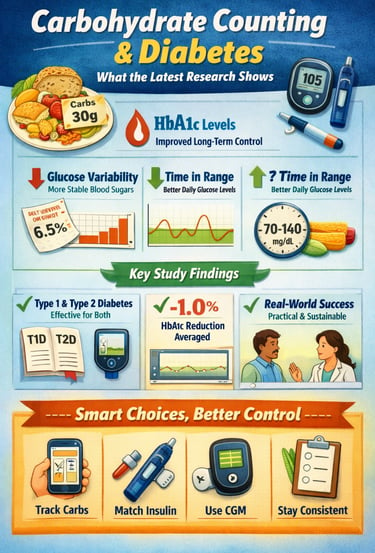
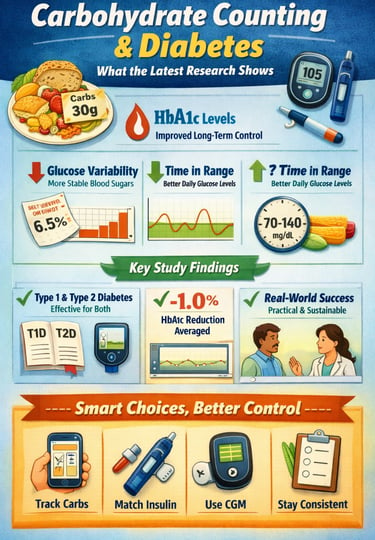
Carbohydrate counting is a diabetes meal-planning method that tracks the amount of carbohydrate consumed at meals and snacks to improve blood glucose control and optimize insulin dosing.
Carb Counting vs. Strict Low-Carb Diets
Carb Counting
Offers greater dietary flexibility and allows a wider range of foods.
Focuses on carbohydrate awareness and portion tracking rather than elimination.
Easier to sustain long-term for many individuals with diabetes.
Supports precise insulin-to-carbohydrate matching and medication adjustment.
May reduce the risk of hypoglycemia when paired with accurate dosing.
Encourages a broader and more balanced food variety.
Strong evidence supports improvements in Time in Range (TIR) and glucose stability.
Often associated with a better quality of life and improved dietary satisfaction.
Strict Low-Carb Diets
Typically involves significant carbohydrate restriction and tighter food limitations.
Focus primarily on reducing overall carbohydrate intake.
Can be difficult for some individuals to maintain over long periods.
Insulin dosing adjustments may be less predictable in some situations.
Risk of hypoglycemia may increase if diabetes medications are not appropriately adjusted.
Food choices are often more limited compared with flexible carbohydrate-counting approaches.
Evidence for improving Time in Range (TIR) is promising but remains mixed across studies.
Quality-of-life outcomes vary depending on adherence, lifestyle compatibility, and dietary preferences.
Best Foods for Carb Counting in Diabetes
High-Fiber Carbohydrates
oats
lentils
beans
quinoa
Lower Glycemic Fruits
berries
apples
pears
Smart Carb Swaps
brown rice instead of white rice
whole-grain bread instead of refined bread
What if managing diabetes could become simpler, more predictable, and more personalized—just by understanding how much carbohydrate is on your plate? In recent years, carbohydrate counting has emerged as one of the most powerful tools for optimizing blood glucose control in both type 1 and type 2 diabetes. Unlike restrictive diets that eliminate entire food groups, carbohydrate counting focuses on awareness and precision. It helps you understand how different foods impact your post-meal glucose response, empowering you to make informed decisions at every meal (Sakane et al., 2025).
The latest studies reveal that individuals who consistently track their carbohydrate intake achieve significantly better HbA1c levels, reduced glucose variability, and improved time-in-range metrics (Cai et al., 2025; Ibrahim et al., 2023). This approach is especially beneficial for people using insulin therapy—allowing them to more accurately match insulin doses to carbohydrate content and avoid dangerous highs and lows. Evidence also shows that even without insulin adjustments, simply being mindful of carbohydrate quantity leads to more stable daily glucose patterns (Al-Mssallem et al., 2020).
In an era where diabetes technology is evolving rapidly, from continuous glucose monitors to smart insulin pumps, carbohydrate counting remains a foundational skill. It bridges advanced science with everyday eating habits, placing control back into the hands of the person living with diabetes
Quick Summary
Carbohydrate counting improves HbA1c, glucose stability, and time in range.
Unlike strict low-carb diets, carb counting allows flexible eating patterns.
Matching insulin doses to carbohydrate intake improves post-meal glucose control.
Research shows awareness and consistency matter more than extreme carbohydrate restriction.
Combining carb counting with continuous glucose monitoring (CGM) enhances diabetes management.
."
Understanding Carbohydrate Counting: A Foundation for Diabetes Management
Carbohydrate counting is a meal-planning tool that helps people with diabetes understand how different foods affect their blood glucose levels. Rather than eliminating carbohydrates, this approach teaches you to monitor and track your carbohydrate intake, which is the primary macronutrient affecting postprandial glucose (blood sugar after meals).
The concept is straightforward: different carbohydrate-containing foods affect blood sugar differently, and by quantifying your intake, you can better predict and manage your glucose response. This is particularly important for people using insulin therapy or glucagon-like peptide-1 (GLP-1) agonists, as it allows for more precise medication dosing.
What the Latest Research Tells Us
Recent studies have provided compelling evidence about the effectiveness of carbohydrate counting across different diabetes populations. Let's explore the key findings from current research.
Comprehensive Evidence from 2025 Systematic Review
Sakane, Domichi, and Suganuma (2025) conducted a systematic review and meta-analysis examining the efficacy of carbohydrate counting in both type 1 and type 2 diabetes mellitus. This comprehensive analysis combined data from multiple studies to provide a broad overview of the intervention's effectiveness.
Key Takeaway: This systematic review demonstrates that carbohydrate counting interventions show measurable benefits in glycemic control for both diabetes types. The meta-analysis suggests that structured education in carbohydrate calculation leads to improvements in HbA1c levels (a marker of long-term blood sugar control) and helps reduce the variability in glucose monitoring outcomes.
Evidence-Based Nutrition Options for Type 2 Diabetes
The Journal of Clinical Endocrinology & Metabolism recently featured research by Baskin and Karp (2025) that examined evidence-based nutrition approaches for type 2 diabetes management. This work explored the spectrum of dietary interventions available to clinicians and patients.
Key Takeaway: Among the various nutrition strategies evaluated, carbohydrate counting stands as one of four primary evidence-based options for managing type 2 diabetes. The research highlights that when combined with other lifestyle modifications and appropriate pharmacotherapy, carbohydrate-controlled diets show significant promise for improving metabolic outcomes and reducing cardiovascular risk factors in people with type 2 diabetes.
Real-World Barriers: What Dietitians Are Telling Us
Dimitriades and Pillay (2022) conducted important research examining how dietitians actually implement carbohydrate counting in clinical practice. They explored training gaps and real-world barriers that prevent wider adoption of this valuable tool.
Key Takeaway: While carbohydrate counting is effective, successful implementation faces significant challenges. These include time constraints in clinical settings, inadequate training in carbohydrate quantification methods, patient complexity, and varying levels of patient motivation. The study emphasizes that proper dietitian training and patient education are essential for maximizing the benefits of this approach. Healthcare providers need robust support systems to effectively teach and monitor carbohydrate counting in their patients with type 1 diabetes.
Clinical Impact: Practical Results in Diabetes Management
Ibrahim, Shahat, Amer, and Aljohani (2023) published a comprehensive review in Cureus examining the practical impact of carbohydrate counting on managing diabetic patients. This research synthesized evidence about real-world outcomes.
Key Takeaway: The evidence demonstrates that carbohydrate counting significantly improves several important markers of diabetes control, including HbA1c reduction, better blood glucose stability, decreased hyperglycemic episodes (dangerously high blood sugar), and improved quality of life. The intervention appears particularly effective when combined with continuous glucose monitoring (CGM) technology and personalized education. Importantly, this approach works across different age groups and diabetes durations, making it a versatile option for many patients.
Dietary Intake and Type 2 Diabetes Control
Al-Mssallem, Al-Qarni, and Al-Jamaan (2020) conducted a cross-sectional study examining the relationship between dietary carbohydrate intake levels and diabetes control in type 2 diabetes patients.
Key Takeaway: This research reveals important patterns about how daily carbohydrate consumption impacts glycemic outcomes. Patients who actively monitored and moderately controlled their carbohydrate intake demonstrated superior blood glucose management compared to those without structured tracking. The study suggests that the specific amount of carbohydrates consumed matters less than having an intentional, tracked approach. This finding underscores the value of awareness—simply being mindful of carbohydrate content in meals can significantly improve metabolic control.
Carbohydrate Intake and Glucose Variability in Type 1 Diabetes
Cai, Li, Xiong, Zhang, He, and Su (2025) investigated associations between daily dietary carbohydrate intake and time in range (TIR) in adults with type 1 diabetes. Time in range is a crucial modern metric for assessing how often people maintain healthy glucose levels throughout the day.
Key Takeaway: This recent research demonstrates that tailored carbohydrate intake strategies directly improve TIR metrics in type 1 diabetes management. Adults who carefully matched their carbohydrate consumption to their insulin dosing achieved significantly better glycemic stability and spent more time within their target blood glucose range. The study suggests that personalized carbohydrate targets, determined through ongoing glucose monitoring and adjusted based on individual response patterns, yield the best outcomes. This finding is particularly relevant in the era of continuous glucose monitors and insulin pump therapy, where real-time data allows for precise carbohydrate-to-insulin ratios.
How to Get Started with Carbohydrate Counting
Understanding the research is one thing; applying it to your daily life is another. Here's a practical approach:
Step 1: Learn the Basics - Work with a registered dietitian or certified diabetes educator to understand what counts as a carbohydrate. This includes starches, fruits, milk products, and sugary foods, but also vegetables and legumes.
Step 2: Identify Portion Sizes - Use food labels, portion guides, or apps to determine the carbohydrate content of your meals. One exchange typically equals 15 grams of carbohydrates.
Step 3: Track and Adjust - Monitor how different carbohydrate quantities affect your blood sugar levels. Using a blood glucose meter or continuous glucose monitor helps identify your personal patterns.
Step 4: Use Your Data - Share your carbohydrate tracking records with your healthcare team. This information helps optimize your medication dosing and overall diabetes management strategy.
Step 5: Practice Consistency - Over time, carbohydrate estimation becomes easier. Most people develop the ability to quickly estimate carbohydrate content at a glance.
Carbohydrate Counting vs Glycemic Index
While Carbohydrate Counting focuses on the total amount of glucose entering the system, the Glycemic Index (GI) determines the speed at which that glucose arrives. Integrating both is the "gold standard" for minimizing glycemic variability.
The "Volume" vs. "Velocity" Framework
Carb Quantity (The Volume): This is the total number of grams you consume. It dictates the peak height of your blood sugar. If you eat 60g of carbs, your body must process 60g of sugar, regardless of the source. This is the primary metric for calculating insulin-to-carb ratios.
Carb Quality (The Velocity): This is where the Glycemic Index comes in. It measures how quickly a carbohydrate-containing food raises blood glucose.
High-GI foods (e.g., white bread, sugary cereals) cause a sharp, rapid "spike."
Low-GI foods (e.g., lentils, oats, non-starchy vegetables) result in a slower, sustained "roll."
Why the Distinction Matters Clinically
Even if two meals have the exact same Carb Quantity, their clinical impact can be vastly different. A meal with high quantity but low quality (low GI) is much easier for the body—and insulin—to manage because it prevents the "glucose roller coaster."
Recent research suggests that focusing on quality (fiber-rich, complex carbs) improves satiety and insulin sensitivity, making the "quantity" part of the equation easier to maintain over time.
Why a Carbohydrate Food Table Matters
A quick reference table of common foods and their approximate carbohydrate content can dramatically simplify the carbohydrate-counting process. While apps and food labels are useful, many daily meals—especially home-cooked or culturally specific dishes—do not come with precise nutritional information. Having a small, easy-to-remember list helps patients estimate portions more confidently and reduces guesswork during meals.
For beginners, this table serves as a practical starting point: a visual cue that improves accuracy and consistency. For more experienced individuals, it works as a mental checklist to prevent undercounting or overcounting carbohydrates. The goal isn’t perfection—it’s awareness. Even approximate tracking has been shown to improve blood glucose stability and enhance time-in-range outcomes.
Common Foods and Their Approximate Carbohydrate Content
Cooked rice — 1 cup = 45 g carbohydrates
Chapati/Roti (wheat) — 1 medium = 15–18 g carbohydrates
Apple — 1 medium = 25 g carbohydrates
Banana — 1 medium = 27 g carbohydrates
Potato (boiled) — 1 medium = 30 g carbohydrates
Milk — 1 cup = 12 g carbohydrates
Lentils (cooked) — 1 cup = 40 g carbohydrates
Bread — 1 slice = 15 g carbohydrates
Pasta (cooked) — 1 cup = 43 g carbohydrates
Frequently Asked Questions
Does Carb Counting Lower HbA1c?
Yes. Multiple studies show that carbohydrate counting can significantly lower HbA1c levels in both type 1 and type 2 diabetes. By tracking carbohydrate intake and matching it more accurately with insulin or medication, people experience fewer post-meal glucose spikes and better long-term glycemic control. Recent systematic reviews and meta-analyses demonstrate measurable reductions in HbA1c when carbohydrate counting is combined with structured diabetes education and consistent monitoring.
Can Carb Counting Improve Time in Range?
Yes. Research increasingly shows that carbohydrate counting improves Time in Range (TIR), which measures how often glucose stays within the target range of 70–180 mg/dL. Accurate carbohydrate estimation helps reduce extreme highs and lows, leading to more stable daily glucose patterns. This benefit is especially pronounced in individuals using continuous glucose monitoring (CGM) systems and insulin therapy.
Is Carb Counting Better Than Restrictive Dieting?
For many people, yes. Carb counting is often more flexible, sustainable, and individualized than strict low-carb diets. Instead of eliminating carbohydrates, it teaches awareness, portion control, and smarter food choices. This allows people to maintain a balanced diet while still improving glucose control. Research suggests that consistency and carbohydrate awareness may matter more than extreme restriction for long-term diabetes management and quality of life.
Does Carb Counting Work in Type 2 Diabetes?
Absolutely. Although carbohydrate counting is commonly associated with type 1 diabetes, evidence shows it is also highly effective in type 2 diabetes. Studies demonstrate improvements in HbA1c, glucose stability, insulin sensitivity, and postprandial glucose control. Even individuals not using insulin often benefit from understanding and moderating their carbohydrate intake.
Can Carb Counting Reduce Glucose Variability?
Yes. One of the major benefits of carbohydrate counting is reduced glucose variability—the large swings between high and low blood sugar levels. By maintaining more consistent carbohydrate intake and improving medication matching, people experience smoother glucose patterns throughout the day. Lower glucose variability is associated with better metabolic health, improved energy levels, and reduced risk of diabetes complications.
Q: Is Carb Counting Better Than Restrictive Dieting?
It depends on the individual. For many people, carbohydrate counting offers greater flexibility, better long-term sustainability, and improved quality of life. However, some patients achieve excellent blood sugar control and even reduce or eliminate medications with well-planned low-carb or very-low-carb diets. The best approach is usually the one that fits your lifestyle, food preferences, and health goals while delivering good glucose results. Many people even combine elements of both strategies successfully.
Is carbohydrate counting the same as a "low-carb diet"?
No. Carbohydrate counting focuses on knowing and tracking your carbohydrate intake rather than eliminating carbs. You maintain a balanced diet while being intentional about portion sizes and carbohydrate distribution throughout your meals.
Can I do carbohydrate counting without a continuous glucose monitor?
Absolutely. While CGM technology provides helpful feedback, traditional blood glucose meters work well with carbohydrate counting. The key is regular monitoring and recording your results alongside your carbohydrate intake.
How long does it take to see results from carbohydrate counting?
Many people notice improvements in blood sugar stability within days to weeks. Measurable changes in HbA1c (which reflects 3-month average glucose) typically appear within 3 months of consistent practice.
What if I don't have access to a dietitian?
Many resources exist, including diabetes educator webinars, hospital-based diabetes education programs, and reputable online platforms. Ask your doctor for referrals. Some insurance plans cover dietitian consultations for diabetes management.
Do I need to count carbohydrates for non-starchy vegetables?
Most non-starchy vegetables contain minimal carbohydrates and don't significantly impact blood glucose. Traditionally, they're counted as "free" foods. However, starchy vegetables like potatoes and corn do require carbohydrate counting.
Can children use carbohydrate counting?
Yes. In fact, carbohydrate counting is increasingly taught to children with type 1 diabetes, helping them develop healthy eating habits and understand their disease. Age-appropriate education is key.
Semantic Insights: The Complete Picture of Diabetes Nutrition
The research consistently shows that nutritional management of diabetes isn't one-size-fits-all. Carbohydrate counting, alongside considerations of glycemic index, fiber content, and nutrient density, forms a comprehensive approach to metabolic health. Terms like postprandial glucose response, insulin sensitivity, and glucose variability are central to understanding why carbohydrate awareness matters so profoundly.
Modern diabetes care recognizes that blood glucose management depends on multiple factors—medication, physical activity, stress, sleep, and food choices. Carbohydrate counting specifically addresses the nutritional component with scientific precision. When combined with glucose monitoring technology and lifestyle modification, it represents a practical bridge between laboratory science and real-world living with diabetes.
Clinical pearls
1. Prioritize "Time in Range" Over Just HbA1c
While HbA1c provides a 3-month average, it can hide dangerous "highs" and "lows." Recent research emphasizes Time in Range (TIR)—the percentage of the day your glucose stays between 70–180 mg/dL. Aiming for a higher TIR reduces the risk of long-term complications more effectively than focusing on an average number alone.
2. The "Mindfulness Effect" Trumps Rigid Restriction
Clinical data suggests that the act of tracking carbohydrates is often more impactful than the total amount of carbs consumed. Being intentional and aware of what is on your plate creates a "feedback loop" that naturally improves glucose stability, even if you aren't on a strictly "low-carb" diet.
3. Pair Carbs with "Buffers" to Flatten the Spike
To manage postprandial glucose (the spike after eating), think about the "company" your carbs keep. Pairing carbohydrates with fiber, healthy fats, or protein slows down gastric emptying. This ensures glucose enters the bloodstream as a steady stream rather than a flood.
4. Precision Dosing Requires Accurate Quantification
For those using insulin or GLP-1 agonists, carb counting isn't just about nutrition; it’s about pharmacology. Accurate counting allows you to match your "insulin-to-carb ratio" precisely. Even a 15-gram error (the equivalent of one slice of bread) can lead to significant glucose variability over time.
5. Utilize the "Second Meal Effect"
Research shows that the composition of your breakfast can influence your blood sugar response for the rest of the day. Consuming a breakfast with low-glycemic-index carbs and high fiber can improve your insulin sensitivity during lunch and dinner, a phenomenon known as the "second meal effect."
Author’s Note
As a clinician and researcher deeply involved in diabetes care, my goal in writing this article is to bridge the gap between scientific evidence and practical daily living. Carbohydrate counting is not merely a dietary technique—it is a structured, data-driven approach that empowers people with diabetes to understand and influence their own metabolic health. The studies cited in this article, ranging from meta-analyses to clinical practice evaluations, reflect the growing consensus in the scientific community: carbohydrate awareness improves glycemic control, enhances time in range, and supports better long-term outcomes.
Yet evidence alone is not enough. Implementing carbohydrate counting requires education, support, and consistency. Many patients face barriers such as limited access to trained dietitians, varying food literacy, or the complexity of calculating carbohydrate portions in culturally diverse meals. This article aims to provide clarity, practical tools, and confidence for both patients and healthcare professionals seeking an evidence-based foundation for diabetes management.
Carbohydrate counting is one of the most evidence-based nutritional strategies for diabetes management. Unlike highly restrictive diets, it improves glucose control through awareness, precision, and individualized adjustment. Research consistently shows benefits for HbA1c, time in range, and glucose variability—especially when combined with CGM technology, high-fiber nutrition, and personalized medical care.
Disclaimer: This article is for informational purposes only and does not constitute medical advice. Individual circumstances vary, and treatment decisions should always be made in consultation with qualified healthcare professionals.
Related Articles
Feed Your Gut, Fuel Your Health: Diet, Microbiota, and Systemic Health | DR T S DIDWAL
What’s New in the 2025 Blood Pressure Guidelines? A Complete Scientific Breakdown | DR T S DIDWAL
Low-Fat vs. Low-Carb: Which Diet is Best for Weight Loss? | DR T S DIDWAL
5 Steps to Reverse Metabolic Syndrome: Diet, Habit, & Lifestyle Plan | DR T S DIDWAL
The Role of Cholesterol in Health and Disease: Beyond the "Bad" Label | DR T S DIDWAL
Lowering Cholesterol with Food: 4 Phases of Dietary Dyslipidemia Treatment | DR T S DIDWAL
High Triglyceride Levels: 5 New Facts to Help You Lower Your Risk | DR T S DIDWAL
The Best Dietary Fat Balance for Insulin Sensitivity, Inflammation, and Longevity | DR T S DIDWA
References
Baskin, R. G., & Karp, K. A. (2025). Navigating the spectrum of 4 evidence-based nutrition options for type 2 diabetes management. The Journal of Clinical Endocrinology & Metabolism, 110(Supplement_2), S112–S117. https://doi.org/10.1210/clinem/dgae646
Cai, Y., Li, X., Xiong, X., Zhang, L., He, J., & Su, H. (2025). Associations between daily dietary carbohydrate intake and TIR in adults with type 1 diabetes. Frontiers in Nutrition, 12, 1638849. https://doi.org/10.3389/fnut.2025.1638849
Dimitriades, M. E., & Pillay, K. (2022). Carbohydrate counting in type 1 diabetes mellitus: Dietitians' perceptions, training and barriers to use. South African Journal of Clinical Nutrition, 35(3), 94–99. https://doi.org/10.1080/16070658.2021.1979764
Ibrahim, H., Shahat, E. A., Amer, L. A., & Aljohani, A. K. (2023). The impact of using carbohydrate counting on managing diabetic patients: A review. Cureus, 15(11), e48998. https://doi.org/10.7759/cureus.48998
Al-Mssallem, M. Q., Al-Qarni, A. A., & Al-Jamaan, M. (2020). Dietary carbohydrate intake in patients with type 2 diabetes mellitus and diabetes control: A cross-sectional study. Food & Nutrition Research, 64, 4751. Sakane, N., Domichi, M., & Suganuma, A. (2025). Efficacy of carbohydrate counting in people with type 1 and type 2 diabetes mellitus: A systematic review and meta-analysis. Diabetology International, 16(3), 546–558.V https://doi.org/10.1007/s13340-025-00810-4
Sakane, N., Domichi, M., & Suganuma, A. (2025). Efficacy of carbohydrate counting in people with type 1 and type 2 diabetes mellitus: A systematic review and meta-analysis. Diabetology International, 16(3), 546–558. https://doi.org/10.1007/s13340-025-00810-4