Calisthenics: Build Strength & Real Fitness With Your Own Body
The complete, research-backed guide to bodyweight training — from ancient origins to cutting-edge science on strength, endurance, balance, and longevity.
EXERCISE
Dr. T.S. Didwal, M.D.(Internal Medicine)
5/24/202624 min read
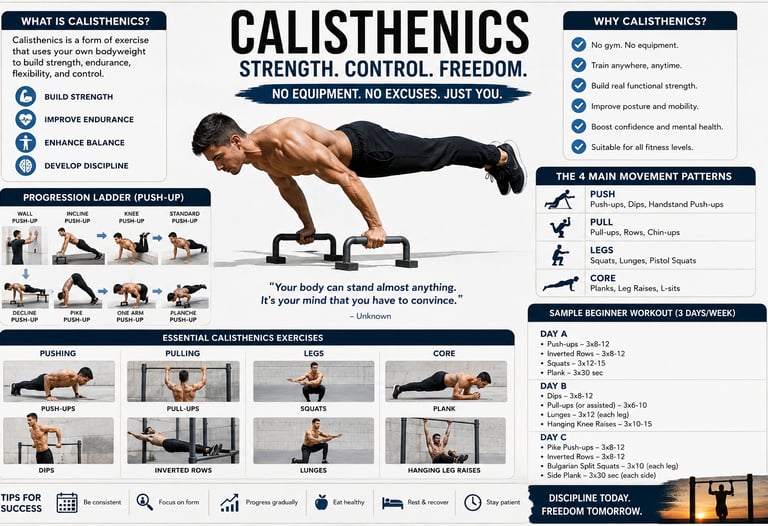
Calisthenics is a form of bodyweight training that builds strength, muscle, endurance, balance, and mobility using exercises like push-ups, pull-ups, squats, and planks. Research shows calisthenics can improve cardiovascular health, neuromuscular function, posture, and body composition — all without gym equipment.
What if the single most effective fitness tool you own costs absolutely nothing, fits in any space, and has been scientifically shown to build muscle, sharpen your balance, improve cardiovascular health, and even extend your life — all without a single piece of equipment? That tool is calisthenics, and millions of people are rediscovering it.
Derived from the Greek words kallos (beauty) and sthenos (strength), calisthenics is the art of using your own bodyweight as resistance. Push-ups, pull-ups, squats, dips, planks — these aren't just gym warm-ups. They are a complete training system with a body of science growing faster than almost any other fitness discipline.
This guide compiles the most current research — including a 2025 comprehensive review published in the International Journal of Creative Research Thoughts, a landmark 2022 study from the University of Essex demonstrating measurable neuromuscular gains in just four weeks, and a 2024 Indian clinical trial showing dramatic improvements in flexibility, muscle strength, and endurance in sedentary students — to give you the most complete picture of what calisthenics can actually do for your body.
By the end of this guide, you will know:
The proven physiological mechanisms behind callisthenics-induced strength and hypertrophy
How even 16 minutes of daily bodyweight exercise can reverse the damage of prolonged sitting
Exact beginner-to-advanced workout progressions you can start today
How calisthenics compares to weightlifting — and when each wins
The most common myths, mistakes, and how to avoid them
Answers to the 10 questions people search for most
01 — What Is Calisthenics?
Calisthenics is a form of physical training that uses the body's own mass as the primary source of resistance — no barbells, no machines, no gym required. Movements are typically compound and functional, meaning they recruit multiple muscle groups simultaneously rather than isolating individual muscles the way a bicep curl or leg extension machine does.
The scope ranges enormously. At the accessible end, you have push-ups, bodyweight squats, lunges, and planks — movements almost anyone can begin today. At the elite end lies some of the most impressive feats in all of sport: the planche (a horizontal full-body hold supported only by the hands), the front lever, the muscle-up, and the human flag. These skills demand extraordinary levels of strength, coordination, and neuromuscular control.
Key Definition
Calisthenics = structured bodyweight exercise that builds strength, endurance, flexibility, coordination, and balance using progressive overload without external weights.
What makes callisthenics truly unique is its dual nature: it is simultaneously a fitness system and a skill discipline. Unlike loading more weight onto a barbell, progressing in callisthenics requires developing the nervous system, mastering body mechanics, and acquiring genuine movement skills. This is why adherence tends to be higher — there is always a new skill to pursue.
02 — History & Evolution of Calisthenics
Callisthenics is not a modern fitness trend. It is one of humanity's oldest training practices, with roots stretching back over two millennia.
Ancient Origins
Ancient Greek warriors and athletes used systematic bodyweight movements to build combat-ready physiques. The word itself is Greek. Simultaneously, India's yogic tradition had long incorporated bodyweight movements aimed at unifying physical strength with mental stillness, and Chinese martial arts placed great emphasis on body control, leverage, and precise movement patterns — all core principles of modern callisthenics.
19th Century: The Formalization Era
In the 1800s, the Swedish and German gymnastic movements formalized bodyweight exercise as part of military training and public physical education. Friedrich Ludwig Jahn — often called the "father of gymnastics" — built upon these traditions to create structured training systems that spread across Europe and eventually to the United States, where calisthenics became a staple of school and military fitness curricula.
The Modern Renaissance
The internet age catalyzed a global calisthenics resurgence. Social media platforms — particularly Instagram and YouTube — allowed self-taught practitioners to share jaw-dropping skill demonstrations, creating organic communities around the "street workout" movement. Organizations like the World Callisthenics Organisation (WCO) formalized competitive events. Today, structured programs like Convict Conditioning, Overcoming Gravity, and community-developed frameworks like Reddit's Recommended Routine bring scientific rigor to what was once an informal practice.
03 — The Science of Bodyweight Training
How Calisthenics Builds Muscle (Hypertrophy)
Muscle growth requires three key stimuli: mechanical tension, metabolic stress, and muscle damage. Calisthenics delivers all three — provided the exercise is sufficiently challenging. The critical variable is relative intensity: a push-up performed to near-failure creates nearly identical mechanical tension on the pectoral muscles as a bench press at equivalent relative load.
A landmark study by Gentil et al. (2017) found no significant difference in muscle hypertrophy between push-up training and bench press training in untrained men — a finding that directly challenges the assumption that external loading is necessary for muscle growth. More recently, Schoenfeld et al. (2021) reported that bodyweight training can match resistance training in strength gains when volume and effort are equated.
Progressive Overload Without Weights
The primary mechanism of all strength training is progressive overload: consistently increasing the demand on your muscles over time. With weights, this typically means adding more plates. With calisthenics, it means:
Changing leverage — e.g., elevating feet during push-ups shifts more load to the chest and shoulders
Altering tempo — slow eccentrics (lowering phase) dramatically increase time under tension
Reducing support — progressing from two-limb to single-limb movements (pistol squat, one-arm push-up)
Increasing complexity — adding balance, rotation, or isometric holds
Adding volume — more sets and reps as capacity improves
Neuromuscular Adaptations
Calisthenics produces some of the most remarkable neuromuscular adaptations in all of exercise science. A 2022 study by Mear, Gladwell, and Pethick at the University of Essex demonstrated that just four weeks of brief, daily calisthenic exercise significantly increased knee extensor maximal voluntary contraction (MVC), improved force steadiness (measured by standard deviation and coefficient of variation of force fluctuations), and enhanced dynamic balance on the Y balance test. Crucially, these gains occurred with only approximately 16 minutes of daily exercise spread across an 8-hour workday.
The researchers proposed that the strength gains were not primarily hypertrophic but rather driven by neural adaptations — specifically, decreased motor unit recruitment thresholds and increased motor unit discharge rates. This means calisthenics literally trains the nervous system to communicate more efficiently with muscle fibers, a quality that improves functional performance across all activities of daily life.
Research HighlightEvery 15N increase in lower extremity strength is associated with a 7% reduction in all-cause mortality risk. The Mear et al. (2022) calisthenics intervention produced strength gains of this magnitude in just four weeks.
Cardiovascular and Metabolic Effects
High-intensity calisthenics circuits — incorporating burpees, mountain climbers, jump squats, and explosive push-up variations — provide substantial cardiovascular training stimulus. Research on sedentary adults found that calisthenics performed three times weekly for ten weeks produced meaningful improvements in blood pressure, resting heart rate, resting metabolic rate, and body fat levels.
Additionally, a 2024 study on sedentary college students by Agalyadharshini demonstrated that a six-month structured calisthenics program produced statistically significant improvements across all measured fitness parameters: flexibility (t-value of 40.20), muscle strength (push-up test), and muscular endurance (sit-up test). These were not marginal gains — they were transformative improvements in previously sedentary individuals.
16M :Daily calisthenics needed to improve neuromuscular function (Mear et al., 2022)
4 weeks: Time to measurable improvements in muscle strength & dynamic balance
82%: Adherence rate to the hourly calisthenics break protocol in controlled research
35+: Pathological conditions linked to prolonged sedentary behavior (Booth et al., 2012)
04 — Callisthenics as an Antidote to the Sitting Epidemic
Here is an alarming reality: research estimates that adults spend 51–68% of their waking hours in sedentary behaviors — sitting or reclining with energy expenditure at or below 1.5 metabolic equivalents. Time spent sedentary is associated with increased risk of at least 35 pathological conditions and all-cause mortality, even after accounting for participation in regular exercise sessions.
The mechanism is partly muscular. Prolonged inactivity:
Decreases muscle cross-sectional area
Reduces voluntary motor unit activation
Decreases motor unit firing rates
Drives maladaptive metabolic and cardiovascular responses
Impairs the ability to control force — a key predictor of balance and fall risk
"Small changes in activity level and pattern — just 16 minutes of calisthenics per day — can mitigate the negative effects of prolonged sedentary time on neuromuscular function."
The "Movement Snack" Strategy
One of the most actionable findings from recent research is that breaking up sitting time with brief bouts of calisthenics — rather than performing all exercise in one consolidated gym session — delivers measurable improvements in muscle strength, force control, and dynamic balance. The Mear et al. study used a protocol of performing one set (8 reps × 5 exercises including squats and lunges) every hour during the workday, building from 4 sets/day in week 1 to 8 sets/day by weeks 3–4.
This approach is particularly powerful because:
It doesn't require changing clothes, a gym, or any equipment
It fits into the rhythm of any workday
It countermands the neuromuscular degradation caused by continuous sitting
It's sustainable — the 82% adherence rate in the study confirms this
Important Context: Breaking up sitting is not a replacement for structured exercise — it is a critical complement to it. Current physical activity guidelines recommend both reducing sedentary time AND meeting minimum aerobic and strengthening exercise targets.
The Hourly Calisthenics Break Protocol
Week 1
4 sets/day · 8 reps each of: Squats, Arm Circles, Calf Raises, Knees-to-Elbow, Lunges · 2 min/set
Week 2
6 sets/day · Same exercises · Progress at comfortable pace
Wk 3–4
8 sets/day · Full hourly break protocol · ~16 min total daily movement
05 — Proven Health Benefits of Calisthenics
1. Muscular Strength & Hypertrophy
Calisthenics promotes strength through progressive overload achieved via leverage manipulation, tempo control, and movement complexity. A 2024 six-week case study (Reenaviviony Tony et al., Sultan Idris Education University) documented significant improvements in grip strength and muscular endurance (push-up and sit-up tests) following structured calisthenics performed 3–4 days per week. Importantly, these gains occurred in a student with prior calisthenics experience, suggesting continued adaptability even past the beginner phase.
2. Flexibility & Joint Mobility
Many calisthenics movements inherently require and develop a high degree of flexibility. The deep squat, lunge, and hollow body hold all demand active mobility. A 2024 study on sedentary college students (Agalyadharshini) found dramatic improvements in sit-and-reach flexibility scores after a structured 12-week program — with a t-value of 40.20, indicating highly significant change. Regular calisthenics practice also enhances joint range of motion and muscular elasticity, particularly when integrated with dynamic warm-up protocols.
3. Cardiovascular Health
Circuit-style calisthenics — minimal rest between diverse exercises — creates a potent cardiovascular stimulus. Research shows that bodyweight circuit training can improve aerobic capacity, lower resting blood pressure, and reduce resting heart rate in previously sedentary individuals within 8–10 weeks.
4. Core Stability & Posture
Movements like planks, hollow holds, L-sits, and hanging leg raises intensely target the core musculature. A 2019 study by Silva et al. demonstrated improved posture, core strength, and musculoskeletal endurance following calisthenics interventions. Unlike machine-based exercises that support and isolate, calisthenics forces the core to act as a stabilizing unit during every movement — which is how it functions in real life.
5. Balance & Neuromuscular Control
The Mear et al. (2022) study found a statistically significant improvement in dynamic balance (Y balance test posterolateral reach, p = 0.046) following just four weeks of bodyweight training. This is clinically meaningful: balance is one of the strongest predictors of fall risk in aging populations, and lower extremity force control — also improved in that study — is itself a stronger predictor of dynamic balance than maximal strength alone.
6. Mental Health & Cognitive Function
Calisthenics contributes to psychological wellbeing by reducing cortisol, decreasing symptoms of anxiety and depression, and promoting mindfulness through focused movement practice. Skill-based training adds an additional dimension: achieving a new skill (your first pull-up, your first muscle-up) produces a powerful experience of self-efficacy that generalizes beyond the gym. Research also links regular bodyweight exercise to improved memory, attention, and executive function.
7. Body Composition
The 2024 six-week study documented meaningful improvements in body mass index, waist circumference, hip circumference, and waist-to-hip ratio following a structured calisthenics program. Calisthenics burns significant calories both during sessions (particularly in HIIT-format circuits) and through the elevation of resting metabolic rate that accompanies increased muscle mass.
06 — Calisthenics vs. Weight Training: Which Is Better?
This is one of the most searched questions in fitness, and the honest answer is: it depends on your goals. Here's a direct comparison based on the current research:
Financial Overhead & Equipment Requirements
Calisthenics: Zero cost. Utilises native body mass; eliminates the need for expensive gym memberships or complex mechanical apparatus.
Weight Training: Moderate to High cost. Requires recurring commercial gym membership fees or a substantial upfront investment in a home gym setup (barbells, plates, racks).
Physical Accessibility & Environmental Constraints
Calisthenics: Universal accessibility. Can be executed anywhere, at any time, requiring minimal physical space and zero dedicated infrastructure.
Weight Training: Location-dependent. Bound to specific training environments, making consistency highly reliant on proximity to facilities or equipment.
Upper-Body Hypertrophy & Strength Development
Calisthenics: Excellent. Highly effective for inducing mechanical tension and metabolic stress across the shoulder girdle, chest, back, and arms through multi-planar leverage.
Weight Training: Excellent. Provides precise, isolated targeting of specific upper-body skeletal muscle groups, allowing for direct hypertrophy tracking.
Lower-Body Strength & Sarcopenia Prevention
Calisthenics: Moderate / Limited Loading. Structurally constrained by a natural loading ceiling, modifying leverage (e.g., pistol squats) offers progression, but lacks deep axial loading capacity.
Weight Training: Superior. Progressive overload is infinitely scalable via heavy barbell or machine loading (squats, leg presses), making it the gold standard for lower-body mass and bone mineral density preservation.
Core Activation & Sagittal Stability
Calisthenics: Superior. Demands constant, high-threshold isometric multi-planar core bracing to manage shifting centers of gravity and leverage.
Weight Training: Good. Highly effective when utilizing heavy compound barbell movements, but drops significantly when using fixed-path isolation gym machines.
Neuromuscular Skill Mastery & Motor Adaptation
Calisthenics: Advanced. Requires ongoing, complex neurological motor patterning, spatial awareness, and intramuscular coordination to master new movement progressions.
Weight Training: Low to Moderate. Focuses primarily on simple, linear, or fixed-axis force production against external resistance.
Biomechanical Injury Risk Profile
Calisthenics: Low risk. Exercises occur through native, self-limiting closed-kinetic chain pathways that automatically adapt to individual joint architecture.
Weight Training: Moderate to High risk. Heavy external loading increases joint shear and axial spinal compression if technical execution or structural limits are exceeded.
Beginner Progression & Scalability
Calisthenics: Complex. Demands immediate kinesthetic awareness, as progression requires altering body leverage, angles, and biomechanical mechanical advantages.
Weight Training: Linear and Simple. Highly accessible for beginners; progression is scaled incrementally by simply adding micro-loads (weight plates) to a fixed movement pattern.
Long-Term Adherence & Engagement
Calisthenics: High adherence. Driven by highly tangible, skill-based milestones and movement mastery, shifting focus away from pure aesthetics.
Weight Training: Variable. Relies heavily on numerical milestones (weight on the bar) and physical metrics, which can lead to psychological plateaus.
Cardiovascular & Metabolic Conditioning
Calisthenics: High potential. Naturally lends itself to high-density circuit configurations with minimal transitions, keeping heart rate elevated into aerobic and anaerobic zones.
Weight Training: Moderate. Typically restricted by the mandatory, extended rest intervals required for central nervous system and ATP recovery between heavy sets.
Proprioception & Spatial Control
Calisthenics: Superior. Maximizes mechanoreceptor and proprioceptive feedback loops by forcing the brain to navigate the entire body through three-dimensional space.
Weight Training: Moderate. Prioritizes the manipulation of an external object rather than relative body leverage and spatial control.
Geriatric Rehabilitation & Healthy Aging Suitability
Calisthenics: Highly suitable. Safely preserves functional, real-world closed-chain movement patterns while minimizing joint stress and protecting aging connective tissues.
Weight Training: Highly effective, but requires supervision. Exceptional for counteracting sarcopenia and osteopenia, but demands strict clinical monitoring to prevent joint overload and spinal compression
The verdict: For most people — especially those without gym access, those returning from injury, or those with limited time — calisthenics is the superior starting point. For athletes seeking maximum lower-body mass or sport-specific power output, a hybrid approach (calisthenics foundation + targeted weight training) is likely optimal. The 2025 review by Kadolkar notes that supplementing calisthenics with resistance bands, weighted vests, or targeted weight exercises can overcome the primary limitation of insufficient lower-body loading.
07 — Core Movements & Progressions
The elegance of calisthenics lies in its infinite progressions. Every fundamental movement has a hierarchy from accessible to elite. Here are the four primary movement patterns and their progressions:
Pushing (Horizontal & Vertical)
Beginner Wall push-ups → Incline push-ups → Knee push-ups
Beginner Standard push-ups → Wide-grip → Diamond push-ups
Intermediate Archer push-ups → Pike push-ups → Decline push-ups
Advanced Pseudo-planche push-ups → One-arm push-ups → Planche push-ups
Pulling
Beginner Dead hang → Scapular pulls → Inverted rows
IntermediateAssisted pull-ups → Chin-ups → Pull-ups
Intermediate Wide-grip pull-ups → Neutral-grip → Towel pull-ups
Advanced Archer pull-ups → L-sit pull-ups → One-arm pull-up → Muscle-up
Lower Body
BeginnerBox squats → Bodyweight squats → Jump squats
Intermediate Bulgarian split squats → Reverse lunges → Step-ups
Advanced Single-leg squat prep → Pistol squat → Weighted pistol (vest)
Core & Full Body
Beginner Dead bug → Hollow body hold → Plank → Side plank
IntermediateHanging knee raises → Toes-to-bar → L-sit on parallettes
AdvancedDragon flag → Front lever tuck → Full front lever → Planche
Progression Principle: Never move to the next progression until you can perform the current level for 3 sets of 10–15 reps with excellent form. Rushing progressions is the #1 cause of overuse injury in calisthenics.
08 — Beginner 4-Week Calisthenics Workout Plan
Based on the evidence — particularly the structured progression used in the Mear et al. research and the six-month program studied by Agalyadharshini — here is a scientifically grounded beginner program. This 3-day per week plan targets all major movement patterns.
Weeks 1–2: Foundation Phase
Focus: Form, body awareness, baseline strength. Rest 60–90 seconds between sets.
Day A :Incline Push-ups 3×8 · Inverted Rows 3×8 · Bodyweight Squats 3×12 · Dead Bug 3×8 each side · Plank 3×20s
Day B: REST or light walking/stretching
Day C :Standard Push-ups 3×6 · Dead Hang 3×20s · Reverse Lunge 3×8 each · Hollow Hold 3×15s · Calf Raises 3×15
Day D: REST
Day E: Repeat Day A with +1–2 reps or better form goal
Weeks 3–4: Volume Phase
Focus: Increased volume, introduce more challenging variations. Rest 60 seconds between sets.
Day A Push-ups 4×8 · Scapular Pull-ups 3×8 · Jump Squats 3×10 · Hollow Body Hold 3×20s · Side Plank 3×20s/side
Day C:Diamond Push-ups 3×6 · Inverted Rows 4×8 · Bulgarian Split Squat 3×8/leg · Tuck Sit (parallettes or floor) 3×10s · Glute Bridge 3×15
Day E :Circuit: 5 exercises × 40s on / 20s off × 3 rounds — Push-ups, Squats, Inverted Rows, Mountain Climbers, Plank. No additional rest between exercises.
Safety First. Always begin sessions with a 5–10 minute dynamic warm-up (leg swings, arm circles, hip rotations, light jumping jacks). End with 5 minutes of static stretching. If you experience sharp joint pain — not muscle fatigue — stop and consult a healthcare professional.
Daily Movement Snack Protocol (for office workers)
Inspired directly by the Mear et al. (2022) research, incorporate this throughout your workday — regardless of whether you have a formal workout scheduled:
Every 60–90 minutes, stand up from your chair
Perform 8 bodyweight squats
Perform 8 walking lunges (4 each leg)
Perform 8 calf raises
Perform 8 arm circles (forward and backwards)
Perform 8 standing knee-to-opposite-elbow twists
Total time: under 2 minutes. Scientific benefit: proven.
09 — Evidence Summary: Key Calisthenics Studies
1. Neuromuscular Control & Sedentary Intervention
Mear, Gladwell, & Pethick (University of Essex, 2022)
Study Design: Randomized Controlled Trial (RCT); n=17 sedentary adults 6 hours/day sitting; 4-week protocol scaling up to 8 sets/day of brief bodyweight exercises.
Key Findings: Just ~16 minutes of daily calisthenics significantly increased knee extensor Maximum Voluntary Contraction (MVC; p=0.036, d=0.21). It dramatically enhanced neuromuscular motor control, yielding a massive decrease in force fluctuation Standard Deviation (p=0.031, d=0.99$) and Coefficient of Variation (p=0.016, d=1.30) at 40\% MVC. Functional balance also improved via the Y-Balance posterolateral reach (p=0.046, d=0.91).
Clinical Relevance: Breaking up prolonged sedentary office hours with micro-doses of calisthenics rapidly restores motor unit recruitment, joint stability, and force output.
Study Limitations: Small sample size (n=8 in intervention arm); preliminary trial architecture; short follow-up window.
2. Long-Term Functional Conditioning in Sedentary Populations
Agalyadharshini, R. (KG College of Physiotherapy, Tamil Nadu, 2024)
Study Design: Longitudinal intervention study; n=20 sedentary participants aged 18–25; 6-month structured, progressive calisthenics program.
Key Findings: Marked improvements were demonstrated across all parameters (p < 0.05). Specifically, joint and myofascial flexibility shifted dramatically via the sit-and-reach metric (t=40.20), paired with significant advancements in upper-body muscle strength (push-up threshold) and core endurance (sit-up capacity).
Clinical Relevance: Extended commitment to structured bodyweight progression safely eliminates physical deconditioning in young adults without relying on loaded equipment.
Study Limitations: Absence of a dedicated parallel control group; 6-month trial design limits insight into hyper-acute training adaptations.
3. Anthropometric Shifts & Biomechanical Endurance
Reenaviviony Tony, F. et al. (Sultan Idris Education University, Malaysia, 2024)
Study Design: Prospective single-subject case study; 21-year-old male with baseline calisthenics experience; 6-week protocol at 3–4 sessions/week.
Key Findings: Documented a complete optimization of body composition, showing measurable decreases in BMI, waist circumference, hip circumference, and waist-to-hip ratio. Musculoskeletal endurance expanded via absolute push-up and sit-up velocity, accompanied by a distinct increase in manual grip strength.
Clinical Relevance: Short-term high-frequency calisthenics effectively drives metabolic and anthropometric remodeling even in individuals who have already surpassed the novice training threshold.
Study Limitations: Single-subject (n=1) design inherently constrains immediate generalizability to untrained populations.
4. Systemic Review of Hypertrophic and Postural Equivalence
Simran Kadolkar (KLE Institute of Physiotherapy, May 2025 Review)
Study Design: Systematic narrative review of contemporary kinesiological and exercise science literature.
Key Synthesized Points:
Hypertrophic Equivalence: Confirms that when mechanical tension and volume are equated, there is no statistically significant difference in skeletal muscle hypertrophy between bodyweight training (push-ups) and free weights (bench press) in untrained individuals (validating Gentil et al., 2017 and Schoenfeld et al., 2021).
Postural Mechanics: Highlights distinct, superior outcomes in spinal posture, deep core stabilizer activation, and general musculoskeletal endurance compared to completely sedentary controls (validating Thomas et al., 2017).
Identified Bottlenecks: Reconfirms a natural mechanical loading ceiling regarding isolated lower-body (quadriceps/gluteal) structural hypertrophy, highlighting the ongoing need for long-term longitudinal data.
10 — Common Myths & Mistakes in Calisthenics
Myth 1: "Calisthenics Can't Build Real Muscle"
Busted. Research by Gentil et al. (2017) and Schoenfeld et al. (2021) demonstrates equivalent hypertrophy between bodyweight and weighted training when volume and intensity are equated. The key word is progressive — stagnating on easy push-ups won't build muscle, just as doing the same light weight for years won't. Match the challenge to your current capacity and keep pushing forward.
Myth 2: "You Need a Pull-Up Bar to Do Calisthenics"
Partially true, easily solved. A pull-up bar is highly recommended — it's the most effective tool for developing upper-body pulling strength, and it costs under $30. But many gyms have bars, playground equipment works perfectly, and Australian rows (under a table) can substitute for beginners. Push-ups, squats, lunges, and core work require zero equipment whatsoever.
Myth 3: "Calisthenics Is Only for Young People"
Wrong — and the research proves the opposite. The Mear et al. study included adults aged 18–59, and the authors specifically highlight older adults as an ideal target population for calisthenics-based movement breaks, precisely because muscle strength, force control, and balance all decline with age — and calisthenics directly addresses all three. Many top calisthenics practitioners are in their 40s, 50s, and beyond.
Myth 4: "More Reps Is Always Better"
False. High-rep, low-difficulty training is the enemy of progress. If you can perform 30 bodyweight squats without difficulty, you are not creating sufficient mechanical tension for meaningful strength or muscle adaptation. You must progress to a harder variation — single-leg work, slower tempo, elevated surface — to keep creating the stimulus for adaptation.
Mistake 1: Skipping the Warm-Up
The most common cause of preventable injury. Calisthenics — especially movements involving the wrists, shoulders, and elbows — demands mobile, warm joints. Spend 5–10 minutes on joint circles, dynamic stretching, and light movement before every session.
Mistake 2: Neglecting Antagonist Muscles
A program heavy on pushing (push-ups, dips) without sufficient pulling (rows, pull-ups) creates muscle imbalances that increase shoulder injury risk. The 2025 Kadolkar review explicitly identifies "strengthening antagonist muscles" as a primary injury prevention strategy. For every pushing movement, include a pulling equivalent.
Mistake 3: Chasing Skills Before Earning Them
Attempting the planche, muscle-up, or human flag before building sufficient foundational strength is how tendons get damaged. Respect the progressions. The investment in foundations is what makes advanced skills not just achievable, but safe.
Mistake 4: No Rest Days
Muscle grows during recovery, not during training. Most beginners benefit from 2–3 rest days per week. Active recovery (walking, light stretching, yoga) accelerates muscle repair and reduces systemic fatigue.
11 — Nutrition & Recovery for Calisthenics Athletes
No training program outperforms poor nutrition and inadequate recovery. The 2025 Kadolkar review underscores that success in calisthenics "depends on recovery and nutrition" — not just on the exercises themselves.
Key Nutritional Priorities
Protein (1.6–2.2g/kg bodyweight): The building block of muscle repair and growth. Prioritize complete protein sources: eggs, poultry, fish, legumes, dairy, or quality plant-based combinations.
Carbohydrates: Your primary fuel source for high-intensity calisthenics sessions. Whole grains, fruits, and root vegetables are optimal choices. Don't fear carbs — they are what power the squats and pull-ups that build your physique.
Healthy Fats: Essential for hormonal production (including testosterone, which drives anabolic signaling). Prioritize fatty fish, avocados, olive oil, and nuts.
Micronutrients: Vitamin D (bone and muscle function), magnesium (muscle contraction and sleep quality), and calcium (bone density and neuromuscular signaling) are particularly important for active individuals.
Hydration: Even mild dehydration impairs strength, endurance, coordination, and recovery. Aim for urine that is pale yellow throughout the day.
Recovery Essentials
Sleep 7–9 hours per night — the single most powerful recovery intervention available
Incorporate active rest days (walking, mobility work, light yoga)
Schedule deload weeks every 4–6 weeks (reduce volume by ~40%) to prevent overtraining
Monitor for signs of overtraining: persistent fatigue, declining performance, irritability, disrupted sleep
Consider post-workout protein within 2 hours of training to optimize muscle protein synthesis
Pro Tip Wrist wraps, parallette bars, and gymnastics rings can meaningfully reduce joint stress while increasing training variety — particularly for practitioners with wrist discomfort from floor-based pushing movements.
12 — Frequently Asked Questions
Can calisthenics build muscle as effectively as lifting weights?
Yes — for most people, especially beginners and intermediate trainees. Research including Gentil et al. (2017) showed no significant hypertrophy difference between push-up training and bench press in untrained men. The key is progressive overload: continually making the exercises harder as you adapt. Where weights have an advantage is in lower-body hypertrophy — loaded squats and deadlifts are harder to match with bodyweight alone, though pistol squats and Nordic curls can go a long way.
How long does it take to see results from calisthenics?
Most people notice strength improvements within 2–4 weeks — particularly neurological gains (better coordination, more efficient movement). Visible physique changes typically begin appearing at 6–12 weeks of consistent training. The Mear et al. study documented statistically significant improvements in muscle strength and balance in just four weeks. Consistency and progressive difficulty are far more important than any specific program or exercise selection.
How many days per week should I do calisthenics?
For beginners, 3 days per week with rest days between sessions is ideal. This allows sufficient recovery while maintaining training frequency. More advanced practitioners can train 4–5 days per week by splitting muscle groups (e.g., push/pull/legs/core) or by incorporating skill practice (handstands, L-sit work) on additional days since these sessions are less fatiguing than strength training.
Is calisthenics good for weight loss?
Yes, particularly when performed in circuit format with minimal rest. Calisthenics circuits create both the caloric expenditure of cardiovascular exercise and the metabolic elevation (excess post-exercise oxygen consumption) of strength training. Research on sedentary adults shows meaningful reductions in body fat percentage within 8–10 weeks. However, nutrition remains the primary driver of weight loss — training is the sculptor, diet is the foundation
.
Can I do calisthenics if I'm a complete beginner with no fitness background?
Absolutely — and calisthenics may be the ideal starting point precisely because it begins with movements you can already do (walking, standing, sitting) and builds incrementally. Begin with wall push-ups rather than standard push-ups, use a chair for squat support, and prioritize form over quantity. The 2024 Agalyadharshini study enrolled entirely sedentary students aged 18–25 and documented significant improvements across all fitness measures within the program.
What equipment do I need for calisthenics?
Technically, none — your body is the gym. Practically, a pull-up bar (wall-mounted, doorframe, or outdoor) is the single most valuable addition, providing access to the entire family of pulling movements. A set of parallette bars reduces wrist strain and opens up dip and L-sit training. Gymnastics rings are an advanced tool that adds instability and exercise variety. A resistance band can assist pull-ups and dips in early training phases.
Is calisthenics safe for older adults?
Not only safe — it may be especially beneficial. The Mear et al. (2022) study authors highlight older adults as an ideal population for callisthenics-based movement breaks, noting that muscle strength, force control, and balance all decline with aging and that calisthenics directly targets all three. The bodyweight nature of the training means loads are automatically proportional to body mass, reducing absolute injury risk compared with external weights. Always begin conservatively and consult your physician if you have existing joint conditions.
What is the best calisthenics exercise for beginners?
The push-up is arguably the most complete beginner calisthenics exercise — it trains the chest, shoulders, triceps, and core simultaneously, requires no equipment, can be scaled from very easy (wall or incline) to very challenging (archer, one-arm), and provides immediate feedback on strength progression. The bodyweight squat is equally essential for lower body development. Pairing these two movements with a dead hang (for shoulder health) and a plank gives you a complete foundational program.
Can calisthenics help with back pain?
Properly programmed calisthenics can be highly beneficial for common back pain, particularly non-specific low back pain associated with weak core musculature and poor posture. Core-strengthening movements (dead bugs, hollow holds, bird dogs, planks) and hip-dominant exercises (glute bridges, bodyweight RDLs) address the most common muscular contributors to back pain. However, anyone with diagnosed spinal conditions, disc herniation, or acute pain should seek clearance from a physiotherapist or physician before beginning any training program.
How is calisthenics different from yoga and Pilates?
All three use bodyweight and share emphases on body control and mindfulness — but the goals and methods differ meaningfully. Calisthenics prioritizes progressive strength and skill development; the movements are typically dynamic and loaded. Yoga emphasizes flexibility, breath, and mind-body integration, with poses held statically. Pilates focuses specifically on core stability and controlled movement patterns, often using specialized equipment. Hybrid practitioners often find that yoga mobility work significantly accelerates calisthenics skill development, making them complementary rather than competing disciplines.
13 — Conclusion & Your Action Plan
Calisthenics is not a compromise. It is not what you do when you can't afford a gym membership or don't have time for "real" training. It is a complete, science-validated fitness system that builds genuine strength, develops extraordinary neuromuscular control, improves cardiovascular health, enhances flexibility and balance, and — according to the latest research — requires as little as 16 minutes of daily activity spread across the workday to produce measurable results.
The evidence is clear: whether you are a sedentary student looking to transform your physical fitness, an office worker battling the neuromuscular degradation of a desk-bound life, or an experienced trainee seeking to develop elite-level strength skills, calisthenics offers a scientifically sound, accessible, and supremely sustainable path forward.
"Calisthenics is a sustainable and empowering training modality for diverse populations — a holistic, evolving discipline with growing relevance in fitness, rehabilitation, and preventive healthcare."
— Kadolkar, S. (2025), KLE Institute of Physiotherapy
Your 5-Step Action Plan — Start Today
Set a reminder every 60–90 minutes during your workday to perform one set of the movement snack protocol (squats, lunges, calf raises, arm circles, knee twists). This single habit, backed by peer-reviewed research, will begin improving your strength and balance within weeks.
Assess your baseline this week: How many push-ups can you do with perfect form? How long can you hold a plank? Record your numbers — they are your starting point, not a judgment.
Begin the 4-week beginner plan outlined in Section 8. Commit to three sessions per week for 28 days before evaluating progress.
Prioritize sleep and protein. Without these two recovery fundamentals, any training program underperforms. Aim for 7–9 hours of sleep and approximately 1.6–2g of protein per kilogram of bodyweight daily.
Progress relentlessly but patiently. When an exercise becomes easy, you graduate to the next progression — not by adding more reps, but by making it harder. This is the lifelong engine of calisthenics.
Medical Disclaimer
The information in this article, including the research findings, is for educational purposes only and does not constitute medical advice, diagnosis, or treatment. Before starting a resistance exercise program, you must consult with a qualified healthcare professional, especially if you have existing health conditions (such as cardiovascular disease, uncontrolled hypertension, or advanced metabolic disease). Exercise carries inherent risks, and you assume full responsibility for your actions. This article does not establish a doctor-patient relationship.
Related Articles
How to Build a Disease-Proof Body: Master Calories, Exercise & Longevity | DR T S DIDWAL
References
Agalyadharshini, R. (2024). Effects of calisthenics training on flexibility, muscle strength, muscle endurance in sedentary college students. Indian Journal of Physiotherapy and Occupational Therapy – An International Journal. Advance online publication. https://doi.org/10.51224/SRXIV.449
Booth, F. W., Roberts, C. K., & Laye, M. J. (2012). Lack of exercise is a major cause of chronic diseases. Comprehensive Physiology, 2(2), 1132–1211. https://doi.org/10.1002/cphy.c110025
Dunstan, D. W., Howard, B., Healy, G. N., & Owen, N. (2012). Too much sitting—A health hazard. Diabetes Research and Clinical Practice, 97(3), 368–376. https://doi.org/10.1016/j.diabres.2012.05.020
Ekelund, U., Steene-Johannessen, J., Brown, W. J., Fagerland, M. W., Owen, N., Powell, K. E., Bauman, A., & Lee, I.-M. (2016). Does physical activity attenuate, or even eliminate, the detrimental association of sitting time with mortality? A harmonised meta-analysis of data from more than 1 million men and women. The Lancet, 388(10051), 1302–1310. https://doi.org/10.1016/S0140-6736(16)30370-1
Gentil, P., Lira, C. A. B., Paoli, F., Dos Santos, J. A. B., Silva, E. P. T., Vasconcelos Junior, F. S., & Bottaro, M. (2017). A comparison of elbow flexion and knee extension exercises performed with identical relative loads but different absolute loads. Applied Physiology, Nutrition, and Metabolism, 42(9), 1008–1011. https://doi.org/10.1139/apnm-2016-0563
Hamilton, M. T., Hamilton, D. G., & Zderic, T. W. (2007). Role of low energy expenditure and sitting in obesity, metabolic syndrome, type 2 diabetes, and cardiovascular disease. Diabetes, 56(11), 2655–2667. https://doi.org/10.2337/db07-0882
Harvard Health Publishing. (2024). Calisthenics: An effective, low-frills way to stay fit. Harvard Medical School. https://www.health.harvard.edu
Healy, G. N., Dunstan, D. W., Salmon, J., Cerin, E., Shaw, J. E., Zimmet, P. Z., & Owen, N. (2008). Breaks in sedentary time: Beneficial associations with metabolic risk. Diabetes Care, 31(4), 661–666. https://doi.org/10.2337/dc07-2046
Hunter, S. K., Pereira, H. M., & Keenan, K. G. (2016). The aging neuromuscular system and motor performance. Journal of Applied Physiology, 121(4), 982–995. https://doi.org/10.1152/japplphysiol.00475.2016
Kadolkar, S. (2025). A comprehensive review of calisthenics: Evolution, science, and practice. International Journal of Creative Research Thoughts, 13(5), a121–a126. https://ijcrt.org/papers/IJCRT2505016.pdf
Kotarsky, C. J., Christensen, B. K., Miller, J. S., & Hackney, K. J. (2017). Effect of progressive calisthenic push-up training on muscle strength and thickness. Journal of Strength and Conditioning Research, 32(3), 651–659. https://doi.org/10.1519/JSC.0000000000002345
McPhee, J. S., French, D. P., Jackson, D., Nazroo, J., Pendry, N. W., & Schonknecht, P. (2016). Physical activity in older age: Perspectives for healthy ageing and frailty. Biogerontology, 17(3), 567–580. https://doi.org/10.1007/s10522-016-9641-0
Mear, E., Gladwell, V. F., & Pethick, J. (2022). The effect of breaking up sedentary time with calisthenics on neuromuscular function: A preliminary study. International Journal of Environmental Research and Public Health, 19(21), Article 14597. https://doi.org/10.3390/ijerph192114597
Parry, S., Straker, L., Gilson, N. D., & Smith, A. J. (2013). Participatory workplace interventions can reduce sedentary time for office workers: A randomized controlled trial. PLOS ONE, 8(11), Article e78957. https://doi.org/10.1371/journal.pone.0078957
Reenaviviony Tony, F., et al. (2024). Effect of 6-weeks calisthenic training on physical fitness: A case study report. Fitness, Performance and Health Journal, 3(1), 6–13. https://doi.org/10.53797/fphj.v3i1.2.2024
Schoenfeld, B. J., Ogborn, D., & Krieger, J. W. (2016). Effects of resistance training frequency on measures of muscle hypertrophy: A systematic review and meta-analysis. Sports Medicine, 46(11), 1689–1697. https://doi.org/10.1007/s40279-016-0543-8
Schoenfeld, B. J., et al. (2021). Resistance training recommendations to maximize muscle hypertrophy in an athletic population: A position stand from the IUSCA. Strength & Conditioning Journal, 43(2).
Silva, A. F., et al. (2019). Effect of calisthenics training on posture, core strength and musculoskeletal endurance. Journal of Exercise Physiology Online, 22(4).
Thomas, E., Bianco, A., Mancuso, E. P., Patti, A., Tabacchi, G., Paoli, A., Messina, G., & Palma, A. (2017). The effects of a calisthenics training intervention on posture, strength and body composition. Isokinetics and Exercise Science, 25(3), 215–222. https://doi.org/10.3233/IES-170001
Tremblay, M. S., Aubert, S., Barnes, J. D., Saunders, T. J., Carson, V., Latimer-Cheung, A. E., Chastin, S. F. M., Altenburg, T. M., Chinapaw, M. J. M., & Sedentary Behavior Research Network Terminology Consensus Project Participants. (2017). Sedentary Behavior Research Network (SBRN) — Terminology Consensus Project process and outcome. International Journal of Behavioral Nutrition and Physical Activity, 14(1), Article 117. https://doi.org/10.1186/s12966-017-0525-8
Volpi, E., Nazemi, R., & Fujita, S. (2004). Muscle tissue changes with aging. Current Opinion in Clinical Nutrition and Metabolic Care, 7(4), 405–410. https://doi.org/10.1097/01.mco.0000134362.76653.b2
World Health Organization. (2020). WHO guidelines on physical activity and sedentary behaviour. World Health Organization. https://www.who.int/publications/i/item/9789240015128Ready to Start Your Calisthenics Journey?
Save this guide, share it with someone who needs it, and take your first action today — even if it's just one set of ten bodyweight squats right now.