BMI vs Body Fat: Which Better Predicts Hidden Cardiometabolic Risk
Think a normal BMI means you're healthy? New research shows hidden visceral fat can raise heart and diabetes risk. Learn better tests beyond BMI.
OBESITYMETABOLISM
Dr. T.S. Didwal, M.D.(Internal Medicine)
4/8/202614 min read
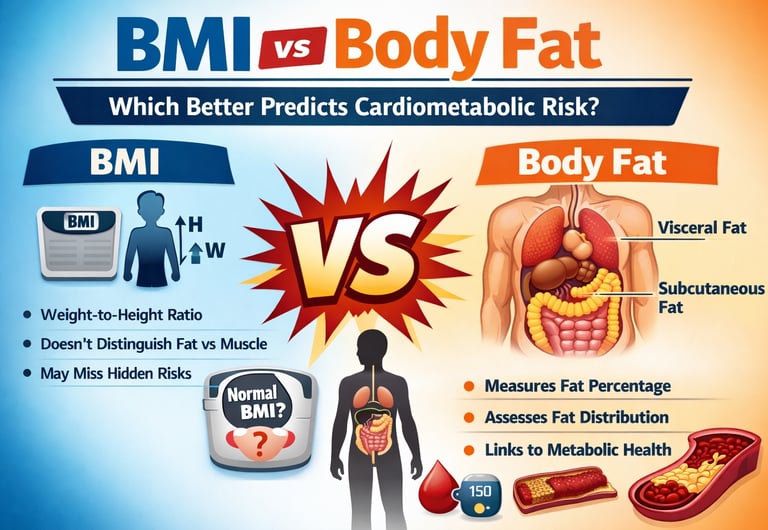
BMI alone is not a reliable indicator of cardiometabolic health. Recent 2024–2025 research shows that individuals with a normal Body Mass Index can still have high cardiovascular risk due to excess visceral fat, insulin resistance, inflammation, and adverse lipid profiles. This condition, often called “normal-weight obesity,” highlights that fat distribution and metabolic health are more important than body weight alone.
Key takeaway: Measuring waist circumference, metabolic markers (glucose, lipids), and lifestyle factors provides a far more accurate assessment of heart disease and diabetes risk than BMI by itself.
Clinician’s Editorial Perspective:
BMI is an outdated standalone tool in modern practice
While useful for population screening, BMI fails to capture individual cardiometabolic risk. Its continued overreliance creates a gap between current evidence and real-world clinical decision-making.The “normal BMI, high-risk” patient is frequently missed
Patients with metabolically unhealthy normal weight (MUNW) often present with:Visceral adiposity
Insulin resistance
Atherogenic dyslipidemia
Chronic low-grade inflammation
Despite normal BMI, these individuals carry substantial cardiovascular risk and often remain undiagnosed without targeted testing.
Standard clinical workflows are insufficient
Without routine assessment of:Waist circumference
Lipid profile (including triglycerides and HDL)
Glycemic markers (fasting glucose, HbA1c)
these high-risk patients are falsely reassured and present later with overt disease.
Obesity is metabolically heterogeneous
The concept of metabolically healthy obesity (MHO) highlights that:Not all individuals with high BMI have the same risk
Some maintain preserved insulin sensitivity and lower inflammatory burden
Risk stratification must go beyond weight alone
Weight-centric approaches may lead to mismanagement
Overemphasis on weight loss can:Miss high-risk normal-weight individuals
Overtreat low-risk obese patients
Reduce patient engagement when outcomes don’t align with BMI targets
Mechanistic insight supports a shift in focus
Visceral fat acts as an endocrine organ, driving:Inflammatory cytokine release
Hepatic lipid overproduction
Prothrombotic (coagulation) pathways
These are the true drivers of atherosclerosis — not BMI per se.
The future is precision cardiometabolic care
Clinicians must integrate:Anthropometric measures (waist, WHR)
Biochemical markers
Functional health metrics (fitness, insulin sensitivity)
Clinical mandate
Move beyond BMI-centric models toward metabolic risk–based assessment, aligning practice with current evidence and improving early detection of cardiometabolic disease.
Why BMI Alone Is No Longer Enough
For decades, Body Mass Index (BMI) has been treated as a clinical shortcut — a quick, convenient number used to categorize patients as underweight, normal, overweight, or obese. It is embedded in guidelines, insurance frameworks, and routine consultations. But emerging evidence from 2024–2025 suggests that this reliance may be quietly missing a substantial proportion of high-risk individuals — and in some cases, offering false reassurance to those who appear “healthy” on paper (Pant, 2025; Tu et al., 2025).
Recent large-scale analyses reveal a striking paradox: a significant proportion of individuals with a “normal” BMI harbor excess visceral fat, insulin resistance, dyslipidemia, and systemic inflammation — a phenotype now widely described as metabolically unhealthy normal weight (MUNW) or “normal-weight obesity” (Pant, 2025). These individuals often remain undiagnosed because BMI fails to capture fat distribution and metabolic function, two of the most critical determinants of cardiometabolic risk. In fact, central adiposity — not total body weight — has emerged as a stronger predictor of cardiovascular events and mortality across multiple populations (Shah et al., 2024).
At the same time, an equally counterintuitive finding has gained traction: not all individuals classified as obese by BMI carry the same level of risk. A subset, termed metabolically healthy obese (MHO), may demonstrate relatively preserved insulin sensitivity, favorable lipid profiles, and lower inflammatory burden — at least in the short term (Tu et al., 2025; Valle et al., 2025). This challenges the long-standing assumption that weight alone is the primary driver of disease.
Mechanistically, the explanation lies beneath the surface. Visceral adipose tissue acts as an active endocrine organ, driving inflammation, altering lipid metabolism, and promoting a prothrombotic state through coagulation pathways — processes that BMI cannot quantify (Valle et al., 2025; Asztalos et al., 2025).
The implication is clear: in modern cardiometabolic medicine, where fat is stored and how the body functions matters far more than what the scale says.
30% of people with "normal" BMI carry high abdominal fat and elevated cardiometabolic risk
5 major 2024–2025 studies redefining how we assess cardiovascular risk
40% of adults classified as obese by BMI are "metabolically healthy" by lab measures
2× higher CVD risk for normal-BMI individuals with central adiposity vs. those without
The "Normal BMI, Hidden Risk" Paradox
Normal BMI With Abdominal Obesity Associated With Cardiometabolic Risks
Perhaps the most striking finding in recent literature comes from a 2025 JAMA research communication by Pant, which highlights a population that often flies under the clinical radar: individuals with a normal BMI (18.5–24.9 kg/m²) who nonetheless carry dangerous levels of abdominal fat.
This condition — sometimes called "normal-weight obesity" or "thin-fat syndrome" — is increasingly recognized as a significant cardiometabolic hazard. The paper underscores that abdominal obesity, typically measured by waist circumference or waist-to-hip ratio, is an independent predictor of cardiovascular events, insulin resistance, dyslipidemia, and hypertension — even in patients whose BMI would be classified as healthy.
Why does this matter to you? Because millions of people receive reassurance from their physician purely based on a "normal" BMI number, without additional screening for central adiposity. They are told their weight is fine, yet their visceral fat — the metabolically active fat that surrounds internal organs — is silently contributing to arterial inflammation, impaired glucose metabolism, and elevated cardiovascular risk.
Clinical Takeaway: If your BMI falls within the normal range but you carry excess fat around your midsection (waist circumference >88 cm for women; >102 cm for men), you may need additional metabolic screening beyond standard weight-based assessments.
Abdominal Fat: The Silent Culprit Behind Heart Risk
Relationship Between BMI and Cardiometabolic Health in a Multi-Ethnic Population
The Project Baseline Health Study — a large, multi-ethnic cohort analysis by Shah and colleagues — adds crucial nuance to the BMI-risk conversation. Examining thousands of participants across diverse racial and ethnic backgrounds, this research highlights that the relationship between BMI and cardiometabolic outcomes is not uniform across populations.
The data reveal that individuals of South Asian, East Asian, and other non-European ancestry tend to experience elevated cardiometabolic risk at BMI thresholds significantly lower than those used in standard clinical guidelines. A South Asian patient with a BMI of 23 kg/m² may already be at a risk level equivalent to a European patient with a BMI of 28–30 kg/m². This discrepancy has profound implications for clinical screening, pharmacological thresholds, and lifestyle counseling.
Furthermore, the Project Baseline data show that total body fat percentage — not BMI — correlates more strongly with adverse metabolic markers such as elevated fasting glucose, HbA1c, triglycerides, and C-reactive protein. Among individuals with identical BMI scores, those with higher visceral fat burden demonstrated consistently worse cardiometabolic profiles.
Ethnic Consideration: Standard BMI cut-offs were largely derived from European populations. If you are of Asian, South Asian, or Middle Eastern descent, discuss ethnicity-adjusted risk thresholds with your doctor. The World Health Organization recommends lower intervention cut-offs for Asian populations (BMI ≥23 for overweight; ≥27.5 for obesity).
Coagulation Factors: An Overlooked Link Between Obesity and Cardiovascular Disease
Cardiovascular Risk Factors Associated With BMI and Metabolic Health Phenotypes Based on Measures of Coagulation Factors
One of the most mechanistically novel studies in this collection comes from Valle and colleagues (2025), published in the International Journal of Obesity. Their work examines coagulation factors — blood-clotting proteins — as markers of cardiovascular risk across different BMI and metabolic health phenotypes.
Coagulation factors such as fibrinogen, Factor VIII, and von Willebrand factor are often overlooked in standard metabolic panels, yet they represent a critical pathway through which excess adiposity promotes cardiovascular disease. Adipose tissue — particularly visceral fat — is metabolically active and pro-inflammatory. It releases cytokines that upregulate coagulation cascades, promoting a prothrombotic state that increases the risk of myocardial infarction and ischemic stroke.
The study stratified participants into four groups based on BMI classification (normal vs. overweight/obese) and metabolic health status (metabolically healthy vs. metabolically unhealthy). Key findings:
Coagulation Risk by Phenotype
Normal BMI + Metabolically Healthy
Lowest fibrinogen & Factor VIII levels
CVD Risk Level: Lowest
Normal BMI + Metabolically Unhealthy
Elevated coagulation markers (fibrinogen & Factor VIII)
CVD Risk Level: Moderate–High
Obese + Metabolically Healthy
Mild elevation in coagulation markers
CVD Risk Level: Moderate
Obese + Metabolically Unhealthy
Highest coagulation burden (highest fibrinogen & Factor VIII)
CVD Risk Level: Highest
Metabolic health matters more than BMI alone.
A normal-weight person who is metabolically unhealthy (with high fasting glucose, elevated triglycerides, low HDL, or hypertension) often carries a significantly worse coagulation risk than an obese person who remains metabolically healthy.
This highlights the importance of evaluating metabolic biomarkers, not just body weight, when assessing a patient’s true cardiovascular and clotting risk.
Body Mass Index and Cardiovascular Risk Markers: A Large Population Analysis
In a large population-based analysis, Asztalos and colleagues (2025) examined the relationship between BMI and a comprehensive panel of cardiovascular risk markers — including lipid profiles, inflammatory markers, insulin sensitivity indices, and blood pressure — across a nationally representative sample.
Their findings confirm a dose-response relationship between increasing BMI and worsening cardiometabolic markers, but with important caveats. The steepest deterioration in risk marker profiles occurred in the transition from normal BMI to overweight (25–29.9 kg/m²), not in the transition from overweight to obese — challenging the assumption that only severe obesity demands clinical concern.
Key cardiometabolic markers adversely affected, even in the overweight BMI range, included:
Elevated LDL cholesterol and triglycerides; reduced HDL cholesterol (the "protective" lipoprotein); increased high-sensitivity C-reactive protein (hsCRP), a marker of systemic inflammation; impaired fasting glucose and elevated insulin levels indicating early insulin resistance; and elevated systolic and diastolic blood pressure.
Importantly, the study also identified that HDL particle quality — not just HDL quantity — was significantly reduced at higher BMI levels, an often-neglected dimension of lipid analysis that has strong predictive value for atherosclerotic cardiovascular disease (ASCVD). Standard lipid panels measure HDL cholesterol concentration but not HDL particle functionality; this study suggests that future risk assessment tools may need to incorporate HDL particle metrics.
Practical Insight: Even a modest weight gain moving you from "normal" to "overweight" BMI can trigger measurable deteriorations in your lipid panel, inflammatory markers, and glucose metabolism. Early intervention matters more than waiting for obesity-range BMI.
Metabolic Health Across BMI Categories: NHANES Findings
Metabolic Health and Cardiovascular Disease Across BMI Categories: NHANES Findings
Drawing on data from the National Health and Nutrition Examination Survey (NHANES) — one of the most comprehensive population-level health databases in the world — Tu and colleagues (2025) provide a sweeping analysis of how metabolic health status intersects with BMI categories to determine cardiovascular disease (CVD) risk.
The NHANES analysis identifies four key population phenotypes: metabolically healthy normal weight (MHNW), metabolically healthy overweight/obese (MHO), metabolically unhealthy normal weight (MUNW), and metabolically unhealthy overweight/obese (MUOW). The CVD risk hierarchy, after adjusting for confounders including age, sex, smoking, physical activity, and socioeconomic status, is telling:
MUOW individuals carry the highest CVD risk, as expected. But the second highest risk belongs to MUNW individuals — normal-weight people with metabolic dysfunction — not to MHO (metabolically healthy obese) participants. People who are obese but metabolically healthy have a CVD risk profile comparable to, or sometimes even slightly better than, their normal-weight counterparts with metabolic dysfunction.
Metabolic Phenotypes and Relative Cardiovascular Disease (CVD) Risk
MHNW (Metabolically Healthy Normal Weight)
Normal BMI + Metabolically healthy
Optimal blood pressure, glucose, lipids, and inflammation markers
Relative CVD Risk: Lowest (Reference group)
MHO (Metabolically Healthy Obese)
High BMI (overweight/obese) but metabolically healthy
Preserved insulin sensitivity, favorable lipid profile, low inflammation
Relative CVD Risk: Low to Moderate (slightly higher than MHNW, but significantly lower than unhealthy groups)
MUNW (Metabolically Unhealthy Normal Weight)
Normal BMI but metabolically unhealthy (“normal-weight obesity”)
High visceral fat, insulin resistance, atherogenic dyslipidemia, elevated inflammation
Relative CVD Risk: High (often second-highest risk, sometimes comparable to or higher than MHO)
MUO (Metabolically Unhealthy Obese)
High BMI + Metabolically unhealthy
Highest burden of insulin resistance, visceral fat, inflammation, and adverse lipids
Relative CVD Risk: Highest
Key Clinical Insight:
After adjusting for age, sex, smoking, physical activity, and other factors, the CVD risk hierarchy from the NHANES analysis is typically:
MHNW < MHO < MUNW < MUO
Important takeaway: A normal-weight person who is metabolically unhealthy (MUNW) often carries higher CVD risk than an obese person who is metabolically healthy (MHO).
This underscores why clinicians must assess metabolic health status, not just BMI, when evaluating true cardiovascular risk.
This finding has revolutionary implications for clinical practice. It means that an obese patient with normal blood pressure, healthy glucose metabolism, favorable lipid panel, and no inflammatory markers may actually benefit more from metabolic optimization (improved diet quality, sleep, stress management, physical activity) than from aggressive weight-loss interventions driven purely by BMI targets.
It does not mean obesity is "safe" — the data also confirm that long-term maintenance of metabolic health in the context of obesity is difficult, and metabolic health status can deteriorate over time even in currently healthy obese individuals. But it does mean that treating BMI as the sole therapeutic target misses the forest for the trees.
Practical Applications: What You Can Do Today
The convergent message of all five studies is not that BMI is useless — it remains a reasonable population-level screening tool — but that it is insufficient as a standalone individual-level risk assessment. Here is what the evidence suggests you and your healthcare provider should do:
Measure Waist Circumference
Request a waist circumference measurement at every checkup. A waist >88 cm (women) or >102 cm (men) flags abdominal obesity regardless of BMI.
Request a Full Metabolic Panel
Ask for fasting glucose, HbA1c, triglycerides, HDL/LDL, hsCRP, and blood pressure — not just weight. These reveal your true metabolic phenotype.
Prioritize Movement Over Weight
Regular aerobic exercise — 150 min/week of moderate activity — improves metabolic markers independently of weight change. Even a 5–10% fitness gain matters.
Focus on Diet Quality
Whole-food, plant-forward dietary patterns improve HDL particle function, reduce inflammation, and lower fibrinogen — all independent of weight loss.
Know Your Ethnic Risk Profile
If you are of South or East Asian descent, discuss lower BMI cut-offs and earlier metabolic screening with your provider. One size does not fit all.
Prioritize Sleep & Stress
Chronic sleep deprivation and psychological stress independently worsen insulin resistance, raise inflammatory markers, and promote abdominal fat accumulation.
Frequently Asked Questions
Is Your BMI Misleading You? Hidden Cardiometabolic Risk Explained
BMI alone cannot accurately predict cardiometabolic risk. Recent research shows that individuals with normal BMI may still have high risk due to visceral fat, insulin resistance, and inflammation. Assessing waist circumference, metabolic markers, and lifestyle factors provides a more precise evaluation of heart disease and diabetes risk.
BMI vs Body Fat Percentage: Which Better Predicts Risk?
Body fat percentage is a more accurate predictor of cardiometabolic risk than BMI because it directly measures adiposity. BMI cannot distinguish between fat and muscle or identify fat distribution, whereas higher body fat—especially visceral fat—is strongly linked to insulin resistance, dyslipidemia, and cardiovascular disease.
How Visceral Fat Causes Heart Disease?
Visceral fat contributes to heart disease by releasing inflammatory cytokines, increasing liver fat production, and promoting insulin resistance. It also activates coagulation pathways, raising the risk of atherosclerosis, heart attack, and stroke.
Waist-to-Height Ratio vs BMI: Which Is Better?
Waist-to-height ratio (WHtR) is a better predictor of cardiometabolic risk than BMI because it reflects fat distribution. A ratio above 0.5 indicates increased risk of visceral fat, insulin resistance, and heart disease across different populations.
Can you have a normal BMI but still be at high risk of heart disease?
Yes. Research from 2025 confirms that individuals with a normal BMI (18.5–24.9) can still face high cardiometabolic risk due to "normal-weight obesity." This occurs when a person has low muscle mass but high levels of visceral (internal) fat.
The Risk: High abdominal fat triggers systemic inflammation and insulin resistance.
The Diagnostic: Doctors recommend measuring waist-to-hip ratio and blood markers alongside BMI.
What is the difference between BMI and abdominal obesity?
BMI measures total body mass relative to height, whereas abdominal obesity specifically measures visceral fat stored around the midsection. Abdominal obesity is a more accurate predictor of heart disease because visceral fat is metabolically active and promotes arterial plaque.
BMI Limit: General health is defined as 18.5–24.9.
Waist Limit: Risk increases at >88 cm (35 in) for women and >102 cm (40 in) for men.
What is "metabolically healthy obesity" (MHO)?
Metabolically healthy obesity (MHO) describes individuals with a BMI over 30 who maintain normal blood pressure, healthy blood sugar levels, and low systemic inflammation. While MHO carries lower immediate risk than "unhealthy" obesity, it may still transition to metabolic disease over time.
To be classified as Metabolically Healthy, an individual with a BMI over 30 must typically meet the following clinical criteria:
Optimal Blood Pressure: Consistently maintaining readings below 120/80 mmHg without the use of anti-hypertensive medications.
Stable Glycemic Control: Fasting plasma glucose levels staying below 100 mg/dL, indicating high insulin sensitivity and low risk for Type 2 diabetes.
Healthy Lipid Profile: High-Density Lipoprotein (HDL) cholesterol levels remaining above 50 mg/dL (for women) or 40 mg/dL (for men).
Low Systemic Inflammation: Minimal levels of C-reactive protein (hs-CRP), suggesting that the stored fat is not currently triggering an immune response.
Balanced Triglycerides: Fasting triglyceride levels remaining below 150 mg/dL, which indicates efficient fat processing by the liver.
While these metrics suggest a lower immediate risk for heart disease, recent research emphasizes that "Healthy Obesity" is often a transient state. Over time, the body’s ability to store fat safely can reach its limit, leading to the "spillover" of lipids into the liver and muscles, eventually shifting the profile from healthy to high-risk.
How do coagulation factors link obesity to heart disease?
Recent 2025 studies show that excess visceral fat releases pro-inflammatory cytokines that increase coagulation factors like fibrinogen and Factor VIII. This creates a "prothrombotic state," making the blood more likely to clot, which directly increases the risk of heart attack and stroke.
Does BMI risk vary by ethnicity?
Yes. Standard BMI scales often underestimate risk for non-European populations. For example, individuals of South Asian and East Asian descent often develop type 2 diabetes and heart disease at significantly lower BMI thresholds than Caucasians.
WHO Asian Thresholds: Overweight begins at 23.0, and Obesity begins at 27.5.
What tests assess cardiometabolic risk better than BMI?
To get a full picture of heart health, patients should request a Metabolic Panel rather than relying on the scale. Key tests include:
Waist Circumference: To measure visceral adiposity.
ApoB or LDL-P: To measure actual lipid particle count.
hs-CRP: A marker of systemic inflammation.
HOMA-IR: To detect early-stage insulin resistance.
Why BMI Fails in Asians?: Ethnicity and Risk
BMI underestimates cardiometabolic risk in Asian populations, who tend to develop visceral fat and insulin resistance at lower BMI levels. As a result, lower BMI cut-offs are recommended to identify risk earlier and prevent diabetes and cardiovascular disease.
Can You Improve Metabolic Health Without Weight Loss?
Yes, metabolic health can improve without significant weight loss. Regular exercise, improved diet quality, better sleep, and stress reduction enhance insulin sensitivity, reduce inflammation, and improve lipid profiles independently of changes in body weight.
Author’s Note
This article reflects an evolving shift in cardiometabolic medicine — one that moves beyond simplistic, weight-centric models toward a more precise and biologically grounded understanding of risk. While Body Mass Index (BMI) has long served as a practical screening tool, emerging evidence from recent large-scale and mechanistic studies underscores its limitations in capturing the complexity of human metabolism.
The intent of this piece is not to dismiss BMI entirely, but to place it in appropriate clinical context. Cardiometabolic health is determined by a constellation of factors — including fat distribution, insulin sensitivity, inflammatory status, lipid dynamics, and increasingly, coagulation pathways. As highlighted in the latest research, individuals with similar BMI values can have profoundly different risk profiles, reinforcing the need for individualized assessment rather than reliance on a single metric.
From a clinician’s standpoint, this paradigm shift carries important implications. It calls for broader screening strategies, earlier identification of high-risk phenotypes such as metabolically unhealthy normal weight (MUNW), and a more nuanced approach to counseling patients. Equally, it challenges us to communicate risk more effectively — helping patients understand that “normal weight” does not always equate to “metabolically healthy,” and that meaningful improvements in health can occur even in the absence of significant weight loss.
For readers, the key message is empowerment through understanding. By focusing on measurable, modifiable factors — including waist circumference, metabolic biomarkers, physical activity, and dietary quality — individuals can take proactive steps to reduce their long-term risk of cardiovascular disease and type 2 diabetes.
As always, this content is intended for educational purposes and should complement, not replace, personalized medical advice.
Disclaimer: This article is for informational purposes only and does not constitute medical advice. Individual circumstances vary, and treatment decisions should always be made in consultation with qualified healthcare professionals.
Related Articles
Thin-Fat Phenotype Explained: Why Normal Weight Doesn’t Mean Low Heart Risk
Beyond BMI: Why Waist-to-Height Ratio (WHtR) is the New Clinical Gold Standard
What Causes Visceral Fat? Hormones, Lifestyle, and Metabolic Risk Explained | DR T S DIDWAL
The BMI Paradox: Why "Normal Weight" People Still Get High Blood Pressure | DR T S DIDWAL
The #1 Diet Strategy to Reduce Visceral Fat According to Latest Research
Why Belly Fat Causes Insulin Resistance: Portal Theory Explained Simply
References
Pant, S. (2025). Normal BMI with abdominal obesity associated with cardiometabolic risks. JAMA, 334(21), 1875. https://doi.org/10.1001/jama.2025.17532
Valle, M. M., Robledo, A., O'Leary, S., et al. (2025). Cardiovascular risk factors associated with BMI and metabolic health phenotypes based on measures of coagulation factors. International Journal of Obesity, 49, 2530–2537. https://doi.org/10.1038/s41366-025-01915-1
Asztalos, B. F., Russo, G., He, L., & Diffenderfer, M. R. (2025). Body mass index and cardiovascular risk markers: A large population analysis. Nutrients, 17(5), 740. https://doi.org/10.3390/nu17050740
Tu, D., Li, P., & Li, K. (2025). Metabolic health and cardiovascular disease across BMI categories: NHANES findings. Journal of Health, Population and Nutrition, 44, 273. https://doi.org/10.1186/s41043-025-01003-0
Shah, N. P., Lu, R., Haddad, F., Shore, S., Schaack, T., Mega, J., Pagidipati, N. J., Palaniappan, L., Mahaffey, K., Shah, S. H., Rodriguez, F., & Project Baseline Health Study Group. (2024). Relationship between body mass index and cardiometabolic health in a multi-ethnic population: A project baseline health study. American Journal of Preventive Cardiology, 18(Suppl. C), Article 100646. https://doi.org/10.1016/j.ajpc.2024.100646