Why Sitting All Day Is Quietly Damaging Your Heart—Even If You Exercise
Sitting for more than 8 hours a day can harm your heart, blood vessels, and metabolism. Discover the science behind sedentary behavior and the simple habits that protect your cardiovascular health.
EXERCISEHEART
Dr. T.S. Didwal, M.D.(Internal Medicine)
6/27/202617 min read
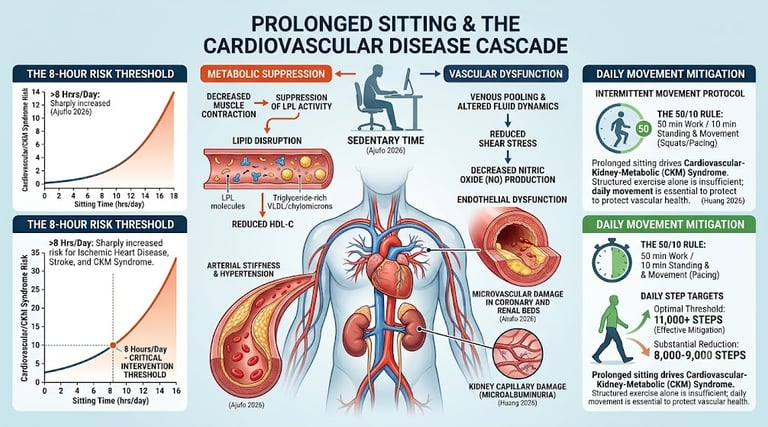
Prolonged sitting is an independent risk factor for cardiovascular disease. Spending more than 8 hours per day sedentary reduces blood flow, suppresses fat metabolism, impairs glucose regulation, and promotes inflammation. Breaking up sitting every 30–60 minutes and achieving 8,000–11,000 daily steps can substantially reduce these health risks.
Key Takeaways
Prolonged sitting is an independent cardiovascular risk factor. Spending more than 8 hours per day sedentary is consistently associated with a higher risk of cardiovascular disease, insulin resistance, chronic kidney disease, and premature mortality—even among people who exercise regularly.
Exercise alone cannot completely offset uninterrupted sitting. The "active couch potato" phenomenon shows that a daily workout does not fully reverse the metabolic and vascular damage caused by long, uninterrupted periods of sitting throughout the day.
The damage begins at the cellular level. Prolonged inactivity suppresses lipoprotein lipase (LPL) activity, reduces nitric oxide (NO) production, impairs GLUT-4–mediated glucose uptake, and promotes endothelial dysfunction, inflammation, and dyslipidemia.
Breaking up sitting is a powerful therapeutic strategy. Standing, walking, or performing light movement every 30–60 minutes restores muscle activity, improves vascular function, enhances glucose metabolism, and reduces cardiometabolic risk.
Daily step count is a practical prescription for cardiovascular protection. Current evidence suggests that 8,000–9,000 daily steps substantially reduce the health risks associated with prolonged sitting, while approximately 11,000 steps per day may largely offset excess cardiovascular risk in highly sedentary individuals.
Even light physical activity delivers measurable health benefits. Replacing just 30 minutes of sitting with light activities such as walking or household movement improves blood pressure, blood glucose regulation, and lipid metabolism, with greater benefits achieved through moderate-to-vigorous exercise.
Muscle is a critical metabolic organ—not just a source of strength. Preserving skeletal muscle through regular resistance training enhances glucose disposal, lipid clearance, vascular health, and long-term protection against Cardiovascular-Kidney-Metabolic (CKM) syndrome.
Modern cardiovascular prevention requires reducing sedentary time—not just increasing exercise. The strongest protection comes from combining regular structured exercise, frequent movement throughout the day, adequate daily step counts, and consistent resistance training to maintain lifelong cardiovascular and metabolic health.
Introduction
Modern convenience has inadvertently engineered physical movement out of our daily lives. Whether sitting at an office desk, commuting, or relaxing in front of a screen, the average adult spends a staggering 8 to 12 hours per day in a sedentary state. While it is easy to view sitting as merely a passive absence of exercise, recent clinical and epidemiological research reveals a far more concerning reality: prolonged sedentary behavior is an active, independent driver of cardiovascular-kidney-metabolic (CKM) syndrome, endothelial dysfunction, and premature mortality.
Crucially, emerging data demonstrates that a standard 30-minute workout may not be enough to completely undo the systemic damage caused by sitting for nine consecutive hours. This phenomenon, often termed the "active couch potato" effect, highlights the urgent need to understand the distinct physiological impact of uninterrupted sitting.
In this comprehensive, evidence-based guide, we will break down the latest clinical data from 2024–2026 regarding sedentary behavior and cardiovascular disease risk. You will discover the exact molecular mechanisms that occur when you sit, how daily step counts can offset these risks, and a practical, clinically verified blueprint to protect your vascular health without sacrificing your productivity.
1. The Physiology of Inactivity: What Happens When You Sit?
To understand why prolonged sitting accelerates cardiovascular disease (CVD), we must look beneath the surface at the acute physiological alterations that occur within hours of immobilization
The Molecular Mechanism: How Prolonged Sitting Harms the Heart
When you remain seated for uninterrupted periods, your body triggers two distinct, parallel pathways that actively damage your metabolic and vascular health.
1. The Metabolic Suppression Pathway (Lipid Disruption)
Decreased Skeletal Muscle Contraction: Sitting paralyzes the body's largest muscle groups (quadriceps, hamstrings, and glutes), stopping the mechanical contractions that power systemic metabolism.
Suppression of LPL (Lipoprotein Lipase) Activity: Without muscular contraction, the cellular signals that produce LPL drop drastically within hours. $LPL$ is the foundational enzyme responsible for clearing fats from your bloodstream.
Triglyceride Accumulation: Absent active LPL, the body cannot efficiently hydrolyze circulating very-low-density lipoproteins (VLDL) and chylomicrons, leading to elevated, sluggish blood lipid levels.
Reduced HDL-C Biogenesis: The breakdown in lipid processing directly halts the production of "good" high-density lipoprotein cholesterol ($HDL-C$), leaving your blood vessels unprotected against plaque formation.
2. The Vascular Hemodynamic Pathway (Endothelial Damage)
Altered Fluid Dynamics & Venous Pooling: Gravity causes blood to stagnate and pool in your lower extremities, reducing the volume of blood returning to your heart and disrupting healthy blood flow patterns.
Reduced Friction (Shear Stress): The slow, sluggish flow reduces the frictional force—known as fluid shear stress—exerted by blood against the inner lining of your arteries.
Decreased Nitric Oxide (NO) Production: Healthy shear stress is the primary trigger for endothelial cells to synthesize nitric oxide (NO)—the body's natural vasodilator and defense against arterial hardening. When shear stress drops, NO production plummets.
Endothelial Dysfunction: The loss of protective nitric oxide leaves your arteries constricted, stiff, inflamed, and highly susceptible to atherosclerosis, hypertension, and long-term cardiovascular damage.
Clinical Insight: This dual-pathway destruction explains the "active couch potato" phenomenon. Even if you have a great workout routine, allowing these two cascades to run uninterrupted for 8 to 10 hours a day progressively damages your cardiovascular, kidney, and metabolic systems.
The Suppression of Lipoprotein Lipase (LPL)
Lipoprotein lipase (LPL) is a foundational enzyme anchored to the capillary endothelium, primarily within skeletal muscle tissue. LPL plays a central role in lipid metabolism by hydrolyzing circulating triglycerides into free fatty acids for tissue uptake and oxidation. When large skeletal muscle groups—particularly the quadriceps, hamstrings, and gluteals—remain completely inactive during sitting, the cellular signals that stimulate LPL synthesis are blunted.
The Cascade: Within hours of uninterrupted sitting, skeletal muscle LPL activity drops significantly.
The Result: This suppression impairs the clearance of very-low-density lipoproteins (VLDL) and chylomicrons from the bloodstream, leading to elevated postprandial lipemia and a concurrent drop in high-density lipoprotein cholesterol (HDL-C) biogenesis.
Endothelial Dysfunction and Hydrostatic Shear Stress
The vascular endothelium is an active endocrine organ that responds dynamically to mechanical forces. Blood flowing through an artery exerts a frictional force on the endothelial surface known as fluid shear stress. This shear stress acts as a primary mechanical trigger for the production of endothelial nitric oxide synthase (eNOS), which synthesizes nitric oxide (NO)—the body's principal endogenous vasodilator and anti-atherosclerotic molecule.
When you sit for extended periods, several adverse hemodynamic shifts occur:
Venous Pooling: Gravity causes blood to pool in the lower extremities, reducing venous return to the heart.
Turbulent and Sluggish Flow: The reduction in cardiac output and lower extremity arterial blood flow transitions healthy, laminar shear stress into low or turbulent shear stress.
Loss of Nitric Oxide: Absent the stimulus of laminar shear stress, endothelial cells downregulate NO production. This promotes sustained vasoconstriction, leukocyte adhesion, pro-inflammatory cytokine expression, and systemic arterial stiffness.
Impaired Glucose Homeostasis and GLUT-4 Translocation
Skeletal muscle is the primary site for insulin-mediated glucose disposal. Under normal conditions of muscular contraction, intracellular vesicles containing glucose transporter type 4 (GLUT-4) migrate to the cell membrane. This translocation allows glucose to enter the muscle cells independently of insulin signaling.
Prolonged sitting keeps muscles in a state of metabolic torpor. Without the mechanical contractions that drive non-insulin-dependent GLUT-4 translocation, the body must secrete progressively higher amounts of insulin to clear dietary carbohydrates. Over time, this leads to down-regulation of insulin receptor sensitivity, chronic hyperinsulinemia, and systemic insulin resistance—a core precursor to atherogenesis.
2. The Latest Clinical Evidence (2024–2026): Interpreting the Data
The paradigm surrounding sedentary behavior has shifted due to high-quality, large-scale studies and meta-analyses published between 2024 and 2026. These papers utilize objective measurements (such as thigh- and wrist-worn accelerometers) rather than relying solely on self-reported questionnaires, which often underestimate total sitting time.
The NHANES Analysis (Huang et al., 2026)
A comprehensive analysis of National Health and Nutrition Examination Survey (NHANES) data by Huang and colleagues (2026) evaluated the longitudinal association between daily sedentary time and robust cardiovascular risk markers.
Findings: The researchers observed a non-linear, threshold-based increase in cardiovascular risk. Individuals exceeding 8 hours per day of total sedentary behavior exhibited a significantly higher hazard ratio for ischemic heart disease and stroke compared to those sitting fewer than 4 hours.
Clinical Relevance: The risk curve steepens sharply once sedentary time passes the 8-hour mark, suggesting a critical threshold for clinical intervention.
The Umbrella Review (O’Brien et al., 2024)
Published in Sports Medicine, this massive umbrella review consolidated data from dozens of systematic reviews and meta-analyses, examining the impact of sedentary behaviour on blood pressure and clinical CVD events.
Findings: The review established a clear, dose-dependent relationship between high sedentary time and elevated resting blood pressure, independent of structured exercise habits.
Clinical Relevance: It confirmed that sedentary behavior behaves as an independent pathogenic factor for hypertension and subclinical vascular damage.
The Large-Scale Meta-Analysis (Jingjie et al., 2022 / Updated 2025)
Building on earlier foundational work, updated meta-analyses of observational cohorts confirm that the highest quartiles of sedentary time carry a 20% to 35% relative risk increase for all-cause and cardiovascular mortality. These updates reinforce that the risk is particularly pronounced when sitting time is accumulated in long, uninterrupted bouts exceeding 30 to 60 minutes.
3. The CKM Syndrome Connection: Cardiovascular, Kidney, and Metabolic Health
In late 2023, the American Heart Association (AHA) formally defined Cardiovascular-Kidney-Metabolic (CKM) syndrome, recognizing the deep systemic interplay between metabolic disorders (insulin resistance, obesity), chronic kidney disease (CKD), and the cardiovascular system.
The JACC: Advances Study (Ajufo et al., 2026)
A landmark 2026 study published in JACC: Advances utilized accelerometer-measured sedentary behavior to trace the development of future disease through the lens of CKM health.
The Findings: Ajufo and colleagues demonstrated that prolonged sedentary time is directly linked to an accelerated progression through the stages of CKM syndrome. Even in individuals without baseline cardiovascular disease, high total sedentary time strongly predicted the onset of microalbuminuria (a marker of kidney capillary damage) and incident Type 2 diabetes.
The Mechanism: The study highlights that sedentary behavior drives visceral adiposity accumulation and chronic low-grade systemic inflammation (marked by elevations in high-sensitivity C-reactive protein, or hs-CRP). This systemic inflammation damages the microvasculature of both the glomerulus in the kidneys and the coronary arteries, underscoring the systemic nature of CKM syndrome.
4. Isotemporal Substitution: The Power of Swapping Sitting for Movement
Historically, public health recommendations focused almost entirely on adding exercise to one's day. However, because a day is fixed at 24 hours, any increase in active time must replace time spent in another behavior. This reality is analyzed using isotemporal substitution modeling.
The Systematic Review (Sun et al., 2026)
A 2026 systematic review published in Frontiers in Sports and Active Living investigated the exact cardiovascular outcomes of replacing sedentary time with various intensities of physical activity, focusing specifically on older adults.
Replacing 30 Minutes of Sitting with Light Physical Activity (LPA): Swapping 30 minutes of sitting for light movement (such as slow walking, casual tidying, or light gardening) led to measurable improvements in systolic blood pressure, fasting glucose, and lipid profiles.
Replacing 30 Minutes of Sitting with Moderate-to-Vigorous Physical Activity (MVPA): When that same 30-minute block of sitting was replaced with MVPA (such as brisk walking, cycling, or resistance training), the risk reduction for cardiovascular events dropped even more significantly.
Physiology & Behavior Analysis (Li & Sun, 2026)
Simultaneously, a 2026 study in Physiology & Behavior looked at the dual effects of physical activity and sedentary behavior on both cardiovascular and respiratory systems. Their data showed that substituting sedentary blocks with brief, high-intensity intervals or sustained moderate activity restored respiratory muscle efficiency, improved heart rate variability (HRV), and reduced arterial stiffness.
5. The Step-Count Solution: How Many Daily Steps Offset Sitting?
For many desk-bound professionals, eliminating sitting entirely is impractical. The critical question then becomes: How much physical activity is required to neutralize the cardiovascular damage of a sedentary lifestyle?
The "All of Us" Research Program Data (Zheng et al., 2026)
A major study published in Nature Communications (2026) utilized data from the National Institutes of Health’s All of Us Research Program to answer this question. By tracking thousands of participants using wearable devices, researchers analyzed how daily step counts interact with sedentary time to influence CVD risk.
The Threshold: The researchers found that the elevated cardiovascular risks associated with high sedentary time (>8 hours/day) were substantially reduced at 8,000 to 9,000 steps per day.
The Optimal Target: To fully flatten the hazard ratio curve and effectively neutralize the risk of a highly sedentary desk job, individuals needed approximately 11,000 steps per day. At this level, the excess cardiovascular risk from prolonged sitting was largely mitigated.
6. Clinical Interpretation and Real-World Importance
When evaluating this data from a clinical standpoint, it is helpful to look past relative risk percentages and focus on what these findings mean for long-term health and patient care.
Beyond the "Active Couch Potato"
A crucial clinical takeaway from the 2024–2026 literature is that structured exercise and sedentary behavior are distinct health factors. Going to the gym for 45 minutes in the morning does not grant a "vascular pass" to sit uninterrupted for the next 9 hours. The metabolic changes that occur during prolonged sitting—such as reduced LPL activity, decreased nitric oxide production, and altered fluid dynamics—happen continuously throughout those sedentary hours.
Why Muscle Mass and Contraction Matter
Skeletal muscle is a highly active metabolic organ. Muscle contractions do more than just burn calories; they act as a mechanical pump that assists venous return, stimulate endothelial health via shear stress, and clear glucose and triglycerides from circulation.
For aging individuals, protecting muscle tissue is an essential component of maintaining long-term metabolic health. Sarcopenia—the age-related loss of skeletal muscle mass and quality—reduces the body's primary reservoir for glucose storage and lipid clearance. When a person has less functional muscle mass, the metabolic consequences of prolonged sitting become even more pronounced.
Keeping muscles active through regular resistance training and breaking up sedentary blocks provides a double benefit: it preserves metabolic capacity and maintains the cellular pathways required to process glucose and lipids efficiently
.
7. The Anti-Sedentary Protocol: Actionable Daily Frameworks
To translate this scientific data into a practical routine, you can use the targeted, evidence-based frameworks below. These protocols are designed to break up sedentary time and accumulate enough daily movement to help protect your vascular system.
Protocol A: The Desk-Worker’s Intermittent Movement Strategy
Based on behavioral change techniques highlighted in recent scoping reviews (Wu et al., 2026), the goal here is to shift from uninterrupted sitting to structured, intermittent movement.
The 50/10 Rule: For every 50 minutes of continuous desk work, set a silent timer. Commit to 10 minutes of standing or light movement.
Movement Snacks: During those 10 minutes, perform low-intensity activities that stimulate lower-limb muscle contractions:
2 minutes of air squats or heel raises (to trigger GLUT-4 translocation).
8 minutes of casual walking around the office or home.
Phone Call Pacing: Make it a non-negotiable rule to stand up and pace during every voice call.
Protocol B: The 11,000-Step Accumulation Framework
To hit the optimal protective target identified in the 2026 Nature Communications study and neutralize the risks of a desk job, you can split your movement into four distinct, manageable blocks throughout the day:
Block 1: Morning (Pre-Work)
Activity Strategy: Take a 15–20 minute brisk outdoor walk right before starting your day.
Step Yield: Adds 2,000 to 2,500 steps to your baseline.
Block 2: Mid-Day (Lunch Break)
Activity Strategy: Commit to a 20-minute walk immediately after eating. This specific timing utilizes postprandial (post-meal) muscle contractions to improve acute glycemic control and blunt blood sugar spikes.
Step Yield: Adds 2,500 to 3,000 steps to your baseline.
Block 3: Evening (Post-Work)
Activity Strategy: Complete a 30–40 minute sustained walk or a structured resistance/cardio training session to clear accumulated daily stress and stimulate full-body circulation.
Step Yield: Adds 4,500 to 5,500 steps to your baseline.
Block 4: Passive Accumulation (Throughout the Day)
Activity Strategy: Weave short movement habits into your office routine—take the stairs, pace during phone calls, and use the 50/10 intermittent desk strategy.
Step Yield: Adds approximately 1,000 steps to your baseline.
The Bottom Line: Combining these four structured blocks easily clears the 11,000+ total daily steps threshold, effectively flattening the cardiovascular hazard ratio curve and protecting your vascular system from the damage of prolonged sitting.
8 .Key Clinical Studies: Quick Breakdown
1. The 8-Hour Danger Threshold (Huang et al., 2026)
Journal: Cardiovascular Therapeutics
Study Design: Epidemiological Analysis utilizing robust NHANES data.
Core Focus: Total daily sedentary time mapped against objective cardiovascular disease (CVD) risk markers.
Primary Findings: Cardiovascular and ischemic risk curves show a non-linear, sharp upward acceleration once total sitting time crosses 8 hours per day.
Clinical Importance: Establishes a concrete 8-hour threshold for clinicians to screen, risk-stratify, and advise patients on sedentary behavior limits.
2. The Microvascular & Organ Damage Connection (Ajufo et al., 2026)
Journal: JACC: Advances
Study Design: Prospective Cohort utilizing precise, objective accelerometer tracking.
Core Focus: Uninterrupted physical inactivity and its longitudinal tracking of future Cardiovascular-Kidney-Metabolic (CKM) disease.
Primary Findings: Prolonged sitting actively accelerates a patient's progression through CKM syndrome stages, independently driving early microalbuminuria (kidney capillary leakage) and insulin resistance.
Clinical Importance: Demonstrates that sedentary behaviour causes widespread, systemic microvascular damage affecting the renal glomerulus and coronary beds simultaneously.
3. The Daily Step Countermeasure (Zheng et al., 2026)
Journal: Nature Communications
Study Design: Multi-Cohort Analysis via the National Institutes of Health All of Us Research Program.
Core Focus: The direct interaction between a patient's daily step volume and their total daily sedentary hours.
Primary Findings: The elevated risk of a highly sedentary lifestyle begins to drop significantly at 8,000 to 9,000 steps per day, and is completely neutralized or flattened at 11,000 steps per day.
Clinical Importance: Provides clear, device-measurable lifestyle targets that clinicians can prescribe to desk-bound professionals.
4. The Power of Small Substitutions (Sun et al., 2026)
Journal: Frontiers in Sports and Active Living
Study Design: Systematic Review utilizing isotemporal substitution modeling.
Core Focus: Swapping fixed blocks of sitting time for either Light Physical Activity (LPA) or Moderate-to-Vigorous Physical Activity (MVPA) in older adults.
Primary Findings: Replacing just 30 minutes of sedentary time with Light Physical Activity (such as casual walking or moving) yields measurable, statistically significant reductions in resting blood pressure and lipid markers.
Clinical Importance: Confirms that minor, low-intensity daily adjustments offer measurable vascular protection, which is particularly vital for geriatric patients with limited exercise tolerance.
5. The Hypertension Link (O’Brien et al., 2024)
Journal: Sports Medicine
Study Design: Massive Umbrella Review of global systematic reviews and meta-analyses.
Core Focus: The impact of long-term sedentary behavior on resting blood pressure and hard clinical CVD events.
Primary Findings: Confirmed a direct, independent, dose-dependent relationship between high sitting time and elevated resting blood pressure.
Clinical Importance: Solidifies prolonged sitting as an independent risk factor for increased systemic vascular resistance and subclinical arterial stiffness, entirely distinct from a patient's structured exercise habits.
9. Common Myths and Mistakes About Sedentary Behavior
Myth 1: "I go to the gym for an hour every morning, so I am not sedentary."
The Reality: As established by the latest 2026 data, structured exercise does not completely erase the metabolic and vascular changes caused by sitting for the rest of the day. You can be highly active at 7:00 AM, and still experience suppressed $LPL$ activity and lower extremity venous pooling if you sit continuously from 9:00 AM to 5:00 PM. Intermittent movement throughout the day is essential.
Myth 2: "Standing desks solve all the cardiovascular risks of sitting."
The Reality: While standing desks help prevent lower limb blood pooling and slightly increase caloric expenditure compared to sitting, standing completely still for hours presents its own vascular challenges, including lower-extremity venous stasis. The true benefit comes from dynamic muscle contraction—walking, shifting weight, calf raises, and moving—rather than static standing.
Myth 3: "Light movement like slow walking doesn't help my heart."
The Reality: The 2026 isotemporal substitution models show that replacing 30 minutes of sitting with light physical activity (LPA) measurably improves blood pressure and metabolic markers. Light movement triggers skeletal muscle contractions, which are sufficient to restart $LPL$ activity and facilitate glucose uptake through GLUT-4 pathways.
10. Frequently Asked Questions (FAQs)
1. Exactly how many hours of sitting per day increases my risk for heart disease?
According to the 2026 NHANES analysis by Huang et al., cardiovascular risk rises in a non-linear fashion, with a distinct, sharp increase observed once total accumulated sedentary time exceeds 8 hours per day.
2. Can I offset a full day of office sitting by walking more?
Yes. The 2026 Nature Communications study from the All of Us Research Program demonstrated that accumulating 8,000 to 9,000 steps per day significantly reduces the cardiovascular risks of sitting. Reaching approximately 11,000 steps per day effectively neutralizes the excess risk associated with high sedentary time.
3. What is Cardiovascular-Kidney-Metabolic (CKM) syndrome, and how does sitting affect it?
Defined by the American Heart Association, CKM syndrome describes the systemic link between metabolic conditions, kidney disease, and cardiovascular pathology. Ajufo et al. (2026) showed that prolonged sitting accelerates CKM progression by promoting visceral adiposity, systemic inflammation, and microvascular damage, which can manifest as microalbuminuria and insulin resistance.
4. How often should I break up my sitting time during the workday?
Clinical data suggests breaking up sedentary time every 30 to 60 minutes is ideal. Implementing a "50/10" strategy—50 minutes of work followed by 10 minutes of standing, pacing, or performing light muscle contractions—helps maintain vascular shear stress and keeps metabolic pathways active.
5. Why is a single workout session insufficient to reverse the damage of sitting?
Uninterrupted sitting causes a rapid downregulation of lipoprotein lipase (LPL) activity in skeletal muscle and reduces nitric oxide synthesis due to diminished fluid shear stress. These adverse physiological shifts occur continuously during the hours you are sitting. A single workout provides an acute metabolic boost but does not prevent the vascular and lipid stagnation that accumulates over hours of stillness.
6. Does sitting affect blood pressure directly?
Yes. The 2024 umbrella review published in Sports Medicine established that prolonged sedentary behavior is directly linked to elevated resting blood pressure and increased arterial stiffness, independent of your structured exercise habits.
7. What type of exercise is best for replacing sedentary time?
While moderate-to-vigorous physical activity (MVPA) like brisk walking, cycling, or resistance training yields the largest relative risk reductions, light physical activity (LPA)—such as slow walking or casual movement—still offers meaningful improvements in blood pressure and glycemic control when substituted for sitting.
8. Are there simple psychological or behavioral techniques to help reduce sitting?
As noted in behavioral scoping reviews (Wu et al., 2026), effective strategies include using habit-stacking (e.g., "whenever I am on a phone call, I must stand"), environmental cues (such as setting an hourly vibration alarm on a smartwatch), and monitoring your daily progress with a step tracker.
11. Conclusion and Action Plan
The scientific consensus from 2024–2026 is clear: prolonged sedentary behavior is a distinct health risk factor that can lead to subclinical vascular damage, metabolic dysfunction, and an increased risk of Cardiovascular-Kidney-Metabolic (CKM) syndrome. Structured exercise remains essential, but protecting your heart also requires mindful attention to how much you move throughout the day.
Your Vascular Protection Action Plan:
Monitor Your Baseline: Use a wearable tracker to assess your current daily sitting hours and step count.
Break Up Sedentary Blocks: Set a recurring timer to ensure you stand and move for 5 to 10 minutes after every 50 minutes of continuous sitting.
Target the Protective Range: Incorporate dedicated walking blocks—such as a 15-minute walk after meals—to move your daily total toward the highly protective threshold of 8,000 to 11,000 steps.
Prioritize Muscle Health: Maintain a consistent routine of resistance training to preserve the skeletal muscle mass necessary for optimal metabolic function and lipid clearance.
Medical Disclaimer
The information in this article, including the research findings, is for educational purposes only and does not constitute medical advice, diagnosis, or treatment. Before starting an exercise program, you must consult with a qualified healthcare professional, especially if you have existing health conditions (such as cardiovascular disease, uncontrolled hypertension, or advanced metabolic disease). Exercise carries inherent risks, and you assume full responsibility for your actions. This article does not establish a doctor-patient relationship.
Related Articles
References
Huang, H., Zheng, Z., Yu, Z., Feng, F., Zhang, Z., Fan, B., & Meng, L. (2026). The Association Between Sedentary Behavior and Cardiovascular Disease Risk: An Analysis Based on NHANES Data. Cardiovascular Therapeutics, 2026, Article 6940329. https://doi.org/10.1155/cdr/6940329
Ajufo, E., Kany, S., Rämö, J. T., Churchill, T. W., Guseh, J. S., Aragam, K. G., Ellinor, P. T., & Khurshid, S. (2026). Accelerometer-measured sedentary behavior, future disease, and cardiovascular-kidney-metabolic health. JACC: Advances, 5(5), Article 102718. https://doi.org/10.1016/j.jacadv.2026.102718
Zheng, N. S., Huang, S., Annis, J., et al. (2026). Daily steps offset risks of sedentary behavior in the All of Us research program. Nature Communications, 17, Article 4936. https://doi.org/10.1038/s41467-026-71652-0
Wu, C., Zhou, Q., Yang, Y., & Yang, L. (2026). Behavior change techniques to reduce sedentary behavior and increase physical activity in people at risk for cardiovascular disease: a scoping review. Frontiers in Sports and Active Living, 8, Article 1639584. https://doi.org/10.3389/fspor.2026.1639584
Sun, X., Zhou, Z., Guo, J., Tian, Z., & Gu, N. (2026). Isotemporal substitution of sedentary time with physical activity for cardiovascular health in older adults: a systematic review. Frontiers in Sports and Active Living, 8, Article 1708003. https://doi.org/10.3389/fspor.2026.1708003
Li, Z., & Sun, Y. (2026). Effects of physical activity and sedentary behavior on cardiovascular disease and respiratory diseases. Physiology & Behavior, 310, Article 115297. https://doi.org/10.1016/j.physbeh.2026.115297
O’Brien, M. W., Shivgulam, M. E., Domínguez, A. H., et al. (2024). Impact of Sedentary Behaviors on Blood Pressure and Cardiovascular Disease: An Umbrella Review of Systematic Reviews and Meta-Analyses. Sports Medicine, 54(11), 3097–3110. https://doi.org/10.1007/s40279-024-02099-w
Jingjie, W., Yang, L., Jing, Y., et al. (2022). Sedentary time and its association with risk of cardiovascular diseases in adults: an updated systematic review and meta-analysis of observational studies. BMC Public Health, 22, Article 286. https://doi.org/10.1186/s12889-022-12728-6