Why High-Polyphenol Extra Virgin Olive Oil Is Better for Your Heart
Discover what the latest 2026 clinical trials reveal about extra virgin olive oil and heart health. Learn how EVOO affects cholesterol, inflammation, blood pressure, and cardiovascular disease—and how much you should consume.
NUTRITIONHEART
Dr. T.S. Didwal, M.D.(Internal Medicine)
7/3/202618 min read
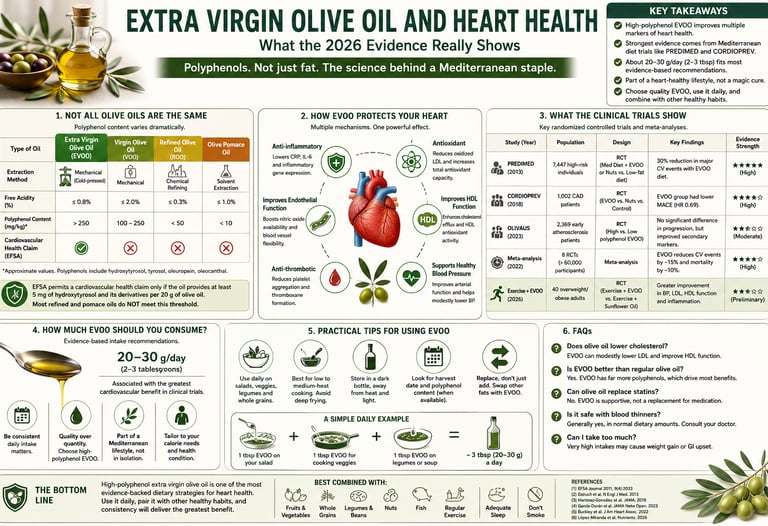
Extra virgin olive oil (EVOO) supports heart health by reducing inflammation, protecting LDL from oxidation, improving blood vessel function, and modestly lowering blood pressure. The strongest evidence suggests consuming about 1.5–2 tablespoons (20–30 g) daily as part of a Mediterranean-style diet, replacing saturated fats rather than adding extra calories.
Key points:What the Latest Research Says About Extra Virgin Olive Oil (EVOO) and Heart Health
Not all olive oils offer the same heart benefits. The strongest evidence applies only to high-polyphenol extra virgin olive oil (EVOO). According to the European Food Safety Authority (EFSA), heart-health claims require at least 5 mg of hydroxytyrosol and related polyphenols per 20 g of oil. Refined, "light," and pomace olive oils lose most of these protective compounds during processing.
EVOO protects your heart through multiple mechanisms. Rather than working in just one way, EVOO helps reduce chronic inflammation (CRP and IL-6), protects LDL ("bad") cholesterol from oxidation, improves blood vessel function by increasing nitric oxide availability, and supports healthier blood pressure and circulation. These combined effects help slow the development of atherosclerosis.
Large clinical trials confirm real cardiovascular benefits. Landmark studies such as PREDIMED and CORDIOPREV demonstrate that an EVOO-rich Mediterranean diet reduces the risk of major cardiovascular events. In people with established coronary heart disease, CORDIOPREV showed fewer recurrent heart attacks and strokes over approximately seven years compared with a low-fat diet.
People with diabetes may benefit even more. Research from the CORDIOPREV trial found that EVOO-rich diets significantly improved blood vessel function in people with prediabetes and type 2 diabetes, suggesting that individuals with metabolic disease may experience greater vascular benefits than healthy adults.
New 2026 research suggests EVOO may enhance the benefits of exercise. An early clinical trial found that consuming EVOO after supervised exercise improved HDL ("good") cholesterol, reduced inflammatory markers such as IL-6, and lowered P-selectin, a marker linked to platelet activation and blood clot formation. Although promising, this study was small and should be considered preliminary until confirmed in larger trials.
The evidence is strong—but not every study shows the same results. High-quality studies consistently report improvements in inflammation, blood pressure, and several cardiovascular biomarkers. However, some trials, including the OLIVAUS studies, found that while EVOO improved HDL levels and systolic blood pressure, it did not consistently improve HDL's cholesterol-removing function. This highlights the importance of interpreting the research objectively.
Aim for replacement—not simply adding more calories. Most clinical studies support consuming 20–30 g (about 1½–2 tablespoons) of EVOO daily. For the greatest heart benefit, EVOO should replace butter, margarine, and other less healthy fats, rather than being added to an already high-calorie diet.
Store EVOO properly to preserve its heart-protective compounds. Polyphenols gradually break down when exposed to light, heat, and air. Choose EVOO packaged in dark glass bottles or tins, store it in a cool, dark place, and use it within a few months after opening to maintain its antioxidant and anti-inflammatory properties. People taking blood-thinning medications should discuss major dietary changes with their healthcare provider because EVOO has mild natural anti-platelet effects.
Introduction
If you've stood in a grocery aisle wondering whether the extra virgin olive oil (EVOO) in your cart is actually doing anything for your heart, you're asking the right question. Olive oil has been marketed as a "heart-healthy fat" for decades, but the label gets stretched to cover products that share little more than a bottle shape with the real thing.
The good news: the clinical evidence behind genuine, polyphenol-rich extra virgin olive oil is unusually strong for a nutrition topic. It spans large cohort studies, randomized controlled trials, and — as of 2025 and 2026 — new mechanistic and exercise-combination research that clarifies how and for whom EVOO helps the cardiovascular system.
What Makes EVOO Different From Other Olive Oils
"Olive oil" on a label can mean several very different products. The distinction isn't marketing fluff — it changes the chemistry your body absorbs.
Extra virgin olive oil (EVOO): Mechanically extracted, unrefined, with free acidity under 0.8%. Retains the highest concentration of phenolic compounds — hydroxytyrosol, tyrosol, oleuropein, and oleocanthal.
Virgin olive oil (VOO): Also unrefined but with slightly higher acidity and generally lower phenolic content.
Refined olive oil (ROO): Chemically processed to remove defects, which strips out most polyphenols in the process.
Olive pomace oil: Extracted from leftover pulp using solvents; the lowest-quality, lowest-polyphenol category.
This matters because regulators have drawn a hard line based on phenolic content. The European Food Safety Authority (EFSA) permits a cardiovascular health claim on olive oil only when it contains at least 5 mg of hydroxytyrosol and its derivatives per 20 g — a threshold refined and pomace oils typically don't meet.<cite index="3-1">Products marketed generically as "olive oil" without meeting this phenolic threshold are not backed by the same evidence base as true high-polyphenol EVOO</cite>. In practical terms: the polyphenols, not just the monounsaturated fat, are doing much of the cardiovascular work — which is why swapping in a cheap "light" or refined olive oil doesn't replicate the research findings below.
How EVOO Affects the Cardiovascular System: The Mechanisms
Cardiovascular disease develops through several interacting pathways: chronic low-grade inflammation, oxidative damage to LDL particles, endothelial dysfunction, unfavorable lipid profiles, and abnormal blood clotting (thrombosis). EVOO's phenolic compounds appear to intervene at multiple points in this chain.
1. Anti-inflammatory activity
Chronic inflammation — tracked clinically via C-reactive protein (CRP) and interleukin-6 (IL-6) — is now recognized as a direct contributor to atherosclerotic plaque formation, not just a bystander marker. In several controlled trials, high-polyphenol olive oil reduced CRP and IL-6 more than lower-polyphenol comparators, and a Mediterranean diet rich in EVOO reduced postprandial expression of inflammatory genes (including NF-κB and TNF-α) compared with saturated-fat-rich or refined-carbohydrate diets.<cite index="3-1">A Mediterranean diet enriched with virgin olive oil produced significantly lower postprandial expression of inflammatory genes than a diet high in saturated fat</cite>
2. Antioxidant protection of LDL particles
Oxidized LDL (ox-LDL) is more atherogenic than native LDL — it's more readily taken up by arterial wall macrophages, accelerating plaque buildup. Hydroxytyrosol and oleuropein act as direct free-radical scavengers. Trials substituting high-polyphenol for low-polyphenol olive oil have shown measurable drops in ox-LDL alongside increases in total antioxidant capacity, particularly in people carrying abdominal obesity or elevated baseline inflammation.
3. Improved endothelial function
The endothelium — the single-cell lining of blood vessels — regulates vascular tone via nitric oxide (NO). Dysfunction here is one of the earliest detectable steps toward atherosclerosis. Trials measuring flow-mediated dilation (FMD, a standard endothelial function test) found that phenol-rich olive oil consumption increased nitric oxide metabolites and improved FMD, especially in people with prediabetes or type 2 diabetes, more so than in metabolically healthy participants.
4. Favorable shifts in lipid and lipoprotein profiles
EVOO's monounsaturated fat (mainly oleic acid) modestly raises HDL cholesterol and improves the ratio of HDL to LDL particles, and some trials report improvements in HDL's functional "cholesterol efflux capacity" — its ability to actually clear cholesterol from artery walls, not merely its concentration in blood. This functional distinction matters more than raw HDL numbers, which is a nuance many popular articles skip.
5. Reduced platelet activation and clotting risk
Hydroxytyrosol has been shown in laboratory studies to blunt thrombin-induced platelet activation, a mechanism relevant to the formation of clots that trigger heart attacks and strokes. P-selectin, a molecule expressed on activated platelets and endothelial cells during clot formation, is one biomarker researchers use to track this pathway — and it's a marker that shows up directly in the newest 2026 research discussed below.
6. Blood pressure effects
High-polyphenol EVOO has produced modest but statistically significant reductions in systolic blood pressure (roughly 2–3 mmHg) in controlled crossover trials, without significant effects on diastolic pressure or arterial stiffness. A 2–3 mmHg reduction sounds small, but at a population level, this magnitude of systolic BP reduction is associated with meaningfully lower stroke and coronary event rates.
What the Clinical Trials Actually Show
Rather than citing "studies show," here's what the highest-quality human trials and reviews have actually found, including where results were mixed.
PREDIMED and its metabolomic follow-ups. In the landmark Spanish PREDIMED trial, a Mediterranean diet supplemented with EVOO reduced major cardiovascular events in people at high cardiovascular risk compared with a low-fat diet. Subsequent metabolomic analyses of PREDIMED participants found that plasma metabolite profiles reflecting higher olive oil intake were inversely associated with cardiovascular disease incidence, though the same profiles were not significantly linked to type 2 diabetes risk — an important distinction between EVOO's cardiovascular and metabolic effects.
CORDIOPREV. In patients who already had coronary heart disease, a Mediterranean diet rich in olive oil outperformed a low-fat diet at preventing recurrent cardiovascular events over roughly seven years of follow-up, and separately improved endothelial function specifically in participants with type 2 diabetes or prediabetes — with no significant difference between diets in people without diabetes.
A 2025 systematic review (17 trials, Nutrients journal). This review pooled clinical trial data across two decades and consistently found favorable shifts in inflammatory markers (CRP, IL-6), oxidative stress markers (ox-LDL, total antioxidant capacity), endothelial function (flow-mediated dilation, nitric oxide metabolites), and blood pressure with higher-polyphenol olive oil — while explicitly noting that <cite index="3-1">further multicenter clinical studies enrolling a wider range of patients are still needed to confirm and better characterize these effects</cite>.
The OLIVAUS trials (Australia). These crossover trials compared high-polyphenol to low-polyphenol EVOO directly (rather than olive oil versus a non-olive-oil diet), isolating the polyphenol variable. Results were mixed but informative: high-polyphenol EVOO improved HDL lipid fraction and reduced systolic blood pressure, but did not significantly improve HDL's cholesterol efflux capacity — a reminder that not every proposed mechanism holds up when tested directly.
Guasch-Ferré et al. (JACC, 2020), U.S. cohort data. In large American cohorts, higher olive oil intake (replacing margarine, butter, or mayonnaise) was associated with lower cardiovascular disease risk, reinforcing that these findings aren't limited to Mediterranean populations already eating an otherwise olive-oil-centric diet.
Where the evidence is weaker. Several trials found statistically significant within-group improvements (e.g., a marker improved over time in the EVOO group) without reaching significance in the between-group comparison against placebo or a control oil — a distinction that's easy to gloss over in headlines but matters enormously for how confidently you can attribute the effect to EVOO itself rather than chance or other lifestyle factors.
New for 2026: Can Extra Virgin Olive Oil Enhance the Benefits of Exercise?
One of the most interesting studies published in 2026 explored whether extra virgin olive oil (EVOO) can provide additional heart-health benefits when combined with regular exercise. Unlike earlier research that focused mainly on diet, this study investigated whether adding EVOO to a structured exercise program could further improve cardiovascular health.
How was the study conducted?
Researchers enrolled 17 sedentary, overweight men aged 40–60 years. Participants completed an 8-week supervised exercise program that combined aerobic and resistance training three times per week.
After each workout:
One group consumed high-quality extra virgin olive oil (0.2–0.4 g per kilogram of body weight).
The other group received a glycerin placebo.
Researchers measured several markers of heart health before the study and again 48 hours after the final exercise session, including:
C-reactive protein (CRP) – a marker of inflammation
Interleukin-6 (IL-6) – another inflammatory marker
HDL ("good") cholesterol
P-selectin – a marker linked to platelet activation and blood clot formation
Cardiac troponin I – a marker of heart muscle stress
Blood lipids
Natural antioxidant enzymes that help protect cells from oxidative damage
What Did the Study Find?
The results suggest that combining exercise with EVOO may provide additional cardiovascular benefits beyond exercise alone.
Lower inflammation
CRP levels decreased only in the group that exercised and consumed EVOO. However, the difference between the two groups was not statistically significant, meaning researchers cannot say with certainty that EVOO alone caused this improvement.
Higher HDL ("Good") Cholesterol
The EVOO group experienced a significantly greater improvement in HDL cholesterol, suggesting that EVOO may enhance some of the beneficial effects of regular exercise on cholesterol metabolism.
Improved Cardiovascular Biomarkers
Participants taking EVOO also showed more favorable changes in:
IL-6, indicating reduced inflammation
P-selectin, suggesting lower platelet activation and potentially reduced blood clotting activity
Cardiac troponin I, a marker associated with heart muscle stress
These findings suggest that EVOO may help support cardiovascular health through several complementary biological pathways.
Antioxidant Effects
Natural antioxidant enzymes increased in both groups, with somewhat greater improvements in the EVOO group. However, these differences were not statistically significant, so more research is needed before drawing firm conclusions.
What Does This Mean for You?
This study provides encouraging early evidence that consuming extra virgin olive oil alongside a regular exercise program may offer additional heart-health benefits, particularly by improving HDL cholesterol and reducing certain inflammatory and clotting-related biomarkers.
However, it's important to keep the findings in perspective.
The study included only 17 participants and lasted just eight weeks. Because of its small size, researchers consider it preliminary rather than definitive. Larger, longer-term clinical trials are needed to confirm whether these benefits translate into fewer heart attacks, strokes, or other cardiovascular events.
Bottom Line
Current evidence suggests that regular exercise remains the cornerstone of cardiovascular health. Adding high-polyphenol extra virgin olive oil to an overall heart-healthy Mediterranean-style diet may provide additional benefits, but it should be viewed as a supportive dietary strategy—not a substitute for exercise, healthy eating, or prescribed medications. The 2026 study is an exciting step forward, but more research is needed before routine post-exercise EVOO supplementation can be formally recommended.
Evidence Summary: Key Clinical Studies on Extra Virgin Olive Oil (EVOO) and Heart Health
PREDIMED (Estruch et al., 2018)
Population: Adults at high cardiovascular risk in Spain
Study Design: Large randomized controlled trial (RCT)
Key Finding: An EVOO-enriched Mediterranean diet significantly reduced major cardiovascular events compared with a low-fat diet.
Strength of Evidence: ⭐⭐⭐⭐⭐ High (Landmark RCT)
CORDIOPREV (Delgado-Lista et al., 2022; Torres-Peña et al., 2018)
Population: Patients with established coronary heart disease
Study Design: Randomized controlled trial with approximately 7 years of follow-up
Key Findings:
Reduced recurrent cardiovascular events (Delgado-Lista et al., 2022)
Improved endothelial function in people with prediabetes and type 2 diabetes (Torres-Peña et al., 2018)
Strength of Evidence: ⭐⭐⭐⭐⭐ High
2025 Systematic Review (Ussia et al., 2025)
Population: Adults with cardiovascular disease or elevated cardiovascular risk
Study Design: Systematic review of 17 clinical trials
Key Findings:
Reduced inflammatory markers
Lower oxidative stress
Improved endothelial function
Modest reductions in blood pressure
Strength of Evidence: ⭐⭐⭐⭐☆ Moderate to High (Some study heterogeneity)
OLIVAUS Trials (Sarapis et al. 2023)
Population: Healthy Australian adults
Study Design: Double-blind crossover randomized controlled trials
Key Findings:
Improved HDL lipid profile
Reduced systolic blood pressure
Enhanced antioxidant status
No significant improvement in HDL cholesterol efflux capacity
Strength of Evidence: ⭐⭐⭐☆☆ Moderate
Population: Large U.S. adult cohorts
Study Design: Prospective cohort study
Key Finding: Higher olive oil consumption was associated with a lower risk of cardiovascular disease.
Strength of Evidence: ⭐⭐⭐☆☆ Moderate (Observational)
Population: Overweight men aged 40–60 years participating in supervised exercise
Study Design: Small randomized controlled trial (n = 17)
Key Findings:
Improved HDL cholesterol
Lower IL-6 (inflammation)
Reduced P-selectin expression
Lower cardiac troponin I
Suggests potential additional cardiovascular benefits when EVOO is combined with exercise
Strength of Evidence: ⭐⭐☆☆☆ Low to Moderate (Small sample size and short intervention duration)How Much EVOO Should You Actually Consume? {#how-much}
Based on the trials above, the effective range clusters consistently:
Cardiovascular-risk-reduction studies (PREDIMED, cohort data): roughly 20–30 g/day (about 1.5–2 tablespoons) as part of an overall Mediterranean-style eating pattern — not olive oil poured onto an otherwise unchanged diet.
High-polyphenol crossover trials (OLIVAUS, Sarapis et al.): around 60 mL/day (about 4 tablespoons) of high-polyphenol EVOO specifically, though this is a research dose rather than a general public health recommendation.
The 2026 exercise study: a post-exercise dose scaled to body weight (0.2–0.4 g/kg), which for a 90 kg (198 lb) man works out to roughly 18–36 g per session.
For most people, 2 tablespoons (about 27 g) daily, used as the primary cooking and dressing fat — replacing butter, margarine, or refined vegetable oils rather than adding on top of them — reflects the intake level behind most of the strongest outcome data.
Consult your doctor before making significant dietary changes if you have an existing cardiovascular condition, are on anticoagulant or antiplatelet medication (EVOO's mild anti-platelet effect could theoretically add to these drugs' effects), or have a fat-restricted diet for another medical reason.
Practical Application: Getting EVOO Into Your Diet
Choosing a bottle that actually delivers polyphenols:
Look for a harvest date, not just an expiration date — polyphenol content degrades over time and with heat/light exposure.
Dark glass or tin packaging protects against light-driven oxidation.
A peppery, slightly bitter finish when tasted straight is a rough sensory indicator of higher phenolic content (oleocanthal specifically produces that throat-catching sensation).
Store away from heat and light, and use within a few months of opening.
Using it without destroying the compounds:
EVOO is reasonably heat-stable for everyday sautéing and roasting (smoke point roughly 375–410°F/190–210°C depending on quality), but very high-heat searing or deep frying will degrade more of the phenolic content than gentler cooking methods.
Using it raw — as a finishing drizzle, in dressings, or stirred into cooked vegetables just before serving — preserves the most polyphenols.
A simple weekly framework:
Replace butter/margarine on bread with EVOO and a pinch of herbs.
Use EVOO as the base for salad dressings instead of bottled dressings.
Finish cooked vegetables, legumes, or soups with a tablespoon of EVOO after cooking.
Use it as the primary cooking fat for weeknight sautéing.
If you exercise regularly, consider a small post-workout serving alongside a protein source, mirroring the 2026 study's protocol — though this remains an exploratory, not established, practice.
Common Myths and Mistakes
Myth: "All olive oil is the same." As covered above, refined and pomace oils lose most of the phenolic compounds responsible for the cardiovascular effects seen in trials. The fat content is similar; the bioactive compound content is not.
Myth: "More is always better." Olive oil is calorically dense (about 120 kcal per tablespoon). Trial doses in the 20–60 mL/day range were typically used to replace other fats, not added on top of an already high-fat diet. Unlimited intake without replacing other fats can contribute to excess calorie intake.
Myth: "Olive oil alone will offset a poor diet." The strongest outcome data (PREDIMED, CORDIOPREV) tested EVOO within a broader Mediterranean dietary pattern — high in vegetables, legumes, fish, and nuts, low in processed foods — not as an isolated add-on to an otherwise unchanged Western diet.
Mistake: Cooking with a cheap "light" or "pure" olive oil. These labels typically refer to a milder flavor from more processing, which strips polyphenols — not a "lighter" calorie content.
Mistake: Buying based on price alone. Olive oil fraud (mislabeling refined or blended oils as extra virgin) is a well-documented problem in the industry. Purchasing from producers with clear harvest dates and third-party certification reduces this risk.
FAQs
Does extra virgin olive oil lower cholesterol? It modestly raises HDL ("good") cholesterol and, in high-polyphenol formulations, has reduced oxidized LDL in several trials — though effects on total or LDL cholesterol numbers are generally smaller than its effects on inflammation and oxidative markers.
How much olive oil per day is heart-healthy? Most supportive evidence centers on roughly 20–30 g (1.5–2 tablespoons) daily as part of a Mediterranean-style diet, used to replace other fats rather than added on top of them.
Is extra virgin olive oil better than regular olive oil for the heart? Yes, based on current evidence — EVOO retains substantially more phenolic compounds (hydroxytyrosol, oleuropein, oleocanthal) than refined "regular" or "light" olive oil, and it's specifically these compounds that drive most of the anti-inflammatory and antioxidant effects documented in trials.
Can olive oil replace cholesterol medication? No. None of the trials discussed here tested EVOO as a replacement for statins or other prescribed cardiovascular medications; it has been studied as a dietary adjunct alongside standard medical care, not a substitute for it.
Does heating olive oil destroy its health benefits? Moderate cooking heat degrades some but not all phenolic compounds; EVOO remains more heat-stable than commonly assumed for typical home cooking, though raw use preserves the most polyphenols.
Is olive oil good for people with diabetes? Trial data (including CORDIOPREV) suggests EVOO-rich Mediterranean diets may improve endothelial function specifically in people with type 2 diabetes or prediabetes, though effects on diabetes risk itself have been less consistent than effects on cardiovascular outcomes.
What's the difference between EVOO and "high-polyphenol" EVOO? All genuine EVOO retains more polyphenols than refined oil, but "high-polyphenol" products (often explicitly labeled with a polyphenol content, e.g., >250 mg/kg) go further and were the specific formulations used in several of the trials showing blood pressure and antioxidant benefits.
Can extra virgin olive oil help after a heart attack? The CORDIOPREV trial specifically studied people with existing coronary heart disease and found EVOO-rich Mediterranean diets reduced recurrent cardiovascular events compared with a low-fat diet over roughly seven years — but this should always be discussed with your cardiologist alongside prescribed secondary-prevention treatment.
Does combining olive oil with exercise add extra benefit? Early 2026 research combining EVOO supplementation with structured exercise found favorable shifts in HDL, inflammatory markers, and clotting-related biomarkers compared with exercise alone — but the trial was small (17 participants) and its authors urged cautious interpretation.
Are olive oil supplements (capsules) as effective as the oil itself? Most of the strongest clinical data used liquid EVOO consumed with food, not concentrated supplements; capsule formulations haven't been studied to the same extent, so it's premature to assume equivalent effects.
Does olive oil interact with blood thinners? EVOO's mild anti-platelet activity is a theoretical consideration for people on anticoagulant or antiplatelet medication. This hasn't been shown to cause clinically significant interactions at dietary doses, but you should discuss any substantial dietary change with your prescribing physician.
What's the best way to store olive oil to preserve its benefits? Keep it in a dark glass or tin container, away from heat and direct light, and use it within a few months of opening — phenolic content declines with time and oxidative exposure.
Conclusion and Action Steps
The evidence for extra virgin olive oil's cardiovascular benefits is genuinely strong by nutrition-science standards — anchored by large randomized trials like PREDIMED and CORDIOPREV, reinforced by a 2025 systematic review of 17 clinical studies, and now extended by early 2026 research into how EVOO interacts with exercise. At the same time, honest reporting means acknowledging where results were mixed, sample sizes were small, or between-group differences didn't reach statistical significance — that nuance is what separates a trustworthy summary from a marketing claim.
Your next steps:
Choose a genuine, dark-bottled, harvest-dated extra virgin olive oil — not a refined or "light" product.
Aim for roughly 1.5–2 tablespoons daily, used to replace butter, margarine, or refined oils rather than added on top of them.
Build it into a broader Mediterranean-style pattern — vegetables, legumes, fish, nuts — rather than treating it as a stand-alone fix.
If you have existing cardiovascular disease, diabetes, or take blood-thinning medication, talk to your doctor before making significant changes to your fat intake.
Revisit this space periodically — this is an active research area, and the 2026 exercise-combination findings suggest more targeted, mechanism-specific studies are likely on the way.
Disclaimer: This article is for general educational purposes only and does not constitute individualized medical advice. Always consult a qualified healthcare provider before starting, stopping, or changing any supplement, medication, or treatment plan — especially if you have a personal or family history of early cardiovascular disease, a known lipid disorder, or are pregnant, breastfeeding, or managing a chronic condition.
Related Articles
Plant Protein vs Animal Protein: Can Switching Help You Live Longer? What Research Reveals
Carb Counting vs Low-Carb Diets: Which Controls Blood Sugar Better?
Low-Fat vs Low-Carb: Which Diet Is Best for Weight Loss?
Can a Low-Carb Diet Reverse Metabolic Syndrome? Latest Research Explained
References
Covas, M. I., Nyyssönen, K., Poulsen, H. E., et al. (2006). The effect of polyphenols in olive oil on heart disease risk factors: A randomized trial. Annals of Internal Medicine, 145(5), 333–341. https://doi.org/10.7326/0003-4819-145-5-200609050-00006
Delgado-Lista, J., Alcala-Diaz, J. F., Torres-Peña, J. D., et al. (2022). Long-term secondary prevention of cardiovascular disease with a Mediterranean diet and a low-fat diet (CORDIOPREV): A randomised controlled trial. The Lancet, 399(10338), 1876–1885. https://doi.org/10.1016/S0140-6736(22)00122-2
Donat-Vargas, C., Sandoval-Insausti, H., Peñalvo, J. L., et al. (2022). Olive oil consumption is associated with a lower risk of cardiovascular disease and stroke. Clinical Nutrition, 41(1), 122–130. https://doi.org/10.1016/j.clnu.2021.11.002
Estruch, R., Ros, E., Salas-Salvadó, J., et al. (2018). Primary Prevention of Cardiovascular Disease with a Mediterranean Diet Supplemented with Extra-Virgin Olive Oil or Nuts (PREDIMED). New England Journal of Medicine, 378(25), e34. https://doi.org/10.1056/NEJMoa1800389
García-Gavilán, J. F., Babio, N., Toledo, E., et al. (2023). Olive oil consumption, plasma metabolites, and risk of type 2 diabetes and cardiovascular disease. Cardiovascular Diabetology, 22, 340. https://doi.org/10.1186/s12933-023-02066-2
Ghazali, R. (2026). Olive oil compounds: Biological and chemical actions for health—An updated review. Food Chemistry Advances, 11, 101273. https://doi.org/10.1016/j.focha.2026.101273
Guasch-Ferré, M., Liu, G., Li, Y., et al. (2020). Olive oil consumption and cardiovascular risk in U.S. adults. Journal of the American College of Cardiology, 75(15), 1729–1739. https://doi.org/10.1016/j.jacc.2020.02.036
Helal, O., Berrougui, H., Loued, S., & Khalil, A. (2013). Extra-virgin olive oil consumption improves the capacity of HDL to mediate cholesterol efflux. British Journal of Nutrition, 109(10), 1844–1855. https://doi.org/10.1017/S000711451200366X
Milena, E., & Maurizio, M. (2025). Exploring the Cardiovascular Benefits of Extra Virgin Olive Oil: Insights into Mechanisms and Therapeutic Potential. Biomolecules, 15(2), 284. https://doi.org/10.3390/biom15020284
Ruano, J., Lopez-Miranda, J., Fuentes, F., et al. (2005). Phenolic content of virgin olive oil improves ischemic reactive hyperemia in hypercholesterolemic patients. Journal of the American College of Cardiology, 46(10), 1864–1868. https://doi.org/10.1016/j.jacc.2005.06.082
Sarapis, K., George, E. S., Marx, W., et al. (2022). Extra virgin olive oil high in polyphenols improves antioxidant status in adults (OLIVAUS). European Journal of Nutrition, 61(2), 1073–1086. https://doi.org/10.1007/s00394-021-02714-x
Sarapis, K., George, E. S., Marx, W., et al. (2023). Extra virgin olive oil improves HDL lipid fraction but not HDL-mediated cholesterol efflux capacity (OLIVAUS). British Journal of Nutrition, 130(4), 641–650. https://doi.org/10.1017/S0007114522003889
Sarapis, K., Thomas, C. J., Hoskin, J., et al. (2020). The Effect of High Polyphenol Extra Virgin Olive Oil on Blood Pressure and Arterial Stiffness in Healthy Australian Adults. Nutrients, 12(8), 2272. https://doi.org/10.3390/nu12082272
Schwingshackl, L., Christoph, M., & Hoffmann, G. (2015). Effects of olive oil on markers of inflammation and endothelial function: A systematic review and meta-analysis. Nutrients, 7(9), 7651–7675. https://doi.org/10.3390/nu7095356
Serreli, G., Boronat, A., De la Torre, R., et al. (2024). Cardiovascular and metabolic benefits of extra virgin olive oil phenolic compounds: Mechanistic insights from in vivo studies. Cells, 13(18), 1555. https://doi.org/10.3390/cells13181555
Tarabanis, C., Long, C., Scolaro, B., & Heffron, S. P. (2023). Reviewing the cardiovascular and other health effects of olive oil: Limitations and future directions of current supplement formulations. Nutrition, Metabolism and Cardiovascular Diseases, 33(12), 2326–2333. https://doi.org/10.1016/j.numecd.2023.08.014
Tartibian, B., Hosseiniazar, K., & Azadpour, N. (2026). The effect of combined exercise training and extra-virgin olive oil supplementation on P-selectin gene expression and cardiometabolic–antioxidant biomarkers in overweight middle-aged men. Sport Sciences for Health, 22, 242. https://doi.org/10.1007/s11332-025-01234-x
Torres-Peña, J. D., Garcia-Rios, A., Delgado-Casado, N., et al. (2018). Mediterranean diet improves endothelial function in patients with diabetes and prediabetes: A report from the CORDIOPREV study. Atherosclerosis, 269, 50–56. https://doi.org/10.1016/j.atherosclerosis.2017.12.011
Ussia, S., Ritorto, G., Mollace, R., et al. (2025). Exploring the Benefits of Extra Virgin Olive Oil on Cardiovascular Health Enhancement and Disease Prevention: A Systematic Review. Nutrients, 17(11), 1843. https://doi.org/10.3390/nu17111843
Vázquez-Jiménez, C., Rodríguez-Pérez, M. D., Ortega-Hombrados, L., et al. (2026). Bioactive Phenolic Compounds in Extra Virgin Olive Oil: Implications for Cardiovascular Health. Food Science & Nutrition, 14(2), e71441. https://doi.org/10.1002/fsn3.71441