The Most Effective Exercise for Longevity and Metabolic Fitness: A Science-Based Ranking
HIIT, aerobic, or resistance training? Learn which exercise modes deliver superior heart, metabolic, and longevity benefits according to new network meta-analysis evidence.
EXERCISE
Dr. T.S. Didwal, M.D.
12/5/202513 min read
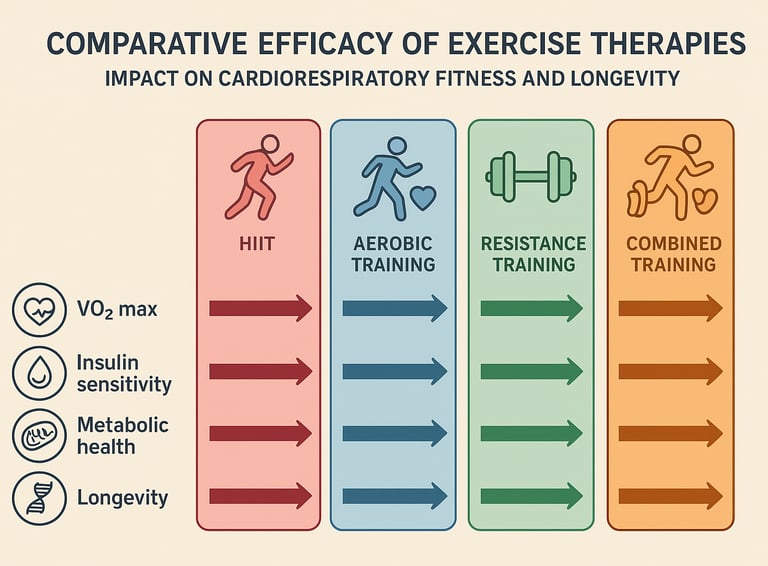
When it comes to improving cardiorespiratory fitness and extending your healthspan, not all exercise is created equal. While we've known for decades that physical activity is essential for heart health and longevity, recent groundbreaking research has uncovered something far more nuanced: different types of exercise interventions produce dramatically different results depending on your specific health condition and fitness goals.
If you're wondering which exercise therapy will deliver the best outcomes for your heart, your weight, or your overall longevity, you're not alone. This question has puzzled fitness enthusiasts, healthcare providers, and researchers alike. Fortunately, a new wave of sophisticated network meta-analyses and systematic reviews published in 2024-2025 have provided compelling evidence that will reshape how we think about exercise training modes and their effectiveness.
In this comprehensive guide, we'll explore four landmark studies that compare the efficacy of various exercise interventions across different populations. Whether you have coronary heart disease, struggle with overweight and obesity, are a cancer survivor, or simply want to optimize your fitness, the evidence in these studies offers personalized insights that could transform your health outcomes.
Exercise Pearls for Better Health and Longevity
1. The Power of Combining Workouts: Combined Exercise is King
The Finding: Studies consistently show that combining Aerobic Training (like walking, cycling, or jogging) with Resistance Training (like lifting weights or bodyweight exercises) is superior to doing either one alone.
What It Means for You: Don't skip the strength training! This "hybrid" approach offers the most comprehensive benefits—it improves your heart function (like aerobic exercise) and your metabolism (like resistance exercise) simultaneously. It's the best prescription for people with heart disease and those managing weight.
2. Boost Your Metabolism: Resistance Training for Metabolic Health
The Finding: For improving how your body processes food and sugar (metabolic health), resistance training is especially crucial. It was shown to be highly effective in reducing insulin resistance and improving blood sugar control (like your A1c).
What It Means for You: If you're struggling with overweight, obesity, or pre-diabetes, prioritize building muscle. Muscle tissue is metabolically active and acts like a sponge for excess glucose. Making time for weightlifting, even with simple resistance bands or bodyweight exercises, is a powerful tool to reverse metabolic issues.
3. Consistency Wins the Race: Adherence Beats Intensity (Long-Term)
The Finding: For people with chronic conditions (like heart disease or cancer survivors), moderate-intensity exercise often leads to better long-term outcomes than high-intensity protocols (like HIIT). Why? Because it's easier to stick with!
What It Means for You: Don't feel pressured to go all-out. Sustainability is more important than intensity. A moderate-intensity walk or cycle that you do consistently three times a week will provide superior benefits over an exhausting, high-intensity workout you only manage to do once a month. Consistency is the foundation of longevity.
4. Your Unique Plan: Personalization is Essential
The Finding: There is no single "best" exercise for everyone. The most effective prescription is one that is tailored to your specific health status, fitness level, and tolerance.
What It Means for You:
Heart Patients/Cancer Survivors: Start with moderate intensity and focus on sustainability.
Relatively Healthy Adults with Obesity: You may be able to incorporate more vigorous (HIIT) exercise for faster fitness gains, but remember to still combine it with strength training for metabolic benefits.
Action Step: Consult your doctor or a certified exercise specialist to create a plan that matches your current health condition.
5. The Ultimate Predictor: Fitness is a Longevity Metric
The Finding: The improvements in your cardiorespiratory fitness (measured as VO2 max) that result from consistent, evidence-based exercise are one of the strongest modifiable predictors of how long and how healthily you will live.
What It Means for You: When you exercise, you're not just burning calories—you're directly improving your body's most critical systems. Fitness isn't just about looking good; it's about life expectancy and preventing disease. Your exercise commitment today is a direct investment in your long, healthy future.
The Evolution of Exercise Science: Why Comparison Studies Matter
For decades, the mantra was simple: "Just exercise." But modern exercise science has evolved beyond this one-size-fits-all approach. Today's comparative effectiveness research asks more sophisticated questions: Is aerobic exercise superior to resistance training? Should you combine them? Does high-intensity interval training (HIIT) outperform moderate-intensity continuous training?
These aren't trivial questions. The stakes involve your cardiovascular health, your ability to manage chronic diseases, and potentially, your years of healthy living. That's why network meta-analyses—studies that simultaneously compare multiple interventions—have become so valuable. They synthesize data from dozens of randomized controlled trials, allowing researchers to rank exercise interventions by their proven effectiveness.
Study 1: Exercise Efficacy in Coronary Heart Disease Patients
Gomes-Neto et al. (2024) examined exercise interventions in people with coronary heart disease through a systematic review and network meta-analysis.
What They Found
The research team analyzed data from numerous randomized controlled trials to determine which exercise training modes were most effective for patients with established coronary artery disease. This was significant because coronary heart disease remains the leading cause of death globally, and understanding optimal exercise therapy protocols could save lives.
The key discovery? Aerobic exercise combined with resistance training—often called combined exercise interventions or hybrid training—emerged as particularly effective for improving multiple cardiovascular markers simultaneously. The study revealed that patients who engaged in combined aerobic and resistance training demonstrated superior improvements in cardiac function compared to those doing single-modality training.
Why This Matters for Heart Patients
For individuals with coronary heart disease, the implications are profound. Rather than focusing exclusively on one type of exercise, the evidence suggests that multimodal exercise programs provide comprehensive cardiovascular benefits. This finding supports a more integrated approach to cardiac rehabilitation and secondary prevention of heart disease events.
Key Takeaway: Combined exercise therapies outperformed isolated training modes in promoting cardiorespiratory improvements and reducing cardiovascular risk factors in patients with coronary heart disease.
Study 2: Weight Management and Fitness Gains in Adults with Obesity
Chen et al. (2025) conducted a Bayesian network meta-analysis examining exercise interventions in adults living with overweight and obesity.
What This Cutting-Edge Analysis Revealed
Using advanced statistical methodology, this study compared the relative effectiveness of various exercise training modes for improving cardiorespiratory fitness in a population struggling with weight management. The researchers looked at how different exercise protocols—from aerobic training to HIIT, from traditional steady-state cardio to resistance exercise—affected fitness outcomes.
The findings were illuminating: high-intensity interval training (HIIT) consistently ranked among the top interventions for rapid improvements in aerobic fitness and VO2 max (maximum oxygen uptake). However, this didn't mean HIIT was universally superior. For individuals just beginning their fitness journey or those with significant physical limitations, moderate-intensity continuous training proved more sustainable and adherence-friendly.
The study also highlighted that combined exercise programs incorporating both cardiovascular training and strength training produced the most comprehensive metabolic improvements, including better glucose control and improved insulin sensitivity.
The Practical Implication
For someone struggling with obesity and seeking to improve their cardiorespiratory fitness, the evidence suggests that HIIT might deliver faster results, but combined exercise protocols offer more comprehensive metabolic benefits. The best exercise, ultimately, is the one you'll actually do consistently.
Key Takeaway: HIIT interventions excel for rapid fitness improvements, while combined aerobic and resistance training provides superior metabolic health outcomes in adults with overweight and obesity.
Study 3: Metabolic Health Through Strategic Exercise Selection
Study Reference: Wang et al. (2024) conducted a network meta-analysis examining how different exercise training modes affect systemic metabolic health in adults with overweight and obesity.
The Metabolic Health Revolution
This study took a broader view than simple fitness metrics. The researchers asked: which exercise interventions best restore healthy metabolic function, improve insulin sensitivity, reduce inflammation, and enhance overall systemic metabolic health?
The distinction is crucial. You can improve your fitness without necessarily optimizing your metabolic health—and vice versa. True health requires both. Wang's team found that resistance training and combined exercise programs were particularly effective at restoring metabolic homeostasis, improving lipid profiles, and reducing insulin resistance.
Interestingly, the research revealed that resistance training, often overlooked in traditional cardiovascular rehabilitation programs, played an underappreciated role in metabolic optimization. Participants who incorporated strength training showed improvements not just in muscle strength, but in crucial metabolic markers like HbA1c (indicating long-term blood sugar control) and triglyceride levels.
Why Metabolic Health Trumps Fitness Metrics
You could run a marathon but still have poor metabolic health if your diet is poor and stress is high. Conversely, someone could have lower aerobic capacity but superior metabolic function due to smart exercise choices and lifestyle habits. Wang's research underscores that exercise therapy should be selected not just for fitness gains, but for comprehensive systemic metabolic improvement.
Key Takeaway: Resistance training and combined exercise programs are superior for optimizing systemic metabolic health, improving insulin sensitivity, and restoring healthy metabolic function in adults with obesity.
Study 4: Specialized Exercise Interventions for Cancer Survivors
Study Reference: Zhou et al. (2025) conducted a Bayesian network meta-analysis examining exercise therapies specifically for breast cancer survivors, comparing cardiorespiratory fitness outcomes across different training modalities.
Cancer Survival and Exercise: A Critical Connection
For cancer survivors, exercise isn't just about fitness—it's about recurrence prevention, managing treatment side effects, and reclaiming quality of life. This study was particularly important because it examined a population with unique constraints and vulnerabilities.
The analysis revealed that aerobic exercise and combined exercise programs were most effective for improving cardiorespiratory fitness in cancer survivors. However, the study also highlighted an often-overlooked consideration: adherence and tolerability. Moderate-intensity aerobic exercise demonstrated superior long-term adherence rates compared to high-intensity interventions, particularly in survivors still managing treatment-related fatigue.
The research suggested that individualized exercise prescriptions considering the survivor's specific cancer type, treatment history, and current symptoms produced the best outcomes. A one-size-fits-all approach was less effective than tailored exercise interventions.
Longevity and Quality of Life
Perhaps most importantly, the study connected cardiorespiratory fitness improvements to broader outcomes relevant to cancer survivors: reduced recurrence risk, improved cardiovascular health (particularly important since cancer treatments can damage the heart), enhanced psychological well-being, and extended survival.
Key Takeaway: Aerobic exercise and combined training programs improve cardiorespiratory fitness in cancer survivors, with moderate-intensity exercise showing superior adherence and long-term sustainability compared to high-intensity interventions.
Synthesizing the Evidence: Common Threads Across Studies
As we examine all four studies together, compelling patterns emerge:
The Case for Combined Exercise Programs
Across studies examining coronary heart disease, obesity, metabolic health, and cancer survival, combined exercise interventions consistently ranked among the most effective approaches. Whether we're talking about aerobic plus resistance training or cardiovascular plus strength components, the synergistic benefits of multimodal training appear robust across diverse populations.
This makes biological sense. Aerobic exercise builds cardiovascular capacity and mitochondrial function. Resistance training preserves muscle mass, improves metabolic rate, and enhances insulin sensitivity. Together, they address multiple physiological systems simultaneously.
The Role of Intensity, Duration, and Adherence
While HIIT and high-intensity exercise showed promise in some contexts (particularly for rapid fitness improvements in otherwise healthy adults with obesity), the studies collectively suggest that intensity must be matched to individual capacity and health status. For vulnerable populations—those with established cardiovascular disease or recovering from cancer treatment—moderate-intensity exercise with superior adherence rates may deliver better long-term outcomes than theoretically superior but unsustainably intense interventions.
Personalization Is Paramount
No single "best" exercise therapy emerged universally superior across all populations. Instead, the evidence supports individualized exercise prescriptions tailored to specific health conditions, fitness levels, and personal preferences.
Practical Implications: Which Exercise Should YOU Choose?
If You Have Coronary Heart Disease
Combined aerobic and resistance training represents your most evidence-supported option. Aim for moderate-intensity aerobic exercise (150 minutes weekly) combined with resistance training 2-3 times weekly. Always consult your cardiologist before starting new exercise programs.
If You're Living with Overweight or Obesity
Combined exercise programs offer the most comprehensive benefits, but your starting point matters. If you're sedentary, begin with moderate-intensity continuous training before progressing to HIIT. As your fitness improves, high-intensity interval training can accelerate results.
If Optimizing Metabolic Health Is Your Priority
Resistance training deserves equal emphasis with cardiovascular exercise. Aim for at least two sessions weekly of strength training combined with aerobic activity. This combination addresses both insulin sensitivity and metabolic function more effectively than cardio alone.
If You're a Cancer Survivor
Work with your oncology team and a qualified exercise specialist to develop individualized exercise prescriptions. Moderate-intensity aerobic exercise combined with resistance training provides optimal benefits while remaining sustainable long-term.
Addressing Common Questions: FAQ
Q: Is HIIT always better than moderate-intensity exercise?
A: No. While HIIT excels for rapid fitness improvements in relatively healthy individuals, moderate-intensity continuous training often produces superior long-term outcomes for people with chronic diseases or limited exercise tolerance due to better adherence rates.
Q: Do I need a gym membership to benefit from combined exercise programs?
A: Absolutely not. Resistance training can use bodyweight, resistance bands, or household items. Aerobic exercise includes walking, cycling, swimming, or running—most of which require minimal equipment.
Q: How quickly will I see improvements in cardiorespiratory fitness?
A: Most research shows measurable improvements within 4-8 weeks of consistent exercise training. Significant adaptations typically emerge within 8-12 weeks. Remember, consistency matters more than intensity initially.
Q: Can exercise therapy prevent heart disease and cancer?
A: While exercise can't guarantee prevention, extensive research demonstrates that regular physical activity significantly reduces the risk of developing coronary heart disease, certain cancers, and other chronic diseases. For those with existing conditions, appropriate exercise interventions reduce recurrence risk and improve outcomes.
Q: Is it ever too late to start exercise training?
A: Extensive evidence demonstrates that exercise benefits people across the lifespan. Benefits can begin at any age, though individualized exercise prescriptions become increasingly important with advancing age or pre-existing health conditions.
Q: What if I can't tolerate high-intensity exercise?
A: Moderate-intensity exercise produces substantial benefits. Consistency and adherence matter far more than intensity level. A sustainable moderate-intensity program beats an unsustainable high-intensity one.
The Longevity Connection: Exercise as Medicine
While these studies focus on cardiorespiratory fitness and specific health markers, the underlying mechanism connecting these improvements to longevity is well-established: cardiovascular fitness is one of the strongest predictors of lifespan and healthspan (years lived in good health).
Aerobic fitness reflects your heart's ability to pump blood efficiently, your lungs' capacity to extract oxygen, and your muscles' ability to utilize that oxygen. These capabilities directly correlate with resistance to cardiovascular disease, cancer, and other chronic conditions that limit lifespan.
Metabolic health—improved by resistance training and combined exercise programs—determines your risk of diabetes, obesity, and associated complications. Muscle strength and mass, preserved through resistance training, predicts healthy aging, fall prevention, and independence in later life.
By selecting evidence-based exercise interventions that comprehensively address cardiorespiratory fitness, metabolic health, and muscular strength, you're investing in not just how long you live, but how well you live.
Limitations and Future Directions
Addressing Observational vs. Interventional Evidence
While a significant portion of research linking exercise to longevity, reduced mortality, and lifespan extension is derived from large-scale observational cohort studies, and thus cannot establish direct causation, it would be a mistake to dismiss their conclusions. Observational designs remain the most feasible approach for studying outcomes such as death rates and long-term disease progression, which cannot be ethically or practically examined in randomized controlled trials over decades. Importantly, the findings from these large population studies are strongly supported by interventional trials demonstrating that aerobic training, resistance training, and high-intensity interval exercise lead to measurable and clinically meaningful improvements in insulin sensitivity, blood pressure, lipid metabolism, inflammation, body composition, mitochondrial function, VO₂max, and muscle mass. These are established, mechanistic predictors of longevity. Therefore, even though the mortality reductions observed in cohort studies cannot prove causality, the physiological and metabolic evidence from randomized trials provides a solid biological rationale that exercise is genuinely driving improved longevity — not merely associated with it.
These studies, while rigorous, operate within certain constraints. Most research focuses on specific populations—those already diagnosed with a disease or those with obesity. More research is needed on preventive exercise interventions in healthy populations and on how exercise specifically impacts longevity outcomes rather than just intermediate markers like fitness and metabolic health.
Additionally, many studies don't adequately control for other lifestyle factors like diet, sleep, and stress management. In real life, exercise is rarely the only variable affecting health outcomes.
Conclusion: Your Personalized Exercise Prescription Awaits
The evidence is clear: different exercise interventions produce different outcomes, and the "best" exercise is the one scientifically proven effective for your specific situation, matched with your capacity for adherence.
Whether you're managing coronary heart disease, working to improve fitness amid obesity, optimizing metabolic health, or recovering from cancer treatment, evidence-based combined exercise programs incorporating both aerobic and resistance training at moderate to high intensity consistently emerge as superior choices.
But here's the beautiful part: you don't need perfection. You need consistency. You need an exercise program you'll actually maintain. And you need to start where you are, with what you have, and progress gradually.
The research shows that investing in appropriate exercise therapy today directly impacts your cardiorespiratory fitness, your metabolic health, your disease risk, and ultimately, your longevity. That's not just fitness motivation—that's science-backed wisdom about living longer, healthier lives.
Key Takeaways
Combined aerobic and resistance training outperforms single-modality exercise programs across multiple health conditions
HIIT excels for rapid fitness gains in relatively healthy individuals; moderate-intensity exercise often produces superior long-term outcomes due to better adherence
Resistance training plays a crucial but underutilized role in optimizing metabolic health and insulin sensitivity
Individualized exercise prescriptions considering health status, fitness level, and preferences produce the best outcomes
Moderate-intensity to vigorous exercise, consistently performed, is superior to sporadic intense efforts
Cardiorespiratory fitness and metabolic health improvements directly correlate with extended healthspan and longevity
Call to Action
Your health is your most valuable asset. The science is clear, the evidence is robust, and the time to act is now. Whether you're dealing with cardiovascular disease, managing weight, optimizing health, or recovering from illness, there's never been a better time to implement an evidence-based exercise program.
Start today. Begin with a single workout. Consult your healthcare provider about creating an individualized exercise prescription tailored to your unique situation. Consider working with a certified exercise specialist or fitness professional who understands exercise therapy and can guide you safely.
Your future self—healthier, stronger, and with more years to enjoy life—will thank you.
Ready to transform your health through science-backed exercise? Take action today. Your longevity depends on the decisions you make right now.
Disclaimer: This article is for informational purposes only and does not constitute medical advice. Individual circumstances vary, and treatment decisions should always be made in consultation with qualified healthcare professionals.
Related Articles
Mitochondrial Dysfunction: The Core Driver of Aging and How Exercise Reverses It | DR T S DIDWAL
The Science of Healthy Brain Aging: Microglia, Metabolism & Cognitive Fitness | DR T S DIDWAL
The Aging Muscle Paradox: How Senescent Cells Cause Insulin Resistance and The Strategies to Reverse It | DR T S DIDWAL
VO2 Max & Longevity: The Ultimate Guide to Living Longer | DR T S DIDWAL
Movement Snacks: How VILPA Delivers Max Health Benefits in Minutes | DR T S DIDWAL
Blue Zones Secrets: The 4 Pillars of Longevity for a Longer, Healthier Lifepost | DR T S DIDWAL
References
Chen, Z., Tian, S., Tian, Y., Shi, B., & Yang, S. (2025). Comparative effectiveness of various exercise interventions on cardiorespiratory fitness in adults living with overweight or obesity: A systematic review and Bayesian network meta-analysis. Journal of sports sciences, 43(11), 1027–1035. https://doi.org/10.1080/02640414.2025.2483591
Gomes-Neto, M., Durães, A. R., Conceição, L. S. R., Saquetto, M. B., Alves, I. G., Smart, N. A., & Carvalho, V. O. (2024). Some types of exercise interventions are more effective than others in people with coronary heart disease: systematic review and network meta-analysis. Journal of physiotherapy, 70(2), 106–114. https://doi.org/10.1016/j.jphys.2024.02.018
Wang, H., Cheng, R., Xie, L., & Hu, F. (2024). Comparative efficacy of exercise training modes on systemic metabolic health in adults with overweight and obesity: a network meta-analysis of randomized controlled trials. Frontiers in endocrinology, 14, 1294362. https://doi.org/10.3389/fendo.2023.1294362
Zhou, X., Yang, Y., Zhai, L., Gan, J., Li, C., & Zhu, Y. (2025). Comparative Efficacy of Different Exercise Therapies for Cardiorespiratory Fitness in Breast Cancer Survivors: A Systematic Review and Bayesian Network Meta-analysis. Sports medicine - open, 11(1), 67. https://doi.org/10.1186/s40798-025-00872-3