Satellite Cells: The Tiny Muscle Stem Cells That Determine How Much Muscle You Build
Satellite cells are the hidden muscle stem cells behind hypertrophy and recovery. Explore evidence-based strategies to maximize muscle growth and athletic performance.
EXERCISESARCOPENIA
Dr. T.S. Didwal, M.D.(Internal Medicine)
6/9/202623 min read
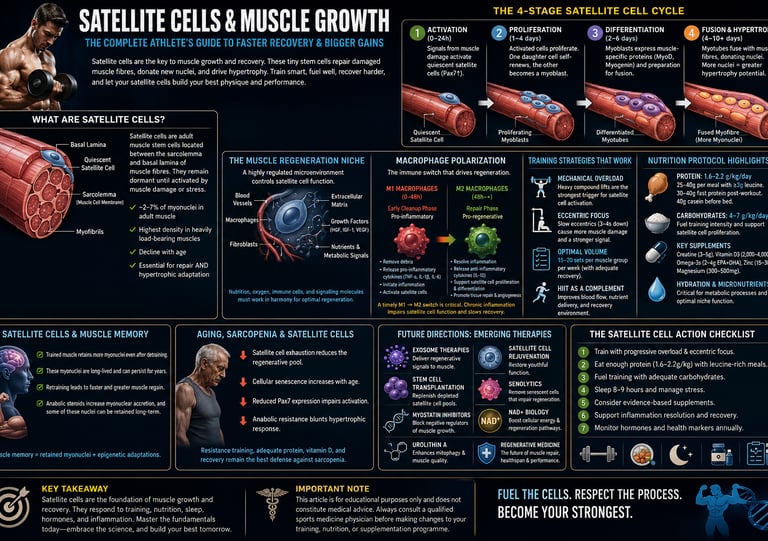
Satellite cells are muscle stem cells that repair and grow muscle after exercise. They activate with heavy lifting, multiply over 2–4 days, and fuse to muscle fibers to add new nuclei. Training, protein, sleep, and hormones like IGF-1 control how well they work.
How satellite cells drive muscle growth:
Activation: Heavy lifting wakes satellite cells within hours via IGF-1 and HGF signals.
Proliferation: Cells multiply days 1–4, making new myoblasts.
Differentiation: Myoblasts mature into muscle-building cells days 2–6.
Fusion: New cells merge with muscle fibers, adding nuclei for bigger, stronger muscles.
Key Takeaways: Satellite Cells & Muscle Growth — The Athlete’s Playbook
1. Satellite cells are your built-in repair team
Think of them as quiet construction crews living in your muscles. They only wake up when you stress the muscle, like after a heavy squat or hard sprint, and their job is to patch damage and build you back bigger and stronger. No satellite cells, no real growth.
2. Recovery isn’t downtime, it’s construction time
The 48–72 hours after training is when these cells multiply fastest. If you hit the same muscle too soon, you cut the job short. Smart athletes train hard, then deliberately step back so the repair crew can finish the work.
3. Not all satellite cells are the same
The cells around your powerful fast-twitch fibers respond best to heavy lifts and explosive work. Those around endurance fibers are built for the long haul. If your goal is size and strength, prioritize compound lifts, controlled eccentrics, and true progressive overload.
4. Food is the raw material, not just fuel
Satellite cells need building supplies. That means 1.6–2.2 g of protein per kg bodyweight daily, with 25–40 g per meal to trigger growth. Carbs aren’t the enemy — low glycogen means weaker training and slower cell activation. And nutrients like leucine, vitamin D, omega-3s, and creatine directly help the repair process.
5. Your hormones are the foreman on the job site
Testosterone, IGF-1, and growth hormone tell satellite cells to get to work. Chronically high cortisol and myostatin tell them to stand down. Stress, poor sleep, and undereating raise the wrong hormones. Quality sleep and managed stress keep the foreman on your side.
6. Sleep is when the real growth happens
Most growth hormone is released in deep sleep. Cut sleep to 5–6 hours and you blunt IGF-1, spike cortisol, and stall satellite cell activity. For serious recovery, 8–9 hours isn’t luxury — it’s logistics for muscle.
7. You can grow your satellite cell “workforce”
Resistance training doesn’t just use satellite cells — it increases how many you have. Trained muscle literally has more stem cells ready to deploy. That’s part of “muscle memory.” The earlier you start training, the bigger crew you build, but it’s never too late to add to it.
8. More isn’t always better — smarter is
Chasing soreness, living on protein shakes, or training 7 days a week backfires. Too much damage, too few calories, or zero rest suppresses satellite cells. Alcohol after training? It can cut protein synthesis by ~24%. The elite move: progressive overload + real food + real sleep + real recovery.
The bottom line for athletes: You don’t grow in the gym. You grow when satellite cells get the signal, the materials, and the time to do their job. Train to create the signal. Eat and sleep to support the work.
Introduction
Every time you finish a brutal leg session or push through a new bench-press PR, millions of microscopic repair crews spring into action inside your muscle fibres. These aren't metaphorical workers — they're muscle satellite cells, and the latest science confirms they are the single most important factor in how fast you grow, how quickly you recover, and how long you can sustain peak athletic performance.
If you've ever wondered why two athletes with identical training programmes end up with dramatically different results, satellite cell biology is a big part of the answer.
In this guide, you will learn: exactly what satellite cells are, how they regenerate damaged muscle fibres, which training and nutrition strategies activate the most of them, and what the cutting-edge 2024–2026 research says about maximising their potential. Whether you are a competitive bodybuilder, an endurance athlete, or a serious recreational lifter, this is the science that should underpin every decision you make inside — and outside — the gym.
What Are Satellite Cells? (The Biology Made Simple)
Satellite cells are adult muscle stem cells that sit quietly between the outer membrane (the sarcolemma) and a thin sheath called the basal lamina of each muscle fibre. Under a microscope, they look like tiny satellites orbiting the fibre — hence the name coined by researcher Alexander Mauro back in 1961.
Think of them as the sleeping construction workers of your muscles. Under normal conditions, they are dormant, contributing almost nothing to your day-to-day movement. But the moment muscle fibres are damaged — through heavy lifting, sprinting, or any mechanical stress — these cells wake up, multiply, and get to work repairing and expanding the damaged tissue.
Key Facts for Athletes
• They make up roughly 2–7 % of myonuclei (muscle cell nuclei) in adult skeletal muscle.
• Satellite cell density is highest in the most heavily loaded muscles — your quads, glutes, and lats have more than your forearms.
• Their numbers naturally decline with age, which partly explains why recovery slows in masters athletes.
• A 2024 review in Inflammation and Regeneration confirmed that satellite cells are essential not only for repair after injury but for the normal hypertrophic adaptations that follow resistance training (Byun, Lee & Baek, 2024).
How Satellite Cells Drive Muscle Regeneration — Step by Step
Understanding this four-stage process will transform how you think about your training programme, rest days, and nutrition timing.
Stage 1 — Activation (Hours 0–24 post-exercise)
Mechanical damage and the biochemical signals that follow — including hepatocyte growth factor (HGF), insulin-like growth factor 1 (IGF-1), and fibroblast growth factor (FGF) — flip the satellite cell's molecular 'on switch'. The transcription factor Pax7 is upregulated first, pulling the cell out of dormancy.
Stage 2 — Proliferation (Days 1–4)
Activated satellite cells begin dividing rapidly. One daughter cell commits to becoming a new muscle nucleus (myoblast), while the other returns to quiescence to replenish the stem cell pool — a process called self-renewal. This is why your satellite cell reservoir does not run dry after repeated training cycles.
Stage 3 — Differentiation (Days 2–6)
Committed myoblasts stop dividing and begin expressing muscle-specific proteins. Myogenin and MyoD — master regulatory transcription factors — orchestrate the expression of genes for contractile proteins like myosin and actin.
Stage 4 — Fusion & Hypertrophy (Days 4–10+)
Differentiated myoblasts fuse with existing muscle fibres, donating their nuclei. More nuclei means more 'transcriptional territory' — each nucleus can only supervise a limited volume of cytoplasm (the myonuclear domain theory). More nuclei = larger, stronger muscle fibres.
🔬 Athlete Insight
The 48–72 hour window after intense resistance training is when satellite cell proliferation peaks. Training the same muscle group again before day 2 can interrupt this cycle — one reason why adequate recovery is non-negotiable for maximising muscle growth.
A landmark 2024 review in Current Topics in Developmental Biology (Guilhot et al., 2024) detailed how disruptions to any of these four stages — through overtraining, poor nutrition, or hormonal imbalances — directly impair hypertrophy and prolong recovery time.
Satellite Cell Heterogeneity: Why Not All Repair Cells Are Equal
Satellite cells are not a uniform population. Different subtypes vary in their regenerative capacity, self-renewal potential, and responsiveness to exercise. Satellite cells associated with Type II (fast-twitch) fibres tend to proliferate more rapidly and respond strongly to resistance training, whereas those linked to Type I (slow-twitch) fibres exhibit greater self-renewal capacity. This heterogeneity may partly explain individual differences in muscle growth and recovery.
Muscle regeneration also depends on immune-cell signaling, particularly the transition from M1 to M2 macrophages. Following muscle damage, M1 macrophages dominate the early phase, clearing debris and releasing inflammatory signals that activate satellite cells. As regeneration progresses, M2 macrophages become predominant, suppressing inflammation and releasing growth factors that promote satellite cell proliferation, differentiation, and tissue repair.
Disruption of this M1-to-M2 transition—through overtraining, aging, poor sleep, or chronic inflammation—can impair muscle regeneration and delay recovery.
Key Takeaway: Effective muscle growth depends not only on satellite cells themselves but also on their interaction with the immune system. Satellite cell heterogeneity and the coordinated transition from M1 to M2 macrophages are critical determinants of muscle repair, recovery, and hypertrophy.
Satellite Cells and Muscle Memory
One of the most intriguing discoveries in muscle biology is the concept of muscle memory. When satellite cells fuse with muscle fibres, they donate additional myonuclei that support protein synthesis and muscle growth. Evidence suggests that many of these myonuclei persist even after prolonged inactivity or muscle loss.
As a result, previously trained individuals often regain muscle mass and strength more rapidly during retraining than they gained it initially. This retained myonuclear pool provides a cellular foundation for muscle memory.
Research has also shown that anabolic steroids can increase myonuclear accretion, and some of these additional nuclei may persist long after steroid use has ceased, potentially contributing to long-term performance advantages.
For athletes, muscle memory means that periods of detraining due to injury, illness, or inactivity do not necessarily erase previous adaptations. The persistence of myonuclei may facilitate faster recovery and muscle regain when training resumes.
Key Takeaway: Satellite cells contribute to muscle memory by adding myonuclei to muscle fibres. These long-lasting cellular adaptations help explain why regaining lost muscle is often faster than building it for the first time.4. The Metabolic Niche: Fuelling Your Repair Crews
A satellite cell does not work in isolation. It exists within a highly regulated microenvironment — the 'muscle regeneration niche' — composed of the extracellular matrix, local blood vessels, immune cells, fibroblasts, and metabolic signals that collectively control how well satellite cells perform.
The Role of Metabolism in Satellite Cell Behaviour
A landmark 2026 review in Trends in Molecular Medicine (Lu, Chi & Wang, 2026) described the niche as a 'metabolic symphony' — every player (cell type and nutrient signal) must hit the right note at the right time for regeneration to proceed efficiently. Disruptions — from calorie restriction, alcohol, chronic inflammation, or sleep deprivation — cause the orchestra to fall out of sync.
Key Metabolic Drivers
• Amino acid availability: Particularly leucine, which directly triggers mTORC1 signalling and promotes satellite cell differentiation.
• Glucose & glycogen: Satellite cell proliferation is energy-intensive. Chronically low carbohydrate availability impairs the speed of the proliferation phase.
• Omega-3 fatty acids: EPA and DHA reduce the pro-inflammatory signalling that can delay satellite cell activation if inflammation becomes chronic.
• Oxygen delivery: Satellite cell activation requires local angiogenesis (new blood vessel growth). Training that improves cardiovascular fitness enhances blood supply to muscle, indirectly supporting repair capacity.
Hormonal & Endocrine Control of Satellite Cells
According to a 2026 editorial in Nature Reviews Endocrinology (Lafuste & Relaix, 2026), the hormonal environment is one of the most powerful modulators of satellite cell function — and one of the most under-appreciated levers athletes have at their disposal.
Anabolic Hormones That Boost Satellite Cells
• Testosterone: Directly stimulates satellite cell proliferation and myogenic differentiation. Part of why resistance-trained men with higher testosterone show faster hypertrophy.
• IGF-1 (Insulin-like Growth Factor 1): Perhaps the most potent satellite cell activator. Produced locally in muscle after mechanical loading. Both systemic (liver-derived) and local (muscle-derived, called mechano-growth factor or MGF) forms contribute.
• Growth Hormone (GH): Acts partly via IGF-1. GH pulses during deep sleep are a key reason why sleep quality is inseparable from muscle growth.
Hormones That Impair Satellite Cell Function
• Cortisol: Chronically elevated cortisol (from overtraining, under-eating, or psychological stress) suppresses satellite cell proliferation and can push cells toward apoptosis (self-destruction).
• Myostatin: A muscle growth inhibitor that directly limits satellite cell activation. Training reduces myostatin; overtraining and severe caloric restriction can raise it.
⚠️ Clinical Note
If you are experiencing prolonged recovery times, loss of strength, or poor body composition despite consistent training, it is worth having your testosterone, IGF-1, cortisol, and thyroid hormones checked by a sports medicine physician. Hormonal imbalances are a correctable cause of impaired satellite cell function.
Training Strategies That Maximise Satellite Cell Activation
The good news: you can deliberately design your training to generate the strongest possible satellite cell response. Here are the evidence-based levers.
1. Mechanical Overload Is the Primary Trigger
Heavy resistance training — particularly exercises that take muscles through a full range of motion under high load — produces the greatest mechanical damage and the strongest satellite cell response. Compound lifts (squats, deadlifts, rows, presses) activate more muscle fibres and produce more satellite cell activation than isolation exercises.
2. Eccentric Training
The lowering (eccentric) phase of a lift produces more muscle damage than the concentric (lifting) phase, and thus a stronger satellite cell signal. Deliberately slowing the eccentric — 3–4 seconds down — is one of the most potent hypertrophy strategies supported by the literature.
3. Muscle Damage vs Mechanical Tension — Finding the Balance
Excessive muscle damage without adequate recovery actually impairs the satellite cell cycle. The optimal stimulus is enough damage to activate the repair process without overwhelming it. This is why progressive overload (gradually increasing weight, volume, or intensity over weeks) outperforms ego-lifting every time.
4. High-Intensity Interval Training (HIIT) as a Complement
HIIT improves the vascular component of the niche — better blood flow means faster delivery of growth factors, nutrients, and immune cells to damaged fibres. For athletes combining strength and conditioning, 2–3 HIIT sessions per week can improve satellite cell environment without compromising hypertrophy when periodised correctly.
5. Training Volume & Frequency
A 2024 bibliometric analysis published in Heliyon (Huang et al., 2024) reviewed over a decade of satellite cell research and identified training volume as one of the most consistently studied variables. Higher weekly volume (15–20 sets per muscle group) is associated with greater satellite cell activation, but only when recovery is adequate between sessions.
Sample Weekly Training Framework
Here is the weekly training framework structured into clear bullet points, detailing the specific session types and corresponding satellite cell mechanisms for each day:
Monday: Heavy Compound Lower Body
Session Type: Heavy compound movements (e.g., Squats, Romanian Deadlifts).
Satellite Cell Goal: Primary Activation. Recruits high-threshold Type II muscle fibers to initiate downstream myogenic signaling.
Tuesday: Upper Body Push (Eccentric Emphasis)
Session Type: Pressing movements with a deliberate 3–4 second lowering phase.
Satellite Cell Goal: Mechanical Damage Signaling. Micro-tears trigger localized cytokine release, pulling quiescent satellite cells into the cell cycle.
Wednesday: Conditioning or Active Recovery
Session Type: High-Intensity Interval Training (HIIT) or low-intensity active recovery.
Satellite Cell Goal: Micro-Vascularization. Enhances capillary density within the muscle bed to improve tissue oxygenation and flush inflammatory byproducts.
Thursday: Heavy Compound Upper Body
Session Type: Heavy pulling and pressing movements (e.g., Rows, Pull-ups, Overhead Press).
Satellite Cell Goal: Primary Activation. High mechanical tension initiates upper-body myogenic regulatory factor expression.
Friday: Hypertrophy Volume
Session Type: Moderate load, high-volume accessory movements (10–20 repetitions).
Satellite Cell Goal: Proliferation Support. Elevated metabolic stress and cellular swelling drive the rapid proliferation of previously activated blast cells.
Saturday: Skill Work or Accessory Movements
Session Type: Sport-specific drills or isolated, local accessory exercises.
Satellite Cell Goal: Maintenance Stimulus. Delivers low-stress neurological and structural reinforcement without inducing deep systemic fatigue.
Sunday: Complete Rest or Mobility Work
Session Type: Complete rest, dedicated yoga, or joint mobility drills.
Satellite Cell Goal: Regeneration Cycle. Optimizes systemic recovery, downregulates cortisol, and allows for clean cellular differentiation and muscle fiber integration.
Nutrition Protocols to Supercharge Muscle Regeneration
Training provides the stimulus; nutrition provides the raw materials and signalling environment that satellite cells need to do their work. Get the nutrition wrong and even the best training programme will underdeliver.
Protein: Quantity, Quality & Timing
• Total daily protein: 1.6–2.2 g per kg of body weight is the current evidence-supported range for athletes in hypertrophy phases. Emerging data suggests going to 2.4–3.1 g/kg may offer additional benefits in hard cutting phases to preserve lean mass.
• Leucine threshold: Each meal should contain at least 2–3 g of leucine to reliably trigger mTORC1 and satellite cell differentiation. This means ~25–40 g of complete protein per meal.
• Post-workout timing: Consuming 30–40 g of fast-digesting protein within 60 minutes post-training capitalises on the elevated HGF and IGF-1 environment created by exercise.
• Pre-sleep casein: 40 g of slow-digesting casein protein before bed supplies amino acids throughout the night, when GH pulses drive satellite cell activity.
Carbohydrates: The Underrated Satellite Cell Support
Muscle glycogen is the primary fuel for high-intensity training. When glycogen stores are low, training intensity drops, mechanical damage is blunted, and satellite cell activation is sub-optimal. Aim for 4–7 g of carbohydrate per kg of body weight on heavy training days.
Micronutrient and supplements
Vitamin D
Role in Satellite Cell Function: Regulates satellite cell self-renewal and expression of myogenic regulatory factors; clinical deficiency directly impairs muscle tissue regeneration.
Evidence Level: Strong
Practical Dose: 2,000–4,000 IU/day (optimized based on baseline serum 25(OH)D levels).
Creatine Monohydrate
Role in Satellite Cell Function: Accelerates intramuscular ATP resynthesis, increases cellular hydration, and acutely upregulates satellite cell proliferation and mitotic activity following mechanical stress.
Evidence Level: Strong
Practical Dose: 3–5 g/day (consistent daily dosing; a loading phase is optional).
Leucine / Essential Amino Acids (EAAs)
Role in Satellite Cell Function: Acts as the primary direct nutritional trigger for the $\text{mTORC1}$ pathway, driving muscle protein synthesis and supporting satellite cell differentiation into functional muscle fibers.
Evidence Level: Strong
Practical Dose: 3 g of leucine per main protein-containing meal.
Omega-3 Fatty Acids (EPA/DHA)
Role in Satellite Cell Function: Modulates the post-exercise inflammatory response to prevent chronic low-grade tissue inflammation, thereby optimizing the local cellular niche environment.
Evidence Level: Moderate
Practical Dose: 2–4 g/day of combined EPA and DHA.
Zinc
Role in Satellite Cell Function: Serves as an essential cofactor for enzyme systems involved in $\text{IGF-1}$ signaling pathways, cellular division, and general satellite cell proliferation.
Evidence Level: Moderate
Practical Dose: 15–30 mg/day (elemental zinc).
Magnesium
Role in Satellite Cell Function: Supports neuromuscular relaxation, optimises the systemic testosterone-to-cortisol ratio, and improves sleep architecture to facilitate deep tissue repair.
Evidence Level: Moderate
Practical Dose: 300–500 mg/day (preferring highly bioavailable forms like glycinate or malate).
Clinical Quality Control Note: Supplement manufacturing quality and bio-accessibility vary significantly across commercial brands. It is highly recommended to select products verified by independent third-party testing organizations (such as USP, NSF, or ConsumerLab) to ensure purity, safety, and accurate active ingredient dosing.8. Sleep, Recovery & the Satellite Cell Window
This is possibly the most under-implemented performance tool available to athletes — and it costs nothing.
Why Sleep Is a Biological Non-Negotiable
The majority of growth hormone release occurs during slow-wave (deep) sleep. GH drives IGF-1 production, which in turn is the most potent growth factor signal for satellite cell activation. Sleeping fewer than 7 hours per night measurably reduces GH output, elevates cortisol, and directly suppresses the satellite cell regeneration cycle.
Practical Sleep Protocol for Athletes
Target 8–9 hours of sleep per night during heavy training blocks.
Keep a consistent sleep and wake time (circadian rhythm integrity amplifies GH pulse amplitude).
Eliminate blue light exposure 60–90 minutes before bed to accelerate melatonin onset.
Keep your bedroom cool (16–19 °C) — core body cooling triggers deeper sleep stages.
Consider 40 g of casein protein + 200–400 mg of magnesium glycinate 30–45 minutes before bed.
Active Recovery Methods With Satellite Cell Evidence
• Cold water immersion (10–15 °C for 10–15 min): Reduces acute inflammation and muscle soreness. Use strategically — immediately post-training it may blunt the hypertrophy signal, so reserve for competition weeks.
• Compression garments: Moderate evidence for reducing DOMS and maintaining satellite cell niche blood flow between sessions.
• Massage & foam rolling: Improves local blood flow and reduces connective tissue tension around the niche, potentially improving nutrient delivery.
Future Directions in Satellite Cell Research
Emerging regenerative strategies aim to improve muscle repair by targeting satellite cells and their microenvironment. Although most remain experimental, several approaches are attracting significant scientific interest.
Exosome Therapies
Exosomes are extracellular vesicles that transport proteins, lipids, and microRNAs between cells. Preclinical studies suggest they may enhance satellite cell activation, modulate inflammation, and support muscle regeneration without requiring direct stem-cell transplantation. Human evidence remains limited.
Stem-Cell Transplantation
Transplantation of satellite cells or other muscle progenitor cells is being investigated as a treatment for severe muscle injury, muscular dystrophy, and sarcopenia. Major challenges include poor cell engraftment, limited survival, and immune-related barriers.
Myostatin Inhibitors
Myostatin is a negative regulator of muscle growth that suppresses satellite cell activity and hypertrophy. Pharmacological inhibition of myostatin has been shown to increase muscle mass in experimental models and is being explored for muscle-wasting disorders.
Satellite Cell Rejuvenation
Aging impairs satellite cell function through intrinsic cellular changes and alterations in the stem-cell niche. Experimental approaches targeting metabolic pathways, epigenetic regulation, and niche signaling seek to restore the regenerative capacity of aged satellite cells.
Senolytics
Senolytic therapies selectively remove senescent cells that accumulate with aging and contribute to chronic inflammation. By improving the regenerative environment, senolytics may indirectly enhance satellite cell function and muscle repair.
NAD⁺ Biology
Age-related declines in NAD⁺ levels are associated with mitochondrial dysfunction and impaired tissue regeneration. NAD⁺ precursors such as NMN and NR are being studied for their potential effects on satellite cell metabolism, mitochondrial health, and muscle regeneration.
Urolithin A
Urolithin A promotes mitophagy, the selective removal of damaged mitochondria. Early human studies suggest improvements in mitochondrial function and muscle performance, although their direct effects on satellite cells remain under investigation.
Key Takeaway
Most regenerative therapies targeting satellite cells remain in preclinical or early clinical development. While these approaches may eventually contribute to the treatment of sarcopenia, muscle injury, and muscle-wasting diseases, resistance training, adequate nutrition, and recovery remain the most evidence-based strategies for preserving satellite cell function and skeletal muscle health.
Evidence Summary: Key Studies at a Glance
The Role of Muscle Satellite Cells in Athletic Performance and Recovery
When you lift weights or sprint, you create microscopic tears in your muscle fibers. The unsung heroes behind repairing that damage and building larger, stronger muscles are muscle satellite cells (SCs). Discovered as quiet, dormant stem cells nestled on the outer surface of muscle fibers, recent breakthrough studies from 2024 to 2026 show that these cells are far more complex than we ever realized.
Below is an in-depth breakdown of the latest peer-reviewed science mapping out how satellite cells function and how athletes can leverage this data to maximize muscle hypertrophy and recovery.
1. Satellite Cells: Beyond Injury Repair to Muscle Hypertrophy
Study: Byun, Lee & Baek — Inflammation and Regeneration (2024)
The Key Discovery: For years, a debate simmered in sports science: are satellite cells strictly for fixing severe muscle trauma, or are they required for everyday muscle growth? This study confirms that satellite cells are absolutely essential for hypertrophic adaptation (building muscle size). They do not just patch up injuries; they fuse with existing fibers to donate their nuclei, expanding the muscle's capacity to synthesize new protein.
Athletic Relevance & Actionable Takeaway: If you want to maximize muscle gains, your training must actively trigger satellite cell activation. Heavy resistance training, eccentric loading (the lowering phase of a lift), and high-volume training are the primary mechanical stimuli that wake these cells up.
2. The Genetic Switches: Pax7 and MyoD Regulators
Study: Careccia, Mangiavini & Cirillo — International Journal of Molecular Sciences (2024)
The Key Discovery: Satellite cell behavior is governed by a strict genetic cascade, specifically transcription factors like Pax7 (which keeps the cells in a pool ready to work) and MyoD (which signals them to start turning into mature muscle). If these regulatory factors are disrupted, the satellite cells lose their way, and muscle regeneration completely stalls.
Athletic Relevance & Actionable Takeaway: Overtraining and underfeeding (chronic energy deficiency) are the fastest ways to disrupt these genetic regulators. When you starve your body of calories or don't allow adequate rest between brutal workouts, you blunt the Pax7 and MyoD signals, effectively halting your body's ability to repair and grow.
3. Satellite Cell Heterogeneity: Why We Recover Differently
Study: Guilhot et al. — Current Topics in Developmental Biology (2024)
The Key Discovery: Not all satellite cells are created equal. This research identified at least three distinct sub-populations of satellite cells, each carrying unique roles. Some react instantly to minor tweaks, while others wait for major trauma; some focus on self-renewal, while others immediately build new tissue.
Athletic Relevance & Actionable Takeaway: This explains the vast inter-individual differences in recovery rates among athletes. If your training partner bounces back from a heavy leg day in 24 hours while you need 72 hours, it isn't necessarily a lack of effort—it's likely driven by your unique genetic profile and the ratio of satellite cell sub-populations you possess. Individualized programming is crucial.
4. The Top Levers: Training Volume and Hormonal Milieu
Study: Huang et al. — Heliyon (Bibliometric Analysis, 2010–2023) (2024)
The Key Discovery: Analyzing over a decade of global research, this bibliometric mapping concluded that progressive training volume and a favorable hormonal environment are the two most heavily validated modulators of satellite cell activity in scientific literature.
Athletic Relevance & Actionable Takeaway: Total weekly training volume (sets x reps x load) is the primary physical lever to force satellite cell proliferation. However, volume means nothing without the right hormonal backdrop. To optimize this, athletes must focus on high-yield lifestyle factors: getting 7-9 hours of quality sleep, managing psychological stress, and ensuring sufficient dietary fat intake to support natural hormone production.
5. The "Metabolic Symphony" of the Cellular Niche
Study: Lu, Chi & Wang — Trends in Molecular Medicine (2026)
The Key Discovery: The environment surrounding a satellite cell (its "niche") acts like a metabolic symphony. Local nutrient availability, systemic metabolites, and cellular energy pathways orchestrate exactly how and when these cells wake up, multiply, and fuse into muscle fibers.
Athletic Relevance & Actionable Takeaway: Nutrient timing and quality dictate cellular output. Flooding your system with essential amino acids (especially leucine) and maintaining optimal glycogen stores ensures that the satellite cell niche has the raw energy and signaling blocks required to sustain high-rate muscle repair post-exercise.
6. The Endocrine Master System: Testosterone, IGF-1, and GH
Study: Lafuste & Relaix — Nature Reviews Endocrinology (2026)
The Key Discovery: This landmark review solidifies the endocrine system as the master regulator of satellite cell dynamics. Anabolic hormones—specifically Testosterone, Insulin-like Growth Factor 1 (IGF-1), and Growth Hormone (GH)—directly bind to satellite cells, pulling them out of dormancy and exponentially accelerating muscle tissue regeneration.
Athletic Relevance & Actionable Takeaway: Baseline hormonal health is the foundation of athletic longevity. Low testosterone or impaired growth hormone axes directly cripple satellite cell performance. Safeguard your endocrine system by avoiding extreme, prolonged caloric deficits, optimizing micronutrient intake (like Vitamin D and Zinc), and prioritizing circadian rhythm alignment.
Current Scientific Limitations to Keep in Mind
While this cutting-edge molecular biology is exciting, athletes and coaches must apply these findings with a realistic perspective:
Animal vs. Human Data: A massive portion of mechanistic satellite cell research is still conducted using rodent models or isolated, in-vitro cell cultures. While mammalian pathways are similar, human in vivo (inside the living body) responses can vary.
Small Sample Sizes: Human trials looking at satellite cells require invasive muscle biopsies, meaning sample sizes are often small and heavily skewed toward specific populations (like young, untrained males or elite athletes).
Individual Baselines: Baseline satellite cell density and genetic responsiveness vary wildly from person to person. What works perfectly to stimulate hypertrophy in one athlete might cause overtraining symptoms in another.
10. Common Myths & Mistakes
Myth 1: 'Soreness = growth. No soreness = no gain.'
Delayed-onset muscle soreness (DOMS) is a marker of muscle damage — but not an accurate proxy for satellite cell activation or hypertrophy. Highly trained athletes generate less soreness because their satellite cells and connective tissue adapt. Chasing soreness leads to chronic overreaching.
Myth 2: 'More protein is always better.'
Protein intakes above ~2.4–3 g/kg/day show diminishing returns for satellite cell support in most athletes. Excess calories from protein come at the cost of carbohydrate availability — which, as discussed, is critical for training quality and glycogen-dependent satellite cell proliferation.
Myth 3: 'Training every day maximises satellite cell activation.'
Satellite cells need time to complete their proliferation and differentiation cycles. Training the same muscle group before 48 hours of recovery can interrupt the differentiation phase, reduce net myonuclear accretion, and increase injury risk over time.
Myth 4: 'Supplements can replace training stimulus.'
Creatine, leucine, and omega-3s all support satellite cell function — but they amplify the training stimulus; they cannot replace it. No supplement activates satellite cells without mechanical loading.
Myth 5: 'Ageing makes satellite cell decline inevitable and irreversible.'
While satellite cell numbers do decline with age (sarcopenia), research consistently shows that resistance training in master's athletes (50+) maintains satellite cell density and responsiveness significantly better than a sedentary lifestyle. It is never too late to start training.
Frequently Asked Questions (FAQs)
Q: How long does it take for satellite cells to repair muscle after a workout?
The repair cycle typically spans 5–10 days for heavily damaged muscle. Satellite cell activation begins within hours; peak proliferation occurs between 48–72 hours; fusion and nuclear donation continue for up to 10 days in heavily loaded muscle. This is why full adaptation from a training session continues long after soreness has disappeared.
Q: Do women have as many satellite cells as men?
Yes — satellite cell density is similar between sexes. Women do, however, experience different hormonal modulation (oestrogen appears to have some muscle-protective effects, potentially reducing excessive inflammation post-exercise). Lower absolute testosterone means women typically have a lower baseline rate of satellite cell-mediated hypertrophy, though relative gains from training are comparable.
Q: Can I increase my satellite cell numbers through training?
Yes. Resistance training consistently increases satellite cell density in the trained muscle groups over weeks to months. This is one of the adaptation responses that makes trained athletes better at rebuilding muscle than untrained individuals — their muscle tissue has literally more stem cells available to mobilise.
Q: Does intermittent fasting hurt satellite cell function?
Short-term fasting (16:8 protocols) does not appear to significantly impair satellite cell function when total daily protein and calorie targets are met. However, prolonged fasting or severe caloric restriction reduces IGF-1, upregulates cortisol and myostatin, and can impair the proliferation phase. If muscle growth is a priority, ensure adequate calorie intake even within an intermittent fasting window.
Q: Are satellite cells the same as stem cells used in regenerative medicine?
Satellite cells are a type of muscle-specific adult stem cell. They are distinct from embryonic stem cells or induced pluripotent stem cells (iPSCs). In regenerative medicine, satellite cells are a target for treating muscular dystrophies and age-related muscle loss (sarcopenia), but the research is still largely pre-clinical.
Q: Does alcohol impair satellite cell function?
Yes, and significantly. Alcohol consumption after training has been shown to reduce mTOR signalling, impair satellite cell proliferation, and reduce rates of protein synthesis by up to 24 % (in some studies). Even moderate post-exercise alcohol (3–4 drinks) meaningfully blunts the hypertrophic response. If gains matter, prioritise recovery over post-training drinks.
Q: How does overtraining affect satellite cells?
Chronic overtraining — training hard without adequate recovery — leads to persistent elevations in cortisol, systemic inflammation, and myostatin. These biochemical conditions actively suppress satellite cell activation and can drive cells into apoptosis (programmed cell death). Paradoxically, training harder without enough rest leads to fewer functional satellite cells over time.
Q: Are there any legal supplements specifically proven to increase satellite cell activity?
Creatine monohydrate has the most consistent evidence — several studies show it increases myonuclear accretion (satellite cell donation of nuclei) when combined with resistance training. Leucine-enriched protein, vitamin D3 (in deficient individuals), and omega-3 fatty acids also have meaningful evidence. No supplement replaces training, but these are evidence-backed adjuncts.
Q: What happens to satellite cells during a detraining period?
When you stop training, satellite cell density gradually decreases in previously trained muscles — but more slowly than other adaptations (e.g., cardiovascular fitness, strength). The concept of 'muscle memory' is partly explained by satellite cells that have already donated nuclei to muscle fibres: those myonuclei persist even during detraining, allowing faster regain of muscle mass when training resumes.
Q: Is there an optimal age to 'bank' satellite cells through training?
While satellite cell numbers are highest in adolescence and early adulthood, the window for building a robust myonuclear pool through training is wide. Research in individuals aged 60–70 still shows meaningful increases in satellite cell density with progressive resistance training. The earlier you start, the larger the pool you build — but starting at any age confers measurable benefit.
Conclusion & Action Steps
Satellite cells are not a peripheral detail in muscle biology — they are the central mechanism by which your training actually turns into new muscle tissue. Every rep you perform, every gram of protein you consume, and every hour of sleep you log either supports or undermines their ability to do that job.
The science is clear: optimising satellite cell function is not about finding a magic supplement or a secret protocol. It is about executing the fundamentals — progressive training, adequate protein, sufficient calories, quality sleep, and managed stress — with a level of consistency and intelligence that most athletes never truly achieve.
Your 7-Point Satellite Cell Action Checklist
Train with progressive overload — focus on compound lifts with eccentric emphasis.
Hit 1.6–2.2 g/kg of protein daily — distribute across 4–5 meals with ≥3 g of leucine each.
Fuel your training — don't chronically restrict carbohydrates in heavy training phases.
Sleep 8–9 hours — treat sleep as your highest-leverage recovery tool.
Manage stress — chronically high cortisol is one of the most potent inhibitors of satellite cell function.
Consider creatine, vitamin D3, and omega-3s — the best-evidenced satellite cell support supplements.
Get bloodwork done annually — hormonal deficiencies (testosterone, vitamin D, thyroid) are correctable and significantly impair satellite cell function if left unaddressed.
Medical Disclaimer
The information in this article, including the research findings, is for educational purposes only and does not constitute medical advice, diagnosis, or treatment. Before starting an exercise program, you must consult with a qualified healthcare professional, especially if you have existing health conditions (such as cardiovascular disease, uncontrolled hypertension, or advanced metabolic disease). Exercise carries inherent risks, and you assume full responsibility for your actions. This article does not establish a doctor-patient relationship.
Related Articles
Can High Iron Accelerate Aging? What Ferritin Levels Reveal About DNA Damage | DR T S DIDWAL
No Time to Train? Science-Backed Workouts That Deliver | DR T S DIDWAL
References
All sources are peer-reviewed and published in indexed scientific journals. Where 2026 publications are cited, they represent the most current available research at the time of writing.
26. Byun, W. S., Lee, J., & Baek, J. H. (2024). Beyond the bulk: overview and novel insights into the dynamics of muscle satellite cells during muscle regeneration. Inflammation and Regeneration, 44(1), 39. https://doi.org/10.1186/s41232-024-00354-1
27. Careccia, G., Mangiavini, L., & Cirillo, F. (2024). Regulation of satellite cells functions during skeletal muscle regeneration: A critical step in physiological and pathological conditions. International Journal of Molecular Sciences, 25(1), 512. https://doi.org/10.3390/ijms25010512
28. Guilhot, C., et al. (2024). The satellite cell in skeletal muscle: A story of heterogeneity. Current Topics in Developmental Biology, 158, 15–51. https://doi.org/10.1016/bs.ctdb.2024.01.018
29. Huang, N., Zou, K., Zhong, Y., Luo, Y., Wang, M., & Xiao, L. (2024). Hotspots and trends in satellite cell research in muscle regeneration: A bibliometric visualization and analysis from 2010–2023. Heliyon, 10(19), e37529. https://doi.org/10.1016/j.heliyon.2024.e37529
30. Lu, Y., Chi, Z., & Wang, D. (2026). Metabolic symphony coordinates the muscle regeneration niche. Trends in Molecular Medicine, 32(3), 211–230. https://doi.org/10.1016/j.molmed.2025.07.006
31. Lafuste, P., & Relaix, F. (2026). Endocrine control of skeletal muscle regeneration and clinical applications. Nature Reviews Endocrinology, 22, 5–6. https://doi.org/10.1038/s41574-025-01205-w
Additional recommended reading (external link opportunities):
• Morton RW, et al. (2018). A systematic review, meta-analysis and meta-regression of the effect of protein supplementation on resistance training-induced gains. British Journal of Sports Medicine.
• Schoenfeld BJ. (2010). The mechanisms of muscle hypertrophy and their application to resistance training. Journal of Strength and Conditioning Research.
• Lasevicius T, et al. (2018). Effects of different intensities of resistance training with equated volume load on muscle strength and hypertrophy. European Journal of Sport Science.
• Damas F, et al. (2016). Resistance training-induced changes in integrated myofibrillar protein synthesis are related to hypertrophy only after attenuation of muscle damage. Journal of Physiology.
© 2026 — Evidence-Based Performance Science. All rights reserved.
This article is for educational purposes only and does not constitute medical advice. Always consult a qualified sports medicine physician before making changes to your training, nutrition, or supplementation programme.